PERTUSIER (Charles).Livre Rare Book
2 098 résultats
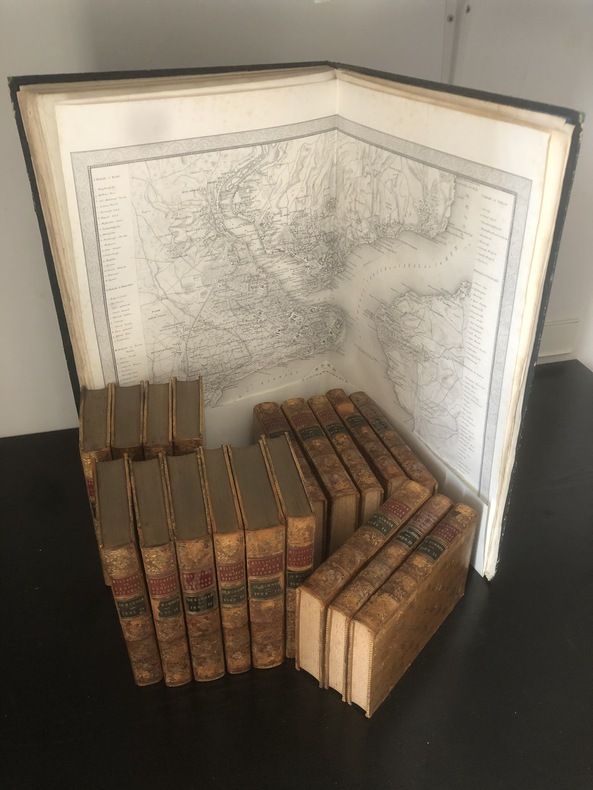
18150005071815 Paris, H. Nicolle, 1815-17. Trois volumes in-8 (135 X 200 mm) et un atlas grand in-folio (433 X 570 mm) demi-veau vert empire, dos lisse cloisonné de chainettes et filets dorés, guirlandes dorées en queue et tête, fleuron doré dans les compartiments, pièces de titre et de tomaison veau noir, date dorée en queue, coiffes filetées, tranches mouchetées (reliure moderne). Tome I : (2) ff. de faux-titre et titre, 438 pages - Tome II : (2) ff. de faux-titre et titre, 467 pages - Tome III : (2) ff. de faux-titre et titre, 476 pages - Atlas : (2) ff. de faux-titre et titre, 10 pages d'explication des planches, 25 planches (dont 4 à double page). L'intégralité des feuillets et planches de l'atlas ainsi que quelques feuillets des volumes de texte ont été lavés, tache claire en marge latérale des premiers feuillets de texte de l'atlas et de la première planche, sans atteinte au texte ni à la gravure, quelques déchirures habilement restaurées, quelques taches essentiellement dans les marges, rousseurs aux volumes de texte.
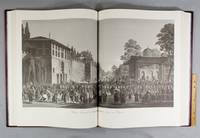
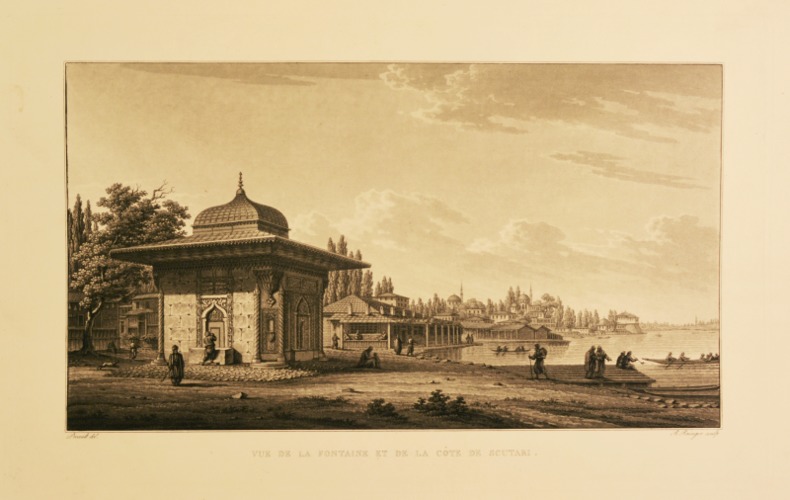
As New English Original bdg. In publisher's original slip-case. Elephant folio. (66 x 50 cm). In French and English. Color and b/w ills. 144 p., 49 plates., 3 maps. Another superb facsimile edition of a very rare book by Ertug & Kocabiyik. In 1795 the Alsace-born Antoine Ignace Melling, who had come to Constantinople to seek his fortunes, was appointed imperial architect by the Ottoman Sultan Selim III. During his tenure in that position, he also designed and landscaped a seaside palace for Selim's sister, Princess Hatice. While in Constantinople, Melling executed a number of astonishing panoramic views of the city and its environs.Melling returned to Paris in about 1803. In 1809 he set up an engraving studio for the purpose of reproducing these drawings. The completed images were published as a series of fascicles that were sent out to subscribers. The last one appeared in 1819. The Ertug & Kocabiyik facsimile edition of the complete book is produced from the original "elephant folio", an unfolded first edition in the collection of Ahmet Ertug. The technical aspects of the project were done under the supervision of Mr. Ertug in Switzerland by some of the world's leading facsimile specialists. This outstanding facsimile edition is available in two different bindings. One is bound in sturdy Japanese cloth and the other is a very limited edition of only 50 copies bound in leather that is intended for connoisseurs of exceptionally fine books. The binding and decoration of all the leather-bound copies were done by hand. The book measures 50 by 66 cms. The foldout image plates are 65 by 97 cms. There are 48 views of Constantinople in the late 18th century and also three maps. The publishers also offer an edition of the unfolded image plates presented in a leather-bound case. Only 25 copies of this version have been produced. The text for this edition is bound separately and presented in a pocket in the leather case. The descriptions of the views in the facsimile edition are in the original French and an English translation is also provided. The Ertug & Kocabiyik facsimile edition of "Voyage pittoresque" is an outstanding achievement and one that is certain to appeal to collectors of rare books and to those who admire beautiful art objects.
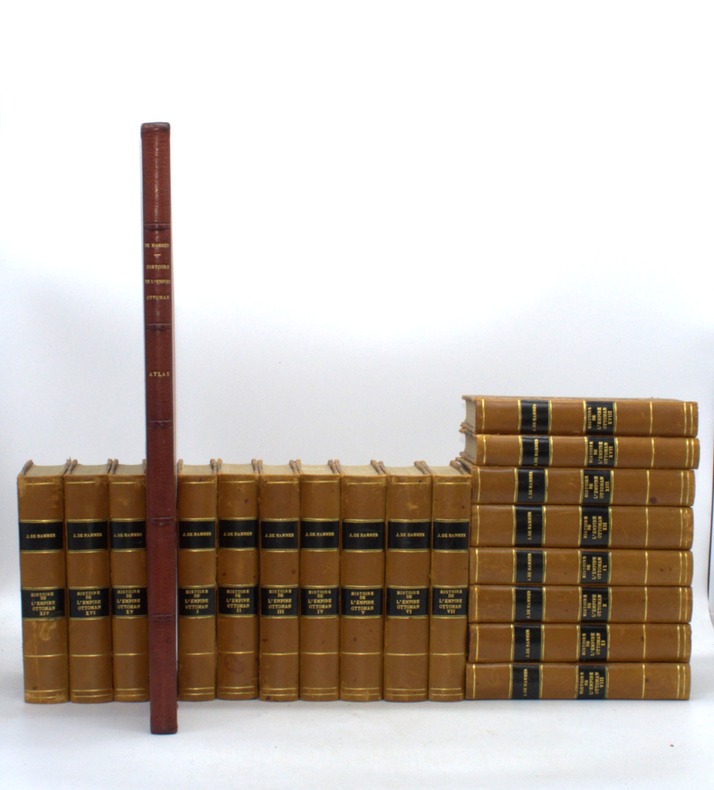
1835PHO-1099Paris, Bellizard, Barthes, Dufour et Lowell ; Londres, Bossange, Barthes et Lowell ; Saint-Petersbourg, Fd. Bellizard et Cie, 1835-1841. 18 volumes de texte in-8 et un atlas in-folio TEXTE : 18 volumes in-8, relié plein cuir tacheté époque, dos lisse orné avec pièce de titre rouge et auteur et tomaison vertes, filet sur les plats, adhésif, frottements, défauts d'usage .., rousseurs dans le texte. ATLAS : Paris. Bellizard, Dufour etc. 1844. Imprimé chez Thierry Frères. Reliure époque, dos lisse. Grand in-folio (555x375mm) il est composé d'un titre, d'une listes des cartes, d'une carte générale de l'Empire Ottoman avec les contours aquarellés (690x550mm), de 21 cartes particulières (dont une sur 2 feuilles et 2 à double page dépliantes représentant les états de l'empire ottoman et les états limitrophes (845x590mm et 845x545), de 13 plans de batailles ou de siège, et de 3 plans de villes dont un grand plan dépliant de Constantinople (690x670mm) par G. Heck et Lon. Plée et gravée par U. Muschani. Reliure avec défauts, réparation au dos, fente intérieure, petite mouillure angulaire, une carte et un feuillet détaché
CJW1322Bern: Ertug & Kocabiyuk 2002. No. 46 OF 50 SPECIALLY BOUND COPIES of a total edition of 350. 670 x 508 mm. 26 3/8 x 20". 3 p.l. 10 pp. 63 leaves. <br/> Publisher's scarlet morocco by Buchbinderei Burkhardt AG covers with gilt-rolled border cornerpieces tooled in gilt upper cover with gilt calligraphic Arabic centerpiece lower cover with gilt central heraldic device marbled endleaves all edges gilt. With a portrait frontispiece of Emperor Selim III 48 DOUBLE-PAGE PLATES AND THREE DOUBLE-PAGE MAPS. ◆A virtually as-new copy.<br/> <br/> This is one of the deluxe copies of a modern facsimile of Melling's massive and magnificently illustrated work devoted to 18th century Constantinople a book that provided the earliest interior views and plans of the harems and palaces of Sultan Selim III when it was published in 1819. The illustrations remain the best and certainly most attractive record we have of the city during this era in its history. Our edition was produced from a copy of the elephant folio first printing in the collection of the facsimile's publisher Ahmet Ertug with images faithfully reproduced in their original mammoth size 650 x 970 mm. After his arrival in Constantinople in 1795 architect and painter Antoine Ignace Melling 1763-1831 was appointed imperial architect by Selim III. In the course of his duties he designed and landscaped a seaside palace for Selim's sister Princess Hatice and produced these striking panoramic views of the city and its environs. After completing the palace and a number of other building projects for Selim he returned to Paris and in 1804 issued a prospectus for this work. He established an engraving studio in 1809 to reproduce these drawings and began publishing the completed prints as a series of fascicles that were sent to subscribers. The last one appeared in 1819. The outstanding success of an exhibition of the paintings on which the "Voyage Pittoresque" was based earned Melling the rank of painter to the Empress Josephine. When "Voyage Pittoresque" was originally published booksellers in England sold copies for £84 a huge sum for a book at the time. The original edition in pleasing condition now fetches between $75000 and $100000. Our handsomely bound actual size facsimile offers an attractively priced alternative. Ertug & Kocabiyuk unknown
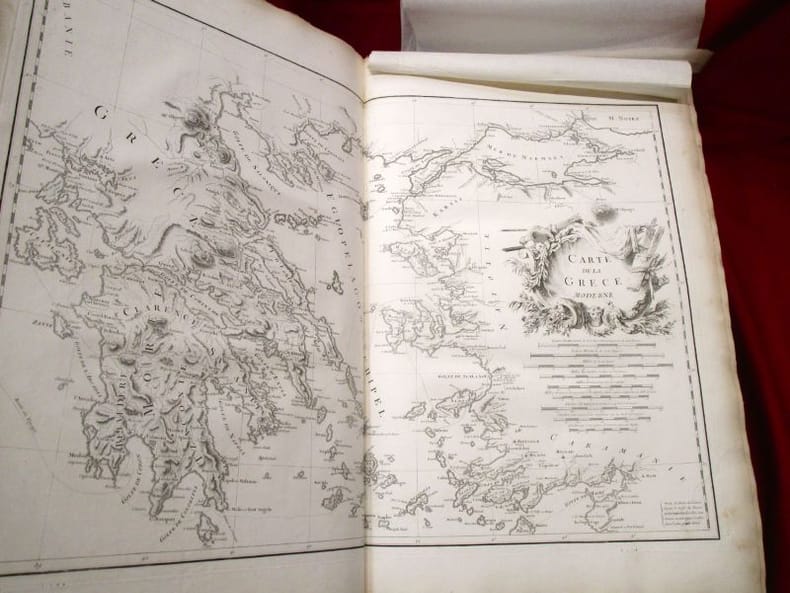
17821183461782,1809,1822 in-folio A Paris, chez J. J. Blaise, 1782-1809-1822, 5 volumes grand in-folio comprenant 3 titres gravés, 1 portrait d'après Boilly, deux cartes dépliantes de la Grèce non numérotées, le tableau dépliant de" La Race de Dardanus" et 284/285 vues (numérotées de 1 à 126, SANS la 110; de 1 à 157 dont deux "bis").Tome I : (4) ff. (faux-titre, page de titre, frontispice, explication du frontispice), XII (discours préliminaire), 204 pages, 125/126 planches - Tome II, en 4 volumes en pagination continue, 159 planches (157+2 bis). Première partie : (4) ff. (faux-titre, page de titre, explication du frontispice), 1-176 pages; 177-346 pages; Seconde partie : 347-448 pages; XII, 449-518 pages (MANQUENT 2 feuillets, p.469 à 472). INCOMPLET mais tout de même rare ensemble. Reliure d'attente, papier à la colle, en mauvais état (dos d'un volume manquant, autres dos réparés avec scotch blanc etc). Quelques rousseurs, le volume II.2 particulièrement dégradé par le travail d'humidité et les traces de mouillures, sinon intérieur en bon état général. PRÉVOIR POUR EXPÉDITION : plus de 18 kg sans emballage.
054919Paris Chez de Bure 1749 in 12 (17x10,5) 3 volumes reliures plein veau fauve de l'époque, dos à nerfs ornés de caissons dorés, pièces de titre de maroquin rouge, pièces de tomaison de cuir beige, tranches teintées rouge. Tome 1: XXXVI et 391 pages. Tome 2: XVII et 579 pages. Tome 3: IX et 559 pages, et 17 pages de catalogue des livres de l'éditeur in fine. Edition originale. Superbe exemplaire, reliures très fraîches ( Photographies sur demande / We can send pictures of this book on simple request )
1835PHO-1982Paris, Bellizard, Barthes, Dufour et Lowell ; Londres, Bossange, Barthes et Lowell ; Saint-Petersbourg, Fd. Bellizard et Cie, 1835-1844. 18 volumes de texte in-8 et un atlas in-folio. TEXTE : 18 volumes in-8, relié demi basane et coins moderne, dos lisse orné avec pièces d’auteur, titre et tomaison noires, frottements et épidermures, défauts d’usage, rousseurs dans le texte, tampon et étiquette du relieur. ATLAS : Paris. Bellizard, Dufour etc. 1844. Imprimé chez Thierry Frères. Demi basane et coins à long grain grenat, dos à nerfs avec titre et auteur, In-folio (520x345mm), IV-82pp.-40 planches, il est composé du Commentaire sur l’Atlas de l’Empire Ottoman, d'une liste des cartes, d'une carte générale de l'Empire Ottoman (690x550mm), de 22 cartes particulières (dont une sur 2 feuilles) (815x850), de 13 plans de batailles ou de siège, et de 4 plans de villes dont un grand plan dépliant de Constantinople (690x670mm), le plan de Vienne est en 2 états, par G. Heck et Plée et gravé par U. Muschani, roussurs éparses, 2 cartes uniformément brunies avec réparations, mouillure claire en marge, tache sur les 16 premiers feuillets en tête et en fin d’ouvrage en pied. Provenance : collection de S.A.R. le Prince Osman Ibrahim d'Égypte (1951-2025), fils de S.A.R. le Prince Amr Ibrahim d'Égypte et de S.A.I. la Princesse Nejla Hibetullah Sultan (Necla Osmanoğlu) de Turquie, petite-fille du dernier calife Abdulmejid II et du sultan Mehmed VI, avec sa marque au tampon.
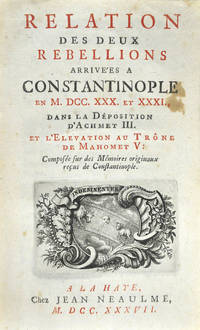
86461The Hague Jean Neaulme 1737. . First edition first issue. Small 8vo iv 164 viiiadspp. title printed in red and black with engraved device small stain to title light waterstain to inner upper margin bound in recent green morocco backed marbled boards spine gilt lettered.<br /> mba004 This account describes the two rebellions which broke out during the unsettled period following the victories of Nadir Kuli Khan of Persia against Turkey during September 1730 and which brought to and end the 'Tulip Period'. On the 20th of that month a minor riot developed into a full scale insurrection and Sultan Ahmet III was forced to abdicate in favour of his nephew Mahmoud I. The janissaries were led by one of their own an Albanian by the name of Patrona Halil and for two months the empire was in the hands of the insurgents. They were eventually overthrown by the Grand Vizier the Mufti and Aga of the Janissaries with the help of the Khan of the Crimea and Patrona and 7000 of his supporters were put to death. The first issue has the title printed in red and black as here.<br /> Atabey 1026; Blackmer 1407. The Hague, Jean Neaulme, 1737. hardcover
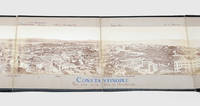
1875170484Constantinople c.1875. A superb photographic panorama A panoramic 360-degree view of the city. Towards the Golden Horn the Topkapi Palace and the city's great mosques can be seen including Hagia Sophia the Blue Mosque the Yeni Mosque and the Süleymaniye. Panoramas of this period usually favour the Galata Tower as a vantage point. The view is unsigned though likely from the studios of Pascal Sébah and Policarpe Joaillier or the Swede Guillaume Berggren. Both are renowned for their handsome panoramas of the city. In 1857 Sébah opened one of the first photographic studios in Constantinople. The business was taken over by his son Jean in 1883 who styled himself J. Pascal Sébah and went on to become a talented photographer in his own right. In 1888 he partnered with Policarpe Joaillier their firm becoming the official photographers of the Sultan. "From the 1870s Sébah and Joaillier were major suppliers of evocative imagery to the increasing number of people who undertook the Victorian Grand Tour" Hannavy p. 1261. Berggren moved to Constantinople in 1866 and opened his studio on Grand Rue de Pera in the early 1870s. His oeuvre included studio work a remarkable series of documentary portraits of working people and the eternalising of the construction of the Anatolian Railway. Oblong quarto concertina 290 x 255 mm. Comprising 8 mounted albumen prints each 165 x 248 mm together approximately 165 x 1984 mm mounts captioned in manuscript red and blue ink. Contemporary dark brown pebbled paper over bevelled boards later blue paper on verso of mounts. Minor loss to corners and edges of boards a few surface scratches; prints yellowed and faded in margins some a little creased at folds: a very good example. John Hannavy ed. Encyclopaedia of Nineteenth-Century Photography Vol. I 2005; Engin Özendes From Sebah & Joaillier to Foto Sabah: Orientalism in Photography 2004. hardcover
15880031131588 A Paris, Chez Hierosme de Marnef & la veufve Guillaume Cavellat, 1588. Petit in-quarto (165 X 222) veau marbré, double filet doré et guirlande dorée en place des nerfs, caissons dorés, pièce de titre maroquin grenat, encadrement de filet noir sur les plats, coupes filetées, tranches rouges (reliure XVIIIe) ; (1) f. blanc, titre, (11) ff. (épitre, préface, table et portrait), 468 pages, (1) f. (achevé d'imprimer et marque de l'imprimeur). Restaurations à deux angles et un mors. Exemplaire un peu court de marge en tête mais sans atteinte au texte, infime travail de vers dans la marge inférieure des premiers feuillets, à peine visible ; cerne de mouillure claire dans la marge inférieure des cinq premiers feuillets, minuscule manque de papier en pied des deux premiers feuillets (feuillet blanc et titre).
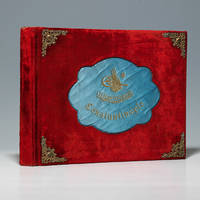
18901031341890. PHOTOCHROM ZURICH. Constantinople. Zürich: Photochrom Zürich circa 1890. Oblong folio 16 by 12 inches 30 photochrom images each measuring approximately 9 by 6-1/2 inches and mounted on heavy cardstock; original red velvet blue silk gilt-lettered title centerpiece on front cover brass cornerpieces. $4500.Rare photographic album of Constantinople circa 1890 by the renowned studio of Photochrom Zürich with 30 beautiful mounted vintage photochrom color prints offering exceptional views of majestic mosques palaces and plazas as well as the people of this great city in magnificent velvet binding with brass furniture.This splendid souvenir album of Constantinople contains exquisite color photographic prints of images taken at the turn of the 20th century produced by the revolutionary photochrom process. Photochrom also called the Aäc process is ""a very successful form of color photolithography developed in the late 19th century by the Swiss firm of Orell Füssli and used mainly for topographical views; photochroms have almost the appearance of color photographs but through a glass will show a delicate ink pattern which was achieved by a combination of photographic and manual work on grained i.e. lithographic stones being a forerunner therefore of modern screenless offset lithography"" Gascoigne 206. In this process black and white photographic negatives were directly transferred onto lithographic printing plates to produce color prints. These photographs are a high point in late 19th-century photography when albums such as these captivated a world newly spellbound ""by photography's capacity to 'take them there' and bring them directly in contact with the long ago and far away"" Parr & Badger I:18. Each image captioned with a four-digit number followed by ""P.Z."" for Photochrom Zürich and then the title of the scene in French. A few instances of marginal spotting to mounts; photochrom prints clean and fine with vivid colors. Binding splendid. An about-fine copy of this lovely album. unknown
Very Good Turkish, Ottoman (1500-1928) Original manuscript autograph handwritten document sealed 'Hüsrev Mehmed' sent to (and responded by) Serkâtib Mustafa. Written in special paper with 'ahar'. 39x21 cm. In Ottoman script. Slightly tear on folded place and slightly stains. Otherwise a very good manuscript paper. The document was written in accordance with the Ottoman state correspondence tradition prior to modernization. However, it is an indication of modernization that it is written to the serkâtib of Humâyûn (head clerk of the Ottoman / Turkish court) and not to the Sultan directly. The importance of this document is that it has many hints of modernization movements of the last period of Empire, depiction of the division of the first modern Ottoman army (Asakir-i Mansure-i Muhammediye) that's before one year of Egyptian Campaign by Koca Husrev Pasha and before eight years of proclamation of Reform (Tanzimat) and after only 22 years of Turkish Magna Carta (Sened-i Ittifak). Husrev Pasha was 'serasker' (commandant and head) of Assakir-i Mansure-i Muhammediye Army in that year. Husrev's text starts as 'Devletlü, inayetlü, atufetlü, oglum.." in 'Elqab'. In the Ottoman diplomacy, first person who used 'oglum' [i.e. my son] in elqab of the documents was Koca Hüsrev Pasha. (Source: Osmanli Arsiv Belgeleri, Orhan Sakin). Koca Hüsrev Pasha (Khosrew Pasha) was an Ottoman Kapudan Pasha ("Grand Admiral") of the Ottoman Navy and statesman who reached the position of Grand Vizier rather late in his career, between 2 July 1839 and 8 June 1840 in the reign of Abdülmecid I. However, during the 1820s, he occupied key administrative roles in the fight against regional warlords, the reformation of the army, and the reformation of Turkish attire. In 1801, Hüsrev Pasha commanded the 6,000 Ottoman troops who assisted the British in removing the French from Rashid (Rosetta). For this, he was made governor of Egypt Eyalet (province), in which position he was charged with assisting Hüseyin Pasha in the killing or imprisoning the surviving leaders of the Mamluks. Many of these were freed by or fled with the British, while others held Minia between Upper and Lower Egypt. [.] He was later made governor again by Muhammad Ali for 2 days [.] After Diyarbekir and Salonica, in 1806 he was governor of Bosnia Eyalet, before being reappointed as governor of Salonica in 1808. Hüsrev Pasha held the rank of Kapudan Pasha of the Ottoman Navy from 1811 to 1818. He was then appointed governor of the Eyalet of Trabzon twice, during which time he conducted for the Black Sea region of Turkey the struggle the central Ottoman state was waging against local feudal rulers (Derebeys). During the Greek War of Independence, he was appointed Kapudan Pasha again in the end of 1822. In 1826, Husrev Pasha played vital roles both in the Auspicious Incident (the annihilation of the Janissary Corps in 1826) and in the formation of the new "Mansure Army" modeled after those of European Powers. Appointed as seraskier (commander the army) of the Mansure in May 1827, Husrev reformed and disciplined the corps. Himself ignorant of modern military methods, he assembled a staff of foreign experts and other personnel to assist him, the "Seraskeriye", which constituted the first staff in Ottoman history. Due to his early championing of military reform and virtual control over the new Ottoman army, Husrev was able to install many of his protégés in senior military positions. Husrev Pasha was also instrumental for the near-abandonment of the turban and the adoption of the fez as a universal headgear for Muslim men of the Ottoman Empire (excluding the religious classes) under Sultan Mahmud II. (Wikipedia). Möltke talks about him in famous book includes his personal letters as 'he is more powerful than sultan'. Following the suppression of the Janissaries in 1826, Sultan Mahmud II transferred the functions of the old Agha of the Janissaries to the seraskier.
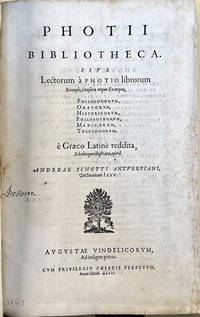
43456Augsburg: Christoph Mang. <p>Photius I Saint Patriarch of Constantinople ca. 810 - 893. Bibliotheca; sive lectorum a Photio librorum recensio censura atque excerpta. Latin translation with notes by Andreas Schott S.J. 28 555 37 pages including final blank. Augsburg: Christoph Mang 1606. 312 x 201 mm. Vellum ca. 1606 spine ends restored inner hinges cracking vellum over covers wrinkled. Infrequent light marginal dampstaining but very good. Booklabel of Frederic Huidekoper on rear pastedown. </p> <p> First Edition in Latin of the chief work by this 9th-century Byzantine scholar and Eastern Orthodox church leader consisting of a critical account of 280 works read by him many of which are now lost. The Greek original text was first published in 1600. "To Photios we are indebted for almost all we possess of Ctesias Memnon of Heraclea Conon the lost books of Diodorus Siculus and the lost writings of Arrian. Theology and ecclesiastical history are also very fully represented but poetry and ancient philosophy are almost entirely ignored. It seems that he did not think it necessary to deal with those authors with whom every well-educated man would naturally be familiar. The literary criticisms generally distinguished by keen and independent judgment and the excerpts vary considerably in length. The numerous biographical notes are probably taken from the work of Hesychius of Miletus" Wikipedia article on Photius. Hoffmann III 91; Sarton I 594. </p> . Christoph Mang unknown
wx389Sébah & Joaillier Cartonné In-4 (36,5 x 31,5 cm), format à l'italienne, dos en cuir, percaline chagrinée sur les plats biseautés, titre et décor doré (tour de Galata et tour de Léandre) au premier plat dont les bords sont biseautés, croissant de lune et étoile entourés de lauriers dorés au quatrième plat, sans date (circa 1888), 10 photographies sur papier albuminé, montées à la manière d'un leporello sur des panneaux en carton fort de 34 x 30,5 cm reliés par un morceau de toile pour former un panorama d'Istanbul d'environ 3,47 mètres de long ; mors légèrement fendus en queue, quelques épidermures sur le cuir au dos et sur les bords du premier plat, quelques traces sur les plats, zones décolorées au quatrième plat dont le cartonnage est un peu incurvé, par ailleurs assez bel exemplaire. Livraison a domicile (La Poste) ou en Mondial Relay sur simple demande.
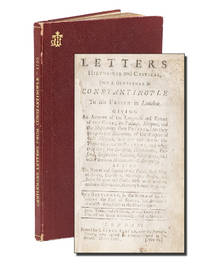
173510011London: Printed for George Spavan 1735. First Edition. Hardcover. Very good. Octavo. 4.625 x 7.125 inches. 2 blanks 86 2 blanks pp. A British account of 18th-century Constantinople by an anonymous author "a gentleman" from the retinue of George Hay the 8th Earl of Kinnoul British ambassador to Constantinople 1729-1737. Title page professionally reinforced at an early date. Very good. Rebound in red textured cloth titled in gilt on spine with gilt monogram to upper cover all edges gilt. Classical archaeologist Henry Schroder Robinson's copy with his ex libris label affixed to front pastedown; inscribed to Robinson on front free endpaper "To Henry / the Bibliophile / as a token of appreciation / from / The Gennadius Library / June 30 1969". Text bright and unmarked binding square and tight. Very scarce with three copies appearing in libraries worldwide OCLC and no auction records. The Gennadius Library is located within the American School of Classical Studies at Athens. Printed for George Spavan hardcover
Abundant black and white illustrations and reproductions of photos. Features: Two Men's Madness - six lives and a fine ship, the Frank N. Thayer, are lost through the unaccountable frenzy of two Indians; In Wildest Ireland - A.W. Cutler describes and photographs "unspoilt" regions of the Emerald Isle - with many fascinating photos; The Guardian of the Line - the ordeal undergone by a humble railway-crossing keeper's wife in Lithuania on the Russian Front; In Search of the Unknown Land - The tragic story of the Stefansson Arctic Exploration Expedition, twelve-page article including many photos; The Tales of Golab Khan - some amusing stories of Indian life; The Airman's Escape - two British aviators raid a Bulgarian town, then one is shot down and must be rescued by his companion; From Job To Job Around the World - part VI - Two American wanderers make there way through the Holy Land to Constantinople - with photos; The Trouble at Crib No. 2 - a tug-boat fireman recounts an exciting story of a winter rescue on the Great Lakes; Australia's Water Miracle - article and photos describe how the Government of New South Wales has created a miracle of irrigation; The Story of Count Seilern - A Tragedy of the Hapsburgs; Alpine Acrobats - A vivid account, illustrated by some very remarkable photographs, of the first ascent of the needle-like "Cigar Rock" in the Italian Alps; Lovely one-page illustrated ad by Canada Steamship Lines promotes their Niagara to the Sea all-water route; and more. pp. 4 [ads], [3], 290-385, 7-32 [ads]. Unmarked with moderate wear. Soiling to back cover. Covers beginning to loosen, otherwise a sound vintage copy of this exceptional issue.. Book
17450030241745 Fontenoy [recueil A], Paris [recueils C à Y], Bruxelles [recueil Z], sans nom d'éditeur, 1745-1762. Vingt-quatre parties reliées en douze volumes in-12 (106 X 174 mm) basane fauve, dos cinq nerfs ornés, caissons dorés, dentelles dorées en queue et tête, pièce de titre maroquin ocre, coupes filetées, tranches rouges (reliure de l'époque). Tome I : titre imprimé en rouge, IV (avertissement), un feuillet de table, 224 pages - titre imprimé en rouge, un feuillet (avertissement et table), 222 pages ; Tome II : IV (dont titre imprimé en rouge & avertissement), 2 feuillets de table, 208 pages - titre imprimé en rouge, 247 pages, 2 feuillets de table ; Tome III : titre imprimé en rouge, 265 pages, 3 feuillets de table - titre imprimé en rouge, II (avertissement), un feuillet de table, 195 pages ; Tome IV : titre imprimé en rouge, 248 pages, 1 feuillet de table, (1) - titre imprimé en rouge, 236 pages, 1 feuillet de table ; Tome V : titre imprimé en rouge, 209 pages, 1 feuillet de table - titre imprimé en rouge, 210 pages, 3 feuillets de table ; Tome VI : titre imprimé en rouge, 235 pages, 2 feuillets de table & avertissement - titre imprimé en rouge, 235 pages, 2 feuillets de table ; Tome VII : titre imprimé en rouge, 227 pages, 5 pages non chiffrées (table) ; titre imprimé en rouge, 226 pages, 1 feuillet de table ; Tome VIII : titre imprimé en rouge, 219 pages, 2 feuillets de table - titre imprimé en rouge, 216 pages, 1 feuillet de table ; Tome IX : titre imprimé en rouge, 226 pages, 1 feuillet de table - titre imprimé en rouge, 214 pages, 1 feuillet de table ; Tome X : titre imprimé en rouge, 235 pages, 1 feuillet de table - titre imprimé en rouge, 256 pages, 2 feuillets de table ; Tome XI : titre imprimé en rouge, 239 pages, (1) page de table - titre imprimé en rouge, 219 pages, 4 pages de table non chiffrées ; Tome XII : titre imprimé en rouge, 210 pages, 3 feuillets de table - titre imprimé en rouge, 197 pages, (3) pages de table.
179021667Constantinople, de l’Imprimerie du palais de France, mars 1790 ; in-4°, demi-veau havane, dos à faux nerfs et titre doré (reliure un peu postérieure); XXXII, 462 pp., [1]f. de Faute à corriger.
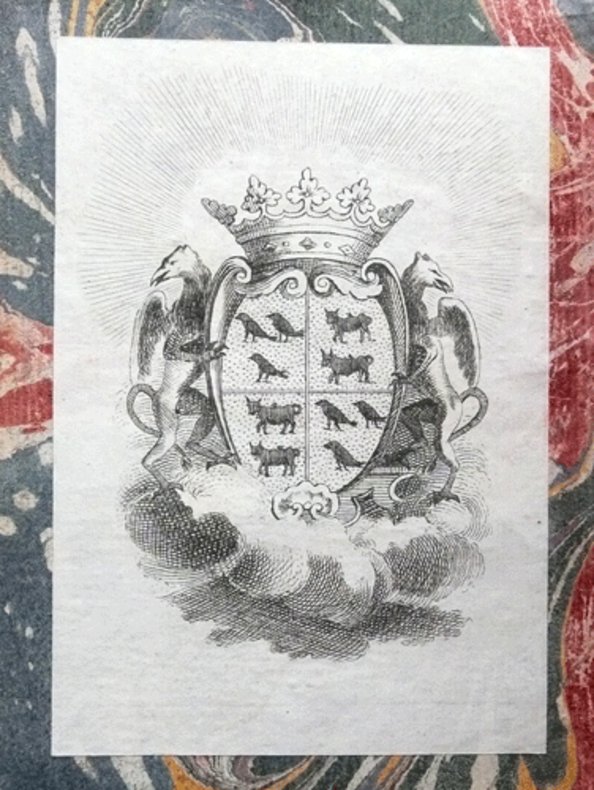
16129681Geneva: Oliva Pauli Stephani 1612. Folio in 6s pp. xxxii cols. 1624 104 ff. xii. Title page printed in red and black large woodcut olive-tree title device Schreiber 34 woodcut head- and tailpieces and initials Greek and Latin text in double column some spotting and browning at intervals largely due to paper qualityl later sheep circa 1700 minor wear abrasions to covers and wear to headcaps. A couple of ink library stamps St Patricks Collge Maynooth. Ownership inscription of Antoine Pericaud probably the Lyons-based antiquary author and translator 1782-1867. Engraved armorial bookplate to verso of title. Second edition overall and the first bilingual edition of the Myriobiblon combining David Hosechels recension of the original Greek text 1601 with Andreas Schotts 1606 Latin translation. A powerful and capable statesman and churchman Photios a 9th century Patriarch of Constantinople was also at the centre of intellectual life in the Byzantine capital. His Bibliotheca or Myrobiblon supposedly written just before Photios undertook a dangerous diplomatic mission and dedicated to his brother Tarasius as a consolation in case he should fail to return is an account of some 280 books read and reviewed many of them classical works which have since been lost and for which this is the most important surviving record. Reynolds and Wilson credit him with inventing the book review Scribes and Scholars third ed. p. 62. Renouard Annales de l'imprimerie des Estienne 197 no.21 also noting copies dated 1611; further copies traced dated 1613; Schreiber The Estiennes 275. Book ] Oliva Pauli Stephani, unknown
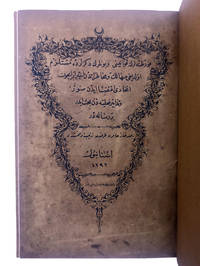
Very Good French Contemporary 1/4 leather bdg. with marbled boards. Small 4to. (27 x 19 cm). 23 p. (11 p. in Ottoman script (Old Turkish with Arabic letters; 12 p. in French), with rare 4 folded maps. A very good copy. First and only edition of this extremely rare bilingual book in French and Ottoman Turkish, including the first records on the formation and characteristics of storms to explain how storms and hurricanes occurred, which route they followed, and how they were conveyed to the regions that need to be warned by telegraph, for the vessels sailing in the seas, by French expert Coumbary who was founded the Rasathâne-i Âmîre [i.e. Ottoman Imperial Observatory]. Both the original French and Turkish translations of the work were published together in one volume. The work also included four maps which were drawn for this work only. The first map shows the movement of a storm that occurred on March 8, 1865, the second one shows the occurrence between the Tropic Cancer and Capricorn whirlwinds, storms in the Atlas and Indian oceans, the movements in the Bay of Bengal, the storms in different directions in the China Sea, the Gulfstream, Grönland, and Azores. The second observatory in the Ottoman era was established for meteorology. Before this center was established, beginning from the Reformation (1839), many meteorological observatories were built by foreigners in various cities such as Istanbul, Smyrna, Trebizond, Tekirdag, and Merzifon both as private and public establishments. The very first known temperature readings are the meteorological observations made by the Priest Dalmas at the St. Benôit monastery between 1839-1847. Later William Lane, an Englishman who came to Istanbul during the Crimean War, made observations at the British Cemetery at Haydarpasa. W. Noe, director of the Mekteb-i Fünûn-u Sahane made observations at the house in Kalyoncukulluk where he lived until the Beyoglu Fire in 1848; and finally, it is known that French engineer Ritter, who was invited by the government for waterworks in Kuruçesme (1856-1860) also conducted meteorological observations. Observations on precipitation and humidity conducted between 1875-1892 by an amateur observer on the Thomson Farm in Erenköy are invaluable on the subject of Istanbul's climate. These observations have been published in Budapest in 1928. Excellent observations on heat, pressure, and humidity, made in the summer residence of the Russian ambassador on Büyükada have also been published, in Annales St. Petersburg. In 1858, the French government established the first observatory communicating data over the telegraph, and in 1863, by compiling meteorological data in France, the French National Meteorological Network started operations. In 1868, upon the recommendation of the French government, the Rasathane-i Âmire was founded to convey meteorological forecasts to certain centers by telegraph. Instruments were purchased from leading European factories, and operations started on top of a hill 74 meters high on Pera. The first director was Mr. Aristide Coumbray, who came to Istanbul to renovate the telegraph network. (Instruments commissioned from France were set up at Mr. Coumbary's home, which stood at the garden of the Swedish Embassy. The observatory was later moved after its offices were prepared.) Coumbary represented Turkey in the first international meteorology congress, convened in Wien five years later in 1873. Rasathane-i Âmire worked by the same system as the National Meteorology Center in France. In the observation books of 1868 (August-November), names of affiliated stations are given to us Soulina, Köstence (Constantia), Varna, Burgaz, Valona, Elbasan, Durazzo, and Beirut. Later, stations in Izmir, Diyarbakir, Baghdad, and Fao were also added. The observatory founded by Aristide Coumbary in 1868 in Istanbul, operated until the end of the First World War. Özege 5735.; TBTK 7688, 10862.; Not in OCLC.
Very Good Turkish, Ottoman (1500-1928) In contemporary Ottoman quarter burgundy leather bdg. with red boards. Gilt lettering of the title with some decorative elements and four raised bands to the spine. Large roy. 8vo. (25 x 16 cm). In Ottoman script. 2 volumes set: (310 p.; 264 p). Hadikatû'-l cevâmî. 2 volumes set. [= Hadiqatul-gewami = The garden of the mosques]. Occasionally foxing on boards, slight stains on paper. Otherwise a very good copy. First edition of this rare monumental two-volume set in which an inventory is kept of almost all architectural buildings such as mosques, masjids, fountains, schools, and lodges in Ottoman Istanbul and its surroundings, built since Sultan Mehmet II up to 1768, in a traveler style, by Ayvansarayî, who was hafiz and janissary sekban who lived in the 18th century. "This excellent book has an extremely important place in the literature not only in terms of architectural works and topography but also as a historical source of Constantinople". (Hammer). Long recognized by Turkish scholars as a unique source of Istanbul's architecture and urban form, the text, which was started in 1182 (1768-69) and completed in 1195/1780 and revised and enlarged between 1248/1832-33 and 1253/1838 by Ali Sati, son of Mahmud Efendi, one of the judges of Medina, contains separate descriptions of each of Istanbul's more than 800 mosques, plus accounts of its madrasahs, tombs, tekkes and other monuments. The annotations place each of these buildings within the city's urban plan and provide biographical information about the patrons, architects, and other personalities mentioned in the text. Ayvansarayi's original text, which survives in a number of manuscript copies, was enlarged in the 1830s by Ali Sati Efendi, whose reworking was published in print in 1865 and has thus become the best-known version of the Hadika. (Crane). The author, who first visited the mosques and masjids inside the city walls in a topographic order, then examined the ones outside the city walls, then discussed Eyüp, Galata, both sides of the Bosphorus, Üsküdar (Scutari), Kadiköy (Khalkedon) mosques and masjids. After giving the name of the building in each article, if a mosque was transformed from the church, he noted this issue and recorded the name of the person who had it built. If known, he also indicates where this person's grave is located. Detailed info about the restoration of the architectural building has been restored. And he gives detailed information on additional facilities such as a public fountain, sebil, school, madrasah, and in some cases the people who lie in its burial ground, with brief information about the foundation of this charitable building. Hegira 1281 = Gregorian 1865. Özege 6565.; Thirteen copies in the US libraries according to the OCLC.
Very Good Bulgarian Original blue cloth bdg. with embossing. Slightly stains on boards and toned on pages. Otherwise a very good copy. 12mo. (16,5 x 12 cm). In Bulgarian. 1230, [2] p. [HOLY BOOK IN BULGARIAN PRINTED IN TSARIGRAD (CONSTANTINOPLE)] Bibliia sirech sveshtenoto pisanie na Vetkhiia i Noviia zavet: Viarno i tochno prevedena ot pûrvoobraznoto. [.] In 1840 5,000 copies of the first complete translation of the New Testament were printed in Smyrna by the British and Foreign Bible Society. A second edition which was printed in Smyrna in 1850 was an almost exact reprint of the 1840 edition. A third edition followed in 1853 with 15,000 copies. The fourth edition was published in 1857 in Bucharest, and for the first time civil characters type was used. In 1859, two more editions were published. In 1866, a new "pocket" edition with text revised by Elias Riggs and Dr. Albert Long was printed in Constantinople. The New Testament was revised and reprinted a total of nine times. In the period from 1840 to 1860 the Eastern (Tarnovo) dialect was adopted as literary Bulgarian language and the Macedonian dialect, in which the New Testament had been translated, was widely rejected. By 1858 Neofit Rilski had finished large portion of the Old Testament. Riggs met with Neofit Rilski and discussed a possible revision of the Bulgarian New Testament to remove the Macedonian dialect elements. Neofit objected the revision, so Riggs took the translation and returned to Constantinople. In January 1859 Riggs invited the Bulgarian teacher Hristodul Kostovich to help him with the revision. In 1862 Long and Riggs visited the noted Bulgarian writer and poet Petko Rachov Slaveykov in Tryavna. Slaveykov agreed to help with the translation and began the work on the revising of Neofit's New Testament at once. Long joined the revision of the New Testament into the Eastern dialect in 1863 and later assisted with the translation of the Old Testament. In June 1871, after more than 12 years of revision and translation, 36,000 copies of the complete Bible translation in Bulgarian were published in Constantinople. The translation came to be known as the "Tsarigrad (Constantinople) Edition". Tsarigrad [or; Tsargrad, Tzargrad, Czargrad] Tsargrad is a Slavic name for the city or land of Constantinople, the capital of the Eastern Roman (Byzantine) Empire, and present-day Istanbul in Turkey. A physical copy of this edition is not located in OCLC. For digital register: OCLC 181122059.
003395Paris, Firmin Didot, 1827 8 livrets in-12 (15,5 x 9,7 cm), cartonnages gaufrés d'éditeur de différentes couleurs, nom de chaque ville inscrit au centre du premier plat, 36 pages chacun, illustrés d'une lithographie au début, soigneusement coloriée à la main à l'époque.
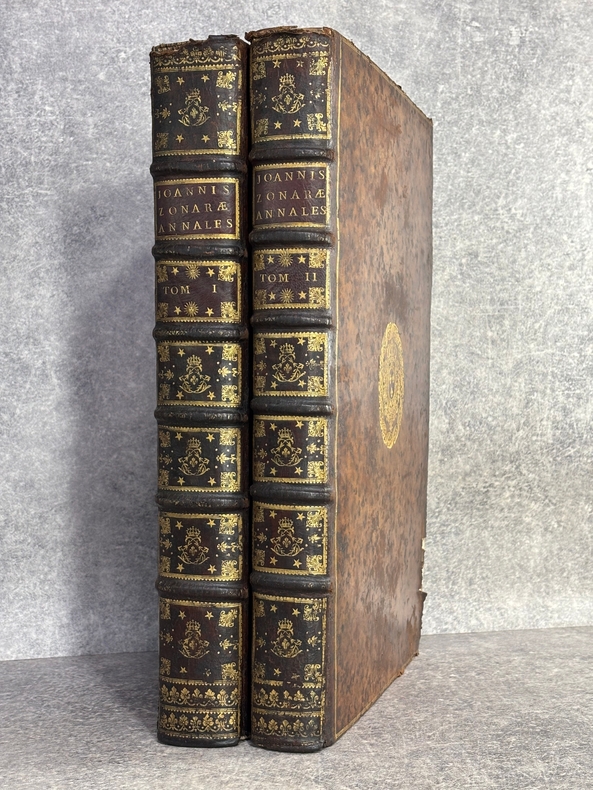
16863846PARISIIS. E TYPOGRAPHIA REGIA. 1686-1687. 2 GRANDS VOLUMES IN-FOLIO (31 X 44,5 X 12,5 CENTIMETRES ENVIRON) DE (32) + 648 ET (4) + 362 + 163 + (68) PAGES, RELIURE D'EPOQUE PLEIN VEAU MARBRE, DOS A SIX NERFS ORNE DE CAISSONS A FLEURONS DORES AUX EMBLEMES ROYAUX, TITRE DORE SUR ETIQUETTE MAROQUIN ROUGE, TRIPLE FILET DORE ENCADRANT LES PLATS AVEC ARMES ROYALES DOREES DE LOUIS XIV AU CENTRE, DENTELLE DOREE SUR COUPES, TRANCHES MOUCHETEES ROUGES. TEXTE GREC ET LATIN EN REGARD SUR DEUX COLONNES. DEBUT DU TITRE EN CARACTERES GRECS. COLOPHON: PARISIIS, E TYPOGRAPHIA REGIA, CURANTE SEBASTIANO MABRE-CRAMOISY, EJUSDEM TYPOGRAPHIAE DIRECTORE, 1686-1687. ILLUSTRE D’UNE GRANDE VIGNETTE DE TITRE AUX ARMES DE LOUIS XIV, REPETEE DANS CHACUN DES VOLUMES, DE BANDEAUX ET LETTRES ORNEES. DE LA COLLECTION BYZANTINE PUBLIEE SOUS LA DIRECTION DU PERE LABBE A QUI CETTE CHARGE AVAIT ETE CONFIEE PAR COLBERT. OUVRAGE RARE. QUELQUES DEFAUTS DE RELIURE, DONT MANQUES DE CUIR, SINON BON ETAT INTERIEUR.
1875055260Constantinople Istanbul: Neologos Litografyasi - Votîra ve Sürekasi Matbaasi. AH 1292 1875. 1st Edition . Leather. Very Good. 8vo - over 7¾ - 9¾" tall. Contemporary 1/4 leather bdg. with marbled boards. Small 4to. 27 x 19 cm. 23 p. 11 p. in Ottoman script Old Turkish with Arabic letters; 12 p. in French with rare 4 folded maps. A very good copy. First and only edition of this extremely rare bilingual book in French and Ottoman Turkish including the first records on the formation and characteristics of storms to explain how storms and hurricanes occurred which route they followed and how they were conveyed to the regions that need to be warned by telegraph for the vessels sailing in the seas by French expert Coumbary who was founded the Rasathâne-i Âmîre i.e. Ottoman Imperial Observatory. Both the original French and Turkish translations of the work were published together in one volume. The work also included four maps which were drawn for this work only. The first map shows the movement of a storm that occurred on March 8 1865 the second one shows the occurrence between the Tropic Cancer and Capricorn whirlwinds storms in the Atlas and Indian oceans the movements in the Bay of Bengal the storms in different directions in the China Sea the Gulfstream Grönland and Azores. The second observatory in the Ottoman era was established for meteorology. Before this center was established beginning from the Reformation 1839 many meteorological observatories were built by foreigners in various cities such as Istanbul Smyrna Trebizond Tekirdag and Merzifon both as private and public establishments. The very first known temperature readings are the meteorological observations made by the Priest Dalmas at the St. Benôit monastery between 1839-1847. Later William Lane an Englishman who came to Istanbul during the Crimean War made observations at the British Cemetery at Haydarpasa. W. Noe director of the Mekteb-i Fünûn-u Sahane made observations at the house in Kalyoncukulluk where he lived until the Beyoglu Fire in 1848; and finally it is known that French engineer Ritter who was invited by the government for waterworks in Kuruçesme 1856-1860 also conducted meteorological observations. Observations on precipitation and humidity conducted between 1875-1892 by an amateur observer on the Thomson Farm in Erenköy are invaluable on the subject of Istanbul's climate. These observations have been published in Budapest in 1928. Excellent observations on heat pressure and humidity made in the summer residence of the Russian ambassador on Büyükada have also been published in Annales St. Petersburg. In 1858 the French government established the first observatory communicating data over the telegraph and in 1863 by compiling meteorological data in France the French National Meteorological Network started operations. In 1868 upon the recommendation of the French government the Rasathane-i Âmire was founded to convey meteorological forecasts to certain centers by telegraph. Instruments were purchased from leading European factories and operations started on top of a hill 74 meters high on Pera. The first director was Mr. Aristide Coumbray who came to Istanbul to renovate the telegraph network. Instruments commissioned from France were set up at Mr. Coumbary's home which stood at the garden of the Swedish Embassy. The observatory was later moved after its offices were prepared. Coumbary represented Turkey in the first international meteorology congress convened in Wien five years later in 1873. Rasathane-i Âmire worked by the same system as the National Meteorology Center in France. In the observation books of 1868 August-November names of affiliated stations are given to us Soulina Köstence Constantia Varna Burgaz Valona Elbasan Durazzo and Beirut. Later stations in Izmir Diyarbakir Baghdad and Fao were also added. The observatory founded by Aristide Coumbary in 1868 in Istanbul operated until the end of the First World War. Özege 5735.; TBTK 7688 10862.; Not in OCLC. <br/> <br/> Neologos Litografyasi - Votîra ve Sürekasi Matbaasi., [AH 1292] hardcover