TAMARA TALBOT RICE.MareMagnum
Timothy E. GregoryLivre Rare Book
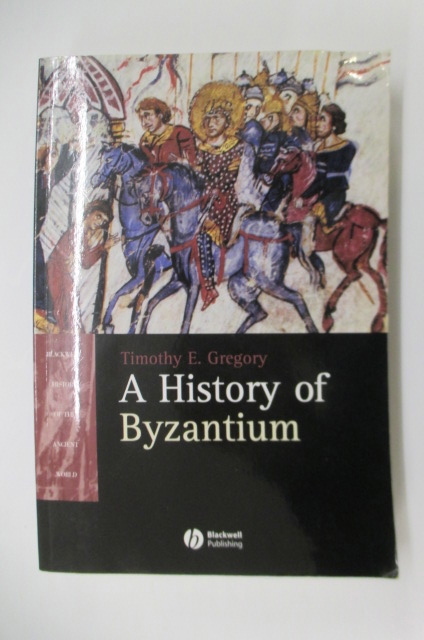
A HISTORY OF BYZANTIUM.
LAN059C20GAR2005 / 382 pages. Broché. Editions Blackwell.
Librairie du Levant · Bayonne, France20,00 €
1 659 résultats
Fine Turkish Paperback. Cr. 8vo. (20 x 14 cm). In Turkish. 287 p., ills. Bizans'ta günlük yasam: Konstantinopolis Bizans'in mücevheri. [= Everyday life in Byantium]. Translated by Bilgi Altinok. Ills. by Helen Nixon Fairfield.
Fine English Paperback. Pbo. Demy 8vo. (21 x 14 cm). In Turkish. [vi], 251 p., 47 numerous b/w and color ills., 96 numerous color photos, 4 color plts. of miniatures. Haliç zinciri. 1000 copies were printed.
Fine English Paperback. Pbo. Oblong large 8vo. (22,5 x 24 cm). In English, German, and Turkish. 96 p., numerous b/w and color ills., 2 folding plts. Istanbul The Great Palace Mosaic. The story of its exploration, preservation and exhibition, 1983-1997.= Istanbul Das Grosse byzantinische Palastmosaik. Seine Erforschung, Konservierung und Prasentation, 1983-1997.= Istanbul büyük saray mozayigi. Arastirmalar, onarim ve sergileme, 1983-1997.
Very Good English Paperback. Pbo. 4to. (28 x 20 cm). In Turkish. [xii], 188 p., 145 numerous b/w plts. Aksehir ve köylerindeki Türk anitlari. Geleneksel Türk evi Mimari Yerlesim mimarisi Sivil mimari Sanat tarihi Aksehir Yerel kültür Ahsap.
Facsimile of the edition first published by Methuen, London 1926) 310p. index. Name of previous owner on ffep. else as new. Book
103889Assen, v.Gorcum, 1971.
98355Wien, Verlag der Österr. Ak. der Wissensch., 1976.
Very Good English Paperback. Pbo. Roy. 8vo. (24 x 17 cm). In Turkish. 19 p., 6 b/w plts. Ilim ve sanat tarihimizde Fatih Sultan Mehmed. Sultan Mehmet II in the Turkish history of art and science.
(Art of the World series) Translated by Betty Forster 225p. plates .bibliography. index decorative end papers Book
New English Paperback. Pbo. Demy 8vo. (22 x 15 cm). In Turkish. 165 p. Istanbul folkloru. Istanbul folklore. ISTANBUL Constantinople Folklore Traditions Beliefs Ottoman culture Byzantium Urban legend.
New English Paperback. Pbo. Roy. 8vo. (24 x 17 cm). In French. 188 p. Contents: Première partie : Byzance, l'Anatolie et le monde islamo-turc Chapitre premier Permanences régionales en hérésiologie anatolienne de l'Antiquité aux Ottomans ? Colloque "Syncrétismes et hérésies dans l'orient seldjoukide et ottoman "(G. Veinstein), Collège de France, Paris, 2001 Chapitre deuxième Pratiques et représentations du pouvoir à Byzance entre Rome et le monde musulman ? Séminaire d'Histoire du Moyen-Age (C. et H. Carozzi), Université de Provence, Aix-en-Provence, 2003. Chapitre troisième Byzantinoturcica : quelques remarques sur un creuset culturel " - Pour Revue Archivum Ottomanicum G. Hazai), Budapest Chapitre quatrième Saints reliques et miracles de Byzance à Istanbul -"Istanbul, gloires et dérives", Revue Autrement, Hors-Série n° 29, Paris, 1988 Deuxième partie : Le temps des Seldjoukides Chapitre premier Entre Byzance et Konya : l'intercirculation des idées et des hommes au temps des Seldjoukides ? Pour Revue Mésogeios, Paris Chapitre deuxième Eglise et clercs byzantins dans l'épopée turque ? VIIIe Symposion Byzantinon : "L'Eglise dans le monde byzantin (1204-1453)", Université Marc Bloch, Strasbourg, 2002 Chapitre troisième Intégration et exclusion des chrétiens dans le sultanat seldjoukide d'Asie-Mineure (XIIe-XIIIe siècles) Séminaire d'Histoire du Moyen-Age (G. Dédéyan), Université Paul Valéry, Montpellier, 2004 Troisième partie : Le temps des Ottomans Chapitre premier Le soufi et le basileus : Haci Bayram Veli (1340-50 env. - 1430) et Manuel II Paléologue (1350-1425) ? Pour Rivista di storia bizantina, (M. Gallina), Université de Turin Chapitre deuxième Entre mythe et histoire : les narrations tardives de la conquête d'Istanbul, d'après trois auteurs ottomans du XVIIe siècle (Solakzâde, mort en 1657, Evliyâ Çelebi, mort en 1685, et Müneccimbasi, mort en 1702 ? Pour "Recueil de textes sur la prise de Constantinople en 1453" (J.-C. Cheynet, J. Paviot, N. Vatin), Paris Chapitre troisième Dominicains et Ottomans, trois expériences extrêmes : Tommaso Campanella (1568-1639), Fra Domenico Ottomano (1642-1676) et Cheikh Mansûr Boetti (1743-1794) ? Revue Mémoires dominicaines, n°15, Paris, 2001 Chapitre quatrième Francophones et francophonie en monde turc des croisades au XVIIIe siècle ? Colloque "Francophonie en Turquie et dans les Balkans", Université Hacettepe, Ankara, 2004 Chapitre cinquième Les collines d'Istanbul : trois moins quatre égale sept ! Revue Autrement, Hors-Série n° 29, Paris, 1988.
New English Paperback. Pbo. Roy. 8vo. (24 x 17 cm). In French. 200 p. Contents: PRÉFACE IMAGOLOGIE JUDÉO-BYZANTINE I. Image du judaïsme byzantin du XIIIe siècle à la chute de Constantinople dans les écrits chrétiens orthodoxes. / 1. Place du judaïsme dans l'Orthodoxie: entre dépendance et stéréotypes A. Un peu d'histoire officielle et édificatrice Le judaïsme comme légitimité pour l'empereur-prêtre byzantin Les juifs à Byzance ou apprendre à vivre avec son prochain Accords et désaccords entre pouvoir spirituel et autorité temporelle Les juifs peuvent-ils être sauvés? B. Stéréotypes théologiques négatifs attachés aux juifs et au judaïsme. Des juifs assassins du Messie Des juifs fidèles au démon Les juifs à l'origine des hérésies? Judaïsme et excès de chair Judaïsme et avarice Stéréotypes liés à l'exercice de professions. / 2. Image des juifs et du judaïsme dans les récits dits populaires A. Simple réemploi d'une tradition stérilisante B. Quelques traces des relations quotidiennes entre chrétiens et juifs avant le XIIIe siècle C. Les Byzantins étaient ils antisémites? / 3. Images des Juifs dans les écrits de la haute Eglise byzantine A. Eglise et judaïsme sous les Paléologues, les difficultés de trouver une place au judaïsme historique dans l'orthodoxie B. Quelques textes orthodoxes contre les juifs du XIIIe au XVe siècle C. Des chrétiens qui vont consulter des médecins juifs malgré l'interdiction canonique D. Le juif dans la cité : un problème pour quelques uns. / 4. Fracture de l'image stéréotypée du judaïsme : Juifs convertis au Christianisme II. Survivance des chrétiens judaïsants en Anatolie : témoignages du XIVe siècle A. Les judaïsants dans l'Empire byzantin : Chionios, Chionai Chionios Chionai : états historiographique Vers une relecture des sources B. Chioniadis ou la vie d'un savant précurseur de l'humanisme Sources Eléments biographiques Vie de Chioniadis De Chioniadis à Michel Chrysokokkis C. Proposition d'explication du mouvement Chionai : Des chrétiens et musulmans influencés par des mouvements messianiques juifs Des judaïsants implantés de longue date en Anatolie D. Continuités En Anatolie ottomane Et dans le monde slave LE DOUBLE IMPACT DES TRADITIONS APOCALYPTIQUES DE LA ZONE BYZANTINO-TURQUE SUR L'ITALIE DE LA RENAISSANCE : PROLÉGOMÈNES III. Prolégomènes concernant l'apport de la kabbale judéo-byzantine à la Renaissance humaniste italienne : Gilles de Viterbe et le sefer ha Temunah A. Pléthon à l'école d'Elisha, juif de cour à Andrinople B. Des romaniotes au carrefour des cultures chrétiennes, musulmanes et juives C. Le Sefer ha-Temunah et son école D. Quelques brefs éléments bibliographiques permettant de décou-vrir les rapports entre Gilles de Viterbe et le judaïsme IV. Influences des croyances apocalyptiques liées à la prise de Constantinople par les Turcs dans le monde italien de la Renaissance via le judaïsme byzantin A. Meleto, un chercheur de vérité à l'écoute des préoccupations apocalyptiques de son temps B. Apocalypses juives et la prise de Constantinople en 1453 C. Revue des différentes traditions liées à la chute de Constantinople L'apocalypse dans le monde byzantin sous les Paléologues Le Christ à Jérusalem ou à Constantinople? : collusion entre lectures juive et chrétienne Comment s'éteindra Constantinople L'apocalypse au temps des Paléologues Rencontres des croyances apocalyptiques byzantines, turques et romaniotes POSTFACE Table des matières.
No Roman emperor had a greater impact on the modern world than did Constantine. The reason is not simply that he converted to Christianity, but that he did so in a way that brought his subjects along after him. Indeed, this major new biography argues that Constantine's conversion is but one feature of a unique administrative style that enabled him to take control of an empire beset by internal rebellions and external threats by Persians and Goths. The vast record of Constantine's administration reveals a government careful in its exercise of power but capable of ruthless, even savage, actions. Constantine executed (or drove to suicide) his father-in-law, two brothers-in-law, his eldest son, and his once beloved wife. An unparalleled general throughout his life, planning a major assault on the Sassanian Empire in Persia even on his deathbed. Alongside the visionary who believed that his success came from the direct intervention of his God resided an aggressive warrior, a sometimes cruel partner, and an immensely shrewd ruler. These characteristics combined together in a long and remarkable career, which restored the Roman Empire to its former glory. Beginning with his first biographer Eusebius, Constantine's image has been subject to distortion. . the most comprehensive, authoritative, and readable account of Constantine's extraordinary life. 368p. illus. bibliography index Book
As New English Paperback. Pbo. Mint. Cr. 8vo. (20 x 14 cm). In Turkish. 232 p. Patriarchate history in Turkey. Baslangiçtan günümüze patrikhane dosyasi.
1925125321925 PARIS, Sté d'Ed. "Les belles lettres", 1925 - Broché - Pet. in-8 - 219 pages - Propre
PARIS, Sté d'Ed. "Les belles lettres", 1925 - Broché - Pet. in-8 - 219 pages - Propre
1980X114439Norman, University of Oklahoma Press 1980 ix + 182pp., 3rd printing, softcover, copy from the library of the Belgian scholar and specialist in byzantinology prof. Justin Mossay (with his ex-libris), text is clean and bright, good condition, X114439
LAN059C20GAR2005 / 382 pages. Broché. Editions Blackwell.
22x14. 391p. Anotaciones a lápiz. Falto de cubierta. Enc. Tela.
New English Paperback. Demy 8vo. (22 x 12 cm). Edition in English. 132 p., color ills. The Roman theater at Nicaea: An archaeological guide. The city of Nicaea was located near a large lake and fertile plain, which was the main reason of city's importance through the ages. Notable for its climate and geographical features, it was a socio-political and economic centre of the Bithynia. It has always been one of the most important cities in the region during the Hellenistic, Roman, Byzantine, Seljuks and Ottoman periods. Although the Roman Theatre is the most striking structure of the city, other architectural remains such as tombs, bridges, aqueducts, city walls and gates are still standing. The Roman theatre at Nicaea is located in the southwestern part of the city, close to the city walls and Lake Iznik (Ascania Limme). One of the most impressive archeological buildings in Anatolia, the theatre has been a frequent destination for western travellers for many years. The first scientific studies on the theatre were conducted in 1938 by A. M. Schneider in order to have a better idea of the substructures. The excavations revealed that the theatre was built on a Hellenistic stratum. Although it ceased to function as a theatre in the Late Roman Period (4th cent. AD), it was used for different purposes in the Byzantine and Ottoman periods.
New English Paperback. Folio. (33 x 23 cm). In English, German, and Turkish. 135 p., color and b/w ills. 3000 copies were printed. Istanbul. The city where faiths meet; all together and side by side.= Istanbul. Eine Stadt der Glaubensbegegnungen; Gemeinsam und miteinander.= Istanbul. Inançlarin bulustugu kent; birlikte ve yanyana. [Exhibiton catalogue and symposium papers]. Photos by Ara Güler, Ani Çelik Arevyan, Kamil Firat, Manuel Çitak, Murat Germen, Orhan Cem Çetin. Texts by Afife Batur, Murat Ural.
As New English Paperback. Pbo. Mint. Cr. 8vo. (19,5 x 13,5 cm). In Turkish. [8], [xii], 290 p. B/w ills. Turkish Edition of Ebersolt's 'Constantinople Byzantine et les voyageurs du Levant'. Bizans Istanbulu ve Dogu seyyahlari. [= Constantinople Byzantine et les voyageurs du Levant]. Translated by Ilhan Arda. Preface by Semavi Eyice.
New English Paperback. Pbo. Roy. 8vo. (24 x 17 cm). In Turkish. 362 p. Orta Asya battalnâmelerinden Seyitbatal Comogu.
New English Original bdg. Dust wrapper. Color ills. Oblong 8vo. 155 p. Color and b/w ills. Second edition. Monuments of unaging intellect. Historic postcards of Byzantine Istanbul.
