Jean-Jacques AillagonLivre Rare Book
Marcel DurliatLivre Rare Book
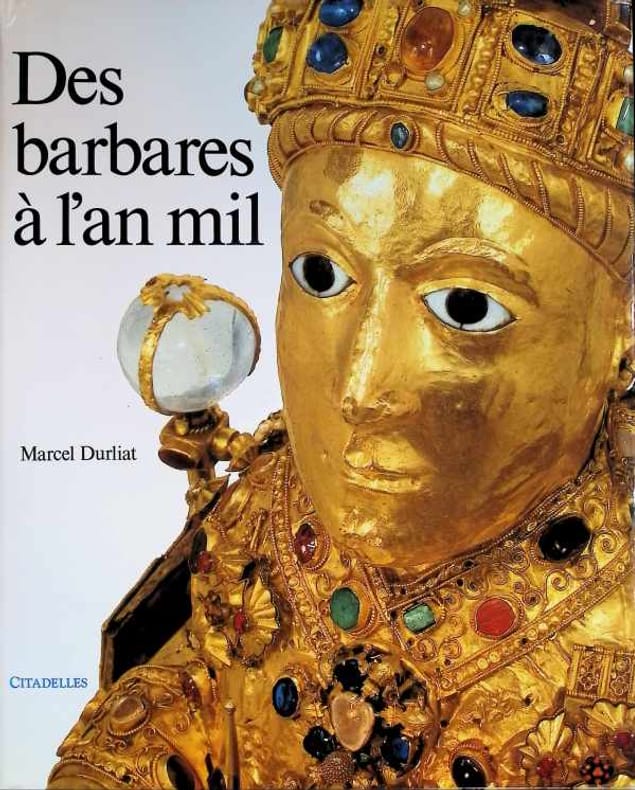
Des Barbares à l'an mil
1992027262Paris 1992 Citadelle & Mazenod Hardcover As New
Antiquariaat Tanchelmus b.v · Berchem, Belgique50,00 €
103 résultats
21225U.K., Skira, 2008 Hardback, with dusjacket, 279x240mm, 700p, 890 col.ill, 110 bwill, English edition new condition, Art and Exhibition Hall, Bonn Expo: 22/8/08 - 7/12/2008. ISBN 9788861304888.
1992027262Paris 1992 Citadelle & Mazenod Hardcover As New
1965122016Bordas Bordas Laffont - Bibliothéque des Connaissances Essentielles 1965, 2 forts volues petits In-4 reliés pleine toile noire éditeur sous jaquettes illustrées et rhodoids. 608 + 607 pages. Nombreues sphotos. Trés bon état.
Bordas Laffont - Bibliothéque des Connaissances Essentielles 1965, 2 forts volues petits In-4 reliés pleine toile noire éditeur sous jaquettes illustrées et rhodoids. 608 + 607 pages. Nombreues sphotos. Trés bon état.
4674Paris, Librairie de Victor Palmé, 1879. In-8 broché, 54 p. Dédicace de l'auteur à son beau-frère Paul Allard. Tiré à 50 ex. Bon état : manque plat inférieur. Extrait de la Revue des Questions historiques, juillet 1879.
200837533London: Christopher Helm 2008. 1st edition. Hardcover. Fine/Near Fine. 1st edition 2008. A Fine copy in a Near Fine dust jacket. Small 4to. 512 pp. bound in publishers photo illustrated paper covered boards with matching dust jacket. Minor signs of shelf wear only; text appears clean and unmarked. Dust jacket now protected in mylar sleeve. Christopher Helm hardcover
0259831182.Gpaperback. Good. Access codes and supplements are not guaranteed with used items. May be an ex-library book. paperback
0259450596.Gpaperback. Good. Access codes and supplements are not guaranteed with used items. May be an ex-library book. paperback
3659677507.Gpaperback. Good. Access codes and supplements are not guaranteed with used items. May be an ex-library book. paperback
1390109224.Ghardcover. Good. Access codes and supplements are not guaranteed with used items. May be an ex-library book. hardcover
196730779Gallimard Jaquette en très bon état Couverture rigide toile Paris 1967
50637Plon.1921-1922.Ex.1148 et 909.2 vols.br.un-8.Couvertures légèrement piquées et insolées.
1985939161985 Ed. Mazenod, L'Art et les Grandes Civilisations - 1985 - In-Folio, cartonnage toilé gris sous jaquette illustrée en couleurs + étui cartonnage muet - 618 p. - Illustrations couleurs et N&B
20192-6139470781LAP Lambert Academic Publishing 2019. Paperback. New. 8.62x5.91x0.39 inches. LAP Lambert Academic Publishing paperback
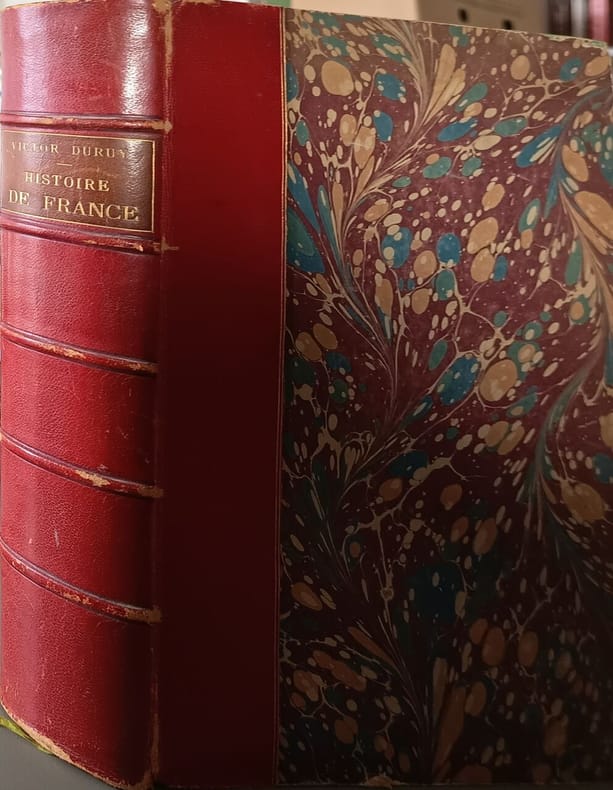
189212793Librairie Hachette 1892 945 pages in4. 1892. demi basane dos à nerfs. 945 pages. Cet ouvrage de Victor Duruy publié par la librairie Hachette retrace l'histoire de France depuis l'invasion des barbares dans la Gaule romaine jusqu'à l'époque contemporaine de l'auteur. Il s'agit d'une édition revue augmentée et illustrée comprenant 925 pages et une reliure rouge avec dorures
0366856553.Gpaperback. Good. Access codes and supplements are not guaranteed with used items. May be an ex-library book. paperback
0.79 x 9.06 x 5.91 Inches; 256 pages; Disagrees with the commonly held notion that the Roman imperial government disintegrated during the 5th century, and was replaced by the Germanic administrations of such peoples as the Visigoths, Burgundians, and Franks. Argues instead that the new kingdoms were an outgrowth of Roman rule, and owed much to it.
Very light shelfwear to DJ. ; With a contribution by Lee Sherry. ; Transformation of the Classical Heritage; 441 pages; The chaotic events of A. D. 395-400 marked a momentous turning point for the Roman Empire and its relationship to the barbarian peoples under and beyond its command. In this masterly study, Alan Cameron proposes a complete rewriting of received wisdom concerning the social and political history of these years. Our knowledge of the period comes to us in part through Synesius of Cyrene, who recorded his view of events in his De regno and De providentia. By redating these works, Cameron offers a vital, new interpretation of the interactions of pagans and Christians, Goths and Romans. In 394/95, during the last four months of his life, the emperor Theodosius I ruled as sole Augustus over a united Roman empire that had been divided between at least two emperors for most of the preceding one hundred years. Not only did the death of Theodosius set off a struggle between Roman officeholders of the two empires, but it also set off renewed efforts by the barbarian Goths to sieze both territory and office. Theodosius had encouraged high-ranking Goths to enter Roman military service; thus well placed, their efforts would lead to Alaric's sack of Rome in 410. Though Cameron's interest is in the particularities of events, the book conveys a wonderful sense of the general time and place. Cameron's rebuttal of modern scholarship, which pervades the narrative, enhances the reader's engagement with the complexities of interpretation. The result is a sophisticated recounting of a period of crucial change in the Roman Empire's relationship to the non-Roman world.
With a contribution by Lee Sherry. ; Transformation of the Classical Heritage; 441 pages; The chaotic events of A. D. 395-400 marked a momentous turning point for the Roman Empire and its relationship to the barbarian peoples under and beyond its command. In this masterly study, Alan Cameron proposes a complete rewriting of received wisdom concerning the social and political history of these years. Our knowledge of the period comes to us in part through Synesius of Cyrene, who recorded his view of events in his De regno and De providentia. By redating these works, Cameron offers a vital, new interpretation of the interactions of pagans and Christians, Goths and Romans. In 394/95, during the last four months of his life, the emperor Theodosius I ruled as sole Augustus over a united Roman empire that had been divided between at least two emperors for most of the preceding one hundred years. Not only did the death of Theodosius set off a struggle between Roman officeholders of the two empires, but it also set off renewed efforts by the barbarian Goths to sieze both territory and office. Theodosius had encouraged high-ranking Goths to enter Roman military service; thus well placed, their efforts would lead to Alaric's sack of Rome in 410. Though Cameron's interest is in the particularities of events, the book conveys a wonderful sense of the general time and place. Cameron's rebuttal of modern scholarship, which pervades the narrative, enhances the reader's engagement with the complexities of interpretation. The result is a sophisticated recounting of a period of crucial change in the Roman Empire's relationship to the non-Roman world.
5627041like new. unknown
48480Plon.1922.2 vols.br.Ex.n° 970 sur pur fil.282 et 259 p. BE.
2008__140810475XA & C Black Publishers Ltd 2008. Hardcover. New. 512 pages. 9.61x7.01x1.50 inches. A & C Black Publishers Ltd hardcover
Small chip along top edge of DJ else Fine. ; 1.02 x 9.21 x 6.22 Inches; 304 pages; Why did the Western Roman empire collapse in the fifth century and the Eastern Roman empire survive for another thousand years? The Rome That Did Not Fall examines the two halves of the Roman empire in the fifth century the Latin West and the Greek East. Stephen Williams and Gerard Friell explore how, despite similar military and political turmoils, the western empire all but collapsed and the eastern empire survived and consolidated its power in the face of the invading barbarians, weak and immature emperors and intrigues around the throne. The Rome That Did Not Fall analyzes the remarkable recovery of the eastern empire, comparing the parallel and diverging developments in east and west, and tracing the evolution of new skills and strategies in the east diplomatic, military, political and fiscal. This well-illustrated and well-documented book provides a stimulating exploration of the fifth century Roman empire.
19811211469PN. New. 1981. Reprint Edition. Soft Cover. Date is copyright date; this is a later reprint edition . PN paperback
20021224522PN. New. 2002. Reprint Edition. Soft Cover. Date is copyright date; this is a later reprint edition . PN paperback