345 résultats
1983106280BBBonn, Friedrich-Ebert-Stiftung, 1983. 4°. 371 S. Original-Broschur.
192136413ABBerlin, B.Harz, 1921. 8° (22,3 x 14 cm). Original-Leinenband mit rotgeprägtem Deckel- und Rückentitel sowie einer Einbandillustration in Schwarz von Ludwig Kainer.
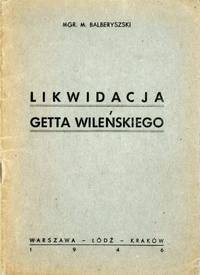
1946106106BBWarszawa / Lodz/ Krakow, 1946. Gr.8°. 300 S. mit 1 gefalt. Plan des Ghettos und beiliegenden Korrekturzettel. Typographisch gestaltete Original-Broschur. (=Dokumenty i materialy do dziejow okupacji niemieckij w Polsce; 3,1 / Wydawnictwa Centralnej Zydowskiej Komisji History
Firenze, Libreria Bodoniana (Via Panzani, 5), 1875, in-24, br. editoriale cilestrina con copertina posteriore fittizia, pp. 48. Almanacco dal tono beffardo (evidente fin dalla presentazione a firma d'un tale "Scelmò-Ben-Cimicì, che indica "Moscé Birbichim" come autore delle "canzoni" a seguire) che raccoglie testi già presenti nella memoria popolare fiorentina come antisemiti, ma con registro più irridente che insolente; Lo "Sposalizio" è una satira delle nozze ebraiche pubblicata per la 1a volta nel 1752 (si ricorda che il ghetto di Firenze, a ridosso del Mercato Vecchio, fu istituito da Cosimo I nel 1571 ed aperto nel 1835, per esser poi abbattuto nell'opera di risanamento di Firenze capitale); gli altri testi ebbero qualche edizione ottocentesca, sia a Lucca (F.Bertini), che a Bologna e Firenze (Salani); ultima versione dello "Sposalizio", ma con registro ben diverso è la commedia (una sorta di Acqua cheta" in versione yiddish) che Moshe David Cassuto e figli sotto lo pseudonimo di Bené Kedem, ne hanno tratto, valorizzando il tema popolare coll'uso del bagitto, dialetto usato dagli ebrei toscani. Molto raro.
1983112107ABBerlin, Evangelische Verlagsanstalt, (1983). 8°. 322 S. Original-Leinenband mit OUmschlag.
ZEIT1546o.J. SOBOL, Joshua. Ghetto. Schauspiel in drei Akten. Mit Dokumenten und Beiträgen zur zeitgeschichtlichen Auseinandersetzung sowie Zeichn. von Johannes Grützke. Berlin, Quadriga (1984). 248 S. mit Zeichn. u. 22 Fotos auf 16 Taf., ill. OKart. / BEIRACH, Moshe. Aus dem Ghetto in die Wälder. Bericht eines jüdischen Partisanen 1939-1945. (= Fischer TB 28199). Frankfurt, Fischer (2009). 230 S., ill. OKart. ISBN 9783596181995 / BRECHER, Elinor. Ich stand auf Schindlers Liste. Lebenswege der Geretteten. 7. Aufl. (= Bastei Lübbe 60397). Bergisch Gladbach, Bastei Lübbe (1998). 522 S., ill. OKart. ISBN 3404603974
JUDA2184o.J. Ziemian, Jozef. Papierosiarze z Placu Trzech Krzyzy. Lodz, Oficyna Bibliofilow 1995. 140(4) S., mit zahlr. Abb., 1 gefalt. Karte, ill. OKart., unwesentl. Gebrauchsspuren. Przewodnik po Cmentarzu Zydowskim w Lodzi/A Guide to the Jewish Cementery in Lodz. Lodz 1997. 87 S., mit zahlr., tls. farb. Abb., farb. ill. OKart., leicht aufgelesen. (In Englisch/Polnisch). ISBN 8390464632. Karta 81/2014. Obecni Zydzi Polscy. 152 S., 2 Bl. div. Anz., mit zahlr., tls. farb. Abb., OKart., geringe Gebrauchsspuren. ISBN 08673764 / FUKS, Marian. Adama Czerniakowa dziennik getta warszawskiego 6 IX 1939-23 VII 1942. Warszawa, Paristwowe Wydawnictwo Naukowe 1983. gr.-8°, 411 S., mit zahlr. Bildtaf., ill. OKart., geringe Gebrauchsspuren. ISBN 8301030429 / DUDA, Eugeniusz. Krakowskie judaica. Waszawa, "Kraj" 1991. gr.-8 quer, 154 S., mit 92 Abb., ill. OKart., Gebrauchsspuren. ISBN 8370052452. In Polnisch
ZEIT1588o.J. MARK, Bernhard. Der Aufstand im Warschauer Ghetto. Entstehung und Verlauf. Berlin, Dietz 1957. 428 S., mit 46 Bildern u. 1 Karte, OLn. m. Deckelvign. u. ill. OU., papierbed. stark gebräunt, Umschlag mit stärkeren Gebrauchsspuren / SCHWARBERG, Günther. Das Getto. Göttingen, Steidl (1993). 4°, 216(2) S., mit / SPRINGER, P. Bernhard. Kapelle des seligen Pater Maximilian Maria Kolbe von Ernst Degasperi. Minoritenkonvent Alservorstadt - Wien . 32 S., mit Abb., ill. OKart. / MARK, Bernard. Der Aufstand im Warschauer Ghetto. Entstehung und Verlauf. Berlin, Dietz 1957. 428 S., mit Abb. im Text u. 1 gefalt. Plan. OLn. m. Deckelvign., papierbed. gebräunt, vereinzelt einige Bleistiftanstreich / KURZMAN, Dan. Der Aufstand. Die letzten Tage des Warschauer Ghettos. (München), Bertelsmann (1979). gr.-8°,413 S, mit 51 Abb. auf Taf., gezeichn. Vorsätze, OLn. m. OU., 2 themenbezog. Zeitungsbeil. ISBN 3570021327 / BAUMAN, Janina. Winter in the Morning. A Young Girl's Life in the Warsaw Ghetto and Beyond 1939-1945. (Londonm Virago Press 1986). gr.-8°, 195 S., mit 1 Titebild, 16 Fotos auf Taf., OLn. m. ill. OU., Text papierbed. gebräunt, am Umschlag geringe Gebrauchsspuren. ISBN 0860686477
1961ABE-908325321152 PAGES FORMAT 30X40-EN UNE: MAURICE MERLEAU PONTY/GROS PLAN-GOUVERNEMENT: DIRECTION EVIAN/2P PAR JEAN DANIEL/2 PHOTOS-O.A.S.: A L'ECOLE DU F.L.N./3P PAR PAUL MARIE DE LA GORCE/DESSIN DE TIM/2 PHOTOS-"LUNDI 20 HEURES" PAR SINE/4 DESSINS SUR 1P-POLITIQUE: LES DEUX DROITES/2P PAR BRIGITTE GROS/5 PHOTOS PINAY LE PEN REYNAUD-QUI GOUVERNERA LA FRANCE EN 1970?/4P/PHOTO PIERRE POUJADE/PHOTO MAURICE THOREZ-ASTRONAUTIQUE: OU EN SONT LES AMERICAINS?/1P PAR ALBERT DUCROCQ/PHOTO ALAN SHEPARD-GUERRE ET PAIX: LA POLITIQUE INTERROMPUE/PHOTO F.J.STRAUSS-HISTOIRE: LE PROCES INTERIEUR/GHETTO DE VARSOVIE/FREDERIC ROSSIF/2P PARMADELEINE CHAPSAL/2 PHOTOS-ETUDE: LA FEMME AU TRAVAIL/2P PAR MENIE GREGOIRE/2 PHOTOS-SANTE: UN VIEIL ENNEMI/TUBERCULOSE/1P PAR ROSIE MAUREL/PHOTO-INTELLECTUELS: LE PRIX B.B./REPUBLIQUE DES LETTRES DE FORMENTOR/2P PAR FRANCOIS ERVAL-HOMMES: LA VIE D'UN PHILOSOPHE/MORT DE MAURICE MERLEAU PONTY/2P PAR COLETTE AUDRY/PHOTO-CE QUE MERLEAU PONTY PENSAIT SUR./2P-RECIT: LA GROTTE DU COLONEL BUIS/3P PAR THOMAS LENOIR/ALGERIE/PHOTO-UNE ENQUETE DE GEORGES DE CAUNES: LES COULISSES DE LA TV/3P/"LA PETITE TV ILLUSTREE: DE CHABANNES A DE GAULLE"-FESTIVAL DE CANNES/2P PAR MICHELE MANCEAUX/"LA CIOCIARA"/PHOTO J.P.BELMONDO ET SOPHIA LOREN-VEDETTES: L'HOMME AUX LONGUES JAMBES/MORT DE GARY COOPER/1P PAR CHRISTINE DE RIVOYRE/PHOTO-THEATRE: "EN ATTENDANT GODOT"/1P PAR ROBERT KANTERS/PHOTO ETIENNE BIERRY ET LUCIEN RAIMBOURG-SCULPTURE: ARISTIDE MAILLOL/1P PAR MARIA CRAIPEAU ET DINA VIERNY/2 PHOTOS-AU 42e SALON DES ARTISTES DECORATEURS/LES 24 HEURES DE L'HOMME MODERNE-"APRES L'INCIDENT" PAR J.J.SERVAN SCHREIBER
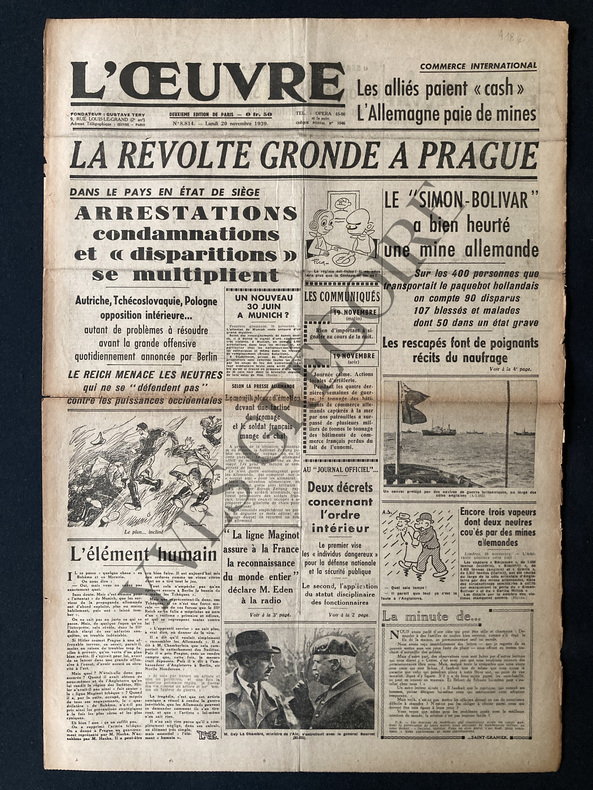
1939ABE-169737136494 PAGES 37,5 CM X 54 CM-LA REVOLUTION GRONDE A PRAGUE DANS LE PAYS EN ETAT DE SIEGE ARRESTATIONS CONDAMNATIONS ET "DISPARITIONS" SE MULTIPLIENT-LE "SIMON-BOLIVAR" A BIEN HEURTE UNE MINE ALLEMANDE, SUITE P4-"LA LIGNE MAGINOT ASSURE A LA FRANCE LA RECONNAISSANCE DU MONDE ENTIER" DECLARE M.EDEN A LA RADIO, SUITE P3-DESSIN DE HAUTOT "LE PLAN.INCLINE", HITLER-P2: "SERVICE DE L'HUMANITE" UN APPEL DE LORD SNELL AU PARLEMENT BRITANNIQUE-P3: LE FUHRER VOULAIT MOBILISER UN MILLION DE TCHEQUES LE PRESIDENT HACHA N'A PAS VOULU-LE GHETTO DE VARSOVIE EST SEPARE DE LA CAPITALE PAR DES BARRICADES-P4: UN INCENDIE AU MUSEE DE QUIMPER
19417842ALitzmannstadt, 1941. [2 Warenabbildungen]
Original boards. 8vo; 53, 75 pages; Some text in English, some in Yiddish. Nice book Co-sponsored by the Emma Lazarus Federation, the Furrier Joint Council of N. Y. & the Joint Board of the Fur Dressers & Dyers Unions. Bumps to edges. Very Good Condition. (HOLO2-127-6)
JUDA2214o.J. BLUMENTAL, Nachman (Ed.) Yizkor Baranow. A Memorial to the Jewish Community of Baranow. Jerusalem, Yad Vashem 1964. gr.-8°, XVI S., engl. Text, 236 hebräischer Text mit zahlr. Abb., OLn. m. hebr. Rückentit., leichte Gebrauchsspuren. / BAUMINGER, Arieh. L. Les Justes. Jerusalem, Yad Vashem (1969). gr.-8°, 102 (statt 104) S., letztes Bl. fehlt (herausgeriss.), OBrosch., lichtspurig, abgegriff., Umschlag vorne tlw. vom Textblock gelöst. / Der HOLOCAUST. Jerusalem, Yad Vashem 1979. 79 S., stark illustriert, OBrosch.
1995ZEIT1649(Passau, Neue Presse (1995). 4°, 227 S., mit zahlr. Fotos, Mit Beiträgen u.a. von Wladyslaw Bartoszewski und Andrzej Szczyiorski
1st edition. Original Paper wrappers, 8vo, 206 pages. Includes illustrations & facsimiles. 21 cm. In Yiddish. Title translates as, "The Ghetto in Flames: An Anthology." Early report, from the year following the Warsaw Ghetto Uprising, with reporting on the revolt. SUBJECT(S): Jews -- Poland -- Warsaw. World War, 1939-1945 -- Jews. Geographic: Poland -- History -- Occupation, 1939-1945. Warsaw (Poland) -- History -- Warsaw Ghetto Uprising, 1943. OCLC: 1227410408. Clean and fresh. Very good. Important. (HOLO2-98-26A-+)
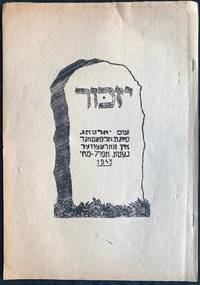
194443395Shvayts Switzerland: Undzer Vort Poale Tziyon Left 1944. May 1944. 1st edition. Original stapled printed paper cover 4to 2 25 pages. <br> In Yiddish. Title translates as "In Memoriam. On the Anniversary of the Uprising in the Warsaw Ghetto April-May 1943.<br> First Anniversary of the Warsaw Ghetto uprising published in Europe during the Holocaust by Jewish "Poale Tziyon Left" members in Switzerland. The organization's name which means "Workers of Zion" is sometimes also romanized as "Poale Zion" or "Poaley Syjon." <br> <br> The imprint "Undzer Vort" "Our Word" was a Left Poale Tziyon publisher in Switzerland which also published a mimeograph newspaper titled "Undzer Vort" OCLC: 232675203 during this same period. A fully underground version of the paper was also published in Nazi-Occupied Belgium see below.<br> <br> Indeed Poale Tsiyon Left was an important part of Jewish resistance throughout Europe most notably during the Warsaw Ghetto Uprising which this publication commemorates. <br> <br> "The Holocaust-era Jewish resistance group ZOB was formed from a coalition including Hashomer Hatzair Dror Bnei Akiva the Jewish Bund various Jewish Communist groups and both factions of Poale Zion. Poale Zion was also active in the Anti-Fascist Bloc.<br> Several notable Jewish resistance fighters during the Holocaust particularly those involved in the Warsaw Ghetto Uprising were members of Poale Zion. They include:<br> <br> Adolf Berman Warsaw ZOB fighter; Secretary of Zegota Poale Zion Left<br> Hersz Berlinski member of Warsaw ZOB Command Poale Zion Left<br> Yochanan Morgenstern member of Warsaw ZOB Command Poale Zion Right<br> Emanuel Ringelblum member of Warsaw ZOB; chronicler of the Warsaw Ghetto Poale Zion Left" Wikipedia.<br> <br> The booklet opens with the moving story of the start of the uprising:<br> <br> "It has been a year since the glorious uprising of the Jews in the Warsaw ghetto.<br> April 19 1943 - barely a few tens of thousands of Jews left in Warsaw after about half a million of their brothers and sisters were exterminated in the most gruesome way they rose up with organized resistance against the renewed attempts.that they too like the previous ones would be led out like sheep to the slaughter.<br> Forty thousand Jews weapons in hand opposed an enemy tenfold a hundred hundred times outnumbered.Women men and children the high class and the humble.<br> From the beginning they all knew without exception that they would be defeated that the outcome was not in doubt and that the enemy intended nothing but destruction for all of them.<br> But no Nazi expected to fall on such a battlefield.<br> And his was the biggest slap in the face which the proud Nazis.so hated when it was received from these these trampled down these unrefined these scorned these despised Jewish 'untermenchen'" Translated from the opening paragraphs on page 1.<br> <br> The publication later continues with a damnation of the "democracies" who did so little and a holding up of the comrades of Poale Tziyon who are doing so much fighting on all fronts:<br> <br> "The 'world democracies' didn't do anything.to save the Jewish victims and to stop the misery train they issued platonic statements about punishing the 'crimes' after the massacre. The warnings have so far helped little.<br> The.Sacrifices keep growing.The world that is fighting 'for justice' and that is busy with courts after the massacre has not found any means to rescue the few escaped heroes in the ghetto for a whole year.<br> This long eulogy is for dozens and hundreds of comrades who fell as loyal children of the nation and fighters for its working class on the fronts in the distant.north in the camps of France and Belgium. who went from one end of the world to the other - at their wounds and from hundreds of thousands of others - comrades of the Poale-Tziyon movement." page 24. <br> <br> Poale Zion.was a movement of Marxist-Zionist Jewish workers founded in various cities of Poland Europe and the Russian Empire at about the turn of the 20th century after the Bund rejected Zionism in 1901.<br> Poale Zion was torn between left-wing and right-wing factions in 1919-1920; the organization formally split at the Poale Zion fifth world congress in Vienna in 1920 following a similar division that occurred in the Second International.<br> The right wing was less Marxist and more nationalist and favoured a more moderate socialist program and supported the International Working Union of Socialist Parties to continue the work of the Second International essentially becoming a social democratic party. The left-wing faction did not consider the Second International radical enough and some accused its members of betraying Borochov's revolutionary principles although Borochov had begun to modify his ideology as early as 1914 and publicly identified as a social democrat the year before his death.<br> Poale Zion Left which supported the Bolshevik revolution continued to be sympathetic to Marxism and Communism and attended the second and third congresses of the Communist International in a consultative capacity. They lobbied for membership but their attempts were unsuccessful as the internationalist communist movement under Lenin and Trotsky was opposed to Zionist nationalism. The Comintern advised individual members of Left Poale Zion to join their national Communist parties as individuals; at their 1922 Danzig conference these terms were rejected by the party. The Comintern declared it an enemy of the workers' movement.<br> Poale Zion Left opposed the decision by Poale Zion to rejoin the World Zionist Organization viewing it as essentially bourgeois in character and viewed the Histadrut as reformist and non-socialist. Aside from differing attitudes towards Zionism and Stalinism the two wings of Poale Zion parted ways over Yiddish and Yiddish culture.<br> The Left was more supportive of the latter similar to the members of the Jewish Bund while the Right bloc identified strongly with the emerging modern Hebrew movement in the early 20th century.<br> In Poland for a brief period following World War I both factions of Poale Zion were reported as legal and functioning political parties. The Polish Left party was the largest Left Poale Zion party in the world. It worked closely with the Bund in developing Yiddish schools in Poland and supporting secular Yiddish culture although they had political differences e.g. the Bund was more supportive of the Polish Socialist Party than LPZ.<br> As part of the large-scale ban on Jewish political parties in post-World War II Poland by the Communist leadership both Poale Zion groups were disbanded in February 1950" Wikipedia.<br> <br> Interestingly the image on the front cover this distinctive gravestone with "Yizkor" in a specific heavy font was a frequent image for memorials to the victims of pogroms as well as the Shoah in particular for memorials to the Warsaw Ghetto Uprising. A few examples include:<br> • Hashin & Ben Gurion Yizkor tsum ondenken di gefalene vekhter un arbeiter in Erets Yisroel New York Poale Zion Palestine Committee 1917. Internal illustrated title page<br> • Hurbn Proskurov New York: Proskurover Relief Organization 1924. See image on JHU's online Yizkor Book Exhibit at www.library.jhu.edu/news/2025/06/yizkor-books-traveling-homelands-and-portable-memorials And from another memorial to the first anniversary of the Warsaw Ghetto Uprising:<br> • Tsum Yortog Funm Oyfshtand in Varshever Geto April-May 1943. Ramat Gan: Defus "liga" 1944. OCLC: 63647084. See Nr. 35 in our catalog 215 at danwymanbooks.cdn.bibliopolis.com/images/upload/catalog-215.pdf <br> <br> "Undzer Vort" also published similar underground Poale Tziyon Left newspapers and other materials in Nazi-occupied countries such as Belgium: <br> "'Linke Poale Zion' Left-wing Workers of Zion was a Zionist-Socialist party in Belgium and one of the initiators of the Jewish Defense Committee of Belgium. This committee managed to save about 3000 children and several thousand Jewish adults from the clutches of the Nazis.<br> With his party comrades Abusz Werber ensured the editing publication and distribution of 28 issues of a secret underground newspaper in Yiddish"Unzer Wort" Undzer Vort Our Word which appeared until the Liberation in September 1944 and even after" Werber The Word of Abusz Werber 2017. Note how the Yiddish documents on the cover of the book are similar to our Undzer Vort publication from Switzerland: https://m.media-/images/I/71sWHrhxgoL._SL1360_.jpg. <br> <br> SUBJECTS: Holocaust Jewish 1939-1945 -- Poland -- Warsaw -- Illustrations. <br> OCLC: 233365664. OCLC locates only 1 copy worldwide NLI.<br> <br> Final leaf in facsimile. Paper toning as expected but strong. About Very Good Condition thus. Rare and important. B Holo2-163-28-XX. Shvayts [Switzerland]: Undzer Vort [Poale Tziyon Left] unknown
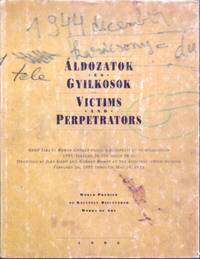
199539266Budapest: Cultural Exchange Foundation 1995. Paperback. 1st edition. Original stiff paper wrappers with illustrated dust jacket 4to 122 pages. Includes llustrations and portraits ; 28 cm. Filled with drawings. Collection of 36 sketches drawn by Ilka Gedo in the Budapest Ghetto during Nazi occupation and sketches by Gyorgy Roman of defendants at war crimes trials held in Hungary after the war. <br> OCLC: 34942605. <br> Text is by several authors and is in English and Hungarian. Light edgewear and library marks to dust jacket otherwise Very Good condition with card pocket at rear no other markings. BK5 HOLO2-136-37--'e. [Budapest]: Cultural Exchange Foundation paperback
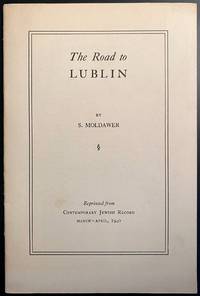
194043325New York: American Jewish Committee 1940. 1st separate edition. Original paper wrappers. 8vo pages 119-133 14 pages total. “Reprinted from Contemporary Jewish Record March-April 1940.†Includes photo of “Armbands which Nazis are compelling the Jews to wear.†Moldawer’s story originally appeared in The Forward N.Y.C. Jan. 2-5 1940 in Yiddish. <br> Moldawer a Polish Jew who had resided in Germany had been caught by the outbreak of the war in Hamburg on his way to the United States. Together with other Jews holding U.S. visas and steamship tickets on the Hamburg-America Line-which had suspended operations-he was deported to Lublin via Prague. Moldawer used his U.S. visa and left Poland in December 1939 and was able to issue this report which became important at the time for understanding what was happening to the Jews in Poland and is often cited in later analysis. <br> <br> “During the Holocaust 99% of the Jews from Lublin District in the General Governorate of German-occupied Poland were murdered along with thousands of Jews who had been deported to Lublin from elsewhere. There were three extermination camps in Lublin District Sobibor Belzec and Majdanek.<br> The ghettoization of the Jews for the purpose of persecution terror and exploitation in the Nazi German controlled towns began immediately after the invasion of Poland….The number of major urban ghettos established in the General-Government in 1939–40 including those of Kraków and Warsaw reached one hundred before the end of the year. In the Lublin area the situation initially differed. Instead of their urban concentration some 10000 Polish Jews had been expelled from Lublin in early March 1940 to the rural towns where ghettos were not set up based solely on Globocnik's opposition to the Jewish people living near his staff headquarters. The remaining 40000 Jews of Lublin were forced into the Lublin Ghetto in May 1940†Wikipedia. <br> SUBJECTS: Nazi concentration camps. World War 1939-1945 -- Jews. Concentration Camps Camps de concentration nazis. Guerre mondiale 1939-1945 -- Juifs. Majdanek Concentration camp. OCLC: 39753405. Touch of edgewear to rear wrapper Very Good Condition Overall. B HOLO2-162-15-AX-BB. New York: American Jewish Committee unknown
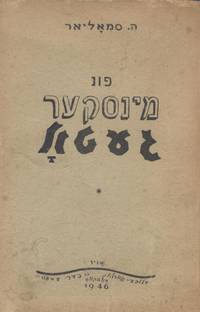
194630905Moskve: Melukhe-farlag "Der Emes 1946. 1st edition. Original Printed Boards Small 8vo 167 pages. In Yiddish. Title translates as "From the Minsk Ghetto." Title also in Russian: Minskoe getto.<br> In 1941 a group of Jews among them the Polish Jew Hersh Smolar; 1905–1993 the author organized a resistance movement in the ghetto in close connection with the Minsk Communist underground led by Isay Kazinets 1910–1942 and Masha Bruskina 1924–1941. Members of the resistance organized acts of sabotage and working together with the Judenrat led by Il’ia Mushkin diverted the production of the ghetto’s workshops and factories to the partisans. An underground printing press issued the leaflet Vestnik rodiny Homeland’s Messenger. <br> The resistance enabled thousands of Jews to escape to the forests where they founded seven partisan brigades one of which in September 1943 organized the assassination of the governor-general of Belorussia Wilhelm Kube. <br> Approximately 10000 Minsk Jews succeeded in escaping from the ghetto a proportion without parallel in Holocaust history. At liberation 13 Jews had survived the ghetto and about 5000 Jewish partisans and their families returned from the forests. <br> In 1945 the first memorial to Jewish victims in Minsk—and the only one in the USSR with a Yiddish inscription explicitly mentioning the Jewishness of the victims—was erected†Bemporad YIVO Encyclopedia of Jews in Eastern Europe. <br> SUBJECTS : Jews -- Persecutions -- Belarus -- Minsk. Holocaust Jewish 1939-1945 -- Belarus -- Minsk -- Personal narratives. World War 1939-1945 -- Jewish resistance -- Belarus -- Minsk. Named Person: Smolar Hersh 1905- Geographic: Minsk Belarus -- Ethnic relations. <br> OCLC: 12284925. Small stain to title page Jewish institutional stamp on final page rear of title page and text block edges no other markings spine neatly rebacked new endpapers Good condition. B YID-17-15-ALBXGGCCOE. Moskve: Melukhe-farlag "Der Emes unknown
194613981Lodzsh: Tsentraler Yidisher Historisher Komisye baym Tsentral-Komitet fun Poylishe Yidn 1946. 1st edition. Later cloth with original dramatic photgraphic cover mounted on front 8vo 70 1 pages 1 l. includes facsimiles. 21 cm. Poems. "Oysgabes fun Der Tsentraler Yidisher Historisher Komisye baym Tsentral-Komitet fun Poylishe Yidn. Serye yidishe literatur 1." <br> A committee dedicated to recording the fate of Polish Jews published this book length poem by Simkhah Szajewics. Written in the Lodz Ghetto it appeared immediately after the war in 1946; Szajewicz perished in a concentration camp in 1944" from the permanent exhibit at the National Yiddish Book Center which houses their copy in their Rare Book Collection. <br> The book actually includes two long poems: "Lekh-lekha" and "Friling 702 " as well as letters and other related material. <br> See David Roskies interesting reflection on this work and it's stunning photographic cover at jtsa.edu/torah/go-forth-the-grammar-of-remembrance. <br> For more about the author-poet see Chava rosenfarb's essay on Shayevitch in Tablet Magazine at tabletmag.com/sections/arts-letters/articles/the-last-poet-of-lodz. SUBJECTS: Jews -- Persecutions -- Poland -- Lódz. Holocaust Jewish 1939-1945 -- Poetry. Jews -- Correspondence. Expertly rebound in attractive black cloth with the original photographic front cover mounted on the front. Very Good Condition. B HOLO2-110-36-CCALX-'emm H-40-10. Lodzsh: Tsentraler Yidisher Historisher Komisye baym Tsentral-Komitet fun Poylishe Yidn unknown
194643329Warszawa; Lódz: Zaklady Graficzne WINW: Centralna Zydowska Komisja Historyczna 1946. 1st Edition. Original Paper Wrappers 8vo 40 pages. 21 cm. In Polish. Title translates as "The Liquidation of the Vilna Ghetto." Includes bibliographical references. <br> Personal eyewitness account by Mendel Balberyszski 1894–1966 a prominent Vilna Jewish leader and later Holocaust survivor detailing life in the Vilna Ghetto and its destruction under German occupation. Balberyszski served on the Advisory Council of the “small ghetto†opposing Judenrat collaborationist policies. He survived both the liquidation of the ghetto and the Holocaust. <br> Balberyszski a Lithuanian-Polish Jewish politician and journalist was prewar editor at Vilna’s Der Tog and active in the Folkspartei and later the Polish Democratic Party. After the war he emigrated to Melbourne where he became a leading communal figure. His memoir was later republished in English as Stronger than Iron: The Destruction of Vilna Jewry 1941–1945 2010.<br> Pages 38-40 detail a list of 35 titles issued 1945–46 by the Historical Commission documenting early postwar Jewish testimony efforts.<br> SUBJECTS : Holocaust Jewish 1939-1945 Lithuania Vilnius. Jewish ghettos Lithuania Vilnius. World War 19391945 Lithuania Vilnius Atrocities. Jews Lithuania Vilnius. OCLC: 13911170. Very Good Condition overall. B H2-3-5-VLGGAMPCCFE-XBB. Warszawa; Lódz: Zaklady Graficzne WINW: Centralna Zydowska Komisja Historyczna unknown
1961100659Paris, Robert Laffont 1961 Reliure demi-basane fauve maroquinée, dos lisse, couvertures conservées, 683 pp., table des matières.Exemplaire en bon état.
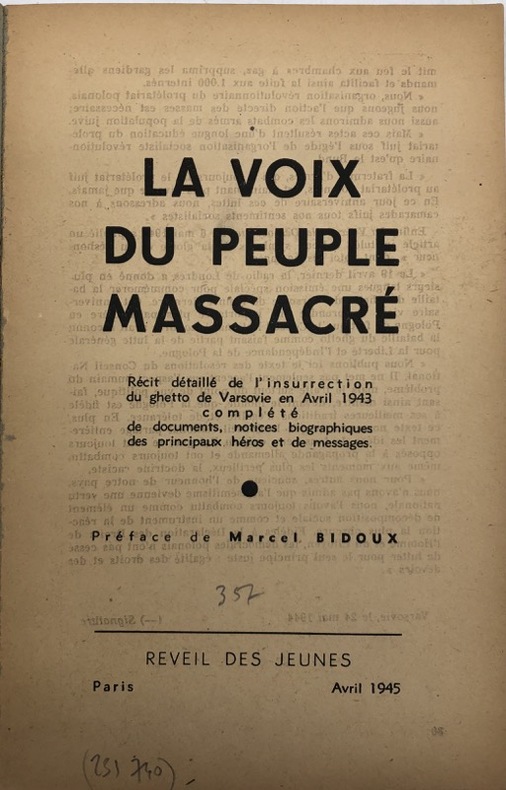
231740Paris, Réveil des jeunes, avril 1945 in-8, 80 pp., avec 7 figures dans le texte, broché.
199414684Varsovie, s.d. (1994), in-4°, 296 pp, très nombreuses photos, cart. éditeur illustré. Texte bilingue anglais et allemand. Warsaw, Poland: Drukarnia Naukowo-Techniczna, 1994 Hard Cover. Near Fine. Laminated pictorial boards, black and white. Text is in English and German. Privately printed in Poland. Illustrated with black and white photographs and drawings. Ink stamp of Warsaw Ghetto on title page.
2001LFA-126739767Revue de 82 pages, format 220 x 280 mm, illustrée, brochée couverture couleurs, bon état