Karski, Jan [Signed]MareMagnum

344 résultats
Signed and inscribed by Jan Karski upon front free endpaper. Karski [1914-2000] recounts his experiences when his homeland of Poland was rent asunder by the joint Nazi and Soviet invasion of 1939, and his harrowing subsequent life as a member of the Polish underground, during which he was captured by the Gestapo and severely tortured. Provides a ghastly eyewitness account of life in the Warsaw ghetto, into which Karski was smuggled so his observations could be reported to the outside world. Firearms advocates will cringe at Karski's account of what happened after he and a large group of Polish soldiers handed over their weapons to their 'comrades' from the Soviet Union. In 2012 Karski was posthumously awarded America's highest civilan honor, the Presidential Medal of Freedom, by President Obama. 391 pages. Moderate wear to publisher's red cloth. Dust jacket now preserved in archival-grade Brodart. Binding intact. A sound copy of this truly unforgettable WWII narrative. Laska 672, Kehr & Langmaid 5407, Weiner Library Catalogue Seven 997, Enser p.343. Book
FIRST EDITION OF ELUARD'S RAREST BOOK, WITH AN ORIGINAL SIGNED DRAWING BY MAURICE MENDJIZKI. Includes a 5-page poem by Eluard and 31 extremely high-quality (Jacomet process?) full-page reproductions of drawings by Mendjizki depicting the suffering and heroism of the Warsaw Ghetto and the Uprising. Dedicated to the artist's son Claude, shot by the Nazis in 1944 for being a member of the Resistance. THIS FIRST EDITION STRICTLY LIMITED TO 100 COPIES, of which this is number 100, SIGNED BY ELUARD AND MENDJIZKY AND CONTAINING AN WONDERFUL ORIGINAL SIGNED DRAWING BY MENDJIZKY, depicting three people trying to sleep in very cramped quarters (200 additional unsigned copies were also printed, 100 in French and 100 in Yiddish, which are not part of the first edition.) Printed on fine wove paper. 4to. Original wraps FINE AND BRIGHT, LIKE NEW WITH NO DEFECTS, IN THE ORIGINAL BOARD CHEMISE AND SLIPCASE. A wonderful example of extremely rare and haunting 20th-century Judaica.
1945STAN0099Praha, Delnicke Nakladatelstvi 1945. 22x15cm. 80 unpaginierte lose Seiten, 27 ganzseitige photogr. Abb., in ill. OUmschlag. Umschlag gering randrissig u. rückseitig etwas stockfleckig, sonst sehr gut erhalten. Die erste Bilddokumentation aus dem befreiten KZ Theresienstadt. Von großer Seltenheit.
320 pages. Name index. Subject index. "A shortened version of the second edition (1957) of a work first published in Polish under the title 'Dziennik Hansa Franka' (Hans Frank's Diary). Frank was a Minister of the Third Reich and Governor General of those areas of Poland occupied by Nazi Germany which were not incorporated into the Reich. At the International Military Tribunal in Nuremberg for the first time in the history of the world thousands of secret documents were revealed belonging to a state in the grip of the imperialist idea of world conquest. Among those documents Hans Frank's Diary occupies one of the leading positions both on account of its contents and on account of its more than ordinary length: 11,000 typwritten pages in foolscap, making up 38 volumes. Any study of the history of the last war must include a reading of Hans Frank's Diary." - Preface. Author was a member of the Polish delegation to the International Military Tribunal at Nuremberg. Usual library markings. Above-average wear. Front hinge taped. Back hinge going. A worthy reading copy of this very important work. LASKA 316, KEHR & LANGMAID 5385. Book
328 pages. "A significant document by which the author acquitted himself of the obligation bequeathed on the survivors of the Holocaust by its victims to tell the world what happened to the Jews during World War Two, when to be a Jew was a crime. The Memoirs based on the author's own experiences and reports told to him by his relatives and friends, survivors of the Holocaust, describe the fate of hundreds of thousands of Polish Jews, banished by the Russians to Siberia and in particular the lot of those who came under the Nazi regime... A rich source of first hand information about the life in the ghetto, the Judenrat, the Jewish Ghetto Police and the methods used by the Nazis in the destruction of the Jews." - dust jacket. Author lost his parents, wife and two sons in the Holocaust. Map endpapers. Black and white illustrations. Book clean and unmarked with light wear. Dust jacket lightly sunned at spine, bears several closed tears and is missing some small chips - now preserved in glossy new archival-grade Brodart cover. A sound copy.. Book
1950007299Paris O.L.B. 1950 In-4 Broché, couverture illustrée Edition originale
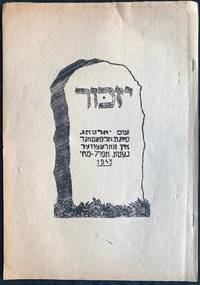
194443395Shvayts Switzerland: Undzer Vort Poale Tziyon Left 1944. May 1944. 1st edition. Original stapled printed paper cover 4to 2 25 pages. <br> In Yiddish. Title translates as "In Memoriam. On the Anniversary of the Uprising in the Warsaw Ghetto April-May 1943.<br> First Anniversary of the Warsaw Ghetto uprising published in Europe during the Holocaust by Jewish "Poale Tziyon Left" members in Switzerland. The organization's name which means "Workers of Zion" is sometimes also romanized as "Poale Zion" or "Poaley Syjon." <br> <br> The imprint "Undzer Vort" "Our Word" was a Left Poale Tziyon publisher in Switzerland which also published a mimeograph newspaper titled "Undzer Vort" OCLC: 232675203 during this same period. A fully underground version of the paper was also published in Nazi-Occupied Belgium see below.<br> <br> Indeed Poale Tsiyon Left was an important part of Jewish resistance throughout Europe most notably during the Warsaw Ghetto Uprising which this publication commemorates. <br> <br> "The Holocaust-era Jewish resistance group ZOB was formed from a coalition including Hashomer Hatzair Dror Bnei Akiva the Jewish Bund various Jewish Communist groups and both factions of Poale Zion. Poale Zion was also active in the Anti-Fascist Bloc.<br> Several notable Jewish resistance fighters during the Holocaust particularly those involved in the Warsaw Ghetto Uprising were members of Poale Zion. They include:<br> <br> Adolf Berman Warsaw ZOB fighter; Secretary of Zegota Poale Zion Left<br> Hersz Berlinski member of Warsaw ZOB Command Poale Zion Left<br> Yochanan Morgenstern member of Warsaw ZOB Command Poale Zion Right<br> Emanuel Ringelblum member of Warsaw ZOB; chronicler of the Warsaw Ghetto Poale Zion Left" Wikipedia.<br> <br> The booklet opens with the moving story of the start of the uprising:<br> <br> "It has been a year since the glorious uprising of the Jews in the Warsaw ghetto.<br> April 19 1943 - barely a few tens of thousands of Jews left in Warsaw after about half a million of their brothers and sisters were exterminated in the most gruesome way they rose up with organized resistance against the renewed attempts.that they too like the previous ones would be led out like sheep to the slaughter.<br> Forty thousand Jews weapons in hand opposed an enemy tenfold a hundred hundred times outnumbered.Women men and children the high class and the humble.<br> From the beginning they all knew without exception that they would be defeated that the outcome was not in doubt and that the enemy intended nothing but destruction for all of them.<br> But no Nazi expected to fall on such a battlefield.<br> And his was the biggest slap in the face which the proud Nazis.so hated when it was received from these these trampled down these unrefined these scorned these despised Jewish 'untermenchen'" Translated from the opening paragraphs on page 1.<br> <br> The publication later continues with a damnation of the "democracies" who did so little and a holding up of the comrades of Poale Tziyon who are doing so much fighting on all fronts:<br> <br> "The 'world democracies' didn't do anything.to save the Jewish victims and to stop the misery train they issued platonic statements about punishing the 'crimes' after the massacre. The warnings have so far helped little.<br> The.Sacrifices keep growing.The world that is fighting 'for justice' and that is busy with courts after the massacre has not found any means to rescue the few escaped heroes in the ghetto for a whole year.<br> This long eulogy is for dozens and hundreds of comrades who fell as loyal children of the nation and fighters for its working class on the fronts in the distant.north in the camps of France and Belgium. who went from one end of the world to the other - at their wounds and from hundreds of thousands of others - comrades of the Poale-Tziyon movement." page 24. <br> <br> Poale Zion.was a movement of Marxist-Zionist Jewish workers founded in various cities of Poland Europe and the Russian Empire at about the turn of the 20th century after the Bund rejected Zionism in 1901.<br> Poale Zion was torn between left-wing and right-wing factions in 1919-1920; the organization formally split at the Poale Zion fifth world congress in Vienna in 1920 following a similar division that occurred in the Second International.<br> The right wing was less Marxist and more nationalist and favoured a more moderate socialist program and supported the International Working Union of Socialist Parties to continue the work of the Second International essentially becoming a social democratic party. The left-wing faction did not consider the Second International radical enough and some accused its members of betraying Borochov's revolutionary principles although Borochov had begun to modify his ideology as early as 1914 and publicly identified as a social democrat the year before his death.<br> Poale Zion Left which supported the Bolshevik revolution continued to be sympathetic to Marxism and Communism and attended the second and third congresses of the Communist International in a consultative capacity. They lobbied for membership but their attempts were unsuccessful as the internationalist communist movement under Lenin and Trotsky was opposed to Zionist nationalism. The Comintern advised individual members of Left Poale Zion to join their national Communist parties as individuals; at their 1922 Danzig conference these terms were rejected by the party. The Comintern declared it an enemy of the workers' movement.<br> Poale Zion Left opposed the decision by Poale Zion to rejoin the World Zionist Organization viewing it as essentially bourgeois in character and viewed the Histadrut as reformist and non-socialist. Aside from differing attitudes towards Zionism and Stalinism the two wings of Poale Zion parted ways over Yiddish and Yiddish culture.<br> The Left was more supportive of the latter similar to the members of the Jewish Bund while the Right bloc identified strongly with the emerging modern Hebrew movement in the early 20th century.<br> In Poland for a brief period following World War I both factions of Poale Zion were reported as legal and functioning political parties. The Polish Left party was the largest Left Poale Zion party in the world. It worked closely with the Bund in developing Yiddish schools in Poland and supporting secular Yiddish culture although they had political differences e.g. the Bund was more supportive of the Polish Socialist Party than LPZ.<br> As part of the large-scale ban on Jewish political parties in post-World War II Poland by the Communist leadership both Poale Zion groups were disbanded in February 1950" Wikipedia.<br> <br> Interestingly the image on the front cover this distinctive gravestone with "Yizkor" in a specific heavy font was a frequent image for memorials to the victims of pogroms as well as the Shoah in particular for memorials to the Warsaw Ghetto Uprising. A few examples include:<br> • Hashin & Ben Gurion Yizkor tsum ondenken di gefalene vekhter un arbeiter in Erets Yisroel New York Poale Zion Palestine Committee 1917. Internal illustrated title page<br> • Hurbn Proskurov New York: Proskurover Relief Organization 1924. See image on JHU's online Yizkor Book Exhibit at www.library.jhu.edu/news/2025/06/yizkor-books-traveling-homelands-and-portable-memorials And from another memorial to the first anniversary of the Warsaw Ghetto Uprising:<br> • Tsum Yortog Funm Oyfshtand in Varshever Geto April-May 1943. Ramat Gan: Defus "liga" 1944. OCLC: 63647084. See Nr. 35 in our catalog 215 at danwymanbooks.cdn.bibliopolis.com/images/upload/catalog-215.pdf <br> <br> "Undzer Vort" also published similar underground Poale Tziyon Left newspapers and other materials in Nazi-occupied countries such as Belgium: <br> "'Linke Poale Zion' Left-wing Workers of Zion was a Zionist-Socialist party in Belgium and one of the initiators of the Jewish Defense Committee of Belgium. This committee managed to save about 3000 children and several thousand Jewish adults from the clutches of the Nazis.<br> With his party comrades Abusz Werber ensured the editing publication and distribution of 28 issues of a secret underground newspaper in Yiddish"Unzer Wort" Undzer Vort Our Word which appeared until the Liberation in September 1944 and even after" Werber The Word of Abusz Werber 2017. Note how the Yiddish documents on the cover of the book are similar to our Undzer Vort publication from Switzerland: https://m.media-/images/I/71sWHrhxgoL._SL1360_.jpg. <br> <br> SUBJECTS: Holocaust Jewish 1939-1945 -- Poland -- Warsaw -- Illustrations. <br> OCLC: 233365664. OCLC locates only 1 copy worldwide NLI.<br> <br> Final leaf in facsimile. Paper toning as expected but strong. About Very Good Condition thus. Rare and important. B Holo2-163-28-XX. Shvayts [Switzerland]: Undzer Vort [Poale Tziyon Left] unknown
1946MMRM1658Varsovie:: American Joint Distribution Committee 1946. 1946. 8vo. 264 4 pp. 11 black and white photographic plates 50 tables charts index. Original printed wrappers; scotch tape along spine front and rear covers age-darkened first 3 pages including half title and last three blank end-papers are loose. Main body of work remains bound and in good condition. Loose pages have some slight area of extremities missing. Some fading and foxing to pages. Thus wrappers poor but text good to good plus. First edition. SEMINAL WORK IN MEDICAL CLINICAL RESEARCH & A CRITICAL ARTIFACT OF THE WARSAW GHETTO AND HOLOCAUST. Copies of the book are uncommon in part because of the fragile nature of the paper used to publish the report. In the immediate aftermath of World War II paper ink and binding facilities in Europe were scarce. The published report was done with economy in mind and with a rushed sense of needing to reveal to the world what happened. / Six articles report on the clinical research by 28 Jewish physicians and a student intern the 1946 book only records the names of 21 physicians and the student – subsequent research in the 1960s revealed the additional names who conducted the studies on adults and children at the two Jewish hospitals in the Ghetto. Abbreviated biographies of the physicians can be found in The Uses of Adversity: Studies of Starvation in the Warsaw Ghetto by Leonard Tushnet published in 1966. The physicians hoped to study these patients to somehow benefit humanity perhaps in the spirit of the Jewish concept of tikkun olam - to repair the world. The studies were conducted in secret since any scientific research in the Ghetto was prohibited by the Nazi overseers. It is also quite possible that many if not all the clinical physicians believed that granting children and others the status of being a patient would protect them by preventing their transport out of the ghetto to death camps. Theories also suggest that the physicians wanted to preserve a record of the atrocities being committed as well as advance medical research. The studies remain the most comprehensive research of the effects and progression of starvation in part because any contemporary studies would largely be blunted by existing ethical guidelines for informed consent and subject welfare. Contemporary debates about the ethical wisdom of conducting these studies remains contentious. / The Warsaw Ghetto occupied approximately 1.3 square miles 3.4km2 and its population was as much as 500000 men women and children. The Ghetto was a staging area for transporting Polish and Eastern European Jews to the death camps and a locale for starving to death Jews prior to transport. The average daily caloric intake of a resident of the Ghetto was 600 to 800 calories of low-protein food for adults. This amount was calculated by Adolf Eichmann to starve-to-death most of the residents in approximately nine months. The physicians performing the research were no exception to the plan. All were starving as they performed their studies. Equipment for clinical research was smuggled into the hospitals. / Each article in the book is devoted to specific results of these studies. Chapter V offers autopsy results on 710 patients; 492 died of starvation and 218 died of complications of secondary conditions. Chapter VI offers clinical observations of one-hundred adults who died from starvation. Chapter VII offers clinical observations of 40 children who died of starvation. Chapter VIII examines the effects of starvation on the cardiovascular system in adults and children. Chapter IX discusses changes in peripheral blood and bone marrow. Ophthalmic responses to starvation are discussed in Chapter X. Only one doctor engaged in the research Emil Apfelbaum survived the war. He arranged to have the studies smuggled out of the Ghetto to a Polish professor of medicine who released the reports after the liberation of Warsaw. After the war Apfelbaum edited the report for publication by the Joint Distribution Committee. He died a week before the book was published. / Research was performed at the two hospitals in the Ghetto from late February to July 22 1942. On July 22 the hospitals were closed and any patients unable to be transported were summarily executed regardless of age. The attending and clinical physicians were fully aware of the fate awaiting transported patients and in many instances they performed euthanasia on elderly and child patients who were scheduled for transport. Some of the physicians committed suicide rather than face transport. Other physicians accompanied their patients to the death camps providing whatever aid they could. / The studies were smuggled out of the ghetto in a manner befitting a Ken Follet thriller. A Jewish physician Henryk Fenigstein played a crucial role. "Before the war Henryk was a stamp collector. In fact he had one of the largest collections of Polish stamps in the country. One day two SS members arrived at the hospital and told Henryk to come with them to Gestapo headquarters. Of course he was terrified. Jews taken to Gestapo headquarters did not return. On arrival he was taken to the office of a senior officer who told him that he himself was an avid stamp collector. He took out a list and handed it to Henryk. He wondered if Henryk had these stamps and if not if he knew where to procure them. Henryk told him that he had many of the stamps including some of the very rare ones. He told him that he thought he could procure the rest. In order to do this he would need a pass to get out of the ghetto for a few hours each week. And of course the SS officer was welcome to those that he had. The officer agreed and even gave Henryk his phone number in case he needed any help. Thus Henryk Fenigstein a key member of the study team was able to leave the ghetto" 2005 lecture Myron Winick. During such an outing Fenigstein arranged for the smuggling of the reports. A pregnant woman reportedly was used to hide the documents and transport them out of the ghetto. / The supervising physician of the project Israel Milejkowski wrote in his Introduction to the studies that each author refused to allow the Nazis to destroy their work and that through the research and the publication of that research "Nous avons termine nos Recherches et nous les conserverons bien comme c'etait Ton desir. Les paroles immortelles que Tu a jetees "Non omnius Moriar" doivent etre en premier lieu appliquees a Toi! Gloire eternelle a Ta Memoire !" / The research as well as results from the Minnesota Semi-Starvation studies of 1944-1945 continues to benefit the millions of persons facing starvation each year. The participants in the Minnesota study lost an average of 25% of pre-test body weight and the final phase of the study included recovery techniques and methods. The Warsaw studies measured effects until death. This artifact of scientific integrity individual bravery and resistance to oppression is a rare opportunity to truly own a small piece of history illuminating the courage of physicians determined to use their craft to help the world and advance the memory of atrocities. American Joint Distribution Committee, 1946. unknown books
8vo., First Edition thus, with front and rear endpaper maps; handsomely bound in full dark red crushed morocco, sides with gilt frame borders, back with raised bands, second and fourth compartments lettered and ruled in gilt, all other compartments tooled in gilt, gilt top, hand-made endpapers, a most attractive copy ideal as a gift or for presentation. Detailed and inspiring history of the Polish Underground by its foremost leader. A cornerstone of the literature of Poland in WWII. VERY SCARCE. Enser, p.342.
x, 214 pp. Index. Foldout map. Seven black and white plates. First published in the U.S. in 1942. "Compiled under the auspices of the Research Institute for Peace and Post War Problems of the American Jewish Committee, New York. [The author] is able to lay bare every step taken by the Nazis to impose their evil will upon Poland; he describes too the resistance and underground activities of the population in opposition to the invader. Poland is being used by the Nazis as a testing ground for their scheme for a future German colonial empire in Europe. This book is of the utmost importance as an analysis of the evil which the United Nations have to combat." - dust jacket. Moderate wear to publisher's black cloth which is lettered in silver with red trim upon backstrip. Binding sound. Gentle toning to clean and unmarked contents. Moderate wear to dust jacket now preserved in archival-grade Brodart. A quality copy of this important work compiled while the final outcome of WWII was unknown. Kehr & Langmaid 5414, Wiener Library Catalogue Seven 983. Book
194032897Litzmannstadt [um 1940], (Buchhandlung S. Seipelt). Gefaltete Karte. 99 x 68 cm. Wenige Bruchstellen an den Falzen. Gering gebräunt. Guter Zustand.
56 pages. Features: ; Cover photo of the men of Annapolis; First-Hand Report on How We Deal with the Germans, and what the consequences may be; President Truman's First Six Months in two pages of photos; What Employers can do to promote labor peace; Dilemma - Twenty Million Surplus Japanese - Jesse Steiner on how the shrunken and crowded empire can avert the evils of overpopulation; Annapolis Logs 100 Years - photo-illustrated article; The Story of the Secret Agents of the OSS and of their work behind enemy lines - article with photos including Major General Donovan; The Appeal of Football; Fannie Farmer and her "Boston Cooking School Cookbook"; Festive photos of V.E. and V.J. Day celebrations around New York; Hitler's rumor-shrouded end leads to this article, Living Myths About 'Dead' Men; Honorable League of Southpaws; Color half-page Super Suds ad features Mrs. Bess Resemini; Great one-page color fashion ad for Botany features dame with huge black hat and ghetto kids in background; Children paint as they feel; Five fashion photos of long elegant dresses; Old Dutch one-page ad features color photo of Mrs. Russell Howard of La Grange IL, Mrs. Victor Martin of Gary IN, and Mrs. C. Dachenbach of Milwaukee, WI; and more. Average external wear and soiling. Unmarked. Moderate age-toning to paper. A sound copy of this vintage WWII-era issue. Book
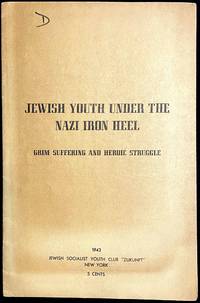
194243351New York: Jewish Socialist Youth Club 1942. Paper Wrappers. Illustrated by 2 Facimilie Illustrations. 1st edition Original Paper Wrappers 8vo 16 pages another variant we have seen has 15 pages. <br> From the year before the Warsaw Ghetto Uprising an early 1942 report by the American branch of the Bund on Jewish resistance by young people in Eastern Europe. <br> "Hand in hand with the underground organizations of the General Jewish Labor Union and in contact with the organization of the Polish socialists the Youth Union 'Zukunfst' conducts an untiring and ramified activity which is preparing the ground for the open struggle of tomorrow against Hitlerism" p. 13. <br> "Tsukunft or Cukunft or Zukunft Yiddish for future was the youth organization of the General Jewish Labor Union or Bund. It was founded in 1910 and in 1916 it was officially called Yugnt-Bund Tsukunft. Their newspaper was the Yugnt veker.<br> In 1922 the organization changed its name to Yugnt-bund "Tsukunft" in poyln 'Youth Bund "Tsukunft" in Poland'.At the time of the sixth Tsukunft conference in 1936 the last before the outbreak of the Second World War the organization counted with 184 local groups.<br> On the eve of the Second World War the organization had 15000 members. The Tsukunft took part in the Warsaw ghetto uprising as part of the Jewish Fighting Organization" Wikipedia.<br> SUBJECTS: Jewish youth -- Poland. Holocaust Jewish 1939-1945 -- Jewish resistance. World War 1939-1945 -- Atrocities. <br> OCLC: 6871875. <br> Covers toning with pen notation to cover otherwise Very Good Condition B Holo2-139-22A-XAECC-'l. Jewish Socialist Youth Club unknown
19417842ALitzmannstadt, 1941. [2 Warenabbildungen]
148 pages. Features: Cover photo of barred Harlem bookstore window; Gorgeous color fashion ads; Royal Copenhagen Porcelain offered by Swank; Qiana Ties; Blackglama Mink; Piaget watches; Two-page Lan-Chile ad (Chilean airline) features three beautiful women and heading "The Savages of South America"; Zodiac SST watch; Movado watches; Five spots for New York's Midnight Chic - Maxwell's Plum (with photo of owner Warner LeRoy), Elaine's (with photo of owner Elaine Kaufman), Raffles (with photo of operator Derek Hall-Caine), Le Club (with photo of Oleg Cassini) and Hippopotamus (with photo of Manager Olivier Coquelin; The Unholy Alliance Against the Campus; Indian Revolutionaries with a Chinese Accent - photo-illustrated article on the Naxalites; Your Policy is Hereby Canceled - the difficulty of obtaining insurance in ghetto and suburb alike; Leroy Johnson Outslicks Mister Charlie - article including photo of Muhammad Ali; Swakara lamb coats; The Omega Dynamic watch; Nice ad for genuine United States Silver Dollar 17-Jewel Watches; Two-page color Cunard Line features the QE II; Johnny Carson Apparel ad features johny in blue and gold; Patek Philippe watch ad; Fantastic 'Boutiqueland' fashion photos; The Troubled Child; Photos in the homes of Kiki Kogelnik and architect David Beer, Henry Geldzahler and Eliot Janeway; Nice one-page color-photo ad for teh National Bank of North America shows brighly-dressed ladies at the door of a walk-in safe; Dewar's Whisky ad features photo of artist Leroy Neiman; Photo of John and Abby Seymour in Save the Children Federation Ad; Sunnyland Farms Pecans ad with photo of Jane and Harry; Nice back cover ad for No-Cal Root Beer says "We Ain't Got No Sugar". Average wear. Crossword completed, otherwise unmarked. A sound vintage copy Book
92 pages. Features: Renault 16TS ad; In Search of a Community - Blacks in Canada; Labor turmoil in U.S.; Black America 1970 - major article with great photos; Mounting uneasiness in Southeast Asia; Color Cadillac ad features a grey 1970 hardtop Sedan deVille; Mideast conflict news; Lieut. General Haim Bar-Lev - how to cope with the Arab armies; Notes from a Soviet Asylum - former Major General Pyotr Grigorenko; Groovy men's color fashion ad for "The Blazer Suit" by Michaels Stern; Education - Young Blacks getting it together - with content on Laura Calhoun, Jennye Guy, Bruce Dalton, Michael Johnson, Chezzie Jordan, and others; Show Business - article with photos of Dick Gregory, Moms Mabley, Redd Foxx and Flip Wilson; Nice color-photo ad for a blue 1970 Olds Cutlass Supreme; What America Would Be Like Without Blacks; Excellent one-page color photo of Dana Chandler Jr. standing beside his painting honouring Black Panther Leader Fred Hampton; Two pages of colour photos of amazing black graffitti art on buildings; Color photos of Malcolm Bailey, Melvin Edwards, Richard Hunt, David Hammons, Sam Gilliam, Daniel Johnson and Joe Overstreet; Environment - Ecology of a Ghetto; Behavior - Black Hangups; Interracial Relationships; Dallas Cowboy running back Calvin Hill; Working in the white man's world; The beginnings of black capitalism; Passing of Joe Pyne, Martin Tananbaum, Major General James Earl Rudder, Oscar Johnson, Vice Admiral Ralph E. Jennings and Jesse M. Donadson; The Black Church - Joseph H. Jackson, Samuel W. Williams; Music - with photos of John Coltrane and Ornette Coleman; Blacks in the Press; and more. Provides a marvelous snapshot of how blacks fit into America in 1970. Average wear. Unmarked. A sound copy. Magazine
80 pages. Features: Cuban Diary - Raising Castro's 'New Man' - article with photo of state-run nursery for children of working mothers; Gorgeous color fashion ads; A Doctor's Diagnosis of Medicare; A Negro Leader Defines a way out of the Exploding Ghetto - Bayard Rustin; A Puerto Rican Describes a Nightmare Night in 'Mi Barrio' - Piro Thomas writes about Spanish Harlem; The (John) Betjeman Phenomenon - photo-illustrated article on England's 61-year-old poet-crusader; Lovely color-photo Lady Manhattan centerfold ad; Fantastic Patty Petite ad features 'Helen of Troy' theme with ancient warriors at her back; Nice hat fashion photos; Fantastic one-page color-photo Lady Arrow ad features Pamela Tiffin; Photos of the home-office of Dr. William Greenspon; Artsy McCallum Boutique ad features Gernreich stocking designs; and more. Above-average wear. Usual library markings. Spine taped. A worthy reference copy. Book
140 pages. Features: College cover photo; Gorgeous color fashion ads; Arnold Palmer is featured in a PBM blazer ad; Classy two-page Jules Jurgensen watch ad; Harman Kardon ad; Early photo-illustrated article on Donald Rumsfeld (Rummy), head of the Office of Economic Opportunity (O.E.O.) - "De-escalator of the war on poverty"; What We Have Forgotten About Pot - an illustrated pharmacologist's History; Photo-illustrated article on Lon Nol of Cambodia - he reads no newspapers and never uses a telephone; On the Lam in America - with mugshots and fingerprints of Dwight Armstrong, Karleton Armstrong, Marie Arrington, Cameron Bishop, Hubert Brown, Leo Burt, John Clouser, Bernadine Dohrn, David Fine, Charles Herron, Benjamin Paddock, Katherine Power, Warren Reddock, Byron Rice, Susan Saxe and Taylor Teaford; Very colorful one-page ad for S.T.J. ladies' fashion designed by Marshall Klugman; Colleges are Skipping over Competent Blacks to Admit 'Authentic' Ghetto Types - so says a black Professor; Nice psychedelic ad for Puritan's fashions for men; Attractive one-page color ad for Fortrel doubleknit suit by Eagle features besuited gent and gal rolling in the hay; Nostalgic two-page color-photo ad for Dymo labelmakers; Steinway piano ad; Love Cosmetics centerfold ad; Nice color ad for Gruen watches; Photos of pictures incorporated into women's fashions; First-born = Fortune's Favorite?; Nice color ad for Polish ham features gorgeous blonde; Photos of Long Island home design by Melvin Dwork; Nice color ad for Dr. Grabow pipes. Five-inch opening to fore-edge of ads on page 11; Bit of light pencil writing on front cover. Average wear. A sound vintage copy Book
160 pages. Features: Cover photo of infant wearing brain-monitoring rig; Gorgeous color fashion ads; Nice color ad for Dante rings for men; Saga Mink ad; Corum color watch ad; Betty Friedan - Mother Superior to Women's Lib (Liberation); Who Runs Egypt? - who will take over after Nasser? - photo-illustrated article; Jerome Bruner argues infants are smarter than anyone things; People are finding ways to fail their draft testing; Nice two-page Jules Jurgensen watch ad; Colorful yApre cravats (ties) ad - with ties designed by Herbert Bergheim; Beautiful Monet jewelry ad features necklace and earrings from the Sari Collection; Middle Age Meets the Kid Ghetto in Madison, WI; Tissot Watches; Doc Severinsen appears in Miracord 770H turntable ad; Nice two-page color ad for Buxton handbags; Color ad for Swank "Date-O-Matic" calendar cuff links; Seiko watch ad; Psychedelic Puritan menswear ad; The Blacks Who Work for Nixon; Wild 'crotch' photo centerfold ad by Jack Winter fashions; Armando Ghedini hair goods ad; Gruen watches; Sony TVs; Ethnic fashion photos for women; They Hear the Sound of Silence - deaf infants; Popeye and Olive Oyl appear in color ad for Start instant breakfast; Photos of furniture designed by Aaron Donner; Color ad for Johnny Carson pajamas; Cuesta-Rey cigars; Thom McAn laced boots; Puss'n Boots salmon and tuna cat foods. Average wear. Unmarked. A sound vintage copy Book
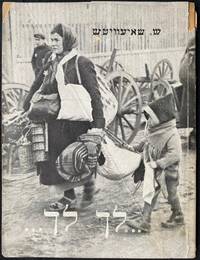
194643433Lodzsh: Tsentraler Yidisher Historisher Komisye baym Tsentral-Komitet fun Poylishe Yidn 1946. 1st edition. Original dramatic photgraphic covers 8vo 70 1 page 1 leaf. Includes facsimiles. 21 cm. In Yiddish. Poems. "Oysgabes fun Der Tsentraler Yidisher Historisher Komisye baym Tsentral-Komitet fun Poylishe Yidn. Serye yidishe literatur 1." <br> "Published by a commission The Central Jewish Historical Commission dedicated to recording the fate of Polish Jews published this book length poem by Simkhah Szajewics. Written in the Lodz Ghetto it appeared immediately after the war in 1946; Szajewicz perished in a concentration camp in 1944" from an exhibit at the National Yiddish Book Center which houses their copy in their Rare Book Collection. <br> The book includes two long poems: "Lekh-lekha" and "Friling 702 " as well as letters and other related material. <br> See David Roskies' interesting reflection on this work and it's stunning photographic cover at <br> jtsa.edu/torah/go-forth-the-grammar-of-remembrance. <br> For more about the author-poet see Chava rosenfarb's essay on Shayevitch in Tablet Magazine at <br> tabletmag.com/sections/arts-letters/articles/the-last-poet-of-lodz. <br> SUBJECTS: Jews -- Persecutions -- Poland -- Lódz. Holocaust Jewish 1939-1945 -- Poetry. Jews -- Correspondence. Crease and wear to wrapper and foot and crown of spine see photo better condition than usually found attractive. Good Condition. B HOLO2-110-36A-CCALX-'emm H-40-10. Lodzsh: Tsentraler Yidisher Historisher Komisye baym Tsentral-Komitet fun Poylishe Yidn unknown
26 pages. Illustrated in black and white. Features: A Design Service for the Poor - article with before and after photos of restored two-family home at 3029 W. Lexington in Chicago's West Side 'black ghetto' of Lawndale; Two multi-use projects with fresh thinking - Newberry Plaza and the Kennelly Square-Warehouse development; Cartoons about the current state of business for architects; Proposals for converting Loop landmarks into condos; Masonry '74 award winners; and more. Moderate wear. Unmarked. Binding intact. A sound copy. Magazine
31 pages. Features: Escape from East Germany - Part 1 - by Gary Hart, as told to Paul Grescoe; "A Better Bet Than Pierre" - Liberal M.P. David Anderson may be the most eligible bachelor in Ottawa; The Quiet Resentment of Joe Zuger, Hamilton Tiger Cat (Ti-Cat) Quarterback; We Finally have a National Arts Centre; Your Name Can Date You; Trapped in the Ghetto - Canada's largest Indian slum in Winnipeg; Doug Wright's Family. Laid in is a 12-page Star Weekly novel entitled "The Short Night" plus a 16 page supplement entitled Star Weekly - Canadian Panorama. Moderate wear. Unmarked. A quality copy. Book
Photos: Pictures from the Korsun area of the Russian front during the encirclement operations; Destroying the Lutfwaffe's aircraft factories - the biggest day raid of the war, carried out by 2,000 American planes; The return of the blitz to London; Photos from inside the Warsaw ghetto; equipment pours into Britain; American action againt the Japanese; Anzio Fighting; Photos from Finland; The German Battleship Gneisenau out of action - photos; and more. Front cover loose but present. Above-average wear. Still a worthy copy. Book
Approximately 250 pages. Library binding with usual markings. Pencil markings and highlighting to contents which include: A nine-page summary of Negro history in Nova Scotia from pre-loyalist times; A Brief Summary of Nova Scotia Negro Communities; From Slavery to the Ghetto - The Story of the Negro in the Maritimes; Summary of Information Obtained from the Survey of the Negro Population of Nova Scotia (1963); Survey of the Negro Population of Annapolis County (1963); Survey of Negro Population of Antigonish County (1963); Similar Surveys are included for Cape Breton Island, Colchester County, Cumberland County, Digby County, Guysboro County, Halifax County, Hants County, Kings County, Queens and Lunenberg Counties, Pictou County, Shelburne County, and Yarmouth County. Average wear. Binding tight. A sound working copy of this informative reference. Book
80 pages. Songs include: Ashes to Ashes; Born in Trouble; Born to be Bad; I'll Love You; The Last Child; Mother's Eyes; Phoenix; The Road Less Traveled; Strike Two. "These title alone evoke a vivid picture of inner-city life, made more tangible by Sample's achingly beautiful musical visions." - from page 5. Clean and unmarked with light wear. A quality copy. Book