Völklein, UlrichAntiquariat.de

1 194 résultats
200111041Gerlingen : Bleicher, 2001. 253 S. 8° (19,5x12,5cm), Hardcover/Pappeinband im OSchutzU.
200411074München: Deutscher Taschenbuch Verlag dtv, 2004. 253 S. 8° (19x12,5cm), O-Kart., Taschenbuch
Broché. 400 pages.
198811006GLM/Ramsay, 1988, in-8°, 400 pp, cart. éditeur, jaquette illustrée, bon état
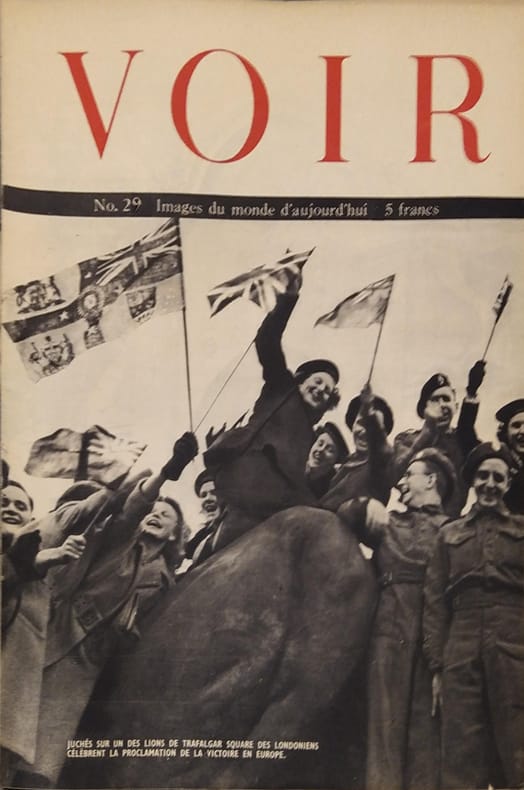
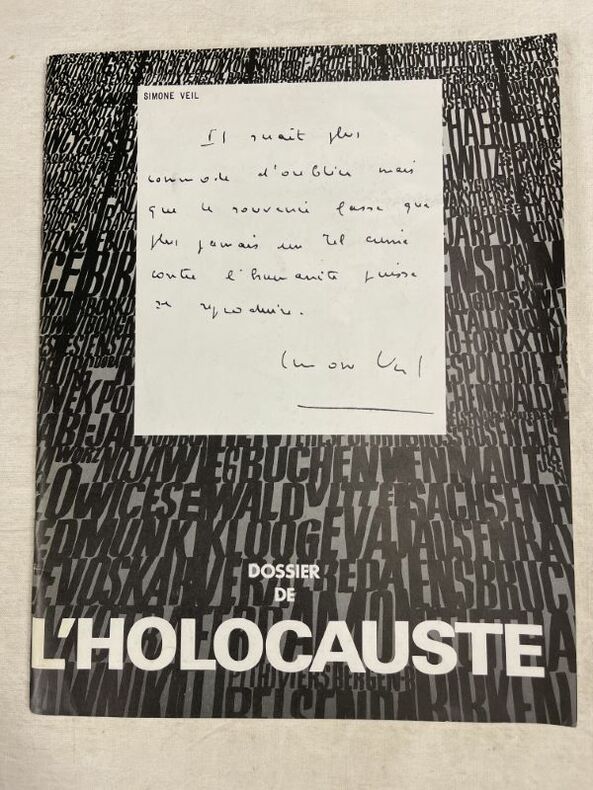
1945142926Couverture souple. Revue 26 x 34 cm.
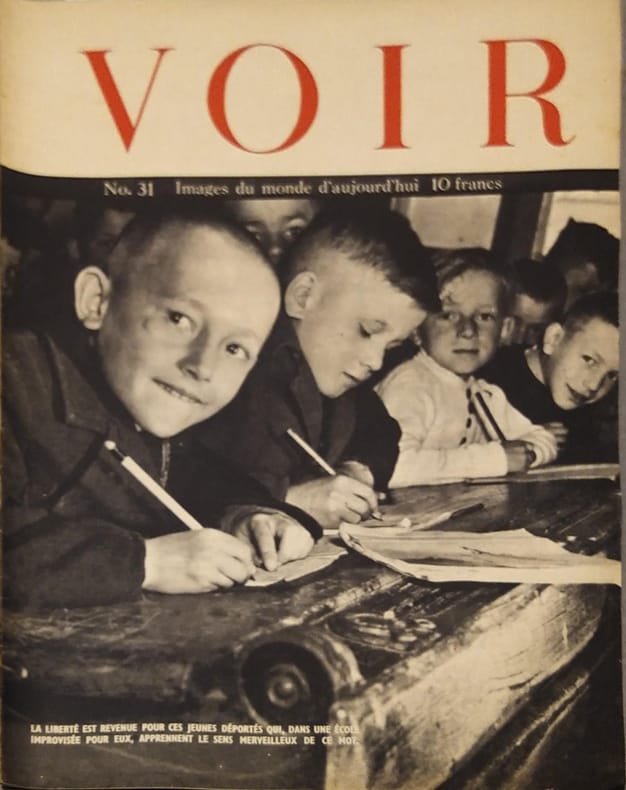
1944142943Couverture souple. Revue 26 x 34 cm.
102.965Leuven, Davidsfonds, 1977. 15 x 24, 424 pp., quelques illustrations (some pictures) en N/B, broché (paperback), bon état (fine condition).
New Greek, Modern (post 1453) Paperback. 4to. (28 x 20 cm). In Greek and Turkish. [200] p., color and b/w ills. Erotokritos: Bir Girit destani. Translation and transcription by Hakki Bilgehan. A poem of a Cretan poet of the 17th century. Vitsentzos Kornaros. Turkish translation and transcription in latin letters of the original Greek poem. 500 copies were printed.
Broch?. 185 pages. Dos muet.
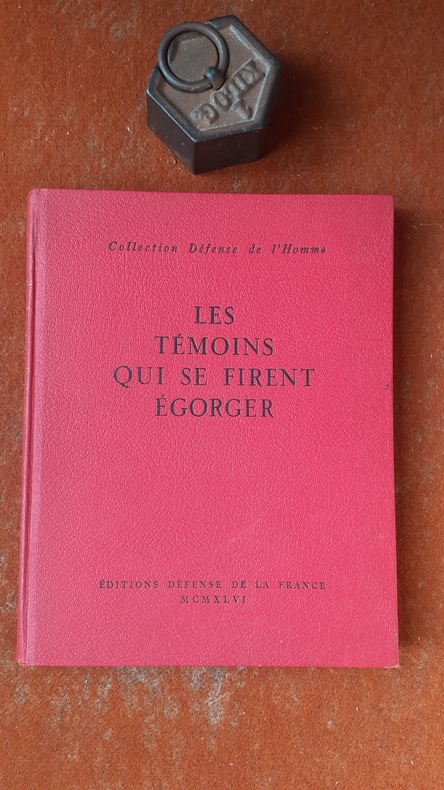
QWA-21422Editions Défense de la France,1946, pet. in-4 cartonnage rouge (21 x 27), 217 p.,1ère édition, coll. "Défense de l'Homme", photos n. et b., carte dépliante coul. des camps, prisons et kommandos de déportés politiques, très bon état.
110028P., F.N.D.I.R.P., 15 octobre 1949, in-8°, 77-(3) pp, broché, bon état (Coll. "Se souvenir"). Edition originale
2022125928Editions Ampelos, 2022, pt in-8°, 111 pp, fac-similé d'une lettre d'Elie Wiesel, broché, couv. illustrée, bon état
64004Perrin, Terre d'histoire, 1999, 564 pp., broché, bon état.
2007102485Albin Michel, 2007, in-8°, 265 pp, 9 dessins, 8 pl. de photos et plans hors texte, biblio, broché, bon état
2007192192Albin Michel Albin Michel, 2007. In-8 broché, 270 pages, avec photos. Préface de Simone Veil. Très bon état
Bernard Grasset 1979, In-4 broché, 77 pages, nombreuses photos et planche dépliante. Bon état
1979161588Bernard Grasset Bernard Grasset 1979, In-4 broché, 77 pages, nombreuses photos et planche dépliante. Bon état
198021316Gallimard, 1980, in-8°, 197 pp,
2001133345Kassel, Gesamthochschul- Bibliothek 2001. 408 Seiten. Mit zahlreichen meist faks. Dolkumenten u. einigen Abbildungen. Illustrierte Originalbroschur. 21x15 cm
1213802Bruxelles, Bern, Berlin, New York, Oxford, Wien: P.I.E. Peter Lang, 2018. 201 p. Brochure.
2012LFA01ce5Un ouvrage de 159 pages, format 210 x 270 mm, illustré, broché couverture couleurs rempliée, publié en 2012, ELAH, bon état
Very Good Armenian Original half bound leather bdg. Large demy8vo. (22 x 15,5 cm). In Armenian. 675 p. Prior to Soviet rule, the Dashnaksutiun had governed the First Republic of Armenia. The Socialist Soviet Republic of Armenia was founded in 1920. Diaspora Armenians were divided about this: supporters of the nationalist Dashnaksutiun did not support the Soviet state, while supporters of the Armenian General Benevolent Union (AGBU) were more positive about the newly founded Soviet state. From 1828 with the Treaty of Turkmenchay to the October Revolution in 1917, Eastern Armenia had been part of the Russian Empire and partly confined to the borders of the Erivan Governorate. After the October Revolution, Bolshevik leader Vladimir Lenin's government announced that minorities in the empire could pursue a course of self-determination. Following the collapse of the empire, in May 1918 Armenia, and its neighbors Azerbaijan and Georgia, declared their independence from Russian rule and each established their respective republics. After the near-annihilation of the Armenians during the Armenian Genocide and the subsequent Turkish-Armenian War, the historic Armenian area in the Ottoman Empire was overrun with despair and devastation. A number of Armenians joined the advancing 11th Soviet Red Army. Afterward, Turkey and the newly proclaimed Soviet republics in the Caucasus negotiated the Treaty of Kars, in which Turkey resigned from its claims to Batumi to Georgia in exchange for the Kars territory, corresponding to the modern-day Turkish provinces of Kars, Igdir, and Ardahan. The medieval Armenian capital of Ani, as well as the cultural icon of the Armenian people Mount Ararat, were located in the ceded area. Additionally, Joseph Stalin, then acting Commissar for Nationalities, granted the areas of Nakhchivan and Nagorno-Karabakh (both of which were promised to Armenia by the Bolsheviks in 1920) to Azerbaijan. From 12 March 1922 to 5 December 1936, Armenia was a part of the Transcaucasian SFSR (TSFSR) together with the Georgian SSR and the Azerbaijan SSR. The policies of the first Soviet Armenian government, the Revolutionary Committee (Revkom), headed by young, inexperienced, and militant communists such as Sarkis Kasyan and Avis Nurijanyan, were implemented in a highhanded manner and did not take into consideration the poor conditions of the republic and the general weariness of the people after years of conflict and civil strife. Such was the degree and scale of the requisitioning and terror imposed by the local Cheka that in February 1921 the Armenians, led by former leaders of the republic, rose up in revolt and briefly unseated the communists in Yerevan. The Red Army, which was campaigning in Georgia at the time, returned to suppress the revolt and drove its leaders out of Armenia. Convinced that these heavy-handed tactics were the source of the alienation of the native population to Soviet rule, in 1921 Moscow appointed an experienced administrator, Alexander Miasnikian, to carry out a more moderate policy and one better attuned to Armenian sensibilities. With the introduction of the New Economic Policy (NEP), Armenians began to enjoy a period of relative stability. Life under the Soviet rule proved to be a soothing balm in contrast to the turbulent final years of the Ottoman Empire. The Armenians received medicine, food, as well as other provisions from the central government and extensive literacy reforms were carried [.] Only one copy is located in OCLC: 782028953 (National Library of Israel - Jewish National Library).
59pp.geïll.met tekeningen & 1 foto, geïll.omslag, stempeltje
1945G33763Amsterdam, John Kappee 1945 59pp. Geïllustreerd met tekeningen & 1 foto, geïllustreerde omslag, stempeltje, G33763
1981134969Esslingen 1981. Typoskript. 95 Blätter. Folienumschlag. 29x21 cm