1 194 résultats
New New English In original bdg. with original dust wrapper. DJ. 4to. (32 x 24 cm). In Turkish. Ills. 608 p. Translation: Mayda Saris. A very heavy volume. 1915 öncesinde Osmanli Imparatorlugu'nda Ermeniler. Armenians in the Ottoman Empire before Relocation, 1915. This collection adds one edition to the books published by Aras Publishing, by French historian Raymond H. Kevorkian and Paul B. Paboudjian. Presents the Armenian population of the Ottoman Empire prior to 1915. More than 2,900 residential units (province, flags, villages). Officers in rural areas of the early 20th century, Armenian religious figures. Statistical breakdown which, for the first time, presents the settlements, their historical background, their schools, churches and monasteries, old and new names, maps, and images. Istanbul, Izmir, Izmit, Ankara, Sivas, Trabzon, Kayseri, Adana, Diyarbakir, Erzurum, Van ... The book consists of two parts. The first part presents the modernization process. The second half presents the 19th century which was a turbulent period for the Armenian peoples of the Ottoman Empire. Fransa'da yayimlandiktan 20 yil sonra Türkiyeli okurla bulusan kitap, 1915 öncesinde Ermeni nüfus barindiran 2900'ü askin yerlesim biriminin (vilayet, sancak, kaza ve köyler) dökümünü sunuyor. 20'nci yüzyil baslarinda tasra bölgelerindeki Ermeni din görevlilerince hazirlanmis olan nüfus istatistiklerini ilk kez gün yüzüne çikaran kitapta, söz konusu yerlesim yerleri; tarihsel arka planlari, sahip olduklari okul, kilise ve manastirlar, eski-yeni isimleri, haritalar ve 1000 kadar görsel esliginde yer aliyor. Istanbul, Izmir, Izmit, Ankara, Sivas, Trabzon, Kayseri, Adana, Diyarbakir, Erzurum, Van... 'Insanlar ve Yasadiklari Topraklar' adini tasiyan ikinci bölümde, Osmanli Imparatorlugu'nda yasayan Ermeni nüfusunun köy köy, kasaba kasaba, ayrintili bir dökümü çikariliyor. Kévorkian, bunu yaparken yerlesim birimlerinin Ortaçag'a, çogu zaman Roma Imparatorlugu dönemlerine uzanan tarihsel arka planlarini da sunmayi ihmal etmiyor. ARMENIANS Ottoman history Social history Armenian questions.
201703735S.l., Secrétariat d'état aux anciens combattants : cogery, 1975 ; in-8, 55 pp., br.
201703734S.l., Secrétariat d'état aux anciens combattants : cogery, 1975 ; in-8, 55 pp., br.
201703733S.l., Secrétariat d'état aux anciens combattants : cogery, 1975 ; in-8, 55 pp., br.
77954Linas, Editions de l'AEP, sans date, petit in 8° broché, 299 pages.
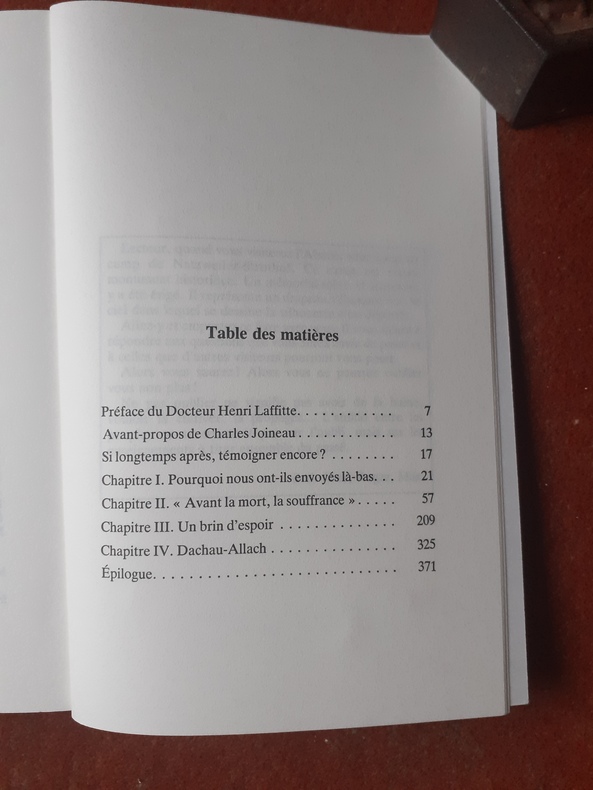
QWA-16861Messidor, 1991, in-8 br., 375 p., préface du Dr Henri Laffitte, avant-propos de Charles Joineau, un cahier de 16 planches photos, cartes, bon état.
1992108389Messidor, 1992, in-8°, 375 pp, 16 pl. de photos hrs texte, une carte du système concentrationnaire nazi, broché, bon état, envoi a.s. de Roger Leroy
2001599752001 Editions BGA Permezel, René Georges - Collection Nouvellet-Dugelay - 2001 - In-Folio, cartonnage gris sous jaquette illustrée - Sans pagination - Reproductions photographiques en N&B
1964132041ddb Paris, DDB 1964. In-12 broché de 86 pages. Bon état
Paris, DDB 1964. In-12 broché de 86 pages. Bon état
200539824Editions de Paris, 2005, in-8°, 150 pp, broché, couv. illustrée, bon état
Very Good Armenian Original fine red cloth bdg. with decorative gilt on board. Spine is repaired masterfully. Large roy. 8vo. (25 x 18 cm). In Armenian. [24], 429 p., 1 folded Armenian map of Turkey (map size: 24x33 cm), 29 unnumbered full-page b/w plates (one is folded). Armenian Golgotha is a memoir written by Grigoris Balakian about his eyewitness account of the Armenian Events. The memoir was released in two volumes. Volume 1, about his life prior to and during the Armenian Deportation, was released in 1922. Volume 2, about his life as a fugitive after the Deportation, was released in 1959. Originally published in Armenian, the memoir was later published in various languages including an English translation by Peter Balakian, Balakian's great-nephew, with Aris Sevag. Grigoris Balakian [or, Palakean, Palakian, Balakean], was a bishop of the Armenian Apostolic Church, in addition to being a survivor and memoirist of the Armenian Events in the Ottoman Empire. Grigoris Balakian was born in Tokat in the Ottoman Empire and graduated from the Sanasarian College in Erzurum. He had been studying architecture in Germany for two years and got a degree in civil engineering. He became a celibate priest ordained under the monastic name Grigoris Balakian. On 24 April 1915, he was among the group of 250 leading Armenian figures of Constantinople who were arrested and deported. One group was deported to Ayas. Balakian was deported to Çankiri, north-east of Ankara with the rest of the 190 other deportees from the capital. Only 16 of them would survive. He marched with 48 deportees from Çankiri in the direction of Deir Al-Zor in the Syrian desert. On the way, Balakian won the confidence of captain of constabulary Shukri Bey and learned about the Ottoman government's plan to exterminate the whole Armenian population. Balakian was able to flee toward Islahie. He joined a group of workers on the Bagdad-railway where Turkish deserters did forced labor alongside Armenian refugees. While Armenian workers between Marash and Bartche were being slain, Balakian fled to another construction site on the Bagdad railway. He was helped by German engineers and finally succeeded - disguised as Herr Bernstein - in escaping from Constantinople to Paris. At the 1921 trial in Berlin against Soghomon Tehlirian, the murderer of Talât Pasha, Balakian appeared as a witness for the defendant together with Johannes Lepsius. Soghomon Tehlirian was ultimately acquitted. Balakian became prelate of Manchester, London, and finally bishop of Marseille. Two churches were built under his guidance in Marseille and Nice (St. Mary, 1928) as well as a number of chapels and schools. He died in Marseille. Balakian is the granduncle of Anna Balakian, an expert on symbolism and surrealism who chaired New York University's Department of Comparative Literature, and the great-granduncle of Peter Balakian, an Armenian-American writer and winner of the 2016 Pulitzer Prize for Poetry. Balakian's memoirs in Armenian Golgotha are an important eyewitness account of the Armenian Events. He describes his experiences during the deportation. Balakian was one of the few surviving leaders of the Armenian community who gave an account of the deportation. Komitas (Gomitas) Vartapet belonged to the same group of detainees as Balakian. His information about the traumatization of the famous composer and founder of modern Armenian classical music is of eminent importance. OCLC: 1137218025. First Armenian Edition. Rare.
Very Good Turkish, Ottoman (1500-1928) Original handwritten law document. 8vo. In Ottoman script. 2 p. Stamped, signed. Several confirmation annotations and signatures. [ARMENIAN MINORITY] A manuscript law petition on the seizure of Tüfekçioglu Kirkor b. Agop's daughter's house sent to Mutasarrifate of Amasya Sanjak in 1339 AH [1923 AD].
Very Good Armenian Original half bound leather bdg. Large demy8vo. (22 x 15,5 cm). In Armenian. 675 p. Prior to Soviet rule, the Dashnaksutiun had governed the First Republic of Armenia. The Socialist Soviet Republic of Armenia was founded in 1920. Diaspora Armenians were divided about this: supporters of the nationalist Dashnaksutiun did not support the Soviet state, while supporters of the Armenian General Benevolent Union (AGBU) were more positive about the newly founded Soviet state. From 1828 with the Treaty of Turkmenchay to the October Revolution in 1917, Eastern Armenia had been part of the Russian Empire and partly confined to the borders of the Erivan Governorate. After the October Revolution, Bolshevik leader Vladimir Lenin's government announced that minorities in the empire could pursue a course of self-determination. Following the collapse of the empire, in May 1918 Armenia, and its neighbors Azerbaijan and Georgia, declared their independence from Russian rule and each established their respective republics. After the near-annihilation of the Armenians during the Armenian Genocide and the subsequent Turkish-Armenian War, the historic Armenian area in the Ottoman Empire was overrun with despair and devastation. A number of Armenians joined the advancing 11th Soviet Red Army. Afterward, Turkey and the newly proclaimed Soviet republics in the Caucasus negotiated the Treaty of Kars, in which Turkey resigned from its claims to Batumi to Georgia in exchange for the Kars territory, corresponding to the modern-day Turkish provinces of Kars, Igdir, and Ardahan. The medieval Armenian capital of Ani, as well as the cultural icon of the Armenian people Mount Ararat, were located in the ceded area. Additionally, Joseph Stalin, then acting Commissar for Nationalities, granted the areas of Nakhchivan and Nagorno-Karabakh (both of which were promised to Armenia by the Bolsheviks in 1920) to Azerbaijan. From 12 March 1922 to 5 December 1936, Armenia was a part of the Transcaucasian SFSR (TSFSR) together with the Georgian SSR and the Azerbaijan SSR. The policies of the first Soviet Armenian government, the Revolutionary Committee (Revkom), headed by young, inexperienced, and militant communists such as Sarkis Kasyan and Avis Nurijanyan, were implemented in a highhanded manner and did not take into consideration the poor conditions of the republic and the general weariness of the people after years of conflict and civil strife. Such was the degree and scale of the requisitioning and terror imposed by the local Cheka that in February 1921 the Armenians, led by former leaders of the republic, rose up in revolt and briefly unseated the communists in Yerevan. The Red Army, which was campaigning in Georgia at the time, returned to suppress the revolt and drove its leaders out of Armenia. Convinced that these heavy-handed tactics were the source of the alienation of the native population to Soviet rule, in 1921 Moscow appointed an experienced administrator, Alexander Miasnikian, to carry out a more moderate policy and one better attuned to Armenian sensibilities. With the introduction of the New Economic Policy (NEP), Armenians began to enjoy a period of relative stability. Life under the Soviet rule proved to be a soothing balm in contrast to the turbulent final years of the Ottoman Empire. The Armenians received medicine, food, as well as other provisions from the central government and extensive literacy reforms were carried [.] Only one copy is located in OCLC: 782028953 (National Library of Israel - Jewish National Library).
Very Good Turkish, Ottoman (1500-1928) Contemporary cloth bdg. with Ottoman gilt on the spine made in the Ottoman period. Original pictorial cover saved inside. Roy. 8vo. (23 x 16 cm). In Ottoman script. 256 p., b/w ills. An illustrated rare book on Misak Torlakian case in 1921. Misak Torlakian, (1889-1968), was the assassin of Behbud Khan Javanshir, Internal Affairs Minister of Azerbaijan, in 1921. Torlakian was admitted "guilty but not responsible" due to his mental condition by the British military tribunal in November 1921. Torlakian was born in 1889 in Trebizond, Ottoman Empire. Joining the Armenian Revolutionary Federation (ARF) at the age of 18, Torlakian, tasked to obtain military intelligence during World War, by then a member of a Russian Army scout unit, provided valuable information about Turkish army dispositions. was sent by the ARF to execute Behbud Khan Javanshir Azad Khanoglu, (Azerbaijani politician, diplomat, Minister of Internal Affairs of Azerbaijan Democratic Republic (ADR) and Deputy Minister of Trade and Industry), (1877-1921). Torlakian murdered Javanshir in October 1921, the British tribunal issued a guilty verdict but ruled that he was not responsible for his actions due to his epilepsy. Torlokyan left for Greece, where he was released and left for the United States. Behbud Khan Javanshir was assassinated outside the Pera Palace Hotel in Istanbul on July 18, 1921. This rare book includes several unnumbered b/w plates like a plan of the route of Behbud Khan Jawanshir from Municipality building in Tepebasi to Pera Palas Hotel, shortly before his assassination, his portrait, Torlakian's photo with his friend and others. Bookseller stamp on colophon. Slightly chipped on two pages' margins. Colophon date 1922 [1328 AH] Özege 21155.; TBTK 1149.; First Edition.
Pluriel, 2013. Fort In-12 broché de 600 pages, cartes. Très bon état
194695531946 Paris, éditions de minuit, 1946. Un volume in-8 broché, 311 pages. Petits manques à la couverture, brunie, envoi de l'auteur.
2004580022004 Albin Michel - 2004 - 1 volume in-8 de 360 pages - broché
16060Albin Michel, 2004. Format 14x22 cm, reliure editeur sous jaquette illustree, 360 pages.Tres bon etat.
2005125744Weinheim ; Basel : Beltz und Gelberg, 2005. 231 S. 8° , Softcover/Paperback
200575011(Hamburg), Landeszentrale für Politische Bildung, (2005). 215 S. Mit 14 (1 doppelblattgr.) s/w. Abb. (21cm. OKart.
198220349Lausanne, EDITA, France Loisirs 1982 In-4 relié 30 cm sur 23. Pleine toile bleue sous jaquette illustrée. Illustrations en noir et en couleurs..jaquette uniformément ternie 178 pages. Très bon état d’occasion.
1213802Bruxelles, Bern, Berlin, New York, Oxford, Wien: P.I.E. Peter Lang, 2018. 201 p. Brochure.
1965125261Couverture souple. Revue. 96 pages.