2 488 résultats
Later cloth with original paper cover mounted on front. 8vo. 94 pages. 24 cm. In German. Series: Ergänzungshefte zur Neuen Zeit, Nr. 20. Title translates to English as, Race and Judaism. SUBJECT (S) : Race. Jews. Jewish question. Zionism. Rassismus. Antisemitismus. Politique internationale. Juifs. Avant 1914. Politique internationale. Racisme. Avant 1914. Allemagne. Juifs. Avant 1914. Pages are slightly darkened, but all text is clear. Ex-libris with usual markings. Otherwise a nice and clean copy. Very good condition. (HOLO2-61-17A)
First edition. Original blue boards with gold font with beautiful original dust jacket. 8vo. 336 pages; 24 cm. Hitler-era publication, written in German with additional Hebrew title page. Includes a 9 word inscription written and signed by the author to Shalom Spiegel, renowned scholar and professor of Hebrew literature at JTS, in August 1937, just before the start of the war. Dr. Tulo Nussenblatt was a famous Zionist scholar and historian before WWII. During the war, Nussenblatt housed many people in his bunker in the Warsaw ghetto. He died in the uprising, still clutching his briefcase full of book materials about Theodor Herzl, about whom he wrote this book. A biography of Herzl divided into 4 sections with smaller divisions within each. Includes several black-and-white photographs of Herzl, his colleagues, and his possessions, as well as facsimiles of important letters, documents, and objects from his life. SUBJECT (S) : Theodor Herzl, Zionism. OCLC lists 21 copies worldwide. Library markings on spine of book, but not on dust jacket which is very clean. Slight toning. Fading on cover boards on spine and edges. Minimal pencil markings that do not affect text. Good condition in Very Good Jacket. A beautiful inscribed copy. (zion-12-39)
1st Edition. Original Wrappers. 8vo. Tri-Fold Holocaust-era Pamphlet with 5 pages ; 24 cm. The Undersigned Rabbis Are: Philip S. Bernstein, Barnett R. Brickner, Israel Goldstein, James G. Heller, Mordecai M. Kaplan, B. L. Levinthal, Israel H. Levinthal, Louis M. Levitsky, Joshua Loth Liebman, Joseph H. Lookstein, Jacob R. Marcus, Abraham A. Neuman, Louis I. Newman, David de Sola Pool, Abba Hillel Silver, Milton Steinberg, and Stephen S. Wise. We, the undersigned Rabbis, they write, of all elements of American Jewish religious life, have noted with concern a statement by ninety of our colleagues in which they repudiate Zionism on the ground that it is inconsistent with Jewish religious and moral doctrine. This statement misrepresents Zionism and misinterprets historic Jewish religious teaching OCLC lists no holdings worldwide. Front wrapper is mostly loose. 4th and 5th page are torn with a few words affected. Otherwise in good condition. Very rare. (zion-10-57)
Original Wraps. Folio. 3 pages. 36 cm. First edition. Large single sided mimeographed typewritten newsletter entitled ORT Highlights. Number 54, New York, 212 Fifth Avenue, May 11, 1950; no publisher given, author, etc. Contains a list of brief articles under the following headings: A Farewell Message to Mme. Roubach, North African Jews Prepare for Emigration to Israel, ORT Leaders Interview Former French Prime Minister, Rehabilitation Center in Austria, Austrian ORT Students Present Birthday Gift to President Chaim Weizmann, ORT Schools in British Zone Germany Will Operate After July 1st, Berlin ORT School Wins Praise at Exhibition, American ORT Federation Elects New Leaders (George J. Mintzer and Julius Hochman) . Subjects: World ORT Union. Jews - Education - Periodicals. Jews - United States Periodicals. None listed on OCLC. Edges damaged and worn, with minor text loss to bottom sentences of pages 1 and 2. Otherwise clean. Good - condition. (HOLO2-113-25)
Original boards. 8vo. VI, 332 pages. 25 cm. First edition. Contains bookstamp of Rabbi Davin Schoenberger of Aachen (who served as chief rabbi of Aachen, Germany, from 1926 to 1938; he performed the marriage of Anne Frank's parents, as reported in his obituary in the New York Times, December 10, 1989) . In German, some Hebrew throughout. Studies in Jewish and Jewish-Arabic Religious Philosophy. ' Extensive study of medieval Jewish religious philosophy; focuses on theological discussions, Aristotelianism, Maimonides, etc. Adolf Abraham Schmiedl (18211914) , Austrian rabbi and scholar. Born at Prossnitz (Prostejov) , Moravia, Schmiedl served as rabbi in Gewitsch, Moravia (184649) ; then as Landesrabbiner at Teschen, Silesia (to 1852) and later at Bielitz (Bielsko) , Prosnitz, and Vienna. - 2008 EJ. Bound in original marbled boards. Subjects: Jewish philosophy. Philosophy, Medieval. Backstrip absent, light foxing throughout, corners of boards lightly bumped, otherwise fresh and clean. Very good condition. (GER-44-35)
1st edition, original cloth with dust jacket, 4to, 11 pages + 754, 170 columns. Illustrations throughout. In Hebrew, with an English section. This is the story of a vanished world, the shtetel of Antopol. The material for this presentation was gathered painstakingly over a long period of time by a relatively small group of dedicated people who wished to preserve its memory and heritage for the descendants of its martyred. More than a history, this story is very personal because our parents, grandparents and great-great grandparents going back many generations came from this community. This is also a place whose many sons and daughters in years past left to seek a new and free life. Many achieved success and prominence all over the world - the United States, South Africa, Argentina, and other areas of the globe. We are the fortunate descendants of these hardy forebears and pioneers. It is hard to imagine that only a few decades ago there existed a vibrant, living community called Antopol, with its men, women and children; its market place, stores, schools. Beth medroshim (Houses of Prayer) , orphanages, Gmilas Hasodim (free loan society for the needy) , newspaper stands - all so familiar and so dear to memory. This little town was typical of hundreds of similar smaller and larger communities. And, like Atlantis, or some past people recounted in a saga, it suddenly vanished in the most bloody massacre in all of history. But this presentation is for the living - to convey to us, the she'erit or last remnant of descendants, something of the heritage, spirit and, record of the life of this community which many of us know only in an abstract and detached way. The task is too great, and our resources too limited to write the whole story. This little volume, condensed and translated into English, is both a record and a personal memorial to a profoundly meaningful and warmly nostalgic past. (foreword from the English version of this book) SUBJECT(S) : Jews -- Belarus -- Antopal. Holocaust, Jewish (1939-1945) . Ethnic relations. OCLC: 19155706. Dust jacket has some tearing and damp stains, cover corners are dented, some wear on bottom of spine, page edges slightly yellowed, internally very good. Good Condition overall. (YIZ-17-7A) xx
1st edition, original wrappers, 8vo. 64 pages, portraits throughout. In Yiddish with English title page. Book 3 part 1 of History of the Jews in Bialystok. SUBJECT (S) : Jews -- Poland -- Bialystok. OCLC: 970935047, OCLC lists 17 copies worldwide. Ex library with usual marks, light wear on spine and cover, Good Condition overall. (YIZ-18-12A)
1st edition, original cloth, 4to, xix+ 288+ (2) pages. On title page: Brzezin memorial book. Illustrations throughout. Yiddish, with English introduction. There once was a town of Jewish tailors Brzezin. From early dawn until late at night one could hear the music of the Singer sewing machines. It was the music of hard work, of intense anxiety, of a hard life, but also of noisy youth, semi-intellectuals, observant Jews, Hasidim who lived and had aspirations in the small Jewish town Brzezin. The Nazi savages extinguished this life forever, transformed it into ashes. Only a few Jews from the tailoring town Brzezin, by some miracle, remain, scattered over the entire world, individuals who were witnesses to the German cannibalism. May these words, frail in print, but inscribed not with ink but with blood, be a modest contribution to the matseve [gravestone] for my native town, Brzezin. Brzezin was one of the oldest and most popular Jewish communities in Poland. When this community was established, it carried the name Krakowek [Little Krakow]. At that time, the community extended from the Strykower highway to beyond the Jewish besoylem [cemetery] to the surrounding hills. The Polish noblewoman, Anna Lasocka, had brought the first weavers from afar into this community. Then the community developed even further and began to broaden its borders. At that time, the town already carried the name Brzezin. Jewish tailors came to Brzezin from many places, and after several generations, the town developed its own type of tailoring industry, by which it was known all over the world. A cottage industry was the main occupation here. As early as 1772, Brzezin was famous for its mass production in tailoring. Until 1914 the great Czarist Russia was flooded with the inexpensive products of Brzeziner tailors. In the years between the two world wars, the export of Brzezin industry was spread over many lands in Europe and into other parts of the world. In this, the great Jewish magaziners [owners of clothing enterprises] exporters such as Frankensztejn, Tuszynski, Sulkowicz, and others played a great role. The Jews in Brzezin did not only work, they also participated actively in the socio-political and cultural life of the town, had their representatives on the town council in town hall, and had their religious and secular educational, cultural, and social organizations. Materially, it was a life of Jewish poverty, but spiritually, socially, and culturally, it was rich. (translated from book) SUBJECT(S) : Holocaust, Jewish (1939-1945) -- Poland -- Brzeziny (Lo´dz´) ; Jews. OCLC: 19306453. Light wear on cover, some wear on spine. Good Condition Overall. (YIZ-16-6A)
1st edition. Original cloth with jacket, 4to. , 840 columns. VOLUME ONE OF TWO ONLY. Illustrated with photographs, facsimiles, folded map. In Hebrew and Yiddish. Series: Sifre zikaron li-kehilot ha-golah. SUBJECT(S) : Jews -- Poland -- Czestochowa -- History. Holocaust, Jewish (1939-1945) -- Poland -- Czestochowa. Czestochowa (Poland) -- Ethnic relations. Other Titles: Ts'enstohov; Entsiklopedyah shel galuyot. Light wear to jacket. Very good condition. (YIZ-14-8)
1st Yiddish Edition. Original Publishers Cloth, 8vo, 416 pages. Includes illustrations and map. Includes Spanish Title page: Judios de Kischeneff. Translation of Yehude Kishinov, originally published in Hebrew. Vol III in the series, Besaraber Yidn. Includes bibliographical references (pages 412-416). The name of Kishinev became known to the world at large as a result of two pogroms. The first, initiated and organized by the local and central authorities, took place during Easter on April 67, 1903 .The pogrom was preceded by a poisonous anti-Jewish campaign led by P. Krushevan , director of the Bessarabian newspaper Bessarabets, who incited the population through a constant stream of vicious articles. One of the authors of the most virulent articles was the local police chief, Levendall. In such a heated atmosphere any incident could have dire consequences, and when the body of a Christian child was found, and a young Christian woman patient committed suicide in the Jewish hospital, the mob became violent. A blood libel , circulated by the Bessarabets, spread like wildfire. (It was later proved that the child was murdered by his relatives and that the suicide of the young woman was in no way connected with the Jews.) According to official statistics, 49 Jews lost their lives and more than 500 were injured, some of them seriously; 700 houses were looted and destroyed and 600 businesses and shops were looted. The material loss amounted to 2,500,000 gold rubles, and about 2,000 families were left homeless. Both Russians and Romanians joined in the riots. Russians were sent in from other towns and the students of the theological seminaries and the secondary schools and colleges played a leading role. The garrison of 5,000 soldiers stationed in the city, which could easily have held back the mob, took no action. Public outcry throughout the world was aroused by the incident and protest meetings were organized in London, Paris, and New York. A letter of protest written in the United States was handed over to President Theodore Roosevelt to be delivered to the czar, who refused to accept it. Under the pressure of public opinion, some of the perpetrators of the pogrom were brought to justice but they received very lenient sentences. L.N. Tolstoy expressed his sympathy for the victims, condemning the czarist authorities as responsible for the pogrom. The Russian writer Vladimir Korolenko described the pogrom in his story House No. 13 as did ?.N. Bialik in his poem Be-Ir ha-Haregah (In the Town of Death).On Oct. 1920, 1905, riots broke out once more. They began as a protest demonstration by the patriots against the czar's declaration of Aug. 19, 1905, and deteriorated into an attack on the Jewish quarter in which 19 Jews were killed, 56 were injured, and houses and shops were looted and destroyed: damages amounted to 300,000 rubles. On this occasion, some of the Jewish youth organized itself into self-defense units . The two pogroms had a profound effect on the Jews of Kishinev. Between 1902 and 1905 their numbers dropped from around 60,000 to 53,243, many immigrating to the United States and the Americas, while many more left after the second attack. The economic development of the town was brought to a standstill .On July 17, 1941, Kishinev was occupied by German and Romanian units, who entered it together with units of Einsatzgruppe D. The massacre of Kishinev's Jews began immediately under the auspices of the Einsatzgruppe, and by the time the concentration of Jews into a ghetto was completed, about 10,000 had been slaughtered. ....On Oct. 4, 1941, deportations began to Transnistria , the first group containing 1,600 persons. After this, between 700 and 1,000 Jews were deported daily, the last group leaving on October 31. ...In Transnistria Jews were sent to various camps and ghettos, where two-thirds of them died from epidemics, hunger, and exposure. The exact number of dead is not known, but taking into account the proportion of those killed in Bessarabia from the time of the Romanian and German conquest until the deportations to Transnistria on the one hand, and the number of those who died in Transnistria on the other, it may be estimated that of the 65,000 Jewish inhabitants in Kishinev in 1941, 53,000 perished (JewishVirtualLibrary). SUBJECT(S): Jews -- Moldova -- Chisinau -- History. Joden. Ethnic relations. Kisjinev. Moldova -- Chisinau. OCLC: 11355859. Institutional bookplate and edgestamps, otherwise clean, spine lightly sunned, about Very Good Condition (YIZ-20-38)
1st edition. No Date [1939]. Small broadsheet. 1 page. 22 cm. Single sided flyer for an Rightwing mass meeting; content of the flyer are as follows: SPEAKERS: BOAKE CARTER Radio's Fearless News Editor, on the timely subject FREE SPEECH AND THE NEWS JOHN E. KELLY Brilliant, well-posted writer and lecturer will speak on JOHN L.LEWISPUBLIC ENEMY No. 2 and others. PresidingGEORGE U. HARVEY Dynamic, Capable Borough President of Queens President of WE AMERICANS. This meetingis under the sponsorship of: American Federation Against Communism, American Patriots, The Christian Front. Tickets may be purchased from: CARNEGIE HALL, 7th St. and 7th Ave., New York, N. Y. IROQUOIS HOTEL, 49 West 44th Street, New York, N. Y. WALTER OGDEN, 413 West 59th Street, New York, N. Y. Admission 25c - 40c Reserved 99c. Arthur Derounian, on page 52 of the book Under Cover, noted the content of Kellys speech as follows: John Eoghan Kelly, Christian Front organizer and promoter of the Franco cause in America, talked on Public Enemy Number Two-John L. Lewis who, according to the inside information obtained exclusively by Kelly, had "100,000 armed Communists rarin' to Sovietize America. Who is Public Enemy Number One? I asked of the man next to me. Roosevelt. Who in hell did you think it wuz?" Also of note, is that the speaker George U. Harvey was the Republican Borough President of Queens for twelve years. The meeting of the Great Pro-American Mass Meeting in Behalf of Free Speech and Americanism, a gathering of several anti-immigrant, anti-Communist, reactionary organizations, on May 24, 1939. The crowd, turned away from their first meeting location at Carnegie Hall, hadre-congregated at the Great Northern Hotel a few doors down 57th street. Police swarmed the lobby, shouts went around to keep the newspapers out, and journalists were violently jostled aside. Among those present at this nationalistic rally were speakers for the American Patriots, Inc; the Christian Front; the American Nationalist Party (NYPL blog article Edith Wynner,Firecracker by Laura Ruttum June 13, 2008.) Subjects: Anti-Semitic Propaganda. OCLC lists 2 copies (NYPL, AJC). Previously folded; otherwise Very Goodcondition. (LB-5-2) Xx
198913773Paris, Presses de la Fondation nationale des sciences politiques, 1989 1 volume 17 x 24cm Broché sous couverture au 1er plat orné d'une photo. 175p.; cartes in texte. Bon état.
Au sommaire: "La transparence et la mémoire - Les Soviétiques à la recherche de leur passé" par Nicolas WERTH, "Les trajectoires territoriales du sionisme" par Alain DIECKHOFF, "1942: le Comité International de la Croix-Rouge, les déportations et les camps" par Jean-Claude FAVEZ, "André Tardieu et la crise du constitutionnalisme libéral (1933-1934)" par Nicolas ROUSSELIER; Dossier "Penser le fascisme": "Giovanni Gentile, philosophe du fascisme" par Sergio ROMANO, "Luigi Sturzo et la critique de l'Etat totalitaire" par Jean-Luc POUTHIER, "Renzo De Felice et l'histoire du fascisme" par Didier MUSIEDLAK; et divers. Français
Later cloth. 4to. 88 leaves. 30 cm. First edition. Fascimile. In German. On the History of the Jewish Community of Aurich, 1592-1940. Compiled photocopy booklet for a course at the IGS School in Aurich, bound in later cloth; illustrated, with several maps, family registers, and historical and legal documents. Subjects: Jews - Germany - Aurich (Lower Saxony) . OCLC lists two copies (HUC, Univ Florida) . Previous owners name on endpage, otherwise clean and fresh. Very good + condition. (HOLO2-108-34)
1st English Language edition. 4to. Original wrappers, xxxix + 663 pages. Illustrations throughout. In English. The book by Serge Klarsfeld, contains vital statistics of some 76, 000 Jews deported from France. Together with his wife Beate, the Paris-based Serge Klarsfeld has published lists of Jews deported from France and Belgium over the last decades. He was the leading Nazi hunter in France . France was one of the more liberal nations in opening its doors to Jewish refugees from Poland, Romania, and Germany. Some 350, 000 Jews were living in France when the Germans invaded the country in June 1940. More than half of them were refugees from Germany who had arrived during the 1930s. Many were French citizens whose families had lived in France for centuries and who were fully assimilated. Others had come to France, often from Eastern Europe, to seek a better life and escape from antisemitism. Approximately 76, 000 Jews were deported from France between 1942 and 1944. Most went to Auschwitz-Birkenau, where the vast majority were exterminated on arrival. Klarsfeld's book is a most startling document. Nearly the size of the Manhattan (NYC) telephone directory, it lists nearly 76, 000 names of Jews deported to Eastern Europe or killed in France. Names are listed in alphabetical order, according to each of the 80 convoys. Family name, first name, birth date, place of birth, and nationality are recorded for every person. Klarsfeld also provides a detailed history of each convoy. (Jewishgen 2018) SUBJECT(S) : Jews -- Persecutions -- France. Holocaust, Jewish (1939-1945) -- Registers of dead -- France. World War, -- Deportations from France. Ethnic relations. Genealogy. Translation of: Le mémorial de la déportation des juifs de France. OCLC: 9685134. Small tear to margin of cover, otheriwse Very Good Condition Overall. (YIZ-16-20) xx
1st Edition. Original Red Paper Wrappers. 8vo. 56 pages ; 24 cm. In German. Title Translates into English as, The German Aliya In Histadruth. Includes the full German text of addresses from Georg Landauer, Moscheh Brachmann, Hans Rubin, Fritz Löwenstein, and Josef Sprinzak. Sprinzak was a leading Zionist activist in the first half of the 20th century, an Israeli politician, and the first Speaker of the Knesset, a role he held from 1949 until his death in 1959. (Wikipdia, 2016) SUBJECT(S) : Jews, German -- Palestine. Histadrut. OCLC lits 5 copies worldwide (Stanford, Harvard, HUC, NLI, Univ of Haifa) , none in New York. Wrappers are worn with a few tears. Small marking on title page. Overall about very good condition. (zion-10-60A)
1st edition, later paper wrappers, 8vo. 808 + xx columns, illustrations throughout. In Hebrew, with an English title page and introduction. We consider it important and necessary to represent a review of our Memorial-Book to the children and friends of the Goniondz Society who do not read Yiddish or Hebrew. Let all of them get an idea about the Hometown of their parents and relatives and together with them hold dear the memory of the small Jewish community, that went to martyrdom during the black period of the bestial Nazi rule. 6, 000, 000 Jews perished during the 2nd World War in Eastern and Central Europe. Many bigger and smaller towns were immortalized in memorial books. They stand out like living symbols, spiritual monuments for the coming generations. Our beloved Goniondz has surely earned such a monument. The Jewish Goniondz was very lively and interesting. The small Jewish population was very active, established many parties and clubs and gave to the world outstanding intellectuals in many fields, both Jewish and general. Citizens of Goniondz are spread out all over the world. The majority of them live in the United States and in Israel, where they have established many societies and cooperatives in the socio-philanthropic field, giving financial and moral support to needy townspeople. The Memorial-Book portrays to a great extent the manysided life of Goniondz before its destruction. (from book) SUBJECT(S) : Jews -- Poland -- Gonia? Dz. Holocaust, Jewish (1939-1945) . Ethnic relations. OCLC: 18096280, OCLC lists 29 copies worldwide. Cover is missing, outside pages have some wear and discoloration, internally very good, Good Condition overall. (YIZ-20-2)
1st edition. Undated, but definitely published Dec. 1942-April 1943 based on ads and statements inside. Octavo, original stapled paper covers, 98 pages. Important Holocaust-era documentation of the attrocities befalling the Jews of Europe,Opening with a statement from FDR from Dec 1942 and continuing with articles by Hayim Greenberg, Victor Gollancz, Marie Syrkin, and the Archbishop of Toulouse as well as unsigned reports on the various nations of Europe. Includes a map as well as documentation of "The Extermination Center" at Chelmno and the use of extermination vans followed by burial in mass graves with chemical desolving agents. . Light wear, Small mark on cover, about Very Good Condition. Important (Holo2-120-1-+-'e)
2022LFA-126743432Revue de 98 pages, format 200 x 265 mm, illustrée, brochée couverture couleurs, bon état
1944164946Suisse, Editions Hist, 1944. 95 S., 2 Bl., mit zwei s/w Abbildungen nach Fotografien. Original broschiert, gr.8°. Softcover Einband etwas berieben, Stempel auf Deckel. Seiten minim gebräunt.
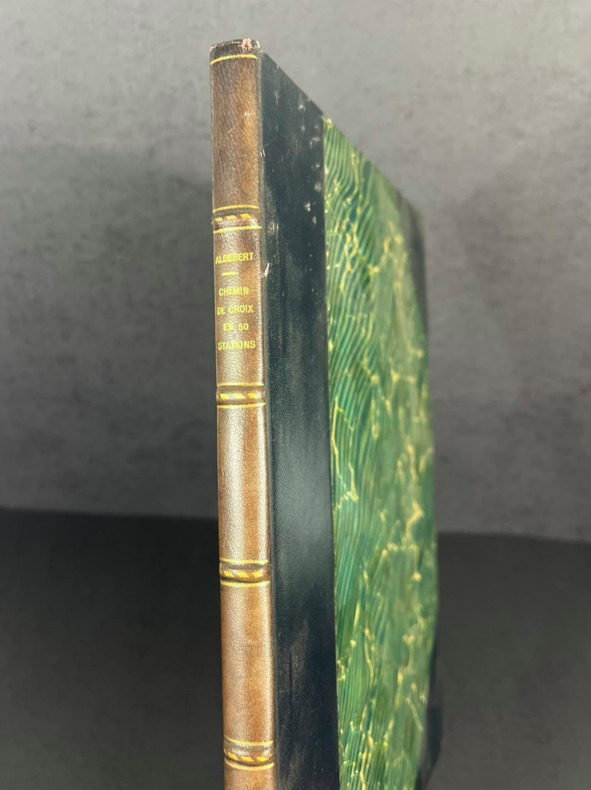
1946563Paris, Arthème Fayard, 1946. Édition originale. Grand album de 22 x 28 cm, 112 (2) pp. Relié demi-cuir noir à coins, dos à 5 nerfs ornés de pointillés et traits dorés, nom d'auteur et titre en doré. Plats marbrés. Couverture originale conservée. Tranchefile. Ouvrage illustré d'une cinquantaine de dessins en noir et blanc de l'auteur. Cet ouvrage est un puissant récit autobiographique illustré de l'artiste français Jean Bernard-Aldebert (connu sous le nom de Bernard-Aldebert, 1909-1974), relatant sa captivité dans cinq camps de concentration nazis différents entre 1944 et 1945. Après avoir bâti une carrière d'illustrateur, de caricaturiste et de satiriste, l'artiste voit son destin basculer tragiquement en novembre 1943. Pour avoir caricaturé Hitler sous les traits d'un chimpanzé dans le numéro du 1er août de l'hebdomadaire humoristique français *Ric et Rac*, Bernard-Aldebert est arrêté par la Gestapo. Il est ensuite transféré en janvier 1944 au camp d'internement de Royallieu-Compiègne, puis successivement à Buchenwald, Mauthausen, Gusen I et enfin Gusen II, où il demeure jusqu'à sa libération le 5 mai 1945. Le texte et les illustrations de l'auteur dévoilent les horreurs subies par les prisonniers dans ces camps : travaux forcés brutaux, famine, tortures sadiques et violences diverses. Si Bernard-Aldebert était surtout connu pour des caricatures au style léger et de charme, les images présentées ici versent dans un tout autre registre. Elles rappellent son style habituel, mais se révèlent bien plus dépouillées, sombres et austères, comme un reflet des émotions des personnages qui y apparaissent. Le texte est accompagné, presque systématiquement sur la page en regard, d'une reproduction en noir et blanc d'un dessin original de l'artiste, pour un total de 50 images. Celles-ci sont issues d'une série de croquis dessinés par Bernard-Aldebert peu après sa libération ; ils offrent, encore aujourd'hui, un témoignage visuel et émotionnel inestimable.
1st edition. Original illustrated paper wrappers, 12mo, 64 pages. 4.75x7 inches. Cover shows a miserable prisoner flanked by ball & chains of swastika and hammer & sickle, behind whom hover Hitler, Mussolini, Stalin, and front and center The Pope. "Jehovah's Witnesses were subjected to intense persecution under the Nazi regime. The Nazis targeted Jehovah's Witnesses because they were unwilling to accept the authority of the state, because of their international connections, and because they were strongly opposed to both war on behalf of a temporal authority and organized government in matters of conscience. Within months of the Nazi takeover, regional governments, primarily those of Bavaria and Prussia, initiated aggressive steps against Jehovah's Witnesses, breaking up their meetings, ransacking and then occupying their local offices. By April 1, 1935, the Reich and Prussian Minister of the Interior ordered the responsible local officials to dissolve the Watchtower Society. Many actions of Jehovah's Witnesses antagonized Nazi authorities. While Witnesses contended that they were apolitical and that their actions were not anti-Nazi, their unwillingness to give the Nazi salute, to join party organizations or to let their children join the Hitler Youth, their refusal to participate in the so-called elections or plebiscites, and their unwillingness to adorn their homes with Nazi flags made them suspect. A special unit of the Gestapo compiled a registry of all persons believed to be Jehovah's Witnesses. Gestapo agents infiltrated Bible study meetings" (USHMM 2016) No copies listed in OCLC. Evenly- toned newsprint, Very Good Condition. Holocaust-related Jehovah's Witnesses material is rare, this imprint especially so. (HOLO2-134-61) xx
Original Wrappers. 8vo. 53 pages. 24 cm. First edition. In Spanish. Title translates as: The Neonazi movement in West Germany. Published by the Institute of Argentine Jews for Culture and Information, this medium length tract documents in detail the abhorrent manifestations of the renewed resurgence of neo-nazis and pro-fascist veteran groups in West Germany. Subjects: Antisemitism - Germany (West) . Fascism - Germany (West) . OCLC lists four copies worldwide (Harvard, HUC, AJU, Natl Libr Israel) . Institutional stamps on cover. Light soiling to wraps and outer edges; water stains throughout. However, text crisp. Fair condition. (HOLO2-99-26)
(FT) Publishers cloth. 8vo. 104 pages. 22 cm. First edition. In Yiddish. Author's note and three selections of poems in English; with one poem in Polish. The poems and memoir of Sam Waks, a survivor of Auschwitz. Subjects: Yiddish poetry. Yiddish literature. Holocaust, Jewish (1939-1945) . Ex-libris stamps on endpages. Otherwise near fine. Very good + condition. (HOLO2-99-38)
1st edition. Original illustrated paper wrappers, 8vo, 24 pages. Loaded with Photographic illustrations of refugee childrens artwork, including children who came to England on the Kindertransport from Germany. Consists of 20 reproductions of paintings and drawings by children in the exhibition "The war as seen by children, " a foreword by J. G. Siebert, outlining the history of the exhibition, and a speech by Austrian-emigre artist Oskar Kokoschka at its opening, January 4, 1943, in the Cooling galleries, New Bond street, a fund-raiser for the German refugee school at Theydon Bois. Variant title: Our Children To-day and To-morrow. No. 1. SUBJECT (S) : Child artists. Art -- Exhibitions. World War, 1939-1945 -- Pictorial works. World War, 1939-1945 -- Children. Exhibition catalogs. A similar copy sold at auction in 2015 for over USD 650. Light Wear, Very Good Condition. (Holo2-126-16) xx