188 résultats
1967029284New York: The Dial Press 1967. Appears never read. Near Fine condition in a bright and shiny Very Good dust jacket. NOT price clipped $5.95. The jacket is lightly rubbed/frayed at the edges with a small mark where a price sticker was removed. Sharp corners. Square and tight. NO owner's name or bookplate. NOT a library discard. NOT a remainder. Pages are fresh crisp clean and unmarked -- apparently unread. NO foxing. Translated by Jacob Guralsky. With black & white illustrations by S. Brodsky. First published censored in 1966 in a Soviet periodical. This is the first printing of the first edition in English. Bound in the original black cloth stamped in bright red on the spine. From the dust jacket: "In the vast literature of World War II no story is more tragic more awesome than the two-year occupation of the Russian city of Kiev by Nazi troops. Here is the first extensive account. of that terrible period of time from 1941 to 1943 in which the Germans systematically murdered some 200000 people beginning with the barbaric massacre of 50000 Russian Jews at the ravine on the outskirts of the city known as Babi Yar. Using. the reseach of many years -- interviews newspaper clippings posters diaries -- the author reveals to us the awful trauma of foreign invasion the destruction of life and property the thunderous entry of German troops. the sickening mass annihilation of Kiev's Jewish population.". First printing so stated. Hardcover. Near Fine condition/Very Good dust jacket. Illus. by NOT a library discard. 8vo. xvi 399pp. Great Packaging Fast Shipping. The Dial Press Hardcover
0845731262New. hardcover. New. Satisfaction Guaranteed or your money back. hardcover
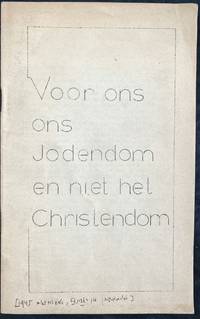
193025194Amsterdam: Selecta 1930. Softcover 24 pages 22 cm. In Dutch. “For us Judaism—and not Christianity. †Jewish response to attempts at conversion just prior to the Holocaust. <br> Chief Rabbi Justus Tal 1881-1954 was "From 1918 until the outbreak of World War II.Chief Rabbi of Utrecht. During the war he was hidden from the Nazis by a Protestant clergyman. Afterwards he assumed the post in Amsterdam and was elected president of the Dutch Conference of Chief Rabbis" JTA 1954. <br> OCLC: 64304774. OCLC lists 14 copies worldwide only 3 in the US HUC Harvard YIVO none south or west of Ohio.<br> Light wear. Handwritten note on bottom of cover notes "edited by Chief Rabbinate of Netherlands Amsterdam 1945.†Good condition. B Holo2-162-37XXXCC-'. Amsterdam: Selecta unknown
1965275922Bergen-Belsen Memorial Press 1965. Hardcover. Very Good. Folio in full black pebbled morocco titles in gilt a.e.g. Binding tight and square no rubbing to the corners small spots of rubbing to the spine ends. The slipcase is covered in paper matching the book's endsheets has heavier rubbing at the corners no separations. On a tipped-in leaf the production's sponsors Hadassah and Josef Rosensaft inscribed 'To Our Good Friend/Dr. Joachim Prinz/in grateful recognition/of your understanding/and friendship/Hadassah and Josef Rosensaft/New York/November 1965' Prinz was a prominent Zionist and civil rights activist. Bergen-Belsen Memorial Press hardcover
1998biblio925<p>512 pages. Translated from German by Mary Harber</p> Rubin Mass Ltd. hardcover
1998BN151634Österreichische Lagergemeinschaft Mauthausen o.J 1998. 1998. Erinnern. Remembering. Souvenir. Ricordare. Mauthausen. - "Signiertes Exemplar" von der Autorin Cathrine Stukhard <br/><br/>Erinnern. Remembering. Souvenir. Ricordare. Mauthausen. - "Signiertes Exemplar" von der Autorin Cathrine Stukhard Holocaust - Mauthausen - Bandion Wolfgang J. Cathrine Stukhard und Stephan Hilge Österreichische Lagergemeinschaft Mauthausen, o.J unknown
2009BN152272Yad Vashem Pubns 2009. 2009. Dividing Hearts: The Removal of Jewish Children from Gentile Families in Poland in the Immediate Post Holocaust Years <br/><br/>Dividing Hearts: The Removal of Jewish Children from Gentile Families in Poland in the Immediate Post Holocaust Years Polen / Judaica / Israel / Holocaust / Antisemitismus - Nachmany Gafny Emunah Yad Vashem Pubns unknown
1989017918New York: Grove Weidenfeld 1989. INSCRIBED / SIGNED by Simon Wiesenthal on the front free endpaper. A beautiful copy of the First U.S. printing. Fine condition in a Fine dust jacket. NO chips. NO tears. NO creases. NO fading. NOT price clipped $22.50. Protected by a removable Brodart clear-plastic sleeve. Bright shiny clean square and tight. Sharp corners. NOT a library discard. NO remainder mark. Pages are clean and crisp. NO underlining. NO highlighting. NO margin notes. First U.S. printing 1989 with "First American edition" so stated and complete number row 10 987654321 on the copyright page. Illustrated with 16 pages of photos. Translated from the German by Ewald Osers. Laid in is a copy of Wiesenthal's 2005 obituary. From the publisher: "Since the end of World War II Wiesenthal has dedicated his life to bringing Nazis to justice. In this book he describes his activities the men such as Eichmann and Mengele he has pursued the Nazi escape organization Odessa but also some of the heroism that the horrors produced. The book asks questions about the function of punishment and the possibility of rehabilitation in such extreme cases of criminality. He shows that many of the most sadistic persecutors of the Nazi regime found it all too easy to merge into normal society and assume a cloak of decency. Wiesenthal's aim has been to expose to the fullest possible extent the hypocritical sham of this normalization which he believes incubates the anti-semitism of which the Nazi regime was the most barbaric manifestation." Index. Bound in the original brown boards with a brown cloth spine stamped in shiny copper. Complete with dust jacket. . INSCRIBED / SIGNED by Simon Wiesenthal. First American edition so stated. Hardcover. Fine condition/Fine dust jacket. 8vo. xi 372pp. 16 pages of photos. Grove Weidenfeld Hardcover
1998220622Urj Press November 1998. Paper Back. Like New. Urj Press unknown
195643653Cassell 1956. 8vo. Thirteenth Impression with 28 plates on 16 and an illustration in the text; black cloth backstrip lettered in red a near fine copy in unclipped dustwrapper the latter with short closed tear at tail of upper joint and with one small loss at upper edge of rear panel. A PRESENTATION COPY FROM THE AUTHOR WITH HIS SIGNED HOLOGRAPH INSCRIPTION ON FRONT FREE ENDPAPER. SIGNED COPIES ARE EXCEEDINGLY SCARCE. Enser pp. 115 467 recording the first edition of 1954. Cassell, hardcover
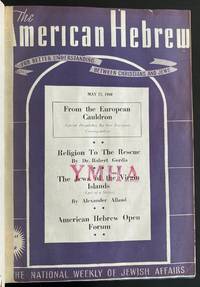
194040003New York N. Y. : American Hebrew 1940. Hardcover. 1st edition. 4to. Period Cloth 4to Approximately 20 pages each issue approximately 520 pages total. Issues were published weekly. <br> Holocaust-era American weekly Jewish magazine. <br> “From the time of its founding The American Hebrew covered many topics of intense Jewish interest internationally†wikipedia. This set of magazines contain articles showing reform Jewish perspectives on WWII and the Holocaust including material about Jewish refugees “Behind the War†“Relationship Between Religion and Democracy “War Propaganda in England and Germany†as well as more mundane topics such as an essay we noted titled “Resort Guide: Another List of Ideal Vacation Spots Selected for American Hebrew Readers.†<br> SUBJECTS: Jewish newspapers. -- United States. <br> OCLC: 1479954. Many copies have a YMHA stamp on cover of magazine. Cloth cover has staining and dampstains pages are not affected. Spine says “American Hebrew 147 May-Nov. 1940â€. Magazines in Very Good Condition. B HOLO2-140-11-X-'mmecc. New York, N. Y. : American Hebrew hardcover
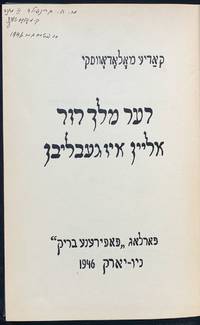
194643238New York: Papirene Brik 1946. First edition. Original boards. 8vo 156 pages 24 cm. In Yiddish. Title appears in English as “Only King David Remained.â€<br> <br> Inscribed by Molodowsky on title page in year of publication<br> <br> Early post-war book of poems by Kadya Mololdowsky that is composed of poems about the Holocaust and that “draw upon traditional Jewish literary responses to catastrophe.†Contains some of Molodowsky’s most well regarded poems.<br> <br> Kadya Molodowsky was a major figure in the Yiddish literary scene in Warsaw from the 1920s through 1935 and in New York from 1935 until her death in 1975. A teacher in the Yiddish schools in Warsaw as a young woman she was best known for her children's poems.<br> <br> In the United States she wrote for the Yiddish press and founded and edited a journal Sviva Surroundings which she published for three decades. Living in Israel 1948-52 she founded and edited a journal Heym. She published six major books of poems 1927-1965 novels short stories plays and essays. Recurrent themes in her work include the lives of Jewish women and girls Jewish tradition in the face of modernity Israel and the Holocaust.<br> <br> SUBJECTS: Yiddish poetry. David King of Israel -- Poetry. David King of Israel. Poetry. OCLC: 19314664.<br> <br> Clean copy with book stamp from “Emil Gorovets’s Library.†Very Good Condition. An attractive inscribed work by a leading female Yiddish writer. YID-48-47-LEXCCM!-’gg. New York: Papirene Brik unknown
1945296615L. B. Fischer 1945. First Edition. Hardcover. Near Fine. Small 8vo in red cloth spine title in black. Binding tight and square corners and spine ends very mildly pushed but absolutely not rubbed. The dustjacket is not price-clipped virtually no rubbing to the corners and spine ends. L. B. Fischer hardcover
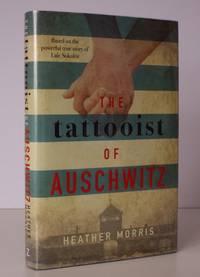
201843212Zaffre 2018. 8vo. First Edition First Issue with photographs full-page map and full-page plan in the text; black cloth backstrip lettered in silver red endpapers a near fine copy in unclipped dustwrapper. The first issue produced in a small print run without 'bestseller' blurb on dustwrapper front. VERY SCARCE ESPECIALLY IN THIS CONDITION. Zaffre, hardcover
198775666New York: Beate Klarsfeld Foundation 1987-. First edition. Five large octavo volumes. 22 493 `; 4 364; 4 467 plus some facsimile illustrations; 4 643 1; 4 561 1 pp/ Pubisher's yellow wrappers lettered in black and each front with an illustration of the Jews of the Grodno Ghetto. Unfortunately a couple of volumes have some tide marks but not horrifiically so. Part 3 has taken the brunt of it. Still an invaluable source record of a great sin of mankind.Comprosed of; v. 1. A. Accounts by Jewish survivors residing in the West. B. Accounts recorded in Poland and the Soviet Union. -- v. 2. Accounts by German witnesses or perpetrators of the final solution. -- v. 3. A. German justice seeking the truth. B. Documents. -- v. 4. Grodno in the Bialystok trial 1966-1967. -- v. 5. The Grodno trial in Cologne 1968. Jewish community in pre-war Grodno includes "Lista Platnikow Skladki Gmninnej Gminy Wyznaniowej Zydowskiej w Grodnie na rok 1937" v. 5 p. 1-97 in the section headed "Jewish Community in Pre-War Grodno"; German documents in Grodno archives: Testimonies concerning Grodno gathered by Jewish underground and recovered after the war; Testimonies gathered in years 1944-1946.; Testimonies gathered in Israel around 1957 in archives of Yad Vashem.From 1939 to 1941 the Soviet Union occupied Grodno. During this time some 4000–5000 Jewish refugees arrived from German-occupied lands to the west. About half of these refugees were later deported into the interior of the USSR. On 13 July 1941 after taking over the city the Germans executed 100 Jews among the intelligentsia and in November of that year they created two ghettos one in the city’s center—to house 15000 Jews designated as “productiveâ€â€”and the other in its suburb of S obodka to house 10000 “unproductive†Jews. The liquidation of the ghettos began in November 1942. The Germans deported Grodno’s Jews to Auschwitz—some via a transit camp in nearby Kelbasin where many died as a result of disease and inhumane conditions—and to Treblinka. On 12 March 1943 the approximately 1000 Jews remaining in the city were deported to the Bia ystok ghetto. When the Red Army entered Grodno on 14 July 1944 only about 250 Jews remained. Beate Klarsfeld Foundation unknown
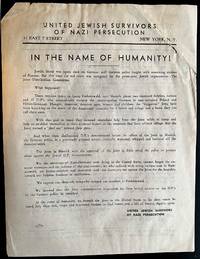
194743409New York The Organization No Date 1947. 1st edition. Double-sided English-Yiddish leaflet 2 pages. The Yiddish header translates roughly as "An Announcement To the Jewish Public"<br> Bilingual American Flyer condemning the Joint the American Joint Distribution Committee AJDC for not doing more to help the Jewish DPs and its "hiding" behind the German police when DP's demonstrated for more action on DP resettlement.<br> The issuing organization the United Jewish Survivors of Nazi Persecution/Farband fun Geveyzene Yidishe Katsetler un Partizaner was the first survivor network founded in the US. Their Yiddish name translates as "The Association of Former Jewish Concentration Camp Inmates and Partisans." The word "Katsetler" in their name is a contraction of "kontsentratsyonslager-er" using the letters K and Z "ka" and "tset" and thus short for "kontsetratsyonslager" a concentration camp inmate or survivor sometimes also noted as a "katsetnik." <br> <br> The flyer announces:<br> <br> "Jewish blood was again shed on German soil! German police fought with remaining victims of Nazism. But this time the sad event was instigated by the prominent Jewish organization-The Joint Distribution Committee.<br> <br> What happened<br> <br> There remains today in Camp Foehrenwald near Munich about two thousand helpless forlorn and ill D.P's who miraculously escaped the extermination furnaces in nazi-occupied Poland and Hitler-Germany. Hungry desperate destitute men women and children the 'forgotten' Jews have been knocking at the doors of the democratic countries for a haven and refuge and a home they can call their own.<br> <br> With this goal in mind they demand immediate help from the Joint while in camp and help to establish themselves in their eventual homes in the countries that have offered refuge. But the Joint turned a 'deaf ear' toward their pleas.<br> <br> And when these disillusioned D.P.'s demonstrated before the offices of the Joint in Munich the German police in a previously planned attack critically wounded whipped and battered off the demonstrators.<br> <br> The Joint in Munich with the approval of the Joint in Paris asked the police to protect them against the Jewish D.P. demonstrators.<br> <br> We the survivors of Nazi-Germany now living in the United States cannot forget the extreme torments and the inferno of the nazi-torture; we who suffered with many victims now in Foch- renwald are horror-stricken and dismayed and our hearts cry out against the Joint for the brutality toward our helpless brethern in misfortune.<br> <br> We express our deep-felt sympathy toward our brothers in Foehrenwald.<br> <br> demand that the Joint representatives responsible for these brutal attacks on the D.P.'s by the German police be punished.<br> <br> In the name of humanity we beseech the Jews in the United States to let their voices be heard help these sick tragic and frustrated victims to find homes and a life of human dignity again" From the English side of the flyer.<br> <br> <br> After World War II Munich served as a major center for Jewish Holocaust survivors the "Sh'erit ha-Pletah" who were living in DP camps. The "Joint" was the primary welfare organization providing aid clothing and food to these camps. While the Joint was a vital lifeline its Munich headquarters at Siebertstrasse 3 sometimes became the focal point for frustration regarding the pace of aid distribution or more frequently the slow pace of emigration to Palestine Aliyah and broader often frustrating postwar conditions.<br> Following the 1947 Exodus ship incident where Jewish refugees were returned to Germany by the British Jewish DPs felt trapped and staged intense demonstrations including protests at the offices of international organizations like the Joint to highlight their despair.<br> These demonstrations were part of a broader effort by survivors to assert their agency and demand rights during their time in Munich 1945-1951. For more on tensions between Munich's Jewish DPs and the Joint see www.juedisches-museum-muenchen.de/en/exhibitions/munich-displaced-online/moehlstrasse. <br> <br> Scholar David Slucki notes about the publishers of this leaflet that "Within months of arriving in the United States in 1946 Jewish Holocaust survivors began to organize themselves to help with the process of resettlement. The small band of socialists who established the Farband fun Geveyzene Yidishe Katsetler un Partizaner United Jewish Survivors of Nazi Persecution this group initiated a dual process of identity formation and memorialization of the Holocaust. <br> The first survivor network founded in the United States the Katsetler Farband this group developed a memorial culture that included commemorations and publications replete with its own rituals and calendar. Moreover the organization was part of a broader process of defining what experiences constituted the Holocaust and who was to be considered a survivor. Ultimately they were among a host of survivor networks in the United States to lay the foundation for Holocaust memorialization" Slucki D. 2017. A Community of Suffering: Jewish Holocaust Survivor Networks in Postwar America. Jewish Social Studies 222 116-145. https://muse.jhu.edu/article/649094<br> <br> We could locate no copies in OCLC-Worldcat Archive Grid nor using a google search. <br> <br> Touch of edgewear one diagonal fold paper generally bright and strong about Very Good- Condition. Holo2-163-28A. New York, The Organization, No Date unknown
1998013349Hamburg: VSA-Verlag 1998 254 pages. Photographs documents images map tables diagrams. German language / Deutsche Sprache / Duitstalig. 1ste / 1st. Soft Cover. Good / Goed. A4. Paperback. VSA-Verlag paperback
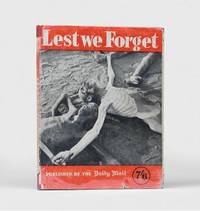
1945190283London: Associated Newspapers Ltd. 1945. First edition first impression rarely encountered in the jacket of one of the earliest full expositions of the Holocaust aimed at a general audience published by Britain's Daily Mail newspaper. The book gathers first-hand accounts and photographs from the liberation of the Nazi camps in the West showing corpses and surviving inmates as well as captured camp operatives. Quarto. Original red cloth front cover lettered and with barbed wire design in black. With the dust jacket illustrated with photograph of Holocaust victims. Light bumping and rubbing at extremities jacket chipped and creased reinforced with tape on verso protective acetate sleeve taped directly to jacket; a very good copy in sound jacket. hardcover
BN66063Unternehmen Legalon: Die Jagd nach dem Erbe des Holocaust Sante Joel Dominique <br/><br/> unknown
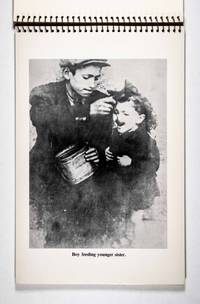
198347653Los Angeles: American Congress of Jews from Poland and Survivors of Concentration Camps 1983. First edition. Softcover. g to vg. Oblong Quarto. 4 55 leaves incl. 49 photographic plates. Original white stiff spiral-bound wraps with black lettering and publisher's device on cover. Catalog of the photo-exhibition "The Tragedy of the Jewish Child Under the Nazis" by the Holocaust Documentation Committee in Los Angeles. <br /> <br /> The exhibition is structure into six categories: Children orphaned and Starving 7; Child Labor Exploited 9; Struggle to Survive Physically and Mentally Warsaw Ghetto Scenes; 17 The Final Destination; 10 Child Partisans 3; After Liberation 3. The exhibition was curated in consideration of the younger viewers therefore omitted those pictures which in their stark and gruesome reality might harm the impressive minds of children Benjamin Grey. Introduction by Dr. Judah Pilch "Lest we forget." Illustrated with forty-five full page b/w photographs documenting the suffering of Jewish children during the Holocaust. Cover with very light soiling and rubbed. Last two plates with some wear along bottom edge not affecting images. American Congress of Jews from Poland and Survivors of Concentration Camps unknown
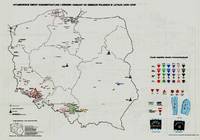
197941929Warszawa Warsaw: Pan´stw. Wydawn. Naukowe 1979. 1st Edition. Original black printed portfolio 8vo. Portfolio of seven large folding maps on on 4 sheets of heavy paper 3 are double sided 1 is singled sided. Primarily black and white with some color. Text in Polish. <br> Title translates to “Nazi camps in Poland 1939 - 1945. An Encyclopaedic Reference Book: Maps." Collection of 7 maps each 84 cm x 60 cm 33 x 24 inches produced by Jan Laskowski at the Main Commission for the Investigation of Nazi Crimes in Poland. The maps comprise Volume II of the work; Volume I is a heavily illustrated 676-page book of the same title which we offer separately. <br> The Seven maps all present are: <br> - Map 1 Single Sided: Hitlerowskie obozy na ziemiach polskich w latach 1939 - 1945. “Nazi camps in Poland in the years 1939 - 1945â€. Showing: concentration and extermination camps sub-camps of concentration camps extermination centers POW camps more important sub-camps working divisions commandos and temporary POW camps penal labor camps major labor camps prisons transit camps & ghettos. <br> - Map 2A: Getta na ziemiach polskich w okresie okupacji hitlerowskiej w latach 1939 - 1945 “Ghettos in Poland during the Nazi occupation in 1939 - 1945â€. <br> - Map 2B: Hitlerowskie obozy przejsciowe na ziemiach polskich w latach 1939 - 1945 “Nazi transit camps in Poland in 1939-1945â€. <br> - Map 3A: Hitlerowskie wiezienia i areszty na ziemiach polskich w latach 1939 - 1945 “Nazi prisons and arrests in Poland in 1939 - 1945â€. <br> - Map 3B: Hitlerowskie obozy pracy na ziemiach polskich w latach 1939 - 1945 “Nazi labor camps in Poland in the years 1939 - 1945â€. <br> - Map 4A: Hitlerowskie obozy jenieckie na ziemiach polskich w latach 1939 - 1945 “Nazi POW camps in Poland in 1939 - 1945â€. <br> - Map 4B: Hitlerowskie obozy koncentracyjne i osrodki zaglady na ziemiach polskich w latach 1939 - 1945 “Nazi concentration camps and extermination centers in Poland in 1939 - 1945â€. <br> Maps 2A & 2B have been described as a “Terrifying pair of maps showing the locations of German POW and internment camps in Poland during World War II highlighting the widespread locations of these establishments. In some parts of the map the information becomes so dense that three inset maps are shown. This map was designed by Jan Laskowski and printed in 1979 as part of a work on the Nazi extermination machine produced by PWN Warsaw a state-owned research-focused publishing house in Poland.<br> The map on the front is particularly interesting for its depiction of symbols used to classify internees in German camps. The uppermost of these depictions shows the combinations that can be made for different types of prisoners of different levels of importance. The armbands that would have been worn by these prisoners is shown as well as the prison uniforms. Other details are also shown. <br> The map lists hundreds of sites run by Nazi operators throughout the country. These include concentration camps death camps transitional camps and ghettos. The map is divided according to Poland's voivodeships with a key in the lower left. Names of cities too long to spell are also provided in the lower left. <br> This map was produced during a point in Poland's history during which it was actively revisiting the period during the Second World War. Leading social scientists devoted their time to trying to gather all the living as well as the recorded history of the events of the Holocaust and related atrocities before this information vanished. Leading these efforts particularly during the 1960s and 1970s was the Glówna Komisja Scigania Zbrodni przeciwko Narodowi Polskiemu known as the Chief Commission for the Prosecution of Crimes against the Polish Nation. They were active in publishing maps both for domestic educational purposes and for international remembrance and diplomatic efforts regarding the Holocaust. Jan Laskowski was a leading cartographer who produced a number of maps in this field. <br> These maps were produced as part of a series of maps that purported to combine to form an atlas of all of Hitler's crimes in Poland. Many of the large wall maps produced during this period could only show a fraction of the crimes or only the atrocities committed in one region. Thus a series of maps was needed to show all the points necessary which this present work contributes to. <br> Polish Reinterpretations of the Holocaust: Studying the effects of German occupation in Poland is a delicate subject. While it is certain that Poland suffered at least as badly as any other European nation during the Second World War reinterpretations of the Holocaust in the country have also been used to satisfy nationalistic tendencies. It has become evident to Western observers in the last several years that there is a strong nationalist movement in Poland that seeks to place blame for the Holocaust solely on the shoulders of non-Polish actors a movement originally fostered under Soviet rule. This movement has gone so far as to limit freedom of speech criminalizing with a three-year sentence the suggestion that Poland or its citizens in any form participated in the murders committed by Nazis. As such the term ‘Polish concentration camps’ has been deemed unacceptable with the government-approved term being ‘concentration camps on Polish territory.’ <br> All lines of evidence show that this map 2A & 2B was produced using the most accurate and impartial historical sources. The language on the map is simple naming only ‘Hitler's Atrocities’ and there is no evidence of a clear anti-German bias. However it is impossible to separate this map one of the most important productions of the remembrance movement during this period from the social situation in which it was produced. Maps like these can easily be converted into propaganda instruments and today's Polish leaders most of whom grew up during Soviet occupation will have formed their understanding of the Holocaust through maps like these. <br> Soviet Censorship: While the content of the map appears to have been produced free from bias the map still had to go through Soviet censorship. Mentioning prisoner of war camps in which primarily Soviet troops were interned would have been a prerequisite condition upon which the publication of the map rested. Further the lack of mention of any Soviet killings or camps requires no explanation….The map unlike many later maps makes no differentiation between the populations who suffered at the various camps. This represents the Soviet agenda that all nations suffered fought and won equally which sought to limit divisions in this post-identity state†Ruderman 2022. <br> SUBJECTS: World War 1939-1945 -- Prisoners and prisons German. -- Concentration camps -- Poland. Guerre mondiale 1939-1945 -- Prisonniers et prisons des Allemands. -- Camps d'internement -- Pologne. Obozy koncentracyjne -- Polska -- 1900-1945. OCLC: 830885973. <br> Light shelf wear to portfolio as expected. All maps in pristine condition with normal folds as issued. Very Good Condition. Complete and dramatic BR5 holo2-147-19-'cc. Warszawa (Warsaw): Pan´stw. Wydawn. Naukowe unknown
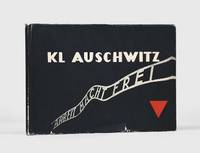
1960190277Krakow: International Auschwitz Committee 1960s. First edition first printing very scarce and even more so in the dust jacket. Offered "in memory of those murdered a warning to those living" the book charts the history of Auschwitz from its founding to its liberation and the trial of camp operators. It is extensively and graphically illustrated with photographs. The text is in English French and German throughout. The publishers the International Auschwitz Committee was founded by survivors in 1952 to preserve the memory of the camp counter anti-Semitism and maintain links between former inmates between nations and across the Iron Curtain. Oblong quarto. Original grey cloth front cover lettered in blind. With dust jacket. Jacket a little rubbed and chipped at extremities without price as issued; a fine copy in very good jacket. hardcover
194547189Krakow: Spóldzielnia Wydawnicza "Czytelnik" Czytelnik Publishing Cooperative 1945. First edition. Softcover. g to von-. Octavo 8 1/4 x 6". 93pp. 13 leaves of double sided photographic plates interleaved and unpaginated. Illustrated tan red and black wrappers with black lettering on the front cover. Photographic b/w frontispiece. Spóldzielnia Wydawnicza "Czytelnik."<br /> <br /> Possibly an earlier publication on lower quality paper compare to a slightly smaller publication by the "Library of the Union of Polish Patriots in the USSR" Biblioteczka Zwiazku Patriotów Polskich w ZSRR with the same text in different layout. That publication issued on higher quality paper and with twenty-eight photogravures three more than in this publication with twelve photographs appearing in both publications though in lesser quality here.<br /> <br /> Court Proceedings of the Polish-Soviet Special Criminal Court established in Lublin in August 1944 in order to investigate the crimes committed by the Germans in the Majdanek extermination camp. Despite the importance of this document it must be mentioned that the Commission made erroneous assumptions regarding the duration of the camp and the number of people killed at Majdanek. The Publishing cooperative "Czytelnik" was established behind Soviet front lines in 1944. It became the first post-World War II. publisher in Poland.<br /> <br /> The total numbers of the victims is still controversial: In this report 1.5 million victims of different nationalities were counted however according to the latest researches there were 79000 victims 59000 of whom were Jews See: Kranz T.: "Bookkeeping of Death and Prisoner Mortality at Majdanek." pp. 81-110. In: Silberklang D. Ed.: Yad Vashem Studies. Vol. 35:1. Jerusalem 2007.<br /> <br /> Illustrated with 25 pages of b/w photographic reproductions including a frontispiece on 13 double-sided interleaved plates altogether thirty-two photographs depicting members of the Commission Nazi guards now prisoners who used to run the camp and survivors alike testifying before the Commission. Also includes views of the actual concentration camp piles of suitcases Zyklon B poison gas pellets gas chambers ovens and survivors amid corpses.<br /> <br /> Wrappers with some chipping rubbing creasing and/or closed tears to extremities. Small stain on the back cover and side edge of book block. Verso of frontispiece with a vertical crease. Some pages throughout with some light age toning or small water spots. Overall text and images clear and vibrant. Wrappers in good interior in very good- condition overall. One of two editions of this work published in Moscow and Krakow in 1945. It is not certain which was released first. Each has different wrappers size pagination and publishers. Spóldzielnia Wydawnicza "Czytelnik" (Czytelnik Publishing Cooperative) unknown
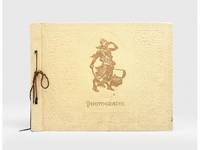
19451874311945-46. A photograph album compiled by an American soldier serving in Austria immediately after the Second World War containing several photographs documenting the Holocaust. The album is divided into three sections labelled "commercial photographs" "'captured' photographs" and "personal photographs". The Holocaust images are in the "commercial" section and show piles of corpses concentration camp prisoners both naked and in striped uniforms and views of the camps and crematoria. Other commercial photographs depict combat scenes entertainment and bombed-out cities. The "'Captured' photographs" - it is unsure what the compiler means by this - also appear to be commercially produced. The "personal photographs" were all captured by the compiler and individually captioned. They depict the American soldier - identified only as "me" - while posted in Pupping Austria. The images include portraits of himself and his named comrades views of the Pupping Prisoner-of-War camp local buildings and landscapes and excursions to nearby Linz. The photographs are dated from November 1945 to June 1946. Oblong folio 370 x 290 mm embossed boards with gilt design on front new string ties containing 137 photographs of varying sizes on 15 card leaves remaining leaves unused. Covers very lightly rubbed and soiled some leaves a little chipped all photographs present. In very good condition. hardcover
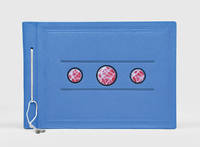
19671824721967. Auschwitz memorialized - a record of "the first fully 'international' event" at the former camp A commemorative album for the opening of the memorial at Auschwitz on 16 April 1967 an important stage in its transition to an international memorial site. Situated at the western end of the railway lines that cross the camp the memorial remains a central part of the Auschwitz complex. The large granite memorial was designed by the Italian architects Andrea and Pietro Cascella. Approximately 200000 people attended the unveiling including Polish state officials the East German and Italian foreign ministers and prisoner organisations. The first two photographs show the memorial the third the crowd bound in by the barbed wire and the fourth the Polish prime minister Józef Cyrankiewicz laying a tribute. The remainder show the attendees eating lunch food stalls and chefs preparing the food. Given this the album was presumably produced for the organizers of the catering. "Abstract in form and vague in its message the monument and the events surrounding its unveiling in April 1967 certainly furthered the memorial site's growing international character and testified to the waning relevance of a traditional Polish-national commemorative idiom at Auschwitz. At the same time however the Birkenau monument failed to specify or acknowledge explicitly the suffering and death of Jews as Auschwitz and therefore took its place in the continuum of commemorative marginalization of the Shoah at the site" Huener pp. 145-6. The memorial does not mention the Jews specifically nor did Cyrankiewicz in his remarks at the event as he wished to continue to present the camp as a specifically Polish tragedy. Nonetheless the unveiling "drew tremendous attention from abroad and can therefore be understood as the first fully 'international' event held at the State Museum at Auschwitz. The highly publicized April ceremonies. reached the wider European public and through the presence of countless journalists the world" Huener p. 146. Oblong quarto 36 x 25 cm containing 28 silver gelatin prints ranging from 17 x 12 to 17 x 23 cm mounted on 21 leaves of thick black card string-tied within blue cloth covers. Fore edge of first leaf a little chipped otherwise binding and contents in excellent condition. Jonathan Huener Auschwitz Poland and the Politics of Commemoration 1945-1979 2003. hardcover