5 326 résultats
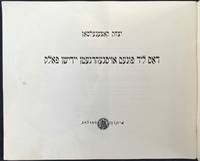
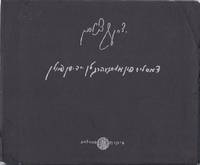
194829513New York; YKUF 1948. Paperback. Original Wrappers. 12mo. 79 pages. 17 cm. Undated edition. In Yiddish. <br> Includes introduction by Miriam Novitch as well as "Vi Yitshak Katsnelson hat geshribn zayne klog-lider" also by Miriam Novitsh on pages 15-16.<br> “Song of the Murdered Jewish People" by Itzhak Katzenelson 1885–1944 a Hebrew and Yiddish poet. â€Katzenelson’s world fell apart when in August 1942 his wife Hanna and two younger sons Ben-Tsiyon and Binyamin were deported to Treblinka. From then on his literary creativity was piercingly shaped by lamentations over the loss of his family. Nonetheless with his oldest son Tsevi he found the strength to join the Jewish Fighting Organization and took part in the first uprising of January 1943. <br> After the ghetto was destroyed in April and May 1943 he escaped to the Aryan section of Warsaw and obtained a Honduran identity document. Nevertheless he was sent to a German detention camp for foreign subjects in Vittel France. He was imprisoned there until April 1944 and devoted most of his time to writing. <br> Two important works were produced during that period: Pinkas Vitel The Vittel Diary a Hebrew composition that uses the language of an incensed diarist and reconstructs the days of terror in Warsaw during the mass deportations; and Dos lid fun oysgehargetn yidishn folk The Poem about the Murdered Jewish People a pathos-filled Yiddish poem that laments the destruction of the Jewish people and of the poet himself who has been become bitterly angry with humankind and God. These two works are among the boldest and most lofty literary expressions to emerge from the Holocaust.…<br> All of Katzenelson’s works from his Vittel period were either buried in hiding places or were given to people he trusted; consequently they were saved and published shortly after the end of the war. <br> In the middle of April 1944 Katzenelson and his son Tsevi were sent to the Drancy transit camp and from there one month later to Auschwitz where they were murdered. In 1950 the Ghetto Fighters kibbutz built a museum and an institute for research about the Holocaust that bear Yitshak Katzenelson’s name†YIVO Encyclopedia. <br> Subjects: Holocaust Jewish 1939-1945 -- Poetry. OCLC: 12260367. <br> Half Dollar size chip to cover no text loss institutional stamp on title page taped spine otherwise Good Condition. BK5 B HOLO2-97-33-XX-ELABCC. New York; YKUF paperback
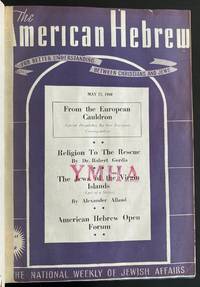
194040003New York N. Y. : American Hebrew 1940. Hardcover. 1st edition. 4to. Period Cloth 4to Approximately 20 pages each issue approximately 520 pages total. Issues were published weekly. <br> Holocaust-era American weekly Jewish magazine. <br> “From the time of its founding The American Hebrew covered many topics of intense Jewish interest internationally†wikipedia. This set of magazines contain articles showing reform Jewish perspectives on WWII and the Holocaust including material about Jewish refugees “Behind the War†“Relationship Between Religion and Democracy “War Propaganda in England and Germany†as well as more mundane topics such as an essay we noted titled “Resort Guide: Another List of Ideal Vacation Spots Selected for American Hebrew Readers.†<br> SUBJECTS: Jewish newspapers. -- United States. <br> OCLC: 1479954. Many copies have a YMHA stamp on cover of magazine. Cloth cover has staining and dampstains pages are not affected. Spine says “American Hebrew 147 May-Nov. 1940â€. Magazines in Very Good Condition. B HOLO2-140-11-X-'mmecc. New York, N. Y. : American Hebrew hardcover
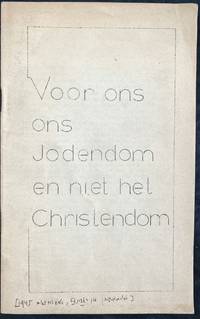
193025194Amsterdam: Selecta 1930. Softcover 24 pages 22 cm. In Dutch. “For us Judaism—and not Christianity. †Jewish response to attempts at conversion just prior to the Holocaust. <br> Chief Rabbi Justus Tal 1881-1954 was "From 1918 until the outbreak of World War II.Chief Rabbi of Utrecht. During the war he was hidden from the Nazis by a Protestant clergyman. Afterwards he assumed the post in Amsterdam and was elected president of the Dutch Conference of Chief Rabbis" JTA 1954. <br> OCLC: 64304774. OCLC lists 14 copies worldwide only 3 in the US HUC Harvard YIVO none south or west of Ohio.<br> Light wear. Handwritten note on bottom of cover notes "edited by Chief Rabbinate of Netherlands Amsterdam 1945.†Good condition. B Holo2-162-37XXXCC-'. Amsterdam: Selecta unknown
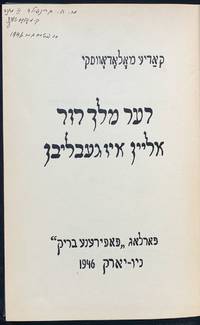
194643238New York: Papirene Brik 1946. First edition. Original boards. 8vo 156 pages 24 cm. In Yiddish. Title appears in English as “Only King David Remained.â€<br> <br> Inscribed by Molodowsky on title page in year of publication<br> <br> Early post-war book of poems by Kadya Mololdowsky that is composed of poems about the Holocaust and that “draw upon traditional Jewish literary responses to catastrophe.†Contains some of Molodowsky’s most well regarded poems.<br> <br> Kadya Molodowsky was a major figure in the Yiddish literary scene in Warsaw from the 1920s through 1935 and in New York from 1935 until her death in 1975. A teacher in the Yiddish schools in Warsaw as a young woman she was best known for her children's poems.<br> <br> In the United States she wrote for the Yiddish press and founded and edited a journal Sviva Surroundings which she published for three decades. Living in Israel 1948-52 she founded and edited a journal Heym. She published six major books of poems 1927-1965 novels short stories plays and essays. Recurrent themes in her work include the lives of Jewish women and girls Jewish tradition in the face of modernity Israel and the Holocaust.<br> <br> SUBJECTS: Yiddish poetry. David King of Israel -- Poetry. David King of Israel. Poetry. OCLC: 19314664.<br> <br> Clean copy with book stamp from “Emil Gorovets’s Library.†Very Good Condition. An attractive inscribed work by a leading female Yiddish writer. YID-48-47-LEXCCM!-’gg. New York: Papirene Brik unknown
196343253New York: YKUF 1963. Paperback. Original Wrappers. 12mo. 79 pages. 17 cm. In Yiddish. <br> <br> Includes introduction by Miriam Novitch as well as "Vi Yitshak Katsnelson hat geshribn zayne klog-lider" also by Miriam Novitsh on pages 15-16.<br> <br> “Song of the Murdered Jewish People" by Itzhak Katzenelson 1885–1944 a leading Hebrew and Yiddish poet. <br> <br> â€Katzenelson’s world fell apart when in August 1942 his wife Hanna and two younger sons Ben-Tsiyon and Binyamin were deported to Treblinka. From then on his literary creativity was piercingly shaped by lamentations over the loss of his family. Nonetheless with his oldest son Tsevi he found the strength to join the Jewish Fighting Organization and took part in the first uprising of January 1943. <br> <br> After the ghetto was destroyed in April and May 1943 he escaped to the Aryan section of Warsaw and obtained a Honduran identity document. Nevertheless he was sent to a German detention camp for foreign subjects in Vittel France. He was imprisoned there until April 1944 and devoted most of his time to writing. <br> Two important works were produced during that period: Pinkas Vitel The Vittel Diary a Hebrew composition that uses the language of an incensed diarist and reconstructs the days of terror in Warsaw during the mass deportations; and Dos lid fun oysgehargetn yidishn folk The Poem about the Murdered Jewish People a pathos-filled Yiddish poem that laments the destruction of the Jewish people and of the poet himself who has been become bitterly angry with humankind and God. These two works are among the boldest and most lofty literary expressions to emerge from the Holocaust.…<br> All of Katzenelson’s works from his Vittel period were either buried in hiding places or were given to people he trusted; consequently they were saved and published shortly after the end of the war. <br> <br> In the middle of April 1944 Katzenelson and his son Tsevi were sent to the Drancy transit camp and from there one month later to Auschwitz where they were murdered. In 1950 the Ghetto Fighters kibbutz built a museum and an institute for research about the Holocaust that bear Yitshak Katzenelson’s name†YIVO Encyclopedia. <br> <br> Subjects: Holocaust Jewish 1939-1945 -- Poetry. OCLC: 28824340. <br> <br> Some stains on covers Good Condition. B HOLO2-97-33A-XX-ELABCC. New York: YKUF paperback
1st Edition. Original Wrappers. 8vo. Tri-Fold Holocaust-era Pamphlet with 5 pages ; 24 cm. The Undersigned Rabbis Are: Philip S. Bernstein, Barnett R. Brickner, Israel Goldstein, James G. Heller, Mordecai M. Kaplan, B. L. Levinthal, Israel H. Levinthal, Louis M. Levitsky, Joshua Loth Liebman, Joseph H. Lookstein, Jacob R. Marcus, Abraham A. Neuman, Louis I. Newman, David de Sola Pool, Abba Hillel Silver, Milton Steinberg, and Stephen S. Wise. We, the undersigned Rabbis, they write, of all elements of American Jewish religious life, have noted with concern a statement by ninety of our colleagues in which they repudiate Zionism on the ground that it is inconsistent with Jewish religious and moral doctrine. This statement misrepresents Zionism and misinterprets historic Jewish religious teaching OCLC lists no holdings worldwide. Front wrapper is mostly loose. 4th and 5th page are torn with a few words affected. Otherwise in good condition. Very rare. (zion-10-57)
Original Wraps. Folio. 3 pages. 36 cm. First edition. Large single sided mimeographed typewritten newsletter entitled ORT Highlights. Number 54, New York, 212 Fifth Avenue, May 11, 1950; no publisher given, author, etc. Contains a list of brief articles under the following headings: A Farewell Message to Mme. Roubach, North African Jews Prepare for Emigration to Israel, ORT Leaders Interview Former French Prime Minister, Rehabilitation Center in Austria, Austrian ORT Students Present Birthday Gift to President Chaim Weizmann, ORT Schools in British Zone Germany Will Operate After July 1st, Berlin ORT School Wins Praise at Exhibition, American ORT Federation Elects New Leaders (George J. Mintzer and Julius Hochman) . Subjects: World ORT Union. Jews - Education - Periodicals. Jews - United States Periodicals. None listed on OCLC. Edges damaged and worn, with minor text loss to bottom sentences of pages 1 and 2. Otherwise clean. Good - condition. (HOLO2-113-25)
Original boards. 8vo. VI, 332 pages. 25 cm. First edition. Contains bookstamp of Rabbi Davin Schoenberger of Aachen (who served as chief rabbi of Aachen, Germany, from 1926 to 1938; he performed the marriage of Anne Frank's parents, as reported in his obituary in the New York Times, December 10, 1989) . In German, some Hebrew throughout. Studies in Jewish and Jewish-Arabic Religious Philosophy. ' Extensive study of medieval Jewish religious philosophy; focuses on theological discussions, Aristotelianism, Maimonides, etc. Adolf Abraham Schmiedl (18211914) , Austrian rabbi and scholar. Born at Prossnitz (Prostejov) , Moravia, Schmiedl served as rabbi in Gewitsch, Moravia (184649) ; then as Landesrabbiner at Teschen, Silesia (to 1852) and later at Bielitz (Bielsko) , Prosnitz, and Vienna. - 2008 EJ. Bound in original marbled boards. Subjects: Jewish philosophy. Philosophy, Medieval. Backstrip absent, light foxing throughout, corners of boards lightly bumped, otherwise fresh and clean. Very good condition. (GER-44-35)
1st edition, original cloth with dust jacket, 4to, 11 pages + 754, 170 columns. Illustrations throughout. In Hebrew, with an English section. This is the story of a vanished world, the shtetel of Antopol. The material for this presentation was gathered painstakingly over a long period of time by a relatively small group of dedicated people who wished to preserve its memory and heritage for the descendants of its martyred. More than a history, this story is very personal because our parents, grandparents and great-great grandparents going back many generations came from this community. This is also a place whose many sons and daughters in years past left to seek a new and free life. Many achieved success and prominence all over the world - the United States, South Africa, Argentina, and other areas of the globe. We are the fortunate descendants of these hardy forebears and pioneers. It is hard to imagine that only a few decades ago there existed a vibrant, living community called Antopol, with its men, women and children; its market place, stores, schools. Beth medroshim (Houses of Prayer) , orphanages, Gmilas Hasodim (free loan society for the needy) , newspaper stands - all so familiar and so dear to memory. This little town was typical of hundreds of similar smaller and larger communities. And, like Atlantis, or some past people recounted in a saga, it suddenly vanished in the most bloody massacre in all of history. But this presentation is for the living - to convey to us, the she'erit or last remnant of descendants, something of the heritage, spirit and, record of the life of this community which many of us know only in an abstract and detached way. The task is too great, and our resources too limited to write the whole story. This little volume, condensed and translated into English, is both a record and a personal memorial to a profoundly meaningful and warmly nostalgic past. (foreword from the English version of this book) SUBJECT(S) : Jews -- Belarus -- Antopal. Holocaust, Jewish (1939-1945) . Ethnic relations. OCLC: 19155706. Dust jacket has some tearing and damp stains, cover corners are dented, some wear on bottom of spine, page edges slightly yellowed, internally very good. Good Condition overall. (YIZ-17-7A) xx
IN HEBREW AND YIDDISH. 1.7 kg. Contains b&w plates. 340x240 mm. 480 pages. Gilt hardcover and spine. Ex-library copy with usual marks. Few pages age stained. Binding visible between pages 120-121. Page 120 stained - no damage to text. Pages yellowing. Else in good condition. PLEASE NOTE: This item is overweight. We may ask for extra shipping costs.
1st edition, original wrappers, 8vo. 64 pages, portraits throughout. In Yiddish with English title page. Book 3 part 1 of History of the Jews in Bialystok. SUBJECT (S) : Jews -- Poland -- Bialystok. OCLC: 970935047, OCLC lists 17 copies worldwide. Ex library with usual marks, light wear on spine and cover, Good Condition overall. (YIZ-18-12A)
1st edition. Original Cloth, 8vo, 480 + 380 pages. In Yiddish. The chronicle of Bialystok: basic material for the history of the Jews in Bialystok until the period after the First World War. Very Good Condition(YIZ-10-1)
1st edition. Original Cloth, 8vo, 480 + 380 pages. In Yiddish. The chronicle of Bialystok: basic material for the history of the Jews in Bialystok until the period after the First World War. OCLC: 10792576. Very Good Condition(YIZ-10-1)
1st edition. Original Cloth, 8vo, 380 pages. In Yiddish. The chronicle of Bialystok: basic material for the history of the Jews in Bialystok until the period after the First World War. Very Good Condition(YIZ-10-1A)
1st edition, original cloth, 4to, xix+ 288+ (2) pages. On title page: Brzezin memorial book. Illustrations throughout. Yiddish, with English introduction. There once was a town of Jewish tailors Brzezin. From early dawn until late at night one could hear the music of the Singer sewing machines. It was the music of hard work, of intense anxiety, of a hard life, but also of noisy youth, semi-intellectuals, observant Jews, Hasidim who lived and had aspirations in the small Jewish town Brzezin. The Nazi savages extinguished this life forever, transformed it into ashes. Only a few Jews from the tailoring town Brzezin, by some miracle, remain, scattered over the entire world, individuals who were witnesses to the German cannibalism. May these words, frail in print, but inscribed not with ink but with blood, be a modest contribution to the matseve [gravestone] for my native town, Brzezin. Brzezin was one of the oldest and most popular Jewish communities in Poland. When this community was established, it carried the name Krakowek [Little Krakow]. At that time, the community extended from the Strykower highway to beyond the Jewish besoylem [cemetery] to the surrounding hills. The Polish noblewoman, Anna Lasocka, had brought the first weavers from afar into this community. Then the community developed even further and began to broaden its borders. At that time, the town already carried the name Brzezin. Jewish tailors came to Brzezin from many places, and after several generations, the town developed its own type of tailoring industry, by which it was known all over the world. A cottage industry was the main occupation here. As early as 1772, Brzezin was famous for its mass production in tailoring. Until 1914 the great Czarist Russia was flooded with the inexpensive products of Brzeziner tailors. In the years between the two world wars, the export of Brzezin industry was spread over many lands in Europe and into other parts of the world. In this, the great Jewish magaziners [owners of clothing enterprises] exporters such as Frankensztejn, Tuszynski, Sulkowicz, and others played a great role. The Jews in Brzezin did not only work, they also participated actively in the socio-political and cultural life of the town, had their representatives on the town council in town hall, and had their religious and secular educational, cultural, and social organizations. Materially, it was a life of Jewish poverty, but spiritually, socially, and culturally, it was rich. (translated from book) SUBJECT(S) : Holocaust, Jewish (1939-1945) -- Poland -- Brzeziny (Lo´dz´) ; Jews. OCLC: 19306453. Light wear on cover, some wear on spine. Good Condition Overall. (YIZ-16-6A)
1st edition. Original cloth with jacket, 4to. , 840 columns. VOLUME ONE OF TWO ONLY. Illustrated with photographs, facsimiles, folded map. In Hebrew and Yiddish. Series: Sifre zikaron li-kehilot ha-golah. SUBJECT(S) : Jews -- Poland -- Czestochowa -- History. Holocaust, Jewish (1939-1945) -- Poland -- Czestochowa. Czestochowa (Poland) -- Ethnic relations. Other Titles: Ts'enstohov; Entsiklopedyah shel galuyot. Light wear to jacket. Very good condition. (YIZ-14-8)
1st edition. No Date [1939]. Small broadsheet. 1 page. 22 cm. Single sided flyer for an Rightwing mass meeting; content of the flyer are as follows: SPEAKERS: BOAKE CARTER Radio's Fearless News Editor, on the timely subject FREE SPEECH AND THE NEWS JOHN E. KELLY Brilliant, well-posted writer and lecturer will speak on JOHN L.LEWISPUBLIC ENEMY No. 2 and others. PresidingGEORGE U. HARVEY Dynamic, Capable Borough President of Queens President of WE AMERICANS. This meetingis under the sponsorship of: American Federation Against Communism, American Patriots, The Christian Front. Tickets may be purchased from: CARNEGIE HALL, 7th St. and 7th Ave., New York, N. Y. IROQUOIS HOTEL, 49 West 44th Street, New York, N. Y. WALTER OGDEN, 413 West 59th Street, New York, N. Y. Admission 25c - 40c Reserved 99c. Arthur Derounian, on page 52 of the book Under Cover, noted the content of Kellys speech as follows: John Eoghan Kelly, Christian Front organizer and promoter of the Franco cause in America, talked on Public Enemy Number Two-John L. Lewis who, according to the inside information obtained exclusively by Kelly, had "100,000 armed Communists rarin' to Sovietize America. Who is Public Enemy Number One? I asked of the man next to me. Roosevelt. Who in hell did you think it wuz?" Also of note, is that the speaker George U. Harvey was the Republican Borough President of Queens for twelve years. The meeting of the Great Pro-American Mass Meeting in Behalf of Free Speech and Americanism, a gathering of several anti-immigrant, anti-Communist, reactionary organizations, on May 24, 1939. The crowd, turned away from their first meeting location at Carnegie Hall, hadre-congregated at the Great Northern Hotel a few doors down 57th street. Police swarmed the lobby, shouts went around to keep the newspapers out, and journalists were violently jostled aside. Among those present at this nationalistic rally were speakers for the American Patriots, Inc; the Christian Front; the American Nationalist Party (NYPL blog article Edith Wynner,Firecracker by Laura Ruttum June 13, 2008.) Subjects: Anti-Semitic Propaganda. OCLC lists 2 copies (NYPL, AJC). Previously folded; otherwise Very Goodcondition. (LB-5-2) Xx
Later cloth. 4to. 88 leaves. 30 cm. First edition. Fascimile. In German. On the History of the Jewish Community of Aurich, 1592-1940. Compiled photocopy booklet for a course at the IGS School in Aurich, bound in later cloth; illustrated, with several maps, family registers, and historical and legal documents. Subjects: Jews - Germany - Aurich (Lower Saxony) . OCLC lists two copies (HUC, Univ Florida) . Previous owners name on endpage, otherwise clean and fresh. Very good + condition. (HOLO2-108-34)
1st English Language edition. 4to. Original wrappers, xxxix + 663 pages. Illustrations throughout. In English. The book by Serge Klarsfeld, contains vital statistics of some 76, 000 Jews deported from France. Together with his wife Beate, the Paris-based Serge Klarsfeld has published lists of Jews deported from France and Belgium over the last decades. He was the leading Nazi hunter in France . France was one of the more liberal nations in opening its doors to Jewish refugees from Poland, Romania, and Germany. Some 350, 000 Jews were living in France when the Germans invaded the country in June 1940. More than half of them were refugees from Germany who had arrived during the 1930s. Many were French citizens whose families had lived in France for centuries and who were fully assimilated. Others had come to France, often from Eastern Europe, to seek a better life and escape from antisemitism. Approximately 76, 000 Jews were deported from France between 1942 and 1944. Most went to Auschwitz-Birkenau, where the vast majority were exterminated on arrival. Klarsfeld's book is a most startling document. Nearly the size of the Manhattan (NYC) telephone directory, it lists nearly 76, 000 names of Jews deported to Eastern Europe or killed in France. Names are listed in alphabetical order, according to each of the 80 convoys. Family name, first name, birth date, place of birth, and nationality are recorded for every person. Klarsfeld also provides a detailed history of each convoy. (Jewishgen 2018) SUBJECT(S) : Jews -- Persecutions -- France. Holocaust, Jewish (1939-1945) -- Registers of dead -- France. World War, -- Deportations from France. Ethnic relations. Genealogy. Translation of: Le mémorial de la déportation des juifs de France. OCLC: 9685134. Small tear to margin of cover, otheriwse Very Good Condition Overall. (YIZ-16-20) xx
1st Edition. Original Red Paper Wrappers. 8vo. 56 pages ; 24 cm. In German. Title Translates into English as, The German Aliya In Histadruth. Includes the full German text of addresses from Georg Landauer, Moscheh Brachmann, Hans Rubin, Fritz Löwenstein, and Josef Sprinzak. Sprinzak was a leading Zionist activist in the first half of the 20th century, an Israeli politician, and the first Speaker of the Knesset, a role he held from 1949 until his death in 1959. (Wikipdia, 2016) SUBJECT(S) : Jews, German -- Palestine. Histadrut. OCLC lits 5 copies worldwide (Stanford, Harvard, HUC, NLI, Univ of Haifa) , none in New York. Wrappers are worn with a few tears. Small marking on title page. Overall about very good condition. (zion-10-60A)
1st edition, later paper wrappers, 8vo. 808 + xx columns, illustrations throughout. In Hebrew, with an English title page and introduction. We consider it important and necessary to represent a review of our Memorial-Book to the children and friends of the Goniondz Society who do not read Yiddish or Hebrew. Let all of them get an idea about the Hometown of their parents and relatives and together with them hold dear the memory of the small Jewish community, that went to martyrdom during the black period of the bestial Nazi rule. 6, 000, 000 Jews perished during the 2nd World War in Eastern and Central Europe. Many bigger and smaller towns were immortalized in memorial books. They stand out like living symbols, spiritual monuments for the coming generations. Our beloved Goniondz has surely earned such a monument. The Jewish Goniondz was very lively and interesting. The small Jewish population was very active, established many parties and clubs and gave to the world outstanding intellectuals in many fields, both Jewish and general. Citizens of Goniondz are spread out all over the world. The majority of them live in the United States and in Israel, where they have established many societies and cooperatives in the socio-philanthropic field, giving financial and moral support to needy townspeople. The Memorial-Book portrays to a great extent the manysided life of Goniondz before its destruction. (from book) SUBJECT(S) : Jews -- Poland -- Gonia? Dz. Holocaust, Jewish (1939-1945) . Ethnic relations. OCLC: 18096280, OCLC lists 29 copies worldwide. Cover is missing, outside pages have some wear and discoloration, internally very good, Good Condition overall. (YIZ-20-2)
69182New York: Raw Books & Graphics 1986. Very Good. Slim folio 36 cm Saddle-stitched illustrated wraps. Wraps lightly rubbed. Moderate soiling to rear wraps of numbers 1 and 3.<br /> <br /> Volume 1 Number 1 Fall 1980. "Two-Fisted Painters" by Art Spiegelman booklet.<br /> <br /> Volume 1 Number 3. 1981. "Maus Chapter Two The Honeymoon" booklet.<br /> <br /> Volume 1 Number 4. 1982. Vinyl record "Reagan speaks for himself" detached and laid in. "Maus Chapter Three Prisoner of War" booklet.<br /> <br /> Volume 1 Number 5. 1983. Couple by Art Spiegelman. "Maus Chapter Four The Noose Tightens" booklet. Stapled in a little loosely.<br /> <br /> Volume 1 Number 6. 1984. "Maus Chapter Five Mouse Tales" booklet.<br /> <br /> Volume 1 Number 7. 1985. "Maus Chapter Six Mouse Trap" booklet. "Red Flowers" booklet by Yoshiharu Tsuge. Deliberately issued by the publisher with a torn front wrap.<br /> <br /> Volume 1 Number 8. 1986. Jimbo by Gary Panter. "Maus Chapter Seven Mauschwitz" booklet. The first number along with six other issues of RAW Magazine Volume 1. Number 2 is not present. <br /> <br /> A very colorful and bold comics and graphics anthology edited by Art Spiegelman and Françoise Mouly a husband and wife team which highlighted artists from around the world and was published in the United States from 1980 to 1991. In addition to the work of Spiegelman and Mouly RAW featured cutting-edge comic artists such as Robert Crumb Gary Panter Charles Burns Kim Deitch Sue Coe Jerry Moriarty Richard Sala and Ever Meulen among many others. In these issues of RAW one will find Gary Panter's best-known comic protagonist "Jimbo" a burly punk and existential adventurer as well as "The Voice of Walking Flesh" by Charles Burns "Love's Savage Fury" by Mark Newgarden and a centerfold by Ever Meulen captioned "Use the Mood of the Past to Rewire Your Brain for the Future." Of significant importance is the fact that Art Spiegelman's seminal graphic work "Maus: A Survivor's Tale" made it's first appearance in this magazine chapters 2-7 are present here as stapled-in booklets. Spiegelman's unrivaled Holocaust narrative "Maus" was awarded the 1992 Pulitzer Prize it was the first graphic novel to win the Pulitzer Prize and he was the first-ever cartoonist to receive the prestigious Edward MacDowell Medal a medal awarded annually since 1960 to artists who have made an outstanding contribution to American culture.<br /> <br /> A nearly consecutive run of volume 1 of this trailblazing magazine with original serialized chapters of "Maus." "The Graphix Magazine for Your Bomb Shelter's Coffee Table." Number 4 front cover caption. Raw Books & Graphics unknown
Cloth, 8vo, 510 pages (volume 18) , 42 volumes, 24 cm. Trial against H. W. Göring, R. Hess, J. Von Ribbentrop, R. Ley, W. Keitel, E. Kaltenbrunner, A. Rosenberg, H. Frank, W. Frick, J. Streicher, W. Funk, H. Schacht, G. Krupp von Bohlen und Halbach, K. Dönitz, E. Raeder, B. Von Schirach, F. Sauckel, A. Jodl, M. Bormann, F. Von Papen, A. Seyss-Inquart, A. Speer, C. Von Neurath, and H. Fritzsche, individually and as members of any groups or organizations to which they belonged. "Documents admitted in evidence are printed only in their original language. " Volumes. 30, 31 and 38 have fold. Charts (4 total) in pockets. Contents: volumes 1. Official documents. --Volumes 2-22. Proceedings. --Volumes 23. Chronological and subject index. --Volumes 24. Document and name index and errata. --Volumes 25-42. Documents and other material in evidence. Subject: Nuremberg Trial of Major German War Criminals, Nuremberg, Germany, 1945-1946. Added author International Military Tribunal. Spine and pages tanned. Edge wear to covers. Ex-library with book plate. Good condition. (H-22) This volume only.
12mo; 117 pages; In German. 2 long handwritten letters from the author laid in. A nicely done history. (GER-39-4)
Very Good Condition Lacks Jacket; Large 8vo; 565 pages; By a participant in the July 20, 1944 plot to kill Hitler. (HOLO2-77-24)