KIEFER, AnselmLivre Rare Book
5 323 résultats
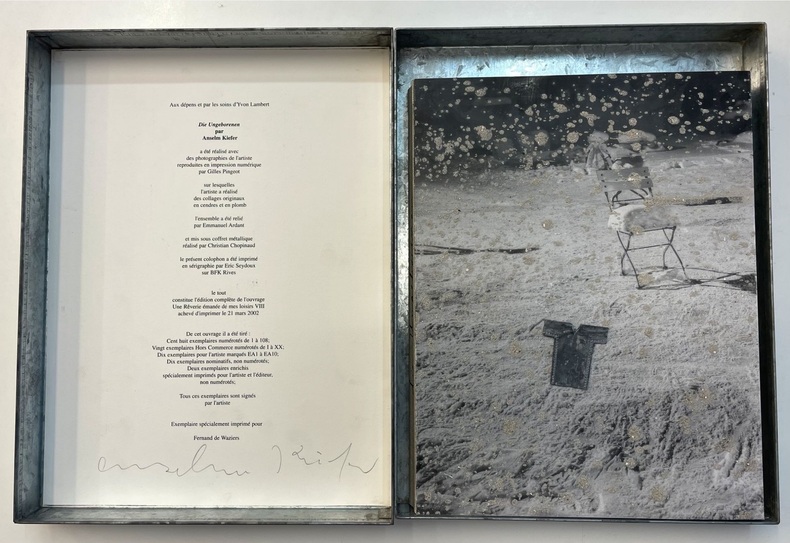
20022124Paris, Yvon Lambert, Coll. « Une rêverie émanée de mes loisirs, VIII », 2002. Un vol. in-4 (30,5 x 23 cm), broché, couverture illustrée, dos toilé titré, boîte d’acier brossé de l'éditeur. ÉDITION ORIGINALE. Collages de cendres et de plomb sur 18 photographies numériques par Anselm Kiefer. Chaque exemplaire composé à la main est sensiblement différent l’un de l’autre. Tirage à 150 exemplaires (N° 48/108 justifié et signé au crayon par l'artiste. Note : Les livres ne se contentent pas d'accompagner la création d'Anselm Kiefer, comme une production secondaire ou un commentaire. Ils y occupent une place centrale en constituant à la fois un lieu d'entrecroisement pour ses autres réalisations (installations et performances, sculptures et gravures, etc.), le creuset d'œuvres à venir ou l'aboutissement de réalisations antérieures. En tant que tels, ils sont un élément essentiel de son travail, un des plus significatifs et des plus fascinants. Bibliographie : Arasse, Anselm Kiefer, p. 47 ; […], Anselm Kiefer. L’alchimie du livre, BNF, 2015. Exemplaire bien signé à l’état de neuf, aucun défaut, les collages de cet exemplaire nominatif sont particulièrement soignés. — (ENGLISH DESCRIPTION) DIE UNGEBORENEN. (Paris, Yvon Lambert 2002). Anselm Kiefer's photographic book / multiple 'Die Ungeborenen': the complete illustrated portfolio of eighteen digital prints with ash and lead collage. Self-wrappered leporello with grey cloth spine, preserved in the original metal box prepared by Christian Chopinaud, with the colophon leaf mounted to the interior of the lid (as issued). Anselm Kiefer's photographic book / multiple 'Die Ungeborenen'. Edition: 150 ex. numbered and signed in pencil by Anselm Kiefer (with a further 20 hors commerce numbered I-XX, ten artist copies numbered 48/108 and signed with pencil by the artist, ten unnumbered nominatives copies, and ten copies from an édition de tête). Justification sheet is pasted to interior of lid. 305 x 230 mm. Printer: Eric Seydoux, Paris (Colophon) Fabricator: Emmanuel Ardant, Paris, Christian Chopinaud (Fabricator of Metal Case). - About the work: 'Die Ungeborenen' (The Unborn) has been a motif in Kiefer's work since the 1970s. Encompassing all of the artist's oeuvre, from painting to sculpture to books (as here), Kiefer has explored the idea of potential in all its forms: potential, i.e. unborn, people, ideas and creative possibilities. To this end, Kiefer has explored a vast mythos including German folklore, philosophy, literature, Jewish myth, Lilith, the first woman, characterised by patriarchy as a demoness and so on. As so often in Kiefer's work, he makes use of lead and ash in this book, applying them directly to his photographs. 'It’s the other aspect of the unborn, the desire of not wanting to be born. Cry of the prophets, the revolt of Job. It would have been better if you had never been born! Everything happens as if it would have been preferable to not be born. The retrograde movement of creation. Theodicy, the accident of creation, God’s regret to have fathered this ungrateful being, this outlaw, who does not abide to the contract.' (Anselm Kiefer). - About the artist: Anselm Kiefer (born in 1945) has established himself as one of the most important post-war German artists. In his works, paintings, sculptures, and installations Kiefer draws from German culture, making more or less explicit references to recent history, literature, philosophy and art. Kiefer’s Die Ungeborenen combines figurative motives with an abstract background. The artist uses narrative elements—the dresses, numbers, and branches—to evocate the demon Lilith, a figure from Jewish folklore, who was believed to kidnap newborn children. The dresses without bodies, and the adjacent numbers, are also a reminder of the Holocaust. In his work, Kiefer frequently offers a reading of recent history through mythological or classic figures, in this case Lilith. He uses the abstraction of the background not per se, but to demonstrate the universality of his approach; the unborn and the ones who lost their lives are like stars in the infinite sky, countless, yet always on our mind. (Literature: Daniel Arasse, Anselm Kiefer (New York: Harry N. Abrams, Inc., 2001), 16-17, 19, ill). More pictures on request.
Signed and inscribed by Jan Karski upon front free endpaper. Karski [1914-2000] recounts his experiences when his homeland of Poland was rent asunder by the joint Nazi and Soviet invasion of 1939, and his harrowing subsequent life as a member of the Polish underground, during which he was captured by the Gestapo and severely tortured. Provides a ghastly eyewitness account of life in the Warsaw ghetto, into which Karski was smuggled so his observations could be reported to the outside world. Firearms advocates will cringe at Karski's account of what happened after he and a large group of Polish soldiers handed over their weapons to their 'comrades' from the Soviet Union. In 2012 Karski was posthumously awarded America's highest civilan honor, the Presidential Medal of Freedom, by President Obama. 391 pages. Moderate wear to publisher's red cloth. Dust jacket now preserved in archival-grade Brodart. Binding intact. A sound copy of this truly unforgettable WWII narrative. Laska 672, Kehr & Langmaid 5407, Weiner Library Catalogue Seven 997, Enser p.343. Book
231, [1] pages. 9.2" x 6.3". Waton (1871-1959) was a Jewish philosopher keenly interested in the works of Marx and Spinoza. In the Foreword, dated 1939, he states "I convinced myself that human society is irresistibly and inevitably moving towards state capitalism and fascism. Further reflection also convinced me that this social transformation would inevitably bring upon the Jews great suffering. How could the Jews face this world situation? This question occupied my mind for the last twelve years. At last I reached the conclusion which I embodied in a program for the Jews. When the Jews declared war against Nazi Germany and fascism (in 1933), I saw that as a suicidal policy. Thus passed more than five years of ever-increasing suffering for the Jews. When the situation became so grave that the Jews themselves began to realize the gravity of the situation, the Spinoza Institute of America asked me to formulate my program." On page 199 he adds "We have to face the fact that the Leader of the German people has no doubt in his mind that the Jewish problem is the centre of all problems, not merely in Germany, but in the world. It is useless to dismiss this as an illusion, because if it is, it demands explanation. But it is no illusion." Brilliant gilt lettering upon front board. Light external wear. Binding tight. Faint patches of soiling to boards. Occasional light pencil marginalia and underlining until page 21. Moderate age-toning to contents. It is left to readers to ponder the impact Waton's program could have had upon twentieth-century history. Book
1st edition. All original paper wrappers, 4to, each copy is 1 leaf folded in half, making [4] pages. Included are: No.50 (September 17, 1940), No. 52 (October 1, 1940), No. 62 (December 30, 1940), No. 71 (March 3, 1941), Nos. 74-80 (March 24 -May 5, 1941), No. 82 (May 19, 1941), Nos. 84-151 (June 2- September 21, 1942), Nos. 153-223 (October 5-February 7, 1944), Nos. 226-234 (February 28-April 24, 1944), Nos. 236-305 (May 8, 1944-December 15, 1945). The numbering system then changed and continues as Vol. VII, Nos 1-19 (January 1-October 1, 1946), all present. 249 issues total, nearly complete and uninterrupted from March 1941-October 1946. Fascinating exile publication, published weekly to alert other refugees, and American decision makers as well, about Nazi abuses in Czechoslovakia and resistance to them, from the great ("Sokol Property Seized: Nazis Destroy Great Czech National Monument) to the small ("Czech Farmers Refuse to Breed Pigs") . Some material on Jews. "News Flashes From Czechoslovakia Under Nazi Domination" ran 1939-1945, then, following the end of the war, continued as simply "News Flashes from Czechoslovakia, " through 1946. The Czechoslovak National Council was established during WWI to help with war efforts. Headlines include, Over 50,000 Czechs in Nazi Torture Chambers, (no. 50) New Persecution of Czech Catholics, (no. 52) Nazis admit Invasion of Czechoslovakia Before Dr. Hacha signed Agreement, (no. 74) German Refugees in Czechoslovakia, (no. 77) Nazis Selling Out in Protectorate, (no. 95) President F.D. Roosevelt on American-Czechoslovak Relations, (no. 115) New Nazi Government for Czechs, (no. 119) Every Seventh Worker in Hitlerland a Foreigner, (no. 120 Nazis Discover Sabotage in Czech Literature and Art, (no. 128) Just Retribution to Nazis Pledged by Czechoslovaks, (no. 139) Czechoslovak Labor Under Nazism, (no. 205) and Religious Situation in Czechoslovakia (Vol VII, no. 19). SUBJECT(S): History. 1938-1945 Czechoslovakia. Also included a publisher's notice about new name and printing schedule. OCLC: 2449105. A few issues have minor tearing and chipping, some are sunned, some have additional creasing from mailing. All are legible and intact. Majority are in Near Perfect Condition. Very Good Condition. (HOLO2-159-10)
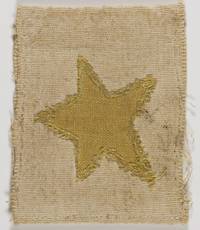
194353630Tunisia 1943. Nearly Fine. Five-pointed yellow cloth star sewn onto plain beige cloth 7.3 by 9 cm. Yellow dye somewhat faded else in fine state of preservation.<br /> <br /> Specimen of the yellow star imposed on the Jewish population of Tunisia in March 1943 as a mark of the slave laboror. Tunisia was the only Islamic country to come under Nazi rule at first indirectly through the Vichy regime in France between 1940 and its liberation by Allied forces on May 7 1943. In response to the Allied invasion of Algeria and Morocco German and Italian forces invaded Tunisia on November 9 1942. By the end of November the Germans took the first anti-Jewish move by arresting four of the community leaders including Moïse Borgel the president of the Jewish congregation. "In addition to the governor-general's sympathetic attitude -- and in some degree to the pro-Jewish attitude of Bey Sidi Mohammed al-Mounsaf -- the Italians also in practice interfered with the application of the anti-Jewish laws" E.H. The dignitaries were released after a week following the intervention of the mayor of Tunis and the Italian consul. Because of objections by the Italians the edict to wear the star does not appear to have been generally enforced with rigor and was only formally imposed in two cities Sfax and Tunis. While 5000 Jews had originally been put on forced labor in thirty locations and camps along the front line "at the time of the collapse and surrenter in early May 1943 only sixteen hundred Jews were employed on forced labor" E.H. Given the relatively small labor force and the lack of zeal in imposing the anti-Jewish ordinances it is clear why so few of these yellow badges have survived. References: I. Gutman ed. Encyclopedia of the Holocaust vol. 4 pp. 1521-23. unknown
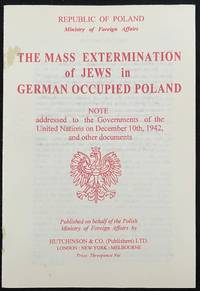
194343453London New York; Published on Behalf of the Polish Ministry of Foreign Affairs by Hutchinson & Co 1943. 1st edition. Original illustrated red and white paper wrappers. 8vo. 16 pages. 22 cm. National Government Publication. Printed in red and black ink. Includes a note by Polish Foreign Minister Edward Raczynski and speeches by Deputy Prime Minister Stanislaw Mikolajczyk.<br> The official 16-page diplomatic publication from December 1942 by the Polish Government-in-Exile in London marking a turning point in international understanding of the Nazi destruction of the Jews of Europe. <br> Jan Karski a courier for the Polish Underground had smuggled microfilmed evidence and intelligence out of occupied Poland to London. This raw intelligence gathered from his time secretly inside the Warsaw Ghetto and the Izbica transit camp formed the core of the facts published in the booklet.<br> <br> "In October 1942 at the height of the destruction of Polish Jewry Jan Karski born Jan Kozielewski was ordered to clandestinely go to the West and deliver a report on the situation of occupied Poland to the Polish government-in-exile in London. The situation of the Jews in Poland was to be one section of that report. Since the government in exile was concerned with the internal politics of Poland's underground parties Karski held meetings with the different factions including the Jewish Zionist and the Jewish Socialist Bund movements. <br> Thus shortly before his departure Karski met with two Jewish leaders who asked him to inform the world's statesmen of the desperate plight of Polish Jewry and of the hopelessness of their situation. Their message was: 'Our entire people will be destroyed.'<br> The Jewish leaders' appeals touched Karski and he decided to see things with his own eyes in order to make his report. With great risk to his life he was smuggled into the Warsaw ghetto and into a camp in the Lublin area. The horrors he witnessed marked him deeply and propelled him to become not only the messenger of the Polish underground but to concentrate on giving voice to the suffering of the dying Jews.<br> In November 1942 Karski reached London delivered the report to the Polish government-in-exile and set out to meet Winston Churchill other politicians journalists and public figures. Upon completing his mission Karski went on to the United States where he met with President Roosevelt and other dignitaries and tried in vain to stir up public opinion against the massacre of the Jews. In 1944 while in the United States Karski wrote a book on the Polish Underground Story of a Secret State with a long chapter on the Jewish Holocaust in Poland.<br> After the war Karski stayed in the United States where he was later appointed Professor at Georgetown University Washington DC.<br> On 2 June 1982 Yad Vashem recognized Jan Karski as Righteous Among the Nations" Yad Vashem. <br> <br> Leading Holocaust scholar Lucy Dawidowicz cites the booklet in her now classic work "The Holocaust and the Historians" Harvard 1983 p. 167; the report could not be more explicit in its description of the horrors nor in its plea for help: <br> "The new methods of mass slaughter applied during the last few months confirm the fact that the German authorities aim with systematic deliberation at the total extermination of the Jewish population of Poland and of the many thousands of Jews whom the German authorities have departed to Poland from Western and Central European countries and from the German Reich itself. The Polish Government considers it their duty to bring to the knowledge of the Governments of all civilised countries the following fully authenticated information received from Poland during recent weeks which indicates all too plainly the new methods of extermination adopted by the German authorities." <br> The report elaborates: "The actual process of deportation was carried out with appalling brutality. At the appointed hour on each day the German police cordoned off a block of houses selected for clearance entered the back yard and fired their guns at random as a signal for all to leave their homes and assemble in the yard. Anyone attempting to escape or to hide was killed on the spot. No attempt was made by the Germans to keep families together. Wives were torn from their husbands and children from their parents. Those who appeared frail or infirm were carried straight to the Jewish cemetery to be killed and buried there. <br> On the average 50-100 people were disposed of in this way daily. After the contingent was assembled the people were packed forcibly into cattle trucks to the number of 120 in each truck which had room for forty. The trucks were then locked and sealed. The Jews were suffocating for lack of air. The floors of the trucks were covered with quicklime and chlorine. As far as is known the trains were dispatched to three localities - Treblinka Belzec and Sobibor to what the reports describe as 'Extermination camps.' <br> The very method of transport was deliberately calculated to cause the largest possible number of casualties among the condemned Jews. It is reported that on arrival in camp the survivors were stripped naked and killed by various means including poison gas and electrocution. The dead were interred in mass graves dug by machinery." <br> <br> Read more about the singular importance of this publication at <br> en.wikipedia.org/wiki/The_Mass_Extermination_of_Jews_in_German_Occupied_Poland# . <br> In 2020 Polish Postal authorities chose this very publication to illustrate their official first day cover honoring righteous Poles who had saved Jews during the Holocaust see illustration. <br> <br> Subjects: World War 1939-1945 - Jews - Poland. World War 1939-1945 - Poland - Atrocities. Holocaust Jewish 1939-1945 - Poland. Jews - Poland. OCLC: 234118765. <br> Touch of staining at staples without the rust almost always seen in other surviving copies. Very Good condition. A copy with rust stains sold in 2018 at auction for over £6000. Rare and very important. BHOLO2-97-48-MMXRLADFACC. London, New York; Published on Behalf of the Polish Ministry of Foreign Affairs by Hutchinson & Co unknown
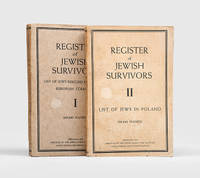
1945193462Jerusalem: Published by the Jewish Agency for Palestine / Search Bureau for Missing Relatives 1945. The search for the living First edition of the first major attempt to reunite Jewish families after the Holocaust listing 118000 survivors and their locations. Almost immediately after the war localized lists were published recording survivors from particular camps ghettos and countries. The Jewish Agency for Palestine established the Search Bureau for Missing Relatives to draw these efforts into a comprehensive register. The introduction notes it was published to "facilitate the re-establishment of contact between the remnants of Jewry in Europe and their relations in the Land of Israel and overseas. The Register contains the names of 60000 Jews of various countries saved from the camps and the ghettos who have been registered wherever they were were found following the liberation of Europe from Nazi servitude". It nevertheless cautions readers not to give up hope if a name is absent given the difficulty of compilation amid the chaos of postwar Europe. Lists also appeared in the weekly bulletin Lakarov Ulerahok while search requests were broadcast on Kol Yerushalayim in Jerusalem. Despite the suggestion of "forthcoming volumes" no further were produced. During its years of operation 1945 to 2002 the Bureau handled more than a million enquiries. The volumes are scarce on the market with most surviving copies held institutionally. They remain important reference works for those tracing relatives. 2 vols octavo. Original brown wrappers lettered in black. Contemporary Hebrew library stamps to title page of the Search Bureau for Missing Relatives; residue of removed labels to front covers. A little toned with minor wear remnants of the paper ties as issued to title pages wrappers of vol. I a little loose with some gatherings shaken. A good set of a fragile publication. unknown
8vo; 1st edition. Original printed paper wrappers, 4to (large), ca 50 pages per issue. In Yiddish. Title translates as, Existence: A Monthly Journal for Literature, Culture and Societal Problems. Tipped in Woodcut Ex-libris by A. Kolnik on cover of issue of 1949, #2-3; additional tipped in illustration on cover of 1949, # 4. Kiyum was a Yiddish monthly started by survivors in Paris, running 1948-1960; Succeeded by Unzer kiyum. Writing in 1952 about the Jewish periodicals in France over the preceding year, the American Jewish Year Book noted, "Particularly worthy of note was Kiyoum ("Existence"), a Yiddish monthly published by the Federation des Societes Juives de France, under the editorship of Israel Jefroykim. This magazine, which devoted its pages to the problems of continuity and creativity in Jewish life, had become one of the best of the serious magazines in Yiddish." [France," in The American Jewish Year Book, Vol. 52 (1951), p. 283]. SUBJECT(S): Jews -- Periodicals. Yiddish literature -- Juifs -- Pe´riodiques. Litte´rature yiddish. OCLC: 10153490. Some covers, on heavy paper, have become fragile and detached, or show other light edgewear, though most remain quite Good. Text pages are also browning, as expected, but remain generally free of chips and breaks. A very nice set (yid-42-25-L-xcce)
First edition. Original red boards with gold font. 4to, 150 pages, 32cm. Loaded with full page graphic anti-Nazi posters advocating American multiculturalism and promoting the US war effort, as well as drawings depicting Nazi atrocities, and photographs of B'nai B'rith leaders and other Jewish organizations, each graphic sponsored by a different Jewish business or family. Includes full page statement with photograph by Humphrey Bogart. Illustrated Diary of Events of the First Five Years of Westchester Lodge. Features quote by and portrait of Franklin Roosevelt, as well as stories, newspaper headlines, articles, and accounts of WWII and the people who fought to save Jews under the Nazi regime. We do not often see locally produced and focused material on Jews from a town or county fighting the Nazis SUBJECT(S) : World War II, American War Efforts, Jews. OCLC lists 4 holdings worldwide (NYPL, Fordham, HUC, Virginia Tech) , none west of Cincinnati. Slight toning to pages. Library stamp, some dust on original cover boards. Very good condition. Page after page of gorgeous Anti-fascist propaganda from the period! Scarce and important (Holo2-133-12)
1st edition. Original Boards in dust jacket. 8vo. [4], 104 pages. 19 cm. Fold out map by Kaufman titled, Map Showing Possible Dissection of Germany and Apportionment of Its Territory. This famous polemic outlines a comprehensive plan for the extinction of the German nation and the total eradication from the earth, of all her people. (Back cover) Self-published and at first obscure, this anti-German book became a central strategic piece for infamous Nazi propagandist Joseph Goebbels, who referenced the book throughout World War II claiming it as proof of a Jewish threat to Germany, writing in his diary August 3, [1941], He really could not have done it better and more advantageously for us if he had written the book to order. I will have this book distributed in millions of copies in Germany, above all on the front, and will write a preface and afterword myself. It will be most instructive for every German man and for every German woman to see what would happen to the German people if, as in November 1918, a sign of weakness were given. (Herf, page 112, The Jewish Enemy) However, this mass publication plan never came to fruition, because Goebbels feared copyright problems. The U.S. was still not in the war, and he worried that the U.S. might retaliate by stripping German works in the U.S. of copyright protection. (Bytwerk, 2012) Instead, edited and editorialized selections of the book were published in the widely circulated Nazi pamphlet DAS KRIEGSZIEL DER WELTPLUTOKRATIE alongside claims that Kaufman was a close associate of Franklin D. Roosevelt, a member of his Brain Trust, and that Roosevelt himself had dictated some of Kaufmans words. (Bytwerk, 2012). Theodore Newman Kaufman (1910 -1986; his middle name sometimes given Nathan), was an American Jewish businessman, born to German-Jewish immigrant parents, who became known for his genocidal views on Germans. In 1941, he wrote and published Germany Must Perish! which called for the sterilization of the German people and the distribution of the German lands. The text was used extensively in Nazi propaganda, often as a justification for the persecution of Jews and was specifically cited as a reason to round up the Jews of Hanover, Germany .Kaufman was a radical intent on preventing American involvement in future wars in Europe. In 1939, under the auspices of the American Federation of Peace, an unknown entity of which he was the president and probably only member, Kaufman produced several publications. One pamphlet .read:A possible plea to Congress. ... Have Us All Sterilized! ... If You Plan On Sending Us To A Foreign War ... Spare Us Any Possibility Of Ever Bringing Children Into This World Into This Country Of Ours!It was with his famous fold-out map in Germany Must Perish, that Kaufman Germany and Austria showed how Germany and Austria could be dismembered; In those same pages he also advocated the forced mass-sterilization of all German men under 65 and the sterilization of most German women under 45. This would eliminate 'inbred Germanism,' he proposed, thus solving a great deal of humanity's problems. He also promoted the distribution of Germany's lands among the neighboring countries, illustrated in his famous map in his book. Indeed, His effort was spearheaded by the self-publication of the book Germany Must Perish! 'Since Germans are the perennial disturbers of the world's peace ... they must be dealt with like any homicidal criminals. But it is unnecessary to put the whole German nation to the sword. It is more humane to sterilize them. The army groups, as organized units, would be the easiest and quickest to deal with. ... The population of Germany, excluding conquered and annexed territories, is about 70,000,000, almost equally divided between male and female. To achieve the purpose of German extinction it would be necessary to only sterilize some 48,000,000 -- a figure which excludes, because of their limited power to procreate, males over 60 years of age, and females over 45. ...Complete sterilization of both sexes, and not only one, is to be considered necessary in view of the present German doctrine that so much as one drop of true German blood constitutes a German..... Kaufman's book gained attention in Nazi Germany, where propagandists used it as evidence of an international Jewish plan to destroy the German people. On July 24, 1941, the Nazi Party's newspaper, Völkischer Beobachter, published a front-page article on the book titled: 'The Product of Criminal Jewish Sadism: Roosevelt Demands the Sterilization of the German People.' The newspaper alleged that Kaufman was a close ally of Samuel Irving Rosenman, an advisor to Franklin Delano Roosevelt and that: 'Given the close relationship of the writer to the White House, this monstrous war program can be seen as a synthesis of genuine Talmudic hatred and Roosevelt's views on foreign policy.' At the time, the German leadership was engaged in a propaganda campaign designed to rally popular support for the German invasion of the Soviet Union. Antisemitism in general, and Kaufman's ideas in particular, became a focus of this campaign.Nazi Propaganda Minister Joseph Goebbels read the book in early August and immediately grasped its value, writing in his diary: 'This Jew did a real service for the enemy [German] side. Had he written this book for us, he could not have made it any better.' Under Goebbels' direction, Germany Must Perish! continued to receive significant media attention in Germany. Portions of the book were read on national radio, and Goebbels ordered the printing of five million copies of a pamphlet that summarized Kaufman's ideas.As an example, Kaufman was condemned on the August 1942 edition of the Nazi wall newspaper Parole der Woche [see photo] Nazi propaganda often used Kaufman's pamphlet as a justification for the persecution of Jews. When the Nazis required German Jews to wear a yellow badge on their clothing on September 1, 1941, they published a flyer explaining to the German people that those individuals wearing the star were conspiring to implement Kaufman's plan for the destruction of Germany. When the Jews of Hanover were forced from their homes on September 8, 1941, German authorities cited Kaufman's book as one of the reasons .The Nazi propaganda ministry continued to publish pamphlets, posters and flyers on Kaufman's ideas through the end of the war, and also urged newspapers and public speakers to remind Germans of Kaufman's book. Kaufman's last major appearance in Nazi propaganda occurred in late 1944, when a five-page section on him was included in the widely published booklet Never!, which described a number of alleged plots to destroy Germany. Randall Bytwerk, an historian of communications at Calvin College, concluded that '[a] German at the time could not have missed encountering' propaganda about Kaufman. The Nation Magazine (Nov 14, 1942) noted, Few Americans have ever heard of a prominent fellow-citizen named Kaufmann ... In Germany every child has known of him for a long time. Germans are so well informed about Mr. Kaufmann that the mere mention of his name recalls what he stands for. In one of his recent articles Dr. Goebbels wrote, 'Thanks to the Jew Kaufmann, we Germans know only too well what to expect in case of defeat.' (Wikipedia) "On 1 September 1941 all Jews remaining in Germany were forced to wear the Yellow Star when in public. In late September 1941, the Nazis released a remarkable mass pamphlet based on a book published in the United States titled 'Germany Must Perish!' The book proposed the partitioning of Germany and the sterilization of its population. The author, Theodore N. Kaufman, was an American Jew of no influence. The pamphlet, titled 'The War Aim of World Plutocracy,' [see photo] included excerpts from Kaufmans book. In early November 1941, this four-page flyer was released. It justified the Yellow Star by reminding Germans of Kaufmans pamphlet, which supposedly was the common goal of 'World Jewry.' Howard K. Smiths 1942 book Last Train from Berlin (p. 197) states that every German got copies of the pamphlet along with the monthly ration card" (Calvin College German Propaganda Archive, 2022). Includes bibliographical references on page 104. SUBJECT(S): World War, 1939-1945. Guerre mondiale, 1939-1945. Politics and government National socialism -- Foreign public opinion, American. Pangermanism. National characteristics, German. Germans -- Foreign countries. -- Reparations. Reconstruction (1939-1951) -- Germany. Allemagne -- Politique et gouvernement. In 25 years this is only the 3rd copy of the 1st edition, in hardback, we have ever seen, and only the second in a dust jacket. The 96 page paperback second edition, though scarce, is far more common. Later reprints of American Neo-Nazi groups were distributed to "prove" Goebel's claims about the Jewish conspiracy against Germany. (More at https://research.calvin.edu/german-propaganda-archive/kriegsziel.htm; https://en.wikipedia.org/wiki/Germany_Must_Perish!) OCLC: 3619129. Dust Jacket in about very good condition with light edge wear, protected in mylar cover. Light shelf wear. Some discoloration to end pages Binding is tight. Text block is fresh and clean. Very good + condition in about Very Good Jacket. Rare and important (HOLO2-109-62-AELXCC+)
xviii, 222 pages. Black and white photographic plates. "When the Germans invaded Hungary in 1944, they immediately shipped virtually the entire Jewish population to Auschwitz. Separated from his family, Dr. Miklos Nyiszli [1901-1956] was chosen to direct the medical pathology work carried on among the prisoners by the Nazis for the purpose of 'scientific research' in that most infamous of all concentration camps. Through the doctor's eyes, we relive not only the day-to-day horrors of life in the KZ but also witness the slow disintegration of an empire built to last a thousand years. What Dr. Nyiszli lived through few will want to believe or even read about." - dust jacket. "Tells of events which, though gruesome, need to be told and retold until their meaning for our times is accepted." - Foreword. Tight and square with moderate external wear. Foxing to top edge. Prior owner's details written and stamped upon front endpaper. Name stamped on top edge. Average wear to dust jacket which is now preserved in archival-grade Brodart. A sound copy of this important account. Laska 1317, Enser p.114. Book
1st edition. Folio. Newspaper. Illustrated throughout. Includes many advertisements and numerous personal family announcements. Following the Kristallnacht pogroms of November 1938, Jewish life in Germany and Czechoslovakia was even further curtailed and all remaining Jewish newspapers were shut down by the government. In their place, the Nazi Party ordered the creation of a single, new Jewish newspaper, "Das Jüdische Nachrichtenblatt, " that would be directly under Gestapo control. It was published concurrently in Berlin, Vienna and Prague and was occupied to a large extent with announcing the ever-increasing number of anti-Semitic discriminations, orders and exclusions imposed by the Reich government. Over the course of its history, the editors of the Jüdische Nachrichtenblatt were Leo Kreindler (1938-42) and Willi Pless (1942-43) . The Berlin edition ran from the 23rd November, 1938 until the final issue of 4th June 1943. The Prague edition continued until 1945. In a ghoulish twist of Nazi irony, Gentiles were forbidden from reading the Jüdische Nachrichtenblatt yet the newspaper's targeted readership, the Jews, were literally hounded to their deaths by the very authorities who presided over the newspaper's ownership! See Reiner Burger, Von Goebbels Gnaden: "Jüdisches Nachrichtenblatt" 1938-1943 (2001) . A mixed collection of 102 issues from Berlin and Prague sold at auction in 2015 for 9225.00 USD. These issues were at one point bound, but the binding was at some point removed. The newsprint is brown and quite fragile, with edgwear and old dampstains, but there is generally little text loss, except to a few letters on the lower outer margins of the final 10 issues. Now housed in an acid-free sleeved portfolio, with each issue in a separate clear sleeve for easy protected viewing. Fair condition, but very rare, very important, and very powerful. (kh-5-47)
10095Antwerpen1985 t/m 1992 diverse formaten geniet of gebrocheerd gelezen staat naam vorige eigenaar - unknown
5704 (1944). Original blank paper wrappers. 8vo. 64 pages. 21 cm. Reprinted in early 1944 for Jewish refugees in Switzerland with some additional notations. In Hebrew and German in parallel columns (with diacritic vowel marks under the Hebrew, and with Yiddish translation between Hebrew). Original 1938 title page, with verso 1944 German title page: Den jüdischen Flüchtlingen in der Schweiz; Zur Feier des [Pesakh]-Festes im Jahre 5704; überreicht vom Schweizerischen Israelitischen Gemeindebund. (For the Jewish Refugees in Switzerland; For the celebration of Pesakh in the year 5704; presented by the Swiss Federation of Jewish Communities). Copyright by Lehrberger & Co. of Frankfurt. A European-published hagada from the darkest period of the Holocaust, produced specifically for those feeling the inferno. During 1943 and 1944, the extermination camps were working at a furious rate to kill the hundreds of thousands of people shipped to them by rail from almost every country within the German sphere of influence, and by the spring of 1944, up to 8,000 people were being gassed every day at Auschwitz (USHMM, 2012). Passover 1944 began on April 8, the day that the roundups of the Jews of Carpatho-Ruthenia and northern Hungary started. On April 14, the last day of the Holiday, László Endre & László Baky (German-installed heads of the Ministry of the Interior) and Eichmann made the official decision to deport all the Jews of Hungary. With ten illustrations; an early 19th century German Orthodox Haggadah originally compiled by Wolf Heidenheim in 1822. Published for German-Jewish refugees in Switzerland under the auspices of the Swiss Federation of Jewish Communities, founded in 1904 to help protect the general interest of Jews in Switzerland; during the second world war, the Federation helped support the refugee community in Switzerland: Prior to and during the Second World War, Switzerland gave refuge to about 23,000 Jewish refugees although the government decided that Switzerland would serve only as a country of transit. These Jews were protected during the Holocaust due to Swiss neutrality. The Jewish refugees, however, did not receive the financial support from the government that non-Jewish refugees received. Many more Jews were prevented from entering, effectively shutting the border. (Jewish Virtual Library; Switzerland). The publishers, Goldschmidt, issued an earlier printing in 1940 (listed in one library on OCLC), no copies of this issue (1944) listed in libraries on oclc. Subjects: Haggada shel Pesah. German-Jewish Refugees - Schweizerischen Israelitischen Gemeindebund. Holocaust. Previous Owner's name on front wrappers, with "Zurich 5" written underneath. Wraps lightly soiled, with small tear at bottom of backstrip; otherwise Very good condition. Rare and important. (HOLO2-104-15)
1st Edition. 4to. Later Blue Boards with Original Wrappers bound inside for each issue. A full run of the first 3 years of The Jewish Tribune, from the year 1933 to 1936. 36 issues in total running about 1100 pages. Note that though these are consecutive they are marked as Volumes 1, 2, and 6. Includes a 1934 article titled, The Holocaust in Germany, " an EXTREMELY early use of this term to describe the growing attacks on the Jews of Germany by the Nazis. This rare run of the first three years of Bombays first Zionist periodical is inscribed by Joseph Sargon, who worked as managing editor of the Jewish Tribune during the publication of these issues. Born and educated in Bombay, Mr. Sargon came to the United States in 1939 (land lived in Brookline) after serving as managing editor of the Bombay Jewish Tribune for 13 years. During his world travels, he interviewed and wrote articles about Mahatma Gandhi, Pandit Nehru and other figures. (Boston Globe, 1990) The Bombay Tribune was established by the nephews of Nissim Elias Benjamin Ezra. N. E. B. Ezra, was a Baghdadi Jewish publisher and Zionist based in Shanghai. He founded the Shanghai Zionist Association in 1903 and its official newspaper, Israel's Messenger, one of China's oldest and most sophisticated Jewish periodicals Influenced by Ezra, his nephews started the newspaper Jewish Tribune in Bombay, India. (Wikipeida, 2017) These 36 issues of the Tribune include the 1st appearance of many articles and editorials from some of the leading Jewish thinkers from across the world including: NEB Ezra, Bernard S. Deutsch, Rabbi Julius J. Price, Haham Moses Gaster, Emanuel Neumann, Israel Cohen, Khan Bahadur Jackson B. Israel, Jl Magnes, Samuel Magnus, David Sassoon, Rabbi Leo Jung, Jl Landau, Rabbi Schlesinger, Laszlo Schwartz, Louis Golding, Jh Hertz (Then Chief Rabbi Of British Empire) , Jacob De Haas, Rabbi D. De Sola Pool, Edward Jacobs, Mrs. Israel Davidson, Lily Tobias, H. Pereira Mendez, Rabbi Benjamin Ouziel, and Cyrus Adler. Includes a few early reporting articles about Nazi Anti-Semitism, early reporting on the 1934 Nepal-Bihar Earthquake, and a few articles about Mahatma Gandhi, among other topics of Jewish and Zionist interest. Period Advertisements throughout. OCLC lists 12 copies worldwide. Ex-library with Jewish Institutional Bookplate and Usual Markings. Inscribed by Sargon on the Front-End Page. Also includes Sargons Personal Bookplate/Nametag. Damp Stains throughout and pages are wavy. Some edgewear. Overall in good condition. (SEF-55-8B)
1st edition. Portfolio, Folio-size, [4] p., xvi leaves of plates, all illustrations. 32 cm. Text in Polish . 16 duotone watercolors of camp life, each accompanied by a textual description of a paragraph or two in the introduction. SUBJECT(S): Geographic: Oranienburg (Concentration camp) -- Pictorial works. Sachsenhausen (Brandenburg, Germany : Concentration camp) -- Pictorial works. OCLC lists only 3 sets worldwide (Yale, U of Illinois, NANTERRE-BDIC in France), none in New York and None in Poland. Extremely scarce. Some images from this portfolio (not originals, but prints, from this very edition, the same as these) are on display via the Museum of the Jews in Poland (in Warsaw) Former owner's numbers in margins of plates, not affecting images. Plates and introduction in Good Condition; Original portfolio with dramatic color graphic on cover is present, but lacks spine and shows heavy wear. (holo2-125-9)
1st edition. Loose sheets as issued, in later custom clamshell box with original portfolio cover mounted on front. 4to. One of 3200 Numbered Copies. 111 plates of drawings, the first 100 relating to Buchenwald, plus 6 portraits, and 5 aquarelles in color. Captions in French, English, and Russian. 26 cm. Title page and preface in French. Boris Taslitzky began painting at the age of fifteen and attended the academie Montparnasse and the École des Beaux-Arts in Paris between 1925 and 1933. In 1933, he joined the Association of Revolutionary Writers and Artists (A. É. AR) where he became general secretary of the section of Painters and Sculptors, and then in 1935, he joined the Communist Party. In 1936, during the presentation of Quatorze Juillet, by Romain Rolland , Taslitzky participated in the exhibition that brought together Picasso , Léger , Matisse , Braque , Jean Lurcat , Laurens and Pinion in the lobby of the Alhambra Theatre. Taslitzky was captured in June 1940, escaped in August and joined the Resistance. He was arrested again in November 1941, sentenced to two years in prison, and then on July 31, 1944 was deported to Buchenwald , where he manages to make some two hundred drawings showing life in the camps. "If I go to hell, I will make sketches. Besides, I have experience, I've been there and I've drawn! ... ", he later said. His mother died at Auschwitz . In 1946, Taslitzky exhibited his works which were inspired by the Resistance and Deportation, winning the Prix Blumenthal. He was later awarded the Military Cross and Military Medal and in 1997 he received the insignia of Chevalier of the Legion of Honour under the Resistance and Deportation. He was both witness and actor in the story of French Resistance and the Holocaust. SUBJECT(S) : Concentration camps -- Pictorial works. Buchenwald (Camp de) Guerre mondiale 1939-1945. Prisonniers et déportés. Camps allemands. Buchenwald. Album. Concentration camps. Pictorial works. Wear to original illustrated cover, which has been mounted on front of box, but no damage to illustration. Moving, early, and important. (holo2-125-44) xx
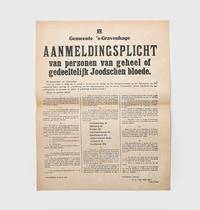
1941167943The Hague: City Legislative Board 31 January 1941. Laying the groundwork for the Holocaust in the Netherlands A significant step in the implementation of the Holocaust in the Netherlands - a broadside ordering all Jews in The Hague to register with the authorities. The broadside was issued in the name of The Hague mayor Cornelis Lodewijk van der Bilt on the order of the Reich Commissariat for the Occupied Dutch Territories. Similar orders were made by municipal bodies across the Netherlands. Headed in Dutch "Obligation to register persons of wholly or partly Jewish blood" it states that anyone with one Jewish grandparent must register by 21 February 1941. Each person will be issued with a certificate which must be shown to authorities on request. Those who do not register are liable to a five-year prison term and confiscation of assets. The move was part of an ongoing campaign against the Jews in the Netherlands that began shortly after the Nazi invasion in May 1940. Registration was with the mayor's office - the poster attests to the co-operation forced or otherwise of existing political structures. Almost all Dutch Jews did comply with the order. Deportations from the Netherlands began in Summer 1942 and was effectively completed by September 1944; less than a quarter of Dutch Jewry who fled the country or hid with supporters survived the Holocaust "The Netherlands" Holocaust Encyclopedia accessible online. Poster 280 x 229 mm printed in black verso blank. A couple of minor creases else very good. unknown
Original Wraps. 4to (large) . 48 pages. 30 cm. First edition. In French. Rare extremely early (1945) illustrated French Exposition of Nazi Crimes. Catalogue, in magazine format, of Nazi crimes; illustrated throughout; with testimony, articles, and prefatory declarations by P. Teitgen, Bidault, Soustelle, and Frenay, denouncing the Nazi Crimes. Illustrated throughout; emphasizes the crimes of Vichy as well. Publié à l'occasion de l'exposition 'Crimes hitlériens'-Déclarations, articles, souvenirs. Sections as follows: l'allemagne et le nazisme, l'ordre hitlérien (congrès de Nuremberg, charnier de Belsen) Mensonges et pattes de velours, le vol de la terre, la guerre biologique, avec une composition de Paul Colin, pleine page, SS et gestapo, Buchenwald, témoignages de ceux qui "en" sont revenus, camp de femmes , l'homme cobaye, bloc 46, le criminel de guerre. [Published on the occasion of the exhibition 'Crimes hitlériens' Declarations, articles, memories. Sections as follows: Germany and Nazism, Hitler's order (the Nuremberg Congress, the grave of Belsen) Lies and velvet paws, theft of land, biological warfare, with a composition of Paul Colin, full screen, SS and Gestapo, Buchenwald, testimonies of those who survived, the women's camp, the pig man, block 46, the war criminal. ]Subjects: Guerre mondiale 1939-1945. Atrocités allemandes. OCLC lists only one copy worldwide (Nanterre) , located in France. Scarce. Damage to lower left coner, no loss of text, otherwise, Very Good Condition. (HOLO2-117-4)
1st edition. Original paper wrappers, 12mo, 32 pages, chiefly photographic illustrations. 16 cm. Exhibition of Photographic Images of German Concentration Camps and Destroyed Arnhem. Catalog for the exhibition, with 24 pages of full-page photos, plus 8 pages of photo descriptions. Text in Dutch. On page 10 is the famous and controversial photo of the Nobel Laureate Elie Wiesel in Buchenwald (first published in the "New York Times" on May 6, 1945 with the caption "Crowded Bunks in the Prison Camp at Buchenwald" taken inside Block 56 by Private H. Miller of the Civil Affairs Branch of the U. S. Army Signal Corps on April 16, 1945.) . In the year following the defeat of the Nazis, exhibitions of photos showing the horrors of the Concentration Camps were a way to show the people of Europe what had been done by the Germans and their allies, and, eventually, to build support for the idea of War Crimes trials. Foto's ... Afgestaan door de U. S. I. S. (United States Information Service, Photographic Section, Amsterdam) en Jan Schiet, fotograaf, Amsterdam. Despite the title, there are no pictures nor text referring to Arnhem in the bookonly from the concentration camps. The Arnhem material may have appeared only in the exhibition itself. OCLC lists only 4 copies worldwide, all in the Netherlands (Sept 2015) . Blue wrappers are sunned with some spotting, spine repaired, otherwise Very Good Condition. Rare and important. (holo2-126-33A) xx
1st edition. Original paper wrappers, 12mo, 32 pages, chiefly photographic illustrations. 16 cm. Exhibition of Photographic Images of German Concentration Camps and Destroyed Arnhem. Catalog for the exhibition, with 24 pages of full-page photos, plus 8 pages of photo descriptions. Text in Dutch. On page 10 is the famous and controversial photo of the Nobel Laureate Elie Wiesel in Buchenwald (first published in the "New York Times" on May 6, 1945 with the caption "Crowded Bunks in the Prison Camp at Buchenwald" taken inside Block 56 by Private H. Miller of the Civil Affairs Branch of the U. S. Army Signal Corps on April 16, 1945.) . In the year following the defeat of the Nazis, exhibitions of photos showing the horrors of the Concentration Camps were a way to show the people of Europe what had been done by the Germans and their allies, and, eventually, to build support for the idea of War Crimes trials. Foto's ... Afgestaan door de U. S. I. S. (United States Information Service, Photographic Section, Amsterdam) en Jan Schiet, fotograaf, Amsterdam. Despite the title, there are no pictures nor text referring to Arnhem in the bookonly from the concentration camps. The Arnhem material may have appeared only in the exhibition itself. OCLC lists only 4 copies worldwide, all in the Netherlands (Sept 2015) . Blue wrappers are sunned with some spotting, otherwise Very Good Condition. Rare and important. (holo2-126-33) xx
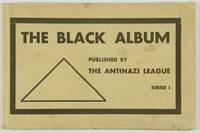
194054535Tel Aviv: The Antinazi League/ The Anti-Nazi League 1940. First edition. Softcover. g- to vg. Oblong 32mo. 8 text leaves 10 postcards. Unpaginated. Illustrated tan wrappers with black lettering on the covers. The work is a collection of 10 illustrated Anti-Nazi postcards issued by the Anti-Nazi League in Tel Aviv. <br /> <br /> This scarce collection of postcards contains some of the earliest photo-documentations visual depictions and statements on Nazi atrocities and oppression during the Holocaust some of which interestingly utilize photomontage techniques. Scenes depict hangings murders forced labor starvation displacement and cremations of Nazi victims. The text captions underneath each of the images are in English. Most of the text of the printed pages is bilingual including covers foreword publisher's statements and publication information in both Hebrew and English. There are two printed lists of images one in Hebrew and one in French. Each of the postcards have a perforated edge where they attach to the album. Only the first card is still attached. The rest are loose but unused. Each of the postcards measure approx. 5.4x4".<br /> <br /> As stated by the publisher the organization had "been established in Palestine with the object of promoting the foundation of a mass organization for propaganda against Nazism and racial hatred". They further state that the "publishing of the Black Album and sending the cards contained therein to friends all over the world are first steps to making the public participate in our struggle for truth against Nazi barbarism."<br /> <br /> Wrappers age toned with some staining and water spots to the English cover. Corners lightly rubbed. Interior with light foxing to the first text leaf.<br /> <br /> Other than some expected age toning the cards themselves and images are clean and in very good shape overall. 4 postcards #3-6 have been detached from the perforated edge but are present. Complete with all cards present. Wrappers in good- interior in very good- condition overall. Quite scarce. Hebrew title: ×”××œ×‘×•× ×”×©×—×•×¨. The Antinazi League/ The Anti-Nazi League unknown
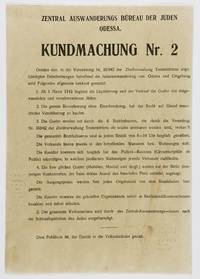
194251752Odessa: Zentral Auswanderungs Büreau 1942. Original document. Loose leaf. Very good condition. Quarto. Original loose leaf with black lettering. Announcement based on ordinance no. 35/942 of the civil government of Transnistria relating to the emigration of Jews in Odessa and surrounding areas. <br /> <br /> The text printed biligually in German and Ukrainian is organized into five statements. The annoucement concerns the liquidation and sale of goods of emigrated or vanished Jews beginning on March 1 1942 with the whole population without limitations given the right to buy these items based on oral agreements. Furthermore the announcement regulates details and procedures of the sale and at the end announces that after the sale proceeds will by handed to the Jews by the Central Emigration Office.<br /> <br /> "The rapid development of Odessa began after the Russian conquest 1789. Its Jewish population also grew quickly and in the late nineteenth and early twentieth centuries it was the most important Jewish literary community after Warsaw. In 1926 there were 153194 Jews in Odessa 36.4 percent of the total population and by 1939 their numbers reached 180000." Encyclopedia of the Holocaust Vol. 3 page 1080.<br /> <br /> When Romanians and Germans laid siege to the city on August 5 1941 many Jews in Odessa managed to leave and eighty to ninety thousand Jews remained in the city. Odessa fell on October 16 and the German Einsatzkommando 11b and the Romanian intelligence service immediately slaughtered over eight thousand residents mainly Jews and Odessa was established as the capital of the Transnistria region. On October 22 the Romanian military headquarters were blown up killing sixty-six officers and the military governor. In reprisal the Romanian ruler Ion Antonescu ordered devastating retaliation including the arrest of one member of each Jewish family. By October 1941 some 40000 Jews were assembled in the ghetto of the nearby city of Slobodka and their valuables confiscated. Deportations of some 20000 Jews began in January of 1942. When Odessa was liberated on April 10 1944 authorities reported that about 99000 Jews had been killed. Odessa again became an important Jewish center with 102000 Jews living there according to a 1959 census.<br /> <br /> Considering the context of "Kundmachung Nr. 2 the Odessa massacre of October 22-24 1941 and the murder of Jews living between the rivers Dniester and Bug during the Romanian and German occupation this succinct notice including its misspellings and mistakes in the German language is a chilling mirror image of the attitude shown by the occupying powers towards the Jews. Approximately 30000 Jews were killed in Odessa and more than 100000 in Transnistria. <br /> <br /> The text is printed in German on one side and Ukrainian on the verso. Minor wear and smudging. Protected in modern mylar. Zentral Auswanderungs Büreau unknown
69182New York: Raw Books & Graphics 1986. Very Good. Slim folio 36 cm Saddle-stitched illustrated wraps. Wraps lightly rubbed. Moderate soiling to rear wraps of numbers 1 and 3.<br /> <br /> Volume 1 Number 1 Fall 1980. "Two-Fisted Painters" by Art Spiegelman booklet.<br /> <br /> Volume 1 Number 3. 1981. "Maus Chapter Two The Honeymoon" booklet.<br /> <br /> Volume 1 Number 4. 1982. Vinyl record "Reagan speaks for himself" detached and laid in. "Maus Chapter Three Prisoner of War" booklet.<br /> <br /> Volume 1 Number 5. 1983. Couple by Art Spiegelman. "Maus Chapter Four The Noose Tightens" booklet. Stapled in a little loosely.<br /> <br /> Volume 1 Number 6. 1984. "Maus Chapter Five Mouse Tales" booklet.<br /> <br /> Volume 1 Number 7. 1985. "Maus Chapter Six Mouse Trap" booklet. "Red Flowers" booklet by Yoshiharu Tsuge. Deliberately issued by the publisher with a torn front wrap.<br /> <br /> Volume 1 Number 8. 1986. Jimbo by Gary Panter. "Maus Chapter Seven Mauschwitz" booklet. The first number along with six other issues of RAW Magazine Volume 1. Number 2 is not present. <br /> <br /> A very colorful and bold comics and graphics anthology edited by Art Spiegelman and Françoise Mouly a husband and wife team which highlighted artists from around the world and was published in the United States from 1980 to 1991. In addition to the work of Spiegelman and Mouly RAW featured cutting-edge comic artists such as Robert Crumb Gary Panter Charles Burns Kim Deitch Sue Coe Jerry Moriarty Richard Sala and Ever Meulen among many others. In these issues of RAW one will find Gary Panter's best-known comic protagonist "Jimbo" a burly punk and existential adventurer as well as "The Voice of Walking Flesh" by Charles Burns "Love's Savage Fury" by Mark Newgarden and a centerfold by Ever Meulen captioned "Use the Mood of the Past to Rewire Your Brain for the Future." Of significant importance is the fact that Art Spiegelman's seminal graphic work "Maus: A Survivor's Tale" made it's first appearance in this magazine chapters 2-7 are present here as stapled-in booklets. Spiegelman's unrivaled Holocaust narrative "Maus" was awarded the 1992 Pulitzer Prize it was the first graphic novel to win the Pulitzer Prize and he was the first-ever cartoonist to receive the prestigious Edward MacDowell Medal a medal awarded annually since 1960 to artists who have made an outstanding contribution to American culture.<br /> <br /> A nearly consecutive run of volume 1 of this trailblazing magazine with original serialized chapters of "Maus." "The Graphix Magazine for Your Bomb Shelter's Coffee Table." Number 4 front cover caption. Raw Books & Graphics unknown
Together 27 vols., 8vo., First Edition, with 2 large folding charts; original printed wrappers, one or two backstrips scuffed at head and tail else a remarkably well-preserved, bright, clean set. The extended set comprises: Part 1: 20 Nov 1945 to 1 Dec 1945 (1946); Part 2: 3 Dec 1945 to 14 Dec 1945 (1946); Part 3: 17 Dec 1945 to 4 Jan 1946 (1946); Part 4: 7 Jan 1946 to 19 Jan 1946 (1946); Part 5: 21 Jan 1946 to 1 Feb 1946 (1946); Part 6: 2 Feb 1946 to 13 Feb 1946 (1947); Part 7: 14 Feb 1946 to 26 Feb 1946 (1947); Part 8: 27 Feb 1946 to 11 March 1946 (1947); Part 9: 12 March 1946 to 22 March 1946 (1947); Part 10: 23 March 1946 to 3 April 1946 (1947); Part 11: 4 April 1946 to 15 April 1946 (1947); Part 12: 16 April 1946 to 1 May 1946 (1947); Part 13: 2 May 1946 to 13 May 1946 (1947); Part 14: 14 May 1946 to 24 May 1946 (1947); Part 15: 27 May 1946 to 6 June 1946 (1948); Part 16: 7 June 1946 to 19 June 1946 (1948); Part 17: 20 June 1946 to 1 July 1946 (1948); Part 18: 2 July 1946 to 15 July 1946 (1948); Part 19: 16 July 1946 to 27 July 1946 (1949); Part 20: 29 July 1946 to 8 August 1946 (1949); Part 21: 9 August 1946 to 21 August 1946 (1949); Part 22: 22 August 1946 to 31 August 1946; 30 Sept 1946 and 1 October 1946 (1950); Part 23: Index (1951). WITH Opening Speeches of the Chief Prosecutors (1946); Speeches of the Prosecutors against the Indicted Organisations (1946); Speeches of the Chief Prosecutors against the Individual Defendants (1946); Judgement of the International Military Tribunal (with the Dissenting Opinion of the Soviet Member) (1946). Volume 1 includes the folding chart of the organisation of the NSDAP; Volume 3 contains the folding chart of the organisation of the SS. EXTENDED SETS ARE EXCEEDINGLY SCARCE.