188 résultats
DADAX1442254351Rowman & Littlefield Publishers 2016-07-15. First Edition. hardcover. New. 6.19x0.72x9.35. Buy with confidence. Excellent Customer Service & Return policy. Rowman & Littlefield Publishers hardcover
194588770Cornell university press January 1945. Hardcover. Acceptable/No Jacket. Bookplate on inside cover with cellephane cover and tape to the bookplate. Spine is mildly shaken. Cornell university press hardcover
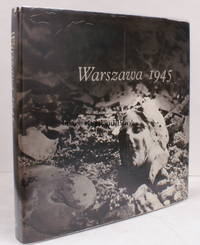
198521346Panstwowe Wydawnictwo Naukowe Warsaw 1985. 4to. First Edition with very numerous full-page photographs throughout; oatmeal Holland backstrip lettered in black black endpapers a near fine copy in unclipped dustwrapper the latter very lightly chafed at extremities. Comprehensive photographic survey with over 240 contemporary images of WWII destruction. Very scarce especially in this condition. Panstwowe Wydawnictwo Naukowe, Warsaw, unknown
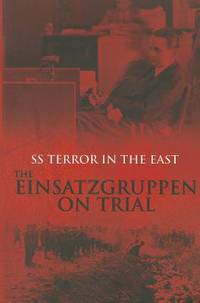
201325177Barnsley South Yorkshire : Pen and Sword Military 2013. softcover. small area of faint discoration to top and bottom edges of exterior not mildew or any progressive issue. minor impact. no other flaws or wear. no markings. no bumps tears creases. strong binding.; english text. 910pp. record of the post-war trial of the einsatzgruppen the highly organized mobile killing squads who operated in the soviet union and baltic states after the german invasion. First Edition Thus. Soft Cover. Very Good Plus. 8vo - over 7¾" - 9¾" tall. Pen and Sword Military Paperback
196625349New York: Praeger 1966. cloth hardcover in dust jacket. old dust-spotting dulling to top-edge.trace of old dampstain to bottom corner. minor wear to some dj edges and small punch-hole to flap price. book has been cleaned. no text marking. no bumps.strong binding. gate-fold photograph of birkenau in winter intact.bears the signature of ruth mitchell and a phrase for every right there is an obligation. May have belonged to US journalist taken prisoner in serbia by the ss also sister of general billy mitchell. ; english text. 433pp. section of photos of the defendants camp maps. english translation of lengthy german account of the 1963 trial in frankfort of 22 former ss staff of auschwitz-birkenau concentration/extermination camp. these individuals appear in countless memoirs written by survivors in dozens of languages. the testimony of witnesses in this trial constitutes a history of the most notorious place in human history. very little on the postwar trials of holocaust perpetrators has been translated into english. particularly of the trials which took place after nuremberg. introduction by hannah arendt. long out of print. First American Edition. Hardcover. Good/Very Good Minus. 8vo - over 7¾" - 9¾" tall. Praeger Hardcover
1947244572Sifriat Poalim - Workers' Book-Guild Hashamer Hatzair 1947. Hardcover. Good. 8vo in a library binding. Manuscript spine title and library number. There are two spots where a previous owner has applied white-out apparently onto a library rubber stamp. Binding tight and square moderate rubbing to the corners and spine ends text block a bit toned. The text is in Hebrew with a second title page in English. At this writing Jan. '21 we find no other copies offered online. Sifriat Poalim - Workers' Book-Guild (Hashamer Hatzair) hardcover
196839635Arthur Barker 1968. 8vo. First Edition thus; terracotta cloth backstrip lettered in black a near fine copy in price-clipped dustwrapper. Published in the same year as the French edition. SCARCE IN THIS CONDITION. Arthur Barker, hardcover
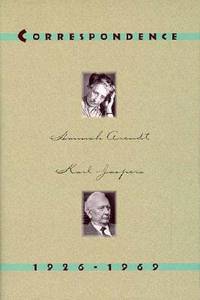
199287328New York: Harcourt Brace Jovanovich 1992. First edition first printing full letter line. Hardcover. Very fine in very fine jacket in archival mylar sleeve in fine dust-jacket. Quarto in beige and aqua photo illus jacket; xxv 821 pages; 25 cm. Includes bibliographical references pages 689-800 and indexes. An exquisite copy. "The correspondence between Hannah Arendt and Karl Jaspers begins in 1926 when the twenty-year-old Arendt studied philosophy with Jaspers in Heidelberg. It is interrupted by Arendt's emigration and Jasper's 'inner emigration' and resumes in the fall of 1945. From then until Jaspers's death in 1969 the initial teacher-student relationship develops into a close friendship. Three countries figure prominently in the correspondence: Germany Israel and the United States. Among the topics are Fascism the atom bomb and the threat of global destruction German guilt for the Holocaust Jewishness the State of Israel American politics and American universities the Eichmann trial in Jerusalem. Arendt and Jaspers discuss people both famous and obscure. They gossip joke complain and argue. They commiserate with each other over the illnesses and infirmities of old age. And they converse about the world's great philosophers: Spinoza Kant Marx Max Weber Heidegger. Here is a fascinating dialogue between a woman and a man a Jew and a German a questioner and a visionary both uncompromising in their examination of our troubled century." —Publisher. Political scientists -- Germany -- Correspondence. Philosophers -- Germany -- Correspondence. Politologues -- Allemagne -- Correspondance. Philosophes -- Allemagne -- Correspondance. Philosophers. Political scientists. A heavy book. An additional shipping charge may apply for priority or international orders. . Harcourt Brace Jovanovich hardcover
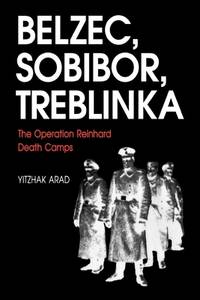
1999006540Bloomington Indiana U.S.A.: Indiana Univ Pr 1999. 437pp/illus. An authentic gripping definitive account of the least known Nazi death camps. Many photos maps letters includes lists of deportations. Clean. First Edition. Trade Paperback. Fine/No Jacket - Wraps. 8vo - over 7¾" - 9¾" tall. Indiana Univ Pr paperback
1979030253New York: Holocaust Library 1979. HARDCOVER edition. Fine condition in a Very Good dust jacket. Only light shelfwear to the jacket. NO chips creases or fading. NOT price clipped $9.95. Sharp corners. Square and tight. NO owner's name or bookplate. NOT a library discard. Pages are crisp clean and unmarked - apparently seldom if ever read. Autobiography of Yitzhak Arad General-Brigadier Israel Defense Forces. Illustrated with map and 56 photos -- including shots with Prime Minister Itzhak Rabin David Ben-Gurion President Anwar Sadat of Eqypt President Jimmy Carter etc. Bound in the original red cloth lettered in black. From the dust jacket: "Isaac Rudnicki now Yitzhak Arad was 13 years old when the Germans overran Warsaw. Like many young people he escaped to the Soviet-occupied part of Poland. Two years later the Nazis arrived there too. The infamous Nazi Einsatzgruppen killing squads pushed the Jewish youth to resistance. Issac became a partisan in the pristine forests of Lithuania. He was instrumental in derailing 13 German military trains with troops and ammunition. After the war Issac went to Palestine just in time to be involved in the Palmach. Isaac Rudnicki now Yitzhak Arad rose to the rank of Brigadier General and after retirement became Director of Vad Vashem in Jerusalem.". 1st ed No additional printings listed. Hardcover. Fine condition/Very Good dust jacket. Illus. by NOT a library discard. 8vo. x 245pp. Great Packaging Fast Shipping. Holocaust Library Hardcover
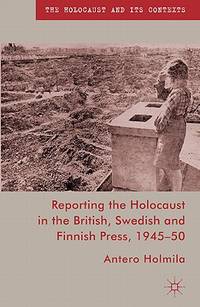
201113573NY/UK: Palgrave/Macmillan 2011. hardcover illustrated boards. no flaws - clean no writing or markings tight binding. an unused copy.; english text.; xiii-276pp. detailed examination of the post-war press in three european nations and their reporting on the holocaust and its aftermath trials etc. First Edition. Hard Cover. Fine/No Jacket as Issued. 8vo - over 7¾" - 9¾" tall. Palgrave/Macmillan Hardcover
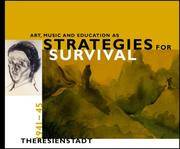
200121710NY/London: Herodias 2001. hardcover in dust jacket. no flaws - clean unmarked tightly bound.; gift inscription by anne dutlinger to famed graphic designer milton glaser on verso of ffep.; xix-204pp. illustrated throughout in color b/w. contains seven essays and assorted other writings from various contributors. comprehensive overview of the theresienstadt ghetto serves as foundation from which to focus upon the teaching of art and music to the children imprisoned there. Signed by Editor/Co-Author. First Edition. Hard Cover. Fine/Fine. Oblong 8vo. Exhibition Catalogue. Herodias Hardcover
1974224082Jerusalem: Yad Vashem 1974. Hardcover. Very Good. 4to in black cloth. Text in English and Hebrew. Very Good in like dustjacket: very light shelfwear rubbing at the corners and spine ends of the jacket. No. 3 of 100 copies not signed on the limitation page but inscribed and signed in English by Bogen on the Hebrew title page. Please request a quote for international shipping. Yad Vashem hardcover
2000222607Auschwitz-Birkenau State Museum 2000. Hardcover. Very Good. Five volumes 8vo in red boards titles in black and silver. Ex-library with spine stickers card pockets etc. The bindings are tight and square there is very little rubbing to the boards and the text blocks are unmarked. Please request a shipping quote before ordering. Auschwitz-Birkenau State Museum hardcover
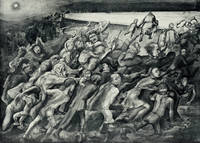
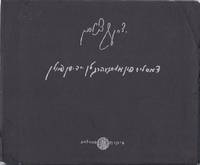
194434835Tel Aviv: Haaretz Printing House 1944. First Edition with annotations in Hebrew. Illustrated with 17 full-page Zinco engravings created by Zincographies Ltd. Oblong folio 34 x 25 cm publisher's original linen backed boards the upper cover printed in Hebrew. 4 text and 17 plates pp. A very good copy well preserved with minor evidence of age or use. RARE EARLY ILLUSTRATED WORK ON THE HORRORS OF THE HOLOCAUST. The evocative illustrations include Jews being rounded up for transport to the camps a depiction of the "death wagons" used for transport the rebellion in the ghetto partisans Treblinka the "monster" Nazi the Underground resistence and more. The album of illustrations was prepared and published during the most intense years of the Holocaust.<br> Lea Grundig 1906 – 1977 was a German painter and graphic artist. In the mid-1930s her work reflected themes of the new Nazi age with her cycles "Harzburger Front" "Unterm Hakenkreuz" 1936 "Der Jude ist schuld!" 1935–38 "Krieg droht!"1935–37 "Im Tal des Todes" 1942/43 and "Ghetto".<br> In 1935 a ban was imposed on exhibits of her work and in May 1936 she was arrested. Later in 1936 she traveled to Switzerland but she then returned to her home city and it was in Dresden that in May 1938 she was again arrested. In March 1939 she was found guilty of "Preparing to commit High Treason" »Vorbereitung zum Hochverrat« as a result of her Communist activities and/or her Jewish provenance and was sentenced to four months imprisonment. She served her sentence which in the event lasted till November/December 1939 in a prison in Dresden. However on her release she was granted an emigration permit. She emigrated to Bratislava then the capital of the still notionally independent Slovak Republic Slovakia. In 1940 she reached a refugee camp in Slovakia from where she moved as an exile to Palestine. Here she survived in a British internment camp at Atlit till 1942. On release she remained till the end of 1948 in Palestine living successively in Haifa and Tel Aviv. She was again able to show her work legally: exhibitions of her work took place not just in Palestine where she was living but also in the USA France South Africa and Great Britain. Haaretz Printing House hardcover
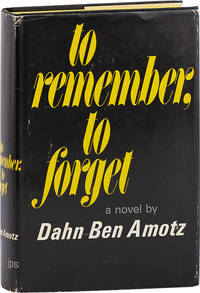
197362864Philadelphia: Jewish Publication Society of America 1973. First American and first English language edition. Octavo. Cloth hardcover; dustjacket; yellow top-stain; 399pp. Tight straight fine copy with top-stain vivid and unfaded. In the original dustwrapper unclipped priced $6.95 on front flap lightly rubbed at extremities VG. <br /> <br /> Ben-Amotz's semi-autobiographical first novel a landmark portrayal of a Polish Holocaust survivor who re-invents himself as a true sabra in postwar Israel. Ben-Amotz would go on to a popular and somewhat controverisal career as a fiction-writer journalist and media personality. Originally published in Hebrew as "Lizkor lishcoah" Tel-Aviv 1968 the English-language translation is by Zeva Shapiro. Surprisingly uncommon especially in nice condition. Jewish Publication Society of America unknown
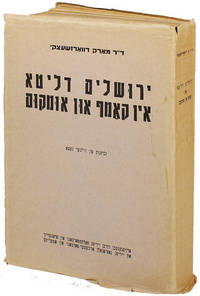
194816623Paris: L'Union Populaire Juive en France 1948. First Edition. Octavo. Printed paper wrappers; 515pp; illus some folding; facs. Includes bibliography. Text entirely in Yiddish. Text slightly tanned but a tight clean copy overall VG or better in the original wrappers. First-hand account of atrocities in the Vilnius ghetto by a survivor; extensively documented including facsimiles of original documents and photographic evidence of Nazi atrocities. Uncommon especially in this state of preservation. L'Union Populaire Juive en France unknown
69182New York: Raw Books & Graphics 1986. Very Good. Slim folio 36 cm Saddle-stitched illustrated wraps. Wraps lightly rubbed. Moderate soiling to rear wraps of numbers 1 and 3.<br /> <br /> Volume 1 Number 1 Fall 1980. "Two-Fisted Painters" by Art Spiegelman booklet.<br /> <br /> Volume 1 Number 3. 1981. "Maus Chapter Two The Honeymoon" booklet.<br /> <br /> Volume 1 Number 4. 1982. Vinyl record "Reagan speaks for himself" detached and laid in. "Maus Chapter Three Prisoner of War" booklet.<br /> <br /> Volume 1 Number 5. 1983. Couple by Art Spiegelman. "Maus Chapter Four The Noose Tightens" booklet. Stapled in a little loosely.<br /> <br /> Volume 1 Number 6. 1984. "Maus Chapter Five Mouse Tales" booklet.<br /> <br /> Volume 1 Number 7. 1985. "Maus Chapter Six Mouse Trap" booklet. "Red Flowers" booklet by Yoshiharu Tsuge. Deliberately issued by the publisher with a torn front wrap.<br /> <br /> Volume 1 Number 8. 1986. Jimbo by Gary Panter. "Maus Chapter Seven Mauschwitz" booklet. The first number along with six other issues of RAW Magazine Volume 1. Number 2 is not present. <br /> <br /> A very colorful and bold comics and graphics anthology edited by Art Spiegelman and Françoise Mouly a husband and wife team which highlighted artists from around the world and was published in the United States from 1980 to 1991. In addition to the work of Spiegelman and Mouly RAW featured cutting-edge comic artists such as Robert Crumb Gary Panter Charles Burns Kim Deitch Sue Coe Jerry Moriarty Richard Sala and Ever Meulen among many others. In these issues of RAW one will find Gary Panter's best-known comic protagonist "Jimbo" a burly punk and existential adventurer as well as "The Voice of Walking Flesh" by Charles Burns "Love's Savage Fury" by Mark Newgarden and a centerfold by Ever Meulen captioned "Use the Mood of the Past to Rewire Your Brain for the Future." Of significant importance is the fact that Art Spiegelman's seminal graphic work "Maus: A Survivor's Tale" made it's first appearance in this magazine chapters 2-7 are present here as stapled-in booklets. Spiegelman's unrivaled Holocaust narrative "Maus" was awarded the 1992 Pulitzer Prize it was the first graphic novel to win the Pulitzer Prize and he was the first-ever cartoonist to receive the prestigious Edward MacDowell Medal a medal awarded annually since 1960 to artists who have made an outstanding contribution to American culture.<br /> <br /> A nearly consecutive run of volume 1 of this trailblazing magazine with original serialized chapters of "Maus." "The Graphix Magazine for Your Bomb Shelter's Coffee Table." Number 4 front cover caption. Raw Books & Graphics unknown
196343253New York: YKUF 1963. Paperback. Original Wrappers. 12mo. 79 pages. 17 cm. In Yiddish. <br> <br> Includes introduction by Miriam Novitch as well as "Vi Yitshak Katsnelson hat geshribn zayne klog-lider" also by Miriam Novitsh on pages 15-16.<br> <br> “Song of the Murdered Jewish People" by Itzhak Katzenelson 1885–1944 a leading Hebrew and Yiddish poet. <br> <br> â€Katzenelson’s world fell apart when in August 1942 his wife Hanna and two younger sons Ben-Tsiyon and Binyamin were deported to Treblinka. From then on his literary creativity was piercingly shaped by lamentations over the loss of his family. Nonetheless with his oldest son Tsevi he found the strength to join the Jewish Fighting Organization and took part in the first uprising of January 1943. <br> <br> After the ghetto was destroyed in April and May 1943 he escaped to the Aryan section of Warsaw and obtained a Honduran identity document. Nevertheless he was sent to a German detention camp for foreign subjects in Vittel France. He was imprisoned there until April 1944 and devoted most of his time to writing. <br> Two important works were produced during that period: Pinkas Vitel The Vittel Diary a Hebrew composition that uses the language of an incensed diarist and reconstructs the days of terror in Warsaw during the mass deportations; and Dos lid fun oysgehargetn yidishn folk The Poem about the Murdered Jewish People a pathos-filled Yiddish poem that laments the destruction of the Jewish people and of the poet himself who has been become bitterly angry with humankind and God. These two works are among the boldest and most lofty literary expressions to emerge from the Holocaust.…<br> All of Katzenelson’s works from his Vittel period were either buried in hiding places or were given to people he trusted; consequently they were saved and published shortly after the end of the war. <br> <br> In the middle of April 1944 Katzenelson and his son Tsevi were sent to the Drancy transit camp and from there one month later to Auschwitz where they were murdered. In 1950 the Ghetto Fighters kibbutz built a museum and an institute for research about the Holocaust that bear Yitshak Katzenelson’s name†YIVO Encyclopedia. <br> <br> Subjects: Holocaust Jewish 1939-1945 -- Poetry. OCLC: 28824340. <br> <br> Some stains on covers Good Condition. B HOLO2-97-33A-XX-ELABCC. New York: YKUF paperback
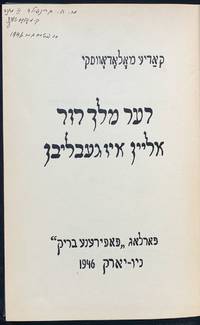
194643238New York: Papirene Brik 1946. First edition. Original boards. 8vo 156 pages 24 cm. In Yiddish. Title appears in English as “Only King David Remained.â€<br> <br> Inscribed by Molodowsky on title page in year of publication<br> <br> Early post-war book of poems by Kadya Mololdowsky that is composed of poems about the Holocaust and that “draw upon traditional Jewish literary responses to catastrophe.†Contains some of Molodowsky’s most well regarded poems.<br> <br> Kadya Molodowsky was a major figure in the Yiddish literary scene in Warsaw from the 1920s through 1935 and in New York from 1935 until her death in 1975. A teacher in the Yiddish schools in Warsaw as a young woman she was best known for her children's poems.<br> <br> In the United States she wrote for the Yiddish press and founded and edited a journal Sviva Surroundings which she published for three decades. Living in Israel 1948-52 she founded and edited a journal Heym. She published six major books of poems 1927-1965 novels short stories plays and essays. Recurrent themes in her work include the lives of Jewish women and girls Jewish tradition in the face of modernity Israel and the Holocaust.<br> <br> SUBJECTS: Yiddish poetry. David King of Israel -- Poetry. David King of Israel. Poetry. OCLC: 19314664.<br> <br> Clean copy with book stamp from “Emil Gorovets’s Library.†Very Good Condition. An attractive inscribed work by a leading female Yiddish writer. YID-48-47-LEXCCM!-’gg. New York: Papirene Brik unknown
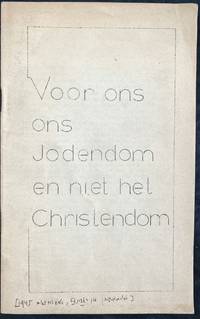
193025194Amsterdam: Selecta 1930. Softcover 24 pages 22 cm. In Dutch. “For us Judaism—and not Christianity. †Jewish response to attempts at conversion just prior to the Holocaust. <br> Chief Rabbi Justus Tal 1881-1954 was "From 1918 until the outbreak of World War II.Chief Rabbi of Utrecht. During the war he was hidden from the Nazis by a Protestant clergyman. Afterwards he assumed the post in Amsterdam and was elected president of the Dutch Conference of Chief Rabbis" JTA 1954. <br> OCLC: 64304774. OCLC lists 14 copies worldwide only 3 in the US HUC Harvard YIVO none south or west of Ohio.<br> Light wear. Handwritten note on bottom of cover notes "edited by Chief Rabbinate of Netherlands Amsterdam 1945.†Good condition. B Holo2-162-37XXXCC-'. Amsterdam: Selecta unknown
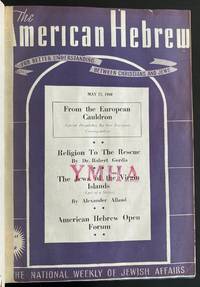
194040003New York N. Y. : American Hebrew 1940. Hardcover. 1st edition. 4to. Period Cloth 4to Approximately 20 pages each issue approximately 520 pages total. Issues were published weekly. <br> Holocaust-era American weekly Jewish magazine. <br> “From the time of its founding The American Hebrew covered many topics of intense Jewish interest internationally†wikipedia. This set of magazines contain articles showing reform Jewish perspectives on WWII and the Holocaust including material about Jewish refugees “Behind the War†“Relationship Between Religion and Democracy “War Propaganda in England and Germany†as well as more mundane topics such as an essay we noted titled “Resort Guide: Another List of Ideal Vacation Spots Selected for American Hebrew Readers.†<br> SUBJECTS: Jewish newspapers. -- United States. <br> OCLC: 1479954. Many copies have a YMHA stamp on cover of magazine. Cloth cover has staining and dampstains pages are not affected. Spine says “American Hebrew 147 May-Nov. 1940â€. Magazines in Very Good Condition. B HOLO2-140-11-X-'mmecc. New York, N. Y. : American Hebrew hardcover
194829513New York; YKUF 1948. Paperback. Original Wrappers. 12mo. 79 pages. 17 cm. Undated edition. In Yiddish. <br> Includes introduction by Miriam Novitch as well as "Vi Yitshak Katsnelson hat geshribn zayne klog-lider" also by Miriam Novitsh on pages 15-16.<br> “Song of the Murdered Jewish People" by Itzhak Katzenelson 1885–1944 a Hebrew and Yiddish poet. â€Katzenelson’s world fell apart when in August 1942 his wife Hanna and two younger sons Ben-Tsiyon and Binyamin were deported to Treblinka. From then on his literary creativity was piercingly shaped by lamentations over the loss of his family. Nonetheless with his oldest son Tsevi he found the strength to join the Jewish Fighting Organization and took part in the first uprising of January 1943. <br> After the ghetto was destroyed in April and May 1943 he escaped to the Aryan section of Warsaw and obtained a Honduran identity document. Nevertheless he was sent to a German detention camp for foreign subjects in Vittel France. He was imprisoned there until April 1944 and devoted most of his time to writing. <br> Two important works were produced during that period: Pinkas Vitel The Vittel Diary a Hebrew composition that uses the language of an incensed diarist and reconstructs the days of terror in Warsaw during the mass deportations; and Dos lid fun oysgehargetn yidishn folk The Poem about the Murdered Jewish People a pathos-filled Yiddish poem that laments the destruction of the Jewish people and of the poet himself who has been become bitterly angry with humankind and God. These two works are among the boldest and most lofty literary expressions to emerge from the Holocaust.…<br> All of Katzenelson’s works from his Vittel period were either buried in hiding places or were given to people he trusted; consequently they were saved and published shortly after the end of the war. <br> In the middle of April 1944 Katzenelson and his son Tsevi were sent to the Drancy transit camp and from there one month later to Auschwitz where they were murdered. In 1950 the Ghetto Fighters kibbutz built a museum and an institute for research about the Holocaust that bear Yitshak Katzenelson’s name†YIVO Encyclopedia. <br> Subjects: Holocaust Jewish 1939-1945 -- Poetry. OCLC: 12260367. <br> Half Dollar size chip to cover no text loss institutional stamp on title page taped spine otherwise Good Condition. BK5 B HOLO2-97-33-XX-ELABCC. New York; YKUF paperback
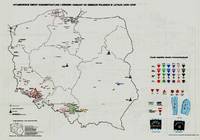
197941929Warszawa Warsaw: Pan´stw. Wydawn. Naukowe 1979. 1st Edition. Original black printed portfolio 8vo. Portfolio of seven large folding maps on on 4 sheets of heavy paper 3 are double sided 1 is singled sided. Primarily black and white with some color. Text in Polish. <br> Title translates to “Nazi camps in Poland 1939 - 1945. An Encyclopaedic Reference Book: Maps." Collection of 7 maps each 84 cm x 60 cm 33 x 24 inches produced by Jan Laskowski at the Main Commission for the Investigation of Nazi Crimes in Poland. The maps comprise Volume II of the work; Volume I is a heavily illustrated 676-page book of the same title which we offer separately. <br> The Seven maps all present are: <br> - Map 1 Single Sided: Hitlerowskie obozy na ziemiach polskich w latach 1939 - 1945. “Nazi camps in Poland in the years 1939 - 1945â€. Showing: concentration and extermination camps sub-camps of concentration camps extermination centers POW camps more important sub-camps working divisions commandos and temporary POW camps penal labor camps major labor camps prisons transit camps & ghettos. <br> - Map 2A: Getta na ziemiach polskich w okresie okupacji hitlerowskiej w latach 1939 - 1945 “Ghettos in Poland during the Nazi occupation in 1939 - 1945â€. <br> - Map 2B: Hitlerowskie obozy przejsciowe na ziemiach polskich w latach 1939 - 1945 “Nazi transit camps in Poland in 1939-1945â€. <br> - Map 3A: Hitlerowskie wiezienia i areszty na ziemiach polskich w latach 1939 - 1945 “Nazi prisons and arrests in Poland in 1939 - 1945â€. <br> - Map 3B: Hitlerowskie obozy pracy na ziemiach polskich w latach 1939 - 1945 “Nazi labor camps in Poland in the years 1939 - 1945â€. <br> - Map 4A: Hitlerowskie obozy jenieckie na ziemiach polskich w latach 1939 - 1945 “Nazi POW camps in Poland in 1939 - 1945â€. <br> - Map 4B: Hitlerowskie obozy koncentracyjne i osrodki zaglady na ziemiach polskich w latach 1939 - 1945 “Nazi concentration camps and extermination centers in Poland in 1939 - 1945â€. <br> Maps 2A & 2B have been described as a “Terrifying pair of maps showing the locations of German POW and internment camps in Poland during World War II highlighting the widespread locations of these establishments. In some parts of the map the information becomes so dense that three inset maps are shown. This map was designed by Jan Laskowski and printed in 1979 as part of a work on the Nazi extermination machine produced by PWN Warsaw a state-owned research-focused publishing house in Poland.<br> The map on the front is particularly interesting for its depiction of symbols used to classify internees in German camps. The uppermost of these depictions shows the combinations that can be made for different types of prisoners of different levels of importance. The armbands that would have been worn by these prisoners is shown as well as the prison uniforms. Other details are also shown. <br> The map lists hundreds of sites run by Nazi operators throughout the country. These include concentration camps death camps transitional camps and ghettos. The map is divided according to Poland's voivodeships with a key in the lower left. Names of cities too long to spell are also provided in the lower left. <br> This map was produced during a point in Poland's history during which it was actively revisiting the period during the Second World War. Leading social scientists devoted their time to trying to gather all the living as well as the recorded history of the events of the Holocaust and related atrocities before this information vanished. Leading these efforts particularly during the 1960s and 1970s was the Glówna Komisja Scigania Zbrodni przeciwko Narodowi Polskiemu known as the Chief Commission for the Prosecution of Crimes against the Polish Nation. They were active in publishing maps both for domestic educational purposes and for international remembrance and diplomatic efforts regarding the Holocaust. Jan Laskowski was a leading cartographer who produced a number of maps in this field. <br> These maps were produced as part of a series of maps that purported to combine to form an atlas of all of Hitler's crimes in Poland. Many of the large wall maps produced during this period could only show a fraction of the crimes or only the atrocities committed in one region. Thus a series of maps was needed to show all the points necessary which this present work contributes to. <br> Polish Reinterpretations of the Holocaust: Studying the effects of German occupation in Poland is a delicate subject. While it is certain that Poland suffered at least as badly as any other European nation during the Second World War reinterpretations of the Holocaust in the country have also been used to satisfy nationalistic tendencies. It has become evident to Western observers in the last several years that there is a strong nationalist movement in Poland that seeks to place blame for the Holocaust solely on the shoulders of non-Polish actors a movement originally fostered under Soviet rule. This movement has gone so far as to limit freedom of speech criminalizing with a three-year sentence the suggestion that Poland or its citizens in any form participated in the murders committed by Nazis. As such the term ‘Polish concentration camps’ has been deemed unacceptable with the government-approved term being ‘concentration camps on Polish territory.’ <br> All lines of evidence show that this map 2A & 2B was produced using the most accurate and impartial historical sources. The language on the map is simple naming only ‘Hitler's Atrocities’ and there is no evidence of a clear anti-German bias. However it is impossible to separate this map one of the most important productions of the remembrance movement during this period from the social situation in which it was produced. Maps like these can easily be converted into propaganda instruments and today's Polish leaders most of whom grew up during Soviet occupation will have formed their understanding of the Holocaust through maps like these. <br> Soviet Censorship: While the content of the map appears to have been produced free from bias the map still had to go through Soviet censorship. Mentioning prisoner of war camps in which primarily Soviet troops were interned would have been a prerequisite condition upon which the publication of the map rested. Further the lack of mention of any Soviet killings or camps requires no explanation….The map unlike many later maps makes no differentiation between the populations who suffered at the various camps. This represents the Soviet agenda that all nations suffered fought and won equally which sought to limit divisions in this post-identity state†Ruderman 2022. <br> SUBJECTS: World War 1939-1945 -- Prisoners and prisons German. -- Concentration camps -- Poland. Guerre mondiale 1939-1945 -- Prisonniers et prisons des Allemands. -- Camps d'internement -- Pologne. Obozy koncentracyjne -- Polska -- 1900-1945. OCLC: 830885973. <br> Light shelf wear to portfolio as expected. All maps in pristine condition with normal folds as issued. Very Good Condition. Complete and dramatic BR5 holo2-147-19-'cc. Warszawa (Warsaw): Pan´stw. Wydawn. Naukowe unknown
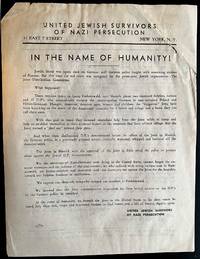
194743409New York The Organization No Date 1947. 1st edition. Double-sided English-Yiddish leaflet 2 pages. The Yiddish header translates roughly as "An Announcement To the Jewish Public"<br> Bilingual American Flyer condemning the Joint the American Joint Distribution Committee AJDC for not doing more to help the Jewish DPs and its "hiding" behind the German police when DP's demonstrated for more action on DP resettlement.<br> The issuing organization the United Jewish Survivors of Nazi Persecution/Farband fun Geveyzene Yidishe Katsetler un Partizaner was the first survivor network founded in the US. Their Yiddish name translates as "The Association of Former Jewish Concentration Camp Inmates and Partisans." The word "Katsetler" in their name is a contraction of "kontsentratsyonslager-er" using the letters K and Z "ka" and "tset" and thus short for "kontsetratsyonslager" a concentration camp inmate or survivor sometimes also noted as a "katsetnik." <br> <br> The flyer announces:<br> <br> "Jewish blood was again shed on German soil! German police fought with remaining victims of Nazism. But this time the sad event was instigated by the prominent Jewish organization-The Joint Distribution Committee.<br> <br> What happened<br> <br> There remains today in Camp Foehrenwald near Munich about two thousand helpless forlorn and ill D.P's who miraculously escaped the extermination furnaces in nazi-occupied Poland and Hitler-Germany. Hungry desperate destitute men women and children the 'forgotten' Jews have been knocking at the doors of the democratic countries for a haven and refuge and a home they can call their own.<br> <br> With this goal in mind they demand immediate help from the Joint while in camp and help to establish themselves in their eventual homes in the countries that have offered refuge. But the Joint turned a 'deaf ear' toward their pleas.<br> <br> And when these disillusioned D.P.'s demonstrated before the offices of the Joint in Munich the German police in a previously planned attack critically wounded whipped and battered off the demonstrators.<br> <br> The Joint in Munich with the approval of the Joint in Paris asked the police to protect them against the Jewish D.P. demonstrators.<br> <br> We the survivors of Nazi-Germany now living in the United States cannot forget the extreme torments and the inferno of the nazi-torture; we who suffered with many victims now in Foch- renwald are horror-stricken and dismayed and our hearts cry out against the Joint for the brutality toward our helpless brethern in misfortune.<br> <br> We express our deep-felt sympathy toward our brothers in Foehrenwald.<br> <br> demand that the Joint representatives responsible for these brutal attacks on the D.P.'s by the German police be punished.<br> <br> In the name of humanity we beseech the Jews in the United States to let their voices be heard help these sick tragic and frustrated victims to find homes and a life of human dignity again" From the English side of the flyer.<br> <br> <br> After World War II Munich served as a major center for Jewish Holocaust survivors the "Sh'erit ha-Pletah" who were living in DP camps. The "Joint" was the primary welfare organization providing aid clothing and food to these camps. While the Joint was a vital lifeline its Munich headquarters at Siebertstrasse 3 sometimes became the focal point for frustration regarding the pace of aid distribution or more frequently the slow pace of emigration to Palestine Aliyah and broader often frustrating postwar conditions.<br> Following the 1947 Exodus ship incident where Jewish refugees were returned to Germany by the British Jewish DPs felt trapped and staged intense demonstrations including protests at the offices of international organizations like the Joint to highlight their despair.<br> These demonstrations were part of a broader effort by survivors to assert their agency and demand rights during their time in Munich 1945-1951. For more on tensions between Munich's Jewish DPs and the Joint see www.juedisches-museum-muenchen.de/en/exhibitions/munich-displaced-online/moehlstrasse. <br> <br> Scholar David Slucki notes about the publishers of this leaflet that "Within months of arriving in the United States in 1946 Jewish Holocaust survivors began to organize themselves to help with the process of resettlement. The small band of socialists who established the Farband fun Geveyzene Yidishe Katsetler un Partizaner United Jewish Survivors of Nazi Persecution this group initiated a dual process of identity formation and memorialization of the Holocaust. <br> The first survivor network founded in the United States the Katsetler Farband this group developed a memorial culture that included commemorations and publications replete with its own rituals and calendar. Moreover the organization was part of a broader process of defining what experiences constituted the Holocaust and who was to be considered a survivor. Ultimately they were among a host of survivor networks in the United States to lay the foundation for Holocaust memorialization" Slucki D. 2017. A Community of Suffering: Jewish Holocaust Survivor Networks in Postwar America. Jewish Social Studies 222 116-145. https://muse.jhu.edu/article/649094<br> <br> We could locate no copies in OCLC-Worldcat Archive Grid nor using a google search. <br> <br> Touch of edgewear one diagonal fold paper generally bright and strong about Very Good- Condition. Holo2-163-28A. New York, The Organization, No Date unknown