188 résultats
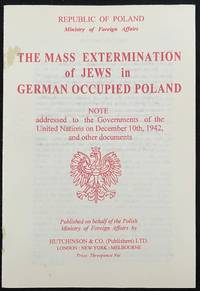
194343453London New York; Published on Behalf of the Polish Ministry of Foreign Affairs by Hutchinson & Co 1943. 1st edition. Original illustrated red and white paper wrappers. 8vo. 16 pages. 22 cm. National Government Publication. Printed in red and black ink. Includes a note by Polish Foreign Minister Edward Raczynski and speeches by Deputy Prime Minister Stanislaw Mikolajczyk.<br> The official 16-page diplomatic publication from December 1942 by the Polish Government-in-Exile in London marking a turning point in international understanding of the Nazi destruction of the Jews of Europe. <br> Jan Karski a courier for the Polish Underground had smuggled microfilmed evidence and intelligence out of occupied Poland to London. This raw intelligence gathered from his time secretly inside the Warsaw Ghetto and the Izbica transit camp formed the core of the facts published in the booklet.<br> <br> "In October 1942 at the height of the destruction of Polish Jewry Jan Karski born Jan Kozielewski was ordered to clandestinely go to the West and deliver a report on the situation of occupied Poland to the Polish government-in-exile in London. The situation of the Jews in Poland was to be one section of that report. Since the government in exile was concerned with the internal politics of Poland's underground parties Karski held meetings with the different factions including the Jewish Zionist and the Jewish Socialist Bund movements. <br> Thus shortly before his departure Karski met with two Jewish leaders who asked him to inform the world's statesmen of the desperate plight of Polish Jewry and of the hopelessness of their situation. Their message was: 'Our entire people will be destroyed.'<br> The Jewish leaders' appeals touched Karski and he decided to see things with his own eyes in order to make his report. With great risk to his life he was smuggled into the Warsaw ghetto and into a camp in the Lublin area. The horrors he witnessed marked him deeply and propelled him to become not only the messenger of the Polish underground but to concentrate on giving voice to the suffering of the dying Jews.<br> In November 1942 Karski reached London delivered the report to the Polish government-in-exile and set out to meet Winston Churchill other politicians journalists and public figures. Upon completing his mission Karski went on to the United States where he met with President Roosevelt and other dignitaries and tried in vain to stir up public opinion against the massacre of the Jews. In 1944 while in the United States Karski wrote a book on the Polish Underground Story of a Secret State with a long chapter on the Jewish Holocaust in Poland.<br> After the war Karski stayed in the United States where he was later appointed Professor at Georgetown University Washington DC.<br> On 2 June 1982 Yad Vashem recognized Jan Karski as Righteous Among the Nations" Yad Vashem. <br> <br> Leading Holocaust scholar Lucy Dawidowicz cites the booklet in her now classic work "The Holocaust and the Historians" Harvard 1983 p. 167; the report could not be more explicit in its description of the horrors nor in its plea for help: <br> "The new methods of mass slaughter applied during the last few months confirm the fact that the German authorities aim with systematic deliberation at the total extermination of the Jewish population of Poland and of the many thousands of Jews whom the German authorities have departed to Poland from Western and Central European countries and from the German Reich itself. The Polish Government considers it their duty to bring to the knowledge of the Governments of all civilised countries the following fully authenticated information received from Poland during recent weeks which indicates all too plainly the new methods of extermination adopted by the German authorities." <br> The report elaborates: "The actual process of deportation was carried out with appalling brutality. At the appointed hour on each day the German police cordoned off a block of houses selected for clearance entered the back yard and fired their guns at random as a signal for all to leave their homes and assemble in the yard. Anyone attempting to escape or to hide was killed on the spot. No attempt was made by the Germans to keep families together. Wives were torn from their husbands and children from their parents. Those who appeared frail or infirm were carried straight to the Jewish cemetery to be killed and buried there. <br> On the average 50-100 people were disposed of in this way daily. After the contingent was assembled the people were packed forcibly into cattle trucks to the number of 120 in each truck which had room for forty. The trucks were then locked and sealed. The Jews were suffocating for lack of air. The floors of the trucks were covered with quicklime and chlorine. As far as is known the trains were dispatched to three localities - Treblinka Belzec and Sobibor to what the reports describe as 'Extermination camps.' <br> The very method of transport was deliberately calculated to cause the largest possible number of casualties among the condemned Jews. It is reported that on arrival in camp the survivors were stripped naked and killed by various means including poison gas and electrocution. The dead were interred in mass graves dug by machinery." <br> <br> Read more about the singular importance of this publication at <br> en.wikipedia.org/wiki/The_Mass_Extermination_of_Jews_in_German_Occupied_Poland# . <br> In 2020 Polish Postal authorities chose this very publication to illustrate their official first day cover honoring righteous Poles who had saved Jews during the Holocaust see illustration. <br> <br> Subjects: World War 1939-1945 - Jews - Poland. World War 1939-1945 - Poland - Atrocities. Holocaust Jewish 1939-1945 - Poland. Jews - Poland. OCLC: 234118765. <br> Touch of staining at staples without the rust almost always seen in other surviving copies. Very Good condition. A copy with rust stains sold in 2018 at auction for over £6000. Rare and very important. BHOLO2-97-48-MMXRLADFACC. London, New York; Published on Behalf of the Polish Ministry of Foreign Affairs by Hutchinson & Co unknown
199537649Bloomington: Indiana U. P. 1995. 3rd printing. Fine. folio. dust jacket xvi 638pp. maps plans index Includes Satellite Camps Auschwitz & the ÒFinal SolutionÓ Gas Chambers & Crematoria Auschwitz underground & Sonderkommando diaries. Comprehensive volume Indiana U. P. unknown
199731661Boston: Little Brown 1997. 1st edition. New Book. folio. dust jacket 255pp. col. & b/w pls. bibliog. index Catalogue of a US Holocaust Museum Project. Kovno Kaunas Ghetto was home to 29000 Jews kept for forced labour for three years. Little Brown unknown
198775666New York: Beate Klarsfeld Foundation 1987-. First edition. Five large octavo volumes. 22 493 `; 4 364; 4 467 plus some facsimile illustrations; 4 643 1; 4 561 1 pp/ Pubisher's yellow wrappers lettered in black and each front with an illustration of the Jews of the Grodno Ghetto. Unfortunately a couple of volumes have some tide marks but not horrifiically so. Part 3 has taken the brunt of it. Still an invaluable source record of a great sin of mankind.Comprosed of; v. 1. A. Accounts by Jewish survivors residing in the West. B. Accounts recorded in Poland and the Soviet Union. -- v. 2. Accounts by German witnesses or perpetrators of the final solution. -- v. 3. A. German justice seeking the truth. B. Documents. -- v. 4. Grodno in the Bialystok trial 1966-1967. -- v. 5. The Grodno trial in Cologne 1968. Jewish community in pre-war Grodno includes "Lista Platnikow Skladki Gmninnej Gminy Wyznaniowej Zydowskiej w Grodnie na rok 1937" v. 5 p. 1-97 in the section headed "Jewish Community in Pre-War Grodno"; German documents in Grodno archives: Testimonies concerning Grodno gathered by Jewish underground and recovered after the war; Testimonies gathered in years 1944-1946.; Testimonies gathered in Israel around 1957 in archives of Yad Vashem.From 1939 to 1941 the Soviet Union occupied Grodno. During this time some 4000–5000 Jewish refugees arrived from German-occupied lands to the west. About half of these refugees were later deported into the interior of the USSR. On 13 July 1941 after taking over the city the Germans executed 100 Jews among the intelligentsia and in November of that year they created two ghettos one in the city’s center—to house 15000 Jews designated as “productiveâ€â€”and the other in its suburb of S obodka to house 10000 “unproductive†Jews. The liquidation of the ghettos began in November 1942. The Germans deported Grodno’s Jews to Auschwitz—some via a transit camp in nearby Kelbasin where many died as a result of disease and inhumane conditions—and to Treblinka. On 12 March 1943 the approximately 1000 Jews remaining in the city were deported to the Bia ystok ghetto. When the Red Army entered Grodno on 14 July 1944 only about 250 Jews remained. Beate Klarsfeld Foundation unknown
73DS. Haifa. A partly printed document signed "Olga Polok" regarding moving funds from her bank fund just four days after the start of World War II: "I. have conferred general authority upon Olga Polak whose signature please find below to administer - as he may think fit - all funds or securities now or in future lying for my our account with yourselves or with any other offices of the Hollandsche Bank Unie N.V. or with any one of their correspondents; to dispose of same to receive the countervalue of all securities moneys deposits bills cheques and promissory notes telegraphic and letter-payments. to give discharge for same to give all kinds of instructions and to sign as my our mandatory receipts. It is hereby expressly stipulated that I we waive the right to notarial notices in connection with any matter arising out of these presents. ". The document has a few light toning patches and is in fine condition overall. An unusual Holocaust-era document. unknown
194547189Krakow: Spóldzielnia Wydawnicza "Czytelnik" Czytelnik Publishing Cooperative 1945. First edition. Softcover. g to von-. Octavo 8 1/4 x 6". 93pp. 13 leaves of double sided photographic plates interleaved and unpaginated. Illustrated tan red and black wrappers with black lettering on the front cover. Photographic b/w frontispiece. Spóldzielnia Wydawnicza "Czytelnik."<br /> <br /> Possibly an earlier publication on lower quality paper compare to a slightly smaller publication by the "Library of the Union of Polish Patriots in the USSR" Biblioteczka Zwiazku Patriotów Polskich w ZSRR with the same text in different layout. That publication issued on higher quality paper and with twenty-eight photogravures three more than in this publication with twelve photographs appearing in both publications though in lesser quality here.<br /> <br /> Court Proceedings of the Polish-Soviet Special Criminal Court established in Lublin in August 1944 in order to investigate the crimes committed by the Germans in the Majdanek extermination camp. Despite the importance of this document it must be mentioned that the Commission made erroneous assumptions regarding the duration of the camp and the number of people killed at Majdanek. The Publishing cooperative "Czytelnik" was established behind Soviet front lines in 1944. It became the first post-World War II. publisher in Poland.<br /> <br /> The total numbers of the victims is still controversial: In this report 1.5 million victims of different nationalities were counted however according to the latest researches there were 79000 victims 59000 of whom were Jews See: Kranz T.: "Bookkeeping of Death and Prisoner Mortality at Majdanek." pp. 81-110. In: Silberklang D. Ed.: Yad Vashem Studies. Vol. 35:1. Jerusalem 2007.<br /> <br /> Illustrated with 25 pages of b/w photographic reproductions including a frontispiece on 13 double-sided interleaved plates altogether thirty-two photographs depicting members of the Commission Nazi guards now prisoners who used to run the camp and survivors alike testifying before the Commission. Also includes views of the actual concentration camp piles of suitcases Zyklon B poison gas pellets gas chambers ovens and survivors amid corpses.<br /> <br /> Wrappers with some chipping rubbing creasing and/or closed tears to extremities. Small stain on the back cover and side edge of book block. Verso of frontispiece with a vertical crease. Some pages throughout with some light age toning or small water spots. Overall text and images clear and vibrant. Wrappers in good interior in very good- condition overall. One of two editions of this work published in Moscow and Krakow in 1945. It is not certain which was released first. Each has different wrappers size pagination and publishers. Spóldzielnia Wydawnicza "Czytelnik" (Czytelnik Publishing Cooperative) unknown
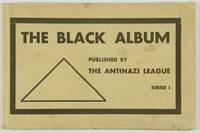
194054535Tel Aviv: The Antinazi League/ The Anti-Nazi League 1940. First edition. Softcover. g- to vg. Oblong 32mo. 8 text leaves 10 postcards. Unpaginated. Illustrated tan wrappers with black lettering on the covers. The work is a collection of 10 illustrated Anti-Nazi postcards issued by the Anti-Nazi League in Tel Aviv. <br /> <br /> This scarce collection of postcards contains some of the earliest photo-documentations visual depictions and statements on Nazi atrocities and oppression during the Holocaust some of which interestingly utilize photomontage techniques. Scenes depict hangings murders forced labor starvation displacement and cremations of Nazi victims. The text captions underneath each of the images are in English. Most of the text of the printed pages is bilingual including covers foreword publisher's statements and publication information in both Hebrew and English. There are two printed lists of images one in Hebrew and one in French. Each of the postcards have a perforated edge where they attach to the album. Only the first card is still attached. The rest are loose but unused. Each of the postcards measure approx. 5.4x4".<br /> <br /> As stated by the publisher the organization had "been established in Palestine with the object of promoting the foundation of a mass organization for propaganda against Nazism and racial hatred". They further state that the "publishing of the Black Album and sending the cards contained therein to friends all over the world are first steps to making the public participate in our struggle for truth against Nazi barbarism."<br /> <br /> Wrappers age toned with some staining and water spots to the English cover. Corners lightly rubbed. Interior with light foxing to the first text leaf.<br /> <br /> Other than some expected age toning the cards themselves and images are clean and in very good shape overall. 4 postcards #3-6 have been detached from the perforated edge but are present. Complete with all cards present. Wrappers in good- interior in very good- condition overall. Quite scarce. Hebrew title: ×”××œ×‘×•× ×”×©×—×•×¨. The Antinazi League/ The Anti-Nazi League unknown
196076676Hollywood: Sons of Liberty ca. 1960. The Barnes titles are all in publisher's printer wrappers all octavos and all are in very good condition. Titles as follows: Blasting the Historical Blackout. 42 pp.: The Court Historians versus Revisionism. Second edition. 32 pp.: The Chickens of the Interventionist Liberals Have Come Home to Roost-The Bitter Fruits of Globaloney. 44 pp.The related titles are;CONNORS Michael F. The Development of Germanophobia. 42 pp.APP Austin J. A Straight Look at the Third Reich. Takoma Park: Boniface Press 1974. 56 pp.APP Austin J Morgenthau Era Letters. Takoma Park: Boniface Press 1966. 111 5 pp.WEBSTER Nesta H. Germany and England. Hollywood: Sons of Liberty n.d. 36 pp.Harry Elmer Barnes was a somewhat respected historian early in his career. He taught economics sociology and history at various colleges and universities including Harvard Columbia Smith Amherst and Temple. He staunchly disagreed with the surrender terms laid out after WWI and eventually morphed into the first American historian to support Holocaust denial and the Revisionist school of history. T copy of Blasting the Historical Blackout was distributed by White Legion Books. OCLC has no listing for Sons of Liberty publications. Sons of Liberty unknown
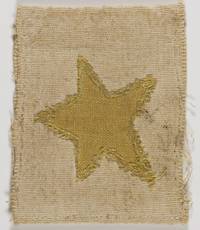
194353630Tunisia 1943. Nearly Fine. Five-pointed yellow cloth star sewn onto plain beige cloth 7.3 by 9 cm. Yellow dye somewhat faded else in fine state of preservation.<br /> <br /> Specimen of the yellow star imposed on the Jewish population of Tunisia in March 1943 as a mark of the slave laboror. Tunisia was the only Islamic country to come under Nazi rule at first indirectly through the Vichy regime in France between 1940 and its liberation by Allied forces on May 7 1943. In response to the Allied invasion of Algeria and Morocco German and Italian forces invaded Tunisia on November 9 1942. By the end of November the Germans took the first anti-Jewish move by arresting four of the community leaders including Moïse Borgel the president of the Jewish congregation. "In addition to the governor-general's sympathetic attitude -- and in some degree to the pro-Jewish attitude of Bey Sidi Mohammed al-Mounsaf -- the Italians also in practice interfered with the application of the anti-Jewish laws" E.H. The dignitaries were released after a week following the intervention of the mayor of Tunis and the Italian consul. Because of objections by the Italians the edict to wear the star does not appear to have been generally enforced with rigor and was only formally imposed in two cities Sfax and Tunis. While 5000 Jews had originally been put on forced labor in thirty locations and camps along the front line "at the time of the collapse and surrenter in early May 1943 only sixteen hundred Jews were employed on forced labor" E.H. Given the relatively small labor force and the lack of zeal in imposing the anti-Jewish ordinances it is clear why so few of these yellow badges have survived. References: I. Gutman ed. Encyclopedia of the Holocaust vol. 4 pp. 1521-23. unknown
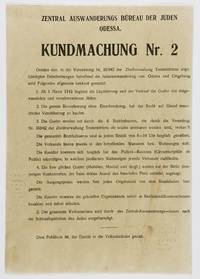
194251752Odessa: Zentral Auswanderungs Büreau 1942. Original document. Loose leaf. Very good condition. Quarto. Original loose leaf with black lettering. Announcement based on ordinance no. 35/942 of the civil government of Transnistria relating to the emigration of Jews in Odessa and surrounding areas. <br /> <br /> The text printed biligually in German and Ukrainian is organized into five statements. The annoucement concerns the liquidation and sale of goods of emigrated or vanished Jews beginning on March 1 1942 with the whole population without limitations given the right to buy these items based on oral agreements. Furthermore the announcement regulates details and procedures of the sale and at the end announces that after the sale proceeds will by handed to the Jews by the Central Emigration Office.<br /> <br /> "The rapid development of Odessa began after the Russian conquest 1789. Its Jewish population also grew quickly and in the late nineteenth and early twentieth centuries it was the most important Jewish literary community after Warsaw. In 1926 there were 153194 Jews in Odessa 36.4 percent of the total population and by 1939 their numbers reached 180000." Encyclopedia of the Holocaust Vol. 3 page 1080.<br /> <br /> When Romanians and Germans laid siege to the city on August 5 1941 many Jews in Odessa managed to leave and eighty to ninety thousand Jews remained in the city. Odessa fell on October 16 and the German Einsatzkommando 11b and the Romanian intelligence service immediately slaughtered over eight thousand residents mainly Jews and Odessa was established as the capital of the Transnistria region. On October 22 the Romanian military headquarters were blown up killing sixty-six officers and the military governor. In reprisal the Romanian ruler Ion Antonescu ordered devastating retaliation including the arrest of one member of each Jewish family. By October 1941 some 40000 Jews were assembled in the ghetto of the nearby city of Slobodka and their valuables confiscated. Deportations of some 20000 Jews began in January of 1942. When Odessa was liberated on April 10 1944 authorities reported that about 99000 Jews had been killed. Odessa again became an important Jewish center with 102000 Jews living there according to a 1959 census.<br /> <br /> Considering the context of "Kundmachung Nr. 2 the Odessa massacre of October 22-24 1941 and the murder of Jews living between the rivers Dniester and Bug during the Romanian and German occupation this succinct notice including its misspellings and mistakes in the German language is a chilling mirror image of the attitude shown by the occupying powers towards the Jews. Approximately 30000 Jews were killed in Odessa and more than 100000 in Transnistria. <br /> <br /> The text is printed in German on one side and Ukrainian on the verso. Minor wear and smudging. Protected in modern mylar. Zentral Auswanderungs Büreau unknown
198537642Sydney: A.A.J.H.S. 1985. 1st edition. Fine. folio. dust jacket 200p. b/w pls. ep maps A commemorative Book of the Holocaust Gathering May 1985 Sydney Australia. Scarce A.A.J.H.S. unknown
2000222089United States Holocaust Memori January 2000. Paper Back. Very Good. Four volumes 4to in printed wraps. Very Good to Near Fine: all bindings tight and square no creases at the gutters very light rubbing at some corners and spine ends. A rather heavy set; please request shipping quote before ordering. United States Holocaust Memori unknown
1959300403Prague: Statni Zidovske Museum 1959. Hardcover. Very Good. Translation of the title: Children's Drawings at the Stop for Death: Terezin 1942-1944. Reissued in 1964 in English as I Never Saw a Butterfly: Children's Drawings and Poems from Terezin Concentration Camp 1942-1944. 4to in buckram spine title in black front board device in black and gilt red ribbon marker bound in. Binding tight and square very modest shelf wear. The dustjacket is rubbed at the corners chipped at the spine ends closed tears and creases at the bottom of both panels. Statni Zidovske Museum hardcover