188 résultats
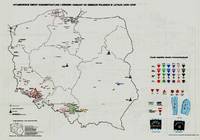
197941929Warszawa Warsaw: Pan´stw. Wydawn. Naukowe 1979. 1st Edition. Original black printed portfolio 8vo. Portfolio of seven large folding maps on on 4 sheets of heavy paper 3 are double sided 1 is singled sided. Primarily black and white with some color. Text in Polish. <br> Title translates to “Nazi camps in Poland 1939 - 1945. An Encyclopaedic Reference Book: Maps." Collection of 7 maps each 84 cm x 60 cm 33 x 24 inches produced by Jan Laskowski at the Main Commission for the Investigation of Nazi Crimes in Poland. The maps comprise Volume II of the work; Volume I is a heavily illustrated 676-page book of the same title which we offer separately. <br> The Seven maps all present are: <br> - Map 1 Single Sided: Hitlerowskie obozy na ziemiach polskich w latach 1939 - 1945. “Nazi camps in Poland in the years 1939 - 1945â€. Showing: concentration and extermination camps sub-camps of concentration camps extermination centers POW camps more important sub-camps working divisions commandos and temporary POW camps penal labor camps major labor camps prisons transit camps & ghettos. <br> - Map 2A: Getta na ziemiach polskich w okresie okupacji hitlerowskiej w latach 1939 - 1945 “Ghettos in Poland during the Nazi occupation in 1939 - 1945â€. <br> - Map 2B: Hitlerowskie obozy przejsciowe na ziemiach polskich w latach 1939 - 1945 “Nazi transit camps in Poland in 1939-1945â€. <br> - Map 3A: Hitlerowskie wiezienia i areszty na ziemiach polskich w latach 1939 - 1945 “Nazi prisons and arrests in Poland in 1939 - 1945â€. <br> - Map 3B: Hitlerowskie obozy pracy na ziemiach polskich w latach 1939 - 1945 “Nazi labor camps in Poland in the years 1939 - 1945â€. <br> - Map 4A: Hitlerowskie obozy jenieckie na ziemiach polskich w latach 1939 - 1945 “Nazi POW camps in Poland in 1939 - 1945â€. <br> - Map 4B: Hitlerowskie obozy koncentracyjne i osrodki zaglady na ziemiach polskich w latach 1939 - 1945 “Nazi concentration camps and extermination centers in Poland in 1939 - 1945â€. <br> Maps 2A & 2B have been described as a “Terrifying pair of maps showing the locations of German POW and internment camps in Poland during World War II highlighting the widespread locations of these establishments. In some parts of the map the information becomes so dense that three inset maps are shown. This map was designed by Jan Laskowski and printed in 1979 as part of a work on the Nazi extermination machine produced by PWN Warsaw a state-owned research-focused publishing house in Poland.<br> The map on the front is particularly interesting for its depiction of symbols used to classify internees in German camps. The uppermost of these depictions shows the combinations that can be made for different types of prisoners of different levels of importance. The armbands that would have been worn by these prisoners is shown as well as the prison uniforms. Other details are also shown. <br> The map lists hundreds of sites run by Nazi operators throughout the country. These include concentration camps death camps transitional camps and ghettos. The map is divided according to Poland's voivodeships with a key in the lower left. Names of cities too long to spell are also provided in the lower left. <br> This map was produced during a point in Poland's history during which it was actively revisiting the period during the Second World War. Leading social scientists devoted their time to trying to gather all the living as well as the recorded history of the events of the Holocaust and related atrocities before this information vanished. Leading these efforts particularly during the 1960s and 1970s was the Glówna Komisja Scigania Zbrodni przeciwko Narodowi Polskiemu known as the Chief Commission for the Prosecution of Crimes against the Polish Nation. They were active in publishing maps both for domestic educational purposes and for international remembrance and diplomatic efforts regarding the Holocaust. Jan Laskowski was a leading cartographer who produced a number of maps in this field. <br> These maps were produced as part of a series of maps that purported to combine to form an atlas of all of Hitler's crimes in Poland. Many of the large wall maps produced during this period could only show a fraction of the crimes or only the atrocities committed in one region. Thus a series of maps was needed to show all the points necessary which this present work contributes to. <br> Polish Reinterpretations of the Holocaust: Studying the effects of German occupation in Poland is a delicate subject. While it is certain that Poland suffered at least as badly as any other European nation during the Second World War reinterpretations of the Holocaust in the country have also been used to satisfy nationalistic tendencies. It has become evident to Western observers in the last several years that there is a strong nationalist movement in Poland that seeks to place blame for the Holocaust solely on the shoulders of non-Polish actors a movement originally fostered under Soviet rule. This movement has gone so far as to limit freedom of speech criminalizing with a three-year sentence the suggestion that Poland or its citizens in any form participated in the murders committed by Nazis. As such the term ‘Polish concentration camps’ has been deemed unacceptable with the government-approved term being ‘concentration camps on Polish territory.’ <br> All lines of evidence show that this map 2A & 2B was produced using the most accurate and impartial historical sources. The language on the map is simple naming only ‘Hitler's Atrocities’ and there is no evidence of a clear anti-German bias. However it is impossible to separate this map one of the most important productions of the remembrance movement during this period from the social situation in which it was produced. Maps like these can easily be converted into propaganda instruments and today's Polish leaders most of whom grew up during Soviet occupation will have formed their understanding of the Holocaust through maps like these. <br> Soviet Censorship: While the content of the map appears to have been produced free from bias the map still had to go through Soviet censorship. Mentioning prisoner of war camps in which primarily Soviet troops were interned would have been a prerequisite condition upon which the publication of the map rested. Further the lack of mention of any Soviet killings or camps requires no explanation….The map unlike many later maps makes no differentiation between the populations who suffered at the various camps. This represents the Soviet agenda that all nations suffered fought and won equally which sought to limit divisions in this post-identity state†Ruderman 2022. <br> SUBJECTS: World War 1939-1945 -- Prisoners and prisons German. -- Concentration camps -- Poland. Guerre mondiale 1939-1945 -- Prisonniers et prisons des Allemands. -- Camps d'internement -- Pologne. Obozy koncentracyjne -- Polska -- 1900-1945. OCLC: 830885973. <br> Light shelf wear to portfolio as expected. All maps in pristine condition with normal folds as issued. Very Good Condition. Complete and dramatic BR5 holo2-147-19-'cc. Warszawa (Warsaw): Pan´stw. Wydawn. Naukowe unknown
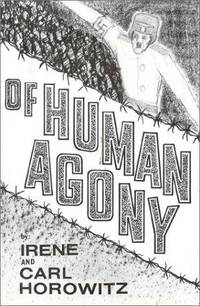
1992026551New York: Shengold Publishers Inc 1992. INSCRIBED / SIGNED by both AUTHORS directly on the front free endpaper. The first signatures are dated 3/13/92. Signed and dated 1/17/15 a second time by Irene in a very shaky hand. This is the 1992 Shengold first edition NOT the 1998 Schreiber reprint. Near Fine condition in a bright and shiny Near Fine dust jacket crease to front inner flap. NO chips or tears. NOT price clipped $18.95. The jacket is protected by a removable Brodart clear-plastic sleeve. NOT a remainder. Previous owner's name and brief gift note. Pages are otherwise crisp clean and unmarked. Photo illustrated. Holocaust memoirs of this Jewish couple - Carl lived as a Christian for 3 years before being discovered and sent away to concentration camp but escaped deportation to Auschwitz. Irene survived confinement in a ghetto by changing hiding places several times. They married in Poland at the end of the war and emigrated to America in 1948. Bound in the original blue cloth stamped in bright gold on the spine. Complete with dust jacket. From the publisher: "This is the candid graphic and moving story of two Holocaust survivors. Their youth and their wits helped them to survive and put their ordeal to a constructive end.". INSCRIBED / SIGNED by both AUTHORS. First Edition. Hardcover. Near Fine condition/Near Fine dust jacket. Illus. by NOT a library discard. 8vo. 202pp. Great Packaging Fast Shipping. Shengold Publishers, Inc Hardcover
1947244572Sifriat Poalim - Workers' Book-Guild Hashamer Hatzair 1947. Hardcover. Good. 8vo in a library binding. Manuscript spine title and library number. There are two spots where a previous owner has applied white-out apparently onto a library rubber stamp. Binding tight and square moderate rubbing to the corners and spine ends text block a bit toned. The text is in Hebrew with a second title page in English. At this writing Jan. '21 we find no other copies offered online. Sifriat Poalim - Workers' Book-Guild (Hashamer Hatzair) hardcover
201322212Dordrecht/Heidelberg/New York/London: Springer 2013. hard cover illustrated boards. no flaws or wear. clean. no markings. tight binding appears unused.; english text.; 196pp. 12 essays and articles including the introduction. many of the papers were presented at a conference in paris 2010. First Edition. Hard Cover. Near Fine Plus/No Jacket as Issued. 8vo - over 7¾" - 9¾" tall. Springer Hardcover
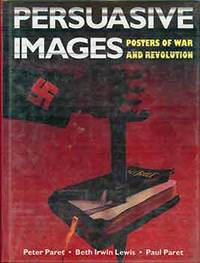
18-9396Princeton N.J.: Princeton University Press 1992. 4to. 233 pp. Very Good. Hard Cover. Blue cloth covered boards. Dust Jacket Very Good. In protective Mylar wraps. Color plates throughout.Heavy volume additional shipping fee may apply.The 317 posters reproduced in this volume are drawn from Russia the USA and Central and Western Europe documenting the political and military conflicts of the 20th century. The posters form a bridge between the claims of the State and the support or submission of those who must fight. Political posters are historical documents. They open windows to the conditions and conflicts of an earlier time. In their designs and slogans we see how governments and political factions responded to economic crises social change. and ideological and armed conflict and how they sought to sway the perceptions and feelings of the man and woman in the street. Posters are also aesthetic objects. Their composition color and symbols are both separate from their overt political message and the instruments of expressing it. Posters reveal their historical meaning more clearly if we pay attention to their visual characteristics as well as to their political intent. This book treats the poster both as art and as historical witness. Posters are not relegated to the secondary role of illustrating a historical text nor are they treated as autonomous aesthetic objects in a history of applied arts. Instead they are substantial components of a historical narrative that is made up of both image and text. The close interaction of words and posters drawn from Russia central and western Europe and the United States opens fresh perspectives on a half century of war and revolution and constitutes a step toward a new kind of integrative history that conveys the past with unusual immediacy. Contents: Introduction: Posters and modern history --Note on the posters --Prologue: before 1914 --I. The First World War --The outbreak of war --The enemy --Combat --Self-Images --Appeals to serve --War loans --Food and industry --The end of the war --II. The Interwar Years --Revolutions --The Soviet Union --Germany and National Socialism --The Spanish Civil War --III. The Second World War --Early stages --The air war --The invasion of Russia --The new order --Home fronts --The United States at war --The last year --Epilogue: after 1945 --List of posters --Index of artists.ISBN: 0691032041 9780691032047. Princeton, N.J.: Princeton University Press, 1992. paperback
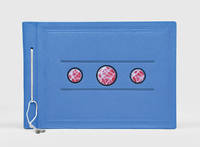
19671824721967. Auschwitz memorialized - a record of "the first fully 'international' event" at the former camp A commemorative album for the opening of the memorial at Auschwitz on 16 April 1967 an important stage in its transition to an international memorial site. Situated at the western end of the railway lines that cross the camp the memorial remains a central part of the Auschwitz complex. The large granite memorial was designed by the Italian architects Andrea and Pietro Cascella. Approximately 200000 people attended the unveiling including Polish state officials the East German and Italian foreign ministers and prisoner organisations. The first two photographs show the memorial the third the crowd bound in by the barbed wire and the fourth the Polish prime minister Józef Cyrankiewicz laying a tribute. The remainder show the attendees eating lunch food stalls and chefs preparing the food. Given this the album was presumably produced for the organizers of the catering. "Abstract in form and vague in its message the monument and the events surrounding its unveiling in April 1967 certainly furthered the memorial site's growing international character and testified to the waning relevance of a traditional Polish-national commemorative idiom at Auschwitz. At the same time however the Birkenau monument failed to specify or acknowledge explicitly the suffering and death of Jews as Auschwitz and therefore took its place in the continuum of commemorative marginalization of the Shoah at the site" Huener pp. 145-6. The memorial does not mention the Jews specifically nor did Cyrankiewicz in his remarks at the event as he wished to continue to present the camp as a specifically Polish tragedy. Nonetheless the unveiling "drew tremendous attention from abroad and can therefore be understood as the first fully 'international' event held at the State Museum at Auschwitz. The highly publicized April ceremonies. reached the wider European public and through the presence of countless journalists the world" Huener p. 146. Oblong quarto 36 x 25 cm containing 28 silver gelatin prints ranging from 17 x 12 to 17 x 23 cm mounted on 21 leaves of thick black card string-tied within blue cloth covers. Fore edge of first leaf a little chipped otherwise binding and contents in excellent condition. Jonathan Huener Auschwitz Poland and the Politics of Commemoration 1945-1979 2003. hardcover
1498566979.Ghardcover. Good. Access codes and supplements are not guaranteed with used items. May be an ex-library book. hardcover
69182New York: Raw Books & Graphics 1986. Very Good. Slim folio 36 cm Saddle-stitched illustrated wraps. Wraps lightly rubbed. Moderate soiling to rear wraps of numbers 1 and 3.<br /> <br /> Volume 1 Number 1 Fall 1980. "Two-Fisted Painters" by Art Spiegelman booklet.<br /> <br /> Volume 1 Number 3. 1981. "Maus Chapter Two The Honeymoon" booklet.<br /> <br /> Volume 1 Number 4. 1982. Vinyl record "Reagan speaks for himself" detached and laid in. "Maus Chapter Three Prisoner of War" booklet.<br /> <br /> Volume 1 Number 5. 1983. Couple by Art Spiegelman. "Maus Chapter Four The Noose Tightens" booklet. Stapled in a little loosely.<br /> <br /> Volume 1 Number 6. 1984. "Maus Chapter Five Mouse Tales" booklet.<br /> <br /> Volume 1 Number 7. 1985. "Maus Chapter Six Mouse Trap" booklet. "Red Flowers" booklet by Yoshiharu Tsuge. Deliberately issued by the publisher with a torn front wrap.<br /> <br /> Volume 1 Number 8. 1986. Jimbo by Gary Panter. "Maus Chapter Seven Mauschwitz" booklet. The first number along with six other issues of RAW Magazine Volume 1. Number 2 is not present. <br /> <br /> A very colorful and bold comics and graphics anthology edited by Art Spiegelman and Françoise Mouly a husband and wife team which highlighted artists from around the world and was published in the United States from 1980 to 1991. In addition to the work of Spiegelman and Mouly RAW featured cutting-edge comic artists such as Robert Crumb Gary Panter Charles Burns Kim Deitch Sue Coe Jerry Moriarty Richard Sala and Ever Meulen among many others. In these issues of RAW one will find Gary Panter's best-known comic protagonist "Jimbo" a burly punk and existential adventurer as well as "The Voice of Walking Flesh" by Charles Burns "Love's Savage Fury" by Mark Newgarden and a centerfold by Ever Meulen captioned "Use the Mood of the Past to Rewire Your Brain for the Future." Of significant importance is the fact that Art Spiegelman's seminal graphic work "Maus: A Survivor's Tale" made it's first appearance in this magazine chapters 2-7 are present here as stapled-in booklets. Spiegelman's unrivaled Holocaust narrative "Maus" was awarded the 1992 Pulitzer Prize it was the first graphic novel to win the Pulitzer Prize and he was the first-ever cartoonist to receive the prestigious Edward MacDowell Medal a medal awarded annually since 1960 to artists who have made an outstanding contribution to American culture.<br /> <br /> A nearly consecutive run of volume 1 of this trailblazing magazine with original serialized chapters of "Maus." "The Graphix Magazine for Your Bomb Shelter's Coffee Table." Number 4 front cover caption. Raw Books & Graphics unknown
199023490Ithaca NY: Center for International Studies Cornell University 1990. soft cover as issued. only slight signs of handling to exterior negligible impact. no real flaws or wear. no markings. no bumps tears creases. tight binding.; english text. shows no isbn.; vii-152pp. eight essays by various contributors. cornell studies in international affairs western societies program occasional papers no. 25. First Edition. Soft Cover. Near Fine. 8vo - over 7¾" - 9¾" tall. Center for International Studies, Cornell University Paperback
BOOK_0373625022New. unknown
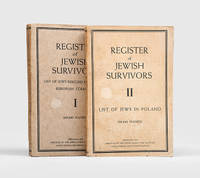
1945193462Jerusalem: Published by the Jewish Agency for Palestine / Search Bureau for Missing Relatives 1945. The search for the living First edition of the first major attempt to reunite Jewish families after the Holocaust listing 118000 survivors and their locations. Almost immediately after the war localized lists were published recording survivors from particular camps ghettos and countries. The Jewish Agency for Palestine established the Search Bureau for Missing Relatives to draw these efforts into a comprehensive register. The introduction notes it was published to "facilitate the re-establishment of contact between the remnants of Jewry in Europe and their relations in the Land of Israel and overseas. The Register contains the names of 60000 Jews of various countries saved from the camps and the ghettos who have been registered wherever they were were found following the liberation of Europe from Nazi servitude". It nevertheless cautions readers not to give up hope if a name is absent given the difficulty of compilation amid the chaos of postwar Europe. Lists also appeared in the weekly bulletin Lakarov Ulerahok while search requests were broadcast on Kol Yerushalayim in Jerusalem. Despite the suggestion of "forthcoming volumes" no further were produced. During its years of operation 1945 to 2002 the Bureau handled more than a million enquiries. The volumes are scarce on the market with most surviving copies held institutionally. They remain important reference works for those tracing relatives. 2 vols octavo. Original brown wrappers lettered in black. Contemporary Hebrew library stamps to title page of the Search Bureau for Missing Relatives; residue of removed labels to front covers. A little toned with minor wear remnants of the paper ties as issued to title pages wrappers of vol. I a little loose with some gatherings shaken. A good set of a fragile publication. unknown
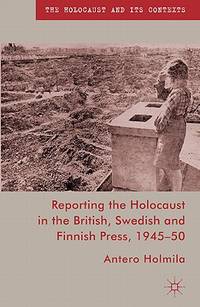
201113573NY/UK: Palgrave/Macmillan 2011. hardcover illustrated boards. no flaws - clean no writing or markings tight binding. an unused copy.; english text.; xiii-276pp. detailed examination of the post-war press in three european nations and their reporting on the holocaust and its aftermath trials etc. First Edition. Hard Cover. Fine/No Jacket as Issued. 8vo - over 7¾" - 9¾" tall. Palgrave/Macmillan Hardcover
198133603Sidgwick & Jackson 1981. 8vo. First UK Edition with frontispiece map and plates; blue cloth gilt back a near fine copy in price-clipped dustwrapper. SCARCE. Sidgwick & Jackson, hardcover
1974224082Jerusalem: Yad Vashem 1974. Hardcover. Very Good. 4to in black cloth. Text in English and Hebrew. Very Good in like dustjacket: very light shelfwear rubbing at the corners and spine ends of the jacket. No. 3 of 100 copies not signed on the limitation page but inscribed and signed in English by Bogen on the Hebrew title page. Please request a quote for international shipping. Yad Vashem hardcover
1986028394Moscow: Progress Publishers 1986. Fine condition in a bright and shiny Very Good dust jacket. Sharp corners. NO owner's name or bookplate. NOT a library discard. NOT a remainder. Pages are fresh crisp clean and unmarked. A volume from the publisher's Impressions of the USSR series. The book begins with a chapter The Road to Berlin which includes a stop at Auschwitz and has 16 pages of related photos some quite gruesome. Other chapters cover: The Road to Heaven The Road to Moscow The Road to the Mountains The Road to Samakand The Road to Mamayev Hill The Road to Babii Yar The Road through the Forest. The book has much on the Ukraine and on the history of Russia's fight against the Nazis in WW2 including many historical photos. Bound in the original brown leatherette stamped in black. From the dust jacket: "Well-known English writer John Summers's ROAD TO SAMARKAND is a documentary account of his journey across the Soviet Union." i. e. his 1984 second visit -- the first visit was in 1977 when he travelled to Donbas Kuzbas and Karaganda and described in his book THE RED AND THE BLACK. 1st ed No additional printings listed. Hardcover. Fine condition/Very Good dust jacket. Illus. by NOT a library discard. 168pp. 40 pages of photos. Great Packaging Fast Shipping. Progress Publishers Hardcover
194588770Cornell university press January 1945. Hardcover. Acceptable/No Jacket. Bookplate on inside cover with cellephane cover and tape to the bookplate. Spine is mildly shaken. Cornell university press hardcover
2025BIBSD0160335612025. Full Leather Bound. NEW. Size: 22.22x 29.21 cms A Unique Premium Leather-Bound book for elite readers/collectors of old rare books. An Original Leather is being used for binding this book with Golden Leaf Printing and designing on Spine front and Back of the book with edge gilding. WE HAVE MULTIPLE OPTIONS IN COLOR OF LEATHER RED GREEN BLUE MAGENTA TAN PURPLE DEEP BROWN BLACK AND WITH DIFFERENT COLOR LABELS. YOU MAY CHOOSE ANY COLOR OF YOUR CHOICE AND MAIL US. This service is chargeable. Original edition was published in 1897 and this unique edition is Reprinted in 2025 with the help of original edition. Black & white printing on high quality natural shade paper with sewing binding for longer life professionally processed without changing its contents. As these are old books we processed each page manually on computer and make them readable. We give our best to give you the best book but in some cases we have to adjust few pages which are blur or missing or black spots. If it is multi volume set then it is only single volume. We hope that you understand these issues in these old treasure. This is an important book for the readers who want to know more about our old treasure. Our dedicated team is trying to bring these rare books back to the shelves. We are also giving service of printing the hard-to-find books which are not listed in our store. Hope you will like it and give your comments and suggestions. Lang: - Hebrew Pages 202. Product Disclaimer: Please be aware that because leather is a natural material slight discoloration or change in texture may be visible. FOLIO EDITION Size 12x19 Inches IS ALSO AVAILABLE ON REQUEST. Please Note:- 4Text Cut hardcover
1985017799Westfield New Jersey: Privately Published 1985. INSCRIBED / SIGNED by the AUTHOR on the first white page. Very Good condition. NOT a library discard. Pages are crisp and clean. NO underlining. NO highlighting. NO margin notes. Autobiography of a Jewish woman that focuses mostly on her girlhood in Hitler's Germany. Illustrated with full page drawings by S. Bonstein one of which depicts "the hiding place" - a crawl space behind a brick wall concealed by a stack of "collapsible" shelves. Spiral bound black plastic comb with printed tan paper covers under clear plastic sheets front and rear. INSCRIBED / SIGNED by the AUTHOR. 1st ed No additional printings listed. Oversize Softcover. Very Good condition/No jacket as issued. Illus. by Bonstein S. drawings. 146 leaves. Privately Published Paperback
197435023George Mann Maidstone 1974. 8vo. with plates and endpaper maps; blue cloth backstrip lettered in silver a very good bright clean copy in price-clipped dustwrapper. Much-needed reissue of the original UK edition of 1958. One of the best and best illustrated eye-witness accounts of the Uprising with useful photographs not easily available elsewhere. The endpapers give a detailed street map of the Ghetto quarter. VERY SCARCE ESPECIALLY IN THE DUSTWRAPPER. Enser p.469 recording the first edition. George Mann, Maidstone, hardcover
194634901Longmans Green New York NY 1946. 8vo. First Edition; blue cloth backstrip lettered in darker blue uncut backstrip lightly faded else a very good bright clean copy in unclipped dustwrapper. One of the best first-hand accounts harrowing and moving by turns. EXTREMELY SCARCE IN THIS CONDITION. Enser p.468. Longmans Green, New York NY, hardcover
1990022495New York: Philosophical Library / Allied Books Ltd 1990. Appears unread. Very Fine condition in a bright and shiny Near Fine dust jacket. NOT price clipped $35. The jacket would also be FINE but for a couple tiny less than ½ inch closed edge tears. NOT a library discard. NO owner's name or bookplate. Crisp clean and unmarked - obviously never read. ISSN 0741-8450. Voume 7 only. Among the articles in this volume are MAJDANEK - CORNERSTONE OF HIMMLER'S SS EMPIRE IN THE EAST by Elizabeth B. White and PRIMO LEVI: THE DROWNED THE SAVED AND THE GREY ZONE by Ilona Klein. Ruth K. Angress & Jonathan Helfand Corresponding Editors; Gerald Margolis Managing Editor. Bound in the original glossy brown cloth stamped in bright gold over black panels on the spine and front cover. Complete with dust jacket. First Printing so stated. Hardcover. Very Fine condition/Near Fine dust jacket. Illus. by NOT a library discard. 8vo. viii 266pp. Great Packaging Fast Shipping. Philosophical Library / Allied Books, Ltd Hardcover
199813881Burlington VT: Verve Editions 1998. cloth hardcover in dust jacket. no flaws. clean no writing or markings strong binding hinges.; 120pp. illustrated throughout in color.; introduction by james young. haunting pieces and installations using photographs slides and their original locations. . First Edition. Hard Cover. Fine/Fine. Oblong 12" 4to. Exhibition Catalogue. Verve Editions Hardcover
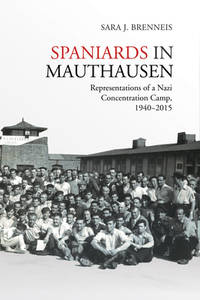
201823640Toronto: University of Toronto Press 2018. soft cover. no flaws or wear. clean. no markings. no bumps creases. tight binding. appears unused.; english text.; xii-365pp. 10 illustrations. the ss concentration camp in austria had a large number of spanish political prisoners who fled franco's regime winding up in france before falling into german hands in 1940. First Soft Cover Edition. Soft Cover. Near Fine Plus. 8vo - over 7¾" - 9¾" tall. University of Toronto Press Paperback
9997678281.Ghardcover. Good. Access codes and supplements are not guaranteed with used items. May be an ex-library book. hardcover
1981004657New York: UAHC. Hardcover. 1981. 4to 237pp . Fine in Very Good DJ. Profusely Illus. B&w Color This is number 510 of a limited edition of 1000 copies in slipcase. Laska #1722. A selection of drawings and paintings from the collection of Kibbutz Lohamei Haghetaot Israel . UAHC hardcover