7 077 résultats
Signed and inscribed by author upon front free endpaper to General R.E. Wood [1879-1969], under whose leadership Sears Roebuck was transformed from a mail-order to a retail sales behemoth. pp. [6], 7-90. "Communist plotters, in the United States as elsewhere, are preparing for the conquest of political power. The discerning student, however, should consider how interventionism, under various enticing labels, is setting the stage for the final overthrow of the voluntary society, the market economy and constitutional government. [This work], by a world-famous expert, will prove a valuable aid to understanding in this field. It will help to explain the errors of those who believe a system based on individual freedom can be 'mixed' with socialism." - Foreword. Book clean and unmarked with moderate wear. Binding tight. Above-average wear to price-clipped dust jacket now preserved in archival-grade Brodart. Greaves & McGee B-14. Book
1st edition. All original paper wrappers, 4to, each copy is 1 leaf folded in half, making [4] pages. Included are: No.50 (September 17, 1940), No. 52 (October 1, 1940), No. 62 (December 30, 1940), No. 71 (March 3, 1941), Nos. 74-80 (March 24 -May 5, 1941), No. 82 (May 19, 1941), Nos. 84-151 (June 2- September 21, 1942), Nos. 153-223 (October 5-February 7, 1944), Nos. 226-234 (February 28-April 24, 1944), Nos. 236-305 (May 8, 1944-December 15, 1945). The numbering system then changed and continues as Vol. VII, Nos 1-19 (January 1-October 1, 1946), all present. 249 issues total, nearly complete and uninterrupted from March 1941-October 1946. Fascinating exile publication, published weekly to alert other refugees, and American decision makers as well, about Nazi abuses in Czechoslovakia and resistance to them, from the great ("Sokol Property Seized: Nazis Destroy Great Czech National Monument) to the small ("Czech Farmers Refuse to Breed Pigs") . Some material on Jews. "News Flashes From Czechoslovakia Under Nazi Domination" ran 1939-1945, then, following the end of the war, continued as simply "News Flashes from Czechoslovakia, " through 1946. The Czechoslovak National Council was established during WWI to help with war efforts. Headlines include, Over 50,000 Czechs in Nazi Torture Chambers, (no. 50) New Persecution of Czech Catholics, (no. 52) Nazis admit Invasion of Czechoslovakia Before Dr. Hacha signed Agreement, (no. 74) German Refugees in Czechoslovakia, (no. 77) Nazis Selling Out in Protectorate, (no. 95) President F.D. Roosevelt on American-Czechoslovak Relations, (no. 115) New Nazi Government for Czechs, (no. 119) Every Seventh Worker in Hitlerland a Foreigner, (no. 120 Nazis Discover Sabotage in Czech Literature and Art, (no. 128) Just Retribution to Nazis Pledged by Czechoslovaks, (no. 139) Czechoslovak Labor Under Nazism, (no. 205) and Religious Situation in Czechoslovakia (Vol VII, no. 19). SUBJECT(S): History. 1938-1945 Czechoslovakia. Also included a publisher's notice about new name and printing schedule. OCLC: 2449105. A few issues have minor tearing and chipping, some are sunned, some have additional creasing from mailing. All are legible and intact. Majority are in Near Perfect Condition. Very Good Condition. (HOLO2-159-10)
1st edition. Original Boards in dust jacket. 8vo. [4], 104 pages. 19 cm. Fold out map by Kaufman titled, Map Showing Possible Dissection of Germany and Apportionment of Its Territory. This famous polemic outlines a comprehensive plan for the extinction of the German nation and the total eradication from the earth, of all her people. (Back cover) Self-published and at first obscure, this anti-German book became a central strategic piece for infamous Nazi propagandist Joseph Goebbels, who referenced the book throughout World War II claiming it as proof of a Jewish threat to Germany, writing in his diary August 3, [1941], He really could not have done it better and more advantageously for us if he had written the book to order. I will have this book distributed in millions of copies in Germany, above all on the front, and will write a preface and afterword myself. It will be most instructive for every German man and for every German woman to see what would happen to the German people if, as in November 1918, a sign of weakness were given. (Herf, page 112, The Jewish Enemy) However, this mass publication plan never came to fruition, because Goebbels feared copyright problems. The U.S. was still not in the war, and he worried that the U.S. might retaliate by stripping German works in the U.S. of copyright protection. (Bytwerk, 2012) Instead, edited and editorialized selections of the book were published in the widely circulated Nazi pamphlet DAS KRIEGSZIEL DER WELTPLUTOKRATIE alongside claims that Kaufman was a close associate of Franklin D. Roosevelt, a member of his Brain Trust, and that Roosevelt himself had dictated some of Kaufmans words. (Bytwerk, 2012). Theodore Newman Kaufman (1910 -1986; his middle name sometimes given Nathan), was an American Jewish businessman, born to German-Jewish immigrant parents, who became known for his genocidal views on Germans. In 1941, he wrote and published Germany Must Perish! which called for the sterilization of the German people and the distribution of the German lands. The text was used extensively in Nazi propaganda, often as a justification for the persecution of Jews and was specifically cited as a reason to round up the Jews of Hanover, Germany .Kaufman was a radical intent on preventing American involvement in future wars in Europe. In 1939, under the auspices of the American Federation of Peace, an unknown entity of which he was the president and probably only member, Kaufman produced several publications. One pamphlet .read:A possible plea to Congress. ... Have Us All Sterilized! ... If You Plan On Sending Us To A Foreign War ... Spare Us Any Possibility Of Ever Bringing Children Into This World Into This Country Of Ours!It was with his famous fold-out map in Germany Must Perish, that Kaufman Germany and Austria showed how Germany and Austria could be dismembered; In those same pages he also advocated the forced mass-sterilization of all German men under 65 and the sterilization of most German women under 45. This would eliminate 'inbred Germanism,' he proposed, thus solving a great deal of humanity's problems. He also promoted the distribution of Germany's lands among the neighboring countries, illustrated in his famous map in his book. Indeed, His effort was spearheaded by the self-publication of the book Germany Must Perish! 'Since Germans are the perennial disturbers of the world's peace ... they must be dealt with like any homicidal criminals. But it is unnecessary to put the whole German nation to the sword. It is more humane to sterilize them. The army groups, as organized units, would be the easiest and quickest to deal with. ... The population of Germany, excluding conquered and annexed territories, is about 70,000,000, almost equally divided between male and female. To achieve the purpose of German extinction it would be necessary to only sterilize some 48,000,000 -- a figure which excludes, because of their limited power to procreate, males over 60 years of age, and females over 45. ...Complete sterilization of both sexes, and not only one, is to be considered necessary in view of the present German doctrine that so much as one drop of true German blood constitutes a German..... Kaufman's book gained attention in Nazi Germany, where propagandists used it as evidence of an international Jewish plan to destroy the German people. On July 24, 1941, the Nazi Party's newspaper, Völkischer Beobachter, published a front-page article on the book titled: 'The Product of Criminal Jewish Sadism: Roosevelt Demands the Sterilization of the German People.' The newspaper alleged that Kaufman was a close ally of Samuel Irving Rosenman, an advisor to Franklin Delano Roosevelt and that: 'Given the close relationship of the writer to the White House, this monstrous war program can be seen as a synthesis of genuine Talmudic hatred and Roosevelt's views on foreign policy.' At the time, the German leadership was engaged in a propaganda campaign designed to rally popular support for the German invasion of the Soviet Union. Antisemitism in general, and Kaufman's ideas in particular, became a focus of this campaign.Nazi Propaganda Minister Joseph Goebbels read the book in early August and immediately grasped its value, writing in his diary: 'This Jew did a real service for the enemy [German] side. Had he written this book for us, he could not have made it any better.' Under Goebbels' direction, Germany Must Perish! continued to receive significant media attention in Germany. Portions of the book were read on national radio, and Goebbels ordered the printing of five million copies of a pamphlet that summarized Kaufman's ideas.As an example, Kaufman was condemned on the August 1942 edition of the Nazi wall newspaper Parole der Woche [see photo] Nazi propaganda often used Kaufman's pamphlet as a justification for the persecution of Jews. When the Nazis required German Jews to wear a yellow badge on their clothing on September 1, 1941, they published a flyer explaining to the German people that those individuals wearing the star were conspiring to implement Kaufman's plan for the destruction of Germany. When the Jews of Hanover were forced from their homes on September 8, 1941, German authorities cited Kaufman's book as one of the reasons .The Nazi propaganda ministry continued to publish pamphlets, posters and flyers on Kaufman's ideas through the end of the war, and also urged newspapers and public speakers to remind Germans of Kaufman's book. Kaufman's last major appearance in Nazi propaganda occurred in late 1944, when a five-page section on him was included in the widely published booklet Never!, which described a number of alleged plots to destroy Germany. Randall Bytwerk, an historian of communications at Calvin College, concluded that '[a] German at the time could not have missed encountering' propaganda about Kaufman. The Nation Magazine (Nov 14, 1942) noted, Few Americans have ever heard of a prominent fellow-citizen named Kaufmann ... In Germany every child has known of him for a long time. Germans are so well informed about Mr. Kaufmann that the mere mention of his name recalls what he stands for. In one of his recent articles Dr. Goebbels wrote, 'Thanks to the Jew Kaufmann, we Germans know only too well what to expect in case of defeat.' (Wikipedia) "On 1 September 1941 all Jews remaining in Germany were forced to wear the Yellow Star when in public. In late September 1941, the Nazis released a remarkable mass pamphlet based on a book published in the United States titled 'Germany Must Perish!' The book proposed the partitioning of Germany and the sterilization of its population. The author, Theodore N. Kaufman, was an American Jew of no influence. The pamphlet, titled 'The War Aim of World Plutocracy,' [see photo] included excerpts from Kaufmans book. In early November 1941, this four-page flyer was released. It justified the Yellow Star by reminding Germans of Kaufmans pamphlet, which supposedly was the common goal of 'World Jewry.' Howard K. Smiths 1942 book Last Train from Berlin (p. 197) states that every German got copies of the pamphlet along with the monthly ration card" (Calvin College German Propaganda Archive, 2022). Includes bibliographical references on page 104. SUBJECT(S): World War, 1939-1945. Guerre mondiale, 1939-1945. Politics and government National socialism -- Foreign public opinion, American. Pangermanism. National characteristics, German. Germans -- Foreign countries. -- Reparations. Reconstruction (1939-1951) -- Germany. Allemagne -- Politique et gouvernement. In 25 years this is only the 3rd copy of the 1st edition, in hardback, we have ever seen, and only the second in a dust jacket. The 96 page paperback second edition, though scarce, is far more common. Later reprints of American Neo-Nazi groups were distributed to "prove" Goebel's claims about the Jewish conspiracy against Germany. (More at https://research.calvin.edu/german-propaganda-archive/kriegsziel.htm; https://en.wikipedia.org/wiki/Germany_Must_Perish!) OCLC: 3619129. Dust Jacket in about very good condition with light edge wear, protected in mylar cover. Light shelf wear. Some discoloration to end pages Binding is tight. Text block is fresh and clean. Very good + condition in about Very Good Jacket. Rare and important (HOLO2-109-62-AELXCC+)
5704 (1944). Original blank paper wrappers. 8vo. 64 pages. 21 cm. Reprinted in early 1944 for Jewish refugees in Switzerland with some additional notations. In Hebrew and German in parallel columns (with diacritic vowel marks under the Hebrew, and with Yiddish translation between Hebrew). Original 1938 title page, with verso 1944 German title page: Den jüdischen Flüchtlingen in der Schweiz; Zur Feier des [Pesakh]-Festes im Jahre 5704; überreicht vom Schweizerischen Israelitischen Gemeindebund. (For the Jewish Refugees in Switzerland; For the celebration of Pesakh in the year 5704; presented by the Swiss Federation of Jewish Communities). Copyright by Lehrberger & Co. of Frankfurt. A European-published hagada from the darkest period of the Holocaust, produced specifically for those feeling the inferno. During 1943 and 1944, the extermination camps were working at a furious rate to kill the hundreds of thousands of people shipped to them by rail from almost every country within the German sphere of influence, and by the spring of 1944, up to 8,000 people were being gassed every day at Auschwitz (USHMM, 2012). Passover 1944 began on April 8, the day that the roundups of the Jews of Carpatho-Ruthenia and northern Hungary started. On April 14, the last day of the Holiday, László Endre & László Baky (German-installed heads of the Ministry of the Interior) and Eichmann made the official decision to deport all the Jews of Hungary. With ten illustrations; an early 19th century German Orthodox Haggadah originally compiled by Wolf Heidenheim in 1822. Published for German-Jewish refugees in Switzerland under the auspices of the Swiss Federation of Jewish Communities, founded in 1904 to help protect the general interest of Jews in Switzerland; during the second world war, the Federation helped support the refugee community in Switzerland: Prior to and during the Second World War, Switzerland gave refuge to about 23,000 Jewish refugees although the government decided that Switzerland would serve only as a country of transit. These Jews were protected during the Holocaust due to Swiss neutrality. The Jewish refugees, however, did not receive the financial support from the government that non-Jewish refugees received. Many more Jews were prevented from entering, effectively shutting the border. (Jewish Virtual Library; Switzerland). The publishers, Goldschmidt, issued an earlier printing in 1940 (listed in one library on OCLC), no copies of this issue (1944) listed in libraries on oclc. Subjects: Haggada shel Pesah. German-Jewish Refugees - Schweizerischen Israelitischen Gemeindebund. Holocaust. Previous Owner's name on front wrappers, with "Zurich 5" written underneath. Wraps lightly soiled, with small tear at bottom of backstrip; otherwise Very good condition. Rare and important. (HOLO2-104-15)
1st edition. Portfolio, Folio-size, [4] p., xvi leaves of plates, all illustrations. 32 cm. Text in Polish . 16 duotone watercolors of camp life, each accompanied by a textual description of a paragraph or two in the introduction. SUBJECT(S): Geographic: Oranienburg (Concentration camp) -- Pictorial works. Sachsenhausen (Brandenburg, Germany : Concentration camp) -- Pictorial works. OCLC lists only 3 sets worldwide (Yale, U of Illinois, NANTERRE-BDIC in France), none in New York and None in Poland. Extremely scarce. Some images from this portfolio (not originals, but prints, from this very edition, the same as these) are on display via the Museum of the Jews in Poland (in Warsaw) Former owner's numbers in margins of plates, not affecting images. Plates and introduction in Good Condition; Original portfolio with dramatic color graphic on cover is present, but lacks spine and shows heavy wear. (holo2-125-9)
1st edition. original Paper Wrappers, 4to, [48] pages. Unpaginated. Text in Hungarian. Mostly illustrations. One of the first collections of Holocaust drawings published after the war. Original illustrated wrappers with red lettering on front cover. A pictorial album by Holocaust survivor Péter Áldor, depicting the atrocities of the German occupation and the repression of the local fascists. This work is profusely illustrated with 18 heart-gripping sketches illustrating in all its horror, human madness and misery. Light stains and wear to cover, internally extremely clean, Overall Very Good Condition, a nice copy. (Holo2-125-25)
Original Wraps. 4to. 112, [1] pages. 28 cm. First edition. In French. Includes 50 original color illustrations throughout of Compiegne Gusen 2, Buchenwald, Mauthausen, & Gusen 1. Illustrated narrative by the artist and survivor Bernard Aldebert. Jean Bernard-Aldebert (1909-1974) was born in Saint-Etienne, and began his career as an illustrator for Le Pêle-Mêle in 1928. He was arrested and deported to the Gusan extermination camp in early 1944, after publishing a satirical drawing in Ric et Rac. His deportation was via Compiegne, KZ Buchenwald, KZ Mauthausen, KZ Gusen I to KZ Gusen II (Bergkristall-Esche II underground plant) . One of the very few survivors of Gusen, he captured his experiences during this ordeal in the album 'Chemin de Croix en 50 Stations', published by the Arthème Fayard group in 1946 (Lambiek Comicopedia, 2014) . Subjects: Guerre mondiale (1939-1945) - Camps de concentration - Récits personnels français. Déportés français - 1939-1945 - Récits personnels français. Gusen (Concentration camp) - Pictorial works. Gusen (Concentration camp) . Pictorial works. OCLC lists 19 copies. Clean and fresh. Very good condition. (HOLO2-118-31) xx
Original Wraps. 4to. [32] pages. 27 cm. First edition. In French. Catalogue of the Exposition Crimes hitlériens. Page [2] contains color reproduction of lithograph poster 'S. S. Crimes Hitlériens' exhibition in Paris at the Grand-Palais, which was originally held from June 10 until July 31, 1945. Committee of honor includes Mitterand; organizing committee includes Coste-Floret, Boissieu, Webel, Paoli, Herst, Billiet. Page [3] includes plan and legend for lay out of the exposition. Complete illustrated throughout, in red and black ink. Includes many gruesome photos of the fate met by members of the French Resistance throughout France, photographs from the Struthof Camp, tallies of deportations of French Jews, tallies of the numbers of forced laborers from France, etc. In June 1945, the French government sponsored a huge exhibition, filling twenty-nine rooms of the Grand Palais, entitled 'Hitler's Crimes'. One of the rooms was devoted, according to the catalogue, to 'The Jews'. It presented a chronology of the internment of Jews in the French Camps of Pithiviers, Beuane-la-Rolande, and Drancy, in the occupied zone, and at Gurs in Southwestern France under the rule of Vichy. It also gave a tally of deportations from Drancy to Germany: 62, 608. Subjects: World War, 1939-1945-Atrocities-Exhibitions World War, 1939-1945-France-Exhibitions France-History-German occupation, 1940-1945-Exhibitions. OCLC lists 6 copies. Some wear and staining to wraps. Closed tears, tape repairs and pen markings. Interior clean and fresh. Good condition. Scarce. (HOLO2-118-28A)
Original Wraps. 4to. [32] pages. 27 cm. First edition. In French. Catalogue of the Exposition Crimes hitlériens. Page [2] contains color reproduction of lithograph poster 'S. S. Crimes Hitlériens' exhibition in Paris at the Grand-Palais, which was originally held from June 10 until July 31, 1945. Committee of honor includes Mitterand; organizing committee includes Coste-Floret, Boissieu, Webel, Paoli, Herst, Billiet. Page [3] includes plan and legend for lay out of the exposition. Complete illustrated throughout, in red and black ink. Includes many gruesome photos of the fate met by members of the French Resistance throughout France, photographs from the Struthof Camp, tallies of deportations of French Jews, tallies of the numbers of forced laborers from France, etc. In June 1945, the French government sponsored a huge exhibition, filling twenty-nine rooms of the Grand Palais, entitled 'Hitler's Crimes'. One of the rooms was devoted, according to the catalogue, to 'The Jews'. It presented a chronology of the internment of Jews in the French Camps of Pithiviers, Beuane-la-Rolande, and Drancy, in the occupied zone, and at Gurs in Southwestern France under the rule of Vichy. It also gave a tally of deportations from Drancy to Germany: 62, 608. Subjects: World War, 1939-1945-Atrocities-Exhibitions World War, 1939-1945-France-Exhibitions France-History-German occupation, 1940-1945-Exhibitions. OCLC lists 6 copies. Creased, hole in front cover, light wear to wraps. Interior unaffected. Good condition. Scarce. (HOLO2-118-28B)
8vo., First US Edition; cloth, covers very slightly faded else a very good, bright, clean copy in unclipped dustwrapper, the whole housed in a calf solander case with gilt back and marbled edges. A SIGNED PRESENTATION COPY TO DAVID LOW, WITH THE AUTHOR'S HOLOGRAPH INSCRIPTION DATED 1947 ON FRONT FREE ENDPAPER. This scarce collection (the author's first book and sole collection of verse) contains the structured poem 'Lessons of War', Part I of which, 'Naming of Parts', is arguably the most famous poem to emerge from WWII. It also contains the famous T S Eliot parody 'Chard Whitlow'. PRESENTATION COPIES ARE EXCEEDINGLY SCARCE. THIS ONE IS TO DAVID LOW, LEADING BRITISH POLITICAL CARTOONIST AND CREATOR OF 'COLONEL BLIMP'. A New Zealander by birth, Sir David Low (1919-1963) arrived in Britain in 1919 to progress his fledgling career as a political illustrator. In his early years in Britain he worked with a variety of publications including the 'Star', 'New Statesmen', 'Punch' and 'The Graphic'. In 1927 he was invited by Lord Beaverbrook to join London's 'Evening Standard' and the rest is history. A staunch anti-fascist, Low used the scaithing and incisive poweer of his cartoons to attack the complacency of the British establishment in the 30s; in 1934 he created in Colonel Blimp' one of the most famous figures in newspaper cartoon history. His work was swiftly banned in both Germany and Italy and after the outbreak of war several of his cartoons were used to inspire the British people during the darker days at the beginning of the conlfict. Low was appointed an official War Artist and as such attended the Nuremberg War Trials. He was knighted in 1962. Many of Low's cartoons were published in book form, the most famous collections being 'Low's Political Parade with Colonel Blimp (1936) and 'Europe at War' (1941). His most famous character was the basis of 'The Life and Death of Colonel Blimp' (Powell & Pressburger, 1936), one of the most important feature films in the history of British cinema. A UNIQUE AND PARTICULARLY APPROPRIATE ASSOCIATION COPY IN THE CONTEXT OF WWII.
1942. First Edition. Paper Wrappers, 8vo, 61 pages. Includes eight photographic illustrations, including three full-page photomontages by Polish avant-garde artist Teresa Zarnower, and original pictorial wrappers with two additional photomontages by Zarnower. Text in Polish. Published by the heavily Jewish Polish Labor Group in New York. The Destruction of Warsaw. Light wear to covers, with light crease through part of front cover and unobtrusive 4 digit number in pen at top near spine. Touch of wear to top of spine, Otherwise Very Good Condition, far better than generally seen of this rare and important Holocaust related avant-gard photography title. (HOLO2-117-61)
90 pages. "Communist plotters, in the United States as elsewhere, are preparing for the conquest of political power. The discerning student, however, should consider how interventionism, under various enticing labels, is setting the stage for the final overthrow of the voluntary society, the market economy and constitutional government. [This work], by a world-famous expert, will prove a valuable aid to understanding in this field. It will help to explain the errors of those who believe a system based on individual freedom can be 'mixed' with socialism." - Foreword. Prior owner's details upon toned front free endpaper. Another person's name inside front board, otherwise contents clean and unmarked. Binding tight. Average wear to publisher's green cloth. Dust jacket not included. Greaves & McGee B-14. Book
1st edition. Original paper wrappers, 16mo (small), 7 pages ; 25 cm (folded to 14 cm in wrappers). "Correspondence between Henry Ford, Louis Marshall and Herman Bernstein. Settlement of Aaron Sapiro's and Herman Bernstein's libel suits" (From the front cover). During the 1920s, Henry Ford gained as much fame for his antisemitic views as for his cars. His newspaper, the Dearborn Independent, published dozens of articles between 1920 and 1925 naming prominent Jewish Americans as conspirators in a plot to overthrow governments all over the world. Though hardly the first of their kind, the accusations in the Dearborn Independent represented the broadest, most sustained published attack on individual Jews and Jews as a group in the nations history. The articles created clear grounds for defamation and libel actions against Ford and the newspaper, and several were filed. In 1927 one lawsuit, Sapiro v. Ford, made it into court, generating international headlines, only to end in mistrial. Ford then disposed of the distasteful affair by signing a statement in which he apologized for the wrongs he had 'unintentionally' done to Jews. Ford's campaign against the Jews, as historians have recognized, reflected the renewed racial tribalism that characterized post-World War I American society (Woeste, Insecure Equality: Louis Marshall, Henry Ford, and the Problem of Defamatory Antisemitism, 1920-1929 in Journal of American History, Dec. 2004). The importance of the end result, here spelled out in this rare period publication, was summarized by Robert Rifkind in his 2008 examination Confronting Antisemitism in America: Louis Marshall and Henry Ford: Putting aside historical revisionism, it becomes clear that the Ford apology achieved a number of things no libel suit could have achieved. First, in broad and unambiguous strokes, Ford repudiated the defamation of Jews in general and not merely the particular claims asserted in the lawsuits. Second, the apology did so with dispatch rather than after further protracted delay. Third, Ford undertook to withdraw The International Jew from circulation both in the United States and abroad, and at least while Marshall remained alive, he seems to have done so. A jury sitting in an action for monetary damages could not have compelled such a result. And finally, a confession, retraction, and apology appearing in Fords name and over Fords signature carried the impressive force of a world-famous mana force that twelve anonymous jurors, easily dismissed as misled by lawyers wiles, could never have had (American Jewish History, Vol. 94, No. 1/2, March/June 2008, pp. 71-90). SUBJECT(S): Antisemitism -- Michigan -- Dearborn. Jews -- Trials (Libel) -- Antise´mitisme -- Juifs -- Proce`s (Diffamation) -- Dearborn independent. OCLC: 264355930. OCLC lists only 3 copies worldwide (Harvard, YIVO, Yale Law), none outside the Northeast. Light wear to wrappers, number penned on cover, no other markings, folded text pages inside extremely clean, an exceptional copy of this rare and very important imprint. Very Good Condition (holo2-148-4).
1st edition. Original paper wrappers. 8vo, 4-8 pages each. Conservative Jewish men's group newsletter from the Holocaust period from the the second synagogue founded in New York (1825) and the third-oldest Ashkenazi synagogue in the United States. "The object of the 'Tattler' will be to provide the members with a regular source of information and entertainment....The Pogroms in Russia during the Czarist regime or the activities of the Zionist movement in recent years had no such effect on the consciousness of the average American Jew except to stir a sense of pity and sympathy for the afflicted ones. But the cruel, heartless persecutions of the Jews in Germany by Hitler and his crew, caused a stirring in the blood of Native Americans of Jewish birth that made them turn about and recall the religion of their fathers and the God of Israel. We of The Men's Club of the Congregation B'nai Jeshurun welcome with open arms all those who are returning to the fold." Most issues include commentary on the increasing oppression of the Jews in Germany; other issues discussed include some current Jewish news, some retelling of Jewish history, congregation news, editorials, fun facts, jokes with lessons. OCLC: 944959016, OCLC lists 2 holdings worldwide (JTS & USHMM), though these holdings appear to be incomplete. First issue shows edgewear, other issues show only creases from folding, touch of wear, good quality paper with just the slightest toning. About Very Good Condition Overall. Rare (HOLO2-159-22A)
volumes 1 till 41 but vol.24 is missing, together +/- 24000pp. with some ills., in-8, text in german, blue cloth with gilt imprinting (some covers are bit discoloured or have few stains, back of few vols.repaired, some corners bumped or used), foxing on some vols.'edges, good condition (interior/text VG)
SHL-43Paris, Les Editions de Minuit, 1943, 1 vol. in-16 broché, couverture blanche ivoire imprimée, titre répété en long au dos, 91 pp. dont 2 ff. blanc, faux-titre, titre - 2 ff. n.c. dont l’achevé d'imprimer “Cet ouvrage publié aux dépens de quelques bibliophiles patriotes a été imprimé sous l’occupation nazie le 25 juillet 1943 jour de la chute du tyran de Rome [Mussolini est mis en minorité par le Grand Conseil fasciste, destitué et placé en résidence surveillée]”. Annotation manuscrite au stylo à bille sur la page de titre autour du nom de l’auteur “ = BRULLER […] graveur, caricaturiste d’origine hongroise [...] prononcer ère n’a écrit ensuite que “la marche à l’étoile” dans cette même collection” Bon état général : très légères et discrètes salissures dans les marges de la couverture, pliure au dos se prolongeant sur un centimètre environ sur le plat sup. au niveau de la couture basse, petites rousseurs pâles au dos de la page de titre et au f. de dédicace en regard “A la mémoire de SAINT-POL-ROUX, Poète assassiné.” [pp. 8 et 9] ; tranche sup. salie. Très rare seconde et ultime édition clandestine de ce titre fondateur des Editions de Minuit.
1st Edition. Original Illustrated Paper Wrappers. 8vo. 70 pages ; 17 cm. Text in Polish. The first separate published account of the Warsaw Ghetto uprising, issued the year following the revolt. Title translates into English as, Warsaw Ghetto Uprising. Issued under Soviet auspices it was written by a participant, the Polish historian, journalist and anti-Fascist activist, Bernard Mark (1908-1966) . Mark narrates the events immediately preceding and during the 1943 armed uprising of Warsaw's Jews, and presents Jewish, Polish, and German documents pertaining to the Warsaw and other ghetto and camp rebellions. (Google Books, 2017) Published by Union of Polish Patriots in the USSR. SUBJECT(S) : Holocaust, Jewish (1939-1945) -- Poland -- Warsaw. Jews -- Poland -- Warsaw. Warsaw Ghetto Uprising. OCLC lists 16 copies worldwide, but none in New York. Paper toning. Very good+ condition, a beautiful copy. (holo2-135-2A)
6511Ensemble constitué de 35 photographies, 14 diffusées par L'Eigentum der Reichsbahnzentrale für den Deutschen Reiseverkehr, 12 par l'Istituto Luce (L'Unione Cinematografica Educativa), 3 photo par Cor. [?] Ghergo, Macerata, et 6 sans aucune mention. 30 sont au format 18 x 24, 3 au format 13 x 18 et les six dernières de formats divers.
1944123391Signal 1944-1945 1 grand in 4 Pleine toile verte avec étiquette de titre en rouge 1 fort volume regroupant 15numéros se suivant de cette revue dans saversion italienne recouvrant les années 1944 et 1945 ( numéros rarissimes) jusqu'à la fin de la guerre. Reliure moderne en pleine toile verte avec étiquette de titre sur fond rouge - Importante documentation en reproduction jointe dans de nombreux numéros. Couvertures originales conservées
Original Cloth. 8vo. 482, [12] pages. 25 cm. First edition. In Hungarian. 'You are the Witness! From Ukraine to Auschwitz. ' With 12 pages of plates (printed in blue ink) . Includes name register of Hungarian Jewish victims of the holocaust on pages 209-482. Finely bound in buckram with gilt title. Subjects: Holocaust, Jewish (1939-1945) - Registers of dead Hungary. Holocaust, Jewish (1939-1945) - Registers of dead - Ukraine. Holocaust survivors - Hungary Registers. Holocaust, Jewish (1939-1945) Jews - Persecutions - Hungary. Jews - Persecutions. Holocaust, Jewish (1939-1945) . OCLC lists 18 copies. Light wear to cloth; pages lightly aged, otherwise clean and fresh. Very good condition. (HOLO2-115-20)
1974List3157St. Petersburg Florida: unpublished 1974. Ninety-four typed and photocopied pages measuring 8 ½ x 11 inches in a soft binding. Binding with wear; pages generally excellent to Near Fine. Overall excellent to Near Fine. Annemarie Bliwernitz 1905–2005 née Entz was born in Notzendorf East Prussia. In 1952 after surviving both World Wars she and her husband Bruno 1900–1992 immigrated first to Canada and then to the United States. Offered here is Annemarie’s unpublished memoir written between 1972 and 1974.<br /> <br /> Bliwernitz grew up in a wealthy land-owning country family which she remembers lived far west enough that they did not have to flee the Russians during World War I and was less affected by the postwar economic situation than were city residents. Most of the memoir is taken up by Bliwernitz’s remembrances of World War II and life leading up to it. Of Hitler’s rise she writes:<br /> <br /> “During these years conditions got worse in Germany . A new name came up ‘Adolf Hitler.’ – It was not hard for him to find followers now by the thousands and soon by the millions. He dared to stand up against the Communists with his brown uniformed S.A. men and a new wind seemed to blow over our illfated land. No wonder young people looked up to him and followed the new star nobody had much to lose. . Bruno and brother-in-law Willy after some meetings attended showed up in the new brown uniform also and farmers and laborers seemed to be united in that new idea. – It really changed Germany in a short time nobody could deny that unemployment ceased people got jobs again and housewives and mothers could buy the necessities of life for their families especially food. And it brought us to our feet again also.â€<br /> <br /> Though of course Bliwernitz maintains that the “Concentration Camps and what happened in them was not known to the German people" she mentions that Bruno quickly became an Arbeitsdienstführer—essentially a labor camp overseer—and remembers dissenters being disappeared:<br /> <br /> “As an example I will tell about Bruno’s oldest brother Alfred. He was all against Hitler from the beginning. One day he came home and picked up his neighbor’s paper at his frontdoor and wrote his ideas about Hitler and his lies down with pencil. This neighbor reported him they picked him up and that was the last his family saw of him. They were told ½ year later that he had died in Stuhm West Prussia a Concentration Camp. No explanation to his wife whatsoever. The same destiny happened to my co-worker a highly educated person at the Translation Office. She said in the lavatory where many ladies could hear: Hitler’s big picture in the office should be placed here in the toilet-rooms where it belongs. One of the ‘kind’ co-workers reported her and she came next day only to pick up her belongings and was not seen any more.â€<br /> <br /> While Bruno is sent to the Eastern Front Bliwernitz and their children flee the Russians trying to reach the Americans on the Western Front. Along the way they encounter deserting German soldiers and near Hamburg liberated camp inmates:<br /> <br /> “Shooting started close to us and we heard bombs exploding would we be hit We found out that the Concentration Camp near us had been opened and those freed inmates had shot their guardians. At daybreak we met the first one still in his black and white striped prison-suit kneeling on the ground by the chicken-coop and with his both hands feeding himself out of the bowl with the chicken food. . They came to us begging for a little bit of salt to cook the horse-meat they had cut out of the dead horses lying along the ditches . We talked to them and I remember one told me he was imprisoned because of his religion not to go to any war. He was from Elbing where I had gone to school as a young girl.â€<br /> <br /> The family are reunited with Bruno and shortly before they surrender to the Americans they destroy the evidence of their party involvement: “Bruno’s N.S.D.A.P. membership-card my certificate for the ‘mother’s cross’ the passports of Horst and Juergen showing that they had been students of the Nazi-school in Stuhm etc.†After the German surrender the family is sent back east where they struggle to avoid starvation then return west where they are sent to live in Hardegsen. They finally decide in 1951 to emigrate as life in postwar Germany is simply too difficult but make the mistake of being honest about their history:<br /> <br /> “Another big obstacle for us was that Bruno had been in a member in a Nazi-party though not an active one. But it was still a handicap in those days for any undertaking. We had not kept it secret in our immigration papers and they wanted a detailed description about our political involvement. That we did wrote a long letter in German didn’t have the money for an interpreter and never got an answer. . That was a bitter pill to swallow.â€<br /> <br /> After this they decide to try for Canada instead and this time savvily “didn’t mention any Nazi-party attachmentâ€. This is a success; the family moves to Winnipeg and eventually to St. Petersburg Florida where the narrative was written. Bliwernitz recalls working as a housekeeper which she contrasts with her previous life in which she and her family would not allow maids farm hands or tradesmen to eat at their table with them.<br /> <br /> Of interest to historians of the German civilian experience during the Second World War especially that of women and children. unpublished unknown
xxiv, 344 pages. Index. Translated from the German manuscript of the third, revised and enlarged edition. Earlier German editions were "smuggled across the German border in great numbers and enthusiastically received by the illegal revolutionary movement. The Fascists banned it in 1935." - xiv. The ten chapters include: Authoritarian Family Ideology and the Mass Psychology of Fascism; The Race Theory; The Symbolism of the Swastika; Organized Mysticism - The International Antisexual Organization; Some Problems of Sex-Political Practice; The Masses and the State; and more. Binding sound. Prior owner's name atop front free endpaper, otherwise unmarked with moderate wear. Above-average wear to dust jacket which is patched at spine ends and preserved in glossy new archival-grade Brodart. A sound vintage copy. Kehr & Langmaid 258, Madden p.55. Book
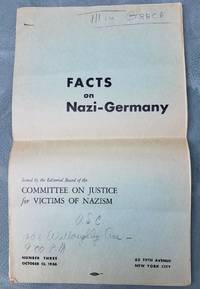
1936159271936. Committee on Justice for Victims of Nazism. Facts on Nazi Germany 1936 anti-Nazi report documenting early concentration camp discipline and political repression under the Third Reich issued to mobilize American awareness during a period of widespread isolationist sentiment in the United States. Produced three years before the outbreak of World War II the document records one of the earliest organized efforts by an American advocacy group to circulate evidence of Nazi violence specifically targeting the treatment of political prisoners in the initial concentration camp system established after 1933. The report identifies Esterwegen as a site of incarceration for political opponents and includes translated internal regulations that detail punitive discipline forced labor expectations and execution threats directed at prisoners categorized as political dissidents Jews and alleged enemies of the state.<br /> <br /> Editorial Board of the Committee on Justice for Victims of Nazism. Facts on Nazi Germany. Number Three. New York: Committee on Justice for Victims of Nazism October 15 1936. Mimeographed document. The publication consists of 11 mimeographed pages and includes contemporary marginalia and underlining in pencil indicating close reading by an early owner. The text opens with an editorial statement noting that the committee had obtained the material "a few days ago" followed by an appeal to American audiences: "By publishing this horrendous document we wish to bring to the consciousness of the American public the plight of the German people under barbarian Hitler rule.the vast majority of the German population looks to the world outside particularly America for moral support." The reprinted German directives emphasize coercion and ideological enforcement stating "Tolerance means weakness.ruthlessness will be exercised when the interests of the Fatherland are at stake." Detailed disciplinary measures include confinement on bread and water corporal punishment and execution for acts such as alleged mutiny or resistance. Specific infractions are enumerated including penalties for writing more than two letters monthly speaking disrespectfully to guards or minor breaches of barracks discipline demonstrating the totalizing regulatory system imposed within the camp.<br /> <br /> Issued during a period when U.S. public opinion remained divided over involvement in European affairs this document contributes to the study of early transnational anti-fascist networks exile politics and information dissemination prior to the consolidation of wartime alliances. Advocacy groups such as the Committee on Justice for Victims of Nazism attempted to counter limited press coverage and official reluctance to confront Nazi Germany by distributing translated materials that documented internal repression. The inclusion of Esterwegen regulations situates the publication within the early development of the concentration camp system before its later expansion and transformation during the war. Minor edge wear horizontal crease last page detached with toning and small losses at the fold and scattered pencil markings; overall good to very good. A scarce example of prewar American anti-Nazi advocacy in printed form with documented engagement by a contemporary reader. unknown
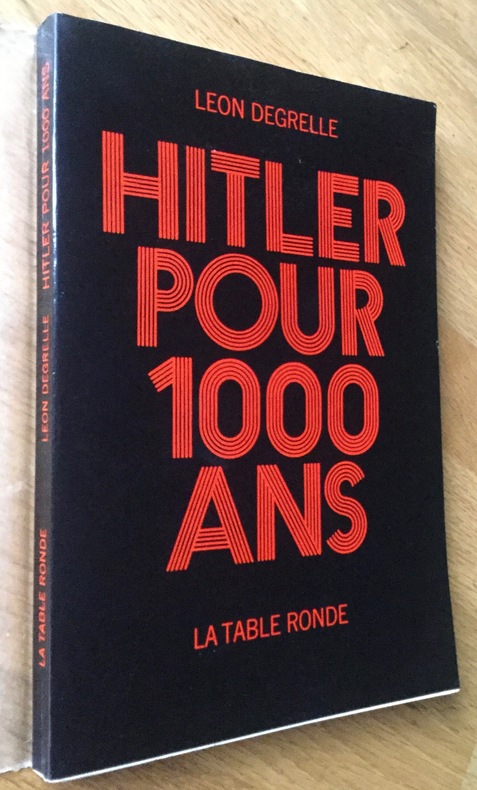
1969UUI-12652In-8 broché carré sous papier cristal d’origine (me semble-t-il), La Table ronde, 1969, 230 pp. Bon état général, bel exemplaire de cette édition originale rare d’un livre mythique, un des 25 sur vélin Périgord, seul grand papier avec quelques hors commerce. Poids 380 g. Envoi lettre verte. Frais d'envoi 6 euros sur la France, 12,90 euros pour l’étranger (tarifs de base hors envois suivis). Possibilité de remise en mains propres sur Paris, possibilité d’envoi MONDIAL RELAY, n'hésitez pas à me contacter avant de passer commande. Twitter : @Pontneuf06.
In 8° grande (24 cm), legatura in piena pelle editoriale con nervi, titolo in oro su tassello al dorso, taglio superiore dorato, fregi e titolo oro al piatto ed al dorso, custodia in cartone editoriale muto, ritratto dell'Autore su tavola in antiporta protetto da velina, pagine 705 con 28 pagine non numerate alla fine del testo, che riproducono alcuni manifesti e volantini della prima ora del partito. Esemplare in condizioni molto buone, lieve difetto ad un nervo al dorso, dedica manoscritta all'occhiello coperta successivamente incollandoci sopra una cartolina d'epoca raffigurante il Mahnmal, monumento commemorativo dei caduti durante il Putsch di Monaco del Novembre 1923. Mancano la parte inferiore e quella superiore alla custodia in cartone editoriale muto. Si tratta della rara edizione "lussuosa" realizzata nel 1939, per celebrare i cinquant'anni di Adolf Hitler.