38 résultats
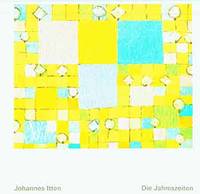
18-7277Nuremburg Germany: Kunsthalle Nurnberg 1972. . 8vo. Oblong. 102 pp. Soft glossy white and color illustrated wraps. Good with marginal toning along page and wrap edges and soiling along bottom right corner of front wrap. Black and white and full-page color plates. Includes a foreword by Curt Heigl and an essay by Hans Heinz Holz. Includes artist biography and selected bibliography. Catalogue created on occasion of exhibition “Johannes Itten: Die Jahreszeiten†held in Nuremberg Germany at the Kunsthalle Nurnberg from February 12 through April 3 1972 and at the Kunstmuseum Winterthur in Winterthur Germany from April 16 through May 28 1972. Title page includes name of previous owner in blue ink: “Peter Selz.†Auf Deutsch. From the Collection of the Art Historian Peter Selz. Nuremburg, Germany: Kunsthalle Nurnberg, 1972. paperback
18-4653Nuremberg Germany: Institut fur Moderne Kunst 1968. . 4to. Oblong. 52 pp. Soft color illustrated white wraps. Good with marginal soiling along wrap corners and light sunning. Black and white plates some fold-outs. Includes writings by Dietrich Mahlow Zdenek Felix Wieland Schmied and an artist biography by Vladimir Burda. Catalog created on occasion of exhibition “Jiri Kolar: Collagen Rollagen Objekte†at the Nuremberg Institut fur Moderne Kunst from October 30 1968 through January 1 1969. Auf Deutsch.From the Collection of the Art Historian Peter Selz. Nuremberg, Germany: Institut fur Moderne Kunst, 1968. paperback
25574LETTERS: 9 July 1953 and 11 May 1954. NOTE: 14 July 1953. All three items on letterheads of the Royal Courts of Justice Strand London WC2. The third letter gives an excellent indication of Birkett’s pride in his use of language. See his entry in the Oxford DNB. The recipient Vere Henry Collins 1872-1966 was an author and grammatical stickler. All three signed ‘Norman Birkett’. In fair condition lightly aged and little grubby. The first letter with a small hole to one corner and the two leaves of the last letter held together with a pin. ONE: ALS 9 July 1953. 1pp 4to. He is adding Collins’s book to his ‘select library on “wordsâ€â€™. ‘I am afrait that “finalise†is in frequent use as “I was sent to finalise the arrangements†and it is often used by witnesses in court and sometimes not without protest from me by barristers.’ He ends: ‘But the purpose of this letter is to thank you if somewhat belatedly for the interest you took in the subject of my address and for your kindness in writing to me.’ TWO: ANS 14 July 1953. 1p 4to. He has no objection if Collins adds the note he sends him ‘to the book now at the printers’. He will get ‘One Word and Another’ when it is published. THREE: ALS 11 May 1954. 3pp 4to. He will read the book Collins has sent him with great pleasure ‘for as you know anything written about words has a great fascination for me’. Turning to Collins’s ‘criticism of some remarks of mine uttered in the course of an after-dinner speech’ which have appeared without Birkett’s knowledge or consent he is for the most part in agreement ‘but I take it a little hard that the unpremeditated effusion of the moment should be treated as though it were a carefully prepared essay. I will say no extempore speech can survive a scrutiny such as the scrutiny you send to me.’ With regard to Collins’s seven points he feels he should ‘keep in mind the difficulties of extempore speaking. The perfect word does not always come readily to the tongue. The sentences do not always flow as one could wish and the “verbal expert†seated in his comfortable study might make a little allowance for human frailty!’ In the following paragraph he turns the tables on Collins analysing his use of language in his letter to Birkett. With a veiled criticism of Collins he explains how ‘the lover of words as I am can become a “tiresome pedant†’ Collins’s criticism has clearly hit home as Birkett adds a fourteen-line postscript in his distinctive close hand ending: ‘I cannot even be sure that the reporter took down accurately what I did say: I had no notes and never dreamt that what I said would receive this unwanted publicity and subject me to the criticism of lovers of good English!’ LETTERS: 9 July 1953 and 11 May 1954. NOTE: 14 July 1953. All three items on letterheads of the Royal Courts of Justice, Strand, unknown
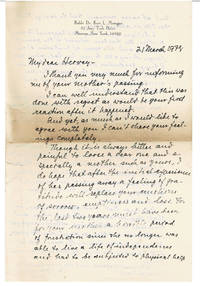
1978100985New York March 21 1978. 1978. Very good. - Over 350 words penned on both sides of his personal 10-7/8 inch high by 7-1/4 inch wide stationery. Responding to a brief mailgram he received from Hervey on March 19th informing him of her mother Faith Baldwin's death. Rabbi Kurt L. Metzger writes a lengthy consoling letter. "Though it is always bitter and painful to loose sic a dear one and especially a mother such as yours I do hope that after the initial experience of her passing away a feeling of gratitude will replace your emotions of sorrow. For the last two years must have been for your mother a horrible period of frustration since she was no longer able to live a life of independence." He describes how she has been relieved of her pain and frustration at "no longer being able to use her God-given gift of being productive in the literary field in which she has secured for herself the immortality of an extremely beloved and highly appreciated author." He hopes that although her mother has passed they will stay in touch "and continue a relationship which I enjoyed with your mother so much over the years." Signed "Kurt". Folded for mailing with a short tear along the left edge and offsetting near the middle. Very good with the original mailgram from Hervey. <p>A friend of Faith Baldwin Rabbi Kurt L. Metzger 1909-1992 was born in Nuremberg and was the Rabbi of Landau from 1935 to 1938. He was arrested while attending the Jewish Theological Seminary and incarcerated at the Buchenwald concentration camp for months but eventually released to serve as the Rabbi of Nuremberg. Metzger immigrated to the United States in 1940 serving as Rabbi of Temple Beth El in Glen Falls New York. The last Rabbi of Nuremberg he returned to visit Germany several times after he was and was named the Honorary Rabbi of his former native town of Nuremberg in 1977.<p>The American author of romance novels and other fiction Faith Baldwin 1893-1978 often wrote of women juggling careers and family enabling working women of all ages to identify with her characters. As a youth Baldwin lived for two years in Europe living in Dresden with one of her mother's close friends while the First World War was raging. She learned German and went to cooking school before returning to the U.S. in 1916. She began working for the War Camp Community Service where she met her future husband. New York, March 21, 1978. unknown
1986AWthNEW 32Munich: Prestel-Verlag 1986. 1986. 4to. pp. 499. 562 illus. 148 colour some full-page. biblio. index. cloth. dw. Exhib. Cat. Hardcover. Munich: Prestel-Verlag, [1986]. Hardcover
feb91306Used. For more details please contact me unknown
1147319049.Gpaperback. Good. Access codes and supplements are not guaranteed with used items. May be an ex-library book. paperback
194646438HMSO 1946-1951. Together 27 vols. 8vo. First Edition with 2 large folding charts; original printed wrappers one or two backstrips scuffed at head and tail else a remarkably well-preserved bright clean set. The extended set comprises: Part 1: 20 Nov 1945 to 1 Dec 1945 1946; Part 2: 3 Dec 1945 to 14 Dec 1945 1946; Part 3: 17 Dec 1945 to 4 Jan 1946 1946; Part 4: 7 Jan 1946 to 19 Jan 1946 1946; Part 5: 21 Jan 1946 to 1 Feb 1946 1946; Part 6: 2 Feb 1946 to 13 Feb 1946 1947; Part 7: 14 Feb 1946 to 26 Feb 1946 1947; Part 8: 27 Feb 1946 to 11 March 1946 1947; Part 9: 12 March 1946 to 22 March 1946 1947; Part 10: 23 March 1946 to 3 April 1946 1947; Part 11: 4 April 1946 to 15 April 1946 1947; Part 12: 16 April 1946 to 1 May 1946 1947; Part 13: 2 May 1946 to 13 May 1946 1947; Part 14: 14 May 1946 to 24 May 1946 1947; Part 15: 27 May 1946 to 6 June 1946 1948; Part 16: 7 June 1946 to 19 June 1946 1948; Part 17: 20 June 1946 to 1 July 1946 1948; Part 18: 2 July 1946 to 15 July 1946 1948; Part 19: 16 July 1946 to 27 July 1946 1949; Part 20: 29 July 1946 to 8 August 1946 1949; Part 21: 9 August 1946 to 21 August 1946 1949; Part 22: 22 August 1946 to 31 August 1946; 30 Sept 1946 and 1 October 1946 1950; Part 23: Index 1951. WITH Opening Speeches of the Chief Prosecutors 1946; Speeches of the Prosecutors against the Indicted Organisations 1946; Speeches of the Chief Prosecutors against the Individual Defendants 1946; Judgement of the International Military Tribunal with the Dissenting Opinion of the Soviet Member 1946. Volume 1 includes the folding chart of the organisation of the NSDAP; Volume 3 contains the folding chart of the organisation of the SS. EXTENDED SETS ARE EXCEEDINGLY SCARCE. HMSO, unknown
1949046935Wash.: GPO. inner hinges cracked; trial of von Weizsaecker Lammers and others; this is from the 15 vol. set on the trials after the main Nuremberg Trial of 1946 . Good. Hardcover. First. 1949. GPO hardcover
1950046933Wash. D.C.: GPO. nice copy; front inner hinge cracked . Very Good. Hardcover. First. 1950. GPO hardcover
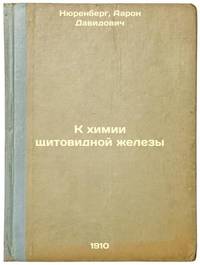
3760629Short description: In Russian. Nuremberg Aaron Davidovich. To the chemistry of the thyroid gland. Kharkov: type. M. Dreishpool and s-vya 1910. The image is provided for reference only. It may reflect condition of one of the available copies or only help in identifying the edition. Please feel free to contact us for a detailed description of the copies available. SKU3760629 unknown
159866701598. 22 leaves including some blanks or pages ruled in ink for entries. Agenda format 315 x 100 mm. stitched as issued uncut. Nuremberg: 1598.<br/> <br/> A fascinating document of a type that rarely survives: the manuscript account book for the spring 1598 Leipzig fair of Hans Straub I or the Elder 1541-1610 the prominent Nuremberg gold- and silversmith alderman and son-in-law of Wenzel Jamnitzer the best-known German goldsmith of his time. The first leaf bears Straub’s hallmark interwined initials “HS†over an arrow pointing upward within a plain shield & also containing the inscription “No. 72â€. Our manuscript sheds important light on the business relations in the late 16th century between the Nuremberg goldsmiths and their trade at the Leipzig fairs.<br/> <br/> Our account book is a list of sales orders and expenditures of Nuremberg goldsmith Hans Straub the Elder during the Leipzig Easter fair held in May 1598. While Straub is not expressly named he can be identified by his hallmark on the first leaf. At the fair trade was done in goblets rings knife-sheaths cutlery jewelry gemstones etc. Several business partners are named including the Nuremberg goldsmiths Heinrich Hahn Haan David Lauer and Paulus Koch. As an example of a transaction we see that the council of Halle paid over 33 florins for a goblet.<br/> <br/> In 1596 Straub was elected Alderman of the Artisans the most elevated and honorable office to which a Nuremberg artisan could aspire. Straub retained this position until his death in 1610. In 1569 he married Anna daughter of the famous goldsmith Wenzel Jamnitzer. On his father-in-law’s death in 1585 Straub inherited his casting molds and used them extensively in his own creations. Despite his long period of activity relatively few pieces made by Hans Straub have survived see Nürnberger Goldschmiedekunst 1541-1868 2007 ed. by Karin Tebbe et al. Vol. I p. 409.<br/> <br/> In fine condition.<br/> <br/> ⧠The mark is similar to Marc Rosenberg Der Goldschmiede Merkzeichen Frankfurt 1925 Vol. III no. 3969. unknown
194617590Folio. 33 x 205 cm. Folded in the middle. The 2 first leafs browned in the folding otherwise fine. <br/><br/><em>First edition of the English Version of the worlds most famous indictment in the form of which it was used during the whole trial. </em> unknown