326 résultats
1937239888Zurigo: Les Editions Girsberger - Les Editions d'Architecture 1937-1970. Rilegato tela sovracoperta cloth dust jacket. Molto buono Very Good. <strong>Opera in</strong> <strong>8 volumi</strong>. Volume 1: 1910-1929 publié"; par W. Boesiger et O. Stonorow - Volume 2: 1929-1934 publié par W. Boesiger - Volume 3: 1934-1938 publié par Max Bill - Volume 4: 1938-1946 publié par W. Boesiger - Volume 5: 1946-1952 publié par W. Boesiger - Volume 6: 1952-1957 publié par W. Boesiger - Volume 7: 1957-1965 publié par W. Boesiger - Volume 8: Les dernières oeuvres publié" par W. Boesiger. A cura di W. Boesiger. I volumi sono illustrati con numerose immagini in parte a colori e a tutta pagina fotografie schizzi piani bozzetti disegni. Edizione in inglese e francese. Cm 23x28. pp. 200 circa a volume. Molto buono Very Good. 2 volumi senza sovracoperta. Sovraccopertine un po' sciupate 2 volumes without dust jacket. . Les Editions Girsberger - Les Editions d'Architecture, hardcover
197156102Galerie Denise René. As New. 1971. Paperback. FREE UPGRADE to Courier/Priority Shipping Upon Request IN STOCK AND IMMEDIATELY AVAILABLE FOR SHIPMENT - AS NEW THE TEXT BLOCK IS PRISTINE CLEAN UNMARKED AND IN EXCELLENT CONDITION - - Text in French and English. -- with a bonus offer-- . Galerie Denise René paperback
2012104557D. A. P. Distribution. New. 2012. Hardcover. 3775734708 . FREE UPGRADE to Courier/Priority Shipping Upon Request - IN STOCK AND IMMEDIATELY AVAILABLE FOR SHIPMENT - Flawless copy brand new pristine never opened -- Text in English and French. 176 pages; many color illustrations. -- with a bonus offer-- . D. A. P. (Distribution) hardcover
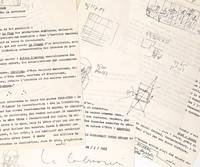
19513031Paris: np 1951. first edition. folder. Very Good. UNIQUE ANNOTATED TYPESCRIPT SIGNED WITH TWO FULL PAGES OF LE CORBUSIER DRAWINGS PRESENTING ONE OF HIS MOST FAMOUS AND INFLUENTIAL PHILOSOPHICAL ACHIEVEMENTS. Born in 1887 Le Corbusier found himself situated between two competing historical and architectural moments: an intricate history of grandiose Gothic and Renaissance style and the sleek efficient creation of the Second Industrial Revolution. In his canonical 1923 Towards an Architecture Le Corbusier argued that modernity must be matched with architectural innovation. Functionality took a core place in Le Corubusier’s thinking. Houses were to be understood as machines for living said Le Corbusier famously and machines were to be governed by the economies in which they existed. From this conviction came Le Corbusier’s famous villas his massive housing blocks in the suburbs of Paris and perhaps most importantly a fathering of modern architecture as defined by an emphasis on function simplicity and new material Towards an Architecture.<br /> <br /> In 1942 Le Corbusier was asked to create a universal measurement for construction materials. What Le Corbusier deemed necessary was not only the creation of a new unit but the arduous task of unifying metric and Anglo-Saxon systems integrating the inch and the centimeter into one intuitive scale. Although an ambitious project this unification coined Modulor existed within the ethos of Le Corbusier’s New Architecture. As Le Corbusier identified it the importance of an architect was in their giving of “a physical order which we feel to be in accordance with that of the world.†This order was not only in aesthetic sleekness but in an ethos of design that mirrored the social moral and political reality surrounding the architect. Therefore units of measurement —as enablers of creation—were to reflect modern efficiency with new universal standards Towards an Architecture.<br /> <br /> It was not immediately clear what should be the basis for the new standardized units. Metric and Anglo-Saxon systems after all are based on different ‘orders’—a meter defined by the speed of light a law of science; a foot defined by the proportions of the human body. Le Corbusier framed this tension in this rare manuscript: “the human body exists on one side and the mathematicians on the other.â€<br /> <br /> Le Corbusier struggled with the concept of the Modulor over many years and the present text dated by Le Corbusier 28/1/1951 represents a more mature and developed presentation of his theories. It reads as a manifesto-like preamble to the Modulor’s ambitions in the postwar world: to “harmonize the flow of worldwide production†to systematize standardization without deadening compromise and to reduce the friction of incompatible systems metric versus foot–inch. Le Corbusier presents the Modulor as a human-scale “gamut†of measurements—explicitly compared to the musician’s scale—grounding chosen dimensions in bodily proportion and number. He invokes the golden ratio and the Fibonacci series as ordering principles and includes the well-known endorsement attributed to Einstein “a scale of proportions that makes the bad difficult and the good easy†framing the Modulor as a tool of order rigor and harmony applicable from the architect’s drafting table to the engineer’s office and the building site.<br /> <br /> The two full drawing sheets marked with figure callouts e.g. “Fig. 35…†“Fig. 65…†“Fig. 100…†and geometric/proportional constructions including a right-angle scheme marked “90°†and φ symbols reinforce the document’s working character: argument paired with visual proof capturing Le Corbusier’s drive to make proportion not merely theoretical but operational.<br /> <br /> Although we haven’t been able to find this exact text published anywhere the present typescript closely aligns—often in phrasing and argumentative sequence—with Le Corbusier’s published presentation of the Modulor and can be read as a self-contained “preamble†distilled from that larger project. However the dated and signed terminal leaf 28 January 1951 and the presence of working ink annotations and separate diagram leaves with figure callouts suggest an independent studio or promotional iteration rather than a simple excised page from a printed book documenting the Modulor as an evolving actively circulated tool.<br /> <br /> The Modulor proved enduringly influential as a conceptual and pedagogical framework for proportion—reinforced by its use in Le Corbusier’s own buildings and its broad afterlife in architectural discourse—even as it never achieved its founder’s ambition of becoming a universally adopted international standard of measurement.<br /> <br /> Paris: January 28 1951. Text in French. 6 leaves each approx. 8.25 × 10.75 in.; with writing or drawings on rectos only including 4 typed leaves with ink annotations and small drawings; 2 leaves of original drawings; last typed leaf signed and dated. In excellent condition with only very light toning and minor handling wear consistent with working material. English translation available upon request.<br /> <br /> A UNIQUE FIRST-HAND ACCOUNT WITH NUMEROUS DRAWINGS PRESENTING ONE OF LE CORBUSIER'S CORE PHILOSOPHIES. np unknown
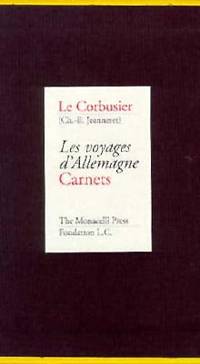
199514596New York: The Monacelli Press Inc. New in New dust jacket. 1995. First Edition Thus. Soft Cover. 1885254156 . Limited printing of 500 copies. In publisher's shrinkwrap. Slipcase is cardboard covered with yellow cloth on top and bottom black cloth around the main body of the case. Front and pack has a paste down with the title author and The Monacelli Press Fondation sic L. C. Originally published in Milan Italy in 1994 in Italian. In English and French; translated from the Italian by Mila Dau. The original four Carnets notebooks are written in French with mostly b/w a few in color drawings sketches notes which are pencil like in appearance. Some of the pages are numbered others are not. This set presents four meticulously reproduced travel notebooks of Charles-Edouard Jeanneret Le Corbusier on his travels through Germany which came at the end of his tour of the Orient. In pocket-sized journals he noted what he saw sketched ideas and places and offered thoughtful commentary on his experiences which took place 1910-1911. A fifth 160-page volume provides a concise overview of his journey in English and a reprinting in French of his written entries. Le Corbusier was born in France on October 6 1887; died in France on August 27 1965. He had a long and successful career helping to create revolutions in architecture during the middle part of the 20th century. Many of these are still strongly influential to the current day. On the back page of the fifth volume titled 'Transcriptions' it states this is a limited edition of 500. ; B & W illustrations; 4 x 6 1/2 x 1 3/4; 300 pages; NEW. Slight rubbing/bumping to slipcase faint 1/2" blue mark on label. . The Monacelli Press, Inc. paperback
199513616New York: The Monacelli Press Inc. New in New dust jacket. 1995. First Edition Thus. Soft Cover. 1885254156 . Limited printing of 500 copies. In publisher's shrinkwrap. Slipcase is cardboard covered with yellow cloth on top and bottom black cloth around the main body of the case. Front and pack has a paste down with the title author and The Monacelli Press Fondation sic L. C. Originally published in Milan Italy in 1994 in Italian. In English and French; translated from the Italian by Mila Dau. The original four Carnets notebooks are written in French with mostly b/w a few in color drawings sketches notes which are pencil like in appearance. Some of the pages are numbered others are not. This set presents four meticulously reproduced travel notebooks of Charles-Edouard Jeanneret Le Corbusier on his travels through Germany which came at the end of his tour of the Orient. In pocket-sized journals he noted what he saw sketched ideas and places and offered thoughtful commentary on his experiences which took place 1910-1911. A fifth 160-page volume provides a concise overview of his journey in English and a reprinting in French of his written entries. Le Corbusier was born in France on October 6 1887; died in France on August 27 1965. He had a long and successful career helping to create revolutions in architecture during the middle part of the 20th century. Many of these are still strongly influential to the current day. On the back page of the fifth volume titled 'Transcriptions' it states this is a limited edition of 500. ; B & W illustrations; 4 x 6 1/2 x 1 3/4; 300 pages; Slight rubbing/bumping to slipcase faint 1/2" blue mark on label. . The Monacelli Press, Inc. paperback
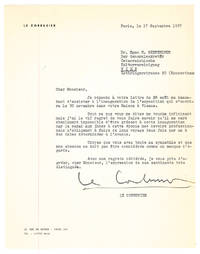
0168-21Paris 17. 9. 1957. 4°. 27 x 24 cm. gefaltet. Bedauert an der Eröffnung einer Ausstellung der Wiener Kulturvereinigung nicht teilnehmen zu können. " car je serais aux Indes à cette époque mes devoits professionels m'obligeant à faire ce long voyage deux fois par an " Lettre dactylographiée avec signature. - Il regrette de ne pas pouvoir assister à l'inauguration d'une exposition de l'Association culturelle de Vienne. Paris, 17. 9. 1957. unknown
2001BN12743Hatje Cantz Verlag 2001. 2001. Hardcover. 292 x 228 x 29 cm. Wie kaum ein anderer revolutionierte Le Corbusier die Architektur des 20. Jahrhunderts - mit frühen Häuserbauten wie der Weißenhofsiedlung oder großen Wohn- und Geschäftsbauten wie den diversen Unités d'Habitation mit kühnen städtebaulichen Projekten für Algier Rio de Janeiro Berlin oder Chandigarh mit theoretischen Arbeiten wie der Entwicklung des »Modulor«. Unseren Klassiker »Le Corbusier - Mein Werk« von 1960 eine lange vergriffene Rarität die in enger Zusammenarbeit mit dem Verleger Gerd Hatje entstand können wir Ihnen nun als Reprint der Erstausgabe wieder anbieten. Anhand von zahlreichen Fotografien Plänen Skizzen und Dokumenten werden die Stationen des architektonischen aber auch des malerischen grafischen und plastischen Werkes von Le Corbusier deutlich. Von Le Corbusier stammt der Text Le Corbusier hat die Bildauswahl getroffen und Le Corbusier selbst hat die Typografie bestimmt. Das Buch das so entstand ist ein Dokument - das Selbstzeugnis eines großen Architekten der Bauten forderte die dem Maschinenzeitalter angemessen wärenHäuser als Wohnmaschinen Städte als durchrationalisierte Arbeits- Verkehrs- und Wohneinheiten. <br/><br/>Wie kaum ein anderer revolutionierte Le Corbusier die Architektur des 20. Jahrhunderts - mit frühen Häuserbauten wie der Weißenhofsiedlung oder großen Wohn- und Geschäftsbauten wie den diversen Unités d'Habitation mit kühnen städtebaulichen Projekten für Algier Rio de Janeiro Berlin oder Chandigarh mit theoretischen Arbeiten wie der Entwicklung des »Modulor«. Unseren Klassiker »Le Corbusier - Mein Werk« von 1960 eine lange vergriffene Rarität die in enger Zusammenarbeit mit dem Verleger Gerd Hatje entstand können wir Ihnen nun als Reprint der Erstausgabe wieder anbieten. Anhand von zahlreichen Fotografien Plänen Skizzen und Dokumenten werden die Stationen des architektonischen aber auch des malerischen grafischen und plastischen Werkes von Le Corbusier deutlich. Von Le Corbusier stammt der Text Le Corbusier hat die Bildauswahl getroffen und Le Corbusier selbst hat die Typografie bestimmt. Das Buch das so entstand ist ein Dokument - das Selbstzeugnis eines großen Architekten der Bauten forderte die dem Maschinenzeitalter angemessen wärenHäuser als Wohnmaschinen Städte als durchrationalisierte Arbeits- Verkehrs- und Wohneinheiten. Hatje Cantz Verlag hardcover
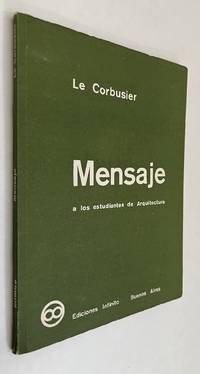
1959101299Buenos Aires: Infinito 1959. Paperback. Two small personal owner name stamps; else fine thus. Very very slight external wear; appears unused. Octavo in olive green illus stiff folded paper wraps; 60 p.; 20 cm. In Spanish. Biblioteca de arquitectura; 6. ¶ "Charles-Édouard Jeanneret 6 October 1887 – 27 August 1965 known as Le Corbusier was a Swiss-French architect designer painter urban planner and writer who was one of the pioneers of what is now regarded as modern architecture. He was born in Switzerland and became a French citizen in 1930. His career spanned five decades in which he designed buildings in Europe Japan India as well as North and South America. He considered that "the roots of modern architecture are to be found in Viollet-le-Duc". Infinito paperback
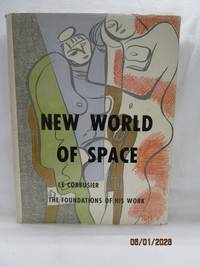
194857612NY: Reynal & Hitchcock. 1948. First Edition. Hardcover. Near Fine in Very Good- dust jacket. Original tan pictorial cloth. Mild foxing to the spine and edges. Rfep creased. Color frontis. Tight and square. The price clipped DJ has mild foxing to rear panel few chips and tears. ; quarto; 128 pages . Reynal & Hitchcock hardcover
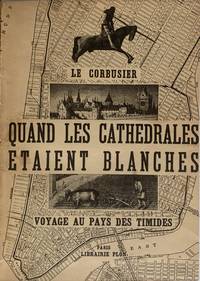
1937238943Parigi: Librairie Plon 1937. Rilegato tela cloth. Molto buono Very Good. 45 disegni in bianco e nero nel testo. Cm 20x14. pp. 324. Molto buono Very Good. Copertina anteriore conservata all'interno della nuova rilegatura in tela rossa Front cover preserved inside the new red cloth binding. Prima edizione First Edition. Librairie Plon, hardcover
196765561NY:: Orion Press. Very Good in Very Good dust jacket. 1967. Hardcover. B001B3QLK8 . Black and white photographs and line drawings throughout. Translated from the French. First edition thus. Very good in a very good edge worn. dust jacket. ; 345 pages . Orion Press, hardcover
0851396526.Gpaperback. Good. Access codes and supplements are not guaranteed with used items. May be an ex-library book. paperback
0851396526New. paperback. New. Satisfaction Guaranteed or your money back. paperback
1947100048NY:: Reinhold Publishing Corporation. Very Good in Good dust jacket. 1947. Hardcover. Black and white illustrations. First edition. Very good in a good long closed edge tear on rear panel foxing dust jacket. ; 80 pages . Reinhold Publishing Corporation, hardcover
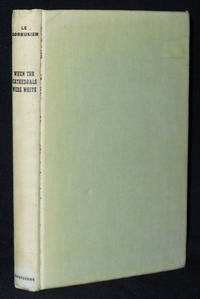
1947009937London: George Routledge & Sons 1947. Hardcover. Very Good. xxii 217 p.; 21 cm. Off-white cloth with black spine title. No dust jacket. Small slip tipped in stating: "Owing to production delays this book was not published until 1948." Translated from the French Quand les Cathedrales Etaient Blanches by Francis E. Hyslop Jr. Scarce. In Very Good Condition: discoloration along joints; faint stain at upper corner of front cover; pages are clean and tight. George Routledge & Sons hardcover
1947399435NY: Reynal and Hitchcock 1947. 1st. Hardcover. Very Good/Poor. Hardcover in a tattered and chipped dust jacket. Off-white cloth with black spine title. 217 pages b&w drawings by the author. Translated from the French Quand les Cathedrales Etaient Blanches by Francis E. Hyslop Jr. Dj is poor with tape repair to the reverse side. Book has a small stamp to the front fly leaf otherwise clean. Record # 399435 Reynal and Hitchcock hardcover
1999126840Princeton Architectural Press, New York, 1999. XIV, 83 S. ; 20,5 x 14 cm ; kart. ;
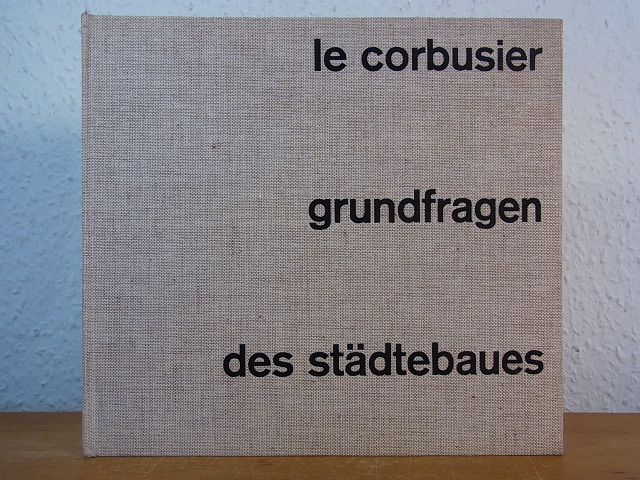
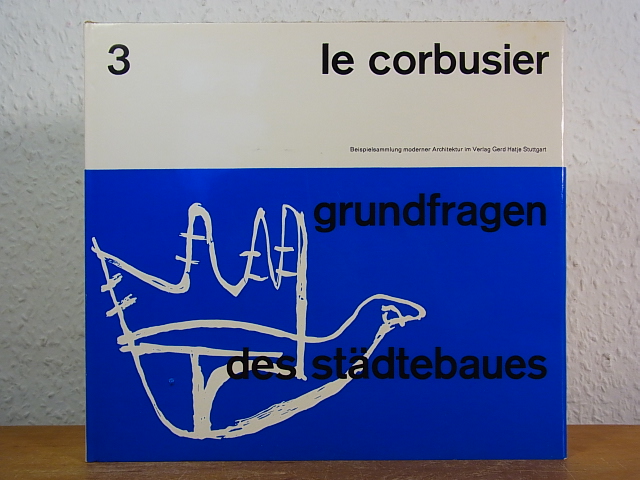
1965126947Stuttgart: Verlag Gerd Hatje, 1965. 115 S. ; 20,5 x 22,5 cm ; Leinen.
1965126519Stuttgart: Verlag Gerd Hatje, 1965. 115 S. ; 20,5 x 22,5 cm ; Leinen.
1987127128Caisse Nationale des Monuments Historiques et des Sites, Paris, 1987. 245 S. ; 26 x 24 cm ; kart. ;
2009127170Fondation Le Corbusier, Paris, 2009. 22 S. ; 29,5 x 16 cm ; broschiert.
194798548ABLondon, D. Dobson, 1947. Mit Illustr. 207 S. OLwd. - Englischer Text. - Name auf Vorsatz, sehr gutes Ex.
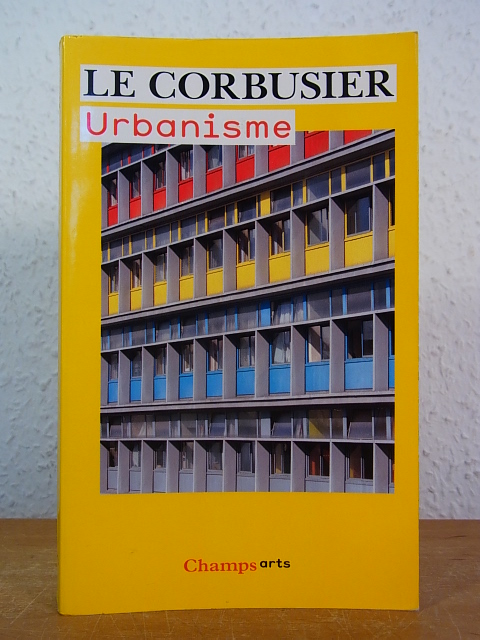
2011126859Flammarion, Paris, 2011. V, 284 S. ; 17,5 x 10,5 cm ; kart. ;
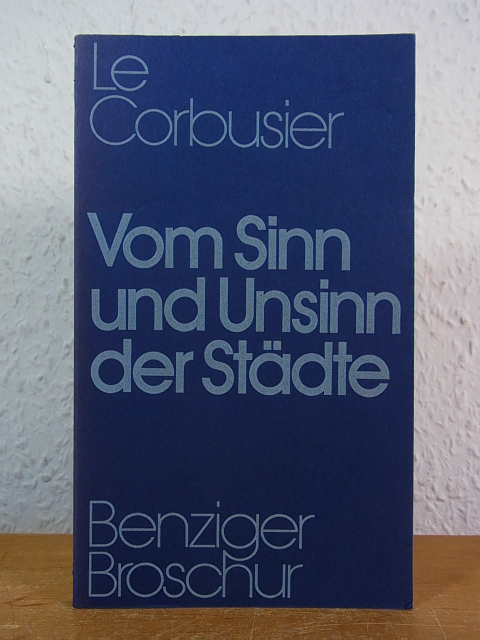
1974126654Zürich und Köln: Benziger Verlag, 1974. 148 S. ; 18 x 10,5 cm ; kart. ;