Charles-Edouard BROWN-SEQUARDBiblio.com
326 résultats
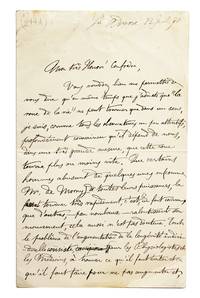
1890713501890. Fine. 12 juillet 1890 11.20 x 17.90 cm une feuille Signed autograph letter about human aging12 July 1890 11.2 x 17.9 cm one leafAutograph letter signed by the physiologist and neurologist Charles Edouard Brown-Séquard dated 12 July 1890 one folded sheet. He outlines a scientific method of prolonging human life while at the same time developing a series of philosophical and epistemological reflections on mortality. Successor to Claude Bernard in the Collège de France Brown-Séquard here tries to push back the limits of ageing and prolong the nervous responses of the brain: Not to grow old before time and to grow old as late as possible that is what should preoccupy those who love life or those who without loving it need to ensure it lasts. Brown-Séquard had just published a study on this subject and had succeeded in administering a harmless nervous stimulation with an injection of liquids extracted from animal testicles. Giving the example of the flamboyant Duc de Morny son of Hortense de Beauharnais who died at the age of 53 the professor lays out a theory that is broader than the simple neurological remedy: It depends on the person whether the wheel of life' spins more or less quickly. That certain men like M. de Morny abuse all their faculties and make the wheel turn very quickly is indubitable The problem in increasing the lifespan of the individual lies therefore for physiologists and doctors in finding what should be avoided and what should be done in order not to increase and indeed to decrease the progress towards natural death. Insisting on the beneficial effects of animal testicle extracts Brown-Séquard compares them with a more nefarious stimulant strychnine discovered a few decades before: I believe I have succeeded in increasing the various force of action of the nerve centers without stimulating exciting or putting them in play which is to say diminishing them by making them expend themselves in action. Testicular liquid acts like strychnine which does not determine the action but which only increases the strength of the reflex in the spinal chord. But the difference is that strychnine leads to a morbidly exaggerated excitability so that the slightest excitement leads to discharges of nervous force. unknown