433 résultats
1970List922Richmond Virginia and Milton Massachusetts 1970. Various formats generally near fine with light normal wear. Near Fine. Throughout his career Martin Luther King Jr. had to defend himself repeatedly over allegations of Communist-related activities and sympathies. His associations with several alleged communistes led the FBI to open an investigation in 1962 and his appearance at the Highlander Folk School led to a proliferation of material from far-right groups alleging that he had attended a "Communist Training School" with billboards showing a picture of King at the school appearing during the Selma-Montgomery March. <br /> <br /> Julia Brown was an FBI agent who according to her own book and lectures spent several years undercover as a member of the Communist Party in Cleveland. She made a career in the 60s writing and lecturing on the subject and in particular trying to tie King to Communism in various ways. Her book on the subject still attracts some readers who maintain that King was secretly a violent Communist whose true intentions were to divide the country. <br /> <br /> Collected here are four ephemeral examples relating to Brown's and others' anti-King efforts mostly from Richmond Virginia as follows:<br /> <br /> Printed broadside 8 ½ x 5 ½ inches entitled Richmond is Indebted to Julia Brown advertising Brown as being responsible for King cancelling two trips to Richmond due to Brown's lectures and encouraging people to attend another by her likely published by the Richmond Area T A C T Committee; printed handbill 8 ½ x 11 inches folded entitled Martin Luther King Memorial Bridge - Never alleging King to be a communist and published by the Action-by-Citizens Committee mid 1970s; small card measuring 3 ¾ x 2 ½ inches advertising a speech by Brown on "The Frightening Background of Martin Luther King" March 28 1968 in Richmond published by the American Opinion Library of Richmond; and an anti Martin Luther King Day two-sided handbill published by the Council on Domestic Relations in Milton Massachusetts likely in 1971 using Brown's likeness and essays on King to argue against the establishment of a national holiday in his honor. unknown books
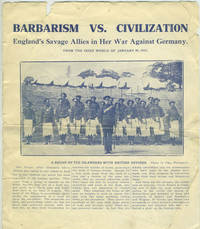
191526775New York 1915. Irish propaganda targeting the British during W.W.I. from the Irish World of January 30 1915. During W.W.I the struggle for Irish independence was suspended with the Nationalist forces splitting over support of the war. This handbill appears to be an effort to incite hatred of the British with racist descriptions of Fijian soldiers "the cannibals we may say" who fought for the British. There is a clear preference for Germany - "And these are the savages the cannibals we may say whom Britain is bringing over to fight the most enlightened nation of Melancthon and SchlegeL of Kant. of Mozart and Beethoven and Wagner of Goethe and Heine." <br /> <br /> The text characterized the Fijians as cannibals "dark copper colored have black eyes and bushy hair worn in the form of a mop" short stature protruding stomachs legs bowed and feet flat and usually nude. The photograph shows the Fijian soldiers standing at attention behind a British Officer photo by Paul Thompson. <br /> <br /> The text of the handbill is extracted from The Irish World and American Industrial Liberator published in New York between 1878-1951. Hand bill 9 x 7 3/4" printed in blue on cream paper verso blank. Creased with marginal tears and small margin loss. <br /> <br /> Unrecorded on OCLC although there is a W.W.I poster with the title "Civilization Vs. Barbarism" 1914 but associated with Red Cross Week. OCLC: 894257435. unknown
1916932Athol Ma 1916. Good plus. Broadside 16 x 5 inches. Previously folded. A couple of chips and small closed tears at edges. Even tanning. Rare broadside advertisement for a weekend engagement of D.W. Griffith's infamous silent epic The Birth of a Nation at Steinberg's Athol Opera House located in Athol Massachusetts. The broadside gives dates and times of screenings November 4-6 2:10 & 8:10 daily a list of cast and characters a lengthy discussion of Griffith's desire for historical accuracy in his work and a message about "the play's message of peace." To wit the broadside states that "If this graphic presentment serves no other purpose its message of universal peace marks it of great important. Morally and educationally it established the futility of armed conflict. But for the hatreds engendered in the Civil War the suffering of the Reconstruction period would never have been known." The film based on Thomas Dixon's 1905 novel The Clansman is often cited as the principal inspiration for the revival of the Ku Klux Klan in the 20th century. unknown books
193661085Washington D.C.: Associates in Negro Folk Education 1936. 8vo. 6 98 pp. Decorated tan softcovers Art Deco designs on front cover lettering in black gilt & red minor scuffing lower fore-edge front cover still a VG copy. First edition of this 4th installment in the storied “Bronze Booklet†series which quickly became a standard reference for teaching African-American history in the United States and Europe and addressed a number of racial conflicts and issues surrounding the impact of race on political and economic history. This important groundbreaking work by Bunche not only represented his most extended analysis of the issues of racism but also the role of race and racism in World economic and political conflicts Imperialism and inherent racism as well as the fact that race “has been used to whitewash some of the blackest pages in American history.†Bunche 1904-1971 was a leading African-American intellectual diplomat supporter of the US Civil Rights movement and would later be awarded the 1950 Nobel Peace Prize the first African=American so honored. Associates in Negro Folk Education, paperback
1930VBF24<p>Black Interest - Racist</p><p>COUSIN KEN: <i><b>The Ten Little Seaside Nigger Boys.</b></i></p><p>London: Renwick of Otley ca.1930s.</p><p>Publisher's address given as: 180 Fleet Street E.C.4 = London</p><p>16 leaves of ink page mock-up pre-production for the book</p><p>comprising manuscript text and illustrations 6 with color plate</p><p>separations plus 1 full ink British Production and watercolor design for the cover. Loose.</p><p>Some pages signed "Ken". </p><p><br /></p> Renwick of Otley books
190122331<p><b>RACISM. THEODORE ROOSEVELT.</b>Drawing. 1p 5 x 6¼ in. </p><b>Transcript</b><p><i>"To hear how Roosevelt is carrying on I would like to give him a swift kick & see him full of holes I wish the nation would make Alice marry Booker T Washington don't you"</i></p><p>Followed by drawing of Alice Roosevelt marrying Booker T. Washington.</p><p><b>Historical Background</b></p><p>In 1901 Roosevelt invited Washington to dine with him at the White House making him the first black man ever to do so. Whoever wrote this racist note and drawing apparently did not approve of the gesture suggesting that Roosevelt's eldest daughter Alice marry the Civil Rights pioneer.</p>
190122331<p><b>RACISM. THEODORE ROOSEVELT.</b>Drawing. 1p 5 x 6¼ in. </p><b>Transcript</b><p><i>"To hear how Roosevelt is carrying on I would like to give him a swift kick & see him full of holes I wish the nation would make Alice marry Booker T Washington don't you"</i></p><p>Followed by drawing of Alice Roosevelt marrying Booker T. Washington.</p><p><b>Historical Background</b></p><p>In 1901 Roosevelt invited Washington to dine with him at the White House making him the first black man ever to do so. Whoever wrote this racist note and drawing apparently did not approve of the gesture suggesting that Roosevelt's eldest daughter Alice marry the Civil Rights pioneer.</p> books
19472097Paris Gallimard, 1947 Traduit de l'américain par Marcel Duhamel en collaboration avec Andrée R. Picard. 224 pp. In-8 en pleine percaline noire, dos plat pièce de titre en maroquin rouge, relié avec sa couverture d'origine. Black boy raconte un épisode d'une histoire souvent vécue par les Noirs d'Amérique. "Les circonstances historiques ont fait de nous, les Noirs d'Amériques du Nord, un peuple de nomades, perpétuellement en mouvement, quittant sans cesse un lieu pour cherche la liberté ailleurs." Richard Wright, issu d'une famille blanche, noire et indienne, est à l'intersection contre la "doctrine de la Suprématie Blanche". Insaisissable et instable, il poursuit sans limite ses aspirations, en "courant après la liberté", pour la condition humaine, la condition de son époque pour les siens et pour les autres. Avant ce livre, son premier roman Native Son livre fut un succès, dynamitant les préjugés racistes. Orson Welles en fit une adaptation pour le théâtre en 1941.