Multiple ContributorsMareMagnum

924 résultats
Features: Le Cauchemar Du Professeur Haumont; Les Marcheurs De La Paix Font La Guerre Au Racisme; Daniel Johnson, par Jean-V. Dufresne; Il etait une fois une ile, la Tortue, habitee par un 'fou'; Masques et Statuettes D'Afrique a Montreal; Les 'Homos' au Canada ils sont plus d'un million. Text in French. Average wear. A sound copy. Book
96 pages. Special Features:The People of Rio "Meet the vivacious, humorous and relaxed inhabitants of a stunning and genial city." and The Fight Against Prejudice "Racism and religious bigotry are deeply rooted in U.S. life, but the will to freedom and equality goes deeper. This is the moral of the uniquely American story of the Anti-Defamation League, a Jewish human-rights organization". Other features include: Washington, D.C. Portrait of a Sick City; The lonely life of an Air Force wife - Capt. Richard Davis, Jean Davis; America's First Turbine Car; Are We Cheating Twenty Million Students?; The Real Crisis in Education and The Twins (Minnesota). Full page colour vintage print advertising includiing 1963 Rambler Classic V-8, Chevrolet Bel-Air, and Royal Crown Cola promoted by Dave Willingham. Above-average wear. Water stains throughout. Small mailing label front panel bottom left. Binding sound. Magazine
ORD-1025Problèmes Français. Beyrouth. 1944. In-12 (116 x 161mm) agrafé, couverture imprimée sur papier jaune, 80 pages, papier lgt jauni, exemplaire non coupé, en bon état. Rare.
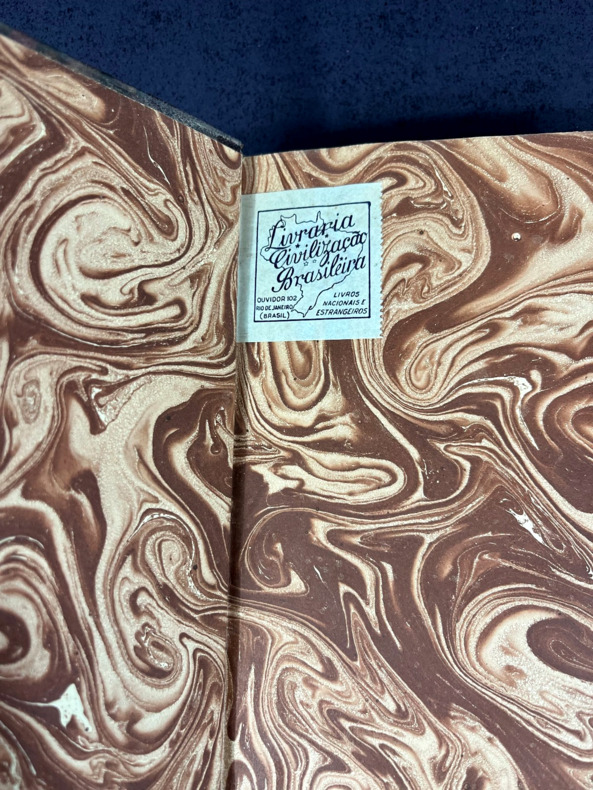
19300513Paris, Firmin-Didot et cie, sans date [circa 1930]. Deux volumes in-12 de 195 x 140 mm, (xxxi) 561 + 566 pp. Reliure demi-chagrin d'époque tabac, dos de style janséniste à 5 nerfs, nom d'auteur, titre et tomaison en caractères d'imprimerie frappés dorés, dépouillé de tout autre ornement. Plats et gardes marbrées. Couvertures conservées. Tranchefile. Ex-libris de l'éditeur Civilização Brasileira au premier volume. À noter le mot "INGRES" écrit en filigrane d'une page de garde blanche de ce même volume. Dos relié conservés à la fin de chaque volume. Dédicace, préface et biographie de Gobineau en tête du premier volume, table des matières à chaque fin de volume. "La chute des civilisations est le plus frappant et en même temps le plus obscur de tous les phénomènes de l'histoire. En effrayant l'esprit, ce malheur réserve quelque chose de si mystérieux et de si grandiose, que le penseur ne se lasse pas de le considérer, de l'étudier, de tourner autour de son secret. Quand, après un temps de force et de gloire, on s'aperçoit que toutes les sociétés humaines ont leur déclin et leur chute, toutes... alors on est contraint de constater que toute agglomération humaine, même protégée par la complication la plus ingénieuse de liens sociaux, contracte, au jour même où elle se forme, et caché parmi les éléments de sa vie, le principe d'une mort inévitable." C'est en s'interrogeant sur les raisons de la chute des civilisations que le comte Arthur de Gobineau s'intéressa aux différences anthropologies entre les différents groupes d'êtres humains. Précurseur, pétri d'un certain pessimisme romantique, Gobineau fut davantage un penseur et un essayiste qu'un scientifique, ce qui lui reprocheront des générations ultérieures de chercheurs tels que Francis Galton ou Georges Vacher de Lapouge. Cependant, et comme ce dernier le remarquait (L'Aryen, son rôle social, 1899), l'érudition et la pensée gobiniennes ont parfois pointé vers des conclusions ou des hypothèses qu'il était difficile d'avoir sans outils scientifiques. Un classique ("souvent cité, jamais lu") qui a souffert d'amalgames négatifs au XXe siècle et que le XXIe va très certainement redécouvrir. Souvent réédité jusqu'à la Seconde guerre mondiale mais plutôt peu courant. Très rare en reliure d'époque.
195546405617Paris, Présence Africaine, (1955) ; in-12, broché. 72 pp.Deuxième édition augmentée par l’auteur de ce célèbre pamphlet anticolonialiste qui avait paru pour la première fois aux éditions Réclame en 1950. “Le fait est que la civilisation dite “européenne”, la civilisation “occidentale” telle que l’ont façonnée deux siècles de régime bourgeois, est incapable de résoudre les deux problèmes majeurs auxquels son existence a donné naissance : le problème du prolétariat et le problème colonial.” Césaire insiste ici sur la parenté qui existe selon lui entre nazisme et colonialisme : “Oui, il vaudrait la peine d’étudier, cliniquement, dans le détail, les démarches d’Hitler et de l’hitlerisme et de révéler au très distingué, très humaniste, très chrétien bourgeois du XXe siècle qu’il porte en lui un Hitler qui s’ignore, qu’Hitler l’habite, qu’Hitler est son démon, que s’il vitupère, c’est par manque de logique et qu’au fond, ce qu’il ne pardonne pas à Hitler, ce n’est pas le crime en soi, le crime contre l’homme, ce n’est pas l’humiliation de l’homme en soi, c’est le crime contre l’homme blanc, c’est l’humiliation de l’homme blanc, et d’avoir appliqué à l’Europe des procédés colonialistes dont ne relevaient jusqu’ici que les Arabes d’Algérie, les Coolies de l’Inde et les nègres d’Afrique.” p. 13.
192863298CBBerlin-Neu-Finkenkrug, Paetel Verlag, 1928. 134 Seiten. 41 Tafeln. Original-Leinenband mit silberngeprägtem Rücken- und Deckeltitel. [4 Warenabbildungen]
47352La Différence.1992.In-8 jaune et blanc.755 p. BE.Légère pliure sur le 1er plat de la couverture.
24853ONE: 15 May 1974; 47a Leigham Court Road Streatham Hill London SW16. TWO: no date; c/o 21 Inglethorpe Street Fulham London SW6. Also an ANS to 'Mrs Poppmacher' Dosse's secretary: 21 February 1973; 169 Breakspears Road Brockley London SE4. Onyeama was the second black boy to go to Eton and the first to complete his education there. See his obituary in the Guardian 11 February 2022. His hugely-controversial 1972 book ‘Nigger at Eton’ which resulted in him being banned from the school was reprinted by Penguin Books in 2020 under the title ‘Black Boy at Eton’. Philip Dosse the recipient of the first two letters was proprietor of Hansom Books publisher of a stable of seven arts magazines including Books and Bookmen and Plays and Players. See ‘Death of a Bookman’ by the novelist Sally Emerson editor of ‘Books and Bookmen’ at the time of Dosse’s suicide in Standpoint magazine October 2018. The three items in good condition lightly aged and folded for postage. ONE: TLS to ‘Dear Philip’ i.e. Philip Dosse publisher of ‘Books and Bookmen’ 15 May 1974. 1p 12mo. Signed ‘Dillibe’. Begins: ‘I thought I would send my critique to Garett via you and take the opportunity to thank you for your offer of free advertisement of my books in B&B. I informed Leslie Frewin his publisher who told me he would contact you to express his gratitude.’ He continues: ‘Believe me it will be a blessing when my book comes out and I receive the other half of my advance because right now to exist on free-lance writing is one hell of a competition. If for the last time I could be sent payment or my critique straight-away I would be truly grateful at the same time aware that of all your contributors I must be the greatest pain in the neck.’ He apologises and states that he will not ask again. TWO: Undated January 1977 TLS to 'Dear Philip'. He hopes 'all's well with' Dosse and sends New Year greetings. 'Enclosed is my review of MUZUNGU by Daniel Topolski.' THREE: TNS to ‘Dear Mrs Poppmacher’ Dosse’s secretary 21 February 1973. He thanks her for the copy of the March issue and asks for ‘three more copies to send off to friends’. ONE: 15 May 1974; 47a Leigham Court Road, Streatham Hill, London SW16. TWO: no date; c/o 21 Inglethorpe Street, Fulham, London S unknown
9286Printed by Villiers Publications Ltd. Ingestre Road London N.W.5. Broadsheet bifolium 4 pp. Text clear and complete. On lightly-aged paper worn along fold lines. Poetry collection containing twenty-eight poems by writers including 'Mazizi Kunene In Exile London 1960' and Hugh MacDiarmid whose two poems have the footnote 'We are especially pleased to print these two new poems by Hugh McDiarmid contributed despite the painful after effects of his recent car smash. We wish him a speedy and complete recovery.' Masthead endorsement by Sean O'Casey: 'I am with you in all efforts to create perfect race equality the world over. My sympathies go in particular to my dark-coloured comrades in South Africa.' Short editorial on the Sharpeville Massacre accompanied by photo of dead man by Ian Berry. Scare: the only copies on COPAC in King's College London and the British Library. Printed by Villiers Publications Ltd., Ingestre Road, London, N.W.5. unknown
8vo; First Edition. Original Printed Green Cloth. 12mo. 235 pages. 19 cm. These articles appeared from May 22 to October 2, 1920in Ford's paper, "The Dearborn Independent." "Why discuss the Jewish Question? Because it is here, and because its emergence into American thought should contribute to its solution, and not to a continuance of those bad conditions which surround the Question in other countries." Chapters: 1. The Jew in Character and Business 2. Germany's Reaction Against the Jew 3. Jewish History in the United States 4. The Jewish QuestionFact or Fancy? 5. Anti-SemitismWill It Appear in the U.S.? 6. Jewish Question Breaks Into the Magazines 7. Arthur Brisbane Leaps to the Help of Jewry 8. Does a Definite Jewish World Program Exist? 9. The Historic Basis of Jewish Imperialism 10. An Introduction to the "Jewish Protocols" 11. "Jewish" Estimate of Gentile Human Nature 12. "Jewish Protocols" Claim Partial Fulfillment 13. "Jewish" Plan to Split Society by "Ideas" 14. Did the Jews Foresee the World War? 15. Is the Jewish "Kahal" the Modern "Soviet"? 16. How the "Jewish Question" Touches the Farm 17. Does Jewish Power Control the World Press? 18. Does This Explain Jewish Political Power? 19. The All-Jewish Mark on "Red Russia" 20. Jewish Testimony in Favor of Bolshevism. Original single volume as originally issued; later joined by vols 2,3 & 4. Henry Ford, a noted anti-semite, had a close association with Dearborn, MI. Ford did not write the articles. He expressed his opinions verbally to his executive secretary, Ernest Liebold, and to William J. Cameron. Cameron had the main responsibility for expanding these opinions into article form. Liebold was responsible for collecting more material to support the articles. The Dearborn Independent, also known as The Ford International Weekly, was a weekly newspaper established in 1901, and published by Henry Ford from 1919 through 1927. The paper reached a circulation of 900,000 by 1925, second only to the New York Daily News, largely due to a quota system for promotion imposed on Ford dealers. Lawsuits regarding antisemitic material published in the paper caused Ford to close it, and the last issue was published in December 1927. The publication's title was derived from the Detroit suburb of Dearborn, Michigan. Derived largely from information found posted on line: Convinced that "bankers" and "the Jews" were responsible for a whole range of things he didn't like, from the world war to short skirts to jazz music, Henry Ford used his newspaper, the Dearborn Independent, to carry on an active anti-Semitic campaign. Between 1920 and 1922 a series of articles denounced all things Jewish. While officially apologizing for the articles in 1927, Ford's anti-Jewish sentiments ran deep. In January 1919, Henry Ford began publication of the Dearborn Independent, a small community weekly he had purchased the previous year. Carrying the subtitle, The Chronicler of the Neglected Truth, the paper primarily served as a forum for Henry Ford's views. Each issue of the Independent carried "Mr. Ford's Own Page," an editorial expressing his opinions, written by William J. Cameron. The Ford Motor Company pressured car dealers to buy multiple subscriptions and hand out copies to customers. The newspaper was popular, and circulation reached 900,000 in 1926. The Dearborn Independent would, most likely, have remained a sidebar in Ford's biography were it not for a controversial series that began on May 22, 1920 and lasted for several years. Appearing on the front page every week, "The International Jew: The World's Problem" examined a purported conspiracy launched by Jewish groups to achieve world domination. The basis for the articles was a notorious forgery, The Protocols of the Elders of Zion, an anti-Semitic hoax, first published in Russia in 1903. Many have accused Ford's personal secretary, Ernest Liebold, of being the source of the campaign, and Liebold's anti-Semitic views are well documented. William Cameron, editor of the Independent, was an enthusiastic supporter of the publication of the anti-Semitic diatribes. However, Ford's own attitudes towards Jews were the major reason for the publication of "The International Jew." His anti-Semitic beliefs formed along several strands from his upbringing, attitudes, and personal beliefs. A common stereotype at the time led some people to assume that Jews controlled the international banking system; that belief may have fed his anti-Jewish feelings. The publication of "The International Jew" caused an uproar. In some quarters, such as anti-immigrant and nativist groups, the series confirmed their own beliefs. Others were appalled by the series, published demands for a retraction, removed the paper from public libraries, and promoted a boycott of Ford automobiles. Some Ford dealers refused to carry the paper. Responding to this pressure, Ford halted publication of the anti-Jewish series in January 1922, only to start it up again less than a year later. Previous owner's name, pocket on rear blank endpaper, no other markings, an excellent copy Very Good Condition. (HOLO2-63-21D)
8vo; First Edition. Original Printed Green Cloth. 12mo. 235 pages. 19 cm. These articles appeared from May 22 to October 2, 1920in Ford's paper, "The Dearborn Independent." "Why discuss the Jewish Question? Because it is here, and because its emergence into American thought should contribute to its solution, and not to a continuance of those bad conditions which surround the Question in other countries." Chapters: 1. The Jew in Character and Business 2. Germany's Reaction Against the Jew 3. Jewish History in the United States 4. The Jewish QuestionFact or Fancy? 5. Anti-SemitismWill It Appear in the U.S.? 6. Jewish Question Breaks Into the Magazines 7. Arthur Brisbane Leaps to the Help of Jewry 8. Does a Definite Jewish World Program Exist? 9. The Historic Basis of Jewish Imperialism 10. An Introduction to the "Jewish Protocols" 11. "Jewish" Estimate of Gentile Human Nature 12. "Jewish Protocols" Claim Partial Fulfillment 13. "Jewish" Plan to Split Society by "Ideas" 14. Did the Jews Foresee the World War? 15. Is the Jewish "Kahal" the Modern "Soviet"? 16. How the "Jewish Question" Touches the Farm 17. Does Jewish Power Control the World Press? 18. Does This Explain Jewish Political Power? 19. The All-Jewish Mark on "Red Russia" 20. Jewish Testimony in Favor of Bolshevism. Original single volume as originally issued; later joined by vols 2,3 & 4. Henry Ford, a noted anti-semite, had a close association with Dearborn, MI. Ford did not write the articles. He expressed his opinions verbally to his executive secretary, Ernest Liebold, and to William J. Cameron. Cameron had the main responsibility for expanding these opinions into article form. Liebold was responsible for collecting more material to support the articles. The Dearborn Independent, also known as The Ford International Weekly, was a weekly newspaper established in 1901, and published by Henry Ford from 1919 through 1927. The paper reached a circulation of 900,000 by 1925, second only to the New York Daily News, largely due to a quota system for promotion imposed on Ford dealers. Lawsuits regarding antisemitic material published in the paper caused Ford to close it, and the last issue was published in December 1927. The publication's title was derived from the Detroit suburb of Dearborn, Michigan. Derived largely from information found posted on line: Convinced that "bankers" and "the Jews" were responsible for a whole range of things he didn't like, from the world war to short skirts to jazz music, Henry Ford used his newspaper, the Dearborn Independent, to carry on an active anti-Semitic campaign. Between 1920 and 1922 a series of articles denounced all things Jewish. While officially apologizing for the articles in 1927, Ford's anti-Jewish sentiments ran deep. In January 1919, Henry Ford began publication of the Dearborn Independent, a small community weekly he had purchased the previous year. Carrying the subtitle, The Chronicler of the Neglected Truth, the paper primarily served as a forum for Henry Ford's views. Each issue of the Independent carried "Mr. Ford's Own Page," an editorial expressing his opinions, written by William J. Cameron. The Ford Motor Company pressured car dealers to buy multiple subscriptions and hand out copies to customers. The newspaper was popular, and circulation reached 900,000 in 1926. The Dearborn Independent would, most likely, have remained a sidebar in Ford's biography were it not for a controversial series that began on May 22, 1920 and lasted for several years. Appearing on the front page every week, "The International Jew: The World's Problem" examined a purported conspiracy launched by Jewish groups to achieve world domination. The basis for the articles was a notorious forgery, The Protocols of the Elders of Zion, an anti-Semitic hoax, first published in Russia in 1903. Many have accused Ford's personal secretary, Ernest Liebold, of being the source of the campaign, and Liebold's anti-Semitic views are well documented. William Cameron, editor of the Independent, was an enthusiastic supporter of the publication of the anti-Semitic diatribes. However, Ford's own attitudes towards Jews were the major reason for the publication of "The International Jew." His anti-Semitic beliefs formed along several strands from his upbringing, attitudes, and personal beliefs. A common stereotype at the time led some people to assume that Jews controlled the international banking system; that belief may have fed his anti-Jewish feelings. The publication of "The International Jew" caused an uproar. In some quarters, such as anti-immigrant and nativist groups, the series confirmed their own beliefs. Others were appalled by the series, published demands for a retraction, removed the paper from public libraries, and promoted a boycott of Ford automobiles. Some Ford dealers refused to carry the paper. Responding to this pressure, Ford halted publication of the anti-Jewish series in January 1922, only to start it up again less than a year later. Previous owner's name, pocket on rear blank endpaper, no other markings, an excellent copy Very Good Condition. (HOLO2-63-21E)
12mo; 1st edition. Original green cloth, 12mo, 255 pages. 20 cm. Singerman 0118: This set is "The most well-known American contribution to the literature of anti-Semitism." Henry Ford, a noted anti-semite, had a close association with Dearborn, MI. Ford did not write the articles. He expressed his opinions verbally to his executive secretary, Ernest Liebold, and to William J. Cameron. Cameron had the main responsibility for expanding these opinions into article form. Liebold was responsible for collecting more material to support the articles. The Dearborn Independent, also known as The Ford International Weekly, was a weekly newspaper established in 1901, and published by Henry Ford from 1919 through 1927. The paper reached a circulation of 900,000 by 1925, second only to the New York Daily News, largely due to a quota system for promotion imposed on Ford dealers. Lawsuits regarding antisemitic material published in the paper caused Ford to close it, and the last issue was published in December 1927. The publication's title was derived from the Detroit suburb of Dearborn, Michigan. Derived largely from information found posted on line: Convinced that "bankers" and "the Jews" were responsible for a whole range of things he didn't like, from the world war to short skirts to jazz music, Henry Ford used his newspaper, the Dearborn Independent, to carry on an active anti-Semitic campaign. Between 1920 and 1922 a series of articles denounced all things Jewish. While officially apologizing for the articles in 1927, Ford's anti-Jewish sentiments ran deep. In January 1919, Henry Ford began publication of the Dearborn Independent, a small community weekly he had purchased the previous year. Carrying the subtitle, The Chronicler of the Neglected Truth, the paper primarily served as a forum for Henry Ford's views. Each issue of the Independent carried "Mr. Ford's Own Page," an editorial expressing his opinions, written by William J. Cameron. The Ford Motor Company pressured car dealers to buy multiple subscriptions and hand out copies to customers. The newspaper was popular, and circulation reached 900,000 in 1926. The Dearborn Independent would, most likely, have remained a sidebar in Ford's biography were it not for a controversial series that began on May 22, 1920 and lasted for several years. Appearing on the front page every week, "The International Jew: The World's Problem" examined a purported conspiracy launched by Jewish groups to achieve world domination. The basis for the articles was a notorious forgery, The Protocols of the Elders of Zion, an anti-Semitic hoax, first published in Russia in 1903. Many have accused Ford's personal secretary, Ernest Liebold, of being the source of the campaign, and Liebold's anti-Semitic views are well documented. William Cameron, editor of the Independent, was an enthusiastic supporter of the publication of the anti-Semitic diatribes. However, Ford's own attitudes towards Jews were the major reason for the publication of "The International Jew." His anti-Semitic beliefs formed along several strands from his upbringing, attitudes, and personal beliefs. A common stereotype at the time led some people to assume that Jews controlled the international banking system; that belief may have fed his anti-Jewish feelings. The publication of "The International Jew" caused an uproar. In some quarters, such as anti-immigrant and nativist groups, the series confirmed their own beliefs. Others were appalled by the series, published demands for a retraction, removed the paper from public libraries, and promoted a boycott of Ford automobiles. Some Ford dealers refused to carry the paper. Responding to this pressure, Ford halted publication of the anti-Jewish series in January 1922, only to start it up again less than a year later. Small spine label, library bookplate, pocket on rear blank pastedown, light wear to cloth, Text pages all very clean, no other markings, Gery Good- Condition. (HOLO2-63-21G)
12970in 8 broché, faux-titre, titre, 379 pages, édition Denoël 1937.mors supérieur gauche coupé sur quelques millimètres
18508221EBParis, au Bureau du Journal de Charivari/Michel Lévy Freres, um [1850]-1868. Groß-8°. 23,5 x 18,5 cm. 16, 16, 16, 16, [16] und [16] Blatt. Halblederband mit goldgeprägtem Rückentitel und marmoriertem Bezugspapier. [6 Warenabbildungen]
189462126Giard & Brière 1894 In-12, demi-basane, dos à nerfs, fleurons dorés, 280 pp. Reliure défraîchie, accrocs de papier sur les plats, moisissures int. en contreplats et in fine. En l’état.
248 pages. Signed and inscribed by author upon front free endpaper. "Rosemary writes about the people and events she has known and witnessed - from her childhood in Jamaica and the family life that helped to shape her early views of life, to her rise within Canada's social fabric, as a politician and a concerned citizen... Filled with provocative statements about racism in Canada, the rights of women, education, the political process, abortion and a host of other issues at the heart of Canada's development as a free and democratic country." - from dust jacket. Clean and unmarked with very light wear. An excellent copy. Book
1879R200004008PARIS ET LES DEPARTEMENTS. 1879. In-12. Broché. Bon état, Couv. convenable, Dos satisfaisant, Intérieur frais. 160 pages.. . . . Classification Dewey : 305.8-Racisme
1946R200004115IMPRIMERIE NATIONALE. 1946. In-8. Broché. Etat d'usage, Couv. convenable, Coiffe en pied abîmée, Intérieur frais. 606 pages.. . . . Classification Dewey : 305.8-Racisme
84 pages. Cover: Dustin Hoffman Special Features: Hope for America and Sex and Racism in the NFL. Other features include: Do We Need a New Pledge of Allegiance?; Pilgrims' Odyssey: A New View; Fired at 49 - Keith Bose; More Electric Power: How on Earth do we get it?; and The Good Guys Wear War Paint (Dustin Hoffman in Little Big Man). Average wear. Binding sound. Magazine
19911Paris, chez Ladvocat, 1824. In-12, 172 pp., demi-basane havane, dos long orné de frises dorées, tranches jaunes mouchetées de rouge (épidermures et petits manques, petites rousseurs).
8vo; First Edition. Original Paper Wrappers. 12mo. 235 pages. 19 cm. These articles appeared from May 22 to October 2, 1920in Ford's paper, "The Dearborn Independent." "Why discuss the Jewish Question? Because it is here, and because its emergence into American thought should contribute to its solution, and not to a continuance of those bad conditions which surround the Question in other countries." Chapters: 1. The Jew in Character and Business 2. Germany's Reaction Against the Jew 3. Jewish History in the United States 4. The Jewish QuestionFact or Fancy? 5. Anti-SemitismWill It Appear in the U.S.? 6. Jewish Question Breaks Into the Magazines 7. Arthur Brisbane Leaps to the Help of Jewry 8. Does a Definite Jewish World Program Exist? 9. The Historic Basis of Jewish Imperialism 10. An Introduction to the "Jewish Protocols" 11. "Jewish" Estimate of Gentile Human Nature 12. "Jewish Protocols" Claim Partial Fulfillment 13. "Jewish" Plan to Split Society by "Ideas" 14. Did the Jews Foresee the World War? 15. Is the Jewish "Kahal" the Modern "Soviet"? 16. How the "Jewish Question" Touches the Farm 17. Does Jewish Power Control the World Press? 18. Does This Explain Jewish Political Power? 19. The All-Jewish Mark on "Red Russia" 20. Jewish Testimony in Favor of Bolshevism. Original single volume as originally issued; later joined by vols 2,3 & 4. Henry Ford, a noted anti-semite, had a close association with Dearborn, MI. Ford did not write the articles. He expressed his opinions verbally to his executive secretary, Ernest Liebold, and to William J. Cameron. Cameron had the main responsibility for expanding these opinions into article form. Liebold was responsible for collecting more material to support the articles. The Dearborn Independent, also known as The Ford International Weekly, was a weekly newspaper established in 1901, and published by Henry Ford from 1919 through 1927. The paper reached a circulation of 900,000 by 1925, second only to the New York Daily News, largely due to a quota system for promotion imposed on Ford dealers. Lawsuits regarding antisemitic material published in the paper caused Ford to close it, and the last issue was published in December 1927. The publication's title was derived from the Detroit suburb of Dearborn, Michigan. Derived largely from information found posted on line: Convinced that "bankers" and "the Jews" were responsible for a whole range of things he didn't like, from the world war to short skirts to jazz music, Henry Ford used his newspaper, the Dearborn Independent, to carry on an active anti-Semitic campaign. Between 1920 and 1922 a series of articles denounced all things Jewish. While officially apologizing for the articles in 1927, Ford's anti-Jewish sentiments ran deep. In January 1919, Henry Ford began publication of the Dearborn Independent, a small community weekly he had purchased the previous year. Carrying the subtitle, The Chronicler of the Neglected Truth, the paper primarily served as a forum for Henry Ford's views. Each issue of the Independent carried "Mr. Ford's Own Page," an editorial expressing his opinions, written by William J. Cameron. The Ford Motor Company pressured car dealers to buy multiple subscriptions and hand out copies to customers. The newspaper was popular, and circulation reached 900,000 in 1926. The Dearborn Independent would, most likely, have remained a sidebar in Ford's biography were it not for a controversial series that began on May 22, 1920 and lasted for several years. Appearing on the front page every week, "The International Jew: The World's Problem" examined a purported conspiracy launched by Jewish groups to achieve world domination. The basis for the articles was a notorious forgery, The Protocols of the Elders of Zion, an anti-Semitic hoax, first published in Russia in 1903. Many have accused Ford's personal secretary, Ernest Liebold, of being the source of the campaign, and Liebold's anti-Semitic views are well documented. William Cameron, editor of the Independent, was an enthusiastic supporter of the publication of the anti-Semitic diatribes. However, Ford's own attitudes towards Jews were the major reason for the publication of "The International Jew." His anti-Semitic beliefs formed along several strands from his upbringing, attitudes, and personal beliefs. A common stereotype at the time led some people to assume that Jews controlled the international banking system; that belief may have fed his anti-Jewish feelings. The publication of "The International Jew" caused an uproar. In some quarters, such as anti-immigrant and nativist groups, the series confirmed their own beliefs. Others were appalled by the series, published demands for a retraction, removed the paper from public libraries, and promoted a boycott of Ford automobiles. Some Ford dealers refused to carry the paper. Responding to this pressure, Ford halted publication of the anti-Jewish series in January 1922, only to start it up again less than a year later. Touch of wear at foot and crown of spine, little bit of residue on front cover, Very Good Condition. (HOLO2-63-21)
12mo; 1st edition. Original paper wrappers, 12mo, 255 pages. 20 cm. Singerman 0118: This set is "The most well-known American contribution to the literature of anti-Semitism." Henry Ford, a noted anti-semite, had a close association with Dearborn, MI. Ford did not write the articles. He expressed his opinions verbally to his executive secretary, Ernest Liebold, and to William J. Cameron. Cameron had the main responsibility for expanding these opinions into article form. Liebold was responsible for collecting more material to support the articles. The Dearborn Independent, also known as The Ford International Weekly, was a weekly newspaper established in 1901, and published by Henry Ford from 1919 through 1927. The paper reached a circulation of 900,000 by 1925, second only to the New York Daily News, largely due to a quota system for promotion imposed on Ford dealers. Lawsuits regarding antisemitic material published in the paper caused Ford to close it, and the last issue was published in December 1927. The publication's title was derived from the Detroit suburb of Dearborn, Michigan. Derived largely from information found posted on line: Convinced that "bankers" and "the Jews" were responsible for a whole range of things he didn't like, from the world war to short skirts to jazz music, Henry Ford used his newspaper, the Dearborn Independent, to carry on an active anti-Semitic campaign. Between 1920 and 1922 a series of articles denounced all things Jewish. While officially apologizing for the articles in 1927, Ford's anti-Jewish sentiments ran deep. In January 1919, Henry Ford began publication of the Dearborn Independent, a small community weekly he had purchased the previous year. Carrying the subtitle, The Chronicler of the Neglected Truth, the paper primarily served as a forum for Henry Ford's views. Each issue of the Independent carried "Mr. Ford's Own Page," an editorial expressing his opinions, written by William J. Cameron. The Ford Motor Company pressured car dealers to buy multiple subscriptions and hand out copies to customers. The newspaper was popular, and circulation reached 900,000 in 1926. The Dearborn Independent would, most likely, have remained a sidebar in Ford's biography were it not for a controversial series that began on May 22, 1920 and lasted for several years. Appearing on the front page every week, "The International Jew: The World's Problem" examined a purported conspiracy launched by Jewish groups to achieve world domination. The basis for the articles was a notorious forgery, The Protocols of the Elders of Zion, an anti-Semitic hoax, first published in Russia in 1903. Many have accused Ford's personal secretary, Ernest Liebold, of being the source of the campaign, and Liebold's anti-Semitic views are well documented. William Cameron, editor of the Independent, was an enthusiastic supporter of the publication of the anti-Semitic diatribes. However, Ford's own attitudes towards Jews were the major reason for the publication of "The International Jew." His anti-Semitic beliefs formed along several strands from his upbringing, attitudes, and personal beliefs. A common stereotype at the time led some people to assume that Jews controlled the international banking system; that belief may have fed his anti-Jewish feelings. The publication of "The International Jew" caused an uproar. In some quarters, such as anti-immigrant and nativist groups, the series confirmed their own beliefs. Others were appalled by the series, published demands for a retraction, removed the paper from public libraries, and promoted a boycott of Ford automobiles. Some Ford dealers refused to carry the paper. Responding to this pressure, Ford halted publication of the anti-Jewish series in January 1922, only to start it up again less than a year later. Some wear at spine, about Very Good- condition. (HOLO2-63-21A)
18411Paris, Delagrave, s.d. [1921] In-4 oblong, 15 pp., cartonnage éditeur illustré, dos de toile brune (frottements et taches, rousseurs et décharges, presque débroché).
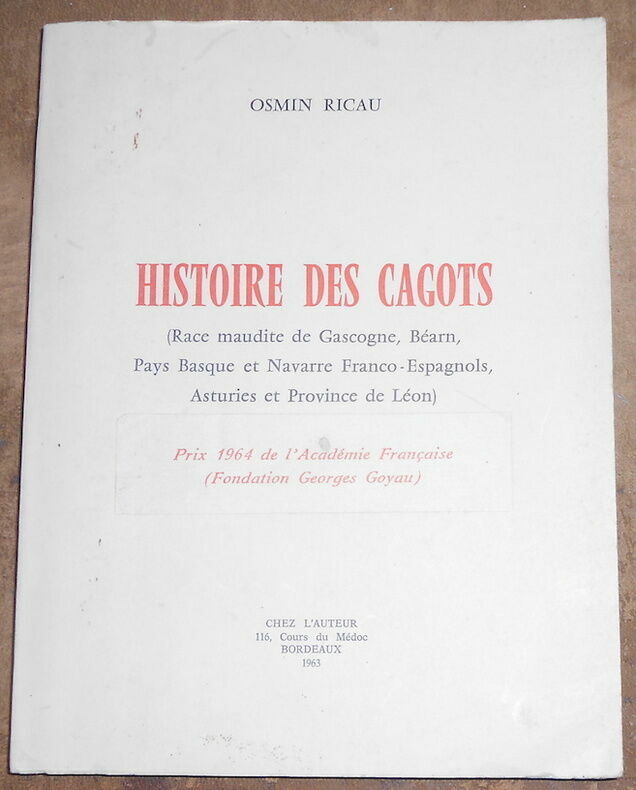
1963188131963. Bordeaux chez l'Auteur 1963 - Broché 17 cm x 22 cm 118 pages - Texte de Osmin Ricau envoi sur deux pages de l'auteur en forme de poème adressé à Jacques Brejon de la Vergné à propos d'un congrès à Strasbourg ; on joint de plus 2 cartes photos illustrées par l'auteur dont l'une comporte aussi un poème manuscrit et le tapuscrit de 7 pages de son intervention dans un congrès avec de nombreuses corrections manuscrites dans lequel il fait certaines références aux Cacous de Bretagne - Non coupé très bon état
12310ATLAS. In 8 reliure éditeur cartonnée, dos toilé bleu. Paris Librairie ancienne Germer Baillière et Cie. Félix Alcan éditeur 1887. Titre illustré, 13 pages, explication es planches. 32 planches, certaines dépliantes. Pâle mouillure triangulaire, en tête des planches I et II, puis planche XVI. Tableaux graphiques, statistiques, des dessins et des photographies de types criminels, ainsi qu’une incroyable planche de craniologie de criminels italiens ( planche XXV) Dernier plat légèrement déformé, avec décollement de papier. Première édition française, atlas seul, qui accompagnait le volume de texte, sous titre : étude anthropologique et médicolégale. Ouvrage emblématique de criminologie naissante et très controversée