924 résultats
ORD-7005Transfusion Sanguine Ethnique. Paris. Mercure de France. 1934. Relié à la suite du même: Vie et Constances des Races. Leçons d'Anthropo-biologie professées à la Facultés de Médecine de Paris. Les Primordiaux et les Immigrants. Racines. Souche. Greffons. Les Crânes et leurs Lois. L'Hérédité et les Lois de Mendel. Lois des Sangs et leurs Frontières. Généalogies. Élevage, et Lois du Métissage. Le Métissage humain. Le Choc des Hérédités. Lois de la Constance des Races. Criminologie. Pathologie. Protection de la Race. L'Immigration. Croisement de Retrempe ou Transfusion de Sève. Avec 21 figures ou cartes. Paris. Mercure de France. 1939. Bien que marqués 3e édition les 2 ouvrages sont de l'année de l'originale. 1 volume in-8 (136 x 223mm) dos lisse basane noire, filets et titre or, plats et gardes marbrés, 352 et 326 pages. Reliure un peu râpée, papier bruni pour le 1er ouvrage, très blanc pour le second. Plutôt bon exemplaire.
171962577Erie PA: Erie Litho & Printing Co. March 17 1923. Large double atlas folio dual-sided broadside printed on newsprint sized 9.25 x 42 in. photo & woodcut engraving illustrations recto & verso toning to paper some chipping & edgewear paper repairs to closed tears still a G- copy. First edition thus of this advertising broadside for Erickson’s “J.W. Johnson’s Old Reliable Virginia Minstrels World’s best colored show. . . “ which touts their supposed 15 year history and appear to have either been reformed from the “Alabama Minstrels†show which played throughout the West and Midwest from 1905-1914 or simply taken over some of their acts. The contortionist fire king Hi Henry Hunt who appears in this broadside regularly performed with the “Alabama Minstrels†from 1905-1913. The silver voiced tenor A.J. McFarland and Grace Arniot Royal Entertainer depicted on the broadside also appear to have been African-American rather than black face performers. The name appears to have been drawn from the 19th-Century original “Virginia Minstrels†or the “Melodious Ethiopian Band†which featured Billy Whitlokc Dick Pelham Frank Brower and Dan Emmett performing in New York’s Bowery Amphitheater in 1843 and launched the minstrelsy form of entertainment. Emmett is perhaps best remembered as the author of “Dixie†which ironically would become the Confederate States unofficial anthem. Assorted versions dating 1920-1924 with different content & sizing appear in 6 libraries Harvard DLC 3 versions Middle Tenn. State Lib. of VA; See: Dr. Karl Koenig The History & Music of the Minstrels Rue Basin Source for Historical Jazz 2024. Erie Litho & Printing Co., unknown
1st Edition. Original Paper Wrappers. 8vo. 3 pages ; 22cm. Sermon preached by Rudolph Grossman, November 10th, 1923 at Temple Rodeph Shalom on the Corner of 63rd Street and Lexington Avenue, New York, on Saturday, November 10th 1923. The Klu Klux Klan has grown to be a serious menace against which the manhood and the womanhood of America must raise its voice in outspoken and vehement protest , Grossman preached in 1923, It is not the Catholic, the Negro, and the Jew alone who are involved in what has come to be a national shame. The honor of Christendom is at stake. Grossman was born in Vienna. He was the son of Rabbi Ignatz Grossman and Nettie Rosenbaum Grossman, and was brought to this country in his childhood. In 1889 he was graduated at the head of his class from the Hebrew Union College in Cincinnati, Ohio After his graduation Dr. Grossman came to New York as associate rabbi of Temple Beth-El. He remained at Temple Beth-El for eight years, and went to Temple Rodeph Sholom in response to a unanimous call Dr. Grossman was president of the Jewish Religious School Union of New York and of the Board of Jewish Ministers and a member of the Commission on Jewish Religious Literature. He had served as vice-president and later as president of the Association of Reform Rabbis of New York. (JTA, 1927) Congregation Rodeph Sholom is a Reform synagogue in New York City. Founded in 1842 by immigrants from the German lands, it is one of the oldest synagogues in the United States. (Wikipedia, 2016) OCLC lists just 1 copy worldwide (HUC). Hole punched with protective material around holes with no text loss. Creased. Some edgewear. Overall good+ condition. (AMR-49-28)
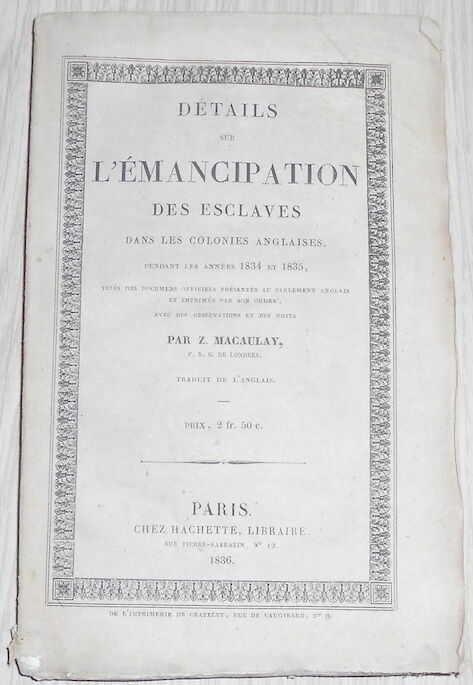
1836188661836. Paris chez Hachette Librairie 1836 - Broché 14 cm x 21 5 cm XIV+ 128 pages - Texte de Z. Macaulay - Bon état
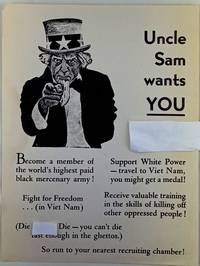
021310No Place: No publisher. Unbound. Good. No publisher place or date. Perhaps circa 1966-68. 8 ½ by 11 inches. Thin paper stock. Black and white printing. A handbill using racist epithets to highlight institutional racism in the military and the US stating among other things "Support White Power-travel to Viet Nam you might get a medal!"; "Receive valuable training in the skills of killing off other oppressed people!"; and "-you can't die fast enough in the ghettos." This imagery has also appeared in a 9x12 inch color format substituting the word "needs" for "wants." The Civil Rights Archive has a circa 1966 photo of Kwame Ture Stokely Carmichael handing out this style leaflet. GOOD condition. Moderate toning. Some creasing along the edges and corners. Faint dampstain at the center left edge. No publisher unknown
Features: If Ho Chih Minh's Army Moves South in Force...; William F. Buckley seeks the Mayor's job in New York; The Wonder is There have been So Few Riots - American Racism; The Way it Was in the London Blitz - Londoners look back with nostalgia; Saga of Greta Lovisa Gustafsson (Garbot); TV Shows for the new season - Eagle in a Cage with Trevor Howard, The Steve Lawrence Show, I Spy with Bill Cosby and Robert Culp, Henry Moore - Man of Form, Trials of O'Brien - Peter Falk, and Jimmy Durante meets the Lively Arts; Feliciano Bejar's Special Niche in Mexico. Unmarked. Average wear. A sound copy. Book
191563112New York: Grosset & Dunlap ca. 1915. 8vo. 8 374 pp. Photo frontisp. 7 photo illust. Red cloth white lettering minor shelfwear faint tidemark wicked into fore-edges of plates at the very fore-edge w/ d.j. cover art with KKK rider on horseback next to heroine minor chipping head & foot of spine minor closed tears edgewear still G/VG- copy. First Photoplay edition of the notorious movie starring Lilian Gish Henry B. Walthall Mae Marsh Miriam Cooper Ralph Lewis George Siemann and others which steeped in the Confederacy’s Lost Cause mythos which had heavily influenced the misguided Dunning School’s interpretation of Reconstruction and significantly influenced Dixon and Woodrow Wilson. Directed by D.W. Griffith the movie was very successful but the racist overtones and blatant support of the Ku Klux Klan triggered widespread protests and it was banned in several cities. Very much like 21st-Century media Birth of a Nation’s portrayal of African-Americans created a justification for prejudice and discrimination which undermined Civil Rights for decades and reactivated the largely quiescent Ku Klux Klan movement and was the first film ever screened at the White House for President Wilson. See: Petaja Photoplay Edition p. 53; The Influence of “The Birth of a Nation†Facing History & Ourselves March 14 2016. Grosset & Dunlap, hardcover
1970List922Richmond Virginia and Milton Massachusetts 1970. Various formats generally near fine with light normal wear. Near Fine. Throughout his career Martin Luther King Jr. had to defend himself repeatedly over allegations of Communist-related activities and sympathies. His associations with several alleged communistes led the FBI to open an investigation in 1962 and his appearance at the Highlander Folk School led to a proliferation of material from far-right groups alleging that he had attended a "Communist Training School" with billboards showing a picture of King at the school appearing during the Selma-Montgomery March. <br /> <br /> Julia Brown was an FBI agent who according to her own book and lectures spent several years undercover as a member of the Communist Party in Cleveland. She made a career in the 60s writing and lecturing on the subject and in particular trying to tie King to Communism in various ways. Her book on the subject still attracts some readers who maintain that King was secretly a violent Communist whose true intentions were to divide the country. <br /> <br /> Collected here are four ephemeral examples relating to Brown's and others' anti-King efforts mostly from Richmond Virginia as follows:<br /> <br /> Printed broadside 8 ½ x 5 ½ inches entitled Richmond is Indebted to Julia Brown advertising Brown as being responsible for King cancelling two trips to Richmond due to Brown's lectures and encouraging people to attend another by her likely published by the Richmond Area T A C T Committee; printed handbill 8 ½ x 11 inches folded entitled Martin Luther King Memorial Bridge - Never alleging King to be a communist and published by the Action-by-Citizens Committee mid 1970s; small card measuring 3 ¾ x 2 ½ inches advertising a speech by Brown on "The Frightening Background of Martin Luther King" March 28 1968 in Richmond published by the American Opinion Library of Richmond; and an anti Martin Luther King Day two-sided handbill published by the Council on Domestic Relations in Milton Massachusetts likely in 1971 using Brown's likeness and essays on King to argue against the establishment of a national holiday in his honor. unknown books
124 pages. References. Bibliography. Black and white illlustrations. "This story of the Komagata Maru is based on the primary source material which I collected from the City Archives, Vancouver , British Columbia." - from Preface. Above-average wear. Unmarked. Binding fragile but intact. Chip missing from base of spine. Book
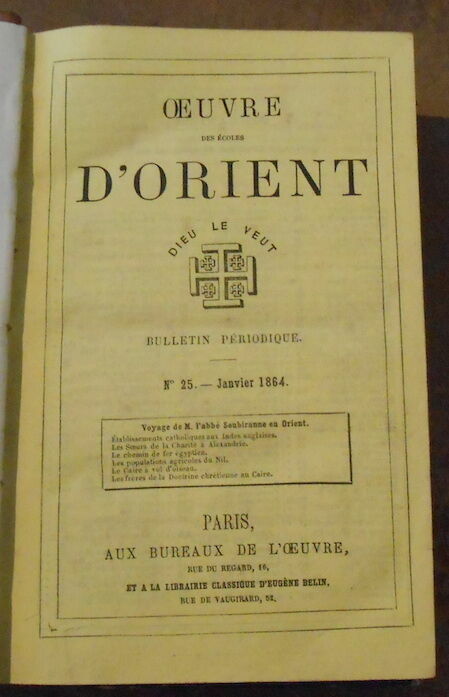
1864156611864. Paris Bureaux de l'Oeuvre du n°25 janvier 1864 au n°54 novembre 1868 soient 30 numéros - Relié demi-bradel couv. des n°s 25 et 54 conservées 13 5 cm x 20 5 cm 384+ 192 pages (pagination continue) - Textes de Fr. Louis-Marie Lion P. Soubiranne Mgr Alexandrian A. Dutau Favérial V. Guérin Soeur Gélas ... - Bon état
186620537<p>Typical of the populist racism characterizing Democratic Party politics immediately after the Civil War this party ticket contains the names of local candidates for office including Brevet Brigadier General Benjamin Lefevre. A native Ohioan Lefevre served throughout the war entering politics when peace was declared but only after breaking an engagement with a Southern belle. He served as a congressman from Ohio throughout reconstruction.</p> <b>RECONSTRUCTION; RACISM.</b>Broadside. <i>"Democratic National Union - No Negro Suffrage"</i> Ohio 1866 3" x 11" 1 p. <br /> books
a75378Washington 1884 1st GPO. Senate Report for the First Session of the 48th Congress. Investigation of the alleged massacre on colored men at Denville Virginia. Hardcover. Octavo 1298pp. a few caricature illustrations and drawings tan buckram. Institution bookplate and blind stamp on title page tiny depository library name stamp on end paper - no other library markings. VG plus. . hardcover
111307A Bruxelles, Les Editions "Action et Civilisation" - Sans date - 4me édition - In-12, broché - 95 p.
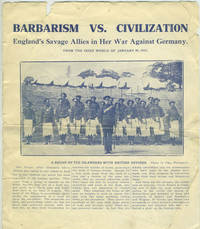
191526775New York 1915. Irish propaganda targeting the British during W.W.I. from the Irish World of January 30 1915. During W.W.I the struggle for Irish independence was suspended with the Nationalist forces splitting over support of the war. This handbill appears to be an effort to incite hatred of the British with racist descriptions of Fijian soldiers "the cannibals we may say" who fought for the British. There is a clear preference for Germany - "And these are the savages the cannibals we may say whom Britain is bringing over to fight the most enlightened nation of Melancthon and SchlegeL of Kant. of Mozart and Beethoven and Wagner of Goethe and Heine." <br /> <br /> The text characterized the Fijians as cannibals "dark copper colored have black eyes and bushy hair worn in the form of a mop" short stature protruding stomachs legs bowed and feet flat and usually nude. The photograph shows the Fijian soldiers standing at attention behind a British Officer photo by Paul Thompson. <br /> <br /> The text of the handbill is extracted from The Irish World and American Industrial Liberator published in New York between 1878-1951. Hand bill 9 x 7 3/4" printed in blue on cream paper verso blank. Creased with marginal tears and small margin loss. <br /> <br /> Unrecorded on OCLC although there is a W.W.I poster with the title "Civilization Vs. Barbarism" 1914 but associated with Red Cross Week. OCLC: 894257435. unknown
1916932Athol Ma 1916. Good plus. Broadside 16 x 5 inches. Previously folded. A couple of chips and small closed tears at edges. Even tanning. Rare broadside advertisement for a weekend engagement of D.W. Griffith's infamous silent epic The Birth of a Nation at Steinberg's Athol Opera House located in Athol Massachusetts. The broadside gives dates and times of screenings November 4-6 2:10 & 8:10 daily a list of cast and characters a lengthy discussion of Griffith's desire for historical accuracy in his work and a message about "the play's message of peace." To wit the broadside states that "If this graphic presentment serves no other purpose its message of universal peace marks it of great important. Morally and educationally it established the futility of armed conflict. But for the hatreds engendered in the Civil War the suffering of the Reconstruction period would never have been known." The film based on Thomas Dixon's 1905 novel The Clansman is often cited as the principal inspiration for the revival of the Ku Klux Klan in the 20th century. unknown books
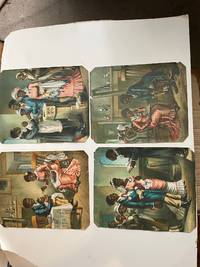
26566English each print 'Copyright Entered at Stationers Hall'. Circa 1888. The four plates each 29 x 23.5 cm are loose and unframed in fair condition aged and worn with no margins chipping to the edges and with the corners cut off at a diagonal. Each title written in pencil in a contemporary hand on the reverse of the print each with a price of '6d'. The subjects are not depicted in unattractive style and are certainly not grotesques but they are shown as 'simple' untroubled individuals with the usual happy gleaming brown faces and shiny white teeth. The 'humour' would appear to be intended to be found in the substitution in quintessentially English scenes of 'foreign' for English faces. This set is generally classed as 'Black Americana' but there are two reasons for assuming that it is of British origin. First each plate is stated in the bottom right-hand corner to be 'Copyright Entered at Stationers Hall' and second a report in the British Printer 1888 notes that 'Two new series of humorous subjects are "New Renderings of Old Song Titles" each picture containing a puzzle and "Sambo's Courtship" both highly amusing and certain to furnish plenty of fun and amusement for the little ones'. Some are listed in "Black Americana: Price Guide: edited by Kyle Husfloen" Google which appears to give incorrect information about the publishing date and "American" printing etc. English (each print 'Copyright Entered at Stationers Hall'). Circa 1888. unknown
193661085Washington D.C.: Associates in Negro Folk Education 1936. 8vo. 6 98 pp. Decorated tan softcovers Art Deco designs on front cover lettering in black gilt & red minor scuffing lower fore-edge front cover still a VG copy. First edition of this 4th installment in the storied “Bronze Booklet†series which quickly became a standard reference for teaching African-American history in the United States and Europe and addressed a number of racial conflicts and issues surrounding the impact of race on political and economic history. This important groundbreaking work by Bunche not only represented his most extended analysis of the issues of racism but also the role of race and racism in World economic and political conflicts Imperialism and inherent racism as well as the fact that race “has been used to whitewash some of the blackest pages in American history.†Bunche 1904-1971 was a leading African-American intellectual diplomat supporter of the US Civil Rights movement and would later be awarded the 1950 Nobel Peace Prize the first African=American so honored. Associates in Negro Folk Education, paperback
1930VBF24<p>Black Interest - Racist</p><p>COUSIN KEN: <i><b>The Ten Little Seaside Nigger Boys.</b></i></p><p>London: Renwick of Otley ca.1930s.</p><p>Publisher's address given as: 180 Fleet Street E.C.4 = London</p><p>16 leaves of ink page mock-up pre-production for the book</p><p>comprising manuscript text and illustrations 6 with color plate</p><p>separations plus 1 full ink British Production and watercolor design for the cover. Loose.</p><p>Some pages signed "Ken". </p><p><br /></p> Renwick of Otley books
190122331<p><b>RACISM. THEODORE ROOSEVELT.</b>Drawing. 1p 5 x 6¼ in. </p><b>Transcript</b><p><i>"To hear how Roosevelt is carrying on I would like to give him a swift kick & see him full of holes I wish the nation would make Alice marry Booker T Washington don't you"</i></p><p>Followed by drawing of Alice Roosevelt marrying Booker T. Washington.</p><p><b>Historical Background</b></p><p>In 1901 Roosevelt invited Washington to dine with him at the White House making him the first black man ever to do so. Whoever wrote this racist note and drawing apparently did not approve of the gesture suggesting that Roosevelt's eldest daughter Alice marry the Civil Rights pioneer.</p>
190122331<p><b>RACISM. THEODORE ROOSEVELT.</b>Drawing. 1p 5 x 6¼ in. </p><b>Transcript</b><p><i>"To hear how Roosevelt is carrying on I would like to give him a swift kick & see him full of holes I wish the nation would make Alice marry Booker T Washington don't you"</i></p><p>Followed by drawing of Alice Roosevelt marrying Booker T. Washington.</p><p><b>Historical Background</b></p><p>In 1901 Roosevelt invited Washington to dine with him at the White House making him the first black man ever to do so. Whoever wrote this racist note and drawing apparently did not approve of the gesture suggesting that Roosevelt's eldest daughter Alice marry the Civil Rights pioneer.</p> books
311 pages. First English printing of the 1973 French first edition. "A chilling novel about the end of the white world." - dust jacket. "The 'Brave New World' of the 70's. I am still haunted by the drama and suspense and horror of that armada!" - Germaine Bree. "Takes on a whole cluster of polemical issues - over-population, race, the Third World, and the character of liberal thought and sentiment." - Max Lerner. Somewhat above-average wear. Spine leaning. Usual library markings. Clear plastic laminate over dust jacket. Book
19472097Paris Gallimard, 1947 Traduit de l'américain par Marcel Duhamel en collaboration avec Andrée R. Picard. 224 pp. In-8 en pleine percaline noire, dos plat pièce de titre en maroquin rouge, relié avec sa couverture d'origine. Black boy raconte un épisode d'une histoire souvent vécue par les Noirs d'Amérique. "Les circonstances historiques ont fait de nous, les Noirs d'Amériques du Nord, un peuple de nomades, perpétuellement en mouvement, quittant sans cesse un lieu pour cherche la liberté ailleurs." Richard Wright, issu d'une famille blanche, noire et indienne, est à l'intersection contre la "doctrine de la Suprématie Blanche". Insaisissable et instable, il poursuit sans limite ses aspirations, en "courant après la liberté", pour la condition humaine, la condition de son époque pour les siens et pour les autres. Avant ce livre, son premier roman Native Son livre fut un succès, dynamitant les préjugés racistes. Orson Welles en fit une adaptation pour le théâtre en 1941.
186425614<p>The second in a series of four racist political cartoons published in 1864 by Bromley & Company which was closely affiliated with the Copperhead New York <i>World</i> newspaper. These prints sought to undermine Abraham Lincoln's chances for reelection by branding him as a "miscegenationist" and playing on white fears of "race-mixing." The cartoon scene pictures several interracial couples enjoying a day at the park eating ice cream discussing wedding plans and a woman's upcoming lecture. Two African American families have white employees a carriage driver and footmen and a babysitter.</p><p>The only other example traced at auction brought $7800 in 2010.</p> <b>ABRAHAM LINCOLN. RACISM.</b>Print. "Miscegenation or the Millennium of Abolitionism." Political Cartoon. New York: Bromley & Co. 1864. 1 p. 20¾ x 13â… in.<p><br /></p><p>American politics had long played on fears of sexual relationships between races. A powerful new word for "race-mixing" was coined in an anonymous December 1863 pamphlet entitled <i>Miscegenation: The Theory of the Blending of the Races Applied to the American White Man and Negro</i> published in New York. Purporting to advocate the virtues of the "blending of the white and black races on this continent" it was a literary forgery prepared by <i>The World</i> managing editor David Goodman Croly and reporter George Wakeman. The authors were unsuccessful in their attempt to trick President Lincoln into endorsing the work.</p><p>At the far left of the image Abraham Lincoln declares "<i>I shall be proud to number among my intimate friends any member of the Squash family especially the little Squashes.</i>" The African American woman to whom he is speaking replies "<i>I'se 'quainted wid Missus Linkum I is washed far her 'fore de hebenly Miscegenation times was cum. Dont do nuffin now but gallevant 'round wid de white gem'men! he-ah! he-ah! he-ah!</i>"</p><p>Senator Charles Sumner says "<i>Mr. President! Allow me the honor of introducing my very dear friend Miss Dinah Arabella Aramintha Squash.</i>" A white carriage driver complains in the background "<i>Gla-a-ang there 240t! White driver white footmen niggers inside my heys! I wanted a situation when I took this one</i>" while a black man in the carriage tells his companion "<i>Phillis de_ah dars Sumner. We must not cut him if he is walking.</i>" A black woman at a table tells a white man with her "<i>Ah! Horace its-its-its-bully 'specially de cream</i>" and he replies "<i>Ah! my dear Miss Snowball we have at last reached our political and social Paradise. Isn't it extatic</i>"</p><p>To the right are two couples embracing each a white woman and an African American man. The first white women tells her partner "<i>Oh! You dear creature. I am so agitated! Go and ask Pa</i>" to which he replies "<i>Lubly Julia Anna name de day when Brodder Beecher shall make us one!</i>" The second white woman says "<i>Adolphus now you'll be sure to come to my lecture to morrow night won't you</i>" to which he answers "<i>I'll be there Honey on de front seat sure!</i>" In the background are various immigrant minorities viewing the scene. One exclaims "<i>Most hextwadinary! Aw neva witnessed the like in all me life if I did dem me!</i>" and another adds "<i>Mine Got vat a guntry vat a beebles!</i>" An Irish girl complains "<i>And is it to drag nagur babies that I left old Ireland Bad luck to me.</i>"</p><p>Manton Marble the editor of <i>The World</i> collaborated with printmaker Bromley & Company to issue a series of four anti-Lincoln "Political Caricatures." The present example was the No. 2 in that series. No. 1 was "The Grave of the Union or Major Jack Downing's Dream"; No. 3 "The Abolition Catastrophe Or the November Smash-up"; and No. 4 "The Miscegenation Ball."</p><p>Republicans responded by trying to turn the "miscegenation" charge against the Democrats. A Republican print "The Political "Siamese" Twins: The Offspring of Chicago Miscegenation" pictures McClellan and Pendleton joined together despite their very different ideas on ending the war.</p><p>Although Abraham Lincoln won New York states' electoral votes in 1860 Stephen Douglas had carried New York City and its environs. Financial elites fearing that civil war would ruin business and recent immigrants fearing competition with free black labor supported Douglas. Lincoln's unpopularity in New York City during the Civil War was a factor in the deadly 1863 Draft Riots.</p><p>In 1864 Lincoln again won the states' electoral votes while New York City favored his Democratic opponent McClellan. In fact Lincoln's majority dropped from 50136 votes in 1860 to only 7373 votes in 1864 with approximately 50000 more total votes cast than in 1860.</p><p>Bromley and Company continued to sell the caricatures after the election as this January 1865 advertisement from an Ohio newspaper makes clear. Another advertisement assured purchasers that the set of four prints available for $1 were "sent on wooden rollers to insure safe carriage."</p><p><b><i>The World</i></b> 1860-1931 a daily independent newspaper was published in New York City. Alexander Cummings founded it as a religious Republican outlet in 1860. August Belmont and others purchased it in 1862 changing the editorial focus. With editor Manton Marble 1834-1917 <i>The World</i> soon became the country's leading Democratic newspaper. In 1864 Union authorities shut down <i>The World</i>and another paper for three days after they published forged documents purportedly written by Lincoln that were really part of a hoax to manipulate the price of gold. The paper actively supported George B. McClellan against Lincoln in 1864.</p><p><b>Condition</b></p><p>Fine for exhibit despite flaws. Cropped with loss of "Political Caricature No. 2" from top edge and part of printed pricing information from bottom edge publisher's name rubbed out from the copyright statement lacking ½" from lower left corners a few short tape repairs by the edges a 2" closed tear through the second dialogue bubble along the top edge and a 3" closed tear parallel to the right edge. Mount remnants on verso.</p>
186425614<p>The second in a series of four racist political cartoons published in 1864 by Bromley & Company which was closely affiliated with the Copperhead New York <i>World</i> newspaper. These prints sought to undermine Abraham Lincoln's chances for reelection by branding him as a "miscegenationist" and playing on white fears of "race-mixing." The cartoon scene pictures several interracial couples enjoying a day at the park eating ice cream discussing wedding plans and a woman's upcoming lecture. Two African American families have white employees a carriage driver and footmen and a babysitter.</p><p>The only other example traced at auction brought $7800 in 2010.</p> <b>ABRAHAM LINCOLN. RACISM.</b>Print. "Miscegenation or the Millennium of Abolitionism." Political Cartoon. New York: Bromley & Co. 1864. 1 p. 20¾ x 13â… in.<p><br /></p><p>American politics had long played on fears of sexual relationships between races. A powerful new word for "race-mixing" was coined in an anonymous December 1863 pamphlet entitled <i>Miscegenation: The Theory of the Blending of the Races Applied to the American White Man and Negro</i> published in New York. Purporting to advocate the virtues of the "blending of the white and black races on this continent" it was a literary forgery prepared by <i>The World</i> managing editor David Goodman Croly and reporter George Wakeman. The authors were unsuccessful in their attempt to trick President Lincoln into endorsing the work.</p><p>At the far left of the image Abraham Lincoln declares "<i>I shall be proud to number among my intimate friends any member of the Squash family especially the little Squashes.</i>" The African American woman to whom he is speaking replies "<i>I'se 'quainted wid Missus Linkum I is washed far her 'fore de hebenly Miscegenation times was cum. Dont do nuffin now but gallevant 'round wid de white gem'men! he-ah! he-ah! he-ah!</i>"</p><p>Senator Charles Sumner says "<i>Mr. President! Allow me the honor of introducing my very dear friend Miss Dinah Arabella Aramintha Squash.</i>" A white carriage driver complains in the background "<i>Gla-a-ang there 240t! White driver white footmen niggers inside my heys! I wanted a situation when I took this one</i>" while a black man in the carriage tells his companion "<i>Phillis de_ah dars Sumner. We must not cut him if he is walking.</i>" A black woman at a table tells a white man with her "<i>Ah! Horace its-its-its-bully 'specially de cream</i>" and he replies "<i>Ah! my dear Miss Snowball we have at last reached our political and social Paradise. Isn't it extatic</i>"</p><p>To the right are two couples embracing each a white woman and an African American man. The first white women tells her partner "<i>Oh! You dear creature. I am so agitated! Go and ask Pa</i>" to which he replies "<i>Lubly Julia Anna name de day when Brodder Beecher shall make us one!</i>" The second white woman says "<i>Adolphus now you'll be sure to come to my lecture to morrow night won't you</i>" to which he answers "<i>I'll be there Honey on de front seat sure!</i>" In the background are various immigrant minorities viewing the scene. One exclaims "<i>Most hextwadinary! Aw neva witnessed the like in all me life if I did dem me!</i>" and another adds "<i>Mine Got vat a guntry vat a beebles!</i>" An Irish girl complains "<i>And is it to drag nagur babies that I left old Ireland Bad luck to me.</i>"</p><p>Manton Marble the editor of <i>The World</i> collaborated with printmaker Bromley & Company to issue a series of four anti-Lincoln "Political Caricatures." The present example was the No. 2 in that series. No. 1 was "The Grave of the Union or Major Jack Downing's Dream"; No. 3 "The Abolition Catastrophe Or the November Smash-up"; and No. 4 "The Miscegenation Ball."</p><p>Republicans responded by trying to turn the "miscegenation" charge against the Democrats. A Republican print "The Political "Siamese" Twins: The Offspring of Chicago Miscegenation" pictures McClellan and Pendleton joined together despite their very different ideas on ending the war.</p><p>Although Abraham Lincoln won New York states' electoral votes in 1860 Stephen Douglas had carried New York City and its environs. Financial elites fearing that civil war would ruin business and recent immigrants fearing competition with free black labor supported Douglas. Lincoln's unpopularity in New York City during the Civil War was a factor in the deadly 1863 Draft Riots.</p><p>In 1864 Lincoln again won the states' electoral votes while New York City favored his Democratic opponent McClellan. In fact Lincoln's majority dropped from 50136 votes in 1860 to only 7373 votes in 1864 with approximately 50000 more total votes cast than in 1860.</p><p>Bromley and Company continued to sell the caricatures after the election as this January 1865 advertisement from an Ohio newspaper makes clear. Another advertisement assured purchasers that the set of four prints available for $1 were "sent on wooden rollers to insure safe carriage."</p><p><b><i>The World</i></b> 1860-1931 a daily independent newspaper was published in New York City. Alexander Cummings founded it as a religious Republican outlet in 1860. August Belmont and others purchased it in 1862 changing the editorial focus. With editor Manton Marble 1834-1917 <i>The World</i> soon became the country's leading Democratic newspaper. In 1864 Union authorities shut down <i>The World</i>and another paper for three days after they published forged documents purportedly written by Lincoln that were really part of a hoax to manipulate the price of gold. The paper actively supported George B. McClellan against Lincoln in 1864.</p><p><b>Condition</b></p><p>Fine for exhibit despite flaws. Cropped with loss of "Political Caricature No. 2" from top edge and part of printed pricing information from bottom edge publisher's name rubbed out from the copyright statement lacking ½" from lower left corners a few short tape repairs by the edges a 2" closed tear through the second dialogue bubble along the top edge and a 3" closed tear parallel to the right edge. Mount remnants on verso.</p> books