929 résultats
1ère édition du fameux pamphlet anti-essentialiste, drôle et provocateur, du Bourguignon Gaston KELMAN, ancien directeur de l'Observatoire du Syndicat d'agglomération nouvelle de la ville d'Evry, consultant-formateur en problématiques socioculturelles liées aux migrations d'origine négro-africaine; notes bibliographiques. Français
Broché. 182 pages.
12mo; 1st edition. Original paper wrappers, 12mo, 255 pages. 20 cm. Singerman 0118: This set is "The most well-known American contribution to the literature of anti-Semitism." Henry Ford, a noted anti-semite, had a close association with Dearborn, MI. Ford did not write the articles. He expressed his opinions verbally to his executive secretary, Ernest Liebold, and to William J. Cameron. Cameron had the main responsibility for expanding these opinions into article form. Liebold was responsible for collecting more material to support the articles. The Dearborn Independent, also known as The Ford International Weekly, was a weekly newspaper established in 1901, and published by Henry Ford from 1919 through 1927. The paper reached a circulation of 900,000 by 1925, second only to the New York Daily News, largely due to a quota system for promotion imposed on Ford dealers. Lawsuits regarding antisemitic material published in the paper caused Ford to close it, and the last issue was published in December 1927. The publication's title was derived from the Detroit suburb of Dearborn, Michigan. Derived largely from information found posted on line: Convinced that "bankers" and "the Jews" were responsible for a whole range of things he didn't like, from the world war to short skirts to jazz music, Henry Ford used his newspaper, the Dearborn Independent, to carry on an active anti-Semitic campaign. Between 1920 and 1922 a series of articles denounced all things Jewish. While officially apologizing for the articles in 1927, Ford's anti-Jewish sentiments ran deep. In January 1919, Henry Ford began publication of the Dearborn Independent, a small community weekly he had purchased the previous year. Carrying the subtitle, The Chronicler of the Neglected Truth, the paper primarily served as a forum for Henry Ford's views. Each issue of the Independent carried "Mr. Ford's Own Page," an editorial expressing his opinions, written by William J. Cameron. The Ford Motor Company pressured car dealers to buy multiple subscriptions and hand out copies to customers. The newspaper was popular, and circulation reached 900,000 in 1926. The Dearborn Independent would, most likely, have remained a sidebar in Ford's biography were it not for a controversial series that began on May 22, 1920 and lasted for several years. Appearing on the front page every week, "The International Jew: The World's Problem" examined a purported conspiracy launched by Jewish groups to achieve world domination. The basis for the articles was a notorious forgery, The Protocols of the Elders of Zion, an anti-Semitic hoax, first published in Russia in 1903. Many have accused Ford's personal secretary, Ernest Liebold, of being the source of the campaign, and Liebold's anti-Semitic views are well documented. William Cameron, editor of the Independent, was an enthusiastic supporter of the publication of the anti-Semitic diatribes. However, Ford's own attitudes towards Jews were the major reason for the publication of "The International Jew." His anti-Semitic beliefs formed along several strands from his upbringing, attitudes, and personal beliefs. A common stereotype at the time led some people to assume that Jews controlled the international banking system; that belief may have fed his anti-Jewish feelings. The publication of "The International Jew" caused an uproar. In some quarters, such as anti-immigrant and nativist groups, the series confirmed their own beliefs. Others were appalled by the series, published demands for a retraction, removed the paper from public libraries, and promoted a boycott of Ford automobiles. Some Ford dealers refused to carry the paper. Responding to this pressure, Ford halted publication of the anti-Jewish series in January 1922, only to start it up again less than a year later. Some wear at spine, about Very Good- condition. (HOLO2-63-21A)
12mo; 1st edition. Original green cloth, 12mo, 255 pages. 20 cm. Singerman 0118: This set is "The most well-known American contribution to the literature of anti-Semitism." Henry Ford, a noted anti-semite, had a close association with Dearborn, MI. Ford did not write the articles. He expressed his opinions verbally to his executive secretary, Ernest Liebold, and to William J. Cameron. Cameron had the main responsibility for expanding these opinions into article form. Liebold was responsible for collecting more material to support the articles. The Dearborn Independent, also known as The Ford International Weekly, was a weekly newspaper established in 1901, and published by Henry Ford from 1919 through 1927. The paper reached a circulation of 900,000 by 1925, second only to the New York Daily News, largely due to a quota system for promotion imposed on Ford dealers. Lawsuits regarding antisemitic material published in the paper caused Ford to close it, and the last issue was published in December 1927. The publication's title was derived from the Detroit suburb of Dearborn, Michigan. Derived largely from information found posted on line: Convinced that "bankers" and "the Jews" were responsible for a whole range of things he didn't like, from the world war to short skirts to jazz music, Henry Ford used his newspaper, the Dearborn Independent, to carry on an active anti-Semitic campaign. Between 1920 and 1922 a series of articles denounced all things Jewish. While officially apologizing for the articles in 1927, Ford's anti-Jewish sentiments ran deep. In January 1919, Henry Ford began publication of the Dearborn Independent, a small community weekly he had purchased the previous year. Carrying the subtitle, The Chronicler of the Neglected Truth, the paper primarily served as a forum for Henry Ford's views. Each issue of the Independent carried "Mr. Ford's Own Page," an editorial expressing his opinions, written by William J. Cameron. The Ford Motor Company pressured car dealers to buy multiple subscriptions and hand out copies to customers. The newspaper was popular, and circulation reached 900,000 in 1926. The Dearborn Independent would, most likely, have remained a sidebar in Ford's biography were it not for a controversial series that began on May 22, 1920 and lasted for several years. Appearing on the front page every week, "The International Jew: The World's Problem" examined a purported conspiracy launched by Jewish groups to achieve world domination. The basis for the articles was a notorious forgery, The Protocols of the Elders of Zion, an anti-Semitic hoax, first published in Russia in 1903. Many have accused Ford's personal secretary, Ernest Liebold, of being the source of the campaign, and Liebold's anti-Semitic views are well documented. William Cameron, editor of the Independent, was an enthusiastic supporter of the publication of the anti-Semitic diatribes. However, Ford's own attitudes towards Jews were the major reason for the publication of "The International Jew." His anti-Semitic beliefs formed along several strands from his upbringing, attitudes, and personal beliefs. A common stereotype at the time led some people to assume that Jews controlled the international banking system; that belief may have fed his anti-Jewish feelings. The publication of "The International Jew" caused an uproar. In some quarters, such as anti-immigrant and nativist groups, the series confirmed their own beliefs. Others were appalled by the series, published demands for a retraction, removed the paper from public libraries, and promoted a boycott of Ford automobiles. Some Ford dealers refused to carry the paper. Responding to this pressure, Ford halted publication of the anti-Jewish series in January 1922, only to start it up again less than a year later. Small spine label, library bookplate, pocket on rear blank pastedown, light wear to cloth, Text pages all very clean, no other markings, Gery Good- Condition. (HOLO2-63-21G)
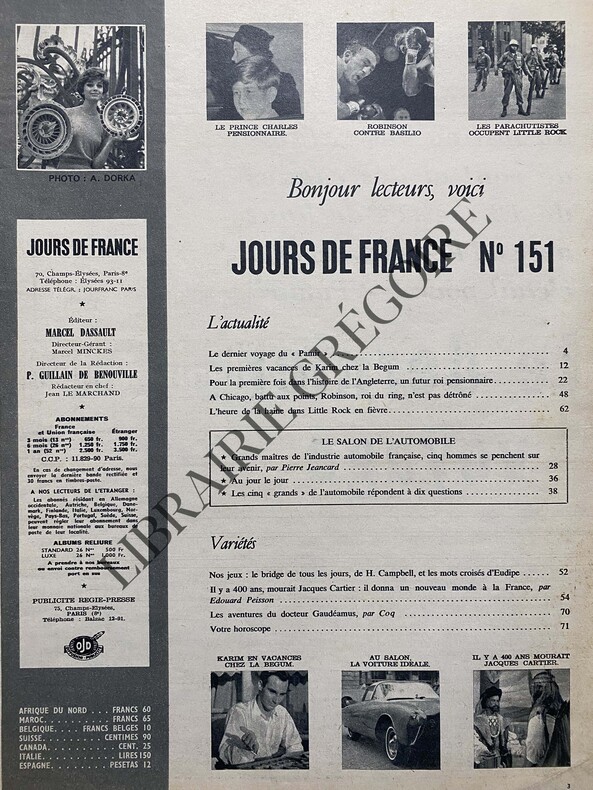
1957ABE-746940751672 PAGES-EN COUVERTURE "MARIE HELENE ARNAUD PRESENTE LE TRANSFLUIDE RENAULT"-PAMIR LE DERNIER VOYAGE/8P-PREMIERS INSTANTS DE DETENTE CHEZ LA BEGUM A YAKIMOUR/5P-UN FUTUR ROI PENSIONNAIRE/CHARLES D'ANGLETERRE/4P-GRANDS MAITRES DE L'INDUSTRIE AUTOMOBILE FRANCAISE CINQ HOMMES SE PENCHENT SUR LEUR AVENIR/11P-APRES "CAPRICE ET VARIATIONS" POUR MONIQUE RIVET L'HEURE DE RECREATION/2 PHOTOS-AVEC "PORTE DES LILAS" RENE CLAIR ECRIT UNE TRAGEDIE DE L'AMITIE/BRASSENS/PIERRE BRASSEUR/DANY CARREL/2P/4 PHOTOS-A CHICAGO, BATTU AUX POINTS ROBINSON, ROI DU RING, N'EST PAS DETRONE/2P/6 PHOTOS-JACQUES CARTIER IL DONNA UN NOUVEAU MONDE A LA FRANCE/7 PAGES PAR EDOUARD PEISSON-A LITTLE ROCK EN FIEVRE L'HEURE DE LA HAINE/5P/7 PHOTOS-FROTTEE EN COUVERTURE SUR 2 CM
1988R200137164Centurion. 1988. In-8. Broché. Etat d'usage, Couv. légèrement pliée, Dos plié, Quelques rousseurs. 168 pages - papier jauni, coins frottés, annotation à l'encre sur la page de garde.. . . . Classification Dewey : 305.8-Racisme
1939GITc462Paris Grasset 1939. In-12 broché 223pp. Bel exemplaire, non coupé.
1934R150142240FERNAND SORLOT.. 1934. In-12. Broché. Etat d'usage, Couv. légèrement passée, Coiffe en tête abîmée, Intérieur acceptable. 123 pages.. . . . Classification Dewey : 305.8-Racisme
1934152592Sorlot, vers 1934. In Sorlot, vers 1934. In-12 broché de 118 pages.Couverture poussiéreuse sinon Bon état
1934822701934 Paris, Sorlot (Collection "Le MOnde Catholique"), (1934), in 12 broché, 123 pages ; cachets.
FERNAND SORLOT.. 1934. In-12 Carré. Broché. Etat d'usage. Couv. légèrement passée. Coiffe en tête abîmée. Intérieur acceptable. 123 pages.
Sorlot, vers 1934. In-12 broché de 118 pages.Couverture poussiéreuse sinon Bon état
199320585CBFrankfurt am Main, Jüdischer Verlag, 1993. 8°, 359 S., original Kartonage (Paperback), deutsche Erstausgabe obere und untere Ecke des Vorderdeckels minimal bestoßen, sonst schönes, sauberes Exemplar
1996R150183930PANORAMIQUES.. 1996. In-8. Broché. Bon état, Couv. légèrement passée, Dos satisfaisant, Intérieur frais. 379 pages. Ancien ourvage de bibliothèque: étiquette de code sur le dos, tampon, pochette et étiquette sur les pages de garde.. . . . Classification Dewey : 305.8-Racisme
1996R200004890ARLEA CORLET. 1996. In-8. Broché. Bon état, Couv. convenable, Dos satisfaisant, Intérieur frais. 379 pages.. . . . Classification Dewey : 305.8-Racisme
1984R200004394BELFOND. 1984. In-8. Broché. Bon état, Couv. convenable, Dos satisfaisant, Intérieur frais. 255 pages.. . . . Classification Dewey : 305.8-Racisme
1969R150219986FLAMMARION. 1969. In-12. Broché. Bon état, Couv. convenable, Dos satisfaisant, Intérieur frais. 124 pages. . . . Classification Dewey : 305.8-Racisme
ISBN : 2854808940. PANORAMIQUES.. 1996. In-8 Carré. Broché. Bon état. Couv. légèrement passée. Dos satisfaisant. Intérieur frais. 379 pages. Ancien ourvage de bibliothèque: étiquette de code sur le dos, tampon, pochette et étiquette sur les pages de garde.
FLAMMARION. 1969. In-12 Carré. Broché. Bon état. Couv. convenable. Dos satisfaisant. Intérieur frais. 124 pages
1949R200004556EDITIONS DU CENTRE. 1949. In-8. Broché. Bon état, Couv. convenable, Dos satisfaisant, Intérieur frais. 93 pages.. . . . Classification Dewey : 305.8-Racisme
1995R150203861LA DECOUVERTE. 1995. In-8. Broché. Bon état, Couv. convenable, Dos satisfaisant, Intérieur frais. 320 pages. Avec Jaquette. . . Classification Dewey : 305.8-Racisme
ISBN : 2707124869. LA DECOUVERTE. 1995. In-8 Carré. Broché, Jaquette. Bon état. Couv. convenable. Dos satisfaisant. Intérieur frais. 320 pages Préface de Emile Poulat- Collection L'Espace de l'histoire
1983R150207861FAYARD. 1983. In-8. Broché. Etat d'usage, Couv. convenable, Dos satisfaisant, Intérieur frais. 353 pages. . . . Classification Dewey : 305.8-Racisme
ISBN : 2213011176. FAYARD. 1983. In-8 Carré. Broché. Etat d'usage. Couv. convenable. Dos satisfaisant. Intérieur frais. 353 pages
PUF Que Sais Je ? 1983, In-12 broché, 127 pages. Bon état.