275 résultats
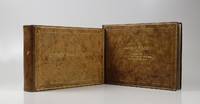
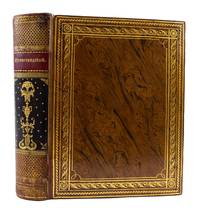
1817ST18762Halle and Berlin: Hallisches Waisenhaus 1817. 275 x 215 mm. 10 3/4 x 8 3/8". 210 leaves 18 pp. 4 leaves. <br/> REMARKABLY FINE CONTEMPORARY MARBLED CALF covers with complex gilt border composed of plain rules and decorative rolls smooth spine divided into compartments by gilt Greek key rolls top and bottom compartments with all-over gilt scallop design long central panel of black morocco with elaborate gilt vase and floral ornament surrounded by small gilt stars and with red morocco titling label above; FULL SPECKLED CALF DOUBLURES the front doublure with a painted lyre featuring gilt strings sword and wreath the rear with a monopteros with an eternal flame at the center upon a plinth superimposed upon which is an onlaid black morocco label framed in gilt and with gilt lettering "18. Oct. 1813" both doublures framed with red morocco supporting an elegant scrolling gilt band densely gilt turn-ins blue silk moiré endleaves all edges gilt an expert two-centimeter repair at head of spine. With frontispiece 21 portraits and 11 maps three folding one with flap all but one with inserted tissue guard. ◆Joints with slight flaking a hint of wear along tail edges as expected bottom spine compartment faintly rubbed with minor loss of gilt a little oxidation to the wreath on front doublure but A VERY HANDSOME BINDING with only minor condition issues. Light overall browning to plates because of paper content but virtually no foxing and only very occasional some quite faint spotting; THE TEXT itself IN NEARLY PRISTINE CONDITION extraordinarily clean bright and fresh with just one or two negligible imperfections.<br/> <br/> In a wonderful binding with unusual doublures this work commemorates the so-called "Wars of Liberation" that effectively ended French hegemony over Europe and that forced Napoleon into exile. Also known as the War of the Sixth Coalition the conflict took place between 1813-14 following Napoleon's retreat from Russia in 1812. Though the major battles primarily took place in German territory rulers of Russia Prussia Austria Spain Portugal the United Kingdom Sweden and many German States all banded together to oppose France. In March of 1814 the allies entered Paris prompting the French Senate to depose Napoleon and install Louis XVIII as the French sovereign. Although Napoleon would briefly return from his exile on Elba to stage a comeback in 1815 it was short lived and ended in his final defeat. The majority of the text here discusses the events of 1813 and 1814 during the height of the conflict and includes portraits of the major players and maps helping to illustrate the most important battles. This work is beautifully printed on thick white paper and is clearly meant to act as both a chronological record of the events and a memorial to those who liberated the German states from a tyrannical power. The lovely marbled calf binding opens to reveal two exceptional doublures painted in the manner of an antique vase with a lyre wreath and sheathed sword on the front doublure and on the rear a monopteros this latter circular colonnade with an eternal flame bearing a small morocco onlay emblazoned with the date 18 October 1813. This refers to the Battle of Leipzig also called the Battle of Nations fought from 16-19 October--by many accounts the single largest and bloodiest battle of the entire Napoleonic Era. It marked a decisive turning point in the Wars of Liberation and was an obvious source of pride for the German people. Given the momentous nature of the book's content the present grand and beautifully designed binding serves as a suitably striking vehicle of presentation. Hallisches Waisenhaus unknown
19702111902154604281Aki Shobo 1970. Soft Cover. Fine. The book is in fine condition. Aki Shobo paperback
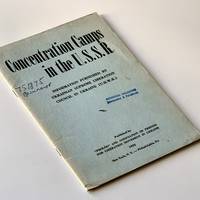
19527841New York N.Y. & Philadelphia Pa.: Prolog" and Association of Friends for Liberation Movement in Ukraine A.F.L.M.U. 1952. First Edition. Card Covers. pp. 1-2 3-23. Octavo 6" x 9". Twice-stapled card covers with title in black. Striking woodcut frontispiece to verso title page attributed to Nil Khasevych well-known artist of Ukrainian Insurgent Army "U.P.A." accompanied by one additional illustrated plate depicting the layout of a Soviet camp unit. One large exceptionally well-preserved map affixed to verso of rear cover entitled: "Gulag - Slavery Inc.: The Documented Map of Forced Labor Camps in Soviet Russia; New Edition 1951 Prepared for the Free Trade Union Committee of the American Federation of Labor." Map captioned with explanatory text. Neat ink accession sticker and stamp to the front cover contents without blemish; very good. Corresponds to OCLC #9270889 & #645594338. Rare in commerce in this edition and state. Remarkable period pro-Ukrainian / Western propaganda. Provenance: Marunchak Collection of Newspapers & Periodicals. <br/><br/>¶ "This is the first pamphlet of a series entitled "Concentration Camps in the U.S.S.R.". Its contents were published by the Ukrainian Supreme Liberation Council U.H.W.R. in the Ukraine for information and guidance for Ukraine underground forces. The contents of this pamphlet is especially noteworthy and documentary in every respect because it is written by an individual who is thoroughly familiar with the subject of slave labor in the U.S.S.R. as one of the inmates of these camps and it contains firsthand information from the people who observe these events and translate them on the spot in the most unusual and realistic manner." Prolog" and Association of Friends for Liberation Movement in Ukraine (A.F.L.M.U.) unknown
1974List3214Washington D.C.: Federal Bureau of Investigation 1974. Mailer measuring 8 x 15 ¾ inches folded in fours. Yellow tape to seal; else Fine. An FBI mailer soliciting information about Emily Harris and Patricia Hearst of the Symbionese Liberation Army SLA a left-wing militant group based in California and responsible for several killings and bank robberies between 1973 and 1975. Hearst the granddaughter of publishing tycoon William Randolph Hearst had been kidnapped by the SLA in February of 1974; in April she turned up on surveillance video robbing a San Francisco bank with other members of the SLA. Harris was involved in Hearst’s kidnapping and was at the time this mailer was distributed on the run with her husband William Harris and Hearst and wanted for firearms violations. The mailer describes the three as “armed and very dangerous.†<br /> <br /> The trio was arrested in San Francisco in 1975. The Harrises served eight years in prison but were re-arrested in 2002 for the murder of Myrna Opsahl during a 1975 bank robbery. Hearst served two years of a seven-year sentence; her sentence was commuted by Jimmy Carter and in 2001 she was pardoned by Bill Clinton. Federal Bureau of Investigation unknown
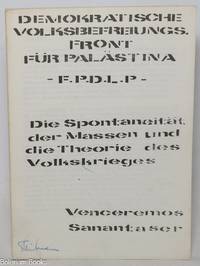
1969340606Heidelberg: SDS-Heidelberg 1969. 57p. 8x6 inches; spine is glued with bookbinding mull as if separated from wrappers yet we find no evidence of missing covers ownership signature and small pen mark on front cover otherwise in very good condition. Text in German. Pamphlet by the group led by Nayef Hawatmeh later known as the DFLP published originally in Arabic under the title Hawl al-'Affwiyya wa al-Nazariyya Bayn al-Munazzamat al-Fida'iyya al-Falastiniyya "On Spontaneity and Theory Among the Palestinian Guerrilla Organizations" Beirut 1969. Two introductory essays: one signed by M.S. intervening in German leftist debates over the nature of Zionism and colonialism in Palestine and another by Gerard Chaliand on line struggle within the PFLP. Also includes statements by the DFLP before and after their split/founding. This translation was issued by the Socialist German Students' Union along with an editorial group named "Venceremos Sanantaser" سننتصر / venceremos in Arabic. SDS-Heidelberg unknown
19561585031st Edition 2nd Printing. 1956. 1950s Chinese Nuclear Science Poster set incomplete 15 posters of 30 in colour. Each poster is numbered and depicts a detailed image for example a variety of types of nuclear weapons and defence construction with explanative notes. <br> <br>This broken set comprises poster numbers 6 8 9 10 11 12 13 14 15 21 22 23 24 25 and 26 of the 30 issued in this set. The posters in this group vary from being in reasonable secondhand condition to poor condition. Each shows signs of wear creasing closed tears and some with loss mainly on edges and corners. Most posters are torn with considerable loss at one corner and in two cases this has caused loss to the image. Many have been mended with tape on the reverse along some edges there is some marking mainly on reverse though in one case on the poster itself. On the reverse of poster 23 there is an amateur painting and some painted text. Text in Chinese. The poster sizes vary ranging approximately from approximately 55 x 77 to and 77 x 53cm. An interesting collection of posters which clearly shows that China was as deeply concerned about nuclear war during the Cold War as it's neighbours Russia and the United States across the Pacific. <br> <br>Poster no. 6 shows details of the lethality and destruction factors of the atomic explosion including shock weaves radiation and radioactive contamination. <br> <br>Poster no. 8 shows the materials to be used to build nuclear protection trenches as well as the construction methods. <br> <br>Poster no. 9 displays the images of the type of bomb shelter known "below chest-level bulletproof shelter" giving its floor plans with information on an estimated time to build and materials to use. <br> <br>Poster no. 10 shows images of the type of bomb shelter known "light bomb shelter" and a floor plan with information about its accommodation capacity 8-10 people estimated time to build 15 days and materials to use. Also it suggests every infantry platoon should install one of these shelters. <br> <br>Poster no. 11 shows images of the type of bomb shelter known "heavy bomb shelter" and a floor plan with information about an estimate time to build 35 days and materials to use. The heavy bomb shelter is used as a command office when needed. <br> <br>Poster no. 12 includes 9 images showing different nuclear protection bunkers built for various weapons and equipment such as 57 x 85cm cannon 122 x 152cm howitzer rocket artillery tank self-propelled artillery trucks and communication equipment. The poster also shows floor plans for each type of the bunkers an estimate time to build and materials to use. <br> <br>Poster no. 13 includes 8 images showing different nuclear protection field war warehouses to store materials and equipment such as ammunition mines explosives fuel barrels PT-10 and PT-25 fuel tanks and army provisions. The poster also shows floor plans with information about an estimate time to build and material to use. <br> <br>Poster no. 14 includes two images showing special squads for detecting radition levels on the upper section of the poster together with action plans below the images. A legend on the lower section shows correspondent names for the coloured routes. Detailed plans designed for searching nuclear contamination source and safe routes to take within the contamination zone. The routes are shown and numbered. Each squad consists of one squad leader. <br> <br>Poster no. 15 features an image of the special squad for detecting radiation level and very detailed information on their responsibility and action plans. An inset includes three images showing how to extract contaminated soil and a legend showing correspondent names for the coloured routes lower right section. <br> <br>Poster no. 21 includes 9 images showing different ways to remove radiative contamination on the roads and on battle field. Two blue charts in the middle section one chart showing different types of vehicles to remove contamination on the roads the other various warning signs according to radiation levels. <br> <br>Poster no. 22 shows images of different types of water supply wells cistern etc. and ways to protect the water supply from radioactive contamination. An image featured in the centre shows the layout of a water plant and how it processes contaminated water. The instruction above the image suggests that processed water shall be consumed only when no clean water is available. Four images with detailed instruction lower section show various water purifying methods distilling filtering and ion exchanging <br> <br>Poster no. 23 displays images of soldiers disinfecting radiation contaminated food with package or without and containers for food storage. <br> <br>Poster no. 24 features a Soviet Union made AN-1-A radiac set left section and two images right section of soldier measuring radiation level and soldier carrying the set. <br> <br>Poster no. 25 shows a circuit diagram of the AN-1-A radiac set with a legend showing different coloured current circuits. <br> <br>Poster no. 26 features another Soviet Union made AN-11-A radiac set. The parts of the set are highlighted upper section. Front view and back view of the set are shown lower section. A small image of the set in use upper right section. . unknown
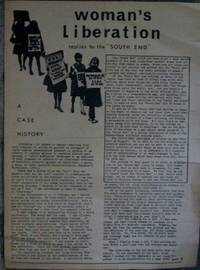
022565Detroit: Detroit Chapter of N.O.W. Publisher. Tabloid. Good. no date presumed 1968 based on dates in the paper. Tabloid newspaper format a single sheet folded into 4 pages. With a few illustrations. Perhaps a one off sort of underground press publication issued by the Detroit chapter of the National Organization of Women. According to the editorial on the front the South End a paper published at Wayne State University published an article on women and issues facing them in American society but spent most of the article discussing women's sex live and their relationships to family and embraced and perpetuated stereotypes as well. Thus the Detroit NOW published this rebuttal paper including essays and letters highlighting the vast inequality in America between men and women. NOW is a feminist organization working for women's rights and equality. It was founded in 1966. GOOD condition. Paper very brittle with many tears along the extremities. Horizontal fold crease present. Moderate toning. Some creasing and wrinkling. Detroit Chapter of N.O.W., Publisher unknown
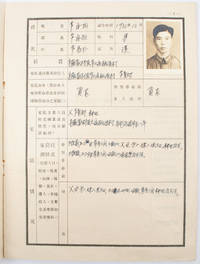
1956171561No place of publication.: 中國人民解放軍總幹部部.Zhongguo ren min jie fang jun zong gan bu bu. 1956. Scarce 1950s Curriculum Vitae or dossier of a Chinese Reserve Force Officer dated on 15th September 1956 with official stamp from the 中國人民解放軍通信第六團 "No. 6 Regiment of Communications Department People's Liberation Army". Officer's ID black and white head and shoulders portrait photograph laid down first page of the dossier 16pp original wrappers light staple stains occasional creasing mainly on corners overall very good. Text in traditional Chinese. 24.8 x 18.4cm. This dossier is for 芦再排 Lu Zaipai born in Anhui Province in 1932 his courtesy name 芦昌仁 Lu Changren. His family background were considered good as he was a peasant before joined the revolution although his maternal uncle was forced to join the Kuomintang in 1941 and was liberated in 1949. The form says Lu Zaipai was enlisted in 1951 and his experience from 1938 till 1951 was given and verified by four different referees. Lu joined the Chinese New Democracy Youth League in February 1954. Lu was a corporal in January 1956 and later promoted to <br>second lieutenant of the reserve force in September same year. . 中國人民解放軍總幹部部.[Zhongguo ren min jie fang jun zong gan unknown
19709177Budapest 1970. First edition. 28x39cm 19 leaves laid loose in red padded leather portfolio. Table of contents introduction by Simon Peter and 17 etchings each signed in pencil by the respective artist. Tissue guards present plates in very bright near fine condition contents leaf and inner portfolio with some foxing. Rubbing to edges of folder otherwise a near fine set. <br /> <br /> Translated as "A Quarter Century of Liberated Hungary" this portfolio was issued in 1970 to commemorate 25 years since the end of World War II. The images in the Socialist-Realist style depict scenes such as the Provisional National Assembly in Debrecen cleaning rubble from the streets of Budapest following the war the birth of the Forint the working class voting during the 1947 parliamentary election in Borsod County factory nationalization and others. Artists include Gyula Hincz 1904-1986 Adam Würtz 1927-1994 Pásztor Gábor 1933–2012 Raszler Károly 1925–2005 and others. <br /> <br /> A scarce complete Cold War-era Hungarian graphic art portfolio with striking images from Nationalist artists. unknown
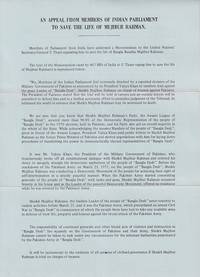
1971215937Canberra.: Information Service of India High Commission of India. 1971. Double-sided sheet neatly folded into thirds. A very good copy of this scarce publication. 30 x 21.5cm. A sympathetic appeal from members of the Indian Parliament to UN Secretary-General U Thant outlining their concerns regarding the ongoing Bangladesh Liberation War the harsh detainment of Sheikh Mujibur Rahman the risk of his execution and the genocide perpetrated by the military junta of Yahya Khan. <br> <br>A telling portent of the decisive Indian intervention in the conflict this open letter was presumably issued shortly after the 1971 Indian general election which returned Indira Gandhi to the premiership with an overwhelming majority in the Lok Sabha at the head of her reorganised Indian National Congress R. . Information Service of India, High Commission of India. unknown
1970158620北京.Beijing.: No publication details. Circa1970. Coloured poster no. 12 of the Chinese Air Defence poster set. Lightly stained along upper edge brown stain with a little minor loss tape repairs in several places along the upper edge on the reverse of the poster. Good copy. Text in Chinese. Poster measures 53.9 x 77.7cm. This poster depicts 5 anti-aircraft firing positions. They are: one person lifts and stabilises the rifle while the other person aims; position aided by fortification; position aided by tree branches; position aided by walls; and kneeling position. <br> <br>中國人民解放軍總參謀部動員部Mobilization Division of People's Liberation Army General Staff Department was first formed in 1954 and later joined with 中国人民解放军总参谋部军务部 Military Division of People's Liberation Army General Staff Department to form a joint division in 1969. In 1975 it returned to its original name. . No publication details. unknown
1970158619北京.Beijing. Circa1970. Coloured poster no.11 of the Chinese Air Defence poster set. Damp staining horizontal and vertical creases where poster has been folded closed tears several of which have been repaired with tape on reverse. Text in Chinese. Poster measures 53.8 x 77.4cm. This poster shows three methods which can be used to fire at enemy paratroopers - each with detailed instructions. A chart in the centre gives useful information regarding the shooting distance required to hit enemy paratroopers based on a multiplication of the shooter's height. <br> <br>中國人民解放軍總參謀部動員部Mobilization Division of People's Liberation Army General Staff Department was first formed in 1954 and later joined with 中国人民解放军总参谋部军务部 Military Division of People's Liberation Army General Staff Department to form a joint division in 1969. In 1975 it returned to its original name. . unknown
1970158580北京.Beijing.: No publication details. circa1970. Coloured Chinese Air Defence poster incomplete set consisting of 9 posters each poster is numbered. The set includes poster numbers 4 8 10 11 12 13 14 15 and 16. These posters are in secondhand condition. The posters show some creasing with a number of small tears particularly at margins some mending on reverse with tape. Two posters are considerably torn at margin affecting the image slightly in one case. There is some browning and staining and there is considerable annotation on the reverse of poster number 8. Text in Chinese. Sheets measure appoximately 53.9 x 77.9cm. Poster no. 4 depicts 9 images of different types of simple air defence shelters trenches caves etc. Brief descriptions of each type of shelter are provided below the images. Three images in the lower section suggest that when selecting the site for air defence shelters one should not build too close to buildings flammables and electric wire. <br> <br>Poster no. 8 includes 9 images showing the alternative shelters when air raids happen and no nearby air defence shelter available. Alteratives suggested include basements beneath a bridge the corner of a wall and under solid staircases as good alternative shelters. <br> <br>Poster no. 10 shows 3 methods to use to fire at enemy aeroplanes each with detailed instructions. The speed and size of the aeroplane and shooting angles and distance are all taken into consideration. A chart in the centre gives the calculations required to be prepared in advance to successfully shoot down an aeroplane. The calculations require taking into account the plane's size and distance. <br> <br>Poster no. 11 includes 3 images to demonstrate methods to fire at enemy paratroopers with detailed instructions. A chart in the centre gives the calculations for advance preparation taking into account the person's height and distance from the invading paratroopers. <br> <br>Poster no. 12 depicts 5 images showing various anti-aircraft firing positions. They are: a position where a single person lifts and stabilises the rifle while the other person aims; position aided by fortification; position aided by tree branches; position aided by walls; and kneeling position. <br> <br>Poster no. 13 is illustrated with 5 images showing two squads rifle shooting squad and machine gun shooting squad who are in charge of the anti-aircraft placement and three main targeted aircrafts bomber military cargo aircraft and helicopter to shoot. <br> <br>Poster no. 14 shows 10 images of self-rescue and first aid for other people after air raids with detailed instructions. Self-rescue actions featured are emergency bleeding control and fire evacuation; first aid treatment introduced are treatment for bone rapture CPR and transport the wounded. <br> <br>Poster no. 15 depicts 5 images demonstrating methods to extinguish fire bombs. Methods include: burying or covering the burning objects with sand and soil; covering the burning objects with soaking wet quilts or sack bag; throwing the burning objects into water containers with iron shovel; and using a fire extinguisher extinguishing powder or carbon nitride. <br> <br>Poster no. 16 includes 6 images showing plans and actions of rescue urgent repair and maintance of law and order with detailed instructions. It suggests: to report to the relevant government agency and evacuate nearby civilians when unexploded bombs are discovered; during air strikes lay down perimeters around shops to prevent from looting; to restore transportation by clearing roads immediately after air raids; to urgently repair damaged electric wires and water pipes; it gives the major patrol sites as the factory shops warehouses dams bridges and power station and urges the viewer to arrest suspects if necessary; to put out fire immediately and to make sure the safety of the civilians is paramount. <br> <br>中國人民解放軍總參謀部動員部Mobilization Division of People's Liberation Army General Staff Department was first formed in 1954 and later joined with 中国人民解放军总参谋部军务部 Military Division of People's Liberation Army General Staff Department to form a joint division in 1969. The Division returned to its original name in 1975. . No publication details. unknown
1970158618北京.Beijing.: No publication details. circa1970. Coloured Chinese Air Defence broken run of 5 posters. Each poster in this small collection is numbered. The collection is made up of poster numbers 10 11 12 13 and 16. <br> <br>The posters are in secondhand condition. Two are poorer condition than the others as there is loss along a margin of each although this loss does not affecting the images themselves. There is creasing and wear and tear particularly at edges and one poster is damp stained. There are some tape repairs on the reverse one Text in Chinese. Poster sheets measure appoximately 54 x 77.5 cm. Poster no. 10 shows 3 images which demonstrate the methods which could be used to fire at enemy aeroplanes. The images are accompanied by detailed instructions. The speed and size of the aeroplane and the angle from which the shot is taken and the distance from the target are all taken into consideration. A chart in the centre gives details of how to prepare in advance for shooting an enemy aircraft. The chart gives details of how to calculate the plane's length taking into account its size and distance to make sure of an accurate shot. <br> <br>Poster no. 11 shows 3 images which demonstrate methods to fire at enemy paratroopers again with detailed instructions of how to do this. A chart in the centre gives details of how to prepare in advance for shooting an enemy aircraft. The chart gives details of how to calculate the plane's length taking into account its size and distance to make sure of an accurate shot. <br> <br>Poster no. 12 depicts 5 images showing various anti-aircraft firing positions. They are: position for one person to lift and stabilise the rifle while the other person aims; position aided by fortification; position aided by tree branches; position aided by walls; and kneeling position. <br> <br>Poster no. 13 includes 5 images showing two squads rifle shooting squad and machine gun shooting squad who are in charge of the anti-aircraft placement and the three main targeted aircraft bomber military cargo aircraft and helicopter which these squads wish to shoot. <br> <br>Poster no. 16 includes 6 images showing plans and the actions required to rescue perform urgent repairs and maintain law and order. Each with detailed instructions. It suggests: to report to the relevant government agency and evacuate nearby civilians unexploded bombs are discovered; during air strikes lay down perimeters around shops to prevent from looting; to restore transportation by clearing roads immediately after air raids; to urgently repair damaged electric wires and water pipes; the major patrol sites: factories shops warehouses dams bridges and the power station and to arrest suspects if necessary; to put out fire immediately and to make sure the safety of the civilians are the most important. <br> <br>中國人民解放軍總參謀部動員部Mobilization Division of People's Liberation Army General Staff Department was first formed in 1954 and later joined with 中国人民解放军总参谋部军务部 Military Division of People's Liberation Army General Staff Department to form a joint division in 1969. The Division returned to its original name in 1975. . No publication details. unknown
196920261Accra-Tema Ghana: Ghana Publishiung Corporation 1969. First Edition. Octavo; vi; 277pp. Very Good copy in original buff printed wrappers. Ghana Publishiung Corporation unknown
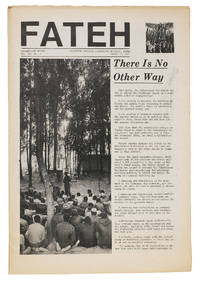
1971ABC_47952Beirut: Palestine National Liberation Movement 1971. 42 x 29 cm. Folded. Numerous black-and-white photographic illustrations. Rare and remarkable periodical published by the Palestine National Liberation Movement or Fatah. This was a revolutionary group and later a political party founded in 1957 by Yasser Arafat 1929-2004 Khalil al-Wazir 1935-1988 and 3 or 4 others. The movement published numerous periodicals and pamphlets between 1968-1972 but Fateh is the most important one. Originally published in Arabic it was also issued in English from 1969 bi-weekly in French from 1970 monthly and in Italian from 1971 bi-weekly. We have not been able to find any other English issues of this periodical for sale anywhere else.The name of the group Fatah is an acronym in reverse for "Harakat al-Tahrir al-Watani al-Filastini" the Arabic translation of "Palestine National Liberation Movement". The intention of the founders was to create an organisation that was independent of governments and political parties with the goal to liberate Palestine through low-intensity guerilla warfare. It was part of several armed fights with Israeli and Jordan forces during the 1960s and 70s. Fatah modelled itself after the revolutionary groups of Algeria Vietnam and Cuba. On page 9 of the present issue of Fateh a large photo has been printed of a group of protesters holding signs with the images of the leaders of these revolutions which is a clear message to the reader.The present issue of Fateh contains numerous articles with news from or about Palestine and the movement. It was printed a few months after Black September the bloody clash between Fatah and the Jordanian army in 1970 during which thousands of Palestines were either killed or expelled from Jordan. The first few pages of the periodical are dedicated to this event and other clashes between the two groups that resulted from it. Other articles discuss a 10-hour battle near Tel Aviv the relationship between America and Israel and injustices against Palestinians. Of particular interest are the three powerful full-page illustrations. They were designed in 1970 and issued separately as posters. The first image of a rifle with an olive branch was designed by Natheer Naba'a who is only known for his posters for Fateh. The second image called "stolen smile" shows a photo of a group of determined children and was designed by Jassem el Zubeidy who is only known for this design. The last image is an illustration of a Palestinian woman with a moving text about Palestine designed by Palestinian artist Kamal Boullata 1942-2019.The periodical is somewhat browned and inkstained and the edges are slightly frayed. Otherwise in good condition.l The English language Fateh periodical is present in ca. 30 libraries worldwide not all possess all volumes issued 1969-1971 see WorldCat 1568957 145144012 72895793 1036673977 924471377 898713265; cf. Interactive encyclopedia of the Palestine question entry: the Palestinian national liberation movement; Periodicals in review: periodicals and pamphlets published by the Palestinian commando organisations. In: Journal of Palestine studies vol. 1 1 1971 pp. 136-151. Palestine National Liberation Movement, unknown
2008169215北京.Beijing.: 星球地图出版社.Xing qiu di tu chu ban she. May2008. Two large coloured maps printed on double sided on a single sheet folded issued shortly after the devastating 2008 Wenchuan Earthquake which was occurred on 12 May 2008. Small tears along folds mended by both non-acidic tape and cello tape some creasing generally good. Text in Chinese. Sheet measures 84.9 x 119.7cm. <br> <br>Map of Sichuan Province: scale 1: 1100000 inset map lower right corner showing the provincial capital city Chengdu a statistical chart lower section listing counties within Sichuan Province their population and territory size. <br> <br>Map of Wenchuan County and Its Vicinity: 1: 300000 various colour representing altitude differences inset map showing the position Wenchuan County within Sichuan Province a mileage chart listing the distance between Wenchuan County to nearby cities. A brief introduction of Wenchuan on left section accompanying the images of the rescue forces. The Great Wenchuan Earthquake was the biggest earthquake in Chinese history with a casualty over 69000 people. . 星球地图出版社.[Xing qiu di tu chu ban she]. unknown
77190Paris Citroën 1915-1916. In two volumes. Oblong folio 31.5 x 43.7 cm. 71 original photographs 22.0 x 28.5-35.5 cm mounted on grey cardboard with printed captions 60; 11. Uniform full mottled calf. Boards with double gilt-rolled ornamental borders and gilt title. = A very rare set both volumes dealing with the Parisian factory founded by André-Gustave Citroën 1878-1935 renowned for its technologically advanced cars but also for its contributions to the French war industry during WWI and in particular the contributions women made as factory workers in the mass production of artillery shells. The first volume is entirely devoted to this subject showing the female munitions-workers at work. André Citroën played an essential part in French women's emancipation: once the women had left their traditional singular role as homemakers replacing the men who fought in the trenches there was no looking back and after the war their participation in the country's workforce became permanent. "World War I radically changed women's role in society as they stepped into the boots of men gone to fight for their countries. In cities across Europe women took on traditionally 'male' jobs - waiting on tables delivering the mail teaching in boys' schools or handling cash as bank clerks. 'Women rapidly became indispensable not only in the nursing and welfare services but in offices and factories and agriculture changing the whole balance of society in the process' says historian Michael Howard. As soon as war broke out in 1914 France's prime minister Rene Viviani called on women to 'replace in the workplace those who are on the battlefield'. . From 1915 onwards Europe's industry - devoted to the war effort - relied massively on the female workforce as did that of the United States from 1917. 'Without women victory will tarry' warned Britain's soon-to-be prime minister David Lloyd George in 1915. Some 400000 women were toiling in France's war factories by 1918 - a quarter of the workforce - handling some 2500 shells per exhausting 11-hour shifts" AFP. The second volume records the building and operational start of the factory itself. It shows the evolution of the works starting with a photo of the still-vacant lot save for gardens and sheds followed chronologically by views of all building developments including one with the famous Eiffel Tower in the distance. Groundwork started in March 1915 and by the 28 September the largely female workforce had already become fully active. The final photo shows the official ceremonial opening of the factory on 24 June 1916 revealing decorations given by General Gilinski on behalf of the Russian emperor. "As soon as war was declared in August 1914 André Citroën was mobilized as a lieutenant then as captain in the 2nd Grenoble Artillery Regiment. On the eastern front he was able to witness France's lack of artillery and ammunition to counter the German forces. Following the death of his brother Bernard on the front André Citroën was determined not only to do his duty but also to repel the enemy as far as possible. In January 1915 he proposed to General Louis Baquet director of artillery at the Ministry of War which was sorely lacking in ammunition to apply Fordism in a factory built in three months and capable of producing 5000 to 10000 artillery shells of Type 75 per day. Thanks to his savings those of his right-hand man Georges-Marie Haardt and especially financing from a rich diamond dealer of Armenian origin Atanik Eknayan who had already saved his fragile Mors 12 car business Citroën erected a huge ultramodern factory on 15 hectares of vacant land and vegetable gardens on the Quai de Javel. With some 13000 workers the factory produced 23 million shells at a rate of 10000 per day an unprecedented rate at the time. 'You have to produce quickly well and economically to put the products manufactured within the reach of the greatest possible number of consumers he said. The pace the factories imposed on workers was tiring and as a result André Citroën was sometimes considered a despot. Nevertheless he was one of the first manufacturers concerned about the well-being of his workers and avoided imposing repetitive tasks. André Citroën's ammunition business quickly gained a reputation and became a model of organization efficiency and social responsibility. Major personalities both civil and military visited the factory. Between 1917 and 1918 the government also charged Citroën with reorganizing supplies for the armaments industry the military postal services and with the distribution of bread ration tickets in the Paris region. When the war was over André Citroën decided to convert his factory on the Quai de Javel into a car manufacturing plan" taken from French Wikipedia. Boards a bit rubbed; a skilful repair to one joint one photograph with a brown spot in the top left corner; otherwise in an excellent state. hardcover
197148779Bloomington IN: Bloomington Women's Liberation Front 1971. First Edition. Five quarto issues 28cm; mimeographed sheets printed in colors and stapled at upper left corner; ca.8-12pp per issue. Light wear to extremities else very Near Fine. A nearly complete run lacking only the first one or possibly two issues of this ephemeral Indiana women's underground publication. OCLC cataloging incorrectly states that publication "began and ceased with Oct 13 1971" and noting physical holdings at 4 locations. Bloomington Women's Liberation Front unknown
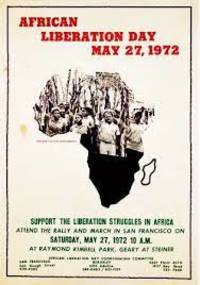
1972182121972. African Liberation Day handbill. African Liberation Day Coordinating Committee: San Francisco 1972. Measures 8.5 x 11 inches. Bold red text reads "African Liberation Day May 27 1972" with black and white photo of Freedom Fighters in Mozambique fit into the shape of the African continent. Green text below the image reads in part "Support the Liberation Struggles in Africa Attend the Rally and March in San Francisco." African Liberation Day was first recognized in 1972 after Owusu Sadaukai visited the liberated zones of Mozambique and witnessed the struggle to build a nation there. He identified international solidarity as a pressing need within the African Diaspora. In his letter urging a national day of solidarity for African Liberation Sadaukai identified the objectives as raising awareness for the conditions in Southern African educating African Americans on the shared struggle between nations and organizing a national protest again U.S foreign policy in Southern Africa. Toning to top edge of handbill. In very good condition. unknown
19882092902137702514Amagasaki Dowa Issue Enlightenment Promotion Association 1988. Soft Cover. Fine. The book is in fine condition. Amagasaki Dowa Issue Enlightenment Promotion Association paperback
1732709696.Gpaperback. Good. Access codes and supplements are not guaranteed with used items. May be an ex-library book. paperback
19722080202105600768Not Available 1972. Soft Cover. Fine. The book is in fine condition. Not Available paperback
0878670173New. paperback. New. Satisfaction Guaranteed or your money back. paperback
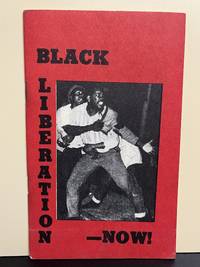
19678016Harlem New York: Black Liberation Commission Of The Progressive Labor Party 1967. Saddle Stitch unpaginated. Very Good. Rare. Light soiling around staples on front and back covers. Very light sight of wear. Rubbed bottom left front cover. Foxing and age wear to text block. Staining throughout pages. Black Liberation Commission Of The Progressive Labor Party unknown