108 résultats
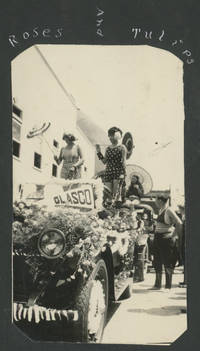
1920List1317Southern California 1920. Limp leatherette album oblong 4to measuring 10 x 7 inches with seventy photographs most measuring 4 x 2 ½ inches. Wear to binding photographs with excellent contrast very good to near fine overall. Near Fine. An energetic album of photographs belonging to one Eddie Jones a fun-loving banjo player from Santa Ana mostly composed of photographs of musicians performing at small parties and functions during the prohibition era. Jones was apparently quite active on the local scene and the album is mostly made up of candid photographs of musicians all captioned some humorously. Many of the photographs show small bands playing guitars many of them playing with slides likely due to the popularity of Hawaiian music at the time. Also included are many photographs of parades in and around Los Angeles as well as photographs of the 1925 Santa Barbara Earthquake showing damaged buildings. Two photographs feature a glass of rye others show agricultural scenes. Newspaper clippings in the back center on the Santa Ana and it’s possible that Jones - who was the common name mentioned in these clippings - was also a farmer from the Santa Ana area when he wasn’t playing music. One photograph shows San Diego a couple show a bullfight in Tijuana. Overall an evocative and well preserved piece of California Prohibition-era history. unknown
[4], 5-254, [2], 8 [ads], pages. This portion of Carr's life story begins after his experience as a submariner in WWI. He serves as an officer of the Mercantile Marine and experiences incredible adventures and hardships before deciding to move his young family from England to New Brunswick. Times are tough in his new land. He describes the local poverty and exposes the awful social problems of rural New Brunswick, as well as his dramatic adventures at work, with a local trapper and as a member of the C.P.R. police. In short, Carr was a man's man and this book is full of manly adventures. Later in life, Carr [1895-1959] became very concerned about what he viewed as plans for world government and wrote Pawns in the Game and Red Fog Over America, books which sold by the hundreds of thousand. The present work is vital in understanding the background and motivations of this fascinating man. Above-average wear to publisher's black cloth. Binding intact. Gift greetings upon front free endpaper. Spine leaning. Dust jacket not included. Not pretty but a worthy reading copy. Book
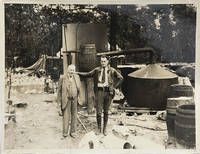
1932181780East Hartford CT & Palm Beach County FL: 1932-c.1933. A collection of photographs documenting the seizure of illegal moonshine stills in Connecticut and Florida during Prohibition and following its repeal. The photographs are from the library of Ralph A. Johnson a revenue agent for the Bureau of Prohibition and its successor the Bureau of Alcohol Tax Unit. Moonshining flourished under Prohibition and even after its repeal its cheapness - and to some its taste - ensured it continued. Across the New England countryside farms housed industrial-sized moonshine operations. The first nine images show an immense moonshine still with vats and equipment inside a Connecticut barn raided by the Bureau of Prohibition on 14 July 1932. Johnson is shown standing next to an unidentified well-dressed man perhaps the moonshiner. The remaining five images depict a large still in Florida seized by the Alcohol Tax Unit in 1933 showing large copper stills connected to barrels above cooking fires glass carboys for the product and barrels with stove-in tops. Taken by Ernest Kirbell signed in the negative a crime photographer with the Connecticut State Police Department these images document the continued profitability of moonshining after Prohibition's repeal. Recent blue leatherette album front cover lettered in silver enclosing 14 silver gelatin photographs preserved in archival sleeves 5 measuring 216 × 279 mm with photographer's signature in negative sequence numbered in blank margin at upper fore edge; 8 measuring 203 × 254 mm; 1 measuring 89 × 140 mm. Sepia toning to photographs minor creasing and edgewear at extremities. In very good condition. hardcover
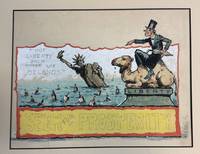
193341184n.p. 1933. 8" x 12". Original color painting on Abacco illustration board matted and framed behind glass. Vibrant colors with some pencil sketch lines showing through. Unsigned and uninitialed. Corners chipped a closed crack in lower left corner. On verso of board is the name of the type of board and available dimensions "Paints Brush and Color Corporation" with distributors listed as E.H. & A.C. Friedrichs Co. of New York The Hirshberg Company of Baltimore and Henry M. Taws of Philadelphia. Very Good. <br /> <br /> Ours is the only copy located after diligent investigation. The camel which Thomas Nast chose as the symbol of the Prohibition Party has replaced the Statue of Liberty on the pedestal. Camels don't drink very often; when they do they only drink water. <br /> This item was likely painted between 1931 and 1933. The official Beer for Prosperity Campaign was organized May 1931 in New York City. Edward H. Schulze was director of the organization and announced that he would support all political candidates in favor of legalizing beer. The slogan spread over the next year and a half. Posters for this campaign in 1932 advertised that legalizing beer would bring two trillion dollars in new revenue in four years because "millions of dollars made from bootleg Beer now finances all kinds of crimes kidnappings etc." Another campaign poster advertised purchases of "Beer for Prosperity" Stamps to "Help Elect to Congress Men Who Will Vote 'Yes.'" Beer for Prosperity Campaign. n.d. In John J. Raskob papers. Manuscripts and Archives Hagley Museum and Library #m473_20100624_005; "Beer For Prosperity Campaign Inc. Will Back Pierce's Congressional Candidacy" The Rutland Daily Herald 23 August 1932 p.7. <br /> We do not know who painted this imaginative item. E.H. & A.C. Friedrichs Company was founded in 1868 and is still in business today under the modern name of Fredrix. The Hirshberg Company originated in 1845 as Hirshberg Hollander & Company and remained in business under a few different Hirshberg names until approximately the early 1960s. Henry B. Taws opened in Philadelphia around 1897 and remained in business until at least 1931. unknown
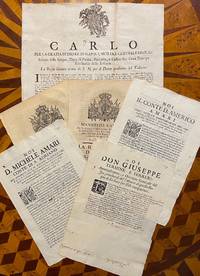
17641067Sicily Naples and Turin 1764. Very good. Together 6 items: 1 broadside 46 x 34.5 cm 5 bandi folio sheets each folded once various sizes various wear some signatures clipped others supplied in manuscript assorted manuscript annotations extracted from bindings. Small but very interesting collection of Bandi on the prohibition of tobacco all scarce none are found in OCLC / FirstSearch. As there was no centralized government in Italy the restrictions on Tobacco was a quagmire of regional taxation restriction and monopolization as is attested by the bandi in the present collection. Increasing tobacco consumption in the Italian penensula merited the establishment of fiscal laws by various States. The present items illustrate the expansion of tobacco culture and the disjointed governmental responses from Sicily Naples and Turin:<br /> <br /> 1. Broadside: Carlo . La Regia Giunta eretta da S.M. per il Dritto proibitivo del Tabacco 3 May 1758.<br /> 2. Noi il Conte d' Americo Amari . del gius proibitivo del Tabacco 23 January 1746 2 pp.<br /> 3. Noi d' Michele Amari conte de S. Adriano . del Jus prohibendi del Tabacco 23 January 1740 2 pp.<br /> 4. Noi Don Giuseppe Termine e Ferreri . del Jus prohibendi del Tabacco 30 November 1733 1 p. <br /> 5. Manifesto Camerale per la vendita. de distribuzione del Tabacco nel Luogo di Refrancore 14 May 1762 3 pp. with Tariffs. <br /> 6. 5. Manifesto Camerale che ristabilisce la vendita e distribuzione del Tabacco nel Luogo di Rochetta Belbo 13 February 1764 3 pp. with Tariffs. unknown
Abundant black and white illustrations and reproductions of photos. Features: 'Twixt Sunset and Sunrise - Mining Engineer William Bartle relates a story from Mexico where, outside the large cities "no foreigner's life is worth a farthing"; The Cannibal Islands - Part II - photo-illustrated article by Clifford Collinson who has lived in the Solomon Islands for several years and, in this instalment, visits the little-known atolls of Ong-Tong-Java, with nice photos; The Disappearance of Annie Mooney - A thirty-year-old mystery is solved in a strange and unlooked-for manner - was she kidnapped by the Chinese all those years ago?; The Most Wonderful School in the World - A remarkable "sun-cure" establishment at Aigle in the Swiss mountains where children - recently hopeless cripples - learn their lessons and romp in deep snow clad only in loin-cloths and boots! - with photos; Obyada, Bad Indian - story related by a member of the Royal North-West Mounted police about a troublesome individual near Red Deer, Alberta; The Rum-Runner - the story of a sea captain's first smuggling voyage, as told in St. Pierre, headquarters of a fleet of ships engaged in the liquor-running business; Soliman the Seer - the mysterious fortune-teller of the Pyraid of Cheops; The Children of the Wilderness (Conclusion) - Juliet Bredon's photo-illustrated travels in little known Mongolia; A Wildfowling Adventure - a nasty little adventure on the Solway Firth; Fishing for Crocodiles - using a special hook and line; On Patrol - a quaint little experience related by a flying officer of the Royal Air Force; The MIssing Links - An Indian magician discovers a thief when the police had failed; Round the World With a Lasso - former Texas Ranger Captain George Ash tours the world giving exhibitions and training troops in the use of the lasso - article with photos; The Strangest Mutiny on Record - The Schooner Pedro Varela; Six Hundred Thousand Francs - One of the most audacious jewel robberies ever perpetrated (in Paris); and more. 88 pages plus 16 pages of nostalgic ads. Clean and unmarked with light wear. A quality copy of this excellent vintage issue. Book
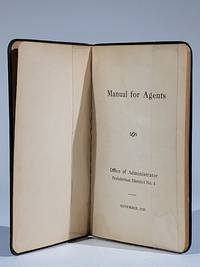
1925965Pittsburgh: Office of Administrator Prohibition District No. 4 1925. Cloth over flexible boards. Sixteenmo. ii 53 pages. Near fine. Bound in black cloth over flexible boards with no exterior titles. A few faint spots to lower board. Binding sound. A rare manual issued by Prohibition District No. 4 Pittsburgh as a pocket guide to help its Revenue and Prohibition agents build strong cases as they enforced the Volstead Act in the field. The contents are distilled ha from Treasury Department Regulations 12 and 60 and aimed at avoiding procedural mistakes during investigations sting operations and arrests. Think Eliot Ness making sure his "i"s are dotted and "t"s are crossed so the bootleggers don't walk on a technicality. Office of Administrator, Prohibition District No. 4 unknown
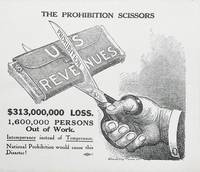
1916190622Newark New Jersey: Bowers 1916. A handbill opposing the introduction of prohibition illustrating it as greatly cutting American revenues leading to "$313000000 loss. 1600000 persons out of work" and therefore "intemperance instead of temperance" - "national prohibition would cause this disaster". Newspapers reported the design placed on billboards and arriving in the mail in early 1916. 178 x 211 mm. Very light central crease and spot at head else in fine condition. hardcover
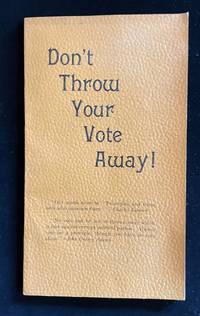
1892013064Hartford: Press of New England Home 1892. 1st Edition. Soft cover. Near Fine. Scarce 1892 campaign booklet for the Prohibition Party's Presidential candidate General John Bidwell its Vice Presidential candidate James Cranfill electors at large congressional candidates and canddiates for Connecticut Governor Ltnt Giovernor. Secretary of State and other state officers - all temperance advocates. Mustard textured paper covers titles printed in black measures approx 4.5x 7.5" 58pages with acceptance speech of Bidwell and full biographies and images from plates of all candidates. In the election of 1892 the Prohibition Party came in 4th place with about 2% of the national vote. OCLC lists no library holdings with this specific title though a search for it by title reveals that one library -Yale - sources "Collection of late 19th century minor political pamphlets" dated 1892 but we cannot confirm if this title is among them. Press of New England Home unknown
188656938Olympia W.T.: Thomas H. Cavanaugh Public Printer 1886. 8vo. 555 5 xxvii 1 xv 1 ix 1 pp. Contemporary full calf red black & gilt morocco spine labels minor uniform toning some edgewear minor bumping to corners still VG copy from the library of Bates & Burnett law firm with William Charles Bates 1885-1973 and Milton L. Burnett 1887-1972 who operated for decades in Vancouver WA from before World War I and moved their firm into the Charles Brown historic house in 1945 beginning a local trend of using older homes for professional buildings and George W. Yocum 1827-1890 longtime Portland attorney. First edition of this rare Washington Territory lawbook including the January 29 1886 Alien Land Ownership law which was the only anti-Chinese measure to pass the legislature as well as two laws related to Prohibition advocated by newly empowered women’s suffrage voters. The Alien Land laws emerged out of the anti-Chinese riots in Tacoma WA in November 1885 when labor organizations such as the Knights of Labor with the aid of the Pierce County Sheriff succeeded in forcing all of the Chinese residents out of town as well as torching their homes. Building on the 1882 Federal Chinese Exclusion Acts the Territorial Legislature specifically excluded any “Alien†who were “incapable of becoming citizens of the United States†could neither own land or convey title of properties to heirs. Unfortunately for the Chinese in Seattle this failed to placate socialist firebrands suffragettes & Knights of Labor advocates Laura Hall Peters and Mary Kenworthy or the equally charismatic Knights of Labor organizer Daniel Cronin. In February 1886 hundreds of working-class white men and women on the pretense of enforcing local health regulations condemned buildings in Seattle’s Chinatown and herded over 350 Chinese residents down to the Seattle docks and demanded they ship out. About 200 Chinese embarked for San Francisco and another had to wait six days for another ship setting off a riot and declaration by Washington Territory Governor Squire and President Grover Cleveland. The “Local Option†law passed by the Territorial Legislature in 1886 garnered huge opposition from saloon owners and cases brought resulted in the 1888 ruling against “Local Option†by the Territorial Supreme Court returning the power back to city councils and county commissioners. See: John Putnam Racism and Temperance: The Politics of Class and Gender in Late 19th-Century Seattle The Pacific Northwest Quarterly Vol. 95 No. 2 Spring 2004 pp. 70-81; Mark Lazarus III An Historical Analysis of Alien Land Law: Washington Territory & State 1853-1889 University of Puget Sound Law Review Vol. XII 1989 pp. 197-246. Thomas H. Cavanaugh, Public Printer, unknown
188239763Middletown 1882. Elephant folio broadside 15-7/8" x 22." Beneath the quoted title eight columns of printed women's names each column containing about one hundred names. Old folds shallow blank margin tear. Very Good.<br /> <br /> Beneath the lists of names is the announcement: "A COUNTY TEMPERANCE CONVENTION! Will be held in the large Dining Hall at FENWICK This Week SATURDAY Sept. 30 1882." Transportation instructions are printed.<br /> Not located on OCLC as of December 2023 or online sites of AAS Yale unknown
193037586np 1930. Set of twelve postal envelopes complete in the "Jury Report On Prohibition" series. Each envelope depicts a Juror numbered 1 through 12 in satiric fashion with printed commentary. Minor occasional dusting Fine.<br/><br/> Examples:<br/> Juror No. 1-- the foreman "A PROFESSIONAL REFORMER also active in the "anti-smoking crusade the Motorless Sabbath League Etc. Etc."<br/> Juror No. 2 - A Resort Proprietor. "I run a roadhouse and don't pay nothing to the Government."<br/> Juror No. 5 - Night Club Hostess. "Hello Suckers! We're all strong for Prohibition and HOW! Ever see so merry a party as this"<br/> Juror No. 8 - Bootlegger. "Prohibition is a Good Thing. I been in the business for twelve years and things are going along better than ever."<br/> Juror No. 9- Grape Grower. "Ever since da Prohibish I get a good a price for da grape."<br/> Juror No. 10- Machine-Gun Dealer. "Thanks to Prohibition I got a good steady job."<br/> Juror No. 12- Racketeer. "Prohibition give us our Big Chancest. unknown books
1920LIST120American 1920. Gelatin silver photograph 5 ½ x 3 ½ inches on Cyko stock photo paper. Very Good. A scarce photograph of a bootlegging operation c. early 1920s. The photograph is printed on Cyko stock which was used through the early 1920s. Few images of bootleggers have survived. The six men in the picture look quite serious in their work and it’s difficult to imagine why they allowed a picture to be taken. A very good example with good contrast well preserved. unknown
1920LIST120American 1920. Gelatin silver photograph 5 ½ x 3 ½ inches on Cyko stock photo paper. Very Good. A scarce photograph of a bootlegging operation c. early 1920s. The photograph is printed on Cyko stock which was used through the early 1920s. Few images of bootleggers have survived. The six men in the picture look quite serious in their work and it's difficult to imagine why they allowed a picture to be taken. A very good example with good contrast well preserved. unknown books
58 pages. Features: Nice color ad for General Electric radios inside front cover; Hudson Essex car ad shows mother dropping kids at school; Nice full-page ad for Mimeograph; They'll Come Shooting (short story); Power and Glory - the gutsy story of Boies Penrose, one of the most prodigious figures in American political life - article with photos; Wild Geese (short story); A Lady of Resource (short story); Naughty Girl - Lenore Ulric serves allure in generous portions - article with photos; The Meanest Beast - battle between black leopard and shark; The Road Back (part VI of short story); You Couldn't Hate Patrick (short story); Thoughts that Win - Advice by champion golfer Jerome D. Travers - article with photo; Nice full-page color ad for Seald Sweet grapefruits; Full-page ad for Canada Dry ginger ales; The Scotty Dog (short story); Fantastic centerfold two-colour ad for Colorado tourism; Louisville & Nashville (L&N) Railroad full-page ad; Full-page ad for Philco radios features photos of Gary Cooper; Nice Chrysler ad; Full-page Fleischmann's Yeast ad encourages readers to eat three cakes per day (!); Back page article on prohibition; Attractive color Ford ad inside back cover shows doctor making housecall in the evening snow; Color Ipana ad on back cover. Average wear. Unmarked. A sound vintage copy. Book
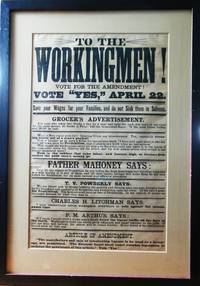
1918723Westerville OH: The American Issue Publishing Co. 1918. Very good. Vintage broadside. Image:12.75 x 20 in.; framed: 19 x 26 in. Custom dark brown wood frame matted under UV museum glass. Not examined outside of frame. Very good or better. <br /> <br /> Westerville Ohio was known as the "Dry Capital of the World" and home of the Anti-Saloon League -- the driving force behind the Prohibition movement in the United States. Some historians consider the league - founded in Oberlin Ohio in 1893 but based in Westerville from 1909 to 1973 - to be the first successful single-issue advocacy group a type of lobbying group common in the modern political landscape. This particular broadside from the prolific group admonishes men to "Save your wages for your families and do not sink them in saloons." There are quotes from Father Mahoney who testifies "Only let the claims of Prohibition be put before the Irish Americans and other Catholics in a way worthy of it and of them and all their tender feelings will make them be not only voters for Prohibition but its most earnest and effective guardians." There are further testimonies from anti-saloon advocates from the Knights of Labor and an author who wrote several books regarding the evils of drink. The American Issue Publishing Co. unknown
167211411Gotha, [ohne Drucker], 1672. 8° (18,5-22,5 cm). 4 Bll. Broschur
193064180Boston MA: Little Brown and Co. 1930. 8vo. xii 173 1 pp. Frontisp. numerous plates. Illustrated mustard-coloured publisher’s cloth wine glass illustration front cover w/ d.j. Art Deco cover art by Herold of drunken revelers minor shelfwear darkening to spine still NF/NF copy from the library of Eleanore Weinstock. First edition of this nicely illustrated and fascinating satirical examination of Prohibition Speakeasies Alcohol and the possible futures at the end of the Roaring 20’s as Americans invented a myriad of ways to keep drinking and socialize. Seldes has managed to inventively interweave a myriad of cocktail recipes into his observations along with a legion of cautionary and humorous tales. Little, Brown, and Co., hardcover
1933157897Cincinnati: Romach and Groene 1933. Vintage photograph of the first legal whiskey produced in Ohio during prohibition at the Carthage Distilling Company in Cincinnati with contemporary annotations of location dates and personnel and a "Rombach and Groene Commercial Photographers Cincinnati Ohio" stamp on the verso. <br /> <br /> A fascinating prohibition artifact depicting fifteen men and one woman standing in a warehouse before a stack of three whiskey barrels the topmost barrel prominently marked "1" less than two months before the passage of the 21st Amendment December 5 1933 repealing prohibition. On the verso in a contemporary hand is written: "First Barrel Whiskey produced in the State of Ohio since the 18th amendment became effective / manufactured and produced at the Carthage Distilling Corpn. plant Cincinnati Ohio / mashed under date Oct. 20th 1933 / drawn and entered under date Oct. 23rd 1933."<br /> <br /> Cincinnati Ohio second only to Louisville Kentucky in the production of bourbon prior to the end of prohibition was best known during prohibition as the headquarters for the "King of Bootleggers" George Remus. Cincinnati was located within a 300 mile radius of 80 percent of all of America's bonded whiskeys making it an ideal location for a massive bootlegging enterprise as well as for the headquarters to the Schenley Distillery one of only six distilleries nationwide with a license to sell medicinal spirits during prohibition. An October 26 1933 article from the Cincinnati Enquirer entitled "Big Blending Plant Planned For Reading; First Legal Whisky In Ohio Is Produced" confirms the annotations on the photograph "Simultaneously with the actual production of medicinal whisky at its plant in Carthage-said to be the first legal whisky turned out in Ohio since prohibition-it became known yesterday that the National Distillers Products Corporation New York largest distiller in the country will locate one of its major blending and bottling plants in the immediate vicinity of Cincinnati." The article continues "The Carthage Distillery on Anthony Wayne Avenue Carthage is the only distillery now operating in the state of Ohio." In 1933 the Carthage Distilling Company was acquired by the National Distillers Products Corporation and in 1987 was bought by Jim Beam.<br /> <br /> Established in 1883 Cincinnati photographers Rombach and Groene specialized in commercial and landscape photography. In 2001 the Cincinnati Museum Center acquired the Rombach and Groene Collection a collection of over 6500 glass and film negatives and a hundred prints dating from 1870 to 1970. The company closed in 1973.<br /> <br /> 10 x 8 inches. Very Good with some modest creasing four small bruises and a small repair to the surface of the image to the center right. Romach and Groene unknown
16077The first five letters from London Forest Hill and Catford; the rest from Pennsylvania with 15 from 621 Kelly Avenue Wilkinsburg Pittsburgh. Between 1 March 1926. A total of 140pp. i.e. 98pp. 12mo; 40pp. 8vo; 2pp. 4to. One letter possibly incomplete unsigned the other 24 signed 'Dundas' with postscripts sometimes signed 'Das'. The three letters before the last addressed to 'Meredith' the other 22 addressed to 'Smut'. Of the 25 letters: 7 from 1926; 4 from 1927; 10 from 1928; 4 from 1929. The first five letters to 19 November 1926 from London three from 143 Como Road Forest Hill SE23; two from 406 Stanstead Road Catford SE6; the rest from Pennsylvania with 15 from 621 Kelly Avenue Wilkinsburg Pittsburgh and one each from 411 Pitt Street Wilkinsburg; 510 Mifflin Avenue Wilkinsburg; 839 E. Hutchinson Avenue Edgewood Pittsburgh; and letterheads of the Penn Albert Hotel Greensburg and the Penn Grove Hotel Grove City. Between 1 March 1926 and 6 June 1929. An interesting correspondence emphatically materialistic and enthused with the youthful good humour and bullishness of a young Englishman who is attempting to make his way as an accountant training with Price Waterhouse in the 'Land of Opportunity'. Dundas adopts American mannerisms 'Gee boy!' and 'O.K.!' and exhibits puerile humour 'We have been having an air polluting competition in the office this evening the chap next to me has won easily but I've cheated him for having a cold I couldn't smell him' and the characteristic casual racism of the period from New York he writes 'And the Hutoo. I've never seen so many at once in my natural.'. References in the correspondence reveal that 'Dundas' is an'Old Erithian' a former students of West Street School Erith Kent and of Scottish extraction and that at the start of the correspondence he works in an office in London. The recipient with whom Dundas was at school is in England training to be an actuary. Topics include: the passage over; New York 'the chap we're staying with took us downtown in his Dodge'; Prohibition; prices clothing rent chewing gum; Dundas's extensive amorous activities including 'heavy necking' with a number of 'girls' 'Gee boy! We've got a nice little girl in this house. . She is by no means slow In the pictures & in the car - Oh! Boy!!! - xxx'; hotels; his work travelling around the area surrounding Pittsburgh as an auditor; jazz; his studying at the Pittsburgh School of Accountancy; festivities in America; his acquistion of a piano; the climate; the relative qualities of American and English men and 'girls'; sports and recreations 'I am going to join the Minnetoska Club here. It is a canoe club tennis Baseball & swimming'; the motor car and 'autoists'; an account of a trip to Sligo 'a town so small that although it is only 100 miles away most Pittsburghers have never heard of it'; his efforts as a photographer 'I have now completed an album containing all the fellows pictures . I have orders for 14 of them now & will probably have orders for 20 or so more . For once photography is paying me'; radio broadcasting 'Did you ever listen to the "Gold Spot Pals" that was the broadcast of the Gold Spot Shoe Company'; road taxes. The correspondence begins with news of a dance with some clues towards the author's identity: 'There weren't very many of our old crowd there mainly people who left before we did. Have you see sic Woollatt just lately Gee! he has grown. . Bob Horlock Bell Harry Cameron Lilian Rayner Doris Knott & one or two others were there.' With the third letter 26 April 1926 comes an announcement: 'now hold tight - Dad & I are trying to get to America we have our names down for the next Quota and expect to go about Sept or Oct but of course there is nothing settled yet and there are many slips twixt the cup and the lip.' On 11 November he reports that 'we got through our Medical Exam O.K. & that we have booked our passage on the Carmania sailing on the 27th inst'. A month later on 14 December he writes from Wilkinsburg to describe the passage over 'On Saturday night we ran into a gale. Gee boy! didn't she rock! I'll say she did. Some of the people had the wind up. One chap at the table next to us got up dressed & put his life belt on.'. By 20 November 1927 his mother and 'Peggy' sister have arrived and he has already dumped a girlfriend 'She kept me waiting for 1 ½ hours one night because she had something to do & we were going to a dance.' enrolled on a course at the Pittsburgh School of Accounting and been to '5 dances in the last 6 weeks'. At the end of 1927 12 December he reports that he is 'still with Price Waterhouse accountants & working hard'. On 16 January 1928 he writes that 'Prohibition here is a big farce & in my opinion is doing more harm than good. It is very much like the "under 16" smoking in the old country. You know how many kids will start smoking at 10 & 12 just to feel big. Well here the high school & college people drink just because they are told they mustn't. Anyone who wants it can get as much as they want - and what stuff gee its poison. I smelled some stuff that was supposed to be whiskey if that was whiskey I'm dutch it smelled more like methylated spirits to me. Of course the good stuff can be bought but one would have to pay $5.00 & up a pint. . I saw one fellow being carried out of the movies on new years night he had been drinking bad liquor & he was all drawn up into a terrible shape.' On 15 April 1928 he reports that he is 'still with P. W. & Co. The boss hasn't officially confirmed that I am permanent but all the seniors seem to think I am. Added to that there are only six out of 35 temporary men left.' On 2 December 1928: 'I too am anxiously waiting the R100. Boy I hope she knocks the Grafs time into a cocked hat. I'd just love the opportunity to say "there see thats what the old country can do!"' On 24 February 1929 he can report that 'Things have broken pretty good for me in the office this year. I am now a ranking senior - that is for the busy season. Right after I came back from Huntington I received my first "In Charge" assignment. It was a large Department store & Mail Order House with 8000000 Capitalization. This entailed 2 stores in New York & 3 in Pittsburgh. . one heck of a lot of hard work for me for the three fellows they gave me were green I even had to teach them how to make a check mark'. The same letter carries a reference to 'Marion Robertshaw' who is 'now with the B.B.C.' On 3 March 1929 he reports that 'Dad is in the experimental Dept of the Hudson Motor works in Detroit and doing very well.' and asks: 'Who are you for in the General Election. Ramsay McDonald has all my wishes with Lloyd George running him a close second. I understand Ll. G. has a new idea for wiping out unemployment. I think if those two men could work together they could put England back in her place. I don't know whether you have realized it but England is certainly slipping badly and something drastic will have to be done for her to regain her place in the worlds affairs. Of course I am relying on American statistics for my assertion.' By the time of the last letter 6 June 1929 he is living a bachelor existence at 839 E. Hutchison Avenue Edgewood 'very comfortably situated in my room & liking it not so bad. At times it gets a little lonesome . life has just been one exam after another . By the way since Dad went to Detroit hes been getting on fine. He got into the experimental dept of Hudson Motor Co on some kind of special exhibition work they were doing & got them to adopt some ideas of his for saving them time & money & he has been made foreman. I was glad to see Ramsay McDonald went into power. Its tough luck he didn't get a working majority. All the papers here are watching the Labor Party closely to see what happens. Here's wishing them all the best. I think the best thing that could happen in England would be for the Liberal Party to be abandoned & join with the Labor.' The first five letters from London (Forest Hill and Catford); the rest from Pennsylvania, with 15 from 621 Kelly Avenue, Wilkins hardcover
188930728New York: The National Temperance Society and Publication House 1889. Original printed wrappers some edge and spine chipping rear wrapper detached but present and original staples. 36pp. Clean text. Except as noted Very Good.<br /> <br /> In 1881 Kansas enacted a constitutional amendment prohibiting the manufacture or sale of alcoholic beverages. Doing so was a misdemeanor punishable by fine or imprisonment. The amendment effectively rendered Peter Mugler who operated a brewery unemployed. He brought suit claiming that Kansas had unconstitutionally deprived him of his property in violation of the Fourteenth Amendment to the U.S. Constitution. Writing for the Court Justice Harlan-- who would issue a powerful dissent several years later in the notorious case of Plessy vs. Ferguson-- held that the amendment was a permissible exercise of the State's police powers which have always been reserved to the States as an attribute of their sovereignty. <br /> The rear wrapper advertises works sponsored by the National Temperance Society.<br /> OCLC locates eleven copies under two accession numbers as of November 2013. The National Temperance Society and Publication House unknown
188930728New York: The National Temperance Society and Publication House 1889. Original printed wrappers some edge and spine chipping rear wrapper detached but present and original staples. 36pp. Clean text. Except as noted Very Good.<br/><br/> In 1881 Kansas enacted a constitutional amendment prohibiting the manufacture or sale of alcoholic beverages. Doing so was a misdemeanor punishable by fine or imprisonment. The amendment effectively rendered Peter Mugler who operated a brewery unemployed. He brought suit claiming that Kansas had unconstitutionally deprived him of his property in violation of the Fourteenth Amendment to the U.S. Constitution. Writing for the Court Justice Harlan-- who would issue a powerful dissent several years later in the notorious case of Plessy vs. Ferguson-- held that the amendment was a permissible exercise of the State's police powers which have always been reserved to the States as an attribute of their sovereignty. <br/> The rear wrapper advertises works sponsored by the National Temperance Society.<br/>OCLC locates eleven copies under two accession numbers as of November 2013. The National Temperance Society and Publication House unknown books
Features: Sanity, Prohibition, and the federal deficit; A gasser blows in - heroic measures necessary to combat flames in oil fields; Where diamonds earn their keep - interesting life of a diamond in an industrial plant - whence it comes, how it is used, and how it ends; Editorials - radium waters - Philippine Independence - Frightfulness in warfare; A Nerve center of communication - how your radio or cable message is speeded through; Eclipses and the Sund's atmosphere - solution of an outstanding solar problem; Flying as fast as sound - considerations of what the future may hold for aviation - some physiological and mechanical aspects of the question; An early Christian cemetary - the Libyan desert gives up further secrets of antiquity; Viscount Grey and Lord Haldane - conclusion of a study of two famous World War personalities; Power from pipe lines to wires - natural gas used as fuel in steam electric plant; Watching the creation of the stars - more concerning the evolution of the galaxies; Unusual fishes - they build nests, walk on land, live in dried mud, and breathe air; Forty-noners starved in the midst of plenty - survey of plants and animals in Death Valley shows that pioneers could have survived the trials of the desert; Modern alchemy - photographing the birth of an atom; What next in elevator technology?; Inter-glacial man in England - human remains and artifacts tell an interesting story of pre-glacial migrations to and from England. Unmarked. Average wear. Book
218 pages. Index. Footnotes. "The first systematic examination of government control of liquor in Canada. As the first province in English Canada to choose government control, British Columbia stood out as a North American experiment in the post-prohibition world of alcohol regulation. Analyzes liquor control from a variety of viewpoints: attitudes and access to alcohol; federal-provincial relations; cartels and patronage; and social reform. Reveals much about he intricacies of the state in economic life, particularly the apparent contradiction between promotion and regulation." - Preface. Former library copy with usual markings and front free endpaper removed. Dust jacket not included. Above-average wear to navy blue boards. Binding intact. A worthy reference copy of this 1991 first printing. Book
20149462650438T.M.C. Asser Press 2014. New/New. <p><strong>Author:</strong> Organisation for the Prohibition of Chemical Weapons</p><p><strong>Publisher:</strong> T.M.C. Asser Press</p><p><strong>ISBN:</strong> 9789462650435</p><p><strong>Release Date:</strong> 2014</p><p><strong>Languages:</strong> English</p><p><strong>Binding:</strong> Hardcover</p><p><strong>Number Of Pages:</strong> 805</p> T.M.C. Asser Press hardcover