179 résultats
19381687391938. MUSSOLINI Benito. Le Giornate del Duce a Genova: 14-15-16 maggio XVI. 108 pp. illustrated throughout with photomontage and reproduced full page etchings by Ettore Mazzini. Folio 440 x 335 mm. bound in original embossed boards. Genova: Partito nazionale fascista 1938. A spectacular piece of fascist book design in the form of a twentieth century fête book in this case celebrating a visit to Genoa by Mussolini. The binding depicts St. George slaying the Dragon St. George being considered an important Saint by the Genoese. The endpapers offer a tremendous contrast being dramatically modernist. In addition to photographs of Mussolini arriving parading and generally taking center stage there are interesting photographs of the various celebrations and the latest triumphs of fascist architecture. Some rubbing and staining to the fragile boards and insignificant foxing to the margins of a few plates. A rare book with OCLC listing only The National Gallery and The University of Genoa. Grillo Il Libro Fotografico Italiano 1931-1941. pp. 180-181. hardcover
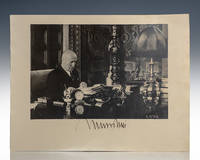
148638Rare original photograph of Benito Mussolini. Vintage matte-finish oversized photograph of Benito Mussolini seated at his desk taken by the Luce photography studio. Boldly signed by Mussolini in fountain pen in the lower margin. In near fine condition. The piece measures 15.75 inches by 11.75 inches. Benito Mussolini 1883–1945 was the founder of Italian Fascism and served as the Prime Minister of Italy from 1922 until 1943. Initially a socialist Mussolini broke with the left and established a nationalist authoritarian regime that emphasized militarism anti-communism and centralized control. His leadership marked the beginning of a totalitarian state in Italy where individual liberties were suppressed and propaganda was used to maintain power. Mussolini sought to restore Italy’s former imperial glory leading to aggressive expansionist policies and eventual alliance with Nazi Germany during World War II. His regime ultimately collapsed in 1943 and he was executed by Italian partisans in 1945. unknown
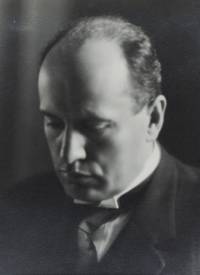
192739394Rome: NP 1927. Original document. Softcover. vg. Folio 13 x 9". Original b/w photographic portrait of Italian dictator Benito Mussolini. The photograph is tipped onto thick cardstock which is inscribed to the then French Minister of Justice Louis Barthou: "A S. S. Louis Barthou con cordiale deferente simpatia. Roma maggio 1927 - V" Mussolini signed To his Excellency Louis Barthou with friendly and respectful sympathy Rome May 1927 - Vth year of the fascist era. The actual photograph is an early official portrait of Benito Mussolini who following the March on Rome in October 1922 became Italy's youngest Prime Minister. The portrait measures 8 1/2 x 6 1/4" and depicts Mussolini dressed in civilian clothes with his head down thus affecting an air of authoritarian severity. <br /> <br /> There is a cruel irony behind this exceptional document. Indeed a few years later February 9 1934 Louis Barthou became the French Secretary of State and as such was assigned to welcome King Alexander I of Yugoslavia during his state visit to Marseille on October 9 of the same year. Within minutes of the King's arrival both His Majesty and Barthou were assassinated by Velicko Kerin a Bulgarian revolutionary with a handgun. One of the bullets struck Barthou in the arm passing though and fatally severing an artery. He died of excessive blood loss less than an hour later. The assassination was planned in Rome by Ante Pavelić head of the Croatian Ustaše a fascist movement that Mussolini had funded for years. Cardstock slightly age-toned and partly creased at upper and lower right corners. Inscription in Italian. Cardstock in overall good photograph in fine condition. NP unknown
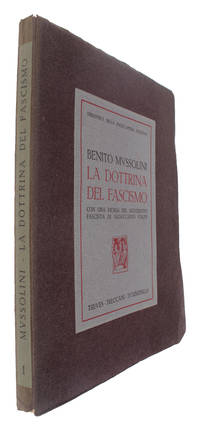
193256938Milano Treves 1932. 4to. Original printed wrappers. Uncut and unopened. With a brindstamped publisher's mark to title-page. A very nice copy with slight marginal wear. 8 133 3 pp. <br/><br/><em>The scarce first edition in book form fourth thousand i.e. with mention of "quinto migliaio" on title-page of the key political document of fascist philosophical thought - the publication in which the ideological cornerstones of The National Fascist Party Partito Nazionale Fascista PNF are officially established. "The Doctrine of Fascism" the first part of which was actually written by Giovanni Gentile who is not mentioned as the author was originally published in the Italian Encyclopedia Vol. 14 1932 as the first section of a lengthy entry on "Fascismo" Fascism. Gioacchino Volpe's "History on the Fascist Movement" was also published in that volume as an appendix to Mussolini's entry and immediately after the Encyclopaedia-publication the two pieces were published together in the first book form of the work under the title "La Dottrina del Fascismo. Con una Storia del Movimento Fascista di Giocchino Volpe" by the "Biblioteca della Enciclopedia Italiana" which undertook the separate publishing of the most important entries of the Encyclopaedia. Mussolini added a series of notes that appered for the first time in the first publication in book-form. The present copy bears the imprint "Quinto migliaio" at the foot of the title-page. We have been unable to determine whether this actually means that the issues of the first edition were in fact divided into thousands and this thus the fourth thousand or whether as would have been common practice with eg. propagandist literature the "fourth thousand" was a way to boost the public perception of the immediate reception of the work. No matter whther the "Quinto migliaio" was a boosting gimmick or not the work ended up being published in enormous numbers after its initial publication in 1932. Not only did it appear in several newspapers already in 1932 it was also published again in book form already in 1933 and kept appearing in different versions with other additions on the subject throughout the following decades. It was also translated into numerous other languages and came to have a tremendous impact on the spreading of fascist thought. This magnum opus of Italian fascism came to have the greatest impact upon Italian politics and the entire political climate of Europe. A key concept of the work is summed up in Mussolini's own words: "Granted that the 19th century was the century of socialism liberalism democracy this does not mean that the 20th century must also be the century of socialism liberalism democracy. Political doctrines pass; nations remain. We are free to believe that this is the century of authority a century tending to the 'right' a Fascist century. If the 19th century was the century of the individual liberalism implies individualism we are free to believe that this is the 'collective' century and therefore the century of the State." </em> unknown