123 856 résultats
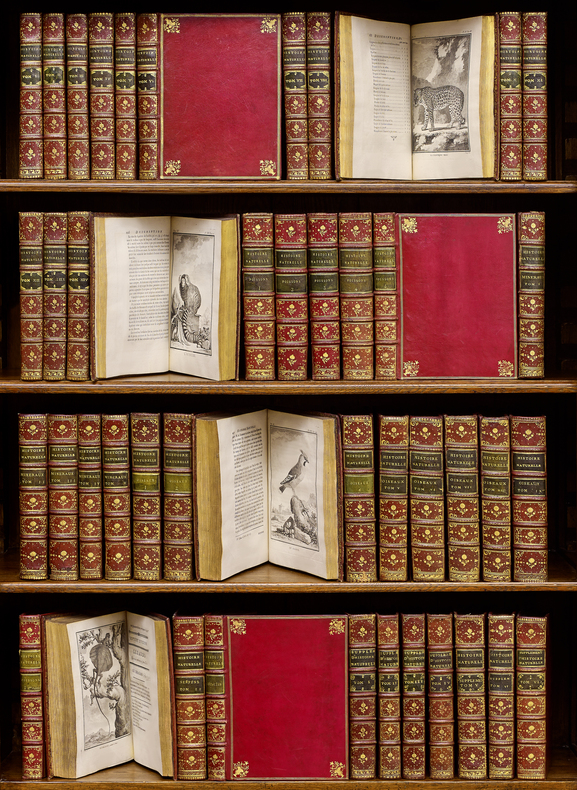
YTB-104Paris, Imprimerie royale, 1749-1804. 45 volumes in-4. Maroquin rouge, triple filet, fleuron au vase fleuri répété dans les angles, dos orné de filets et fleurons, pièces de titre et tomaison vertes, tranches dorées. Les décors varient au fur et à mesure de l’édition de l’œuvre sur cinquante années, avec des minimes différences. Reliure en maroquin de l’époque. 256 x 198 mm. EDITION ORIGINALE DU PLUS CELEBRE OUVRAGE FRANÇAIS ILLUSTRE DE SCIENCES NATURELLES DU SIECLE DES LUMIERES ornée d’un portrait de Buffon, 3 tableaux dépliants, 4 cartes dépliantes et 1 255 planches gravées d’après les dessins de Jacques de Sève. Bien complet de la Table de l'ordre des chiens (vol. V). « Les amateurs recherchent cette première édition in-4 des œuvres de Buffon, à cause de la beauté des gravures qu'elle contient ; mais il est très difficile de se procurer des exemplaires dont tous les volumes soient également pourvus de bonnes épreuves et cela parce que l'ouvrage ayant été publié dans l'espace de 50 ans, beaucoup de personnes ont négligé de retirer les volumes à mesure qu'ils paraissaient... » (Brunet). L'ouvrage comprend 4 parties dues à Buffon avec la collaboration notamment de Louis J. M. Daubenton et de Ph. Guéneau de Montbeillard, et 3 parties de complément publiées par Lacépède après la mort du naturaliste. Etendue pratiquement sans interruption sur près de 50 années, à raison d’un volume par an, la collection se compose des ensembles suivants : 1. Histoire naturelle générale et particulière, 1749-1767 ; 15 volumes. 2. Histoire naturelle. Supplément, 1774-1789 ; 3 volumes. 3. Histoire naturelle des Oiseaux, 1770-1783 ; 9 volumes. 4. Histoire naturelle des Minéraux, 1783-1788 ; 5 volumes. 5. Ovipares et serpents par Lacépède, 1788-1789 ; 2 volumes. 6. Histoire naturelle des Poissons, par Lacépède, 1798-1804 ; 6 volumes. 7. Cétacés. L’an XII Une des œuvres les plus ambitieuses et les plus complètes de la littérature scientifique, ce premier survol général, sous forme accessible, de l’Histoire naturelle, donnait à celle-ci ses lettres de noblesse. Le succès de l'entreprise fut immédiat, éclatant et durable ; la première édition, tirée à 1 000 exemplaires, fut épuisée en 6 semaines. “In 1739 Buffon was appointed Director of the Jardin du Roi. It would appear that the “Natural History” germinated in the preparation of a catalogue of the royal collection. Buffon then enlarged its scope to Aristotelian or Plinian proportions and finally transformed it into a conspectus of nature of a breadth and depth previously unknown. The Natural History was a great popular success” (PMM). Commencée par Buffon et terminée avec la collaboration de Daubenton et Lacépède, cette somme fait de ces naturalistes des Lumières des précurseurs dans des domaines de pointe comme le transformisme, la biogéographie, l'écologie, l’anatomie comparée, l’éthologie et la paléontologie. EXCEPTIONNEL EXEMPLAIRE COMPLET DES 45 VOLUMES RELIES EN MAROQUIN ROUGE DE L’EPOQUE.
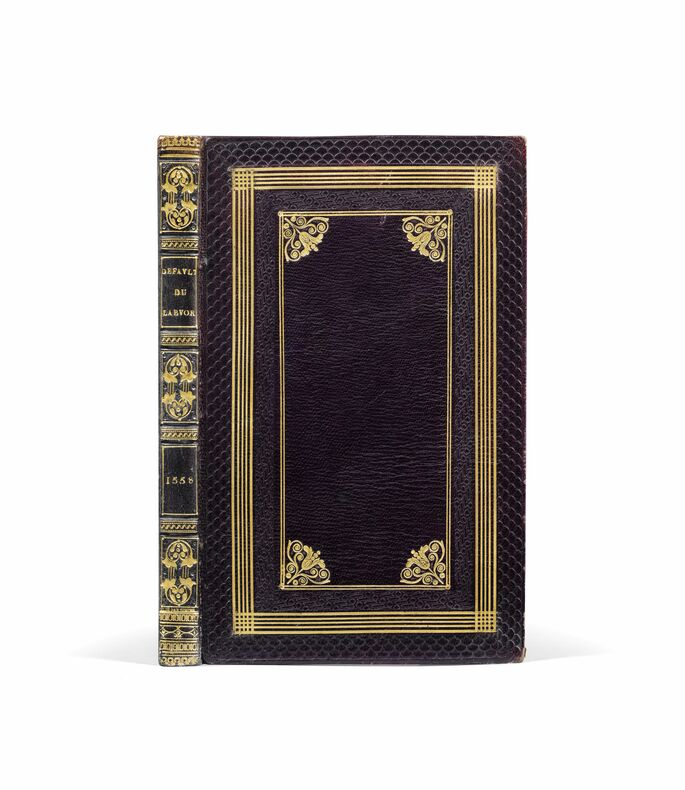
YTB-102Paris, Cavellat, 1558. Petit in-8 de (20) et 80 ff. Maroquin bleu, plats entièrement ornés de filets dorés et motifs à froid, dos à faux nerfs richement orné, coupes décorées, roulette intérieure dorée, tranches dorées. Reliure de Simier, relieur du Roi. 170 x 105 mm. “The exceedingly rare first edition of Belon’s last work”. Pritzel, 609. « Ces remonstrances dans le domaine agricole offrent un grand nombre d’observations utiles » (Michaud). « La traduction latine par Clusius (de l’Ecluse) a été imprimée à Anvers, chez Chr. Plantin,1589, in-8. On trouve au verso de la table des sommaires le portrait de Belon, gravé sur bois » (Brunet, I, 761). Le présent ouvrage qui traite de l’agriculture fut traduit en latin pat de Lécluse sous le titre de Neglecta stirpium Cultura, etc , Anvers, Plantin, 1589, in-8, et Belon le réunit aux Observations, dont il publia aussi une édition latine à Anvers, 1605., in fol, accompagné du portrait de l’auteur. Ces Remontrances offrent un grand nombre d’observations utiles. Il y provoque l’établissement d’une pépinière d’arbres étrangers dont il donne la liste ; il engage le collège des médecins de Paris à cultiver dans un lieu public, « tant pour leur délectation que pour l’augmentation du savoir des doctes » diverses espèces de plantes ; idée adoptée ensuite par Richer de Belleval, qui fonda à Montpellier, le jardin des Plantes, antérieur à celui de la capitale. Le plan de Belon, en partie réalisé par l’évêque du Mans, René du Bellay, dans ses jardins de Tourvoye, fut recommandé à Henri II par le cardinal de Lorraine, mais le mauvais état des finances ne permit pas son exécution. Edition partagée par Guillaume Cavellat et Gilles Corrozet : l'exemplaire est conforme à celui de la BNF, avec, aux lignes 7 et 8 du titre : « La manière d'affranchir & apprivoiser les arbres sauvages". On trouve au verso du huitième feuillet liminaire un portrait gravé sur bois représentant Pierre Belon à l'âge de 36 ans. Ce portrait ornait déjà les Observations de plusieurs singularitez publiées en 1554 par les mêmes Cavellat et Corrozet ; d'après Albert Ohl Des Marais, il est l'œuvre du graveur lorrain Claude Wœiriot (cf. Renouard). SUPERBE EXEMPLAIRE D’UNE EDITION ORIGINALE DEVENUE INTROUVABLE, REVETU D’UNE EBLOUISSANTE RELIURE DE SIMIER, RELIEUR DU ROI.
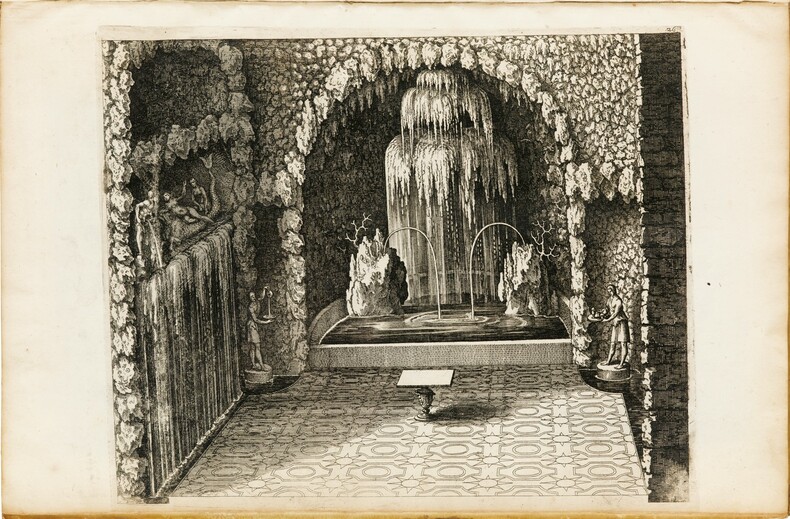
YTB-80Frakfurt, Theodor de Bry, 1620 In-folio de 1 titre frontispice, 1 feuillet de dédicace en français “A sa majesté de Boheme, électeur palatin, duc de Bavière” daté du 20 décembre 1619 ; 4 pages « Au lecteur » de commentaires en français, 30 planches gravées de vues de jardins, fontaines, paysages dont l’immense et magnifique planche dépliante illustrant le château et les jardins d’Heidelberg (dimensions de la planche dépliée : 1 025 mm x 683 mm). Vélin ivoire, dos lisse. Reliure de l’époque en vélin. 390 x 250 mm. EDITION ORIGINALE D’UNE LEGENDAIRE RARETE PRESENTANT LES JARDINS PAYSAGES ET ARCHITECTURES PAR SALOMON DE CAUS POUR L’ELECTEUR PALATIN FREDERICK V. Brunet I, 1691 ; Hunt 204 ; Guilmard, p. 395, n°22 ; Destailleur, 1895, p. 146, n°554 ; non cité par Ganay. « The extraordinary large folding panoramic view of Heidelberg was engraved by Matthias Merian after the painting by Jacob Focquier, while the other plates illustrate the fountains set in verdant grottos, as well as sculpted fountain pools, parterres and various garden ornaments and architecture. » Salomon de Caus est né en 1576 à Dieppe, en Normandie. En 1605 l’archiduc Albert le nomme « ingéniaire à la fontaine artificielle et en toutes autres choses que luy seront commandées ». Dans les années 1608-1609, de Caus est à Londres pour enseigner le dessin au prince Henry ; mais il travaille aussi pour la Cour et la noblesse en tant qu’architecte de jardins. En 1614, par l’entremise de la princesse Élisabeth Stuart, qui avait épousé le Prince électeur Palatin, il répond à l’appel de Heidelberg. Il quitte la ville pour Paris en 1620, à cause de la guerre, pour se mettre au service de Louis XIII, qui l’emploie comme ingénieur et architecte du Roi. Il meurt à Paris en 1626. L’Hortus Palatinus est un recueil de gravures publié en 1620 à Francfort par l’imprimeur et graveur Jean Théodore de Bry dans une double édition originale allemande et française, avec des pages de titre identiques. C’est l’une des plus précoces publications de ce genre. Dans sa structure générale – une dédicace, un court texte de présentation et trente gravures – l’ouvrage fait référence aux Plus excellents bastiments de France de Jacques Androuet du Cerceau (1576 et 1579). Mais à la différence du Français, Salomon de Caus consacre tout son Hortus Palatinus à une seule réalisation, le jardin que Frédéric V, prince électeur palatin élu l’année précédente roi de Bohême, avait fait réaliser pour son château de Heidelberg. Dans ce cas, le jardin devient l’élément le plus représentatif de la résidence, les bâtiments, relativement aux critères de l’uniformisation formelle de la typologie palatiale, s’avérant moins importants. Les gravures sont de Mathieu Mérian, gendre J. T. de Bry, ce qui n’est cependant attesté que par la signature de la « Scenographia » (« Iacob Focqier pinxit, Matthae Merian fecit »). Mérian a suivi la vue du jardin d’Heidelberg peinte par le Flamand Jacques Foucquiers (76 x 103 cm, collection privée), reprise dans un plus grand format (1620, 179 x 263 cm, Heidelberg, Kurpfälzisches Museum). L’Hortus Palatinus peut être considéré comme le chef d’œuvre de Salomon de Caus. En comparaison du jardin de Heidelberg, les travaux qu’il a réalisés à Bruxelles, en Angleterre ou en France (à propos desquels on ne sait pour ainsi dire rien) passent au second plan. Or l’histoire de l’influence de ce jardin détruit dès le XVIIe siècle repose principalement sur le traité, premier recueil d’estampes monographiques consacré à l’aménagement d’un jardin. "This slim volume of plates, published in 1620, is one of the most moving monuments to the fragility of gardens, however great. Caus had designed and supervised the creation of the renaissance marvel, built on an intractable site beside the castle, high above the town and the river Neckar. The text of his book is an au lecteur of only three [sic: four] pages, in which he speaks of the 'delay to the work' which has occurred," precipitated by the wars of Bohemia. His work was never finished, and what had been built was soon abandoned, but its aspirations were unquestionable: "It had delights within and without--Alberti could not complain about the view--and the intricacy and variety respond to the magnitude of its scale. In the eighteenth century, the debased successors to the formal gardens at Versailles will be grand, but empty. At Heidelberg, every section is 'curious', with the excitement in detailed work which inspires the sculpture of fountains in the palazzo Borghese in Rome, or the knots in the garden at Gaillon" (Christopher Thacker, The History of Gardens, 1979, p. 134). SUPERBE EXEMPLAIRE DE L’EDITION ORIGINALE CONSERVE DANS SON VELIN DE L’EPOQUE. DE TOUTE RARETE : NUC ne cite que quatre exemplaires ; aucun exemplaire répertorié sur le marché public au cours du siècle écoulé.
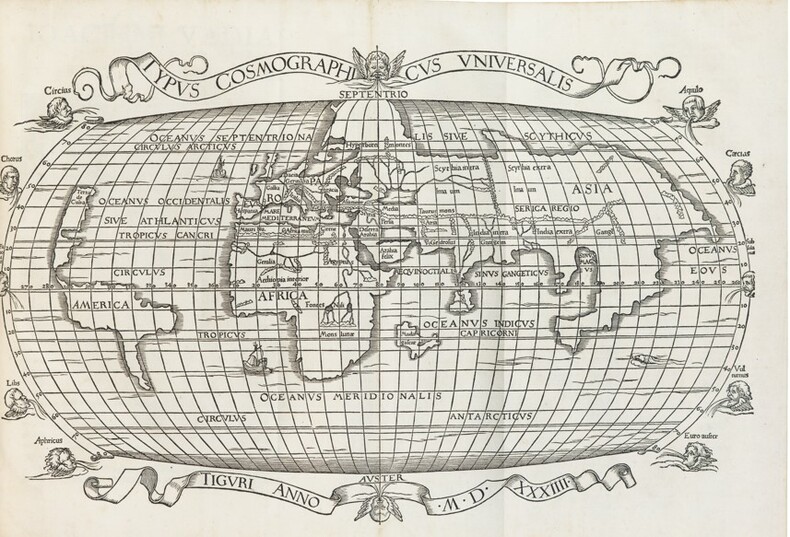
YTB-69Zurich, Christoph Froschauer, 1534. In-folio de 6 ff., 273 pp., 1 p. et 14 ff. ; une carte dépliante. Demi-peau de truie sur ais de bois. Reliure du siècle dernier. 272 x 180 mm. FIRST EDITION of Vadianus’s influential description of the world, with the very important map of the world depicting America for almost the first time, showing the complete outline of South America and according to Sabin « lacking in most of the copies located ». Alden & Landis 534/31; Harrisse, BAV 189 ; JCB I, p, 460 ; Karrow 58/47.1 ; Sabin 98279 (erroneously dated 1533) ; Shirley 70 ; VD 16, V20. The map is a reduced size copy of the world map attributed to Sebastian Munster published in Grynaeus's Novis orbis regionum ac insularum veteribus incognitarum (Basel, 1532) itself primarily based on Waldseemüller's map of 1507.Vadianus describes all the continents, seas and islands, regions, mountains and towns of the world, with separate chapters on Europe, Africa, Asia, Palestine and even Paradise, offering a geographical reading of biblical history, The description of America can be found on pp. 263-273, In the same year an octavo edition was published (without the map), later followed by several other editions. Very good copy. Joachim Vadian (1484-1551), de son nom de naissance von Watt, fut un universitaire humaniste et réformiste de Saint-Gall qui, après une carrière dans la médecine à l'étranger, revient dans sa ville d'origine et participa activement à la vie politique de celle-ci en se faisant élire au sein du Petit Conseil puis en assurant le rôle de Bourgmestre. Il défendit les idées de la Réforme et produisit des travaux sur l'histoire qui firent autorité en son temps. Ex-libris manuscrit ancien de Joann Hueber et ceux de Harrison D. Horblit et celui de B. Mendel qui furent chacun d'importants bibliophiles et collectionneurs américains d'ouvrages scientifiques portant notamment sur les grandes navigations et la découverte de l'Amérique. TRES BEL EXEMPLAIRE COMPLET DE LA MAPPEMONDE tirée Typus cosmographique universalis proposant une projection ovale du monde avec la mention « America » notée pour l’actuelle Amérique du sud tandis que le nord y est nommé « terras de cuba ».
20212081502111902788national library 2021. Soft Cover. Fine. The book is in fine condition. national library paperback
20212081502111904661National Library Publishing Company 2021. Soft Cover. Fine. The book is in fine condition. National Library Publishing Company paperback
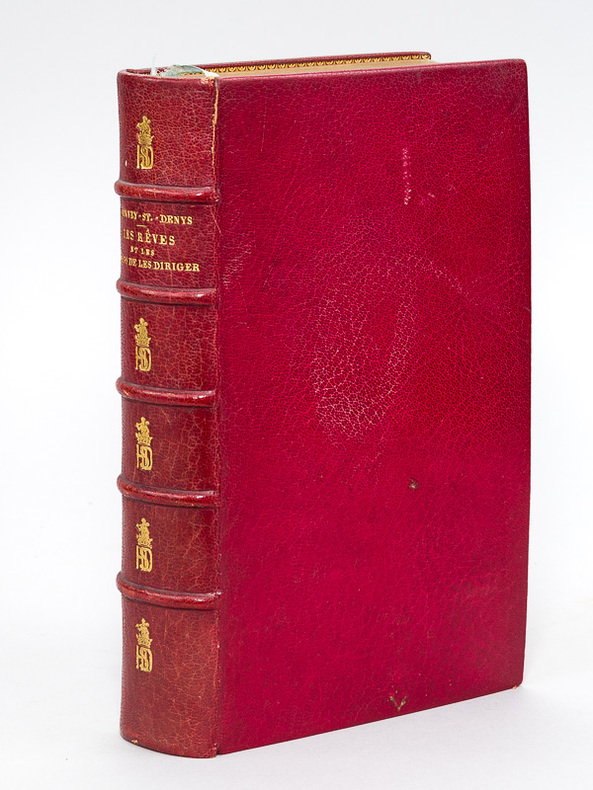
1867582711 vol. fort in-8 reliure plein maroquin rouge, dos à 5 nerfs orné (au chiffre HSD surmonté d'une couronne de marquis et d'un hercule), toutes tranches dorées, chasses et coupes ornées, couvertures conservées, reliure signée de Trautz-Bauzonnet, Amyot, Paris, 1867, 2 ff., 496 pp. avec frontispice lithographié en couleurs, et 9 dessins originaux ou tirages d'essais du frontispice ou des couvertures
1 vol. fort in-8 reliure plein maroquin rouge, dos à 5 nerfs orné (au chiffre HSD surmonté d'une couronne de marquis et d'un hercule), toutes tranches dorées, chasses et coupes ornées, couvertures conservées, reliure signée de Trautz-Bauzonnet, Amyot, Paris, 1867, 2 ff., 496 pp. avec frontispice lithographié en couleurs, et 9 dessins originaux ou tirages d'essais du frontispice ou des couvertures Exemplaire unique de cet ouvrage très rare, dont Freud fut incapable de se proposer le moindre exemplaire, malgré tous ses efforts, comme il l'indique en note dans l'Interprétation des Rêves ! Un des 10 exemplaires sur grand papier ("sur papier espagnol" comme l'indique une note manuscrite de l'auteur dans un autre exemplaire), celui-ci manifestement celui de l'auteur (avec son chiffre couronné "HSD" répété en dos), contenant en sus : les deux couvertures (absentes du seul autre exemplaire répertorié du tirage sur grand papier), le croquis original de la couverture par Henri Alfred Darjou, un tirage de la couverture avant mise en couleur, un dessin original à la plume (étude pour le frontispice, dont un dessin non retenu), un tirage d'ébauche du frontispice, un tirage en noir du frontispice, trois tirages d'essais de mise en couleurs du frontispice, un tirage d'épreuve avant la lettre du second plat. Le sinologue Léon d'Hervey de Saint-Denys avait recueilli les rêves de 1946 de ses nuits, lesquels servirent de matière à cette étonnante étude, pionnière dans l'analyse des rêves d'un point de vue "moderne". L'ouvrage se conclut sur un appendice intitulé : "Un rêve après avoir pris du hatchich" (sic). Havelock Ellis ou André Breton évoquent la rareté de l'ouvrage (l'éditeur Amyot fit faillite peu de temps après sa publication). Bon état (petites fentes en mors en tête, signet usé presque coupé, petits frott. et petits accroc à un plat, très bel exemplaire par ailleurs). Unique copy of this scarce work, of which Freud was unable to offer himself the slightest copy, despite all his efforts, as he indicates in a note in his "Interpretation of Dreams" ! One of the 10 copies on large paper ("on Spanish paper" as indicated by a handwritten note from the author in another copy), this one obviously that of the author (with his number crowned "HSD" repeated on the back ), containing in addition: the two covers (absent from the only other listed copy of the print on large paper), an original sketch of the cover by Henri Alfred Darjou, a print of the cover before coloring, an original pen drawing (study for the frontispiece, including one drawing not retained), a drawing of a sketch of the frontispiece, a black print of the frontispiece, three prints of color trials of the frontispiece, a proof print before the letter of the second cover. The sinologist Léon d'Hervey de Saint-Denys had collected the dreams of 1946 from his nights, which served as material for this astonishing study, a pioneer in the analysis of dreams from a "modern" point of view. The work ends with an appendix entitled: "A dream after having taken hatchich" (sic). Havelock Ellis or André Breton evoke the rarity of the work (the publisher Amyot went bankrupt shortly after its publication). In a note in his "Traumdeutung", Freud evokes this work which he did not manage to obtain despite his efforts. : "[ ... ] ich mir trotz aller Bemühung nicht verschaffen konnte" ("d'Hervey, whose book I could not lay hands on in spite of all my efforts"). Français
181889274In der Realschulbuchhandlung | Berlin 1818 | 54 x 42 cm | En feuilles sous une boîte
1618163261618, Francofurti apud Lucamiennis, in-8 plein vélin jaune, texte en latin. Inventaire des gravures : gravure sur la page de titre de l'Opus chymicum, 1 gravure «Les 12 clefs de Basile Valentin » sur page de titre du Basilica Chymica, 1 gravure (femmes assises sur des lions) sur page de titre du Basilica Philosophica, figures noir et blanc sur les pages 71, 72, 74 et 77. 1/ Basilica medica : Physiologiam, Pathologiam, Therapeuticam, 2/ Basilica chymica : anatomiam auri, argenti & mercurii, Jovis, Martis ac Veneris, tractat de gemmis, examinat mineralia, vegetabilia resoluit, animalia explicat, 3/ Basilica philosophica : horum prior [...] | Etat : Assez bon état général pour un ouvrage de cette époque, vélin noirci, dos désolidarisé, rousseurs, quelques écritures à la plume dans les marges, partie 3 : pages 59 à 88 vermoulues en un point précis (empêchant la lecture de quelques mots sur les pages), pages foncées au début des 2ème et 3ème parties (ne nuisant pas à la lecture), quelques pages réparées. (Ref.: g430)
The archive contains a plethora of material. Original Artwork in different formats, namely a collection of 14 original sketchbooks with numerous original colored drawings, approx. 540 original pencil drawings, 16 original water colored pencil drawings, 24 original watercolors, 15 original ink drawings, 32 original pencil ink drawings, 18 original watercolors, 79 original etchings, partly in aquatint, 30 manuscript pages of notes, 4 original oil studies and 3 photographs. Sheet dimensions from approx. 4 x 8 inches to approx. 22 x 26 inches. The archive includes manuscript cost calculations and numerous, partly large-scale construction drawings for the restoration work at the town hall Bülach. With his keen sense and appreciation of history, the Swiss architect Rordorf was an attentive observer of Swiss culture. As a result of the restoration work based on his designs at the town hall Bülach (around 1905) and in the Castle Greifensee (historic room conversions 1917) he drew the attention of the Swiss public to his work. Also, architectural and floor plan drawings, beautiful views (between 1876-1933) of Switzerland, including Bremgarten, Dübendorf, Effretikon, Lugano, Freiburg, New Bechburg, Thierstein, Bern-Thun, Mariastein, Aarberg, Castle Burgdorf, Kyburg, Locarno, Arbon, Brugg, Zurich, Erlach, as well as Italy, France and Germany. Documents include announcement and invitations and manuscripts of the Société "On the Wall" in Zürich, manuscript letters, poems, purchase contracts and dividing documents between David and Paul Rordorf, etc., as well as a district plan of the city of Zurich. Rordorf-Mahler was a member of the Zurich Artist Society, the Swiss Association of Engineers and Architects, the Société "On the Wall" in Zurich, and at times its President. All in all, an impressive archive of original drawings and at the same time, an important primary source material for the history of architecture in Switzerland. Manuscript
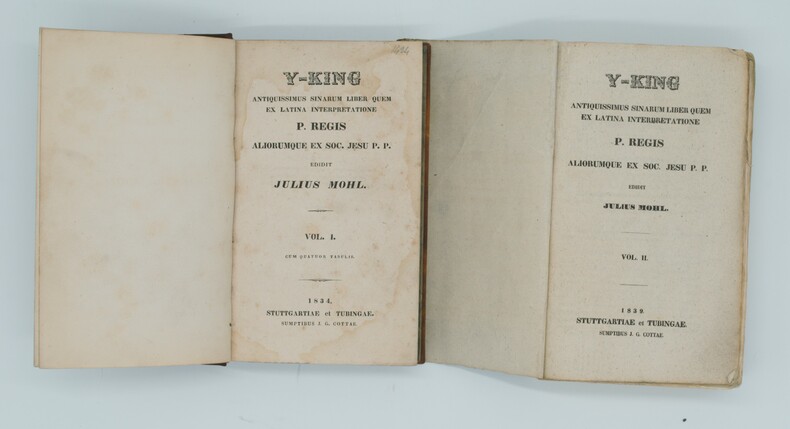
1834PHO-1520Stuttgart & Tubingue, Cotta, 1834-1839. 2 volumes in-8 de [1] f., xvi-474-[1] pp., 4 planches dépliantes ; [1] f., 588 pp. Premier tome relié en demi-basane brune, dos lisse, titre doré, date en queue (reliure moderne) et second tome broché, couverture d’attente, inscriptions manuscrites sur la couverture ("à Monsieur M. Barucchi - Directeur du Musée égyptien, professeur d'histoire à l'Université de Turin), dos usé avec qqs fentes. Les deux volumes réunis dans un emboîtage toilé bleu moderne. Très légères mouillures claires par endroits.
1822B6522Paris: Imprimerie de C.L.F. Panckoucke. 1822. . A very good copy with marginal minor light spotting. Publisher's blind stamps to corners of plates. Edition: Second Edition. Binding: contemporary half red calf over orange calf title in gilt on upper board and spine spine with 6 raised bands spine compartments with gilt ruling and blind decorative central devices. Notes: The second edition contained in total 11 plate volumes in large folio and 24 volumes of text in octavo.<br>The Description de L'Egypte was a series of publications appearing first in 1809 and continuing until the final volume appeared in 1829 which aimed to comprehensively catalog all known aspects of ancient and modern Egypt as well as its natural history. It is the collaborative work of about 160 civilian scholars and scientists known popularly as the savants who accompanied Bonaparte's expedition to Egypt in 1798 to 1801 as part of the French Revolutionary Wars as well as about 2000 artists and technicians including 400 engravers who would later compile it into a full work.<br> Size: Large Folio 670 x 515 mm Illustration: Illustrated with some superb folding large plates of panoramas and maps.<br>Volume 3 illustrated with 43 single full-page plates 20 double page plates 6 large folding plates of maps plans views and more.<br>Volume 4 illustrated with 58 single full-page plates 2 double page plates 4 large folding plates of maps plans views and more lacking 8 plates never bound.<br>Volume four missing plates 3 6 7 10 13 14 29 42 not bound originally.<br> Volume: Volume 3-4 out of 11 pl Category: Book Plate Books General; Book Africa Egypt; Imprimerie de C.L.F. Panckoucke. hardcover
191083637Zurich 21 juin 1910 | 9 x 14 cm | une carte postale
193788282s.d. (1937-1938) | 20.50 x 26.50 cm | 1 p. manuscrite, 1 p. titre tapuscrite, 19 ff. tapuscrits, 1 ff. bl., 6 pl. + 15 ff. tapuscrits, 1 pl.
In-folio grande (49x30), (6cc), XLI tavole a colori, 77pp, paginazione imperfetta (come in altri esemplari di questa tiratura), legatura coeva in mezza pelle con angoli, dorso restaurato a otto comparti con titolo in oro su tassello di marocchino. Edizione originale, prima tiratura, di uno dei più bei libri di entomologia mai pubblicati. Bellissima l’antiporta in bianco e nero (che mostra l’Autore con i suoi strumenti da entomologo su di uno sfondo boscoso) e 41 tavole a colori di superba qualità, raffiguranti farfalle, falene e i diversi stadi delle loro metamorfosi, assieme a piante e fiori di cui si nutrono. Il tutto con accuratezza scientifica e al contempo con la volontà di mostrare la bellezza di questo microcosmo. Ogni tavola è protetta dalle veline originali (alcune con strappetti o piccole mancanze). Questo esemplare presenta la tavola II con i margini inferiori e superiori più corti (ma quello di sotto è intonso); la pagina di fronte B2 ha il margine inferiore più corto e quello esterno appena rifilato; in mezzo sta la velina originale e la coloritura della tavola è assolutamente della stessa qualità delle altre. Essendo questo un esemplare in carta grande è quasi certo che, per qualche motivo contingente, nella bottega stessa del tipografo-editore siano stati inseriti due fogli in carta normale. Nonostante ciò, si tratta di una superba copia assolutamente genuina. Ogni tavola misura mediamente alla battuta del rame 30x23. La coloritura è splendida. Moses Harris (1730-1788) fu uno dei maggiori entomologi del suo tempo. Disegnò le sue farfalle da vivo prestando una particolare cura alla qualità dell’incisione e alla bellezza dei colori. Nissen, 190. In-folio large (49x30), (6cc), XLI colored plates, 77pp, imperfect paging (as in copies of the same issue), contemporary half calf binding with corners, eight-sections restored spine with gilt title on Moroccan label. Original edition, first issue of one of the most beautiful entomology books ever published. Beautiful black and white frontispiece (showing the author with his tools in a forest background) and 41 color plates of superb quality, depicting butterflies, moths, and the different stages of their metamorphosis, together with plants and flowers they feed on. All with scientific accuracy and at the same time with the desire to show the beauty of this microcosm. Each plate is protected by the original tissues (some with tears or small lacks). This copy presents plate II with shorter upper and lower margins (but the one below is uncut); the opposite page B2 has a shorter lower margin and the external one slightly trimmed; in the middle there is the original tissue, and the coloring of the table is absolutely of the same quality as the others. Since this is a large paper copy, it is almost certain that, for some reason, two sheets of normal paper have been inserted in the printer-publisher's shop. Despite this, it is a superb and genuine copy. Each plate measures 30x23. The coloring is splendid. Moses Harris (1730-1788) was one of the leading entomologists of his time. He drew butterflies live, paying particular attention to the quality of the engraving and the beauty of the colors. Nissen, 190.
New York, Ormsby, 1852. Folio. Original illustrated, richly gilt boards with a large gilt centre resembling a guilloche-gravure. Blindstamped corner-ornamentations and gilt lettering to boards as well. Old owner's inscription of ""Nissen & Parker/ 43 Mark Lane"" to front free end-paper and with a gift-inscription from H N Nissen, dated 1867, to first blank. VIII, 102 pp. + 13 engraved plates (including frontispiece, which is ""PLATE 5"") - complete. The 13 finely engraved plates demonstrate different technologies and depict bank notes, vignettes, and various design elements.
69536, Guangxi Normal University Press, 2012 Cloth binding with blue silkscreen printed lettering, 572 pages, 30 x 24 cm, English and Chinese. *Good condition, lightly bleached from sunlight, no dustjacket. With origami fold-out. ISBN 9787549572083.
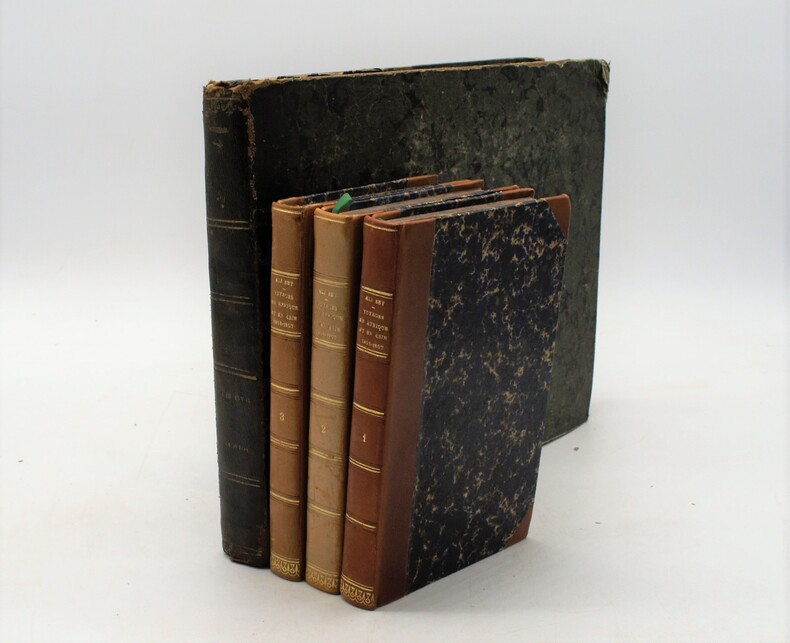
1814PHO-1225Paris , imprimerie Didot l’ainé , 1814 , 4 volumes composé de 3 tome de texte et un Atlas. TEXTE , 3 vol. in-8 (210x135) , relié demi maroquin et coins ,dos lisse avec auteur , titre et tomaison ,tranches marbrées, portrait de l’auteur en frontispice ,xix-395pp-1f (errata), 2ff-464pp-1f (errata),2ff-410pp-1f (errata) , dos et gardes refaits , cachets répétés , premiers feuillets brunis , quelques rousseurs , dos insolés. ATLAS , in-4 (330 x 260) Relié demi basane époque Portrait frontispice XIV-pp-texte 90 planches, dont 14 dépliantes ou sur double page, 5 grandes cartes d après les dessins de l auteur , les cartes Chypre, Maroc, Afrique du Nord, Cote d Arabie, El Cassaba ou le château de Tanger, Temple. Mission d Ali Bey à Tripoli. quelques rousseurs ,Pas de déchirures, coins usés, salissures , les gravures sont de Adam d’après les dessins de l’auteur. Très rare avec le texte
1779148241779-1781, imprimerie royale, in-4 plein cuir de XVI+707 et 844 pages, gardes marbrées, dos à 5 nerfs, titrages dorés, 13 planches dépliantes en fin de chaque ouvrage. | Etat : Bon état général, dos, champs et mors usés, rousseurs, manque de la 14ème planche du 2nd volume, complet de ses 2 volumes. (Ref.: MA87)
155841789Lyon, Macé Bonhomme, 1558. 2 parties en 1 vol. in-4 de (20)-240 et 135 pp. (erreur pour 134 pp.), maroquin rouge, dos orné à nerfs, triple filet doré sur les plats, dentelle intérieure, tranches dorées (reliure du XVIIIe siècle).
- s.n., Paris 1788, in-8 (12,5x20cm), xij ; 344 pp.; (4 p.), relié. - Essai sur le Phlogistique, et sur la constitution des Acides [Essay on Phlogiston] n. p. | Paris 1788 | 8vo (12.5 x 20 cm) | xij ; 344 pp.; (4 p.) | contemporary half sheep First edition and sole publication of the French translation and critical analysis under the direction of Madame Lavoisier of this text published in English the previous year under the title An Essay on Phlogiston and the Constitution of Acids. The work is made up of twelve sections, all followed by critical notes by Louis-Bernard Guyton de Morveau, Pierre Simon de Laplace & Gaspard Monge & Claude Louis Berthollet & Antoine François de Fourcroy. Contemporary half light brown sheep over marbled paper boards, smooth leather spine decorated with gilt fillets and fleurons, morocco leather title piece. Very skillfully restored joints. Interior in very good condition except for two marks left by bookmarks on pages 68-69 and 176-177. Rare autograph inscription by Marie-Anne Paulze Lavoisier to Joseph Louis de Lagrange, prominent mathematician and loyal friend to Antoine Lavoisier. Valuable record of the leading role played by Marie-Anne Paulze Lavoisier in the "chemical revolution" at the dawn of the French Revolution. Phlogiston theory emerged at the end of the 17th century - conceived by Johann Becker and developed by Georg Ernst Stahl - postulating the existence of a "flame element" inherent in combustible bodies and released during combustion. This hypothesis was completely refuted by Lavoisier, who revealed the role of oxygen in the combustion process, thus inventing the theory of oxidation. Irritated by Lavoisier's skepticism with regard to phlogiston theory, the eminent Irish chemist Richard Kirwan published this text titled Essay on Phlogiston. "[...] The French chemists who rallied around Lavoisier decided to respond by translating An Essay on Phlogiston into French." (Keiko Kawashima, "Madame Lavoisier et la traduction française de l'Essay on phlogiston de Kirwan" in Revue d'histoire des sciences, 2000). This text, far from being a simple translation of Kirwan's work, adopted the form of a manifesto in itself in which the greatest chemists of the day contested phlogiston theory, dissecting its advocates' arguments one by one. The huge success of the French translation led Kirwan to attempt to refute the objections of Lavoisier and his collaborators. In 1789, he published a second edition of his work, translating the French notes written by its detractors into English and adding his own refutations. He finally converted to the ideas of the anti-phlogisticians, the founders of modern organic chemistry. Marie-Anne Pierrette Paulze - Mme Lavoisier - played a key role in the career of her husband, who taught her chemistry at her request; she then became his assistant, recording the experiments he carried out and their results. She very quickly took on a role that went beyond that of the devoted wife, becoming a translator but also a writer: many of the notes in the Essai sur le phlogistique were written by her. At the height of her involvement, it was she - in her capacity as a skilled illustrator - who drew all the plates in Traité élémentaire de chimie (1789), appending her signature "Paulze Lavoisier Sculpsit" on this occasion. This specimen includes a rare autograph inscription "by the translator" - Mme Lavoisier - to Joseph Louis de Lagrange (1736-1813), one of her husband's closest friends. It was Lavoisier who aroused the interest of Lagrange in the new science of chemistry. Together they participated in the development of a metric system that standardized weights and measures, which came to light during the Revolution. Working for the revolutionary government, Lagrange had more opportunities than his chemist friend, who was executed as a victim of the Terror. When he learned that Lavoisier had been killed at the guillotine, the mathematician declared: "It took them onl
28174Paris, 1699-1760 [1720-1766]. 62 volumes in-4°, veau fauve marbré, dos à nerfs ornés de fleurons dorés, pièces de titre en maroquin rouge, roulette dorée sur les coupes, tranches jaspées de rouge. Reliure de l'époque, qq. épidermures et petits manques de cuir sur les plats, qq. défauts au niveau de la tomaison aux dos. Plaisant exemplaire en reliure uniforme. On joint 6 volumes de tables couvrant les années 1699-1760. Nombreuses figures gravées sur bois dans le texte et 1178 planches hors-texte gravées en taille-douce dont 459 repliées. Il manque 3 planches (aux volumes de 1723 et 1741).
17680033511768 Paris, Saillant et Desaint, 1768. Deux volumes petit in-folio (260 X 329 mm) veau fauve marbré, dos cinq nerfs, caissons dorés ornés, dentelles dorées en queue, pièce de titre maroquin grenat, coupes et coiffes filetées, tranches rouges (Placé). Tome I: (1) f. blanc, (2) ff. de faux-titre et titre, titre-frontispice, XXIX pages de préface et table, (1) page et (1) f. d'extrait des registres et privilège, 337 pages, 62 planches hors-texte; Tome II: (1) f. blanc, (2) ff. de faux-titre et titre, 280 pages, 118 planches hors-texte. Étiquette de l'imprimeur-libraire et relieur «Placé», installé «Rue du Change, N°13, à Tours, Près Saint-Martin».
Edition française par Pierre Boven, revue par l'auteur, 2 fort vol. grand in-8 reliure demi-basane noire, Librairie Payot et Cie, Lausanne, Paris, 1917 et 1919, LXII-784 pp. et 1 f. (table du volume 2 rapportée) ; XII pp., pp. 785-1762 Remarquable exemplaire dédicacé par Vilfredo Pareto à son jeune disciple français Georges-Henri Bousquet : "A M. G. H. Bousquet Témoignage d'amitié et de haute considération". Il s'agit de l'édition originale de la traduction française du Traité, publié en italien en 1916. Successeur de Léon Walras dans la chaire de Lausanne, le sociologue et économiste Vilfredo Pareto (1848-1923) reste l'un des plus fameux intellectuels de son temps. Son traité de sociologie marque une date dans la discipline, notamment dans l'étude des actions non-logiques et dans l'appréciations de ce qu'il dénomme les "résidus" : "les résidus sont des manifestations de sentiments. Les dérivations comprennent des raisonnements logiques, des sophismes, des manifestations de sentiments employées pour dériver; elles sont une manifestation du besoin de raisonner qu’éprouve l’homme. Si ce besoin n’était satisfait que par les raisonnements logico-expérimentaux, il n’y aurait pas de dérivations et à leur place, on aurait des théories logico-expérimentales. Mais le besoin de raisonnement de l’homme trouve à se satisfaire de beaucoup d’autres manières : par des raisonnements pseudo-expérimentaux par des paroles qui excitent les sentiments, par des discours vains et inconsistants; ainsi naissent les dérivations. Elles font défaut aux deux extrêmes : d’une part pour les actions instinctives, d’autre part, pour les sciences rigoureusement logico-expérimentales. On les rencontre dans les cas intermédiaires" (Traité, paragraphe 1401). L'ouvrage, en état très satisfaisant (très manipulé par G.-H. Bousquet mais bien solide, avec une fente partielle à un mors en tête et frott. en coiffe sup.) est enrichi des très nombreuses annotations du dédicataire, G.-H. Bousquet. Le professeur Georges-Henri Bousquet (1900-1978), docteur en droit en 1923 avec une thèse sur "L'évolution sociale en Hollande 1914-1922", devint un spécialiste de questions économiques, proche de Pareto et Schumpeter. Il fut également un islamisant de l'école de Goldziher et Snouck-Hugronje, professeur aux facultés d'Alger puis de Bordeaux. Il fut proche de son maître en sociologie Vilfredo Pareto, dont il servit fortement la pensée, en l'éditant et en le vulgarisant. G.-H. Bousquet entretint une correspondance avec Pareto et le visita notamment une huitaine de jours dans sa villa de Céligny (Suisse), vers Pâques 1923. Outre Pareto, G.-.H. Bousquet connut personnellement d'aussi grands noms de la pensée économique que Joseph Schumpeter (professeur à Harvard où, grâce à la fondation Rockfeller, G.-H. Bousquet fit un séjour de recherche dans les années 1933-1934.), Irving Fisher ou Albert Aupetit, le disciple de Léon Walras. Le nom du Professeur Bousquet est cité plusieurs fois par Schumpeter dans sa monumentale Histoire de l’Analyse Economique. Français