12 340 résultats
20212081502111902788national library 2021. Soft Cover. Fine. The book is in fine condition. national library paperback
20212081502111904661National Library Publishing Company 2021. Soft Cover. Fine. The book is in fine condition. National Library Publishing Company paperback
1822B6522Paris: Imprimerie de C.L.F. Panckoucke. 1822. . A very good copy with marginal minor light spotting. Publisher's blind stamps to corners of plates. Edition: Second Edition. Binding: contemporary half red calf over orange calf title in gilt on upper board and spine spine with 6 raised bands spine compartments with gilt ruling and blind decorative central devices. Notes: The second edition contained in total 11 plate volumes in large folio and 24 volumes of text in octavo.<br>The Description de L'Egypte was a series of publications appearing first in 1809 and continuing until the final volume appeared in 1829 which aimed to comprehensively catalog all known aspects of ancient and modern Egypt as well as its natural history. It is the collaborative work of about 160 civilian scholars and scientists known popularly as the savants who accompanied Bonaparte's expedition to Egypt in 1798 to 1801 as part of the French Revolutionary Wars as well as about 2000 artists and technicians including 400 engravers who would later compile it into a full work.<br> Size: Large Folio 670 x 515 mm Illustration: Illustrated with some superb folding large plates of panoramas and maps.<br>Volume 3 illustrated with 43 single full-page plates 20 double page plates 6 large folding plates of maps plans views and more.<br>Volume 4 illustrated with 58 single full-page plates 2 double page plates 4 large folding plates of maps plans views and more lacking 8 plates never bound.<br>Volume four missing plates 3 6 7 10 13 14 29 42 not bound originally.<br> Volume: Volume 3-4 out of 11 pl Category: Book Plate Books General; Book Africa Egypt; Imprimerie de C.L.F. Panckoucke. hardcover
177156289Neuchatel L'Imprimerie de la Société Typographique 1771-83. 4to. Bound in 19 contemp. uniform full mottled calf. Raised bands. Gilt spines. Title-and tomelabels with gilt lettering. Spine-ends on nearly all volumes strenghtened. Stamp on title-pages. Each volume around 650 pp. With 508 fine engraved plates. <br/><br/><em>Second edition and the first 4to-edition was published in 19 volumes plus an additional volume by Jean Elie Bertrand where vol. 20 is an additional volume published much later 1799 - not present here - dealing with the art of printing. This importent collection of books on crafts was published by between 1761 and 1788. The full series comprises 113 parts cahiers in 27 folio volumes along with three supplements and "provide detailed accounts of a wide range of handcraft and manufacturing processes carried out in France at that time. The volumes are well-illustrated with precise engravings by Jean Elie Bertrand 1737-1779 a noted typographer from Neuchâtel where the printing was done. Many of them provide the background for shorter articles in Diderot's Encyclopedia which was appearing at much the same time. The project had its origin in request from Colbert in 1675 to the Academy Royal des Sciences for detailed accounts of various mechanic arts to be prepared and for new machines to be reported upon. This led to the formation of the Bignon Commission under Abbé Bignon. René-Antoine Ferchault de Réaumur 1683-1757 became editor soon after he joined the Academy. He inherited number of drawings the earliest prepared in 1693 and an illustrated manuscript on printing type and book binding which had been prepared in 1704. It was left to Réaumur's successor Duhamel du Monceau to bring about the publication of the series probably as the result of the competition from the Encyclopedia." Wikipedia.Brunet II618 ff. - Graesse II 367. </em> hardcover
16934565Paris: L'Imprimerie Royale 1693. First edition. <p>First edition a fine copy in its Royal presentation binding of this remarkable union of major texts on mathematics and physics by the leading scientists of seventeenth-century France. Especially important are nine treatises by Roberval comprising the principal corpus of his published works. They include his independent discovery of the geometry of indivisibles his foundation work on kinematic geometry and his treatise on the composition of movements. </p>. Hardcover. A ROYAL PRESENTATION BINDING. <p>First edition of this superb collection of thirty-one treatises by the leading scientists of seventeenth-century France almost all of which are published here for the first time. This is one of the earliest important publications of the Académie des Sciences and one of the most magnificent and the present copy was probably intended for presentation: it is bound in contemporary calf with the arms of Louis XIV on each cover. Founded on 22 December 1666 one of the principal functions of the Académie was to facilitate publication of the works of its members. Frenicle and Roberval were founding members as was Huygens and without the assistance of the Académie it is likely that many of their works would have remained unpublished only two works by Frenicle and two by Roberval were published in their lifetimes. After the death of Frenicle and Roberval in 1675 their books and manuscripts were entrusted to the astronomer Jean Picard; eight treatises by Huygens were also sent to Picard for publication in this collection. After Picard's death in 1682 publication of the works was brought to fruition by Philippe de la Hire. La Hire also included in the Divers ouvrages five treatises by Picard himself including an unusual 37-page work on dioptrics one by Mariotte and two each by Auzout and Rømer. The most important work in the volume is probably Roberval's Traité des indivisibles composed around the same time as Cavalieri's Geometria indivisibilibus 1635 but independent of it and published here for the first time. The treatises by Frenicle a close correspondent of Fermat treat topics in number theory and related fields. See below for a full list of contents.</p> <br /> <p>Gilles Personne de Roberval 1602-75 arrived in Paris in 1628 and put himself in contact with the Mersenne circle. "Mersenne especially always held Roberval in the highest esteem. In 1632 Roberval became professor of philosophy at the Collège de Maître Gervais. On 24 June 1634 he was proclaimed the winner in the triennial competition for the Ramus chair a position that he kept for the rest of his life at the Collège Royal in Paris where at the end of 1655 he also succeeded to Gassendi's chair of mathematics. In 1666 Roberval was one of the charter members of the Académie des Sciences in Paris . He himself published only two works: Traité de méchanique 1636 and Aristarchi Samii de mundi systemate 1644. A rather full collection of his treatises and letters was published in the Divers ouvrages de mathématique et de physique par messieurs de I'Académie royale des sciences 1693 but since few of his other writings were published in the following period Roberval was for long eclipsed by Fermat Pascal and above all by Descartes his irreconcilable adversary.</p> <br /> <p>"Roberval was one of the leading proponents of the geometry of infinitesimals which he claimed to have taken directly from Archimedes without having known the work of Cavalieri. Moreover in supposing that the constituent elements of a figure possess the same dimensions as the figure itself Roberval came closer to the integral calculus than did Cavalieri although Roberval's reasoning in this matter was not free from imprecision. The numerous results that he obtained in this area are collected in the Divers ouvrages under the title of Traité des indivisibles. One of the first important findings was in modern terms the definite integration of the rational power which he most probably completed around 1636 although by what manner we are not certain. The other important result was the integration of the sine . the most famous of his works in this domain concerns the cycloid. Roberval introduced the "compagne" "partner" of the original cycloidal curve and appears to have succeeded before the end of 1636 in the quadrature of the latter and in the cubature of the solid that it generates in turning around its base .</p> <br /> <p>"On account of his method of the "composition of Movements" Roberval may be called the founder of kinematic geometry. This procedure had three applications-the fundamental and most famous being the construction of tangents. "By means of the specific properties of the curved line" he stated "examine the various movements made by the point which describes it at the location where you wish to draw the tangent: from all these movements compose a single one; draw the line of direction of the composed movement and you will have the tangent of the curved line." Roberval conceived this remarkably intuitive method during his earliest research on the cycloid before 1636. At first he kept the invention secret but he finally taught it between 1639 and 1644; his disciple François du Verdus recorded his lessons in Observations sur la composition des mouvemens et sur le moyen de trouver les touchantes des lignes courbes . In the second place he also applied this procedure to comparison of the lengths of curves a subject almost untouched since antiquity . The third application consisted in determining extrema .</p> <br /> <p>"Roberval composed a treatise on algebra De recognitione aequationum and another on analytic geometry De geometrica planarum et cubicarum aequationum resolutione. Before 1632 he had studied the "logistica speciosa" of Viète; but the first treatise which probably preceded Descartes's Géométrie contains only the rudiments of the theory of equations. On the other hand in 1636 he had already resorted to algebra in search of a tangent. By revealing the details of such works he would have assured himself a more prominent place in the history of analytic geometry and even in that of differential calculus .</p> <br /> <p>"In 1647 Roberval wrote to Torricelli: "We have constructed a mechanics which is new from its foundations to its roof having rejected save for a small number the ancient stones with which it had been built" p. 301 . around 1669 Roberval wrote Projet d'un livre de mechanique traitant des mouvemens composez . Roberval dreamed certainly with too great temerity of a vast physical theory based uniquely on the composition of motions" DSB.</p> <br /> <p>Bernard Frenicle de Bessy 1605-75 was an accomplished amateur mathematician who corresponded with Descartes Huygens Mersenne and perhaps most importantly Fermat. "Frenicle de Bessy is best known for his contributions to number theory. In fact Fermat in a letter to Roberval writes: 'For some time M Frenicle has given me the desire to discover the mysteries of numbers an area in which he is highly versed' . He solved many of the problems posed by Fermat but he did more than find numerical solutions for he also put forward new ideas and posed further questions" Mactutor. </p> <br /> <p>In "Méthode pour trouver la solution des problèmes par les exclusions Frenicle says that in his opinion arithmetic has as its object the finding of solutions in integers of indeterminate problems. He applied his method of exclusion to problems concerning rational right triangles e.g. he discussed right triangles the difference or sum of whose legs is given . The most important of these works by Frenicle is the treatise Des quarrez ou tables magiques. These squares which are of Chinese origin and to which the Arabs were so partial reached the Occident not later than the fifteenth century. Frenicle pointed out that the number of magic squares increased enormously with the order by writing down 880 magic squares of the fourth order and gave a process for writing down magic squares of even order" DSB. </p> <br /> <p>In 1666 Jean Picard 1620-82 "was named a founding member of the Académie Royale des Sciences and even before its opening participated in several astronomical observations. In collaboration with Adrien Auzout he perfected the movable-wire micrometer and utilized it to measure the diameters of the sun the moon and the planets. During the summer of 1667 he applied the astronomical telescope to the instruments used in making angular measurements-quadrants and sectors-and was aware that this innovation greatly expanded the possibilities of astronomical observation. The making of meridian observations by the method of corresponding heights which he suggested in 1669 was not put into practice until after his death. Yet when the Academy decided to remeasure an arc of meridian in order to obtain a more accurate figure for the earth's radius Picard was placed in charge of the operation . it was primarily through the use of instruments fitted with telescopes quadrants and sectors for angular measurements that Picard attained a precision thirty to forty times greater than that achieved previously . This increased precision made possible a great advance in the determination of geographical coordinates and in cartography and enabled Newton in 1684 to arrive at a striking confirmation of the accuracy of his principle of gravitation .</p> <br /> <p>"In 1673 Picard moved into the Paris observatory and collaborated with Cassini Romer and later Philippe de La Hire on the institution's regular program of observations. He also joined many missions away from the observatory. The first of these enabled him to provide more precise data on the coordinates of various French cities 1672-1674; others conducted from 1679 to 1681 with La Hire had the purpose of establishing the bases of the principal triangulation of a new map of France. The results of these geodesic observations were published in 1693 by La Hire pp. 368-370 of the present work" DSB. "In 1692 William Molyneux who was familiar with Isaac Barrow's Lectiones XVIII published his Dioptrica nova which was a practical treatise on lenses and telescopes. He independently arrived at Huygens's rule for images in thin lenses though in a slightly different form and stated less generally. In the following year Jean Picard's posthumous writings on dioptrics pp. 375-412 also contained a similar rule for thin lenses as well as a series of equations for thick lenses. Picard had read and admired the Lectiones XVIII shortly after it had appeared" Feingold Before Newton: The Life and Times of Isaac Barrow 1990 p. 151.</p> <br /> <p>Adrien Auzout 1622-91 made a significant contribution to the final development of the micrometer and to the replacement of open sights by telescopic sights . By the summer of 1666 Auzout and Picard were making systematic observations with fully developed micrometers. In a letter sent on 28 December 1666 to Henry Oldenburg the first secretary of the Royal Society of London Auzout explained how his new micrometer with two parallel wires either of silk of silver one of which could be moved by a screw could be used to calculate the diameters of the planets and the parallax of the moon. His treatise Du micrometre pp. 413-422 appears to be the first published account of Auzout's work.</p> <br /> <p>Of the eight works by Christiaan Huygens 1629-95 in the present volume all appear here for the first time except for his treatise on gravity De la cause de la pesanteur which was first published three years earlier as an appendix to the Traitéde la lumière. </p> <br /> <p>Most of these works were reprinted at The Hague in 1731 in quarto format in three separate volumes. </p> <br /> <p>CONTENTS</p> <br /> <p>FRENICLE: Méthode pour trouver la solution des Problèmes par les exclusions 1-44; Abregé des Combinaisons 45-64; Des Quarrez magiques 423-483; Table générale des Quarrez magiques de quatre de coste 484-507</p> <br /> <p>ROBERVAL: Observations sur la composition des mouvements & sur le moyen de trouver les touchantes des lignes courbes 69-111; Projet d'un livre de Méchanique traitant des mouvements composez 112-113; De Recognitione aequationum 114-135; De Geometrica planarum & cubicarum equationum resolutio 136-189</p> <br /> <p>Traité des Indivisbles 190-245; De Trochoide ejusque spatio 246-278; Epistola Aegedii Personerii de Roberval ad R. P. Mersennum 278-282; Epistola Evangelista Torricellii ad Robervallium 283-284; Epistola Aegedii Personerii de Roberval ad Evangelistam Torricellium 284-302</p> <br /> <p>HUYGENS: De la cause de la pesanteur 305-312; Démonstration de l'equilibre de la balance 313-316; De potentiis fila funesque trahentibus 317-319; Nouvelle force mouvante par le moyen de la poudre a canon & de l'air 320-321; Constructio loci ad Hyperbolam per Asymptotos 322-325; Demonstratio regula de maximis et minimis 326-330; Regula ad inveniendas Tangentes curvarum 330-335; Construction d'un problème d'Optique 336</p> <br /> <p>PICARD: De la pratique des grands Cadrans par le calcul 341-365; De mensuris 366-368; Mésures prises sur les originaux & comparés avec le pied du Chastelet de Paris 368-370; De mensura liquidorum & aridorum 370-374; Fragments de Dioptrique 375-412</p> <br /> <p>AUZOUT: Du micromètre 413-422</p> <br /> <p>MARIOTTE: Règles pour les jets d'eau & de la depense qui se fait par différens ajustages selon les diverses élévations des reservoirs 508-516</p> <br /> <p>RØMER: De crassitie & viribus tuborum in aqua-ductibus secundum diversae fontium altitudines diversaequae tuborum diametros 516-517; Experimenta circa altitudines & amplitudeines projectionis corporum gravium institute cum argento vivo 517-518.</p> <br/> <br/> Folio 365 x 240 mm pp. viii last leaf blank 518 2 colophon with numerous woodcut diagrams and illustrations in text. Contemporary mottled calf with the arms of Louis XIV in the centre of each cover Olivier 2494 fer 10 and with his monogram in each spine compartment hinges with some wear and top capital chipped an entirely unrestored copy in its original state. / Hardcover. L'Imprimerie Royale unknown
19962091502135700647Chinese Book Bureau Touhou Bookstore 1996. Soft Cover. Fine. The book is in fine condition. Chinese Book Bureau Touhou Bookstore paperback
19912091202133213041Hanayama Bungei Publishing Company 1991. Soft Cover. Fine. Number of books: 40 books in total Hanayama Bungei Publishing Company paperback
19932081502111907122Hanayama bungei 1993. Soft Cover. Fine. Size: A4 hardcover book Hanayama bungei paperback
2081502111904681social science literature N.A. Soft Cover. Fine. The book is in fine condition. social science literature paperback
1925000514Damascus: al- Matba'a al- Haditha 1925 Book. As New. Hardcover. 4to - over 9¾ - 12" tall. A comprehensive work by a well-known scholar and politician from Damasscus about the city including the political social and the other aspects during the Ottoman synasty in the last period. Six volumes 4to. in Arabic printed between 1343 and 1347 AH. 1925 and 1927 AD. in Damascus. 309 317 271 310 308 425 p. in later fine bindings. al- Matba'a al- Haditha hardcover
1835037486London: Longman Rees Orme Brown Green And Longmans 1835. 1st Edition . Hardcover. Fine. Frontispiece Illustrated Title Page Illustrations In Text. Viii 688 Pp. Full Year With "Corrections" On Last Page. Recent Full Green Cloth Red Morocco Spine Label Retaining Original Preliminary And Final Blanks. Articles By Edward Blyth At Pp 40 "An Attempt To Classify The 'Varities' Of Animals." P. 198 "A Few Remarks On Hybrids." P. 325 "Observations On The Cuckoo" P. 364 " A Notice Of A Very Remarkable Individual Of The Common Shrike."; Charles Waterton P. 166 251 322 361 453 451 663; W. J. Clarke P. 1 "On Certain Meteoric Phenomena"; Etc. The Blyth Article Is The First Extended Discussion Of The Basic Principles Of Natural Selection; Darwin Read Blyth's Work Carefully And Was A Friend Of Blyth; Loren Eiseley's "Darwin And The Mysterious Mr. X" Is An Account Of Their Relationship With Some Errors But Generally Correct. Binding As New; Preliminary And Final Blanks With Browning And Light Chipping At Corners; Contents Fine Clean Square Unworn. No Names Or Marks. <br/> <br/> Longman, Rees, Orme, Brown, Green, And Longmans hardcover
176256316Königsberg und Leipzig Kanter Berlin Stettin Leipzig Rüdigern 1762-75. 4to. Bound in 13 uniform contemp. full calf. Raised bands. Richly gilt spines. Titlelabels with gilt lettering. On all boards the gilt monogram on red background of King Christian VII. A stamp on title-pages. Around 6000 pp. 4 folded tables and 366 folded engraved plates 1 plate in xerox-copy. Occassionally a few minor brownspots but fine and clean. <br/><br/><em>First German edition of this importent collection of books on crafts which is a translation of "Descriptions des Arts et Métiers." published in French between 1761 and 1788. The full French series comprises 113 parts cahiers in 27 folio volumes along with three supplements and "provide detailed accounts of a wide range of handcraft and manufacturing processes carried out in France at that time. The volumes are well-illustrated with precise engravings by Jean Elie Bertrand 1737-1779 a noted typographer from Neuchâtel where the printing was done. Many of them provide the background for shorter articles in Diderot's Encyclopedia which was appearing at much the same time. The project had its origin in request from Colbert in 1675 to the Academy Royal des Sciences for detailed accounts of various mechanic arts to be prepared and for new machines to be reported upon. This led to the formation of the Bignon Commission under Abbé Bignon. René-Antoine Ferchault de Réaumur 1683-1757 became editor soon after he joined the Academy. He inherited number of drawings the earliest prepared in 1693 and an illustrated manuscript on printing type and book binding which had been prepared in 1704. It was left to Réaumur's successor Duhamel du Monceau to bring about the publication of the series probably as the result of the competition from the Encyclopedia." Wikipedia.Brunet II618 ff. only French editions - Graesse II 367 only the French editions. - Fromm 7040. </em> hardcover
1860023046London: John Murray 1860. Second edition fifth thousand. Octavo pp x 502 32 page publisher's catalogue dated January 1860 slight age-toning and very slight occasional foxing several lightly creased corners a small marginal tear to page 13/14 the folding plate at page 117 is a little foxed but one part of the three sections is now detached and frayed at the bottom edge the hinge following page 120 is widely cracked but no looseness the front free endpaper very slightly marked the front hinge beginning to crack but no weakness the front paste-down endpaper has two early signatures - James Sharp and E. Byres of Claremont House Balham original green cloth the corners very slightly bruised very slight rubbing the spine slightly dull the spine head slightly pulled and similarly so at the base but with one small tear. Freeman 376 variant a . Second edition. Cloth. Good. John Murray Hardcover
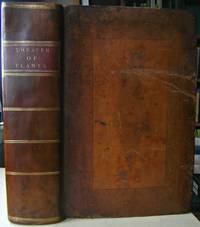
1640015181London: Thomas Cotes 1640. First edition. Large thick folio title page dedication page preface two pages author's tributes ten pages then ii 1734 but actually slightly less as there are several errors of pagination illustrated with over 2100 woodcut figures lacking the extra engraved title page the 20-page addenda at the rear and the errata leaf but otherwise complete and very sound. The contents are extremely clean and tight there is the odd crease and an occasional tiny corner missing but overall in impressive condition. The front and rear endpapers are a little browned and marked both front and rear hinges are cracked and showing a little silver-fish damage but there is no weakness at all. Full panelled calf probably eighteenth century but possibly earlier a little rubbed a little worn at the edges scuffed on the upper cover rebacked fairly recently with a leather spine and red morocco label. Blanche Henrey 286. Very heavy - extra postage will be required. John Parkinson 1567 - 1650 was both the last of the great English herbalists and one of the first of the great English botanists. He was apothecary to James I and a founding member of the Worshipful Society of Apothecaries in December 1617 and was later Royal Botanist to Charles I. The Theatrum was the most complete and beautifully presented English treatise on plants of its time. One of the most eminent gardeners of his day he kept a botanical garden at Long Acre in Covent Garden today close to Trafalgar Square and maintained close relations with other important English and Continental botanists herbalists and plantsmen. . First Edition. Full-Leather. Very Good. Thomas Cotes Hardcover
20202081502111900463Chinese book office 2020. Soft Cover. Fine. Size: Hardcover Chinese book office paperback
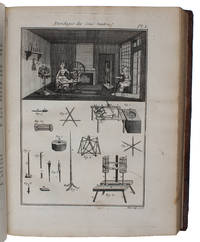
176226629Berlin Stettin und Leipzig Johann Heinrich Rüdigern 1762-75. 4to. Bound in 13 fine uniform full calf raised bands gilt backs. Remains of paperlabels on backs. Top of spine on one volume frayed. Small rubber stamp on titles. A few brownspots. A good copy. Having in all 374 of 585 fine engraved plates 1 plate supplied in xerox-copy. Plates measure around 37x24cm. <br/><br/><em>First German edition of one of the main works of the 18th century in the fields of crafts and technology as it is a translation of the famous series "Description des Arts et Metiers" issued by Academie Royale des Sciences 1760-75. The French edition was published in folio. Band 1: Kohlenbrennen Lichtziehen Ankerschmieden Nadler Papiermacher. 31 plates and 1 table;Band 2: Eisenhämmer. Teil 1-2 Wachsziehen Pergamentmachen Leder-Vergoldung Schieferbrüche. 22 plates; Band 3: Eisenhämmer. Teil 3-4 Spielkartenherstellung Seidenfärberei Pappenmacher. 29 plates 1 plate supplied in xerox-copy; Band 4: Böttcherkunst Weißgerber Ziegelstreichen Zuckersieden Silber affinieren. 30 plates; Band 5: Messingherstellung Tuchmacherkunst Lohgerberei. 33 plates. Band 6: Tuchfrisierkunst Saffianleder-Herstellung Leder auf ungarische Art Weißgerber Hutmacher Dachdecker. 19 plates; Band Band 7: Tapetenweberei Kalkbrennerkunst Ziegelstreichen in Holland Ziegelhütten Ball- und Raquettenmacher. 30 plates and 1 table; Band 8: Perückenmacherkunst Müller Nudelmacher und Bäcker. 15 plates; Band 9: Schuster Schlösserkunst. 48 plates; Band 10: Steinkohlenbergbau Indigobereiter. 22 plates; Band 11: Eisenbergwerke und Hüttenwerke in der Steiermark Leimsiederei Fischerei Teil 1. 25 plates and 1 table; Band 12: Fischerei Teil 2. 50 plates; Band 13: Fischerei Teil 3 Porzellanherstellung. 23 plates and 1 engr. frontisp.; Band 14: Glasmalerei und Glasarbeiten. Mit 13 von 14 Tafeln; Band 15: Wollenzeugfabrikant. 17 plates; Band 16: Seifensider Leinwandhandel Schneiderhandwerk Leinenmanufaktur Tabaksmanufaktur. 27 plates; Band 17: Bleiarbeiter mathematische und astronomische Instrumente Baumwoll-Samtfabrikation. 38 plates; Band 18: Stickerkunst Siebmacher Riemer und Sattler mit Kutschenbau Drahtzieherei Stahlblattmacher. 51 plates Band 19: Schiffbaukunst. 18 plates and 1 engr. frontisp.;Band 20: Zinngießerkunst. 32 plates; Band 21: der Strumpfwirkerstuhl und sein Gebrauch. 14 plates. </em> hardcover
1773019039London: Printed for the author 1773. Second edition "corrected and enlarged". Folio pp iv ii 716 with an engraved frontispiece 60 engraved plates plates 66 - 80 in the appendix i.e. LACKING five plates in the appendix some age-toning internally the odd blemish here and there the frontispiece with two earlier minor repairs a partly unpressed copy which has resulted in a horizontal crease to the last sixty pages or so see illustration and a slight depression to earlier ones bound in a recent half calf with very slight signs of use with marbled endpapers. Plate 31 is bound slightly out of order and plate 59 has a small ink scribble in the margin and has the plate number corrected in ink. Blanche Henrey 805 mentioning a portrait as well as an allegorical frontispiece; the portrait is not present in our copy. Sir John Hill was an English composer actor author and botanist. He contributed to contemporary periodicals and engaged in literary battles with poets playwrights and scientists. A controversial figure John Hill's often provocative and scurrilous writings involved him in many quarrels both in the field of science and that of literature. Nevertheless his general approval of Linnaeus resulted in many of Hill's publications using the Linnean system for the first time. Second edition. Full Leather. Good. Printed for the author Hardcover
017976Taurini: Ex Regio Typographeo Three volumes 1837 - 1843. A partial set of one of the rarest of Mediterranean floras. Illustrated with 96 very fine engraved plates including 3 bis plates - XXXIII LXXVII LXXXVIII a double-page engraved map of Sardinia rather foxed quarto pp xii 606; 562. ii plates volume 96 plates of 114 remarkably clean internally contemporary half calf and cloth the spines with raised bands and black morocco labels slightly rubbed and scuffed a little wear at the corners. The engravings are by by L. Fea S. Botta H. Mil and A. Nizza after drawings by M. Lisa and J.C. Heyland; there is a presentation inscription in Latin in the first volume from the author to Sir Charles James Fox Bunbury. Lacking the final volume which was not published until 1857. The fact that the plates volume is here labelled Volume III suggests that Bunbury received these from the author in 1843 and the final volume was never presented. The author was a botanist at Cagliari then at Turin where he subsequently became Director of the Botanical Gardens. His primary investigations were on the flora of Sardinia of which this work is the first and still the most complete and detailed account. Sir Charles Bunbury was a keen botanist and geologist with a particular interest in paleobotany. He collected plant specimens on expeditions to South America in 1833 and South Africa in 1838. He also accompanied his great friend Sir Charles Lyell the geologist on an expedition to Madeira. He was elected a Fellow of the Royal Society in 1851. From Bunbury the set moved to the Leipzig collector and antiquary Oswald Weigel with his small stamp. Also in each volume is the later bookplate of Kenneth Lazenby a founding member of the Alpine Garden Society. The map is an addition to the published work and is equally rare - "Carta della Sardegna annessa alla 1a parte del viaggio in cetta Isola del Colonello A. della Marmora. 2da Edizione. Carte de la Sardaigne annexee a la 1e´re partie du voyage en cette Ile par le Colonel A. de la Marmora.". Although lacking the later volume this set remains very attractive due to its condition provenance and the additional map. First Edition. Half-Leather. Very Good. Ex Regio Typographeo Hardcover
1965mon0000121503PROGRESS PUB. 1965-01-01. Hardcover. Good. 2.5000 in x 8.5000 in x 5.9000 in. No DJ. Mild shelf wear and fading to both volumes. Former owner's name on inside cover otherwise pages clean. Cup mark on volume one's cover. PROGRESS PUB. hardcover
1734D4425Paris: Par La Compagnie des Libraires 1734. Hardcover. Very Good. Three volumes comprising Vol. III parts I to III of Memoires de lAcadémie Royale des Sciences depuis 1666 jusquà 1699. Paris: Par La Compagnie des Libraires 1733-1734. Part I: 231pp.; Part II: 294pp.; Part III: 215pp. 97 engraved folding plates depicting animals and skeletal diagrams. Engraved portrait frontispiece of Claude Perrault in first volume. Contemporary French calf spines gilt edges red; some occasional browning; repairs to joints some rubbing. Unidentified armorial bookplate to front pastedown beneath monogrammed bookplate D.P. with chipmunk and two mice. A later reduced format edition of Perraults Memoires of 1671-1676 Perraults study of this nature was first published in 1669 with the results of investigations of five animals and later expanded with studies of over forty animals. Prior to 1670 most descriptions of animals paid little attention to their internal structure and there were very few images in natural history encyclopedias that depicted skeletons or muscles. That changed with the establishment of the Académie des Sciences in Paris in 1666 by Jean-Baptiste Colbert with the approval of King Louis XIV. The Academy functioned with neither statutes nor regulations until 1699. At that time the Academy used the term mathématique to encompass the fields that are now called astronomy mathematics and physics and the term physique to encompass the fields that are now called anatomy botany zoology and chemistry. In January 1699 Louis reorganized the Academy giving it first regulations. The effect was to give the King more control over their activities in exchange for becoming an official institution under his protection with the new name Académie Royale des Sciences. One of the original academicians the physician Claude Perrault organized regular sessions at which participants could dissect deceased animals from Louis XIVs royal menagerie and record all they observed. Lions chameleons bears gazelles wolves ostriches crocodiles monkeys eagles tigers porcupines and salamanders among some were all laid open by the academics scalpels. These superb folding plates record in great detail the pioneering work at the Academy. These three volumes in three parts focus on the transformative and foundational years of the French Royal Academy of Sciences and Claude Perraults efforts which had made comparative anatomy a vital tool for the classifying naturalist. <br/><br/> Par La Compagnie des Libraires hardcover
174014160Paris: de L’Imprimerie Royale 1740. Complete with errata’s and original blank leaves two of three finely engraved frontispieces chapter vignettes ornamental head and tail pieces and 82 folding plates. Full mottled calf rebacked the corners a bit worn. Interior is lightly toned with some browning on the preliminaries and last leaves. Generally this is an excellent set. First editions of these three volumes from a series published by the Academy of Sciences. It is a summary of the activities and inventions that have been made and contains the most important discoveries of the time. These periodicals which were at the forefront of scientific development during the Enlightenment contain works produced by an elite class of French scientist for the years 1722 1731 and 1740. Each volume provided an overview of advancements in math and science for each year and the writings therein shaped the world’s understanding of physics mathematics astronomy anatomy and other fields of science. They further provide invaluable historical data such as meteorological and astrological records for each year. <br /> <br /> The memoirs for 1722 include data recorded on both a lunar and solar eclipse as well as other astronomical observations by Jacques Cassini 1677-1756 best know for completing his fathers work on determining the meridian of Paris. The distinguished astronomer provided further research on lunar eclipses in the memoirs of 1731 where he is in great company alongside distinguished mathematicians Alexis-Claude Clairaut 1713-1765 Pierre Bouguer 1698-1758 known for his work in physics photometry and hydrography and the foremost proponent of the Newtonian movement in France Pierre de Maupertuis 1698-1759. Of special note in the 1731 memoirs is Maupertuis’s ballistic arithmetic which was used to try to better understand the movement of the earth and its gravity. Too an article by Clairaut on new formulas for finding the center of gravity. These articles contributed greatly to a better understanding of the earth’s shape and the mechanics of its rotation particularly Bouguer’s essay on the tendency of objects set in motion to move in a curvilinear fashion. The 1740 edition contains Cassini De Thury’s De la Maridienne de Paris. which was an important step in the process of mapping the shape of the earth. Cassini 1714-1784 representing the third generation of the distinguished family of astronomers was the first to question <br /> <br /> <br /> Picard’s measurements which had been used to map the Maridian of Paris. Clairaut’s essay on integral calculus in the same volume which established the existence of an integrating factor for linear differential equations was an important step in the history of mathematics and Mairan’s treatise on reflection and refraction of light and the human eye was essential to the advancement of optics. Mairan 1678-1771 would set the foundation for optical theory with this treatise. de L’Imprimerie Royale unknown
185832039AB1858. alle Bände in Originalausgabe Gotha J. Perthes 1858-1906 4° jeder Band zwischen ca. 300 und 500 S. mit zahlr. oftmals farbigen Ausklapp-Tafeln und Falt-Karten die ersten 4 Bände 1858-1863 als schwarze original Leineneinbände mit goldener Deckel- und Rückenbeschriftung sowie reicher Deckelbildprägung der Band 1868 als schlicher schwarzer Pappband der Zeit dann 1870-1906 Halbleinen-Einbände der Zeit mit Rückenschildern bzw. goldener Rückenbeschriftung und Musterpapierbezügen alle Bände unten mit Rückensignaturschildchen die Rückenkanten der ganz frühen Bände stellenw. angeplatzt wenige Bände oben am Rücken etwas angerändert beim schlichten Pappband von 1868 der Rücken beschädigt und mit Fehlstellen innen aber bindungsstabil die Vorsatz- und/oder Titelseiten aller Bände mit schönem alten Rundstempel und handschriftlicher Signaturnummer der Lehrerbibliothek eines alteingesessenen Frankfurter Gymnasiums sonst gute saubere und augenscheinlich auch vollständige sowie offenbar kaum je benutze Exemplare augenscheinlich vollständig aber nicht eingehend kollationaliert. Vorhanden die Bände 1858 4. Jahrgang 1861 1862 1863 und 1868 bis 1906 51. Jahrgang sowie 3 separat gebundene Inhaltsverzeichnisse 1865-1874 / 1875-1884 / 1885-1894. Der komplette Titel der fühen Bände lautete: 'Mittheilungen aus Justus Perthes' Geographischer Anstalt über wichtige neue Erforschungen auf dem Gesammtgebiete der Geographie'. Ohne die separat erschienen 'Ergänzungshefte'. Abholung im Ladengeschäft in Frankfurt am Main Nordend ggü. Musterschule möglich. Das spart die Portokosten. Pickup at the store in Frankfurt am Main Nordend close to Musterschule is possible. It saves the shipping costs. unknown
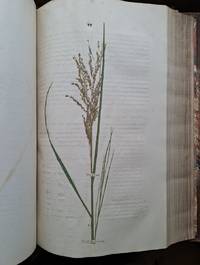
1816021179B. McMillan 1816. First edition. Folio approximately 29cm x 48 cm pp lxvi 316 iv all edges gilt with some foxing on the earlier and later few pages errata slip pasted to verso of the contents pages with 123 mounted specimens in good condition and 35 mounted groups of seeds half morocco and marbled boards a little rubbed and scuffed a darker stain towards the base of the spine marbled endpapers with the armorial bookplate of Henry Collins. The specimens are frequently described as all grass though this is incorrect - approximately nine of them are leguminous plants. Many of them are delicately heightened in watercolour. This copy does not have the folding plan and very few copies do. RARE. A very heavy book weighing nearly 8.5 kilos - extra postage costs will need to be added. A paper in 'Science' 25/01/2002 by Andy Hector and Rowan Hooper has called this book which influenced Charles Darwin "arguably the first ecological experiment". Darwin in his 'Origin of the Species' refers to an experiment investigating the biology of grassland plants that showed how a greater diversity of grasses planted in experimental plots was responsible for greater production of plant matter but Darwin left no clues as to where or when this experiment was done. Hector and Hooper show that it is Sinclair's 'Hortus Gramineus Woburnensis' which details this experimental garden. First Edition. Half Leather. Good. B. McMillan Hardcover
19562091202133211986science publisher 1956. Soft Cover. Fine. Number of books: 6 books in total science publisher paperback
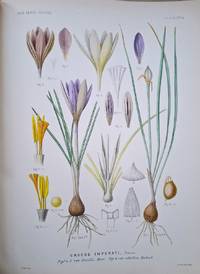
1886021464London: Dulau & Co 1886. Large thick quarto pp viii 326 xx 10 top edge gilt two double page charts and a map 4 coloured plates lettered A to D 77 coloured plates numbered 1 - 67 11 bis plates plate 17 was not published one internal hinge slightly stretched endpaper a little oxidised the half-title and the final leaf foxed the title page lightly foxed slightly age-toned internally the rear hinge a little cracked but not weak original brown beveled cloth slightly worn and rubbed the spine pulled at head and tail with rwo short tears at each a small bruise on the lower cover. The plates are very fine chromolithographs. A very attractive wood-engraved scene usually in Turkey precedes most species section; these are by the Brothers Dalziel. The book was printed by Fawcett of Driffield. With the attractive bookplate of the Scottish author and nurseryman William Cuthbertson at one time a senior partner in Dobies Nurseries. A heavy book - extra postage will be needed. "Maw was a Fellow of the Linnean Society the Society of Antiquaries and the Royal Historical Society. He became a Fellow of the Geological Society in 1864. He was a member of the RHS Scientific Committee during the 1880s and served brief terms on the Floral Committee Daffodil Committee and Library Committee. Maw made frequent plant collecting trips including to the Mediterranean and Eastern Europe. In 1871 he accompanied Sir Joseph Dalton Hooker and John Ball on a plant collecting expedition to Morocco and the Atlas Mountains and letters from Hooker to Maw give details of their preparations. A full account of the trip was published in 'Journal of a Tour in Marocco and the Atlas Mountains'. Maw wrote occasional articles for the garden press and was an accomplished artist: John Ruskin wrote of his crocus drawings that they were 'most exquisite . and quite beyond criticism'. In 1886 Maw published 'A Monograph of the Genus Crocus' the result of over ten years of collecting and research illustrated using his own watercolours. Many of the bulbs and plants he collected on his plant collecting expeditions were planted in the garden at Benthall Hall later owned by the National Trust. Correspondence between Maw and the friends and contacts who helped to collect the 67 species of Crocus detailed in his work forms a significant part of the archive. Maw retired in 1886 due to ill health and moved to live at Rangemore in Kenley Surrey changing the house name to Benthall. Frederica Mary died on 6 Feb 1894. George Maw died on the 7 Feb 1912." - British Museum. ""George Maw 1839-1912 was the industrious author and illustrator of his great 'Monograph of the Genus Crocus' 1886. A many-sided and remarkable man Maw was not a botanist by profession but a chemist and geologist a manufacturer of encaustic tiles at Broseley Staffs. His monograph the result of ten years of inquiry was the most complete work of its kind that has been published on any genus. The plates of this work are marvels of comprehensive detail and put to shame those of many more skilled draughtsmen. From a botanical point of view this work is a landmark."Blunt & Stearn". First Edition. Cloth. Good. Dulau & Co Hardcover