98 résultats
40 p.,1400 lots, nbr. ill. n/b. Inv. 24286
9814Of various heights & lengths ranging from 48 to 80 mm. in height & 4000 to 10500 mm. in length all in very good condition some with silk front endpapers four with orig. core rollers. Japan: mid- to late Edo.<br /> <br> <br> <br /> Ten very rare examples of kokonoe no mamori good luck talismans printed in the form of extremely long and narrow scrolls; because of their ephemeral nature they are rare today. These talisman scrolls were not really meant to be unrolled and studied; instead they were intended to be tightly rolled and kept in a small pouch close to the chest for good luck.<br /> <br> <br> “Such narrow but extremely long handscrolls veritable encyclopedias of Buddhist iconography received the name kokonoe no mamori amulet in nine layers during the Edo period because they begin with a red seal but not always there are many without; we have two with the red seal in the shape of a cauldron containing characters that can be read kokonoe no mamori. All the scrolls start with an image but not always there are many without of Ususama Myoo S: Ucchushma the king who has the power to burn away impurity and evil which is followed by powerful magical syllables J: shingon S: mantra various ‘seed’ mandalas in Sanskrit and sutras in Chinese. Next Buddhist deities including Esoteric icons are depicted along the length of the handscroll; buddhas bodhisattvas the four guardian kings the five great kings of light Yakushi Buddha with sixteen protectors and a thousand-armed Kannon S: Sahasrabhuja with twenty-eight attendants. Many cosmological deities are included: the nine luminaries and Taizanfusei related to the Big Dipper. Such popularized Esoteric icons as Shoten S: Nandikeshvara Dakiniten S: Dakini Idaten S: Skanda Gozu Tenno and Tawara Daikokuten S: Mahakala are also shown. The last section of the scroll contains a series of dharani sutras in Sanskrit magical formulas of knowledge that are composed of syllables with symbolic content…<br /> <br> <br> “Two types of kokonoe no mamori became popular in the Edo period as talismans for journeys and pilgrimages and as a part of the wedding trousseau. One type has at the end of the scroll a portrait of Kukai the founder of Shingon Esoteric Buddhism while the other portrays Saicho the founder of Tendai Esoteric Buddhism.â€â€“Masako Watanabe The Written Image. Japanese Calligraphy and Painting from the Sylvan Barnet and William Burto Collection item 22 pp. 86-88.<br /> <br> <br> As noted these scrolls are in very good to excellent condition. A few have some wear at the beginning. Two of the scrolls are in their original wooden boxes and all of the scrolls are preserved in a modern wooden box. unknown
7414Japan: mid- to late-Edo except for the longest which is modern.<br /> Ten very rare examples of kokonoe no mamori good luck talismans printed in the form of extremely long and narrow scrolls; because of their ephemeral nature they are rare today. These talisman scrolls were not really meant to be unrolled and studied; instead they were intended to be tightly rolled and kept in a small pouch close to the chest for good luck.<br /> "Such narrow but extremely long handscrolls veritable encyclopedias of Buddhist iconography received the name kokonoe no mamori amulet in nine layers during the Edo period because they begin with but not always there are many without a red seal in the shapes of a cauldron containing characters that can be read kokonoe no mamori. All the scrolls start with but not always there are many without an image of Ususama Myoo S: Ucchushma the king who has the power to burn away impurity and evil and is followed by powerful magical syllables J. shingon S: mantra various 'seed' mandalas in Sanskrit and sutras in Chinese. Next Buddhist deities including Esoteric icons are depicted along the length of the handscroll; buddhas bodhisattvas the four guardian kings the five great kings of light Yakushi Buddha with sixteen protectors and a thousand-armed Kannon S: Sahasrabhuja with twenty-eight attendants. Many cosmological deities are included: the nine luminaries and Taizanfusei related to the Big Dipper. Such popularized Esoteric icons as Shoten S: Nandikeshvara Dakiniten S: Dakini Idaten S: Skanda Gozu Tenno and Tawara Daikokuten S: Mahakala are also shown. The last section of the scroll contains a series of dharani sutras in Sanskrit magical formulas of knowledge that are composed of syllables with symbolic content.<br /> "Two types of kokonoe no mamori became popular in the Edo period as talismans for journeys and pilgrimages and as a part of the wedding trousseau. One type has at the end of the scroll a portrait of Kukai the founder of Shingon Esoteric Buddhism while the other portrays Saicho the found of Tendai Esoteric Buddhism."-Masako Watanabe The Written Image. Japanese Calligraphy and Painting from the Sylvan Barnet and William Burto Collection item 22 pp. 86-88.<br /> As noted these scrolls are in good to very good condition. Some have wear or are wormed or have some considerable repairs. A few have dampstaining. As mentioned above the longest scroll is modern. unknown books
200717198San Francisco: The Book Club of California 2007 One of 350 copies. This is book number 222 of the Book Club of California. Quarto. With eight photographs and illustrations from the author's collection. Designed by Jack W. Stauffacher of the Greenwood Press of San Francisco. Computer layout by Kina Sullivan. Set in Cycles type designed by Summer Stone. Printed by Hatcher Press on Finch Vellum #70 paper under the supervision of Susan Schaefer. Bound by the Roswell Book Bindery. Green cloth boards titled in gilt. Prospectus laid in. A fine copy in the plain white dustjacket. The Book Club of California hardcover
GB007HE35GSI3N00Talisman Press. Unknown. Good. Pages can have notes/highlighting. Spine may show signs of wear. ~ ThriftBooks: Read More Spend Less.Dust jacket quality is not guaranteed. Talisman Press unknown
Mm 240x290 Photos by Mauro Magliani. Printed Pages: 318 with colour illustrations throughout. Brand new in original shrinkwrap.
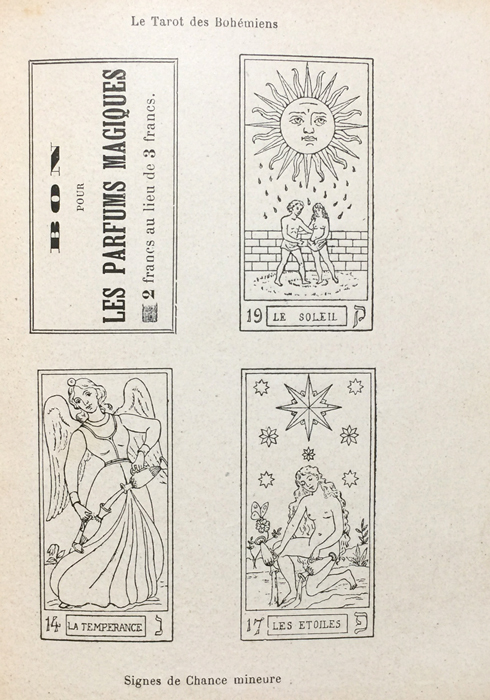
19053598Paris, Librairie Française (Baugé, Maine et Loire, Imp. Dangin) ; in-12 carré, broché ; 64 pp. et 6 planches hors-texte de reproduction du Tarot des Bohémiens, nombreuses illustrations, couverture illustrée.
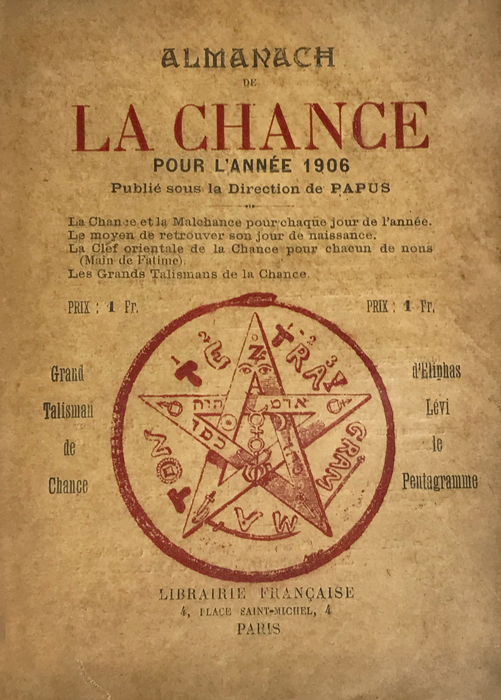
19063510Paris, Librairie Française, 1906 ; in-12, broché ; 63 pp. et couverture illustrée en rouge et noir.
Mm 120x170 Brossura originale, 64 pagine con 22 illustrazioni in bianco e nero nel testo. Opera in ottime condizioni, come nuovo. SPEDIZIONE IN 24 ORE DALLA CONFERMA DELL'ORDINE.
196670715München, Verlag George D.W.Callwey, 1966. Original-Leiennband mit Schutzumschlag, 4°, 270 Seiten.
196640701München, Callwey, 1966. 1. Aufl. 270 S. mit zahlr. Ill. (z.T. farb.) 29 x 26 cm, Leinen mit OSchU
1927015091Paris 1927 In-4 Agrafé
19255205Paris, Cité des Livres (Abbeville, F. Paillart), 1925, collection balzacienne N°1 ; in-12, broché ; (2) ff. blancs, 22, (2) pp., (2) ff. blancs, couverture rempliée lie-de-vin.
94614Le Vieux Papier, fac. 212 (avril 1965) à 218 (octobre 1966) reliés en 1 volume, demi-basane, environ 27x19cm, des frottements d'usage sur la reliure, coiffe inférieure épidermée, bon état pour le reste.
369351 vol in-8 broché - 119 pages - années 1873 - Tome VII - 27 ème livraison
Diversi amuleti e oggetti in terracotta, steatite, bronzo e giada. Tavola incisa all’acquaforte su lastra di rame, inserita nella monumentale opera Description de l’Egypte, II° edizione dal 1820-29 voluta da Luigi XVIII, importante risultato culturale dell’occupazione francese in Egitto per il periodo che va dal 1798 al 1801. Bonaparte decise di invadere queste terre per controllare le vie commerciali verso l’india ed assestare in questo modo un duro colpo all’economia britannica. Durante questa operazione, il Nostro favorì l’attività di numerosi artisti, ingegneri, matematici e naturalisti per registrare e catalogare con estrema precisione le costruzioni e i monumenti egiziani nonché la flora e la fauna. Il risultato di questo immane sforzo, che per la pubblicazione coinvolse quasi duemila tra artisti e tecnici oltre a quattrocento incisori, fu l’opera "Description de l’Egypte, ou recueil des observations et des recherches qui ont été faites en Egypte pendant l’expédition de l’armée française", che offre una globale visione scientifica dell’antico e moderno Egitto, nonché la sua storia naturale. La Description ebbe grande influenza sul movimento orientalista pittorico dell’ottocento e diede un contributo fondamentale alla diffusione dell’Egittologia. Numerosi edifici rappresentati in queste tavole sono stati completamente distrutti nel tempo
Amuleti a forma di scarabeo e diverse figure in terracotta, argento ed ematite. Tavola incisa all’acquaforte su lastra di rame, inserita nella monumentale opera Description de l’Egypte, II° edizione dal 1820-29 voluta da Luigi XVIII, importante risultato culturale dell’occupazione francese in Egitto per il periodo che va dal 1798 al 1801. Bonaparte decise di invadere queste terre per controllare le vie commerciali verso l’india ed assestare in questo modo un duro colpo all’economia britannica. Durante questa operazione, il Nostro favorì l’attività di numerosi artisti, ingegneri, matematici e naturalisti per registrare e catalogare con estrema precisione le costruzioni e i monumenti egiziani nonché la flora e la fauna. Il risultato di questo immane sforzo, che per la pubblicazione coinvolse quasi duemila tra artisti e tecnici oltre a quattrocento incisori, fu l’opera "Description de l’Egypte, ou recueil des observations et des recherches qui ont été faites en Egypte pendant l’expédition de l’armée française", che offre una globale visione scientifica dell’antico e moderno Egitto, nonché la sua storia naturale. La Description ebbe grande influenza sul movimento orientalista pittorico dell’ottocento e diede un contributo fondamentale alla diffusione dell’Egittologia. Numerosi edifici rappresentati in queste tavole sono stati completamente distrutti nel tempo
Numerosi tipi di amuleti, figure e vasi egizi. Tavola incisa all’acquaforte su lastra di rame, inserita nella monumentale opera Description de l’Egypte, II° edizione dal 1820-29 voluta da Luigi XVIII, importante risultato culturale dell’occupazione francese in Egitto per il periodo che va dal 1798 al 1801. Bonaparte decise di invadere queste terre per controllare le vie commerciali verso l’india ed assestare in questo modo un duro colpo all’economia britannica. Durante questa operazione, il Nostro favorì l’attività di numerosi artisti, ingegneri, matematici e naturalisti per registrare e catalogare con estrema precisione le costruzioni e i monumenti egiziani nonché la flora e la fauna. Il risultato di questo immane sforzo, che per la pubblicazione coinvolse quasi duemila tra artisti e tecnici oltre a quattrocento incisori, fu l’opera "Description de l’Egypte, ou recueil des observations et des recherches qui ont été faites en Egypte pendant l’expédition de l’armée française", che offre una globale visione scientifica dell’antico e moderno Egitto, nonché la sua storia naturale. La Description ebbe grande influenza sul movimento orientalista pittorico dell’ottocento e diede un contributo fondamentale alla diffusione dell’Egittologia. Numerosi edifici rappresentati in queste tavole sono stati completamente distrutti nel tempo
Numerosi tipi di amuleti e figure egizie. Tavola incisa all’acquaforte su lastra di rame, inserita nella monumentale opera Description de l’Egypte, II° edizione dal 1820-29 voluta da Luigi XVIII, importante risultato culturale dell’occupazione francese in Egitto per il periodo che va dal 1798 al 1801. Bonaparte decise di invadere queste terre per controllare le vie commerciali verso l’india ed assestare in questo modo un duro colpo all’economia britannica. Durante questa operazione, il Nostro favorì l’attività di numerosi artisti, ingegneri, matematici e naturalisti per registrare e catalogare con estrema precisione le costruzioni e i monumenti egiziani nonché la flora e la fauna. Il risultato di questo immane sforzo, che per la pubblicazione coinvolse quasi duemila tra artisti e tecnici oltre a quattrocento incisori, fu l’opera "Description de l’Egypte, ou recueil des observations et des recherches qui ont été faites en Egypte pendant l’expédition de l’armée française", che offre una globale visione scientifica dell’antico e moderno Egitto, nonché la sua storia naturale. La Description ebbe grande influenza sul movimento orientalista pittorico dell’ottocento e diede un contributo fondamentale alla diffusione dell’Egittologia. Numerosi edifici rappresentati in queste tavole sono stati completamente distrutti nel tempo
Numerosi reperti egizi: bassorilievi, vasi, amuleti, maschere e una tunica. Tavola incisa all’acquaforte su lastra di rame, inserita nella monumentale opera Description de l’Egypte, II° edizione dal 1820-29 voluta da Luigi XVIII, importante risultato culturale dell’occupazione francese in Egitto per il periodo che va dal 1798 al 1801. Bonaparte decise di invadere queste terre per controllare le vie commerciali verso l’india ed assestare in questo modo un duro colpo all’economia britannica. Durante questa operazione, il Nostro favorì l’attività di numerosi artisti, ingegneri, matematici e naturalisti per registrare e catalogare con estrema precisione le costruzioni e i monumenti egiziani nonché la flora e la fauna. Il risultato di questo immane sforzo, che per la pubblicazione coinvolse quasi duemila tra artisti e tecnici oltre a quattrocento incisori, fu l’opera "Description de l’Egypte, ou recueil des observations et des recherches qui ont été faites en Egypte pendant l’expédition de l’armée française", che offre una globale visione scientifica dell’antico e moderno Egitto, nonché la sua storia naturale. La Description ebbe grande influenza sul movimento orientalista pittorico dell’ottocento e diede un contributo fondamentale alla diffusione dell’Egittologia. Numerosi edifici rappresentati in queste tavole sono stati completamente distrutti nel tempo
18,6x11,8 cm; 104, (8) pp. Bella brossura editoriale esoterica con titolo in nero e immagine in azzurro. Numero 13 parte della collana "L'Occultisme Simplifiè". Rara edizione esoterica che tratta i poteri occulti dei colori e la loro possibile applicazione nella Cromoterapia, ai talismani, nell'astrologia. L'opera tratta anche delle gemme. Opera in parte intonsa ed in ottime condizioni di conservazione. Poinsot fu autore di numerosi tetsi di occultismo.
19704323Den Haag: Couvreur um 1970 (?). 2. vollst. neubearb. Auflage. Mit 52 Abbildungen, 214 S., 8° , OKart.
191029797Leipzig, J. C. Hinrichs'sche Buchhandlung, 1910. 8°, 32 S., 32 S. mit 1 Abb., 32 S. mit 7 Abb., 40 S. mit 9 Abb.; 3. ? und seine Denkmäler. 4. Heerwesen und Kriegsführung der Assyrer auf der Höhe ihrer Macht; Hg. von der Vorderasiatischen Gesellschaft; Bezahlung per PayPal möglich , we accept PayPal, Ex Libris-Klebereste a. Vorsatz, Regalspuren am Fußschnitt, Einband ger. beschabt und ger. bestoßen, altersbedingte Bräunungen, sonst ger. Gebr.sp., Leinen
198540922Berlin, Verlag Neues Leben, 1985. 2. Auflage 252 Seiten , 24 cm, Hardcover/Pappeinband
184366732Wien, Joh. Bapt. Wallishausser, 1843. 8°. Mit einem kolor. Frontispiz. 148 S., Späterer Ldr.-Bd. m. Rückenverg. u. goldgepr. Rückenschild.