268 résultats
OKKU1531o.J. nur geringe Gebrauchsspuren. Weis, Christian. Begnadet, besessen oder was sonst? Okkultismus und christlicher Glaube. Sbg., St. Peter (1986). 164 S., OKart./Beda, Anton (= Stocker, Josef). Der Spuk im Chiemgau. Sonderbare Krankheiten. Experimentierfeld der Parapsychologie. Wien, Kreuz-Vlg. 1977. 168 S., 1 Front., OKart./Zacharias, Gerhard. Satanskult und Schwarze Messe. Die Nachtseite des Christentums. Ein mBeitrag zur Phänomenologie der Religion. 4. Aufl. (Mchn.), Herbig (1990). gr.-8°, 196 S., mit zahlr. Textabb. u. 48 Abb. auf Taf., OPp. m. OU.
Firenze, Libreria Editrice Fiorentina, 1975, in-8, br. edit., pp. [30]. Con ill. da vecchie incisioni. Testo a cura di Bernard Delmay. Collezione "Mezzo scudo", diretta da Guglielmo Amerighi.
Twelve glossy color postcards in accordion book format. 5 3/4"w x 4"h. No publication date shown; circa 1980.
OKKU1529o.J. alle Bände mit nur geringen Gebrauchsspuren. Schnackenburg, R. (Hrsg.)., Die Macht des Bösen und der Glaube der Kirche. Mit Beiträgen von H. Bürkle, W. Kasper, E. Ringel, L. Scheffczyk, R. Schnackenburg, P. Stockmeier, W. Wickler. D'dorf, Patmos (1979), 118(1) S., OKart. Paraphe am Reihentit. (Schriften d. Katholischen Akademie in Bayern Bd. 89)./Weis, Christian. Begnadet, besessen oder was sonst? Okkultismus und christlicher Glaube. Sbg., St. Peter (1986). 164 S., OKart./Beda, Anton (= Stocker, Josef). Der Spuk im Chiemgau. Sonderbare Krankheiten. Experimentierfeld der Parapsychologie. Wien, Kreuz-Vlg. 1977. 168 S., 1 Front., OKart./Besessenheit und Exorzismus. Hrsg. v. d. Österr. Arbeitsgem. "Arzt und Seelsorger". Wien, Veritas o. J. (ca. 1976). 68 S., OKart./Berendt, Heinz C. Parapsychologie. Eine Einführung. Stgt. u. a., Kohlhammer (1972). 146 S., 1 Bl. Vlgsanz., OKart.
br. Nei saggi di Germain Bazin, Paul Zumthor e Claude-Edmonde Magny, raccolti in questo volume assieme a quello, fondamentale, di Henri-lrénée Murrou, si dipanano le tramo che avvolgono la modernità nella fascinazione del Male come principio alternative a Dio, suo Avversario seducente e romantico insieme. Da esso promanano energie represse e conculcate dalla fede cieca in un Dio che nei confronti della realtà dolorosa non sa proporre che la pratica di un Bene incapace e per molti versi inefficace: certamente non in grado di giustificare e salvare il male del mondo. Seguire Bazin nella descrizione della trasformazione che l'immagine di Satana subisce nell'arte è un modo di anticipare ciò che avviene in letteratura secondo Zumthor e Magny in due saggi di finezza e sensibilità assolute. Il tentativo di rintracciare la presenza del demonio nel Male incarnato e vivente nella Storia degli uomini, e non solo nelle loro convinzioni, attraverso tutti gli strumenti delle rinnovate scienze sociali e un discreto apparato di studi comparativistici e storici, finisce per trovarsi tra le mani qualcosa di più c, torse, di non previsto. Si tratta, infatti, della descrizione del demonismo moderno, dei suoi essenziali tratti culturali e della sua sostanziale pervasività nel inondo precedente le due guerre mondiali, a partire almeno dal Romanticismo.
In 8° (16x9 cm); due tomi in un volume: (8), 294, (2) pp. e 239, (1) pp. Legatura coeva in piena pergamena con titolo impresso in oro al dorso. Qualche traccia di polvere. All'interno esemplare in ottime condizioni di conservazione. Seconda edizione (anche se Barbier cita l'esistenza di un'edizione del 1731 ma trattatasi probabilmente di un errore bibliografico), notevolmente corretta ed aumentata (praticamente raddoppiata) rispetto all'edizione del 1739, di questo interessante e curioso studio della scrittrice e filosofa ginevrina, Marie Huber (Geneve, 4 marzo 1695 – Lyon, 13 giugno 1753) che fu anche editrice e rarissimo per quell'epoca, scrisse anche di argomenti teologici. Sostenitrice dell'universalismo e considerata anche una neoplatonica, fu accusata da diversi personaggi dell'epoca di “deismo”. Le sue lettere, qui presentate, ebbero numerosi estimatori alla sua epoca come ad esempio il celebre poeta lirico scozzese, Robert Burns o ad esempio, Rousseau che ne cita alcuni passaggi nel libro IV dell'Emile. La Huber in questa serie di sue riflessioni analizza il rapporto fra Dio e l'eternità, le età delle anime e la figura del diavolo attraverso quello che scrissero diversi pensatori attraverso i secoli. La Huber arrivò a concludere che se Dio è onnipotente e perciò anche più potente del diavolo, quest'ultimo è condannato, prima o poi, a cessare d'esistere. A good copy. Rif. Bibl.: Barbier, IV, 618 cita l edizione del 1733 e afferma di non aver mai trovato la prima del 1731; Caillet.
19812110502150415116elementary school 1981. Soft Cover. Fine. Volume: 1 elementary school paperback
1968160549天津.Tianjin.: No publication details. Circa1968. A Chinese Cultural Revolution poster featuring 19 photographic illustrations printed in blue ink with captions under each image text upper margin in traditional Chinese in red ink. Some variation in the printing of the images in some cases the light being rather light. Good copy. Sheet measures 78.9 x 53.4cm. "'Monsters and Demons' 牛鬼蛇神 niugui sheshen was the term used to vilify specialists scholars authorities and 'people who entrenched themselves in ideological and cultural positions' during the Cultural Revolution. Following the rebroadcasting and reprinting of the editorial <br>"Sweep Away All Monsters and Demons" first published in the People's Daily on 1 June 1966 the Red Guards started a huge purge which swept the country 'dragging out' and prosecuting all those ostensibly fitting the description. The editorial was written by order of Mao Zedong's his political secretary Chen Boda one of the members of the Central Cultural Revolution Group which was headed by Jiang Qing." see Stefan Landsberger's excellent site Chinese Posters. <br> <br>The "demons" featured in this poster were government officials from the sports departments within Hebei Province. In the pictures they have all been forced to kneel down hands handcuffed at their back with a big large piece of cardboard listing their anti-revolutionary offences hung around their necks as part of their public shaming. <br>The "demons" were all accused of the crimes of anti-revolution revisionism under the political campaign led by Mao Zedong which started at the beginning of the Cultural Revolution. . No publication details. unknown
First edition, oblong 4to (196 x 242 mm), [10]pp., [8] leaves of plates, lithographed throughout, orig. pink lithographed paper wrappers stitched as issued. The posthumously published work of the Reverend Reginald Heber (1783-1826), the hand-written lithographic verse and gothic like illustrations tells the story of Lord Llewellyn who tries to summon up the Devil with disappointing results. Twyman, Early Lithographed Books, 1.116.
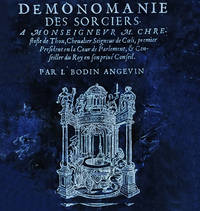
1582143<p>Bodin Jean. <em>De la démonomanie des sorciers. A monseigneur Chrestophle de Thou chevalier seigneur de Coeli premier president en la cour de parlement & conseiller du Roy en son privé conseil. </em>Paris Jacques du Puy 1582.</p><p>4to 18th century half vellum on colored paper handwritten title to spine ff. 12 256. Dedicatory letter to Christophe de Thou father of the French historian and great bibliophile Jacques de Thou.</p><p>Third edition of the "Demonomania of Witches" the best sources on sorcery trials in the 16th century also providing detailed case-histories on sorcerers werewolves public exorcisms and deals with the devil as the case of Magdalena de la Cruz who confessed her pact witchcraft and sexual relations with the Devil for thirty years.</p><p>Arguably the most comprehensive and compelling account of witchcraft and its persecution by both state and religious authorities in the 16th century Bodin's work played a pivotal role in shaping the influential concept of "pact witchcraft"—the notion that sorcery stemmed from an explicit covenant with the Devil. Writing in uncompromising and severe terms he advocated for draconian judicial procedures rejecting conventional safeguards of justice and endorsing the widespread use of torture and execution by fire asserting that sorcerers should be condemned by the hundreds.</p><p>Du Puys first printed this work in 1580 and reprinted it in 1581; the first Latin edition was printed by Thomas Guarinus in Basel 1581.</p><p>Provenance: Some not identified ownership inscriptions crossed out and faded to title-page.</p><p>Condition: Title-page remounted and professionally restored with the name of the printer; the last leaf restored in the blank parts without affecting text. Internally good.</p><p>References: Not in Caillet. Dorbon 387: "Édition non citée par les bibliographes". R. Crahay <em>Bibliographie critique des éditions anciennes de Jean Bodin</em> Bruxelles: Académie Royale de Belgique 1992 no. F4. R. Yve Plessis <em>Essai d'une bibliographie française méthodique & raisonnée de la sorcellerie et de la possession démoniaque</em> no. 843. Pettegree-Walsby 6169. USTC 1699. NUC 0579484. Tchemerzine II 246.</p> Jacques du Puy hardcover
100 pages. Features: Fantastic Chrysler/Plymouth color-photo 4-panel ad inside front cover features the Scamp, Valiant Brougham and Gold Duster; State of the President (Richard Nixon); Electronic Vision - research aims for artificial sight; Film "The Exorcist" leads to frenzy of interest in exorcisms; Pending coalminer strike in Britain; America's oil companies seen as villains in the energy squeeze; Dr. Thomas E. Deiker argues for gun control; Nice color-photo ad for the Ford Maverick; Watergate scandal - John Dean, H.R. Haldeman; Photo of President Nixon and family with Billy Graham; Illinois Democratic candidate Jimmy H. Martin; Murder of John Bambic in San Francisco; John Margulies steals art from his parents, Irwin and Paula; What Makes Syria Tick?; Communist Dissidents Ludvik Vaculik, Paul Goma, Wolf Biermann and Wladyslaw Bienkowski; Terror in Phnom Penh - Frenc Exodus; Eric Gairy of Grenada; Nice color ad for the Zenith Chromacolor II TV; Horrible photos of Sao Paulo highrise fire - with falling bodies; The Cooling of Fidel Castro; John F. Kennedy Jr. with Muhammad Ali; Color-photo GM centerfold ad features the memorable front grills of the 1974 Buick LeSabre, Pontiac grand Am, Oldsmobile Delta 88, Chevelle Laguna Type S-3 and Cadillac Coupe deVille Cabriolet; Bart Bradish has cerebral palsy; Chess article on Boris Spassky; Boxer Joe Frazier - The End of the Road; American Folk Art; Alice Roosevelt Longworth; Increasing demand for kosher meals on Western Airlines; The Devil - a durable personifcation of evil; Cover photo of priest holding crucifix in exorcism-mode; Robert Goulet is featured in a Lauder's Scotch ad; Milton Friedman writes about volunteer armed force; Sam Goldwyn, 1881-1974; Colorful photo ad for Inteerwoven socks features a smiling Al Hirt; The development of flywheel power - most likely to come with the Advanced Concept Train; Color photo at for Twist lemon menthol cigarettes on back cover; and much more. Average wear. Unmarked. A sound copy. Book
In-16° pp. 252, bross.e dit. illustrata.
in-8°, 246 pages, broche, couverture illustree. Bel exemplaire [TX-10]
ril. «Il demonio ha una forza immensa. Anche se oggi si cerca di cancellare perfino il ricordo di questo potere. Papa Francesco, invece, ha cominciato fin dai primi discorsi a parlare anche del demonio: e pure Gesù ha iniziato la sua missione pubblica lottando contro il Maligno. L'ha annientato, l'ha superato». Il fenomeno delle possessioni diaboliche non riguarda solo i singoli, ma anche le società e i popoli. Il piano dell'Islam fondamentalista sarebbero ispirati da Satana e così le barbare uccisioni dei terroristi; ma sono diabolici anche i femminicidi, gli abusi sessuali sui minori, lo sfruttamento della prostituzione, la riduzione in schiavitù di tanti poveri costretti a lavorare per paghe miserabili, i giochi finanziari dei potenti senza scrupoli. Padre Amorth lancia un definitivo e drammatico SOS per denunciare la "modernità posseduta dal Maligno" in cui, mai come oggi, occorre ripetere l'invocazione della preghiera del Padre Nostro: «Liberaci dal male».
br. «Tutti i giorni, quando ci si sveglia, un pensiero a Dio e un pensiero alla Madonna che ci aiutino nella lotta contro Satana, perché è una lotta che incomincia quando ci svegliamo e si protrae fino a quando ci addormentiamo. Che ci siano di aiuto in questa lotta. Che mantengano quindi vivo in noi il pensiero che Satana ci tenta dalla nascita alla morte. Dal mattino alla sera». Padre Amorth «Non tutti sanno che, prima di diventare esorcista, don Amorth aveva scritto sei libri sulla Madonna. E che per parecchi anni è stato direttore di una rivista mariana stampata dai paolini in Roma, intitolata Madre di Dio.» (Slawomir H. Sznurkowski)
59688Collection: Album Enigmes de l'Univers - Robert Laffont 1975 In-4 33 cm 320pp. illustr. petites marques d'usage sur la couverture Nb-0317 unknown
ix, 208 pages. Footnotes. Index. "A compelling yet tragic tale which, sadly, reflects little credit upon any of the participants." - dust jacket. Book clean, bright and unmarked with light wear. Light wear to dust jacket which is now preserved in archival-grade Brodart. A quality copy. Book
196157562London, Heinemann, 1961. origi.Pappband, 8°, 282 Seiten.
202517216JAlhambra: Nucleus 2025. First Edition First Printing. A remarkable copy signed by 13 Directors and Production Team members involved in the film. Signatures obtained at Gallery Nucleus and Netflix screening events. This art book is signed by the following artists and team members of the K-POP Demon Hunters movie production team: Maggie Kang Director Chris Applehans Director Marion Bordeyne Character Designer Rebecca Shieh Visual Development Charles Hilton Visual Development Kat Tsai Visual Development Celine Kim Art Director Laura Price Visual Development Rad Sechrist Story Ami Thompson Character Design Wendell Dalit Art Director Stephen Neary Story / Visual Development Bridget Underwood Story Jeannie Lee Character Designer Tracey Miller-Zarneke Art Book Author. Fine copy. 148 pages. Paperbound. Profusely illustrated in color. The film won the Academy Awards for Best Animated Feature and for Best Original Song. Nucleus unknown
Autori: Arturo Graf. Curatori: C. Perrone.
La storia del “Diavolo” tra documenti, racconti e credenze- Arturo Graf (Atene, 1848 – Torino, 1913) compose Il Diavolo nel 1889 definendo la sua fatica come un “libro popolare, che si potesse leggere senza fatica, ma forse non senza qualche gusto, da chiunque non faccia professione d’erudito”, intendendo con tale termine un pubblico di lettori sì colti ma che non fossero storici, eruditi di professione. Attraverso le parole e gli scritti dei Padri della Chiesa, ma anche quelle delle cronache, dei racconti, dei proverbi e delle credenze popolari, l’autore compone un libro sempre denso ed avvincente. Un discorso sempre elegante e ricercato, ma mai complicato, sulla storia del e sul demonio, e sull’eterno dualismo tra bene e male. Autori: Arturo Graf.
50 pages. Features: Nice ad for Smokey Robinson's 'Big Time' album inside front cover; Great one-page ad for 'Valentino'; Full-page ad for 'Equus'; Part one of a two part examination of the film industry's involvement and responsibilities in the events which paved the way for Senator Joseph McCarthy and his anti-communist pursuits; 'MacArthur' - photos; Photo-illustrated Interview with Robert Wise; Interview with author Frank De Felitta; 'Julia' - photos; 'Taboo' - photos; !977 Film Festival in Taormina, Sicily; Festival '77 - Locarno; Reviews - 'Valentino', 'Silver Bears', 'Annie Hall', 'Bim', 'The Brute', 'Demon Seed', 'Crime Busters'; 'Demon Seed' - photos; and more. Average wear. Unmarked. A sound vintage copy. Magazine
Very Good Turkish, Ottoman (1500-1928) Paperback. 8vo. (18 x 12 cm). In Ottoman script (Old Turkish with Arabic letters). 80 p. Probably taken from a volume. Minor wear on spine. Light fading on pages. Otherwise a very good copy. This interesting, very rare, and also pseudo-historical first book penned specifically on the Yezîdî people by an Ottoman statesman, initially prepared as a report and then published in 1912, before WWI in Ottoman Cairo. One of only three written Eastern sources about this interesting community that has been subject to extremely controversial approaches throughout history. The first is the travel corpus of Evliya Çelebi, the second is 'Abede-i Iblis', and the third is "Al-Yazidiyya Kadîmen wa Hadisen", which was published in Arabic in Beirut in 1934. Yezîdîs, a member of a Kurdish religious minority found primarily in northern Iraq, southeastern Turkey, northern Syria, the Caucasus region and parts of Iran. The Yezîdî religion includes elements of ancient Iranian religions as well as elements of Judaism, Nestorian Christianity and Islam. Although scattered and probably numbering merely between 200,000 and 1,000,000, the Yezîdîs have a well-organized society, with a chief sheikh as the supreme religious head and an emir, or prince, as the secular head. The origins of the Yezîdî faith can be traced to areas of the Kurdish mountains of northern Iraq where pockets of devotion to the fallen Umayyad dynasty persisted long after the death of the last Umayyad caliph, the half-Kurdish Marwan II, in 750. Some descendants of the dynasty settled in the area, further encouraging the development of mystical traditions in which the Umayyad lineage was prominently figured. In the early 12th century, Sheikh 'Adî ibn Musâfir, a Sufi and a descendant of the Umayyads, settled in Lâlish, north of Mosul, and began a Sufi order known as the Adwiyyah. Although his own teachings were strictly orthodox, the beliefs of his followers soon blended with local traditions. A distinct Yezîdî community living in the environs of Mosul appears in historical sources as early as the middle of the 12th century. This book includes descriptions of the Yezîdîs , albeit all the prejudices within it, on their geography, origins, mythology, religions, cosmogony, etc. The book has a long chapter on Yezîdîs' chief divine Malak ?âûs [or, Tavus] ("Peacock Angel"). Malak Taus has often been identified by outsiders with the Judeo-Christian figure of Satan, causing the Yezîdîs to be inaccurately described as "Devil worshippers", as seen in this pseudo-historical book as well. Özege 24.; OCLC 83228795.
First edition, 8vo, 80pp., 10 engraved plates, text and plates a little browned and spotted, orig. boards, stained, upper board almost detached.