2 579 résultats
Very Good English Paperback. Pbo. Cr. 8vo. (20 x 14 cm). In Turkish. 199 p. The competent and comprehensive study on Turkish and Islamic mysticism and sufism in 100 questions. Second Edition. First Edition in 1969.
New English Paperback. Pbo. Demy 8vo. (21 x 14 cm). In Turkish. 344 p. 18. yüzyil Osmanli toplumunda Naksibendi - Müceddidilik.
New Turkish Paperback. Demy 8vo. (22 x 15 cm). In Turkish. 326 p., ills. 19. yüzyilda Bektasîlik. Bektashism in 19th century in the Ottoman Empire.
New English Paperback. Pbo. Demy 8vo. (21 x 14 cm). In Turkish. 170 p. 1980 sonrasi Türk hikâyesinde tasavvuf. Mysticism in Turkish stories after 1980. SUFISM Turkish literature Sufism Tasavvuf Turkish and Islamic mysticism 1980 Coup.
64579Outremont (Québec), Editions Ariane, 2011. 15 x 23, 256 pp., quelques dessins, état neuf.
As New English Paperback. Pbo. Mint. Cr. 8vo. (20 x 14 cm). In Turkish. 328 p. 40 bin Alevi öldürülmedi mi?
170024914[Paris, Jacques Chiquet, s.d. [circa 1700]]. Dimensions : 363 x 233 mm.
Very Good Arabic Original cloth bdg. Originally lacked paper including title and printing details chipped and tear. Interior very good. Otherwise a good copy. [14], 378 p. Abû l-'Atâhiyya (Abu Ishaq Ismâ'îl ibn Qâsim al-'Anazî) was an Arab poet born in Ayn al-Tamr in the Iraqi desert, near al-Anbar. His ancestors were of the tribe of 'Anaza. His youth was spent in Kufa, where he was engaged for some time in selling pottery. During the time when he took the occupation of selling pottery, he saw the assembly of poets in a competition and he participated in it. Thus he became famous for his poetry. For uplifting his poetry he reached to Baghdad. Moving to Baghdad, he continued his business there, but became famous for his verses, especially for those addressed to 'Utba, a concubine of the Abbasid Caliph al-Mahdi. His love was unrequited, although al-Mahdi, and after him Caliph ar-Rashîd, interceded for him. Having offended the caliph, he was imprisoned for a short time. He died in 828 in the reign of Caliph al-Ma'mûn. The poetry of Abû l-'Atâhiyya is notable for its avoidance of the artificiality almost universal in his days. The older poetry of the desert had been constantly imitated up to this time, although it was not natural to town life. Abû l-'Atâhiyya was one of the first to drop the old qasîda (elegy) form. He was very fluent and used many metres. He is also regarded as one of the earliest philosophical poets of the Arabs. Much of his poetry is concerned with the observation of common life and morality, and at times is pessimistic. Thus he was strongly suspected of heresy. Compiled and prepared by Louis Cheikho. Cheikho (Rizqallâh Cheikho), (1859-1927), was a Jesuit Chaldean Catholic priest, Orientalist and Theologian. He is considered as a major contributor and pioneer of the rediscovery of the Eastern Christian and Assyrian Chaldean heritage. Louis Cheikho was born in Mardin, Turkey on February 5, 1859. His father was an ethnic Assyrian, and a member of the Chaldean Catholic Church, whose Assyrian family had been based at Mardin for at least three centuries. His mother was an Armenian named Elizabeth Schamsé, who took him on pilgrimage to the Holy Land when he was 9 years old. In 1868, Cheikhô joined his brother at the Maronite Jesuit Seminary in Ghazîr, Lebanon. At this date, the seminary was not merely preparing young men for the priesthood, but also acted as a secondary college for young Christian and especially Assyrian Chaldean men. Both groups followed a similar syllabus. There, he learned both ancient and modern European and Semitic languages. In 1874 he entered the Jesuit Order and started his novitiate training at Lons-le-Saunier, France. He adopted at that time the name of 'Louis' out of devotion for the young Jesuit saint Louis Gonzaga. In 1878, he returned to Lebanon and taught Arabic Literature at the Jesuit Saint Joseph College in Beirut for 10 years. During this period, Cheikho continued his studies of philosophy at Université Saint-Joseph, Beirut. In 1888, Cheikho travelled to Great Britain for theological studies in preparation for the priesthood. He was ordained priest by the Chaldean Church of the East on 8 September 1891. He then spent one year in Austria and another year in Paris. Those extended European stays allowed him to acquire the academic methodologies that helped him in his later works. Finally in 1894, he settled in Beirut, Lebanon, where he continued his academic career at Université Saint-Joseph. Cheikho died in Beirut in 1927. Cheikho is perhaps the founder of modern publications of unpublished Eastern Christian texts, especially Christian Arabic texts. He also founded, in 1898, the journal Al-Machriq, and contributed many articles and publications to its pages. His work was an inspiration for CEDRAC. (Wikipedia). First Edition. Extremely rare. This edition not in OCLC; for late editions see OCLC 404750229.
Very Good Turkish, Ottoman (1500-1928) Original dark green leather-bound with a flap (miklep). Scratched and fading on binding. Boards gilded traditional decorations. Traditionally framed text peculiar to classical texts of the Islamic world. Minor stains on several pages. Slightly faded on boards. Otherwise a good copy. Large demy 8vo. 822i5 x 15 cm). In Ottoman script. 607 p. Nur ad-Din Abd ar-Rahman Jami, also known as Jami, Mawlana Nur al-Din 'Abd al-Rahman or Abd-Al-Rahman Nur-Al-Din Muhammad Dashti who is commonly known as Jami (August 18, 1414 - November 17, 1492), is known for his achievements as a scholar, mystic, writer, composer of numerous lyrics and idylls, historian, and the greatest Persian and Tajik Sufi poets of the 15th century. Jami was primarily an outstanding poet-theologian of the school of Ibn Arabi and a prominent Khwajagani Sufi. He was recognized for his eloquent tongue and ready at repartee who analyzed the idea of the metaphysics of mercy. Among his famous poetical works are Haft Awrang, Tuhfat al-Ahrar, Layla wa Majnun, Fatihat al-Shabab, Lawa'ih, Al-Durrah al-Fakhirah. Jami worked within the Timurid court of Herat helping to serve as an interpreter and communicator. His poetry reflected Persian culture and was popular through Islamic East, Central Asia, and the Indian subcontinent. His poetry addressed popular ideas that led to Sufi's and non-Sufi's interest in his work. He was known not only for his poetry, but his theological works and commentary on culture. His work was used in several schools from Samarqand to Istanbul to Khayrabad in Persia as well as in the Mughal Empire. For centuries Jami was known for his poetry and profound knowledge. In the last half-century, Jami has begun to be neglected and his works forgotten, which reflects an overarching issue in the lack of research of Islamic and Persian studies. Hediyyetü'l-irfân der serh-i Bahâristân, which was written by Mehmed Sâkir Efendi, is a commentary of the classic of Molla Câmi's Bahâristân. Hediyyetü'l-irfân der serh-i Bahâristân is an important work written in classical commentary style on the Ottoman field. In the work completed in 1794, it is also possible to find information about fields such as Islam, mysticism, history, geography, culture, aesthetics, astronomy, physics, biology, zoology, music as well as rich content related to language and literature. Mehmed Sakir Efendi analyzed Persian and Arabic source words in terms of grammar and semantics; gave information about the language and literary arts; translated sentences by paying attention to their meaning subtlety; enriched the commentary text with gracious verses, honorable hadiths, and his personal comments. Mehmed Sâkir Efendi, (1764-1836), was grown up in Enderun school and had some duties and services in Ottoman Palace, and also was recorded as "sayyid, hodja, dülbend agasi, rikâbdâr, sanjak sheikh, poet, translator, and commentator". He translated Rumi's Masnawi as well. Özege 7257.; TBTK 7106. First Edition.
Very Good Turkish, Ottoman (1500-1928) Paperback. Demy 8vo. (21 x 15 cm). In Ottoman script. 2 books set: (16 p.; 16 p.). Portrait of Tevfik on the front covers. Roumi: 1340 = Gregorian: 1924. Özege 1414. Extremely rare First Ottoman Edition. Neyzen Tevfik was a Turkish / Ottoman poet and 'ney' master. He completed his primary education in Bodrum. He discontinued his studies at Izmir High School. After he met the famous satirists, Poet Esref and Tokadizade Sekip in Izmir, he started writing poetry. He learned to play the reed-flute from a barber in Urfa. In Istanbul, where he was sent to complete his education, he attended many riotous meetings. Although he was helped by Mehmet Akif Ersoy, he could not put his life in order. He stayed five years in Egypt where he had gone 1908. After his return, he often became ill because of his heavy drinking, and the famous doctor Mazhar Osman at Bakirköy Mental Hospital treated him. His life continued in a similarly unorganized way as he tried to make a living as a musician. He is buried in a family graveyard in Kartal. He was the best satire poet in the history of Turkish literature and also a valuable composer. There are many colorful anecdotes about his colorful life.
Very Good Turkish, Ottoman (1500-1928) Original 1/4 leather bdg. Roy. 8vo. (23 x 15 cm). In Ottoman script. [33], 186 p. Hegira 1286 = Gregorian 1869. Özege 4204. Second Edition. 'Alî 'Imâdu d-Dîn Nasîmî, (1369-1417), was a 14th-century Azeri or Iraqi-Turkmen, Hurûfi poet. Known mostly by his pen name (or takhallus) of Nesîmî, he composed one divan in Azerbaijani, one in Persian, and a number of poems in Arabic. He is considered one of the greatest Turkic mystical poets of the late 14th and early 15th centuries and one of the most prominent early divan masters in Turkic / Turkish literary history (the language used in this divan is close to Azerbaijani). Hurufism (Arabic: Hurufiyyah) was a Sufi doctrine based on the mysticism of letters (?urûf), which originated in Astrabad and spread to areas of western Persia and Anatolia in the late 14th and early 15th centuries. Extremely rare.
New English Original bdg. HC. 4to. (29 x 21 cm). In English and Turkish. 321 p., color and b/w ills. [Ibn-i] Arabî and modern era.= Modern çag ve Arabî. The perfect human being (Insan-i kâmil) means a supreme human being who has attained spritual maturity and has been granted the blessing to arrange this world. One such prominent figure is Ibn-i Arabî.
AMO-44961812 [Sans lieu, i.e. Seysses, Toulouse] 1 volume in-4 (24,5 x 20,5 cm) de 348 pages chiffrées et 6 pages de table non chiffrées. Reliure pleine basane fauve de l'époque (première reliure). Usures et manques. Important manque de cuir dans la moitié supérieure du dos. Un coin sommairement anciennement réparé, roulette dorée en encadrement des plats, gardes et doublures de papier marbré. Intérieur parfait. Ecriture très lisible. Manuscrit autographe mis au propre contenant le texte définitif qui sera imprimé en 1814 sous le titre : Traité sur l'époque de la fin du monde, et sur les circonstances qui l'accompagneront, par un Solitaire (à Versailles, de l'imprimerie de J. A. Lebel) avec en plus et inédits, de la page 306 à 311, une importante Note de l'auteur, et de la page 313 à la page 348, des Observations sur le manuscrit d'un solitaire, Lettre de Mr B*** à Mr P***.
1976345Zro Petit in-8 Couverture souple Londres 1976
New English Paperback. Pbo. Oblong large 8vo. (19 x 21 cm). In English. Color and b/w ills. 343 p. A cookery tale: A Turkish cookery book.
Nouvelle Cité 1986, In-8 broché, 81 pages. Bon état.
In 8°, pp. 48 con un ritratto in nero f.t. Bross. con tracce del tempo.
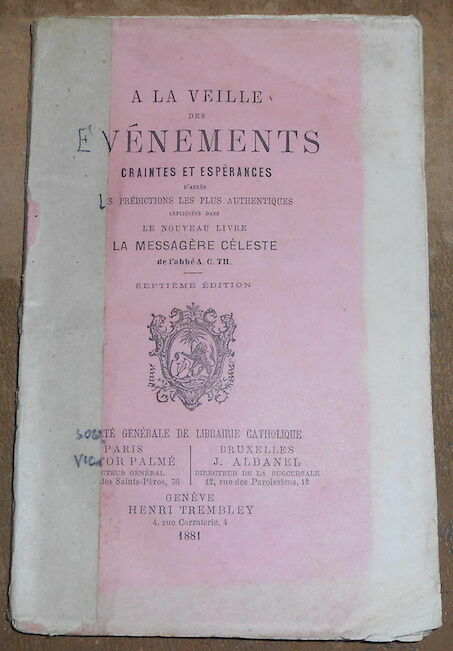
1881155441881. Paris Bruxelles et Genève Éditions Victor Palmé J. Albanel et Henri Trembley 1881 - Broché 12 cm x 18 5 cm pages - Texte de l'Abbé Tholon - Restauré au ruban adhésif état moyen
Casterman 1961, In-8 broché, 222 pages. Bon état.
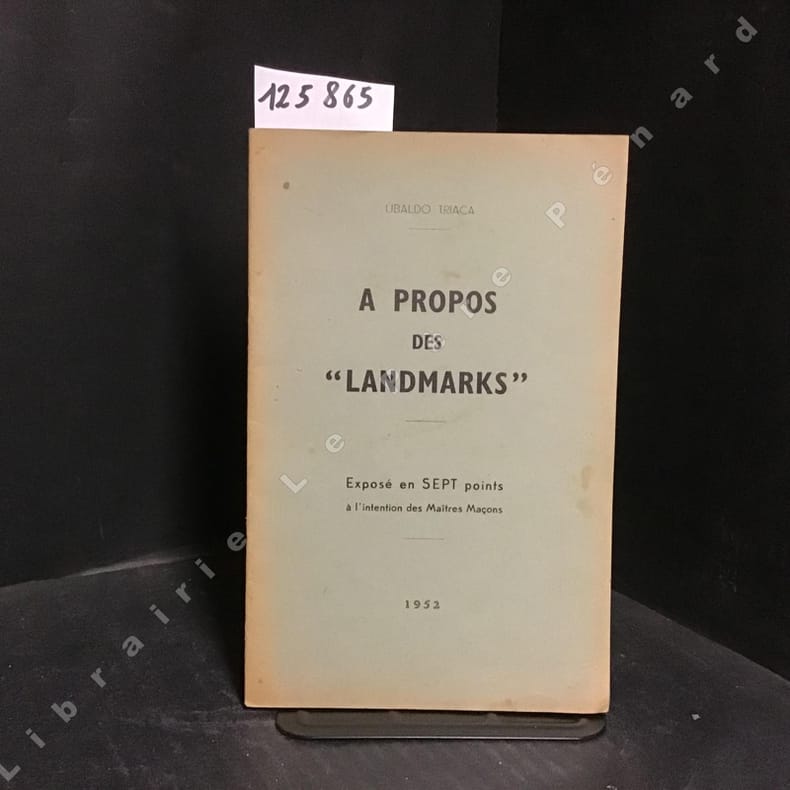
19521258651952 Imprimerie A:. Montourcy, Paris - 1952 - Plaquette in-8 agrafée de 32 pages
Une brochure de format in 8° de 12 pp. Bon état. Peu fréquent. Voir photo.
Un percorso d'amore attraverso le relazioni della co-dipendenza alla libertà.
1976C99988Louvain, 1976 82pp., dans la série "Corpus Scriptorum Christianorum Orientalium" volume 377 (Scriptores Aethiopici, vol.70), 25cm., brochure originale, bon état, [contient le texte en éthiopien], C99988
82pp., dans la série "Corpus Scriptorum Christianorum Orientalium" volume 377 (Scriptores Aethiopici, vol.70), 25cm., brochure originale, bon état, [contient le texte en éthiopien], C99988
New English Paperback. Pbo. Roy. 8vo. (24 x 17 cm). In Turkish. [iv], 340 p. Abdal gizli dili. Inceleme, sözlük.