773 résultats
The preeminent scholar of comparative studies of Indo-European society, Georges Dumézil theorized that ancient and prehistoric Indo-European culture and literature revolved around three major functions: sovereignty, force, and fertility. This work treats these functions as they are articulated through "first king" legends found in Indian, Iranian, and Celtic epics, particularly the Mahabharata. Dumézil, drawing on an extraordinarily broad range of Indo-European sources from Scandinavia to India and offering an original and provocative analytic method, set a new agenda for studies in comparative oral literature, historical linguistics, comparative mythology, and history of religions. The Destiny of a King examines one of the "little" epics within the Mahabharata—the legend of King Yayati, a distant ancestor of the Pandavas, the heroes of the larger epic. Dumézil compares Yayati's attributes and actions with those of the legendary Celtic king Eochaid Feidlech and also finds striking similarities in the stories surrounding the daughters of these two kings, the Indian Madhavi and the Celtic Medb. When he compares these two traditions with the "first king" legends from Iran, he finds such common themes as the apportionment of the earth and the "sin of the sovereign. " Contents: Yayati and his Sons; Yayati and his Daughter's Sons; Vasu Uparicara; Madhavi; Eochaid Feidlech, His Daughers and his sons; Perspectives. ; 6.89 x 0.81 x 4.18 Inches; 170 pages
Slight fraying to spine ends. Minor wear to corners. Rubbing to boards. Minor foxing. Blindstamp to titlepage "presentation copy". Former classics scholar's name on ffep (D. O. Robson). ; Handbooks of Archaeology and Antiquities; 373 pages
Minor shelfwear. Endpapers browned. Scholars' bookplate to inner cover (Slater & Dunbabin). Scholar's name to inner cover (J. B. Clinard). Chipping to spine ends and corners. ; 373 pages
Very minor shelfwear. ; Contents: Quintus of Smyrna and Siege of Troy; Weaver's Life in Oxyrhynchus; Some Ancient Analogues of Consideration; Sources of Aristotle's Poetics; History of the Name of the Temple of Castor in the Forum; Sophocles' Place in Greek Tragedy; "No Trespass" in Latin Linguistics; Leonardo Bruni's Translation of Act I of Plutus of Aristophanes; From Monte Gianicolo; Ancient wit and humor; Cliens in the time of Martial; Papyrus 1804 in the Michigan collection; Aniconic worship Among the Early Romans; Epigraphica; age of Roman Sacrificial Victims. ; 1 x 9.25 x 6.25 Inches
Book is fine. DJ has very minor shelfwear. DJ spine very lightly sunned. ; 194 pages
1.25 x 10 x 6.75 Inches; 288 pages; In recent years, the topic of ancient Greek hero cult has been the focus of considerable discussion among classicists. Little attention, however, has been paid to female heroized figures. Here Deborah Lyons argues for the heroine as a distinct category in ancient Greek religious ideology and daily practice. The heroine, she believes, must be located within a network of relations between male and female, mortal and immortal. Using evidence ranging from Homeric epic to Attic vase painting to ancient travel writing, she attempts to re-integrate the feminine into our picture of Greek notions of the hero. According to Lyons, heroines differ from male heroes in several crucial ways, among which is the ability to cross the boundaries between mortal and immortal. She further shows that attention to heroines clarifies fundamental Greek ideas of mortal/immortal relationships. The book first discusses heroines both in relation to heroes and as a separate religious and mythic phenomenon. It examines the cultural meanings of heroines in ritual and representation, their use as examples for mortals, and their typical "biographies." The model of "ritual antagonism," in which two mythic figures represented as hostile share a cult, is ultimately modified through an exploration of the mythic correspondences between the god Dionysos and the heroines surrounding him, and through a rethinking of the relationship between Iphigeneia and Artemis. An appendix, which identifies more than five hundred heroines, rounds out this lively work.
Book in plastic sleeve. Light Foxing/dustsoiling to book and DJ. Else very minor shelfwear. ; 1.25 x 10 x 6.75 Inches; 288 pages; In recent years, the topic of ancient Greek hero cult has been the focus of considerable discussion among classicists. Little attention, however, has been paid to female heroized figures. Here Deborah Lyons argues for the heroine as a distinct category in ancient Greek religious ideology and daily practice. The heroine, she believes, must be located within a network of relations between male and female, mortal and immortal. Using evidence ranging from Homeric epic to Attic vase painting to ancient travel writing, she attempts to re-integrate the feminine into our picture of Greek notions of the hero. According to Lyons, heroines differ from male heroes in several crucial ways, among which is the ability to cross the boundaries between mortal and immortal. She further shows that attention to heroines clarifies fundamental Greek ideas of mortal/immortal relationships. The book first discusses heroines both in relation to heroes and as a separate religious and mythic phenomenon. It examines the cultural meanings of heroines in ritual and representation, their use as examples for mortals, and their typical "biographies." The model of "ritual antagonism," in which two mythic figures represented as hostile share a cult, is ultimately modified through an exploration of the mythic correspondences between the god Dionysos and the heroines surrounding him, and through a rethinking of the relationship between Iphigeneia and Artemis. An appendix, which identifies more than five hundred heroines, rounds out this lively work.
Former owner's name deleted to ffep in pen. Else book is fine. Browning to DJ spine. Light sticker residue to front panel. ; 160 pages; Most modern studies of Athenian religion have focused on festivals, cult practices, and individual deities. Jon Mikalson turns instead to the religious beliefs citizens of Athens spoke of and acted upon in everyday life. He uses evidence only from reliable, mostly contemporary sources such as the orators Lysias and Demosthenes, the historian Xenophon, and state decrees, sacred laws, religious dedications, and epitaphs. "This is in no sense a general history of Athenian religion," Mikalson writes, "even within the narrow historical boundaries set. It is rather an investigation of what might be termed the consensus of popular religious belief, a consensus consisting of those beliefs which an Athenian citizen thought he could express publicly and for which he expected fo find general acceptance among his peers." What emerges in Mikalson's study is a remarkable homogeneity of religious beliefs at the popular level. The topics discussed at length in Athenian Popular Religion include the areas of divine intervention in human life, the gods and human justice, gods and oaths, divination, death and the afterlife, the nature of the gods, social aspects of popular religion, and piety and impiety. Mikalson challenges the common opinion that popular religious belief in Athens deteriorated significantly from the mid-fifth to the mid-fourth century B. C. "The error in understanding the development of Athenian religion has arisen, it seems to me, because scholars have failed to distinguish properly between the differing natures of the sources for our knowledge of religious beliefs in the earlier and later periods," Mikalson writes. The difference between those sources "is more than simply one of years. It is a difference between poetry and prose, with all the factors which that difference implies."
Dust-soiling to top of textblock. Minor shelfwear. ; Reprint of the 1939 ed. Published by C. W. K. Gleerup, Lund, which was issued as v. 29 of Skrifter utgivna av Kungl. Humanistiska vetenskapssamfundet I Lund. ; Ancient Religion and Mythology; 300 pages
Pages tanned. Browning to spine. Minor bump to top of spine. Small tear to base of spine (1/2 cm). ; Includes Greek Text, Italian translation, introduction and commentary. ; Testi E Documenti Per Lo Studio Dell'antichità LII; 141 pages
Text in Greek; editorial matter in Latin. ; Bibliotheca Scriptorum Graecorum Et Romanorum Teubneriana TEUBNER; 124 pages
Very light shelfwear to DJ. ; 26 römische Gottheiten sind in diesem Band jeweils in einem eigenen Kapitel behandelt: 12 weibliche und 14 männliche darunter so bekannte wie Jupiter, Juno und Minerva, aber auch weniger prominente wie Mater Matuta, Silvanus und Veiovis; 319 pages
Light Foxing to DJ flaps and textblock. Else very minor shelfwear. Book in plastic sleeve. DJ a bit yellowed. ; This collection of nineteen essays delves into themes such as: death, the body, the soul, the individual, and relations between mortals and immortals; the mask, the mirror, the image, and the imagination; the self and the other, and the concept of otherness itself, or "alterity." "Vernant's work ranges across the entire field of ancient Greek religion, philosophy, and literature and joins exacting philological scholarship to exciting and innovative theoretical paradigms. Not since Jane Harrison and Gilbert Murray has a classicist commanded the attention of non-classicists in the way Vernant has over the last twenty-five years." --Choice; 352 pages
Book has been rebound in maroon boards with dark red spine label. Pages browned. Pencilling to titlepage. A few pages are close to falling out. Contents a bit shaken. ; 534 pages
Titlepage loose but present. Last couple of pages are also loose but present. 1/4 leather boards. Boards edgeworn with boards a bit exposed to extremities. Scholars' bookplate to inner cover (Slater & Dunbabin). ; Handbuch Der Klassischen Altertumswissenschaft, Band, 5. Abeteilung 4; 612 pages
Scratches to back panel of DJ else fine. ; 192 pages; In the earliest extant works of Greek literature, Zeus reigns supreme in the Olympian hierarchy. However, scattered and scanty though they may be, there are allusions to threats of rebellion which challenge Zeus' supremacy. This book examines these passages, drawn from Homer, Hesiod and the Homeric Hymns, to offer some new interpretations. While focusing on the theme of cosmic/divine strife, it becomes clear that hints of lost legends underlie these texts. Tracing their hidden logic helps to improve our understanding of early Greek poetry.
1895110873Librairie de l’Art inépendant 1895 In-8 20 x 13 cm. Broché, titre en noir sur le dos et le premier plat, 116 pp. Dos bruni, pages non coupées.
1924134763Paris, Chacornac 1924 In-8 22,5 x 14 cm. Broché, couverture rouge auteur & titre en noir sur le dos et le premier plat de couverture orné d’une vignette, 164 pp., notes, table des matières.
Shelfwear book and dustjacket. Rounding to top of spine. Light pencil underlining on a few pages. ; It is a study of the Roman world in the first five centuries after Christ, and it tells the story of the historically improbable oddity of how a religious cult centered on an obscure construction worker living in the backwaters of a great Empire supplants the sophisticated Classical European religious worldview that had been embraced for thousands of years. Of particular interest to me was the story of Julian the Apostate, the last Roman emperor to openly embrace paganism. The author generously devotes an entire chapter to this remarkable personage. Although Julian was a nephew of Emperor Constantine and was raised as a Christian, he renounced the "new" religion when he became an adult and embraced the gods of his fathers. Because Julian ruled the Empire for a scant three years, he had insufficient time to turn back the tide of religious history, and we are left to wonder how things might have been different if he had ruled for 30 years instead. The author's sympathetic portrayal of this little-known Emperor lent a touching air of wistfulness to the sad story of the clash of Christianity with Paganism. ; 280 pages
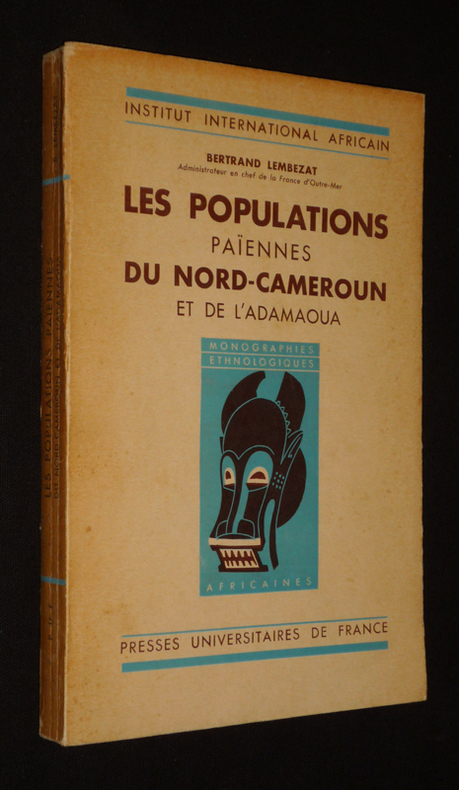
1961vh151Presses Universitaires de France Monographies ethnologiques africaines Broché 1961 In-8 (15,7 x 24 cm), broché, 252 pages ; pliure au dos, couverture brunie, quelques traces sur les tranches, assez bon état par ailleurs. Livraison a domicile (La Poste) ou en Mondial Relay sur simple demande.
9.1 X 6.1 X 1.1 inches; 413 pages
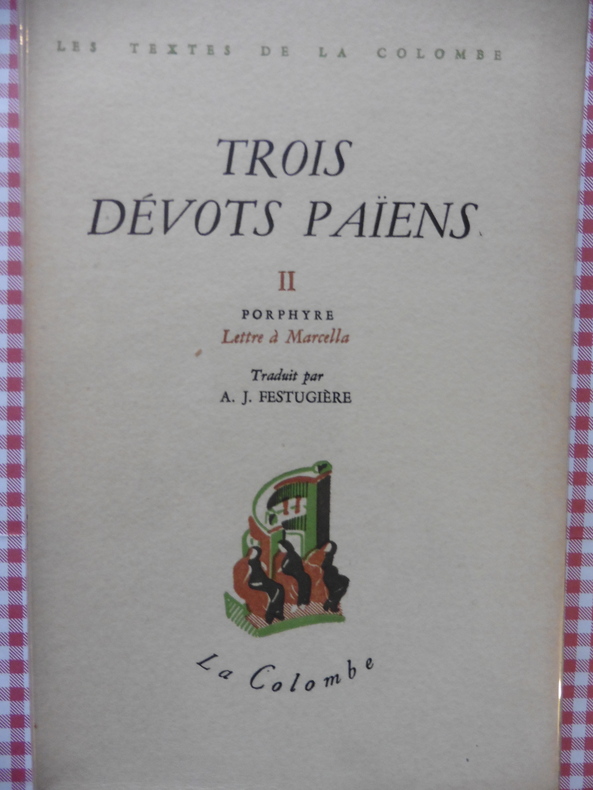
1944ZNF-381Présentation en 3 livrets de textes classiques traduits du grec ancien, collection Les textes de la colombe, éditions du Vieux Colombier, 1944. Exemplaires sur Vélin de Rives.
1868GITg893Paris Bray, Nancy chez Collin 1868. 2 volume in-8 XX 302pp et 376pp. Demi chagrin anthracite, dos à nerfs orné de fleurons finement dorés, plats de percaline brun foncé avec les fers dorés du lycée de Nice au centre du 1er, reliure de l'époque. Intéressantes annotations anciennes, à l'encre, en marge de quelques pages, réfutant les affirmations de l'auteur. Bel exemplaire très frais et bien complet, reliure solide, en très bon état et décorative.
1891GITh316Paris Hachette 1891. In-8 462pp. Demi vélin ivoire à coins, dos lisse, pièces de titre et de tomaison rouges, tête brique, reliure de l'époque. Rousseurs par endroits, petit manque en tête de la pièce de titre, reliure solide et en bon état. TOME I SEUL complet de son texte et des sujets traités (conversion de Constantin, Christianisme et éducation romaine, conséquences de l'éducation païenne sur les auteurs Chrétiens, conversion de Saint Augustin, "Manteau" de Tertullien, fusion des éléments sacrés et profanes. (4569)
xvi + 385pp., in the series "Studien und Texte zu Antike und Christentum. Studies and Texts in Antiquity and Christianity" vol.3, text in English, 23cm., softcover, previous owner's name on first title page, else in very good condition, R101117