773 résultats
Foxing to wraps. Minor rubbing. ; Iconography of Religions XVII, 3; 10.0 X 7.1 X 0.3 inches; 39 pages
Light scratches to rear panel with minor edgewear to wraps. Light soiling to ffep. ; Text is Greek with short abstracts in English. ; 200 pages
Dustjacket has minor shelfwear and rubbing. Light Bumping to bottom of spine. ; Ancient Society and History; 1.68 x 8.76 x 8.78 Inches; 632 pages; Historians who viewed imperial Rome in terms of a conflict between pagans and Christians have often regarded the emperor Constantine's conversion as the triumph of Christianity over paganism. But in Constantine and the Bishops, historian H. A. Drake offers a fresh and more nuanced understanding of Constantine's rule and, especially, of his relations with Christians. Constantine, Drake suggests, was looking not only for a god in whom to believe but also a policy he could adopt. Uncovering the political motivations behind Constantine's policies, Drake shows how those policies were constructed to ensure the stability of the empire and fulfill Constantine's imperial duty in securing the favor of heaven. Despite the emperor's conversion to Christianity, Drake concludes, Rome remained a world filled with gods and with men seeking to depose rivals from power. A book for students and scholars of ancient history and religion, Constantine and the Bishops shows how Christian belief motivated and gave shape to imperial rule.
Very Good English Original yellow cloth bdg. Cr. 8vo (20 x 14 cm). In German. 327, [2] p. Das Lieblingsvolk Buddhas. Die Burmanen und ihr lebendiger Glaube.
Minor yellowing to boards. Scholar's name to inner cover (Cedric Boulter). ; 125 pages
New Persian Paperback. Roy. 8vo. (24 x 17 cm). In Persian with a bilingual title in English and Persian. [10], 321 p. Pre-Islamic Iran: Understanding and critique of historical sources from the entry of Arians Until the collapse of Sassanid Empire.= Bâzshinâsî-i manâbi? va maâkhiz-i târîkh-i Îrân-i bâstân: Az vurûd-i âryâyîhâ tâ suqût-i impirâtûrî-i Sâsânî.
New Persian Paperback. Roy. 8vo. (24 x 17 cm). Text is in entirely Persian with a bilingual title in English and Persian on cover. [10], 482 p. Islamic civilization in Abbasid's period.= Tamaddun-i Islâmî dar 'asr-i 'Abbâsiyân.
Very faint shelfwear. ; In this account, Alexandra Richardson reveals (as she says in her introduction) her quest to get to know a ‘remarkable man who wholly dedicated his later life and finances to restoring and excavating what is surely one of the finest classical Greek sites in the Western Mediterranean. I rapidly began to be drawn in to the sketchy, sometimes speculative, details surrounding the remarkable Captain Hardcastle…I thought back to his unlit villa beside the theatrically shining temples, and the more I got to know the man, the more it seemed entirely in keeping with his personality that his former home should still be not be sharing the spotlight with the great monuments he was so intimately involved with. He remained a mysterious and private person who kept his own counsel throughout life. I was to discover that he wrote very few letters home to his family from the Far East, South Africa, Italy. And when he did write to the chosen few, I had to learn to read between the lines. Luckily his own family wrote to one another making mention of him…With so little to go on, it was just the sort of challenge that a researcher relishes. The Anglo-Italian theme was yet another appeal, my instinctive habitat. No full-scale biography had ever been written about him and thus I was not stepping on any toes. I had the field all to myself, piecing together a profile from many sources, set largely in a period of modern Sicilian history, the 1920s and early ‘30s rarely “popularised” by foreign writers. That was all how the four-year journey began...’ 'This book is the labour of years of research and scholarship. In Alexandra Richardson's book, the personality of Alexander Hardcastle comes to life in all its many facets. Her detailed account of the history of Agrigento is historically correct and written in a fluid style. Her descriptions of Sicily are accurate and lyrical, her cameos of Sicilians witty and a pleasure to read. Richardson's rigorous research describes his painful and determined iter from London to Girgenti, his stubborness and his resilience.' - Simonetta Agnello Hornby, 'The Almond Picker' ; Archaeological Lives; 9.5 X 6.6 X 0.3 inches; 143 pages
This study focuses on the "saucer pyres," a series of 70 deposits excavated in the residential and industrial areas bordering the Athenian Agora. Each consisted of a shallow pit, its floor sometimes marked by heavy burning, with a votive deposit of pottery and fragments of burnt bone, ash, and charcoal. Most of the pots were miniatures (including the eponymous saucers) but a few larger vessels were found, along with offerings associated with funerary cult. The deposits represent a largely Athenian phenomenon, with few parallels elsewherre. When first found in the 1930s, the deposits were interpreted as baby burials. Recent zooarchaeological analysis of the bones, however, reveals that they are the remains of sheep and goats, and that the deposits were sacrificial rather than funerary. The present study investigates the nature of those sacrifices, taking into account the contents of the pyres, their spatial distribution, and their relationship to buildings around the Agora and elsewhere. In light of a strong correlation between pyres and industrial activity, the author argues that the pyres document workplace rituals designed to protect artisans and their enterprises. ; Hesperia Supplement 47; 200 pages
Exact Reprint of the Tetypeset original (1809) Chicago 1930 ARES PUBLISHERS INC. In his school edict Julian prohibits Christian teachers from using pagan scripts e. G. The Illias, that formed the core of Roman education. This was an attempt to remove some of the power of Christian schools by alienating their students from Roman society, not to mention a satirical attack at what Julian may have viewed as a hypocrisy: Christian schools teaching the Bible as the sole source of knowledge while simultaneously teaching classical pagan texts as well, knowledge of which was needed for success in Roman society. In his tolerance edict of 362, Julian decreed the reopening of pagan temples, the restitution of alienated temple properties, and called back Christian bishops that were exiled by church edicts. The latter was an instance of tolerance of different religious views, but may also have been an attempt by Julian to widen a schism between different Christian sects, further weakening the Christian movement as a whole. ; 8.25 x 0.5 x 5.5 Inches; 119 pages
Very light edgewear else fine. ; De Rome à La Troisième Rome. Documents Et Études 1; 196 pages
Very light shelfwear to DJ else Fine. ; 270 pages; This book examines the connection between political and religious power in the pagan Roman Empire through a study of senatorial religion. Presenting a new collection of historical, epigraphic, prosopographic and material evidence, it argues that as Augustus turned to religion to legitimize his powers, senators in turn also came to negotiate their own power, as well as that of the emperor, partly in religious terms. In Rome, the body of the senate and priesthoods helped to maintain the religious power of the senate; across the Empire senators defined their magisterial powers by following the model of emperors and by relying on the piety of sacrifice and benefactions. The ongoing participation and innovations of senators confirm the deep ability of imperial religion to engage the normative, symbolic and imaginative aspects of religious life among senators.
Fine English Original bdg. HC. Roy. 8vo. (24 x 17 cm). In Turkish. [xii], 955, [11] p., color ills. Uluslararasi Anadolu Inançlari Kongresi Bildirileri, 23-28 Ekim 2000, Ürgüp / Nevsehir.
1921104899Paris, Desclée De Brouwer & Cie, Auguste Picard 1921 In-4 25,5 x 16,5 cm. Broché, couverture bleu-ciel, titre en bleu marine sur le dos et le premier plat, VII-438 pp., 252 figures, notes en bas de page, table analytique, index. Exemplaire en bon état.
1863Q119067Paris, Vrayet de Surcy 1863 lxvi + 437pp., 25cm., reliure cart. (plats marbrés, dos en toile), cachet, quelques rousseurs occasionnelles, cfr. Caillet 7599, Q119067
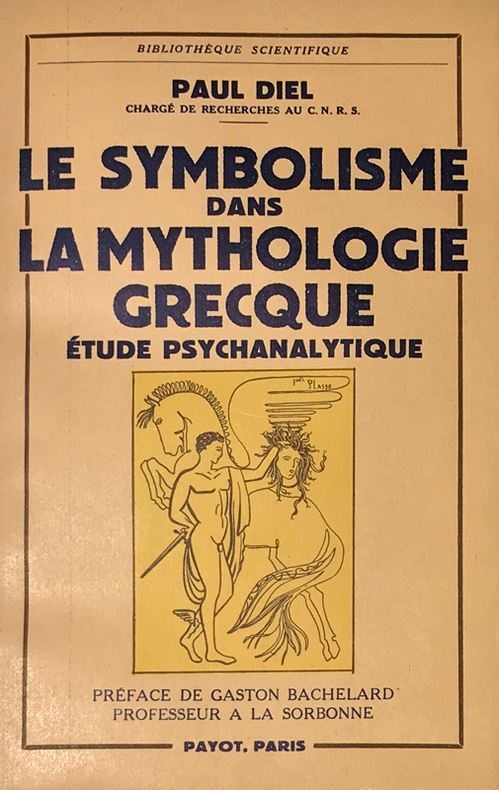
195214978Paris, Payot, 1952 ; in-8, broché ; 310 pp., (4) ff. de catalogue, couverture illustrée d'un dessin de Joel Plasse imprimée en jaune, brun et bleu marine.
1838103031838 Paris chez Périsse frères, 1838; in-12° pleine basane mouchetée de l'époque, dos lisse orné en long, titre doré sur étiquette de maroquin olive, tranches marbrées; XII - 288 - (2)pp.
1872GITc712Paris Firmin Didot 1872. Grand in-8 492pp. Demi chagrin tabac, dos à nerfs, tête dorée, non rogné, reliure de l'époque. Orné de 95 gravures dessinées par Racinet, Bénard etc dont 16 hors texte.
1875GITe573Paris Victor Palmé 1875. In-8 II 351pp. Demi chagrin rouge, dos à 4 nerfs rehaussés d'un filet perlé, reliure de l'époque. Bel exemplaire, bien complet et bien relié.
1914R47201Louvain, 1914 xvi + 160pp., br.orig., 26cm., non coupé, bel état, dans la série "Université de Louvain. Recueil de travaux publiés par les membres des conférences d'histoire et de philologie" 1e série 43e fasc., R47201
xvi + 160pp., br.orig., 26cm., non coupé, bel état, dans la série "Université de Louvain. Recueil de travaux publiés par les membres des conférences d'histoire et de philologie" 1e série 43e fasc., R47201
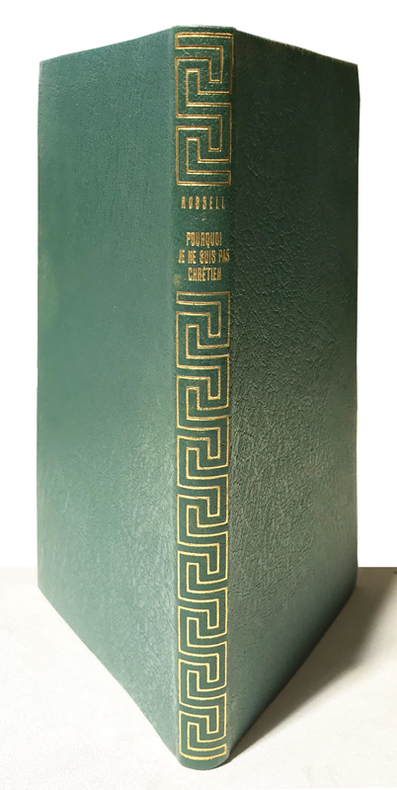
196014989Paris, Guilde Ernest Renan (Genève, Krundig), collection "Raison et Croyance" dirigée par le Professeur Louis Rougier, 1960 ; in-8, plein skinvertex vert, décor de grecque dorée au dos, titre doré (reliure éditeur) ; 380, (6) pp., imprimé sur vélin fin.
Light edgewear. Minor creasing; Acta Universitatis Upsaliensis Boreas. Uppsala Studies in Ancient Mediterranean and Near East Civilization 18; 10.2 X 7.3 X 0.3 inches; 120 pages
Very light shelfwear. ; Ausonius Éditions Scripta Antiqua 16; 9.1 X 6.7 X 0.8 inches; 278 pages