442 résultats
65396Paris, Editions Occulta, 1937. 12 x 19, 256 pp., plusieurs dessins, broché, bon état (couverture légèrement défraîchie).
44667Paris/Bruxelles, Editions Sophora, 1989. 16 x 23, 176 + xxvi pages, nombreuses figures, broché, bon état (couverture légèrement pliée à l'avant).
193286504Paris Les Editions Leymarie 1932, in-8, broché, 206p. Hormis quelques rousseurs sur la couverture, bon état. "Elvezia Gazzotti, dite Lotus de Païni est née italienne dans la région de Ferrare. Elle utilisa les pseudonymes suivants : Lotus Péralté, L.E. de Païni, L. de Païni. Sa mère étant française, elle passe son adolescence sur la Côte d'Azur, avec sa soeur Fiametta, et y suit des cours de peinture. En 1888 ou 1889, elle envoie à un Salon parisien un premier tableau qui est aussitôt remarqué, et qui inaugure sa carrière de peintre. Elle se marie vers 1890 au baron italien Nicolas Païni, qui riche rentier cela va sans dire possède une résidence à Nice, et dont elle divorcera après quelques années. A partir de 1897 elle habite Paris et y expose sous sa nouvelle signature de "Lotus". Elle est dès ce moment sous l'influence de la théosophe Helena Petrovna Blavatsky. En 1900 elle se remarie d'ailleurs à Londres avec un médecin, Paul Pératé, devenu par la suite Péralté, après avoir avec lui rejoint la Société Théosophique. Avec son nouvel époux, Lotus entreprend les traditionnels pélerinages initiatiques de l'Inde (1904) et de l'Egypte (1910). Elle en revient passionnée d'égyptologie et son mari et elle nouent alors de fortes relations avec le musée Guimet. Dès 1908, elle a commencé à écrire et certains de ses articles sont clairement ésotériques. Un des traits marquants de son oeuvre est un primitivisme philosophique proche en un sens de Paul Gauguin ou du Douanier Rousseau en peinture. Elle a écrit 8 livres." (source Julien Champagne).
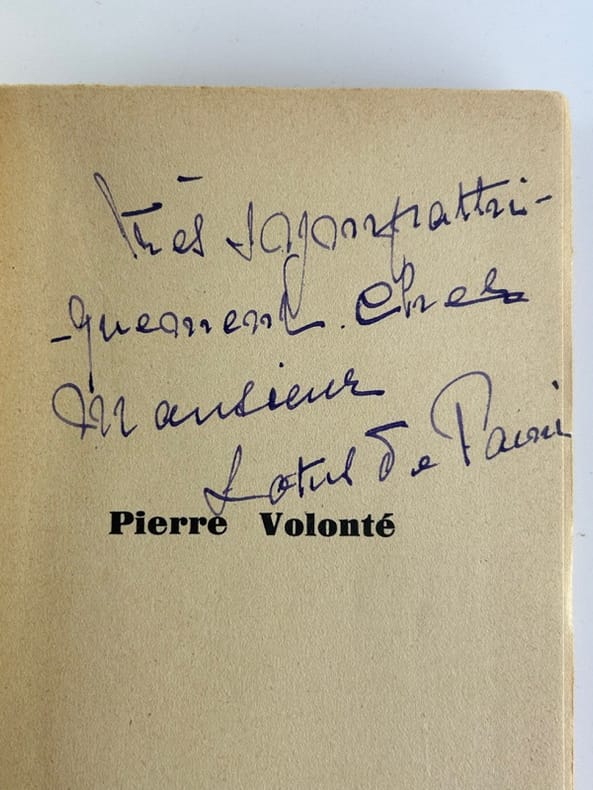
81913Paris, Editions Médicis, 1939. 14 x 20, 213 pp., broché, bon état (couverture défraîchie).
177022246Paris Aux dépens des Libraires associés 1770 in-12 plein-veau 3 parties reliées en un volume, reliure plein veau marbré (binding full marbled calfskin in-12) havane in-douze(17 x 10 cm), dos 5 nerfs (spine with raised bands), décorations "or" et à froid, titre frappé "or", pièce de titre sur fond marron-clair avec filet et roulette "or" en encadrement, filet à froid de part et d'autre des nerfs, entre-nerfs à fleuron (floweret) "or" dans un encadrement à filet et roulette "or" avec rinceaux "or" aux angles, roulette "or" en tête et en pied, coins écornés, filets "or" sur les coupes avec manque de dorure, tête lisse, toutes tranches lisses peignées bleu et rouge, EX-LIBRIS : AUGIER DE LA TERRAUDIERE, sans illustrations, pagination au feuillet : [(23 p. de table) + 169 (1ère partie) + [7]) + 169 (seconde partie)] + [(24) + 60 + (2 p. de privilège)] pages, 1770 Paris Aux dépens des Libraires associés Editeurs ,
2110502150906830Not Available N.A. Soft Cover. Fine. Number of books: 2 Not Available paperback
2021500092347BUSSIERE 2021 168 pages 15 5x23 9x1 4cm. 2021. Broché. 168 pages.
19175[Paris, Pierre Drouart, 1549 ?]. In-8, non paginé [110] ff., a2-o8 (o8 f. bl.), veau marbré brun de l'époque, triple filet doré en encadrement sur les plats cantonnés de fleurons dorés, dos à nerfs orné de caissons et fleurons dorés, tranches mouchetées (coiffes arasées, coins émoussés, épidermures, 2 petites mouillures angulaires, quelques rousseurs et taches, a1 manquant - titre - pas de marque typographique en fin de volume).
198777267Dervy Livres Malicorne sur Sarthe, 72, Pays de la Loire, France 1987 Book condition, Etat : Bon broché, sous couverture imprimée à rabats éditeur noire, illustrée de figures géomantiques grand In-8 1 vol. - 157 pages
198790492Dervy Livres Malicorne sur Sarthe, 72, Pays de la Loire, France 1987 Book condition, Etat : Très Bon broché, sous couverture imprimée à rabats éditeur noire, illustrée de figures géomantiques grand In-8 1 vol. - 157 pages
198775933Dervy Livres Malicorne sur Sarthe, 72, Pays de la Loire, France 1987 Book condition, Etat : Moyen broché, un papier marron a été collé sur la couverture grand In-8 1 vol. - 157 pages
1885064272London: Ward Lock & Co. 1885. Book. Poor. Hardcover. Hand-typed paper label with title and author scotch-taped to spine endpapers have been reinforced with paper and binding tape. Contents/text Very Good. 319pp. Bookplate of late astrologer Alma Crawford Graining on fly. Ward, Lock & Co. Hardcover
1898005345Chicago: Rand McNally 1898. Book. Near Fine. Cloth. First Edition. Very nice copy in olive cloth with gilt stamping. Decorative owner bookplate on pastedown. Tight copy. SCARCE. Rand McNally Hardcover
1898012741Chicago: Rand McNally 1898. Book. Near Fine. Hardcover. Clean bright copy in gilt-stamped olive cloth. Palmistry. Rand McNally Hardcover
200046122Paris, Grancher, 2000, Broché, 249 pages. Bon exemplaire. Epuisé.
200485605Editions Jacques Grancher , ABC Malicorne sur Sarthe, 72, Pays de la Loire, France 2004 Book condition, Etat : Bon broché, sous couverture imprimée éditeur bleu, blanc et rouge, illustrée d'une figure ronde avec des héxagrammes fort In-8 1 vol. - 453 pages
74596Paris, Jacques Grancher, 1991. 14 x 22, 175 pp., très nombreuses figures, broché, bon état.
in-8°, 220 pp., figures, cartonnage illustre plastifie. Tres bel exemplaire. [109B-11]
138874Editions Dangles Paris 1951 In-8 ( 225 X 140 mm ) de 230 pages, broché. Comportant une importante étude critique consacrée au problème Typologique. Préface du Professeur Paul Meriel. Dessins et schémas de Jean de Luigné. Bel exemplaire.
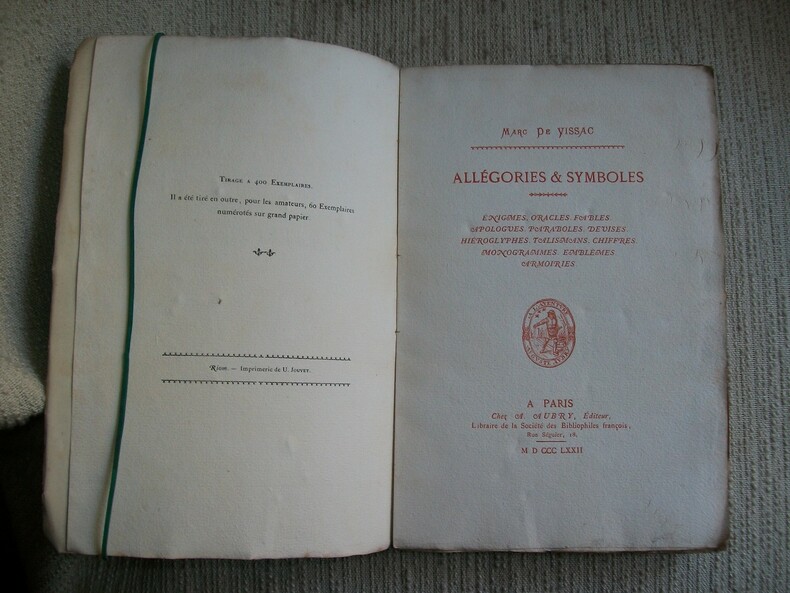
1872GITj552A paris chez Aubry 1872. In-8 broché VIII 247pp 1 feuillet non chiffré table. Tiré à 400 exemplaires, celui-ci 1 des 340 non justifiés imprimés sur beau papier. Couverture poussiéreuse avec manques de papier sur le dos, intérieur en bon état et complet. Caillet 11240.
19942091502135413109Hebei Science and Technology Publishing House 1994. Soft Cover. Fine. Number of books: 4 Hebei Science and Technology Publishing House paperback
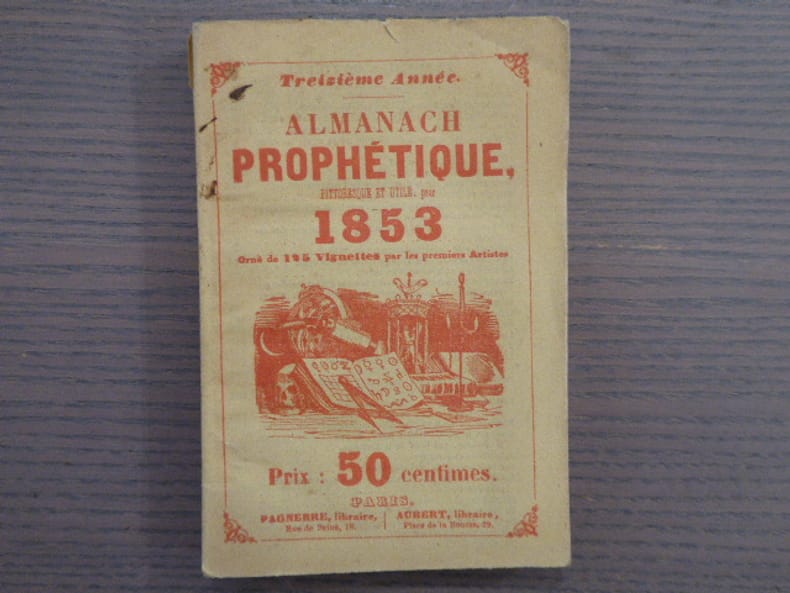
430960Pagnerre Libraire - Aubert Libraire Paris 1853 In-12 carré ( 140 X 95 mm ) de 192 pages, broché sous couverture imprimée. 125 vignettes dans le texte par GAVARNI, DAUMIER, TRIMOLET. EDITION ORIGINALE. Petites taches sur la couverture, bon exemplaire.
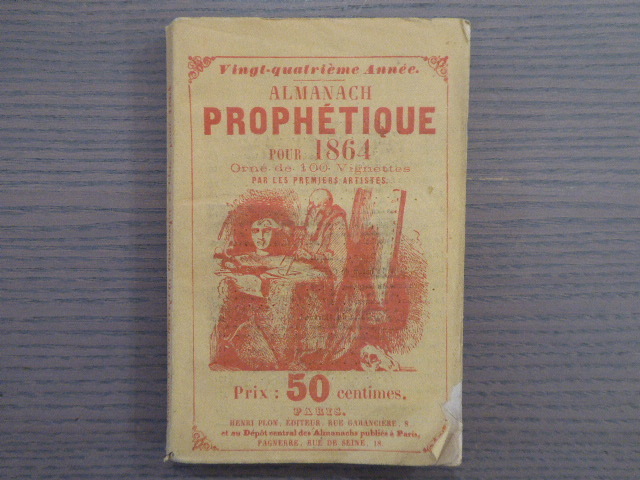
779868Henri Plon, Editeur - Pagnerre Paris 1864 In-12 carré ( 140 X 95 mm ) de 175 pages, broché sous couverture imprimée. 100 vignettes dans le texte par GAVARNI, DAUMIER, TRIMOLET. EDITION ORIGINALE. Petit manque à la couverture, bon exemplaire.
197322898X.Gpaperback. Good. Access codes and supplements are not guaranteed with used items. May be an ex-library book. paperback
22024201China ca. 20th century. A hanging scroll very good 34 x 95 cm. image 32.5 x 21.5 cm. mounted on buff silk small mend on lower part of silk image not affected else solid 3 cinnabar chops/seal. OBSCURE AND RARE WORK The work shows two faces: one female right one male left and are both woodblock printed on two joined sheets then the whole is mounted on an attractive hanging scroll with silk additions. This exact work was used to illustrated item 110 p. 127-8 in Ecke's work: CHINESE FOLK ART II: see below for bibliographic citation. We now quote and summarize what she stated about this work: "The woman's face is divided in half vertically by thirteen horizontally placed sections of Chinese characters which vary in the number of individual characters they contain. The characters are terms of physiognomy and a reading of the history of the woman's life past present and future can be taken from the sections. The characters on the man's face also denote a reading. Around the center of his face between the eyes & above the bridge of the nose are twelve sections which encircled the words. The physiognomic terms for this man are numbered. From the placement of the characters on his face one can read about the people in his life including his relatives and about his own health and fortune. Below the facial diagrams are definitions of the terms." PROVENANCE: The work was acquired directly from Prof. Richard C. Rudolph 1909-2003 the late great author professor and scholar of Chinese studies at the University of California Los Angeles. His cinnabar chop is found in the lower center. As per Ecke this work was mounted as a hanging scroll or Kakejiku in the Japanese style. It has delicate pale yellow silk brocade mounting with a beige silk above that. It is likely that Prof. Rudolph collected these silks in China during his 1948-49 collecting trip. Google him for copious details. ABOUT THE SEALS OR CHOPS: This copy was loaned to Ecke for her book and used in the exhibition at LACMA see below for more details. Our copy is the actual one exhibited in the book Prof. Rudolph affixed his seals to it prior to sale as was his habit. THE SCROLL & MOUNTING: As per Ecke this work was mounted as a hanging scroll or Kakejiku in the Japanese style it is 34 cm. wide 95 cm. long in all. The actual image is 31.5 x 32 cm. and consists of actually two images joined together. The mounting silk is a pale yellow brocade with beige silk above that a very clean nice mounting. It is likely that Prof. Rudolph collected these silks in China during his 1948-49 book buying trip. Google him for copious details. For a more in-depth discussion of this Chinese medical practice see Lessa below who illustrates a similar male face on p.51 fig. #5 and throughout several very similar examples. He explains the thirteen parts in much detail. The whole of chapter 4 is on the face and head he also offers much valuable insight to the significance of reading the face and its associated meanings. The Chinese have reduced the reading of facial attributes to a medical science per Lessa: "No people have exceeded the Chinese in their efforts to determine character and destiny by the very scrutiny of the body itself. In China the documentation is ancient and begins at the time before that of Confucius 220 B.C." He also discusses the "Six Treasuries Three Forces and Three Sections;" also the "Five Planets Six Stars Five Mountains and Four Rivers;" the "Twelve Temples and Five Senses;" in facial line reading. The "Thirteen Parts" resembles our example in that half of the face is covered with explanatory text covering these "parts." All were extracted from Ku China 1728. He further details on pp.54-55 the meanings of lines on the face marks and significance. Moles ear eye nose eye brow and forehead also has their various readings. This text supports the information found on this set of prints we now offer. BIBLIOGRAPHY: Tseng Yu-ho Ecke: CHINESE FOLK ART I see #58 p.90 91 which again cites and illustrates this exact work. Tseng Yu-ho Ecke: CHINESE FOLK ART II: page 127 illustrates this exact item offered see our scan for a copy of this article and example her # 110. Another identical example is found illustrated & described in the Los Angeles County Museum of Art Member's Calendar July 1977 vol.14 no.7. This example is again the one used in the Ecke book loaned to her by Prof. Rudolph ergo this item offered. William A. Lessa: CHINESE BODY DIVINIATION: Its Forms Affinities and Functions. This resource is valuable as it illustrates and discusses in much detail this sort of print and its significance. See chapter 4 pp.41-88 and figures plates 1-17. A very fascinating item and unusual subject seldom found on the market. The current example is an obscure 20th century reprint of the Sung Dynasty original. Suitable for library display. . unknown