PSALMISTA, et Hymnarum.MareMagnum

6 648 résultats
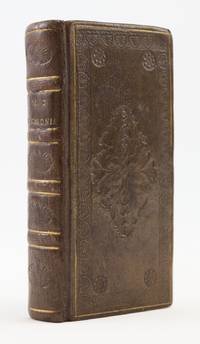
ff. 172 (su 174), legatura inizio '500 in marocchino bruno decorato da bande trasversali alternate a secco e in oro; in testa ad entrambi i piatti impressione a secco "+S+ Emilia". Al primo f. grande iniziale "B" miniata su fondo oro, istoriata all'interno con una finissima figura di Davide in preghiera; la decorazione si estende su 3 margini. In assenza del calendario, l'esame della scrittura, dell'ornamentazione e del testo (litanie ed innario), conducono all'ambiente lombardo e più in particolare ad un ambiente femminile domenicano della regione bresciana. Di notevole interesse la legatura: un ferro assai simile, seppur altrimenti utilizzato, si ritrova su due legature che rivestono edizioni aldine (De Marinis I, 439 e 441, tavv. LXXVIII e LXXVII). Il manoscritto si compone di 17 quaderni di 10 ff. + uno di 4 ff., con richiami. Mancano due fogli tra le attuali carte 12/13 e 16/17. La miniatura misura mm 43x50; nel testo 9 capilettera (mm 40x40) dipinti in blu o rosso su fondo di elaborati e finissimi fregi calligrafici in rosso, verde e seppia. Scrittura semigotica in nero e rosso; notazione musicale quadrata. Il codice, nello stato attuale, non contiene il calendario, né sembra l'attuale legatura averlo potuto contenere, essendo piuutosto stretta e non mostrando segni di asportazione. Di grande interesse è la decorazione della rilegatura. Lo stile della lunga doppia banda verticale (in blu ed oro) che si estende lungo il margine sinistro del primo f. è assai simile a quello dei fogli miniati del Messale romano di scuola lombarda (Brescia, Queriniana, ms. C II 3). Il testo del codice pare avvicinarsi molto a quello del Salterio domenicano commissionato per il monastero domenicano femminile di Santa Caterina di Brescia (Bergamo, Bibl. A.Mai, MA 418). Mentre lo stile della pittura dell'iniziale del f. 1 ricorda parecchio le miniature del Salterio e Innario di scuola lombarda (Brescia, Queriniana, ms. A II 5).. .
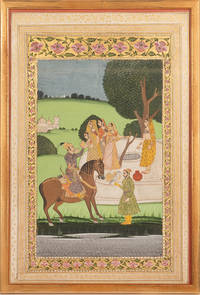
119661Mughal India possibly Murshidabad mid- to late-18th century. . Single miniature painting on card opaque pigments with gold depicting a scene with a Prince on horseback accepting a drink from a gold vessel from a village maiden miniature 282 x 179 mm full album page 394 x 255 mm; painting framed within multiple gilt rulings innermost frame painted with delicate pink and white flowers on a spiralling green vine set against a richly gilt background some very minor surface soiling overall in exceptionally bright and attractive condition framed and glazed.<br /> Scenes painted around imagined amorous encounters between the 'prince and village girl' were popular among artists during the late Mughal period in centres such as Delhi Lucknow and Murshidabad. The concept of 'love at first sight' was similarly echoed in the tradition of the courtly poets of the pan-European middle ages and can be seen echoed through their visual arts.<br /><br />The inspiration behind the theme in this painting was likely rooted in Persian literary sources the Nayrang'i Eshq The Charm of Love by Mughal Sufi poet Ghanimat Kunjahi d. 1695 AD being one such example. Written during a period of considerable Muslim-Hindu cultural interaction the poem was later absorbed into Sanskrit works and grew further in popularity. One notable section of the poem stanza 40.7 describes how in pursuit of a stag Shahid comes upon a village where he is struck by the sight of village girls at a well and is particularly struck by the beauty of Wafa the daughter of the village headsman see C. Shackle Persian Poetry and Q dir Sufism in Later Mughal India: Ghan mat Kunj h and his Mathnaw -yi Nayrang-i 'ishq in The Heritage of Sufism: Volume 3 Late Classical Persianate Sufism Boston 1999. <br /><br />In this painting a beautiful maiden leans across to offer the handsome stranger a drink from the well. Neither appears abashed and their eyes fix upon each other as if a spell has been cast. Of note is the way their hands come together around the vessel of water though they do not touch. The mono green background gives a prominence to this encounter watched by the other village girls. There are subtle details that give context to the scene the stranger's courtly attire and jewelled ruby dagger. His companion's falcon hints at their noble status. By contrast the village girl's sari is tied in the style of a working women as she draws water from the well. For notable examples see Indian Painting 16001870 Oliver Forge & Brendon Lynch New York 2012 and Painting 91 in Domains of Wonder B.N Goswamy & C. Smith 2006.<br /> Mughal India, possibly Murshidabad, mid- to late-18th century. unknown
Grande miniatura su pergamena (mm. 227x313) firmata in maiuscolo dall'artista nell'angolo inf. destro "Nicolaus Balduinus F.". Stupendo foglio miniato di grandi dimensioni e firmato, rarissimo. L'episodio della Vita del Cristo è animato da apostoli e soldati che passano sotto un arco. In primo piano la Vergine. Sullo sfondo raffinata veduta di Gerusalemme. Le opere note di questo pittore miniaturista veneziano del ‘500 sono assai poche e la presente è apparentemente unica ed inedita.. Thieme-Becker V, 186. D'Ancona-Aeschliman p. 39. Favaro, l'arte dei pittori in Venezia e i suoi statuti, p. 141..
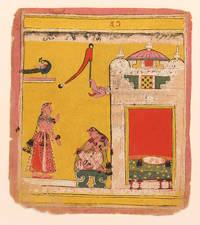
112940India Malwa circa 1630 AD. . Single leaf ink and gouache painting on paper image double-ruled and framed within red borders total leaf 200 x 175 mm; lightly faded with some chipping of paint with slight loss of pigmentation outer edges a little worn contemporary ink inscription to reverse in Sanskrit tipper-into card mount.<br /> Keshav Das d. 1601 was a renowned Indian court poet best known for the Rasikapriya which is considered a pioneering work of Hindu literature dealing with the classification of idealised types of male and female lovers nayakas and nayikas and their emotions and interactions. The work was compiled around the 1590s probably in Bundelkhand to the east of Malwa and the present painting is from a near-contemporary series of illustrations depicting scenes from the poems. Three leaves from the same series are housed in the Ashmolean Museum's collections these all dated c. 1630 also described as Malwa accession nos. EA2012.200 EA2012.202 EA2012.201.<br /> India, Malwa, circa 1630 AD. unknown
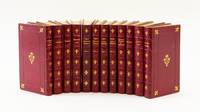
1821ST16814London: William Pickering 1821-31. 85 x 45 mm. 3 1/2 x 1 7/8". 12 volumes. <br/> VERY PLEASING CRIMSON MOROCCO ATTRACTIVELY GILT BY CAPÉ stamp-signed on verso of front free endpaper covers with central gilt fleuron enclosed by blind-ruled frame with oblique gilt floral tools at corners raised bands spine panels with gilt bellflower tool gilt titling turn-ins densely gilt with multiple decorative rolls marbled endpapers all edges gilt. One volume recently placed in a remarkably faithful replica binding. Engraved frontispiece in all but three volumes the second volumes of Dante Tasso and Homer. Virgil with errata slip bound in between pp. 282-83. Keynes 45 47 51 61 72 79 80 81; Bondy pp. 86-90; Spielman 83 93 113 198 205A 407 473 476 502. Isolated tiny rust spots or faint foxing but A SPLENDID SET with no signs of use the text clean fresh and bright the bindings lustrous and unworn.<br/> <br/> This is an exceptionally fine rarely seen complete collection of Pickering's famed miniature Diamond Classics series elegantly bound in red morocco by Capé. William Pickering began his career as a bookseller before turning to publishing in the late 1810s. In 1820 he issued the first in the popular series of "Diamond Classics" miniature books set in tiny 4-1/2 point "diamond" types. Bondy who set aside his arbitrary three-inch limit on size in order to include these books says "Due to the great editorial care and the superb printing and binding which went into their manufacture combined with the importance of their contents these little volumes are now very eagerly collected by minibibliophiles and even more generally by lovers of finely produced books." A number of collectors had their volumes rebound by leading artisans like Charles-François Capé 1806-67 one of the most distinguished binders in France in the middle years of the 19th century and especially well known for the delicacy of his work. He was the binder to the Empress Eugénie and Béraldi calls him "the Bozérian of the second Empire." The present set includes the Pickering Catullus 1824 Cicero 1821 Dante two volumes 1822 Homer's "Iliad" and "Odyssey" two volumes 1831 Horace second printing 1826 Petrarch 1822 Tasso two volumes 1822 Terence 1822 and Virgil 1821. Spielmann singles out the Homer for special praise noting that with its "clear easily legible type" printed by Charles Whittingham it is "one of the best-printed Greek miniature books ever produced." And the Virgil is especially rare: Spielmann and Sheringham aver that all but 100 copies were destroyed by a fire at the offices of printer C. Corrall. The condition here is simply outstanding. William Pickering unknown
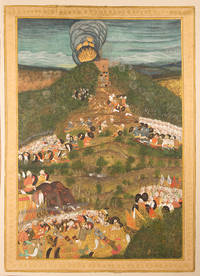
114054Post Mughal India probably late 19th century. . Single large illuminated miniature on paper ink and gouache on paper depicting the view of the Siege of Khandahar in modern-day Afghanistan total leaf 760 x 545 mm miniature 690 x 470 mm; miniature double-ruled in gilt framed decorated with spiraling florettes a few light surface smudges leaf a little cockled mounted to thick card.<br /> A very large and impressive view of the Siege of Khandahar the Mughal-Safavid war of 1649-1653 as presented in the Padshahnameh of Shah Jahan. <br /><br />The Padshahnameh is illustrated chronicle of the reign of Shah Jahan the fifth Mughal emperor commissioned during his reign as a propagandist celebration of his kingdom and dynasty. The text is a detailed chronological narrative of each day of the emperor's reign describing his daily activities court ceremonies as well as the significant events in Emperor Shah-Jahan's life such as the durbars lavish processions and glorious victories on the battlefield.<br /> Post Mughal India, probably late 19th century. unknown
1515ST19567-062Venezia Venice: Alessandro Paganini 1515. 98 x 50 mm. 3 7/8 x 2". 3 p.l. CXXXII leaves. <br/> Early 19th century olive brown calf decorated in blind raised bands gilt lettering red morocco label marbled endpapers. Front flyleaf with mostly effaced ownership signature. Brunet II 21-22 "very rare"; EDIT16 CNCE 14575; USTC 822101. Two very small portions of lost patina minor signs of wear to the leather gilt on label not especially bright but the binding entirely solid and perfectly inoffensive. The first three leaves a little browned and with a dampstain in the top few lines other trivial imperfections but the text generally very clean and fresh.<br/> <br/> Small enough to fit into the palm of a hand this printing of five popular treatises by Cicero exemplifies three of printer Alessandro Paganini's innovations: the vigesimo-quarto or 24mo book a typeface that's a blend of italic and roman and the concept of a publishing series. The son of Venetian printer Paganino Paganini Alessandro fl. 1509-38 sought to outdo rival Aldus Manutius in the production of small format versions of classics as well as cursive-style typefaces. In 1515 he began producing a series of books in 24mo beginning with Dante and Petrarch and continuing with a mix of Classical and Italian authors. The Oxford Companion to the Book declares his books "visually splendid if not always easy on the eye"; that seeming contradiction is demonstrated by the text here a very elegant semi-italic that perhaps is not as easy to read as a simple roman serif--but worth the effort for the beauty. Offered in the most portable form available in the 16th century our volume contains Cicero's essays on moral responsibility friendship old age paradoxical Stoic aphorisms and the dream vision of Scipio. The diminutive size that makes this edition--and other books in this series--so appealing also makes them scarce since small books like other objects no bigger than a mouse tend to be easy to lose. Works from Paganini's series of 24mos are quite scarce in the market and we could trace no copies at all of the Cicero in RBH or ABPC. OCLC and USTC between them find just seven copies of the Cicero in libraries none in North America. Alessandro Paganini unknown
La Bibbia di San Paolo (Bible of St. Pauls Outside the Walls). Istituto Poligrafico e Zecca dello Stato (Editalia), Roma, 1992. Facsimile del codice membranaceo dell’Abbazia di San Paolo fuori le Mura, Roma (secolo IX), per la corte di Carlo il Calvo. Commentario a cura di G. Arnaldi, S. Baiocchi, B. Bischoff, L. Maximilians, H. de Sainte-Marie, M. L. di Franco, J. E. Gahede, J. Gribomont, J. Mallet, F. Mütherich, G. Nardin, S. Pisano, A. Pratesi, K. F. Werner ormato cm 33x27 cm. 580 pagine; carta filigranata con 73 tavole fuori testo, legatura in mezza pelle ed in seta ricamata. Due contenitori-espositori in plexiglass permettono di proteggere il codice e il commentario. Formato facsimile 37x45 cm. Pagine 684. Tiratura limitata e numerata a 1000 esemplari. Condizioni ottime.
Seconda edizione. Testo Italiano e Latino. Roma, 1824; ril. in tela, pp. 48, 62 tavv. b/n, cm 40x53. italiano A ril.
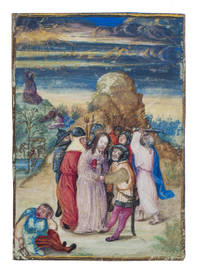
152082NHM8O8K9DUFlanders Bruges or Nürnberg 1520. Miniature painted on vellum 7.8 x 5.6 cm in numerous colours highlighted with gold and in a gold border probably from a book of hours but with no text. A finely rendered miniature showing great detail in bright colours highlighted with gold depicting the Arrest of Christ most likely from a diminutive book of hours. Surrounded by a bustling throng of Roman soldiers carrying spears and wearing halberds Christ appears calm just at the moment when a soldier takes him captive. An elder of the Jewish Temple stands directly behind him dressed in red. To the right stands Simon Peter sword raised having cut off the ear of the High Priest's servant Malchus who sits nursing his bleeding ear in the lower left corner of the composition. An earlier episode Christ's Agony in the Garden of Gethsemane when he learns that one of his disciples will betray him appears in the background at left. A genre scene with men working the fields and crossing a river on a narrow plank bridge occupies the middle ground to the left of the main scene and the towers of a castle or city the middle ground to the right.The general style recalls the art of the last generation of Ghent-Bruges painters especially that of the famed Simon Bening. Though the anonymous artist owes much of his style to Bening's model he was most likely German. The acidic palette bright yellow juxtaposed with blue and lime green and the facial types remarkably expressive even at this tiny scale recall Nürnberg painters in the circle of Glockendon. It is worth remembering that Bening himself collaborated with several Nürnberg painters whose presence in Flanders is thus confirmed.With some fine superficial cracks and an occasional tiny abrasion mostly near the edges but generally in good condition. A lovely miniature of Christ's arrest rendered in remarkably fine detail.l For the general style: U. Merkl Buchmalerei in Bayern in der ersten Hälfte des 16. Jahrhunderts 1999. hardcover
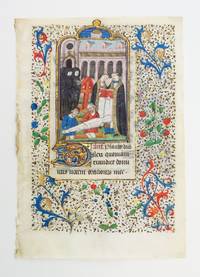
ST17060VFrance probably Besançon 3rd quarter of 15th century. 239 x 165 mm. 9 3/8 x 6 1/2". Single column 15 lines in an elegant gothic book hand. <br/> Rubrics in dark pink line-enders in dark pink and blue with a gilt bezant several one-line initials in burnished gold on dark pink and blue ground with white tracery one three-line initial in blue with white tracery filled with flowers painted pink or blue all on a gold ground verso with panel border of delicate hairline vines terminating in gilt bezants and ivy and with a spray of blue flowers and a red bud recto with A FULLY-REALIZED HALF-PAGE MINIATURE OF A BURIAL in an arch-topped gilt frame with two laymen lowering a shrouded corpse into the ground a small group of hooded monks to the left and two ecclesiastical figures reading from a book to the right all in front of a gothic church painted pink with a blue roof SURROUNDED BY A FULL BORDER consisting of hairline vines terminating in gold bezants and ivy colorful acanthus strawberries and blue flowers the text below the miniature further framed with a thin "U"-shaped line extending the full height of the miniature. A very few trivial imperfections quite minor wear to paint on clothing a little insignificant smudging one small light stain in the blank margin of verso but these defects not the least distracting and overall the miniature in fine condition with rich well-preserved color.<br/> <br/> This is a splendid miniature from a particularly large Book of Hours showing a detailed rendering of a scene from contemporary Medieval life--that of a burial in a churchyard involving clergy mourners and laymen. Apart from those relatively few copies with illustrated calendars the miniatures found in Books of Hours are almost entirely devoted to retrospective Bible scenes that are obviously outside the experience of the illuminator; it is only in the present kind of scene at the beginning of the Office of the Dead that we can see a contemporaneous image that would have come directly from the Medieval experience. While our painting is fairly typical in subject matter and design it offers a number of interesting details about the Medieval rites and rituals surrounding death. The present scene represents the final stage preceded by the funeral procession Requiem Mass prayers Absolution and the procession into the graveyard in which the body is actually laid to rest in the ground. Though the corpse would have been encased in a coffin during the aforementioned rites and processions it was customary to bury the dead in only a shroud in the present example the artist has even thought to show the stitching along the length of the shroud. Three groups of people each serving a different function appear in this miniature: in the foreground are two laborers lowering the body into an earthen grave a small group of mourners in black cloaks stand off to the left and a duo of clergy members stand to the right. The latter have tonsured heads and each wears a black cope donned prior to administering Absolution to the deceased; together they hold a manuscript containing the Rites for Burial. The background is composed of a grand church or cathedral containing a number of fine architectural details including several windows including a clerestory level an arched entrance a dome and decorative touches. Stylistically this leaf can be localized to the Franche-Comté region in eastern France and is closely related if not directly attributable to an atelier specializing in Books of Hours made for the Use of Besançon and most likely situated in that city see Avril and Reynaud p. 197. The similarities are especially apparent in the figures' faces which are slightly puffy in appearance and have distinct slit-like eyes. As noted by Avril and Reynaud the unnamed master of this atelier was deeply indebted to the Master of Morgan 293 a talented Burgundian illuminator active in the second quarter of the 15th century whose name derives from a particularly lovely Book of Hours made for the Use of Besançon. Whoever the artist responsible for the present miniature this work is an excellent representation of a distinct regional style extremely attractive and replete with interesting details that connect us to the Medieval experience. unknown
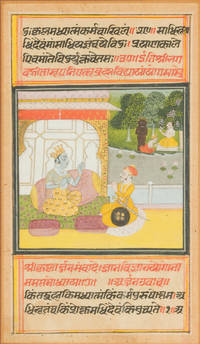
112941India probably Bundi circa 1780 AD. . Single leaf illuminated manuscript on paper in Sanskrit with illuminated miniature in the text lightly rubbed overall bright and attractive unexamined out of frame 205 x 115 mm; mounted and framed Germany gallery label to verso.<br /> An attractive manuscript leaf from a dispersed eighteenth-century manuscript of the Gita containing the heading for the seventh chapter of the text reading 'Gyan-Vigyan Yoga Namm Seventh Chapter'. The miniature set on a beautiful outdoor terrace next to a running stream shows a dialogue between Sri Krishna and Arjun.<br /> India, probably Bundi, circa 1780 AD. unknown
Pergamena miniata cm 26 x 39 originariamente appartenente a rilegatura raffigurante al piatto anteriore l'immagine di una figura chimerica, poggiante sul verde di un prato con fondo rosso, compresa in una bordura a filetto in rosso, e al piatto posteriore una decorazione in rosso e blu, presumibilmente ottenuta a mezzo di stampino compresa in doppio filetto rosso e blu. Un altro filetto in rosso degna lo spazio del dorso compreso tra i due piatti. La pergamena, che originariamente avrebbe potuto ricoprire un registro (con buona probabilita' l'animale fantastico potrebbe essere simbolo di un'impresa araldica), fu riutilizzata nel XVII secolo, sfruttando la parte al verso come copertura di un volume a stampa. Questa pergamena dovrebbe rientrare, in particolare per quanto riguarda la decorazione al piatto posteriore, tra i rari esempi di 'legatura a stampo' veneziana, in uso appunto in questa citta' gia' nel XVI secolo. Questa tipologia ornamentale, abbandonata per quasi due secoli, verra' ripresa nella meta' del XVIII secolo, in particolare dai Remondini di Bassano, per la realizzazione delle loro celebri carte xilografiche. Una simile legatura, seppur datata come produzione del XVIII secolo, risulta documentata in: G. Bologna, Legature, Milano, 1998, p. 137.
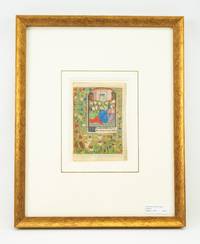
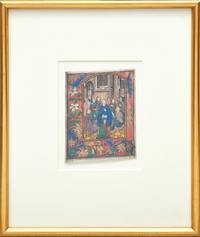
1490ST20853France ca. 1490. 144 x 99 mm. 5 5/8 x 3 3/4". Single column recto with 14 lines in a gothic book hand. <br/> Attractively matted and framed. Rubrics in red two two-line initials one painted pink on blue ground with flowers the other painted blue and inhabited by a rampant lion on pink and gold ground recto with a panel border featuring long-stemmed flowers and owls on a pink ground verso WITH A HALF-PAGE ARCH-TOPPED MINIATURE DEPICTING PENTECOST WITH A FULL BORDER featuring a plethora of different flowers berries greenery songbirds an owl and a butterfly all ON A RICHLY PAINTED GOLD GROUND. Trimmed close on one side and just grazing a border on the opposite side very minor chipping to faces trivial signs of rubbing or wear otherwise a fine leaf--colorful bright and very pleasing to the eye.<br/> <br/> This leaf contains the customary Pentecost miniature associated with the Hours of the Holy Spirit but with several attributes that set it apart from other examples we have encountered. The miniature here depicts a densely crowded scene with the Virgin at the center surrounded by the apostles each of whom wears a burnished gold halo. Packed tightly together they gaze up at a white dove who emanates small red tongues of fire above their heads. According to biblical tradition this visitation by the Holy Ghost in the form of a dove enabled Christ's disciples to start preaching marking the beginning of the Christian Church. The artist favors an unusual pastel palette choosing pale pink for the walls and eggshell blue for some of the floor tiles as well as bright yellow muted lilac rose and lime green for the robes of the apostles. Looking more closely at the figures we see that each face is carefully individualized each with its own features and expressions. Although most crane their necks to get a view of the miracle unfolding one of the apostles looks directly out at the viewer as if surprised by our presence. Moving outside the miniature we note that the leaf features a particularly exuberant border with tangles of flowers fruit acanthus leaves and several birds including an owl in one corner. There is additional interest on the verso with another bright border painted an intense pink and filled with more flowers and owls. unknown
Il Virgilio Riccardiano (Ms. Ricc. 492). Vergilius Publius Maro: Bucolicon, Georgicon, Aeneis Biblioteca Riccardiana, Firenze. ArtCodex, Modena, 2002. Riproduzione in facsimile delle Bucoliche, Georgiche, Eneide di Virgilio con miniature che rappresentano il viaggio di Enea ambientato città di Firenze al tempo di Lorenzo il Magnifico. Legatura in pelle con cornici di filetto impresse a secco sui piatti. Formato 20x31 cm. Pagine 512. Commentario (21x31 cm. pagine 173) in italiano. Cofanetto in legno pregiato, formato 34x44x13 cm. Tiratura limitata e numerata di 999 copie. Condizioni ottime.
La Divina Commedia di Alfonso d'Aragona (Divine Comedy of Alfonso of Aragon). Londra, British Library, Ms. Yates Thompson 36. Sontuoso manoscritto miniato della Divina Commedia di Dante Alighieri. Realizzato a cavallo del XV secolo, nel nord Italia, da due maestri miniatori: Priamo della Quercia e Giovanni de Paolo. Illustrato con 110 miniature inquadriate nei margini inferiori, tre grandi iniziali istoriate con cornici floreali all’inizio dei tre canti, numerose iniziali foliate e tutte le iniziali delle strofe minori delimitate con colori intensi e dorature splendenti. Legatura in velluto di seta con borchie e medaglione centrale e bindelle di chiusura. Formato 26x37 cm. Pagine 380 (190 fogli). Commentario, in due volumi (formato 25x32 cm. 340 pagine totali), a cura di Milvia Bollati. Pregiato cofanetto di custodia. Tiratura limitata e numerata a 750 copie. Condizioni ottime.
Il Salterio di St. Albans, St. Alban’s Psalter. Hildesheim, Dombibliothek Hildesheim (MS St. God. 1), Cologne, Schnütgen Museum, (Inv. No. M694). Istituto dell’Enciclopedia Italiana Treccani, Roma, 2009. Riproduzione in facsimile del manoscritto scritto e miniato in Inghilterra all’inizio del XII secolo nello scriptorium di St. Albans. Ordinato presumibilmente da Geoffrey di Porham, abate di St. Albans, per Cristina di Markyate. il codice (comprendente 150 salmi latini, la Vita di s. Alessio e una lettera di papa Gregorio Magno). All’interno 42 miniature attribuite ad Alexis Master completano il testo composto da 150 salmi latini, la Vita di s. Alessio e una lettera di papa Gregorio Magno. Legatura in pelle con impressioni a secco sui piatti e fermagli dorati di chiusura. Formato 19x28 cm. Pagine 418 (+1). Commentario in italiano (19x29 cm. pagine 277). Cofanetto in pelle con impressioni in oro. Tiratura numerata e limitata di 750 esemplari. Condizioni ottime.
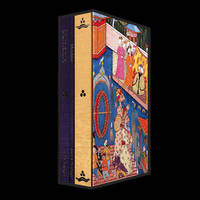
679<p>Istanbul: Ertuğ & Kocabıyık Publications 2000. New. Hardcover. Cloth bdg. Hand-bound by experienced craftsmen in Switzerland. 24x38 cm. In Ottoman Turkish facsimile Turkish transcription and English. 3 volumes set: 352 p. facsimile; 308 2 p. Turkish transcription; 51 2 p. English. Colour ills. First edition. Limited edition. This is a limited edition of 1500 copies handbound in distinctive Japanese cloth embossed with patterns selected from imperial Ottoman textiles and printed on acid free paper. This volume is number 1362. In publisher's special slip case.</p><p>A miniature-illustrated manuscript of an 18th Century Festival in Ottoman Istanbul The original of this outstanding work which is in the library of the Topkapi Palace Museum in Istanbul contains 137 brilliantly-colored miniatures by Levni the renowned painter of the court of Ahmed III 1703-1740. The miniatures illustrate a fifteen-day festival held on the occasion of the circumcision of four of the Sultan's sons in 1720. Surname-i Vehbi follows in the longstanding Ottoman tradition of preparing specially written and illustrated books to commemorate festivities that took place on special occasions such as royal births weddings and the like. These celebrations were marked by activities that included parades musical performances circus acts and fireworks displays all of which were brilliantly captured and executed by Levni in his miniatures. With one exception the miniatures in this striking volume cover two pages. The text for the book was composed by Vehbi a famed court poet and appears in full in this facsimile edition.</p><p>A transcription of the original Ottoman text by Dr. Mertol Tulum and a translation into English by Robert Bragner are provided in a separate volume.Introduction essays by two Turkish scholars; Dr. Kuban and Dr. Yerasimos provide the reader a deeper understanding of the Ottoman society.</p><p>For the facsimile edition a specially produced paper was used to duplicate the appearance and texture of the original volume. State-of-the-art reproduction and printing techniques were employed to ensure that this facsimile edition is a faithful copy of this distinguished work. Hand-bound by experienced craftsmen this is a limited edition of only 1500 copies.</p> Ertuğ & Kocabıyık Publications hardcover
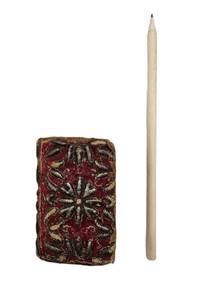
162712714London for the Company of Stationers 1627. The Whole Booke of Psalmes Collected into English Meeter by Thomas Sternehold Iohn Hopkins and others. 171 34 p. Embroidered red velvet binding covered with silver wire 24°. Rare and early miniature binding H. 8 x W. 5.5 x D. 2.5 cm. / 3.15 x 2 x 1 inch. Bound with silver fine wire and with brass sequins. Gold edges. The covers are surrounded by a two-part multi-coloured border partly interwoven with silver wire in the corners stylised branches of golden wire and sequins in the centre a two-coloured embroidered bouquet with flowers of silver wire and coloured metal foils. Back with a double curved two-tone border partly covered with gold wire. Edges scuffed binding restored. The last two pages of the Table are damaged. London, for the Company of Stationers unknown
181092Netherlands: second half of the 15th century. Radiant devotion A vibrant Pentecost scene from a Netherlandish Book of Hours. At the center the Virgin Mary is seated in a deep blue mantle while the Apostles gather around her as the Holy Spirit descends in the form of a dove from above. An owl is nestled in the lower margin of the border. Ornate borders with scrolling foliage naturalistic flora and fauna and architectural interiors are typical of Southern Netherlandish and Flemish illumination from the late 15th and early 16th century. The style and composition is reminiscent of works by artists of the Utrecht school see for example Walters Ms. W.182 or active in Bruges see Walters Ms. W.183 and 184. Provenance: Stephen C. Massey. Illuminated miniature and border on vellum 133 x 105 mm panted in gold and colours. Presented in a gilt frame with UV protective glass. A little rubbing in outer margins of miniature otherwise well preserved and with gilt bright; small bump to edge of frame on the back. A very good example. hardcover
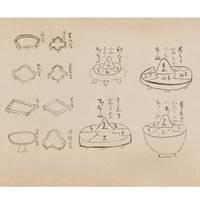
1796108121796. Approx. 40 brush & ink drawings in black & white. Scroll 180 x 1440 mm. central core roller. At end in rough trans.: “Many generations of SÅami bonsan 100 rules & styles. Extremely secret. All the information passed down by mouth is listed here. Handle this information with great care and keep it close. Given by Ishioka Seisaku 石岡æ£æœ” in September 1796 to ZuihÅken no Yahiroko 瑞芳軒之八尋å.â€<br /> <BR> <BR> Bonsan miniature mountain gardens is a sub-category of bonkei 盆景 tray-garden landscapes. Created to fit into small containers good bonsan convey the texture color and form of natural mountainous scenery. These small tray or pot landscapes have their origins in 10th-century China.<br /> <BR> <BR> The text in our scroll is a distillation of the teachings of SÅami ShinsŠ相阿彌真相 1472-1525 painter art critic and artistic adviser to the Ashikaga shoguns in Kyoto master of the tea and incense ceremonies and landscape gardener. He established rules for and a school SÅami ryu of garden design and flower arrangement as well as the rules and styles for bonsan. “As a landscape gardener he designed two of the most celebrated Zen temple gardens in Japan: the RyÅan Temple garden in Kyoto an outstanding example of kare sansui a dry landscape technique in which combinations of stones and sand are used to suggest mountains and water; and the Daisei-in garden a miniature reproduction of a natural landscape also in the kare sansui style. It is believed that he also planned the garden of the famed Silver Pavilion Ginkaku Temple in Kyoto the villa built by his major patron Ashikaga Yoshimasa.â€â€“Encycl. Brit. online.<br /> <BR> <BR> The author begins by extolling the pleasures of bonsan and offers advice on how to observe and enjoy them. He continues with descriptions of the materials used miniature trees sand rocks etc. seasonal variations the kinds of trays square rectangular circular and colors red white blue yellow brown and black and advice on where how and when to display them. The text also discusses the styles created over the centuries and famous sites that could be replicated on the trays.<br /> <BR> <BR> All of this is finely illustrated in a series of about 40 fine black & white brush drawings illustrating the many varieties of bonsan design.<br /> <BR> <BR> Ishioka was a resident of Kyoto and gave instruction on creating miniature gardens. He left another manuscript on miniature gardening see WorldCat 1451711637.<br /> <BR> <BR> In fine condition. Some worming mostly marginal. Preserved in a modern wooden box. unknown
(mm. 52x34), 1 c.b. + cc. 4 nn. + pp. 500, con un ritratto di Dante inciso in antip. Legatura coeva in pieno marocchino scuro, dorso a cinque scomparti con titoli in oro. Sguardie marmorizzate, tagli colorati in rosso. Uno dei 1000 esemplari del celebre "Dantino" stampato a Padova, dai fratelli Salmin, per U.Hoepli. "Antonio Farina de Plaisance, qui fut parmi les plus habiles graveurs que l'Italie ait jamais eut, gravait en 1834 les poinçons de corps 2 sur 3 points d'un caractére microscopique, qui a été fondu seulement en 1850 pour le compte de Giacomo Gnocchi. Après des efforts inutiles pour l'utiliser, le caractère passa aux frères Salmin de Padoue, qui l'employère à imprimer en 1878 mille exemplaires du fameux Dantino, livre qui est généralement appelé Le Plus Petit Livre du Monde à cause plutot de la petitesse du caractère que des dimensions de la page" (Fumagalli, Lexicon, pag. 276). Cfr. anche Mikrobiblion n. 77. Esemplare molto buono, in cofanetto.
Edizione limitata numerata a mano da 1 a 998, esemplare n°.800. Catalogo di Gigetta Dalli Regoli. Il Cofanetto è di pelle con titoli d'oro. Le tavole presenti sono in facsimile. Firenze, 1985; br. in cofanetto, pp. 100, ill. b/n, tavv. b/n e col. italiano ril. in cofanetto
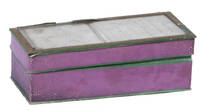
1823ABC_48016Amsterdam: M. Westerman 1823. In the original pink and green cardboard case with glass lid green printed paper wrappers with cream paper dust jackets with the titles in manuscript on the front. Ca 7.7 x 6.5 cm. With 31 engraved plates and 5 engraved maps including a folding world map. 10 volumes. Comprising:1 De aardrijkskunde.2 De gewijde geschiedenis.3 Vaderlandsche geschiedenis.4 Natuurlijke geschiedenis der viervoetige dieren.5 De natuurlijke geschiedenis der vogelen.6 Natuurlijke geschiedenis der insekten kruipende dieren en visschen.7 De kruidkunde.8 Zedelijke verhalen.9 Arabische vertellingen.10 De mythologie. Complete set of the first edition of a charming miniature library preserved in the original box. This educational set for children contains works on geography Dutch history classical mythology natural history and the Bible with all the plates and maps included. A French edition was published in the same year but replaced the volume on Dutch history with a work on French history. Due to the charm of this miniature library a facsimile edition was published in 1984. The present set however is the first edition which is rare on the market and only available in a few libraries.Many miniature books were primarily written for children. As was usually the case with children's books published before the 20th century miniature books were typically instructional or educational in nature. Although they have existed since at least the early 17th century they were only specifically marketed towards children from the mid-18th century onwards. Children's books from the end of the 18th century were often influenced by the theories of Jean Jacques Rousseau 1712-1778 who thought that children should learn through play and at their own pace. According to Welsh the present works show Rousseau's ideas because they present the information through short stories.The edges and corners of the box are somewhat scuffed and the gold trimming on the lid has come loose in some spots with some loss of material. The paper wrappers of some of the volumes show some signs of wear. A few pages loose in ads 5 8 and 9 but they are still included. Otherwise in very good condition.l Saalmink p. 211; Welsh A bibliography of miniature books 1247; cf. Bondy p. 75 French ed.; Welsh The history of miniature books p. 74 2nd ed. M. Westerman, unknown
181542873Cincinnati: Published by Wesley Coleman and William Phillips. Morgan Williams and Co. Printers 1815. 1st Edition Adomeit A34; American Imprints 34917; Bradbury p. 63; Welch 861.2. Not in Rosenbach nor Welsh. Period brown full calf binding. Modest wear to binding with boards a bit splayed. Some browning & ageing to paper with the occasional short edge tear to a leaf no text affected. A Good - VG item. 2 blank v 6 - 167 3 blank pp. Divisional t.p. "History of the New Testament" p. 77. "Appendix" t.p. p. 135. "Psalms" t.p. p. 151. 2-1/2" x 1-1/2" <br/><br/>The first miniature book published in Ohio and quite rare in the trade- RBH records the last appearance as in a 1964 Midland catalogue this copy. Published by [Wesley] Coleman and [William] Phillips. Morgan, Williams and Co., Printers hardcover books