36 résultats
1970216722Indonesia. Before1970s. Water buffalo hide gilt and pigment chiselled and cut out 30 x 40 cms fully extended without batons painted both sides jointed arms one affixed to a horn baton the other bamboo the body affixed to a spliced horn baton minor loss of pigment. Dewa Ruci is the representation of Bima in miniature form. It is used in the story of the young Bima called Bratasena who goes in search of the meaning of life/the water of life. At the end of his journeys he finds it in a miniature of himself representing his true self. The story of Dewa Ruci thus represents the search for perfection and union with the divine and is thus important in Javanese mysticism. <br> <br>Purchased in Java in the early 1970s. <br> <br>See also: Joko Susilo Eisler Shadow-Puppet Collection Catalogue Bates College Lewiston Maine . unknown
1970216719Indonesia. Before1970s. Water buffalo hide gilt and pigment chiselled and cut out 34 x 54 cms fully extended painted both sides two jointed arms affixed to horn batons another spliced horn baton holding the body some minor loss of pigment. This puppet represents the goddess Dewi Naganini in the Javanese 'wayang kulit' or leather shadow puppet theatre tradition. She is the daughter of the serpent god Antaboga and is known for her virtues of loyalty love and devotion to her fellow creatures. <br> <br>Purchased in Java in the early 1970s. <br> <br>See: Joko Susilo Eisler Shadow-Puppet Collection Catalogue Bates College Lewiston Maine . hardcover
1970216160Indonesia. Before1970s. Water buffalo hide and pigment elaborately gilt and cut out 58 x 25 cms painted both sides a spliced horn baton holds the body some abrasions and fading to the painted surface in good condition overall. This puppet represents the dewa Bathara Guru in the Javanese 'wayang kulit' or leather shadow puppet theatre tradition. Bathara Guru the Javanese name for the deity Shiva symbolized the imperfection of man represented in the bodily defects of the puppet: four arms small feet marks on the throat and often though not here depicted with fangs. <br> <br>Purchased in Java in the early 1970s. <br> <br>See: Joko Susilo Eisler Shadow-Puppet Collection Catalogue Bates College Lewiston Maine . hardcover
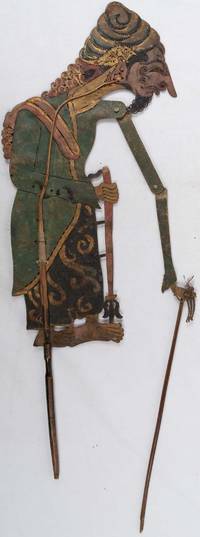
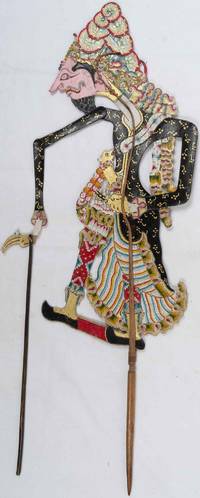
1970216711Indonesia. Before1970s. Water buffalo hide gilt and pigment chiselled and cut out 40 x 39 cms fully extended painted both sides one arm jointed and affixed to a bamboo baton the other arm stationary holding a staff another spliced bamboo baton holding the body some fading and loss of pigment. This puppet represents the seer or sage Durwasa in the Javanese 'wayang kulit' or leather shadow puppet theatre tradition. <br> <br>Resi Durwasa Durvasa in the Indian Mahabharata was known as a bestower both of curses and boons. He invested Krishna with partial invulnerability. To Dewi Kunti he bestowed a mantra to invoke gods by whom she could beget sons. Unwisely trying this out she became pregnant by the Sun God Surya. Resi Druwasa enabled the birth of her son Karna via her ear and the infant was put into a basket and floated down a river to be found and adopted by others. In modern Wayang this story has reputedly been employed to address issues of gender equality. <br> <br>Purchased in Java in the early 1970s. <br> <br>See: Joko Susilo Eisler Shadow-Puppet Collection Catalogue Bates College Lewiston Maine . hardcover
1970216717Indonesia. Before1970s. Water buffalo hide gilt and pigment elaborately chiselled and cut out 49 x 72 cms arms fully extended painted both sides jointed arms each affixed to bamboo batons and another spliced horn baton holding the body; some fading and loss of pigment; stamped "H N" at the base of the puppet. This puppet represents the King/Knight Raden Astadarma in the Javanese 'wayang kulit' or leather shadow puppet theatre tradition. <br> <br>This character appears in the Wayang Madya stories. These stories were originally sponsored by the princely poet Mangkunegara IV 1811–1881 the fourth ruler of Mangkunegaran a principality based in Surakarta Java ruling from 1853 to his death in 1881. In recent times these stories are intended to retell 19th century heroic poems reflecting on 20th Century events linking Wayang Purwa with Wayang Gedog. <br> <br>Purchased in Java in the early 1970s. <br> <br>See: Joko Susilo Eisler Shadow-Puppet Collection Catalogue Bates College Lewiston Maine . hardcover
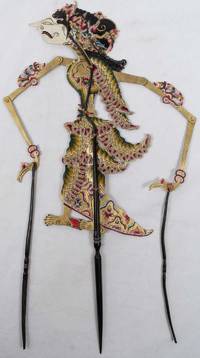
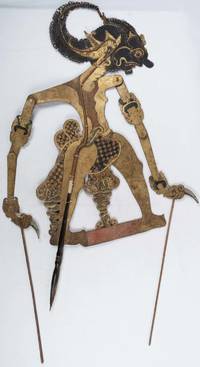
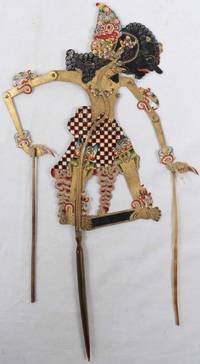
1970216682Indonesia. Before1970s. Water buffalo hide 63 x 90 cms extended pigment and gilt jointed arms painted both sides intricately punctured the jointed arms and body affixed to horn and wooden batons slight wear and rubbing with some loss of pigment overall in good condition. This impressive large puppet represents Bima /Werkadura / Bratasena the incarnation of the god who became the ruler of the wind in the Javanese 'wayang kulit' or leather shadow puppet theatre tradition. <br> <br>"Werkadura is the most feared of warriors creating havoc with his terrible club and atrocious fingernails…Merciless to his enemies gigantic ungainly heavily muscled hairy with protruding eyes and thunderous voice…Nevertheless his unswerving honesty loyalty fortitude and military skill make him among the most admired figures in wayang." Benedict R. O'G. Anderson Mythology and the Tolerance of the Javanese" Cornell 1965 <br> <br>Purchased in Java in the early 1970s. <br> <br>See also: Joko Susilo Eisler Shadow-Puppet Collection Catalogue Bates College Lewiston Maine . hardcover
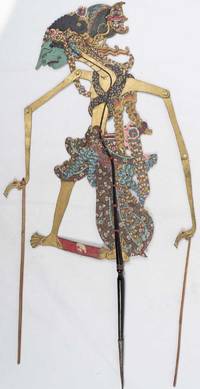
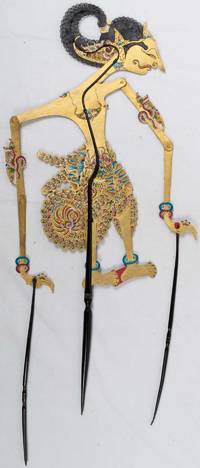
1970216715Indonesia. Before1970s. Water buffalo hide gilt and pigment elaborately chiselled and cut out 43 x 69 cms arms fully extended painted both sides jointed arms each affixed to horn batons and another spliced horn baton holding the body. This puppet represents Suryatmaja or Suryaputra son of Dewi Kunti in the Javanese 'wayang kulit' or leather shadow puppet theatre tradition. <br> <br>A particularly fine example. Purchased in Java in the early 1970s. <br> <br>Also see: Joko Susilo Eisler Shadow-Puppet Collection Catalogue Bates College Lewiston Maine . hardcover
1970216718Indonesia. Before1970s. Water buffalo hide gilt and pigment chiselled and cut out 50 x 41 cms fully extended painted both sides one arm jointed and affixed to a bamboo baton the other arm stationary another spliced bamboo baton holding the body some minor loss of pigment. This puppet represents the priestly hermit Resi Gotama or Gotama Rishi in the Javanese 'wayang kulit' or leather shadow puppet theatre tradition. In this tradition Resi Gotama is married to a beautiful angel Dewi Indradi and despite his royal heritage spurns kingship for life as a hermit. <br> <br>A particularly attractive example. Purchased in Java in the early 1970s. <br> <br>See: Joko Susilo Eisler Shadow-Puppet Collection Catalogue Bates College Lewiston Maine . hardcover
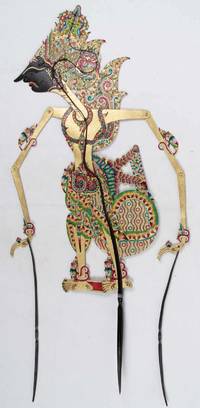
1970216707Indonesia. Before1970s. Water buffalo hide gilt and pigment elaborately chiselled and cut out 54 x 69 cms arms fully extended painted both sides jointed arms each affixed to horn batons and another spliced horn baton holding the body. This Javanese 'wayang kulit' or leather shadow puppet represents Kresna Krishna in the Hindu epic the Mahabharata. His importance and the reasons for his great regard is that he is considered the 8th avatar of the god Wisnu Visnu the protector and preserver of good and destroyer of evil. The 7th avatar is Rama. <br>In Soeharto’s New Order regime this “lineage” of avatars –particularly Rama--became significant in their own mythical presentation to themselves of the regime. It is in the Ramayana—not Mahabharata—that the final battle against evil forces was to be fought and the dharma upheld. <br> <br>"Kresna is part God an incarnation of the mighty Wisnu. He is the consummate politician diplomat and strategist of war. By far the most intellectually brilliant of the Pendawa sic faction it is Kresna who makes their final victory possible. On the other hand he is the conscienceless liar and an unscrupulous schemer who never hesitates to break the rules when he feels it necessary" Benedict R. O'G. Anderson "Mythology and the Tolerance of the Javanese" Cornell 1965. <br> <br>Also see: Joko Susilo Eisler Shadow-Puppet Collection Catalogue Bates College Lewiston Maine. <br> <br>A particularly fine example. Purchased in Java in the early 1970s. . hardcover
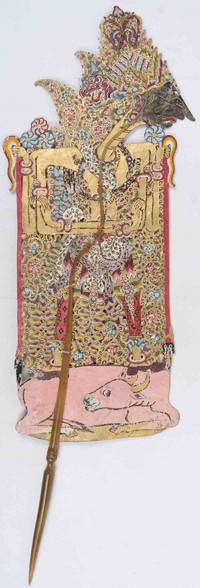
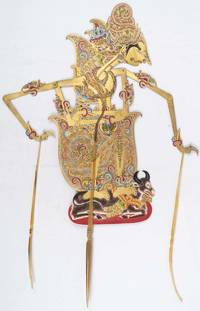
1970216158Indonesia. Before1970s. Water buffalo hide and pigment elaborately gilt and cut out 54 x 69 cms painted both sides jointed arms each affixed to horn batons and another spliced horn baton holds the body. This puppet represents the dewa Bathara Guru in the Javanese and Balinese 'wayang kulit' or leather shadow puppet theatre tradition. Batara Guru is the Indonesian embodiment of the Hindu deity Shiva and perhaps the most sacred of Indonesian shadow puppets. A dalang puppeteer must make offerings to Guru the supreme god creator and ruler of earth who stands at the origin point of humankind before commencing a shadow play performance. Batara Guru also known as Sang Hyang Manikmaya is conceived of as the younger brother of Semar. The figure is generally shown in meditative repose standing upon his mount the bull. He is viewed as a spiritual teacher and guide directing lesser deities and humans in their earthly endeavors. <br> <br>This particularly fine example is elaborately carved with gilt and rides on the mythical bull Nandini. Bathara Guru the Javanese name for the deity Shiva symbolized the imperfection of man represented in the bodily defects of the puppet: four arms small feet marks on the throat and often though not here depicted with fangs. <br> <br>Purchased in Java in the early 1970s. <br> <br>See: Joko Susilo Eisler Shadow-Puppet Collection Catalogue Bates College Lewiston Maine . hardcover
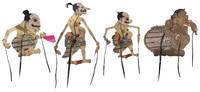
1970216219Indonesia. Before1970s. Water buffalo hide pigment gilt fabric and hair three of the four figures all with jointed arms painted both sides the arms and bodies affixed to spliced horn batons three for each puppet some abrasion and wear with some loss to the pigment but the set in very good condition: <br>Semar body: 35 x 35 cms; Gareng: 36 x 16 cms; Petruk: 53 x 20 cms; Bagong: 41 x 23 cms. A set of four comedic Punakawan figures. Chief of these is Semar one of the most well-loved figures in Wayang both a humble servant and powerful god. "Semar is usually accompanied by his three adopted sons Gareng Petruk and Bagong and together they are known as the Punakawan 'knowing friends or attendants'." Gregory Churchill et al "Semar ever so smartly" Winayangan 2009. <br> <br>In this set Gareng is the eldest son who limps and has a crippled arm; Petruk is the middle child depicted as tall and lanky who has a distinctive long nose; Bagong is the youngest of the three: a chubby figure with big round eyes thick lips and naïve behaviour. <br> <br>".the scene where Semar traditionally emerges is called the goro-goro “world in chaos”. The narration of the puppeteer speaks of earthquakes and storms that beset the cosmos but then announces Semar who appears like a shaft of light piercing the dark. Semar’s cosmic and comic humour promises the audience both laughs and wisdom. He is a clown who connects the cosmic and everyday. All opposites and contradictions dissolve in his wisdom and mythos." World Encyclopedia of Puppetry Arts <br> <br>Purchased in Java in the early 1970s. <br> <br>See: Joko Susilo Eisler Shadow-Puppet Collection Catalogue Bates College Lewiston Maine . unknown