2 398 résultats
204985S.l., (1790) in-8, 2 pp., une feuille.
201414991Paris, Editions du centre national de la recherche scientifique , 1972 ; in-4, cartonnage de l'éditeur.
36740The three performers depicted on the letterhead are Charles W. Nestel "Commodore Foote" his sister Eliza Nestel "Queenie Foote" and Joseph Huntler "Colonel Small". Letterhead printed in blue ink on white lined paper. The letter from the troupe's agent P.A. Clarke seeks to arrange a booking in Danville PA. Offered with the stamped illustrated envelope postal cancel. Minor wear Very Good. <br /> <br /> The elaborate envelope illustration and its printed text depict the three performers flags in the background and reads: ELLINGER & FOOTE'S COMBINATION THE LITTLE MINIATURE TRIO. COMMODORE FOOTE MISS ELIZA NESTELLE COL. SMALL THE THREE SMALLEST PEOPLE IN THE WORLD./ MRS. C.G. RUSSELL W.B. HARRISON PROF. G.H. BROOKS MASTER ZACK MASTER WILLIE. / COL. WM. ELLINGER DIRECTOR. C.G. RUSSELL TREASURER. P.A. CLARKE BUSINESS AGENT." <br /> The envelope is addressed to Agt. Thompson Hall Danville Penna. cancelled 3 cent red Washington stamp and postal rubberstamp dated Hagerstown March 186 Small rubberstamp beneath envelope flap on verso "E.D. Foote Collection. unknown
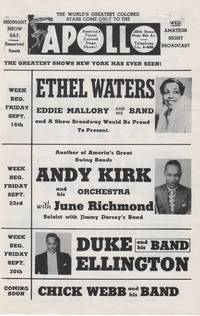
1938206506New York: Apollo Theatre 1938. Small staple holes at upper margin; old horizontal fold long since flattened. Double-sided handbill 5-5/8 x 8-1/2 in. printed on both sides. Weekly handbill advertising upcoming shows for three weeks beginning September 16 1938 although the year is not printed. Headliners for the three weeks are Ethel Waters Andy Kirk and Duke Ellington. Located on west 125th Street in the heart of Harlem the Apollo was and remains one of the cultural meccas of New York City providing top-level entertainment mostly by Black artists for a mostly Black audience. Apollo handbills from the postwar era are not uncommon those from the 1930s are far less so. Apollo Theatre unknown
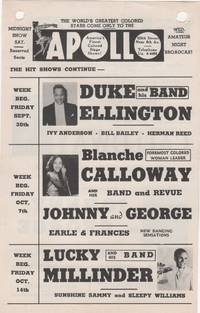
1938206505New York: Apollo Theatre 1938. Small punch-holes at upper margin where it may once have been secured in an album or notebook; slight abrasion to perimeter of holes otherwise about fine. Double-sided handbill 5-5/8 x 8-1/2 in. printed on both sides. Handbill advertising upcoming shows for the weeks of September 30 October 7 and October 14 in 1938 although the year is not printed. Headliners for the three weeks are Duke Ellington Blanche Calloway and Lucky Millinder. Although neglected today Blanche Calloway was the older sister of Cab Calloway and preceded him into show business providing an example for him with her own exuberant performance style. She was a true pioneer as a woman in a male-dominated field. She was in fact the first woman to lead an all-male orchestra which included some rising giants such as Ben Webster saxophone and Cozy Cole drums. Unable to make it far in the face of prejudice against Black and female performers she went on to a long an influential career in radio and as a dedicated advocate for Civil Rights. Apollo Theatre unknown
70604An archive of holographic letters written by members of a multi-generational show business family which found success on the stage and screen and behind the scenes from Broadway to Hollywood. The family patriarch was Bert Kalmar born Albert Kalvarinsky 1884 -1947 a successful lyricist who was inducted into the Songwriters Hall of Fame in 1970. He entered show business as a vaudeville magician and comedian and became a songwriter after a knee injury sidelined his stage career. In addition to yielding numerous hits for the Marx Brothers his partnership with Harry Ruby was portrayed in the 1950 Metro-Goldwyn-Mayer musical Three Little Words with Fred Astaire and Red Skelton. Before turning to songwriting Kalmar was in a vaudeville act with Jessie Brown 1892–1985 whom he married in 1910. They had two children: Irving Bert Kalmar Jr. 1913–97 and Margaret “Peggy†Kalmar 1928–64. Peggy married Robert Allison in 1950 and had no children. This archive contains more than 200 letters mostly written by Bert Jr. and Peggy to their parents as well as several dozen cards from friends sent upon the songwriter’s death in 1947. The letters span from the 1930s to the 1980s. The collection includes a few business-related letters about projects in development as well as royalty and tax statements following Bert Sr.’s death. Among the condolences for Kalmar Sr.’s death are letters from Hollywood notables. Tillie Winslow the wife of Columbia Picture musical producer Max Winslow wrote: “I am so sorry to hear of Bert’s passing. There is so little one can say to help one in times of sorrow. I know how hard the heart can hurt and I feel very keenly for you.†Kalmar Jr. also known as “Bigs†followed in his parents’ footsteps and pursued a career in acting achieving some limited success. Numerous letters in the collection recount his years traveling with a variety of stage productions. In 1943-44 he appeared with Ethel Barrymore in the production “The Corn is Green.†He joined the show in February and recalled the following in a letter to his parents: “I found out to my great surprise that the understudy they had and who had a few lines in Welsh and one in English was leaving before the show that night and I had to learn his business and Welsh lines and go on. The first scene was in mining clothes with soot all over my face. Then in eight minutes I had to have the soot off and juvenile make up on and change clothes for the next scene. I made it. It all went smoothly. Before I went on Miss Barrymore walked all the way across the stage and said ‘You’re the new one aren’t you. We’re glad to have you with us.’ … Later some of the other members of the cast said it was phenomenal – some of them had been in the show six months before she spoke to them.†This collection underscores the growing focus on Hollywood and motion pictures. The Kalmars moved from New York to Beverly Hills for the songwriter’s work and Kalmar Jr. moved between the two coasts to take advantage of opportunities on the stage and in film. This is also evident in letters from friends and associates in the acting world. A letter to Kalmar Jr. from James Lister foreshadows his career as a prominent Hollywood casting director. He wrote on September 1 1954 of his decision to leave New York with “Liam†whom he just signed to Universal Pictures: “We both feel that we’ve had New York and at the moment there seems to be more gold on the other side of the country…as well as trees.†The Kalmars were also close friends of Random House president Bennett Cerf. A typed letter signed TLS in the collection dated November 7 1946 recalls a fun evening: “Phyllis and I counted our evening with you and Jessie among the happiest we spent all year. I hope we can do a repeat performance at a very early date.†A few years after Kalmar’s death Peggy wrote in a letter to her mother about visiting Cerf at his office and his efforts to help her with a job in magazine publishing. The letters are in very good condition and most are accompanied by their original mailing envelope. unknown
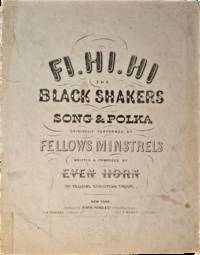
1851List2946New York City 1851. Sheet music measuring 10 x 13 inches 3 pp. Pencil markings of chords over third page. Some staining and a few small tears; overall excellent. Sheet music for “Fi-Hi-Hi†or “The Black Shakers Song & Polka†a track written by Even Horn and originally performed by the Fellows Minstrels. The Fellows who are also called on the cover “Fellows Ethiopean sic Troupe†were a New York City-based minstrel group who briefly ran Fellow’s Opera House on Broadway just above Canal Street. The singer of this tune whose girlfriend has “gone away to Leb’non stateâ€â€”perhaps Mount Lebanon New York or Lebanon Ohio—asks “Oh! pity me ye shakers all/ And tell me where I’ll find herâ€.<br /> <br /> The United Society of Believers or Shakers are an egalitarian and millenarian Christian sect who arrived in colonial America in the 1770s and appalled early Americans with their singing and dancing. Interestingly at least one researcher has suspected a connection between Shaker and minstrel song and dance; for one a popular 1840s Shaker song which goes “Hop up and jump up and whirl round whirl round†makes at least an interesting comparison with “Jump Jim Crow’s†“Wheel about turn about an’ do jus’ soâ€.1 Moreover Shaker communities were open to anyone who was willing to commit to a celibate communal life regardless of race or gender. For instance Mount Lebanon documented having Black members during its early days in the late 1700s2 and in 1819 the Shakers at South Union Kentucky freed those enslaved by their slaver converts.1<br /> <br /> We find eighteen other physical copies of “Fi-Hi-Hi†on OCLC. Of interest to historians of blackface minstrelsy and American theater.<br /> <br /> 1 Anne Grimes “Possible Relationship between ‘Jump Him Crow’ and Shaker Songs†Midwest Folklore 3 no. 1 Spring 1953 47–57.<br /> 2 “African American Shakers: In the Berkshires and Beyond†Hancock Shaker Village accessed March 6 2025 https://hancockshakervillage.org/online-exhibitions/african-american-shakers-berkshires/. unknown
8839P., Daumont (fin XVIIIème).
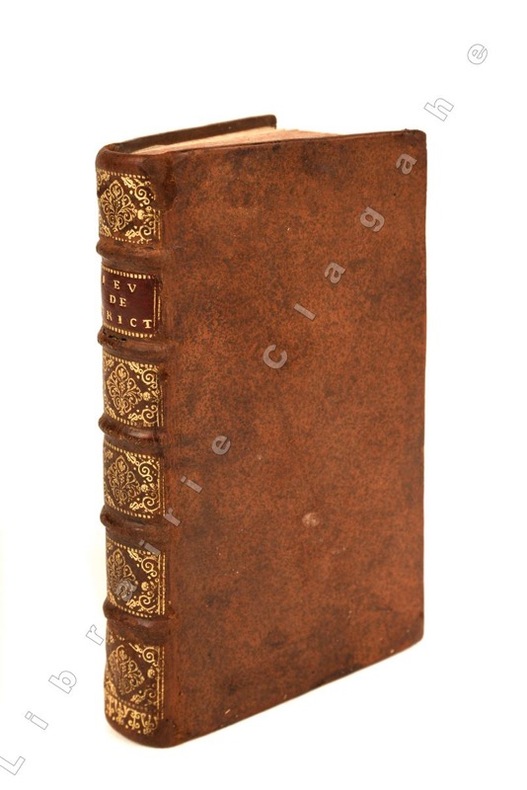
170120822Paris, Henry Charpentier, 1701 ; in-12, veau marbré, dos à nerfs décoré et doré, pièce de titre grenat, roulette dorée sur les coupes (reliure de l’époque) ; [11-1 bl.], 198, [18] pp., figures in texte.Suivi de : Suite du Trictrac, contenant les règles des jeux du revertier [...], et du toc. Comme on les joüe aujourd’huy. Paris, Heny Charpentier, 1699 ; [4], 111, [9] pp. (Barbier II-996-997).
8853P., Basset, (fin du XVIIIème).
8854Sans lieu ni date, (fin du XVIIIème). (Gravures d’un moulin contrecollées au dos).
8851P., Maillet, (fin du XVIIIème). (Gravure «Vaisseau du Premier Range portant pavillon de Vice Amiral» contrecollée au dos).
8884P., Chez Mondhare (fin XVIIIème). (Taches, salissures).
8868P., Daumont, (1759).
8844P., chez Daumont, (fin du XVIIIème).
88431760.
8846P., chez Daumont, (fin du XVIIIème).
8847P., chez Daumont, (fin du XVIIIème).
8840P., Huquier et fils, (fin XVIIIème).
8845P., chez Daumont, (fin du XVIIIème).
8885P., Basset (mi XVIIIème). (Petit trou de ver).
8849P., chez Daumont, (fin du XVIIIème).
8850P., chez Daumont, (fin du XVIIIème).
8880(Trace de pliure au centre).
8865P., de Poilly, (fin du XVIIIème). (Petit trou de ver et pliures).