5 616 résultats
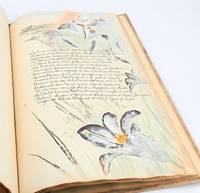
188788480No Location: s. n. 1887. Fine. s. n. No Location 1887 20 x 32 cm 1 portrait-frontispice 1 titre à l'encre 83 p. manuscrites qq. feuillets vierges Exceptional illuminated manuscript of 35 poems by Stéphane Mallarmé probably copied by Joris-Karl Huysmans on watermarked Hollande laid paper after pre-first editions of the poems published in journals. Most of the poems are preceded by a separate title-page noting the source from which it is taken. The manuscript includes a fine charcoal portrait of Mallarmé as a frontispiece by Charles Tichon after a photographic portrait by Van Bosch. The portrait was published in the Mallarmé issue of Empreintes Bruxelles LÉcran du Monde n° 10-11. Another version was published in 1889 Caprice Revue 2e année n° 60. two floral compositions in gouache and watercolor illustrating the poems Les Fleurs and Apparition as well the calligraphed author's name as a title-page. Although unsigned the illutrations are attributed to Louise or Marie Danse. Bradel binding contemporary cream silk boards with floral motif two embroidered green silk markers with floral motif gilt semis patternerd flyleaves and pastedowns slightly faded red edges. Dampstains on the lower part of the lower board rubbed corners a few silk threads loosened on the spine rubbed boards. Outstanding manuscript of 35 poems by Stéphane Mallarmé written shortly before the first collected edition of his poetry of which only 47 copies were ever printed Poésies photolithographed Revue indépendante 1887. This carefully calligraphed collection is attributed to the hand of writer Joris-Karl Huysmans a great admirer of the poet who is said to have given the manuscripts to his friend Jules Destrée. This scribal manuscript which includes some of Mallarmés most celebrated pieces such as Hérodiade L'Après-midi d'un faune Le tombeau d'Edgar Poe Prose pour des Esseintes Le vierge le vivace et le bel aujourd'hui appeared for the first time in the posthumous sale of the Belgian politician and writer Jules Destrée in 1936 at the Galerie Leopold in Brussels. A pencil note on the title page of the collection reads: According to Mr. Simonson expert at the Destrée sale this manuscript was sent by J.K. Huysmans to Jul. Destrée who wanted to read Mallarmé's poems which remained unpublished at the time. Verified through Huysmans' correspondence sold on the same day as this manuscript. As evidenced in their letters Destrée did seek out the help of his friend Huysmans to obtain Mallarmé poems as his work was not readily accessible being for the most part published in journals L'Artiste Les Lettres et les Arts La République des lettres etc. and in the collections of Le Parnasse contemporain. In a letter to Destrée Huysmans wrote You ask me where Mallarmé's poems can be found. They are untraceable but they are in this envelope. Published in 1876 in La République des Lettres they were copied at least the best ones by Le Chat Noir in 1886. I bought two issues which allows me to send them to you. You will see that they are superb written in clear incisive and very strange language. 30 November 1887. It is possible that the poems in this envelope mentioned by Huysmans are the ones Destrée later had bound in this manuscript collection. Huysmans may have copied for Destrée the poems from the journals he only had one copy of and sent him his extra copy of Le Chat Noir from 1886 which included the prose poems Plaintes d'automne Frisson d'hiver I et II and Le Phénomène futur. The writing style of the poems in the collection is indeed very similar to Huysmans' own handwriting his manuscript of his poem collection Le Drageoir à épices displays the same rounded curling style. However Huysmans' handwriting varies considerably depending on the circumstances: novel manuscripts letters first drafts etc. The excessively neat calligraphy of the poems contrasts with the hasty tall and cramped handwriting of sever s. n. hardcover
188788480s. n. | s. l. [1887 ?] | 20 x 32 cm | 1 portrait-frontispice, 1 titre à l'encre, 83 p. manuscrites, qq. feuillets vierges
- 1920-1922, oeuvres : 23x30cm ; cadres : 38,4x48,6cm, trois feuilles sous cadres. - Three original gouaches around dance by Loïs Hutton. 1. Original gouache with dancers May 16th 1920 | work: 23 x 30 cm frame: 38,4 x 48,6 cm | framed leaf This early composition, one of the rare ones still preserved, attests to her modernism and total symbiosis with her choreography. The dominant curves of the bodies in this Gouache with dancers, dated "May 16th 1920" evokes the androgynous silhouettes of Matisse's round dance (La Danse, 1910), as does the choice of vibrant blue and dark ochre tints. A Cubist aesthetic appears in the movement of the dancers with their unrelenting symmetrical balance - while the boldly contoured kaleidoscopic designs betray the influence of Vorticism, whose members during the same period assiduously frequented the underground club of Loïs' lover, Margaret Morris. This work from the London era will find its fulfilment the following year in the choreographies created in France where the Margaret Morris School settle in the summer. The photographs of these sensational performances from Dinard to Cap d'Antibes show very similar compositions, notably one of the scenes of Hutton's ballet, entitled Étincelles, created in 1922 to music by Maurice Ravel. 2. Signed original gouache "Background design, 1922" 1922 | work: 26,5 x 36 cm frame: 40 x 50 cm one framed leaf One of the only original preserved stage decor sketches by Loïs Hutton, also one of the first of her career. This abstract composition reflects the artist's incredible versatility. She flourished both as a principal dancer at her lover's school, the Margaret Morris School as well as a choreographer, set and costume designer. These painted sets on large fabrics served as the backdrop to the school's dance troupe productions and solo dances by Loïs who had previously painted a design on canvas based on a sketch by her mentor the Fauvist painter John Duncan Fergusson. Trying her hand here at a radically new and ambitious style, her design joinsthe angular movements of her dances and is inspired by the teachings of Cézanne: "Everything in nature is modelled on the sphere, the cone and the cylinder" (letter to Emile Bernard). This vital attention paid to volumes goes hand in hand with a fragmentation of motives close to Edward Wadsworth's Vorticism. Hutton visited at that time Wadsworth and the group of Vorticists in Morris' Chelsea underground club, a laboratory of modern dance where the set in its large-format version may have been displayed in December 1921 or the following year as suggested by the two dates on the lower part of the composition and on the back. 3. Signed original gouache "Composition - Ground design of dance, fool's dance" may 22 1919 | work: 20 x 25,5 cm; frame: 30 x 40 cm | one leaf One of Loïs Hutton's rare abstract works, a horizontal and graphic exploration (entitled "Ground design") of her Fool's Dance choreography. A hypnotic solo dance that she performed for the first time in January 1920 to music by Edvard Grieg. In this interesting and innovative vision of dance, Loïs Hutton lays down the products of the force of her choreographic movements on paper: a ballet of lines and curves filled with vivid colours. This fluid and dynamic composition is marked out by a square with asserted outlines, acting as both a physical support for the painting and a material surface for the scene where its movements unfold - an essential space of creation to be compared with the "original plan" theorised several years later by Kandinsky in Point et ligne sur plan (1926). Presented at the Margaret Morris Club in Chelsea where her very first creations were born, Fool's Dance will be performed again at the Château des Deux Rives in Dinard in July of the same year. It earned Hutton one of her first mentions as a performer and choreographer in the French press, in the newspaper Comoedia on 20 July 1920, and marks the beginning of her notoriety in France.
187087776novembre 1870 | 33.20 x 24.50 cm | un bifeuillet
5733Japan: 17th or 18th century. In the seventh and eighth centuries when trade flourished with the rest of Asia especially Korea and China Japanese nobility melded foreign dance and music traditions with native Shinto songs. This amalgam was eventually incorporated into official court functions and became so important that it even merited the establishment of a ministry of dance in 701. Trained court nobles and professionals were the only ones permitted to execute these complex choreographies. Bugaku now known as gagaku was a type of dance performed at the imperial court during the Edo period. At the beginning of the scroll which takes place in the emperor's palace one sees large drums called dadaiko framed by flames and dragons. On top of one of the larger drums there is a motif of the sun. These drums are accompanied by musicians playing a mouth organ sho a bamboo flute ryuteki and smaller drums in the gakuya the musicians' section. They sit under an elaborately decorated banner and provide a steady rhythm for the dancers on stage before them. The elevated stage takabutai where two dancers are performing enbu is adorned with a highly ornate brocade drape. This scroll is illustrated with the kingin deie method in which gold or silver is mixed with animal glue then pasted onto the scroll. This rare technique provides an almost three-dimensional quality to the images. The scroll depicts 43 distinct dances each with unique costumes. The costumes are particularly well-rendered in bright red orange teal blue black grey etc. and many display intricate and mesmerizing patterns. The head-pieces costumes and props are all masterfully portrayed. Gold is featured prominently in many of the costumes and throughout the scroll there are "mists" of gold painted in the background. Above each set of dancers the name of the dance is written. They include: manzairaku engiraku katen karyobin kocho komaboko seigaiha genjoraku dakyuraku konju bato kitoku bairo ryoo and nasori. At the end of the scroll there is another view of the gakuya from a diiferent perspective showing the backs of the drums which are exquisitely decorated in silver. Fine condition. Several images have some creasing but this is not serious. unknown books
in-4, (ff. 12), pp. 370, (ff. 3), legatura coeva in pergamena floscia, titolo ms. al dorso. Frontespizio inciso, con titolo entro elaborata cornice architettonica, tavola incisa con ritratti in ovale dei Duca e Duchessa di Parma e Piacenza e 35 magnifiche incisioni a piena pagina di coppie di ballerini, realizzate da Giacomo Franco. Ciascuna tavola ritrae una dama e un gentiluomo, in magnifici abiti d'epoca testimonianza della moda del tempo, con rimarcabili dettaglio e nitidezza. Seconda edizione, dedicata a Ranuccio Farnese e Margherita Aldobrandina, largamente ampliata dal Caroso stesso (compositore e coreografo, 1526- ca. 1605) rispetto alla prima, pubblicata nel 1581. Celebre quanto bella opera cincequecentesca dedicata al ballo e alla musica di accompagnamento alla danza: descrive i balli più apprezzati presso le corti italiana, francese e spagnola, includendo anche le arie musicali, con relativa notazione per liuto. (C. W. Beaumont, Bibl. Of Dancing, pp.24-25). Esemplare assai bello, fresco e marginoso.. Magriel, Bibl. of dancing, p.44; Eitner II, 341. Derra de Moroda, 528. Teatro Regio, Mostra del libro e documento di danza, p.58. Non presente in: Mortimer Italia e Beaumont. .
1930125381930 1 Mine de plomb signée du monogramme de l'artiste en bas à droite, 1930, 32 x 45 cm, encadrée.
- 1969, 16,8x21,6cm, carnet en spirales. - Handwritten personal diary for the year 1969 1969 | 16.8 x 21.6 cm | spiral-bound notebook Personal diary handwritten by Maurice Béjart, written in a 1969 diary celebrating the centenary of the birth of Mahatma Gandhi. 52 handwritten leaves, written in red and blue pen in a spiral-bound notebook. This diary features amongst Béjart's very rare, privately owned manuscripts, the choreographer's archives being shared between his house in Brussels, the Béjart foundation in Lausanne and the Théâtre Royal de la Monnaie. The choreographer Maurice Béjart's diary written during the year 1969. An extremely rare collection of thoughts, questions and introspections from the point of view of Hinduism and Buddhist wisdom, which Béjart adopts following his first trip to India in 1967. The diary is an emblematic testimony of the indo-hippie era of the 1960s, spiritual and artistic renaissance that inspired numerous ballets of the choreographer (Messe pour le temps présent, Bhakti, Les Vainqueurs). A selection from this diary was published by Maurice Béjart in the second volume of his memoirs (La Vie de Qui ? Flammarion, 1996). During the year 1969, Béjart wrote daily notes in a diary published in memory of Mahatma Gandhi. Fascinated by Hindu mysticism since his trip to India in 1967, he filled in this spiritual journal with numerous mantras and prayers ("Krishna guide my chariot, the light is at the end of the path. OM"; "Buddha is everywhere"; "Let God enter, but how to open the door") and he calls upon the Hindu deities as well as the Bodhisattvas Mañju?r? et T?r? - soothing figures of the Buddhist pantheon. Béjart's "Indian period" was particularly rich in choreographic masterpieces, the progress of which can be followed in his diary (Baudelaire at the beginning of the year, the first performance of the Vainqueurs in Brussels and the Quatre fils Aymon in Avignon, as well as the filming and screening of his Indian ballet Bhakti). At the crossroads of New Age and the hippie movement, Béjart's "conversion" is symptomatic of an era that refuses progress and has a thirst for spirituality: "Calcutta is not India, but our western face. It is not religion or traditional thinking that is to blame, but capitalism. India, a rich country before colonisation." The Beatle's visit to the guru Maharishi's ?shram and Ravi Shankar's concert at Woodstock in 1969 marks the beginning of a real western passion for Indian music and culture, which was decisive in Béjart's ballets at the time. In Béjart's eyes, India presents itself as a place where art and ancestral traditions have not suffered the perversions of positivity. In his creations he seeks to express the spirit of a culture that intimately links the body and the spirit, and in which dance plays a major cosmic and spiritual role. Included in his ballets were Indian dance systems and Vedic songs that were discovered thanks to Alain Daniélou - in 1968 he opened the Messe pour temps présent with a long vînâ solo that lasted fifteen minutes: "Béjart is in his Hindu quarter-hour. And over there, Hindu quarter hours, can last for hours..." commented Jean Vilar, director of the Avignon festival. A wave of Indian fashion also passes through the costumes of the Ballet du XXe siècle company: large silk trousers, tunics, jewellery and oriental eyes. In the diary, Béjart states that there is "no truth without yoga," an art discovered from an Indian master that can be found in many of his ballets in the form of dance exercises on the barre. He also decides to make Bhakti "an act of Faith" by filming himself the ballet choreographer, and during the summer he prepares the Vainqueurs, an unusual meeting between Wagner and traditional Indian ragas. Beyond the prolific artist, we also discover the choreographer's troubled personality in the diary, in the grips of doubt and melancholy: "vague state of physical weightlessness and moral emptiness. Lethargy or laziness. Weakness.
- Michel Lévy Frères, Paris 1862, 12,5x19cm, relié. - Édition originale. Reliure en demi chagrin, dos à cinq nerfs orné de fleurons dorés, date en queue, plats de papier marbré à motifs il-de-chat, premier plat de couverture conservé. Rare et précieux envoi autographe signé du compositeur?: «?à mon ami Seligmann - Hector Berlioz.?» Hippolyte-Prosper Seligmann (1817-1882), violoncelliste et compositeur, fut un membre actif de la Société philharmonique qu'avait créée Berlioz en 1849. Provenance : bibliothèque R. & B. L. avec son ex-libris encollé au dos de la première garde. [ENGLISH DESCRIPTION ON DEMAND]
- A. Bourdilliat & Cie, Paris 1859, 11,5x18cm, reliure de l'éditeur. - Les Grotesques de la musique [The Musical Madhouse] A. Bourdilliat & Cie | Paris 1859 | 11.5 x 18 cm | publisher's original binding First edition. Publisher's green cloth, blindruled frame to boards, yellow endpapers and pastedowns, pastedowns soiled, edges spotted. A little light foxing. A rare and handsome autograph inscription signed by Hector Berlioz in pencil to title: «à mon ami Théodore Ritter, souvenirs affectueux.» Théodore Ritter, son of the composer Eugène Prévost, was Berlioz's student, producing a piano arrangement of L'Enfance du Christ. Inscriptions by Berlioz are rare and highly sought-after. [FRENCH VERSION FOLLOWS] Édition originale. Reliure de l'éditeur en pleine toile verte, dos lisse orné de caissons à froid, encadrement de filets à froid sur les plats, gardes et contreplats de papier jaune, contreplats salis, tranches mouchetées. Quelques petites rousseurs. Rare et précieux envoi autographe signé d'Hector Berlioz au crayon de papier sur la page de titre?: «?à mon ami Théodore Ritter, souvenirs affectueux.?» Théodore Ritter, fils du compositeur Eugène Prévost, fut l'élève de Berlioz pour lequel il réalisa une version pour piano de L'Enfance du Christ.
Did foreign art students covertly install a balcony on the 91st floor of World Trade Center Tower 1 in the months preceding the 911 attacks? This enigmatic work claims to document the evolution and execution of such a stunt in both sketches and color photos. Examine for yourself the photos taken from a helicopter of a person apparently standing on the balcony. 55 pages. Clean, bright and unmarked with negligible wear. Photographic pages tend to stick together so must be opened with care. Provokes disquieting questions about WTC security and the demise of the twin towers in the same year the small print run of this work was issued. Book
191289381Sans nom d'éditeur | Sans lieu d'édition 1912 | 20.9 x 28.5 cm | Agrafé
186271549Michel Lévy frères | Paris 1862 | 12.50 x 19 cm | relié
185968513A. Bourdilliat & Cie | Paris 1859 | 11.50 x 18 cm | reliure de l'éditeur
221843S.l., (ca 1770) 44 x 56 cm, dessin ancien au pastel sur papier fort, sous verre, cadre de bois doré ancien, petite tache au centre du tableau.
175214354Aux dépens de l'Académie, A Paris, Delormel et fils, 1752. In-4 de 56 pp., maroquin rouge fleurdelisé, dos orné à nerfs, frise et roulette dorées d'encadrement sur les plats, armes sur les plats, fleur de lys en écoinçons, tranches dorées (reliure de l'époque).
19151519Paris, Imprimé pour Charles Meunier, 1915. In-folio (37,5 x 27,8 cm), reliure maroquin bordeaux, listel d'encadrement à froid, dos à quatre nerfs titré or, encadrement intérieur orné de listels à froid se croisant aux angles avec jeu de petits carrés dorés, doublure bord à bord de même maroquin, gardes de moire aubergine, tranches dorées sur témoins, couverture, étui (Gruel). TRÈS RARE ÉDITION TIRÉE À 30 EXEMPLAIRES SEULEMENT, illustrée de compositions dans le texte et de 10 EAUX-FORTES DE LOBEL-RICHE EN 5 ÉTATS ET À PLEINE PAGE. Un des 25 exemplaires sur vélin teinté (n° 19) contenant 5 états des gravures hors texte sur papier vélin, papier japon et parchemin, une suite de 11 petites remarques d'artistes gravées à l'eau-forte. Cet exemplaire est enrichi de 8 épreuves d'essais de ces vignettes en états signés, 30 épreuves d'essais et d'artiste toutes signées et annotées des 10 hors-texte, et 15 DESSINS ORIGINAUX de l'artiste au crayon ou en sanguine sur vélin ou calque, généralement très aboutis et signés. EXEMPLAIRE DE MAURICE CHEVALIER portant cet envoi de Lobel-Riche : "Un jour, j'ai compris pourquoi Maurice Chevalier était un artiste et un poète : il avait le secret des grands coeurs qui s'imposent. Et c'est avec plaisir que je lui dédie cet ouvrage en mémoire de notre commun sentiment [...]. PARFAITE ET SOBRE RELIURE ART-DÉCO EN MAROQUIN DOUBLÉ DE GRUEL.
1969655281969 | 16.80 x 21.60 cm | carnet en spirales
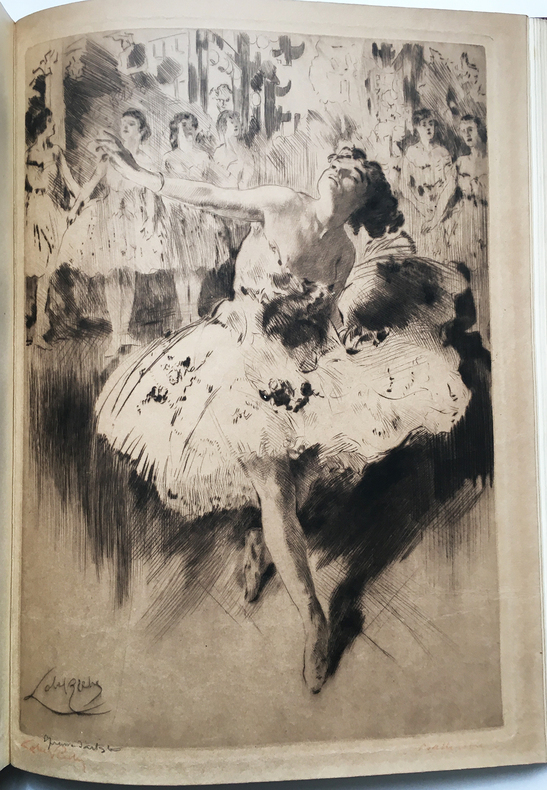
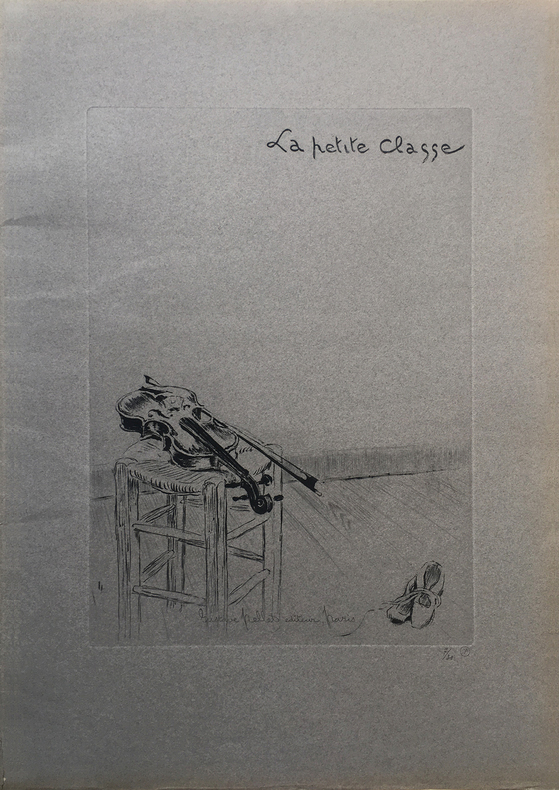
19081849G. Pellet éd., Paris, 1908. Album In-folio (400 x 580 mm), en feuilles, couverture générale de vélin gris illustrée d'une eau-forte, portefeuille de l'éditeur. 12 EAUX-FORTES, AQUATINTE ET POINTE-SÈCHE, chaque épreuve signée au crayon par l'artiste. L'une des très rares 30 suites avec remarques et avant réduction des cuivres. Très belles épreuves, d'une exceptionnelle fraîcheur, avec remarques, signées à la mine de plomb et revêtues du timbre de l'éditeur (L. 1191). Très grandes marges. Chaque planche est signée au crayon par Louis Legrand et justifiée 7/30, portant le cachet de l'éditeur et paraphée GP par lui au crayon. La gravure répétée de la couverture est justifiée et paraphée par Pellet mais non signée par l'artiste comme habituellement. Suite complète. Parfait état de conservation avec le portefeuille original très beau. Photographies supplémentaires sur demande. Album “La petite classe”. Paris, Pellet 1908. Aquatint, etching and drypoint (12 plates 410 x 590 mm) 1/30 on Japan paper with remarques and before plate reduction. Each print is numbered 7/30, signed by Louis Legrand and with the blind stamp of Pellet editor with his paraph. More pictures on request. Références : Arwas 358 à 370 ; Lugt 1191. Sur l'artiste : Louis Legrand est né à Dijon en 1863. Son désir de devenir artiste est tel qu'il étudie à l'école des Beaux-Arts de Dijon en soirées et pendant ses heures de loisirs, tout en travaillant comme employé de banque. En 1883, il obtient le Prix Desvoge. En 1884, il part pour Paris où peu de temps après son arrivée, il s'initie aux techniques de gravure avec Félicien Rops qui dira de lui : Quel homme, ce Legrand, il trouverait des angles dans une boule de billards. Sa technique préférée est l'aquatinte monochrome ou en couleurs. Ses débuts sont assez difficiles et marqués par une certaine maladresse et une inexpérience. Pendant les quelques années qui suivent, Louis Legrand gagne essentiellement sa vie en réalisant des dessins pour des journaux d'enfant. Dès 1887, Louis Legrand collabore au journal Le Courrier français pour lequel il remet chaque semaine un dessin qui met souvent l'accent sur la déchéance et la mort qui attendent la prostituée et son client, plutôt que sur les plaisirs et les jeux. Poursuivi pour obscénité et après avoir purgé une courte peine de prison, Legrand abandonne sa carrière d'illustrateur satirique. En 1891, il participe, avec une série d'illustrations en couleurs, au Gil Blas illustré consacré à un reportage sur le cancan et ses principaux interprètes écrit par Erastène Ramiro et décrivant l'entraînement sévère auquel les danseurs se soumettent. Vendu à 6000 exemplaires, le magazine fait connaître le nom de Legrand à travers la France. Fort de ce succès, l'éditeur Dentu persuade Louis Legrand de réaliser des eaux-fortes de ses mêmes aquarelles afin de les publier l'année suivante sous le titre Le Cours de Danse Fin de Siècle avec un texte révisé de Ramiro. Après avoir terminé sa série sur le cancan, Legrand s'intéresse au monde de la danse et fréquente les coulisses et salles de répétition. C'est le travail avant la scène qui retient l'intérêt de l'artiste. Outre de nombreuses aquatintes, dessins et pastels, il réalise deux albums consacrés à ce monde de la danse. Le premier intitulé "Les Petites du Ballet" (1893) se compose de douze aquatintes et retrace l'évolution des futures ballerines. Le second "La Petite Classe" (1908) composé de douze grandes gravures et aquatintes traite des danseuses professionnelles. C'est le plus accompli du point de vue artistique et technique. En 1896, la galerie " L'Art Nouveau " de Samuel Bing expose près de deux cents gravures de Louis Legrand retraçant ainsi l'ensemble de son œuvre. En 1900, Legrand obtient une médaille d'argent à l'Exposition universelle de Paris. En 1906, il reçoit la Légion d'Honneur. Il meurt en 1951, dans un oubli complet. Les sujets de prédilection de l'artiste sont la vie nocturne parisienne, les bars, les maisons closes, les cabarets. Il a précédé Henri de Toulouse-Lautrec et d'autres dans la représentation du cancan et des demi-mondaines de Montmartre. L'exposition au Musée provincial Félicien Rops présente tous ces thèmes en mettant l'accent sur l'art gravé de l'artiste. (Exposition au Musée Félicien Rops de Namur en 2006 : "Louis Legrand. Entre femmes et remous"). Italien : Portfolio (mm 590x410) contenente 12 incisioni ad acquatinta e puntasecca, ognuna firmata a matita e col timbro di Pellet. Brossura editoriale figurata grigia con un'incisione al piatto recante il titolo della suite e il nome dell'editore. Raro e prezioso esemplare fuori numerazione corrispondente ai 30 su carta Japon con remarques (gli altri 100 su simil-Japon erano senza remarques). Gustave Pellet era uno dei più grandi editori parigini tra '800 e '900: pubblicò le più importanti litografie a colori di Toulouse-Lautrec, opere grafiche dei divisionisti Signac e Luce, oltre ai simbolisti Rops e Redon. Aveva una particolare passione per Legrand di cui pubblicò circa 300 incisioni e acquistò la collezione dei suoi pastelli originali. Gli album di Legrand, specialmente quelli sulla danza, sono ormai rari a trovarsi completi perché spesso smembrati per vendere le singole incisioni.
- Choudens, Paris S.d (1867), 19x28cm, relié. - Roméo et Juliette - Opera score in 5 acts by J. Barbier et M. Carré Choudens, Paris n.d (1867), 19x28cm, bound. First edition. Opera in five acts based on the play Romeo and Juliet by William Shakespeare, music by Charles Gounod for voice and piano and libretto by Jules Barbier and Michel Carré. Bound in half red chagrin (retinted), gilt spine, glazed calico boards with double gilt fillets, central gilt initials of Ernest Beulé on the first board, moiré silk endpapers with some spotting and staining to the margins, first original cover preserved, all edges gilt, strictly contemporary binding. Rare inscription signed by Charles Gounod to the archaeologist E(rnest) Beulé. [FRENCH VERSION FOLLOWS] Edition originale de cette partition de l'opéra en cinq actes tiré de l'oeuvre de William Shakespeare, composition musicale de Charles Gounod pour chant et piano et livret par Jules Barbier et Michel Carré. Reliure en demi chagrin rouge avec reprise de teinte, dos à cinq nerfs orné de doubles caissons et de pointillés dorés, plats de percaline grainée avec double filet doré en encadrement, initiales d'Ernest Beulé estampées à l'or au centre du premier plat, contreplats et gardes de papier moiré comportant quelques salissures et brunissures marginales, premier plat de couverture conservé, toutes tranches dorées, reliure strictement de l'époque. Précieux envoi autographe signé de Charles Gounod à à l'archéologue E(rnest) Beulé sur la page de dédicace.
- 1999, Photographies : 29,7x25cm / Cadres : 62x52cm, deux planches-contact encadrées sous passe-partout. - Diptych of twenty original photographic portraits front and back of Michael Jackson with the golden cape embroidered 1999 | Photograph: 29.7 x 25 cm / Frames: 62 x 52 cm | two contact-sheets framed under a mount Unique original prints of these color photographs, presented like contact sheets, signed by the artist, numbered 1/1 and dated 2010 - date of sale of these unpublished shots by Pierre Bergé et Associés. Original photographs of Michael Jackson by Arno Bani It is in 1999 during a stay in London that Michael Jackson noticed Arno Bani's work in an issue of the Sunday Times magazine. Fascinated by his fashion shots, he brought the young 23 year old photographer to New York and asked him not only to photograph him, but also to define his look for the next ten years. This meeting will be followed by several working meetings and finally a three-day photoshoot at the Malakoff studios in the southern suburbs of Paris. These photographs, supposed to serve as an illustration for the Invincible album cover, were claimed by Michael Jackson's record company and were not revealed to the public until 2010, the year after the King of Pop's death. «This collaboration will finish Arno Bani's installation as one of the most talented photographers of his generation. Subsequently, he was contacted by fashion and luxury institutions such as Lacroix, Givenchy and Cartier and by musicians such as the duo Air, David Guetta and Bob Sinclar. At 25 years old, Arno Bani is a photographer recognised beyond the borders of fashion. Made of oppositions, mixing classicism and modernity, his monochrome approach to image is now inescapable and is seen on the pages of Citizen K, Spoon, Visionaire and Jalouse. He also photographed Monica Bellucci, Mélanie Thierry and Noémie Lenoir.» (Pierre Bergé et Associés sales catalogue, December 2010) Ten original photographic portraits of Michael Jackson with the embroidered golden cape [FRENCH VERSION FOLLOWS] Tirage original unique de cette double série photographique en couleursprésentée comme deux planche-contact, numérotées, datées et signées au verso par l'artiste à l'encre noire: "1/1, sept 2010, Arno Bani". Septembre 2010 est la date de la vente de ces clichés inédits chez Pierre Bergé et Associés. C'est en 1999 lors d'un séjour à Londres que Michael Jackson remarque le travail d'Arno Bani dans un numéro du Sunday Times magazine. Fasciné par ses clichés de mode, il fait venir le jeune photographe de 23 ans à New York et lui demande non seulement de le photographier, mais aussi de définir son look pour les dix prochaines années. Cette rencontre sera suivie de plusieurs réunions de travail et enfin d'une séance photo de trois jours dans des studios de Malakoff, en banlieue sud de Paris. Ces photographies, supposées servir d'illustration à la pochette de l'album Invincible furent revendiquées par la maison de disques de Michael Jackson et ne furent révélées au public qu'en 2010, année suivant la disparition du king of pop. « Cette collaboration achèvera d'installer Arno Bani comme l'un des photographes les plus doués de sa génération. Par la suite, il est sollicité par des institutions de la mode et du luxe comme Lacroix, Givenchy et Cartier ou par les musiciens du duo air, David Guetta et Bob Sinclar. À vingt-cinq ans, Arno Bani est un photographe reconnu au-delà des frontières de la mode. Faite d'oppositions, mélangeant classicisme et modernité, son approche monochromique de l'image est désormais incontournable et s'exprime dans les pages de Citizen K, Spoon, Visionaire ou Jalouse. Il photographie ainsi Monica Bellucci, Mélanie Thierry ou Noémie Lenoir. » (Catalogue de la vente Pierre Bergé et Associés, décembre 2010)
- S.n., s.l. s.d. (1958), 21,2x27cm, 5 feuillets (13,5x21cm) + 1 feuillet (20,8x27,1cm) + 2 feuillets cartonnés (20,9x27,9cm) + 2 feuillets de partition (19,9x27,5cm). - Ensemble complet du manuscrit et du tapuscrit de travail de Boris Vian, genèse de la chanson "Une bonne paire de claques". - cinq feuillets perforés de papier blanc rédigés au stylo bille bleu de la main de Boris Vian présentant le texte intégral de la chanson. Nombreuses ratures et corrections. - un feuillet perforé de papier à carreaux rédigé au stylo bille bleu de la main de Boris Vian d'une strophe inédite jamais ajoutée à la chanson. - deux feuillets perforés contrecollés sur carton, transcriptions du texte intégral et de la strophe inédite. - deux feuillets de partition piano-chant imprimée par les éditions de la Lyre en 1962. Cette chanson, dont l'air sage contraste avec la violence des paroles, connut de nombreux interprètes Louis Massis (1959), Anne Gacoin (1960), Les Charlots (1969), Mouloudji (1976), Henri Salvador (1979), L'Orchestre du Grand Turc (1990), Les Poubelles Boys (1994 et 1999), Les Victor Racoin (1999), Fabienne Déroche (2009), Les Bisons Ravis (2010). « En 1957, un certain Henry Cording enregistre "Rock and Roll Mops". [...] D'ailleurs derrière Henry Cording se cache en fait le chanteur Henri Salvador, et les auteurs de la chanson sont Michel Legrand pour la musique et Boris Vian pour les paroles. Ils récidiveront l'année suivante avec le « Blues du dentiste » et « Une bonne paire de claques dans la gueule ». » (J.-L. Calvet, La bande-son de notre histoire) Le manuscrit de la chanson présente quelques différences avec la version tapuscrite. Le « Tiens, salope ! » des deux versions a été tout à fait abandonné dans le chant. Sur le feuillet quadrillé, titré « Modification pour « Une bonne paire de claques » », figure une savoureuse strophe qui ne fut jamais ajoutée à la chanson finale : « Les compliments, ça fatigue et ça lasse / Et puis c'est rare que ça soye (sic) bien tourné / Une vraie raclée qui vous laisse quelques traces / C'est plus sincère et toujours apprécié. » Une bonn'paire de claques dans la gueule Un bon coup d'savate dans les fesses Un marron sur les mandibules Ca te f'ra une deuxième jeunesse Provenance : Fondation Boris Vian. [ENGLISH DESCRIPTION ON DEMAND]
Sehr seltene französische Erstausgabe über Totentänze. Das Buch wurde von Hausieren und auf Märkten verkauft, und zählt zu den beliebtesten padogogischen Bilderbüchern seiner Zeit. Künstlerlich bedeutende Totentanz-Folge mit 60 eindrucksvollen Holzschnitten. Sehr schönes sauberes Exemplar.
195882212S. n. | s. l. s. d. [1958] | 21.20 x 27 cm | 5 feuillets (13,5x21cm) + 1 feuillet (20,8x27,1cm) + 2 feuillets cartonnés (20,9x27,9cm) + 2 feuillets de partition (19,9x27,5cm)
1945125721945 1 Aquarelle originale sur papier, gouache, signée en bas à droite, 1947, 19 x 27.5 cm., encadrée.