Gospel LightBiblio.com
Bible Story Coloring Pages 1 Coloring Books
0830718699New. Brand new and still unused unknown

Jubilee Books · États-Unis1 503,50 $US≈ 1 272,11 €
2 590 résultats
190623645Reilly & Britton Chicago 1906. Back DJ List thru On Vacation in Green. HBDJ 1906 Early Edition VG-/GOOD- SOLD AS-IS DJ with some wear HEAVY Scuff light stain to Edges Chips Tears Extremities & along Spine ENDS Scuff Chip Tears and Light FADE and LIGHT FoX Soil DJ light Rub small edge Tears Light STAINS Wear Light Soil DARKENED Spine DJ stains Tiny Chips Extremities DJ Light Stains Chips Back DJ Beautiful Beige Cloth with Purple Lilacs & Pasted Beautiful Color Picture Inlay on DJ Duplicated Cover lettered in Black on Spine & Front Small Cover Spine Stains Lettered in GREEN on DJ Spine light Soiling Sun Interior Nice tight light Rub Wear FoX & SOME Stains O/W Nice 347 pgs ADS in Back ends Famous Airship Boys Front DJ few tiny light Stains otherwise clean. Tears small Chips Edges DJ Back Back DJ LIsts thru on Vacation Back inner Flap DJ shows Flying Girls Series. Hard Cover. Reilly & Britton Chicago hardcover
18142111902160200379Bunemon Maruya 1814. Soft Cover. Fine. Number of books: 1 Bunemon Maruya paperback
182149603Paris Crochard 1821. Contemp. hcloth. Gilt lettering to spine. Weak crack in fronthinge but still firm. In: "Annales de Chimie et de Physique Redigées par MM. Gay-Lussac et Arago". 448 pp. 1 folded plate. Some browning to htitle title-page and last leaf otherwise clean. Fresnel's papers: pp. 102-111 167-196 312-315 a. 393-403. Biot Arago Ampee: pp. 80-102 225-258 a. 258-273. <br/><br/><em>First printing of these milestone papers in which Fresnel finally established the transversal nature of lightwaves. The volume also having the notable rapports and notes by Arago Biot Ampere exhibiting the famous controversy over the subject."This concept of transverse waves met with the greatest hostility from the scientists of the day who could not imagine an extremely fluid and rarified ether which at the same time possessed the mechanical properties of a rigid body. Even Arago admitted that he could not follow the exuberant engineer in his ideas. But Fresnel was convinced that at last he had the key to many mysteries and with his model of waves he gave a full clarification of the phenomena of polarization. With insuperable precision he explained a long series of extremely complicated experiments such as those of chromatic polarization that Arago himself had discovered by chance in 1811 and which the followers of Newton could not explain in spite of all their efforts. Following this line Fresnel reached the synthesis which is his masterpiece.we must recall the final interpretation that he gave of the famous phenomenon of partial reflection by transparent surfaces that simple phenomenon which until then had puzzled Grimaldi Newton and Huygens and which in Malus's experiments had unexpectedly acquired a special importencee as it had been compared to the great mystery of double refraction."Ronchi "The Nature of Light" p. 255 ff. </em> hardcover
0830718699New. Brand new and still unused unknown
020505711XNew. Brand new and still unused unknown
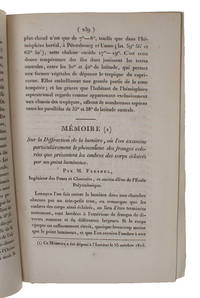
181643910Paris Crochard 1816 No wrappers. In: 'Annales de Chimie et de Physique' Tome I Sec. Series Cahier Mars 1816. With htitle to vol. I. Pp. 225-336 and 1 folded engraved plate. The entire issue offered. Fresnel's paper: pp. 239-281. The plate shows the diffraction patterns. <br/><br/><em>First appearance of Fresnel's landmark mémoir - this mémoir was his first paper on diffraction and was later given the prize of the French Academy and published in Memoires de l'Academie in 1826 in full together with his further developments of his light theory - in which he for the first time explained the causes of the diffraction effects as the mutual interference of the secondary waves emitted by those portions of the original wave-front which have not been obstructed by the diffraction screen. His methods of calculation utilized the principles of both Huygens and Young and he summed the effects due to different portions of the same primary wave-front. The memoir records also Fresnel's famous mirror-experiment."In broad context Fresnel's work can be viewed as the first successfull assault on the theory of imponderables and a major influence on the development of nineteenth-centurty energetics." DSB V p. 171."Augustin Fresnel seems to have adopted a wave theory of light from the very beginning of his studies. His first paper presented to the Academy.in October 1815 and entitled "La Diffraction de la Lumiere" the paper offered was written after a long correspondance with Arago who had promised Fresnel his full support. "The wave theory" Fresnel wrote "is well suited to explaining the complicated propagation of light phenomena and since as we know from the case of sound waves can surcomvent obstacles I decided to make a study of shadows.It is because they cross in regions common to them both that two pencils of rays can produce fringes. hence it follows that the vibrations of rays which cross at very small angles can cancel out whenever crests of one correspond to the throughs of the other." </em> unknown
183343919Leipzig Joh. Ambrosius Barth 1833. Contemp. hcalf. Spine gilt. Very light wear to spine ends and edges. In: "Annalen der Physik und Chemie. Hrsg.von Poggendorff" Jahrgang 1833 Bd. 30 Ergäntzungsheft. 376 pp. a. 2 folded engraved plates. 2 small stamps to p.1 and a small stamp to verso of plates. Entire volume offered. Fresnel's papers: pp. 100-255 a. pp. 255-261. Clean and fine. <br/><br/><em>First German edition of Fresnel's epoch-making memoir from the French Academy 1826 and incorporating his experimental results from the years 1815-19 in which he for the first time explained the causes of the diffraction effects as the mutual interference of the secondary waves emitted by those portions of the original wave-front which have not been obstructed by the diffraction screen. His methods of calculation utilized the principles of both Huygens and Young and he summed the effects due to different portions of the same primary wave-front. He demonstrates that the transverse wave theory of light explains the observed phenomena of reflection refraction interference polarization difraction patterns diffraction fringes etc. making a strong case for the theory of the transverse nature of light waves. The memoir records also Fresnel's famous mirror-experiment."In broad contect Fresnel's work can be viewed as the first successfull assault on the theory of imponderables and a major influence on the development of nineteenth-centurty energetics." DSB V p. 171."Augustin Fresnel seems to have adopted a wave theory of light from the very beginning of his studies. His first paper presented to the Academy.in October 1815 and entitled "La Diffraction de la Lumiere" the paper offered was written after a long correspondance with Arago who had promised Fresnel his full support. "The wave theory" Fresnel wrote "is well suited to explaining the complicated propagation of light phenomena and since as we know from the case of sound waves can surcomvent obstacles I decided to make a study of shadows.It is because they cross in regions common to them both that two pencils of rays can produce fringes. hence it follows that the vibrations of rays which cross at very small angles can cancel out whenever crests of one correspond to the throughs of the other."The voume contains further a notable paper by AMPÈRE "Bestimmung der krummen Fläche der Lichtswellen in einem Mittel dessen Elasticität verschieden ist nach den drei Hauptrichtungen d.h. nach debjenigen in welchem die von der Elasticität erregte Kraft in desselben Richtung wirkt in der die Theilchen dieses Mittels verschoben wurden." First German edition. Pp. 262-295. </em> unknown
181144092Leipzig Johann Ambrosius Barth 1811. Without wrappers. In: "Annalen der Physik. Hrsg. Ludwig Wilhelm Gilbert" Bd. 39 der Reihe Eilftes u. Zwölftes Stück. Titlepage to vol. 39. Pp. 129-244 a. 2 engraved plates. The entire issue offered. Young's papers: pp. 156-205 a. pp. 206-220. And pp. 245-360 a. 2 engraved plates. The entire issue offered. Young's papers: pp. 255-261 a. pp. 262-290. <br/><br/><em>First appearance in German of Youngs 3 groundbreaking papers On the Theory of Light and Colours 1802 - An account of some Cases of the Production of Colours not hitherto described 1802 - The Bakerian Lecture. Experiments and Calculations relative to physical Optics. 1804 - which gives the first really convincing evidence that the fringes are produced by interference of light waves and giving the experimental demonstrations of the general law of Interference.These importent demonstrations served as the experimental basis for the wave hypothesis of light. - In his two first papers "On the Theory of Light and Colours" 1802 and "An account of Some Cases of the Production of Colours not hitherto described" 1802 - he only partially announced his principle of Interference and the statement of it in "An Account." was entirely hypothetical and not experimental. Magie. Source Book in Physics gives extracts of this paper and a later paper under the head: Discovery of the interference of light pp.308-15.Young also shows here that diffraction effects can be explained by the interference law."The experimental basis for the wave hypothesis of light as Young formulated it was interference. The fact has already been observed that two trauins of water waves may be so superposed that in certain regions the throughs of one train will lie continuously on the crests of another thereby producing zero disturbance.Destryctive interference is said to occur between the two trains of waves in the former case and constructivee interference in lthe latter. Similarly two sound waves may be so combined as to produce alternate regions of silence and enhanced sound. The phenomenon of interference of which the forgoing are familiar examples is easely comprehensible in the case of combining waves but would be utterly incomprehensible in the case of combining streams of particles. So when Young demonstrated that two beams of light could under properly controlled conditions be made to combine in such a way as to produce alternate regions of darkness and light he was rightly considered to have identified in light a characteristic property of waves." Lloyd Taylor in: Physics. The Pioneer Science. p. 511.Of the three papers published in the years 1802-04 the last is the most importent as it gives the experimental demonstrations of the interference of light. Dibner in Heralds of Science No. 151 list the first paper so does PMM: 259. </em> unknown
MA07A-07028The Eastman Kodak Company. Used - Good. Good condition. Lot of 100 Studio Light Magazines ranging from 1911-1930 and 64 Portrait Magazines ranging from 1910-1920. Slightly dampstained. Writing on cover. In polypropylene bag. early 20th century photography NOT AVAILABLE FOR SHIPMENT OUTSIDE OF THE UNITED STATES. The Eastman Kodak Company unknown
23515<p>Chicago Reilly & Britton Co. HARDBACK NODustJacket NO DATE EARLY Vintage VG/GOOD NOJACKET AS-IS Beige Yellow & Blue & Brown Illustrated Cover Boards with Boy Prince with Butterfly Wings & Mud-Turtle in Circle Cover Rub Wear Tiny Chips Tears Extremities & Up & Down Spine little Scuff & Chips Light Soil Back BookInterior Nice Condition Light Wear FoX some Aging few small smudges 61 PGS 5 X 6 3/4 IN. APPROX Book is lightly soiled smudged corners tiny bumped rubbed at extremities; spine ends chipped backstrip starting to split along gutters; boards sl. soiled corners lightly frayed. . Hard Cover.</p> Chicago, Reilly & Britton Co. hardcover
2011SONG0830751262Gospel Light 2011-07-29. Pap/Cdr. paperback. Used: Good. 8.50x1.00x11.00. Buy with confidence. Excellent Customer Service & Return policy. Gospel Light paperback
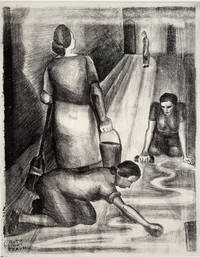
14331Braun Ruth Light American 1906-2003. UNTITLED CLEANING CREW. Lithograph not dated but likely 1930s. Edition size not stated. Signed in pencil lower left. 13 3/8 x 10 1/2 inches image 18 x 12 inches sheet. Framed to 21 x 19 inches. In excellent condition. Ruth Light Braun was born in Brooklyn NY and studied art at Cooper Union. After a period during which she did drawings for the New Yorker and book illustrations she studied for two years with Winold Reiss. She adopted the methods which Reiss used to portray ethnic subjects to doing portraits of Jews in New York. She also did genre scenes of Jew ish life in the city during the 1920s and 1930s and it is likelty that this scene of women cleaning in what may be an office building is one of these. Later she spent time in Palestine but returned to the U.S. after the death of her first husband. She remariied and she and her hisband formed a catering business in Washington DC. In later life she resumed her art career in Florida. unknown
181947357Paris Crochard 1819. 8vo. No wrappers. In "Annales de Chimie et de Physique" Tome X 2. Series Cahier 3. Titlepage to vol. X. Pp. 241-336 entire issue offered Cahier 3. Arago and Fresnel's paper: pp. 288-306. <br/><br/><em>First appearance of this seminal paper in which Arago and Fresnel described the experiments which demonstrated that light vibrates transversely to its direction of forward movement."In a further letter to Arago dated 29 April 1818 Young recurred to the subject of transverse vibrations comparing light to the undulations of a cord agitated by one of its extremities. This letter was shown by Arago to Fresnel who at once saw that it presented the true explanation of the non-interference of beams polarised in perpendicular planes and that the latter effect could even be made the basis of a proof of the correctness of Young's hypothesis; for if the vibration of each beam be supposed resolved into three components one along the ray and the other two at right angles to it it is obvious from the Arago-Fresnel experiment that the components in the direction of the ray must vanish; in other words THAT THE VIBRATIONS WHICH CONSTITUTE LIGHT ARE EXECUTED IN THE WAVE-FRONT." Edmund Whittaker in "A History of the Theories of Aether and Electricity I" p. 115. - Parkinson Breakthroughs 1819 P. - Magie "A Source Book in Physics p. 325 ff. </em> unknown
184644101Paris Victor Masson 1846. No wrappers as extracted from "Annales de Chimie et de Physique" Tome 17 Troisieme Série. Titlepage to tome 17. Pp. 172-199 a. 1 engraved plate pp. 316-338 textillustr. Brownspots to titlepage and some browspots to the second memoir. <br/><br/><em>First editions of two importent memoirs on polarization and reflexion of light by "the founder of the new optics".The first paper takes on a central role in Fresnel's dealing with polarization in general and specially with chromatioc polarization and the explaining the phenomena that arises when light travels through crystals. The paper was read at the Academy on march 30 was not printed at the time as it disappeared and only turned up many years later around 1845 when it was found in the papers of Fresnel's brother. "On croyait ou Mémoire perdu. Il a été retrouvé dans les papiers de M. Léonor Fresnel frère de l'illustre académicien." Thus the offered paper is here PRINTED FOR THE FIRST TIME AND IN ITS FULL LENGHT.The second paper deals with reflection and explains the different phenomena seen when light is reflected from glassplates having two surfaces parallel or with curvature interference of reflected waves and the measure of their different wavelenghts all explained according to the wave theory of light. The paper offered is for the FIRST TIME PRINTED IN ITS FULL LENGHT as it only appeared in the résumé-form in 1820 "Résumé d'un Mémoire sur la Réflexion de la lumière" Annales de Chimie et de Physique tome 15 pp. 379-386."As it was Fresnel succeeded fully in attaining his explicit goal the establishment of the wave conception of light. Not long after his death scientific opinion definitely shiftedin favor of waves and opened up the pathway leading to the deeper insight of Maxwell. In broad context Fresnel's work can be viewed as the first successfull assault on the theory of imponderables and a major influence on the development of nineteenth-centurty energetics." DSB V p. 171. </em> unknown
23554<p>Chicago Reilly & Lee Co. HARDBACK NODustJacket NO DATE EARLY Vintage Third Edition 1st Issue VG/VG- NOJACKET AS-IS Beige Yellow & Blue & Brown Illustrated Cover Boards with Boy Prince with Butterfly Wings & Mud-Turtle in Circle Cover Rub Wear Tiny Chips Tears Extremities & Up & Down Spine little Scuff & FOX Light Soil Pencil Back BookInterior Nice Condition Light Wear few FoX stains some Aging few small smudges 61 PGS 5 X 6 3/4 IN. APPROX Book is lightly soiled smudged corners tiny bumped rubbed at extremities; boards sl. soiled corners very lightly frayed Book is VG- condition overall. Cover has light soiling but is complete and nice. All pages are present and the binding is holding well. The spine is plain cloth rather than regular board material with title as I have seen on others of these books so I assume it has had the spine replaced. It is professionally done and blends well. There is a hand-written name and some staining on the title page and light soiling throughout but overall in one of the best conditions I've seen for one of the Twinkle Tales. . with 14 color illustrations throughout. Lists all of Titles in Series inside Book . Hard Cover.</p> Chicago, Reilly & Lee Co. hardcover
1823029204<p>London: Rodwell & Martin 1823. Un volume 18x26 cm frontespizio illustrato 60 tavole incise e 126 pagine non numerate con testo esplicativo delle tavole ognuna in inglese al recto e francese al verso. Il frontespizio un po' sbiadito e rifilato; le altre tavole in perfette condizioni. Incisioni di: Allen Askey Byrne Cooke Junr. Corbould Edwards Finden Goodall Heath Hollis Hobson Lacy Middiman Miller Pye Radclyffe Wallis e Westwood tratte da dipinti di Dewint. Bellissima legatura coeva in tutta pelle rossa con larga cornice dorata ai piatti dorso con fregi e titoli dorati; labbra e tagli dorati. Ex libris nobiliare inglese al retro del piatto. Uno dei più famosi e bei libri illustrati dell'800 sulla Sicilia. Riferimenti: Mira G. Bibliografia siciliana v. I p. 515; The first proofs of the universal catalogue of Books on art v. I p. 415; Pine-Coffin R.S. Bibliography of British and American travel in Italy to 1860 rif. 823.6. Peso: 1500 gr.</p> Rodwell & Martin hardcover
192223644Reilly & Lee Chicago 1922. HARDBACK NODustJacket 1922 1st Edition 1st Printing VG/VG NOJACKET . Sold AS-IS which is a First Edition of a very scarce period piece of that time. Blue Decorated Cloth with Black Lines Cover with Black Lettering light Rub Wear Interior Nice tight Clean Light FoX Wear 224 pgs Light Fade & Sun & mild FoX SPINE COVER. First Edition. Hard Cover. Reilly & Lee , Chicago hardcover
2082702114602979Ship and Port Editorial Office Showa 55-Heisei 16 N.A. Soft Cover. Fine. The book is in fine condition. Ship and Port Editorial Office Showa 55-Heisei 16 paperback
19902091202133205459chinese bookstore 1990. Soft Cover. Fine. Number of books: 12 books in total chinese bookstore paperback
186755371København 1867. Contemp. marbled clothbacked boards. Titlelabel with gilt lettering on upper cover. Pp. 26-45. Extracted from "Oversigt over det Kgl. danskeVidenskabernes Selskabs Forhandlinger 1867 Nr. 1". <br/><br/><em>Extremely scarce first edition of the paper in which Lorenz independent of Maxwell stated that light is electromechanical in nature probably inspired by his former teacher H. C. Oersted the discoverer of electromagnetism and professor at the Polytechnic College he aimed at unifying the forces of nature without introducing new physical hypotheses. "The idea that the various forces in nature are merely different manifestations of the one and same force has proved itself more fertile than all physical theories".Most impressive of all Lorenz’ achievements in optics is his electromagnetic theory of light developed in a relatively unknown paper of 1867 two years after Maxwell’s famous paper on the same subject. At that time Lorenz did not know Maxwell’s theory and his own approach was quite different. Lorenz’ electromagnetic theory of light can be described briefly as an interpretation of the light vector as the current density vector in a medium obeying Ohm’s law. This paper contains the fundamental equations for the vector potential and the scalar potential or - for the first time - the corresponding retarded potentials expressed in terms of the current density vector and the electrical charge density. The concept of retarded potentials had already been introduced in an earlier paper by Lorenz in connection with research on the theory of elasticity. He found that the differential equation for the current density vector was the same as his fundamental wave equation for the light vector completed with a term which explains the absorption of light in conducting media and that his theory led to the correct value for the velocity of light." Mogens Pihl in DSB.The paper was published in English 1867 "On the identity of the vibrations of light with electrical currents." Philosophical Magazine 34: 287-301 and also in German in "Annalen der Physik" </em> hardcover
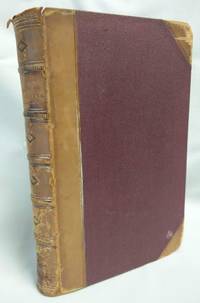
1830013641London: Henry Colburn and Richard Bentley 1830 Book. Illus. by Foldout Map and Three Illustrations. Good Minus. 3/4 Leather. 1st Edition. 12mo - over 6¾ - 7¾" tall. Original 3/4 leather over maroon cloth on boards. Marbled page edges. Five raised bands on spine with gilt and embossed decoration. Minor wear to edges and corners of leather. Top of spine a little frayed. Previous owner's bookplates in front. Front hinge broken but still holding. Medium hinge break between pgs. 120-121. Bad hinge break between pgs. 288-289. Rear hinge cracked. Foldout lithographed map of Nova Scotia counties is in very good condition - just a few extra folds at one edge. Captain Moorsom spent five years in Nova Scotia initially as an officer in the 52nd Regiment. This book is his observances of the people climate geography and economic prospects of the colony written in the form of letters home to friends in England. One biographer calls it "the most complete picture available of Nova Scotia during the 1820s." Some Nova Scotians were upset at some of his comments but Joseph Howe defended Moorsom since he'd promoted the colony in England. This book is on consignment so no discounts apply. It will be sent insured so expect a request for "extra shipping" to cover that cost. Henry Colburn and Richard Bentley hardcover
1891574<p>Nims & Knight Troy NY 1891. HB NODJ 1891 1st edition THUS Interior nice tight Clean light wear Fox & few small tear chips edges pages Brown Tan Green decorated Cloth Gold Gilt cover lightning TO cover EDGES & light wear rub light Fox O/W very nice Some pages with light stain at inner hinge NF/NF AS-IS NODJ121 pages Back Cover small staining copyright page says Copyright 1888 By Samuel E. Cassino. First Thus. Hard Cover.</p> Nims & Knight Troy, NY hardcover
mon0000013698Palgrave Macmillan. hardcover. Good. 1.2000 in x 8.5000 in x 5.4000 in. Hardcover. No jacket. Ex-library with usual markings. Foxing to edges of text-block. Text clean and binding solid. Palgrave Macmillan hardcover
195322013Reading PA Fantasy Press 1953. HBDJ 1953 stated 1st edition Original Red Cloth lettered & Decorated on Spine in Gold Gilt Cover light Rub Wear Interior nice tight Clean light Wear FoX F-/NF DJ slight rub wear & tiny Chips & small mended tears Extremities 256 pages Light soil Back DJ Tiny Tear Base DJ Spine. Signed by Author. First Edition. Hard Cover. Reading, PA Fantasy Press hardcover
195327275Reading PA Fantasy Press 1953 HBDJ 1953 stated 1st edition Original Red Cloth lettered & Decorated on Spine in Gold Gilt Cover light Rub Wear Interior nice tight Clean light Wear FoX F-/NF DJ slight rub wear & tiny Chips & small mended tears Extremities 256 pages Light soil Back DJ Tiny Tear Base DJ Spine Author born in Butler Missouri in 1907 . Signed by Author. 1st Edition. Hard Cover. Very Good/Very Good. Reading, PA Fantasy Press hardcover