130 résultats
181144092Leipzig Johann Ambrosius Barth 1811. Without wrappers. In: "Annalen der Physik. Hrsg. Ludwig Wilhelm Gilbert" Bd. 39 der Reihe Eilftes u. Zwölftes Stück. Titlepage to vol. 39. Pp. 129-244 a. 2 engraved plates. The entire issue offered. Young's papers: pp. 156-205 a. pp. 206-220. And pp. 245-360 a. 2 engraved plates. The entire issue offered. Young's papers: pp. 255-261 a. pp. 262-290. <br/><br/><em>First appearance in German of Youngs 3 groundbreaking papers On the Theory of Light and Colours 1802 - An account of some Cases of the Production of Colours not hitherto described 1802 - The Bakerian Lecture. Experiments and Calculations relative to physical Optics. 1804 - which gives the first really convincing evidence that the fringes are produced by interference of light waves and giving the experimental demonstrations of the general law of Interference.These importent demonstrations served as the experimental basis for the wave hypothesis of light. - In his two first papers "On the Theory of Light and Colours" 1802 and "An account of Some Cases of the Production of Colours not hitherto described" 1802 - he only partially announced his principle of Interference and the statement of it in "An Account." was entirely hypothetical and not experimental. Magie. Source Book in Physics gives extracts of this paper and a later paper under the head: Discovery of the interference of light pp.308-15.Young also shows here that diffraction effects can be explained by the interference law."The experimental basis for the wave hypothesis of light as Young formulated it was interference. The fact has already been observed that two trauins of water waves may be so superposed that in certain regions the throughs of one train will lie continuously on the crests of another thereby producing zero disturbance.Destryctive interference is said to occur between the two trains of waves in the former case and constructivee interference in lthe latter. Similarly two sound waves may be so combined as to produce alternate regions of silence and enhanced sound. The phenomenon of interference of which the forgoing are familiar examples is easely comprehensible in the case of combining waves but would be utterly incomprehensible in the case of combining streams of particles. So when Young demonstrated that two beams of light could under properly controlled conditions be made to combine in such a way as to produce alternate regions of darkness and light he was rightly considered to have identified in light a characteristic property of waves." Lloyd Taylor in: Physics. The Pioneer Science. p. 511.Of the three papers published in the years 1802-04 the last is the most importent as it gives the experimental demonstrations of the interference of light. Dibner in Heralds of Science No. 151 list the first paper so does PMM: 259. </em> unknown
18142111902160200379Bunemon Maruya 1814. Soft Cover. Fine. Number of books: 1 Bunemon Maruya paperback
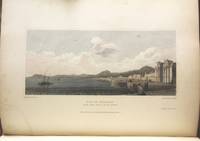
1823B1904London: Rodwell and Martin 1823. A very good and attractive copy. Binding: recent ½ calf with marbled boards spine with 6 compartments of densely blind tooled and gilt tooled raised bands. Red morocco label on two. All edges in gilt renewed endpapers. Notes: William Light was the son of Martinha Rozells and Captain Francis Light founder and governor of Penang. He was born in Kuala Kedah Malaya on 27 April 1786 When only fourteen years old he joined the navy. At twenty-two he served with the Dragoons in Spain and Portugal and in 1811 was appointed Lieutenant. A year later during the battle of Badajos he was attached to General Graham later Lord Lynedoch. From 1814 to 1821 he served in Scotland and Ireland and managed to travel to Sicily Florence and Turin. In 1835 Hindmarsh was appointed Governor of South Australia and recommended Light for the position of Surveyor General. He died on 6 October 1839 from tuberculosis. Size: 4to Illustration: Contains an engraved title and finely hand coloured 60 full page plates depicting various scenes of Sicilian life. Each plate has an accompanying description with English on one side and French on the other. Pages: P. half-title blank title blank plate listing 3 blank 60 plates and discriptions unpaginated. Category: Book Voyages General; Book Europe ItalyBook Plate Books Colour; Rodwell and Martin hardcover
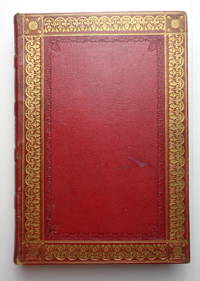
1823029204<p>London: Rodwell & Martin 1823. Un volume 18x26 cm frontespizio illustrato 60 tavole incise e 126 pagine non numerate con testo esplicativo delle tavole ognuna in inglese al recto e francese al verso. Il frontespizio un po' sbiadito e rifilato; le altre tavole in perfette condizioni. Incisioni di: Allen Askey Byrne Cooke Junr. Corbould Edwards Finden Goodall Heath Hollis Hobson Lacy Middiman Miller Pye Radclyffe Wallis e Westwood tratte da dipinti di Dewint. Bellissima legatura coeva in tutta pelle rossa con larga cornice dorata ai piatti dorso con fregi e titoli dorati; labbra e tagli dorati. Ex libris nobiliare inglese al retro del piatto. Uno dei più famosi e bei libri illustrati dell'800 sulla Sicilia. Riferimenti: Mira G. Bibliografia siciliana v. I p. 515; The first proofs of the universal catalogue of Books on art v. I p. 415; Pine-Coffin R.S. Bibliography of British and American travel in Italy to 1860 rif. 823.6. Peso: 1500 gr.</p> Rodwell & Martin hardcover
186743497Leipzig Johann Ambrosius Barth 1867. Contemp. hcalf raised bands gilt spine with gilt lettering. A few scratches to binding. In "Annalen der Physik und Chemie. Hrsg.von Poggendorff" Bd. 99. Entire volume offered. 2X652 pp. and 4 folded engraved plates. Weber & Kohlrausch's paper:pp. 10-25. <br/><br/><em>First appearance of this importent paper the results of which Maxwell later used as a crucial support for his electromagnetical theory of light.".The velocity of light c were measured by W. Weber and R. Kohlrausch in 1855 the paper offered. They used an electrometer to determine the charge of a condnsor in electrostatic units and a ballistic galvanometer to measure the same charge in electrodynamic units. The resulting value for c was in good agreement with that obtained by Fizeau in 1849 and Maxwell accordingly felt entitled to identify light and electromagnetic vibrations. This conclusion recalls Newton's identification of gravity with universal attraction: it was not only because they obeyed the same formal law but also because both led to the same mathematical results that Newton saw fit to combine them."Taton Réne in "History of Sciencein The Nineteenth Century" p. 163. </em> hardcover
1857ZB1289053Charleston: Walker Evans & Co. 1857. 80 pp. self wrappers removed from a larger binding spine rough title page soiled and slightly chipped else good. - If you are reading this this item is actually physically in our stock and ready for shipment once ordered. We are not bookjackers. Buyer is responsible for any additional duties taxes or fees required by recipient's country. Charleston: Walker, Evans, & Co. unknown
1888762241888. SOUTH CAROLINA REGIMENTAL. WASHINGTON LIGHT INFANTRY. Rolls of the Washington Light Infantry in Confederate Service to Which Is Appended the Mortuary of the Three Companies. All Corrected by Special Committees of Each of the Three Companies and Published by the W.L.I. Veterans. Charleston: 1888. 1st ed. 17pp. Orig. pictorial wrappers. Housed in custom cloth folding case. Spine just starting else fine. Dornbusch II 948. unknown
1873C000031866London: Sampson Low Marston Low. 1873. First printing. Hardcover. Good. First edition 1873 original blue cloth gilt beveled edges 267 pp. 10 ORIGINAL MOUNTED PHOTOGRAPHS including frontispiece of Ulysses Grant one of the Oil Fields of Western Pennsylvania several of Washington DC including the Post Office and the White House one of W. H. Seward etc. Good copy with a bit of wear and staining to binding occasional foxing and soil within but still a handsome tight bright copy. Sampson Low, Marston, Low.. hardcover
18901410180Chicago: The Craig Press 1890. Hardcover. Octavo 129 pages. In Fair minus condition. Spine is red with gold print. Boards in red cloth gold print mitred edges; tattering to spine caps and corners blemishes toning shelf wear cocked spine. Text block has cracked hinges front flyleaf loose intermittent spine breaks light age toning to paper. Illustrated: b&w frontispiece and plates photographs with tissue guards. <br /> <br /> NOTE: Shelved in Netdesk Column Z. 1410180. FP New Rockville Stock. The Craig Press hardcover
188117531Paris Calmann-Lévy 1881 14 in-8 Paris, Calmann lévy, Michel Lévy Frères, 1870 à 1882, 14 volumes grand in-8, demi-chagrin vert, dos à 5 nerfs ornés, plats en percaline verte estampés à froid, tranches dorées, reliure de l'époque.
18779144William Mullan & Son London 1877. HB NODJ 1877 1st UK edition Green embossed decorated cloth with Gold Gilt lettered in black & Gold Gilt VG-/VG AS-IS NODJ Cover some rub wear & tiny dings extremities some internal Fox intermittently thruout O/W NIce Tight Clean. First Edition. Hard Cover. William Mullan & Son London hardcover
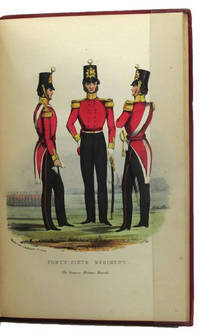
1851152320London: Parker Furnivall and Parker 1851. Containing an Account of the Formation of the Regiment in 1741 and of its subsequent services to 1851. Pp. iixxiixxv-xxxvi76 2 coloured plates appendix; demy 8vo; red cloth lettered ruled and decorated in gilt & blind; uncut; title page browned; Parker Furnivall and Parker London 1851. First edition. Sutcliffe 1/p. 200. From the Military Collection of Anne S. K. Brown with her bookplate on upper pastedown and later from the library of Sydney bibliophile David Levine with his Militaria book label also on upper pastedown. As with many of Richard Cannon's books the pagination is irregular. The text is complete but this copy does not have an engraved title page present in some other of his titles. Parker, Furnivall, and Parker unknown
180143492Halle Rengerschen Buchhandlung 1801. Without wrappers as published in "Annalen der Physik. Herausgegeben von Ludwig Wilhelm Gilbert" Bd. 7 Viertes Stück. The entire issue offered =Heft 4. Pp. 387-528. Ritter's announcement p. 525. With titlepage to volume 7. Clean and fine. Titlepage a bit shavedin inner margin. <br/><br/><em>First printing of Ritter's announcement of his discovery of ultraviolet light in a halfpage letter addressed to Gilbert's Annalen. With that discovery it became clear that visible light represents no more than a fraction of a continous spectrum.A year earlier in 1800 William Herschel discovered infrared light. This was the first time that a form of light beyond visible light had been detected. After hearing about Herschel's discovery of an invisible form of light beyond the red portion of the spectrum Ritter decided to conduct experiments to determine if invisible light existed beyond the violet end of the spectrum as well. He had heard that blue light caused a greater reaction in silver chloride than red light did. Ritter decided to measure the rate at which silver chloride reacted to the different colors of light. He directed sunlight through a glass prism to create a spectrum. He then placed silver chloride in each color of the spectrum and found that it showed little change in the red part of the spectrum but darkened toward the violet end of the spectrum. Johann Ritter then decided to place silver chloride in the area just beyond the violet end of the spectrum in a region where no sunlight was visible. To his amazement this region showed the most intense reaction of all. This showed for the first time that an invisible form of light existed beyond the violet end of the visible spectrum. This new type of light which Ritter called Chemical Rays later became known as ultraviolet light or ultraviolet radiation the word ultra means beyond. - Parkinson Breakthroughs: 1801 P. </em> unknown
180343638Halle Rengerschen Buchhandlung 1803. Without wrappers as extracted from "Annalen der Physik. Herausgegeben von Ludwig Wilhelm Gilbert" Jahrgang 1802 Bd. 12 Zwölftes Stück. Pp. 409-416. Titlepage to vol. 12. <br/><br/><em>This is Ritter's first expositon of his discovery of ultraviolet light. It was announced the year before in a halfpage letter addressed to Gilbert's Annalen and printed in the Annalen. With that discovery it became clear that visible light represents no more than a fraction of a continous spectrum.A year earlier in 1800 William Herschel discovered infrared light. This was the first time that a form of light beyond visible light had been detected. After hearing about Herschel's discovery of an invisible form of light beyond the red portion of the spectrum Ritter decided to conduct experiments to determine if invisible light existed beyond the violet end of the spectrum as well. He had heard that blue light caused a greater reaction in silver chloride than red light did. Ritter decided to measure the rate at which silver chloride reacted to the different colors of light. He directed sunlight through a glass prism to create a spectrum. He then placed silver chloride in each color of the spectrum and found that it showed little change in the red part of the spectrum but darkened toward the violet end of the spectrum. Johann Ritter then decided to place silver chloride in the area just beyond the violet end of the spectrum in a region where no sunlight was visible. To his amazement this region showed the most intense reaction of all. This showed for the first time that an invisible form of light existed beyond the violet end of the visible spectrum. This new type of light which Ritter called Chemical Rays later became known as ultraviolet light or ultraviolet radiation the word ultra means beyond. </em> unknown
1861038252Germany: Stuttgart 1861. No Edition Stated. Hardcover. Very Good. 0x0x0. Paper Is Yellow From The Age In Very Good Condition. German Text. Tiitle "Recht Und Licht Das Gott Leben In Der Und Menldhen Dargestellt " By Auto Hahn. Right And Light. The God-Life In Nature And Man's Rhythm- Specializing in academic collectible and historically significant providing the utmost quality and customer service satisfaction. For any questions feel free to email us. Stuttgart hardcover
18829692Dodd Mead NY 1882. HB NODJ 1882 1st edition Interior relatively Clean Tight with light Fox & some soil & Wear Edges pgs darkened which extends ontosome of the pgs margins inside Mended tear pg 45 pgs Green decorat ed cloth with torn label & darkening stains cover & tiny chips Extremities G/G- NOJACKET. First Edition. Hard Cover. Dodd, Mead NY hardcover
1819ZB626382NY 1918-1932. mostly quartos mostly bound some covers retained illustrated ex library else text clean & bindings tight. - If you are reading this this item is actually physically in our stock and ready for shipment once ordered. We are not bookjackers. Buyer is responsible for any additional duties taxes or fees required by recipient's country. Photos available upon request. NY unknown
1830013641London: Henry Colburn and Richard Bentley 1830 Book. Illus. by Foldout Map and Three Illustrations. Good Minus. 3/4 Leather. 1st Edition. 12mo - over 6¾ - 7¾" tall. Original 3/4 leather over maroon cloth on boards. Marbled page edges. Five raised bands on spine with gilt and embossed decoration. Minor wear to edges and corners of leather. Top of spine a little frayed. Previous owner's bookplates in front. Front hinge broken but still holding. Medium hinge break between pgs. 120-121. Bad hinge break between pgs. 288-289. Rear hinge cracked. Foldout lithographed map of Nova Scotia counties is in very good condition - just a few extra folds at one edge. Captain Moorsom spent five years in Nova Scotia initially as an officer in the 52nd Regiment. This book is his observances of the people climate geography and economic prospects of the colony written in the form of letters home to friends in England. One biographer calls it "the most complete picture available of Nova Scotia during the 1820s." Some Nova Scotians were upset at some of his comments but Joseph Howe defended Moorsom since he'd promoted the colony in England. This book is on consignment so no discounts apply. It will be sent insured so expect a request for "extra shipping" to cover that cost. Henry Colburn and Richard Bentley hardcover
18502201030037xbvkParis, A. Franck - Libraire-Éditeur, 1850. Foretitlepage, titlepage, II, (1.295)-1.856 untrimmed and unopened pages with few graphic diagrams (p. 1.256 wrongly numbered 1.258). - Publisher's ornamental and titled blue paper-cover; 8vo.(ca. 22 x 14 x 3,5 cm).
18472201030035xbvkParis, A. Franck - Libraire-Éditeur, 1847. Foretitlepage, titlepage, IV, 404 untrimmed and unopened pages, with few graphic diagrams. - Publisher's ornamental and titled blue paper-cover; 8vo.(ca. 22 x 14 x 2 cm).
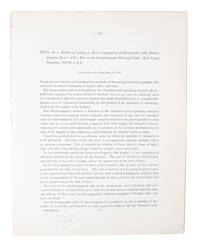
186942029London Taylor & Francis 1869 Large 4to. Without wrappers. Extracted from "Philosophical Transactions of the Royal Society of London." Vol. 158. Maxwell's paper: pp. 643-657. Clean and fine wide margins. <br/><br/><em>First appearance of this major paper on electromagnetic dynamics in which Maxwell improves the groundbreaking equations he had set forth in his famous paper of 1865 the "A dynamical Theory of Electro-Magnetic Fields". In the paper offered here he for the first time proposed to base the electromagnetic theory of light solely on 2 equations. The paper is one of Maxwell's 5 most importent contributions to electromagnetism."Formulas for the forces between moving charged bodies may indeed de derived from Maxwell's equations but the action is not along the line joining them and can be reconciled with a dynamical principle only by taking into account the exchange of momentum with the field. Maxwell remarked that the equations might be condensed but "to eliminate a quantity which expresses a useful idea would be rather a loss than a gain in this stage of our enquiry." he had in fact simplified the equations in his fifth major paper the short but importent "Note on the Electromagnetic Theory of Light." 1868 writing them in an integral form without the function A based on four postulates derived from electrical experiments. This may be called the electrical formulation of the theory in contrast with the original dynamical formulation." C.W.F. Everitt in DSB. </em> unknown
18772110502150908844Kimura Sadagoro Edition 1877. Soft Cover. Fine. Number of books: 3 Kimura Sadagoro Edition paperback
187726077Martinsburg: Independent Printing Company 1877. Original printed wrappers with wrapper title as issued. 8pp stitched. Rear wrapper and first text page margin with the contemporary signature of G. Tabb Snodgrass September 20th 1877. Light dusting Very Good. <br/><br/> Lists names of Officers Sergeants and Corporals; the Order of Business; and the rules for members and officers including disciplinary procedures. A rare item. <br/>OCLC 22480334 1- U WVA. Independent Printing Company unknown books
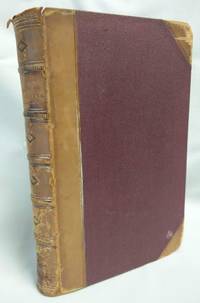
186755371København 1867. Contemp. marbled clothbacked boards. Titlelabel with gilt lettering on upper cover. Pp. 26-45. Extracted from "Oversigt over det Kgl. danskeVidenskabernes Selskabs Forhandlinger 1867 Nr. 1". <br/><br/><em>Extremely scarce first edition of the paper in which Lorenz independent of Maxwell stated that light is electromechanical in nature probably inspired by his former teacher H. C. Oersted the discoverer of electromagnetism and professor at the Polytechnic College he aimed at unifying the forces of nature without introducing new physical hypotheses. "The idea that the various forces in nature are merely different manifestations of the one and same force has proved itself more fertile than all physical theories".Most impressive of all Lorenz’ achievements in optics is his electromagnetic theory of light developed in a relatively unknown paper of 1867 two years after Maxwell’s famous paper on the same subject. At that time Lorenz did not know Maxwell’s theory and his own approach was quite different. Lorenz’ electromagnetic theory of light can be described briefly as an interpretation of the light vector as the current density vector in a medium obeying Ohm’s law. This paper contains the fundamental equations for the vector potential and the scalar potential or - for the first time - the corresponding retarded potentials expressed in terms of the current density vector and the electrical charge density. The concept of retarded potentials had already been introduced in an earlier paper by Lorenz in connection with research on the theory of elasticity. He found that the differential equation for the current density vector was the same as his fundamental wave equation for the light vector completed with a term which explains the absorption of light in conducting media and that his theory led to the correct value for the velocity of light." Mogens Pihl in DSB.The paper was published in English 1867 "On the identity of the vibrations of light with electrical currents." Philosophical Magazine 34: 287-301 and also in German in "Annalen der Physik" </em> hardcover
186753255Kjöbenhavn Bianco Luno 1867. Contemp. hcalf. Gilt spine with gilt lettering. In: "Oversigt over det Kongelige danske Videnskabernes Selskabs Forhandlinger. i Aaret 1867". X273493 pp. textillustrations and plates. Entire volume offered. Lorenz's paper: pp. 26-45 and pp. 9-16 Resumé en Francais. Clean and fine. <br/><br/><em>Scarce first edition of Lorenz' landmark paper which contains his important studies on the electromagnetic theory of light in which he - less than two years after but independently of Maxwell - found that LIGHT MIGHT BE INTERPRETED AS ELECTROMAGNETIC WAVES and that his equations lead to the CORRECT VALUE FOR THE VELOCITY OF LIGHT. "The procedure which Lorenz followed was that of which Riemann had suggested in 1858 namely to modify the accepted formula of electrodynamics by introducing terms which though too small to be appreciable in ordinary laboratory experiments would be capable of accounting for the propagation of electrical effects through space with a finite velocity.The Lorenz- equations are however the fundamental equations of Maxwell's theory; and therefore the theory of L. Lorenz is practically equivalent to that of Maxwell so far as concerns the propagation of electromagnetic disturbances through free aether.he suggested that ALL LUMINOUS VIBRATIONS MIGHT BE CONSTITUTED BY ELECTRIC CURRENTS and hence that there was 'no longer any reason for maintaining the hypothesis of an aether since we can admit that space contains sufficient ponderable matter to enable the disturbance to be propagated" Edmund Whittaker in "A History of the Theories of Aether and Electricity I" p. 267-70. </em> unknown