130 résultats
184423359J. James Burns LONDON 1844. . Includes The Field of Terror Supernatural Wild Love and The Oak of the Idols. A RARE edition.Illustrated in B/W by Franklin title page and other illustrations HardBack NODUSTJACKET 1844 1ST EDition THUS Green Embossed Gold Gilt Cloth with with Cross Design in Center in Gilt Light Rub Wear Scuff Cover & Tiny Chips Extremities VG/VG NOJACKET Some Light Black Marks Top Cover Front Gold Gilt to Pages Edges 51 215 22 20 pages with publishers 4-page catalogue to rearPebble grain green cloth bevelled boards decoratively blocked in gilt to upper cover lettered in gilt to spine and blocked in blind to lower cover. All edges gilt. Light marking with wear to head and tail of spine edges and boards. Gilt bright. Generally a very good copy. First Thus. Hard Cover. J. ( James ) Burns LONDON hardcover
1891NATW0968Lpz., Barth 1891. XII, 139 S., 2 Bl. Vlgsanz., mit Fig. Im Text u. auf 2 Taf., HLn. d. Zt., berieben, Kanten u. Ecken etwas bestoß., Rü. zerschlissen, Innengelenk beschäd., Vorsatzfalz gerissen, fingerfl. bzw. auf Rückseite mit Tintenspur, Innentit. mehrf. Beschriftet, numeriert u. gestemp., auf den ersten Seiten einige Schmutz- bzw. Fingerfl., schwach gebr. Erstausgabe.
180343638Halle Rengerschen Buchhandlung 1803. Without wrappers as extracted from "Annalen der Physik. Herausgegeben von Ludwig Wilhelm Gilbert" Jahrgang 1802 Bd. 12 Zwölftes Stück. Pp. 409-416. Titlepage to vol. 12. <br/><br/><em>This is Ritter's first expositon of his discovery of ultraviolet light. It was announced the year before in a halfpage letter addressed to Gilbert's Annalen and printed in the Annalen. With that discovery it became clear that visible light represents no more than a fraction of a continous spectrum.A year earlier in 1800 William Herschel discovered infrared light. This was the first time that a form of light beyond visible light had been detected. After hearing about Herschel's discovery of an invisible form of light beyond the red portion of the spectrum Ritter decided to conduct experiments to determine if invisible light existed beyond the violet end of the spectrum as well. He had heard that blue light caused a greater reaction in silver chloride than red light did. Ritter decided to measure the rate at which silver chloride reacted to the different colors of light. He directed sunlight through a glass prism to create a spectrum. He then placed silver chloride in each color of the spectrum and found that it showed little change in the red part of the spectrum but darkened toward the violet end of the spectrum. Johann Ritter then decided to place silver chloride in the area just beyond the violet end of the spectrum in a region where no sunlight was visible. To his amazement this region showed the most intense reaction of all. This showed for the first time that an invisible form of light existed beyond the violet end of the visible spectrum. This new type of light which Ritter called Chemical Rays later became known as ultraviolet light or ultraviolet radiation the word ultra means beyond. </em> unknown
180343638Halle, Rengerschen Buchhandlung, 1803. Without wrappers as extracted from ""Annalen der Physik. Herausgegeben von Ludwig Wilhelm Gilbert"", Jahrgang 1802, Bd. 12, Zwölftes Stück. Pp. 409-416. Titlepage to vol. 12.
184844100Leipzig Johann Ambrosius Barth 1848. Without wrappers. In "Annalen der Physik und Chemie. Hrsg. von J.C. Poggendorff" Ergänzungsbd. Bd. II Stück 2. Titlepage to Erg-Bd. 2. Pp. 193-368. The entire issue offered. Fresnel's papers: pp. 304-331 textillustr. a. pp. 332-355 textillustr. A stamp on titlepage and verso of. Clean and fine. <br/><br/><em>First German editions of two importent memoirs on polarization and reflexion of light by "the founder of the new optics". The French versions of the papers appeared in "Annales de Chimie et de Physique"1846.The first paper takes on a central role in Fresnel's dealing with polarization in general and specially with chromatioc polarization and the explaining the phenomena that arises when light travels through crystals. The paper was read at the Academy on march 30 was not printed at the time as it disappeared and only turned up many years later around 1845 when it was found in the papers of Fresnel's brother. "On croyait ou Mémoire perdu. Il a été retrouvé dans les papiers de M. Léonor Fresnel frère de l'illustre académicien." Thus the offered paper is here PRINTED FOR THE FIRST TIME AND IN ITS FULL LENGHT in the German version.The second paper deals with reflection and explains the different phenomena seen when light is reflected from glassplates having two surfaces parallel or with curvature interference of reflected waves and the measure of their different wavelenghts all explained according to the wave theory of light. The paper offered is for the FIRST TIME PRINTED IN ITS FULL LENGHT in the German version as it only appeared in the résumé-form in 1820 "Résumé d'un Mémoire sur la Réflexion de la lumière" Annales de Chimie et de Physique tome 15 pp. 379-386."As it was Fresnel succeeded fully in attaining his explicit goal the establishment of the wave conception of light. Not long after his death scientific opinion definitely shiftedin favor of waves and opened up the pathway leading to the deeper insight of Maxwell. In broad context Fresnel's work can be viewed as the first successfull assault on the theory of imponderables and a major influence on the development of nineteenth-centurty energetics." DSB V p. 171. </em> unknown
183343919Leipzig Joh. Ambrosius Barth 1833. Contemp. hcalf. Spine gilt. Very light wear to spine ends and edges. In: "Annalen der Physik und Chemie. Hrsg.von Poggendorff" Jahrgang 1833 Bd. 30 Ergäntzungsheft. 376 pp. a. 2 folded engraved plates. 2 small stamps to p.1 and a small stamp to verso of plates. Entire volume offered. Fresnel's papers: pp. 100-255 a. pp. 255-261. Clean and fine. <br/><br/><em>First German edition of Fresnel's epoch-making memoir from the French Academy 1826 and incorporating his experimental results from the years 1815-19 in which he for the first time explained the causes of the diffraction effects as the mutual interference of the secondary waves emitted by those portions of the original wave-front which have not been obstructed by the diffraction screen. His methods of calculation utilized the principles of both Huygens and Young and he summed the effects due to different portions of the same primary wave-front. He demonstrates that the transverse wave theory of light explains the observed phenomena of reflection refraction interference polarization difraction patterns diffraction fringes etc. making a strong case for the theory of the transverse nature of light waves. The memoir records also Fresnel's famous mirror-experiment."In broad contect Fresnel's work can be viewed as the first successfull assault on the theory of imponderables and a major influence on the development of nineteenth-centurty energetics." DSB V p. 171."Augustin Fresnel seems to have adopted a wave theory of light from the very beginning of his studies. His first paper presented to the Academy.in October 1815 and entitled "La Diffraction de la Lumiere" the paper offered was written after a long correspondance with Arago who had promised Fresnel his full support. "The wave theory" Fresnel wrote "is well suited to explaining the complicated propagation of light phenomena and since as we know from the case of sound waves can surcomvent obstacles I decided to make a study of shadows.It is because they cross in regions common to them both that two pencils of rays can produce fringes. hence it follows that the vibrations of rays which cross at very small angles can cancel out whenever crests of one correspond to the throughs of the other."The voume contains further a notable paper by AMPÈRE "Bestimmung der krummen Fläche der Lichtswellen in einem Mittel dessen Elasticität verschieden ist nach den drei Hauptrichtungen d.h. nach debjenigen in welchem die von der Elasticität erregte Kraft in desselben Richtung wirkt in der die Theilchen dieses Mittels verschoben wurden." First German edition. Pp. 262-295. </em> unknown
187143538Leipzig Johann Ambrosius Barth 1871. Without wrappers as issued in "Annalen der Physik und Chemie. Hrsg. von J.C. Poggendorff" 142. Bd. 1. issue "Heft" No 1 1871. Titlepage to vol. 142. Titlepage with small stamps on verso Pp. 1-176 a. 4 folded engraved plates entire issue offered. Kundt's paper: pp. 163-171. <br/><br/><em>First printing of this importent paper on the theory of dispersion. "The theory of the dispersion of light was given its modern form when F.P. Leroux found that a prism filled with iodine vapour refracts the red rays to a greater extent than it refracts the blue 1862 and when Kundt 1871 - in the paper offered - showed the connection between this phenomenon and absorption: in the neighbourhood of an absorption band the refractive index undergoes considerable variations.the mechanical theory - which had already been suspected by Maxwell in 1869 - was perfected by Helmholtz in 1875; three years later H.A. Lorentz translated the results into electromagnetic language and so independently did Helmholtz in 1892." Taton in "History of Science in the 19th Century" p. 221 - In 1888 Kundt succeeded Helmholtz at Berlin.Magie "A Source Book in Physics" pp. 382 ff. </em> unknown
186743497Leipzig Johann Ambrosius Barth 1867. Contemp. hcalf raised bands gilt spine with gilt lettering. A few scratches to binding. In "Annalen der Physik und Chemie. Hrsg.von Poggendorff" Bd. 99. Entire volume offered. 2X652 pp. and 4 folded engraved plates. Weber & Kohlrausch's paper:pp. 10-25. <br/><br/><em>First appearance of this importent paper the results of which Maxwell later used as a crucial support for his electromagnetical theory of light.".The velocity of light c were measured by W. Weber and R. Kohlrausch in 1855 the paper offered. They used an electrometer to determine the charge of a condnsor in electrostatic units and a ballistic galvanometer to measure the same charge in electrodynamic units. The resulting value for c was in good agreement with that obtained by Fizeau in 1849 and Maxwell accordingly felt entitled to identify light and electromagnetic vibrations. This conclusion recalls Newton's identification of gravity with universal attraction: it was not only because they obeyed the same formal law but also because both led to the same mathematical results that Newton saw fit to combine them."Taton Réne in "History of Sciencein The Nineteenth Century" p. 163. </em> hardcover
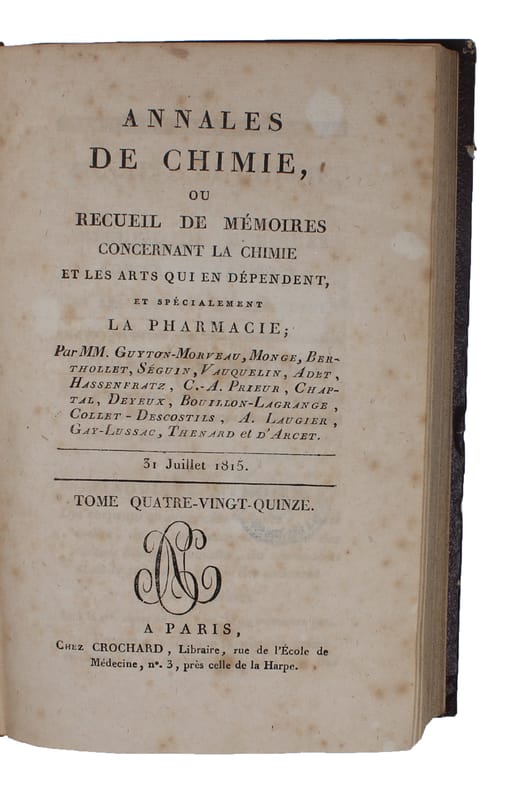
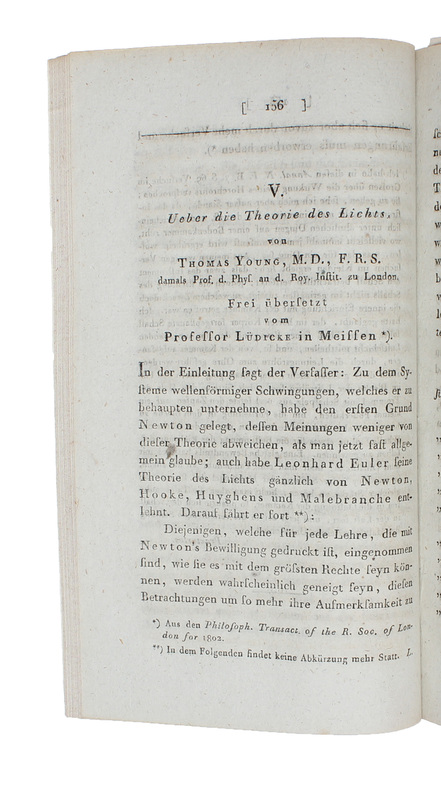
181144092Leipzig Johann Ambrosius Barth 1811. Without wrappers. In: "Annalen der Physik. Hrsg. Ludwig Wilhelm Gilbert" Bd. 39 der Reihe Eilftes u. Zwölftes Stück. Titlepage to vol. 39. Pp. 129-244 a. 2 engraved plates. The entire issue offered. Young's papers: pp. 156-205 a. pp. 206-220. And pp. 245-360 a. 2 engraved plates. The entire issue offered. Young's papers: pp. 255-261 a. pp. 262-290. <br/><br/><em>First appearance in German of Youngs 3 groundbreaking papers On the Theory of Light and Colours 1802 - An account of some Cases of the Production of Colours not hitherto described 1802 - The Bakerian Lecture. Experiments and Calculations relative to physical Optics. 1804 - which gives the first really convincing evidence that the fringes are produced by interference of light waves and giving the experimental demonstrations of the general law of Interference.These importent demonstrations served as the experimental basis for the wave hypothesis of light. - In his two first papers "On the Theory of Light and Colours" 1802 and "An account of Some Cases of the Production of Colours not hitherto described" 1802 - he only partially announced his principle of Interference and the statement of it in "An Account." was entirely hypothetical and not experimental. Magie. Source Book in Physics gives extracts of this paper and a later paper under the head: Discovery of the interference of light pp.308-15.Young also shows here that diffraction effects can be explained by the interference law."The experimental basis for the wave hypothesis of light as Young formulated it was interference. The fact has already been observed that two trauins of water waves may be so superposed that in certain regions the throughs of one train will lie continuously on the crests of another thereby producing zero disturbance.Destryctive interference is said to occur between the two trains of waves in the former case and constructivee interference in lthe latter. Similarly two sound waves may be so combined as to produce alternate regions of silence and enhanced sound. The phenomenon of interference of which the forgoing are familiar examples is easely comprehensible in the case of combining waves but would be utterly incomprehensible in the case of combining streams of particles. So when Young demonstrated that two beams of light could under properly controlled conditions be made to combine in such a way as to produce alternate regions of darkness and light he was rightly considered to have identified in light a characteristic property of waves." Lloyd Taylor in: Physics. The Pioneer Science. p. 511.Of the three papers published in the years 1802-04 the last is the most importent as it gives the experimental demonstrations of the interference of light. Dibner in Heralds of Science No. 151 list the first paper so does PMM: 259. </em> unknown
183343919(Leipzig, Joh. Ambrosius Barth, 1833). Contemp. hcalf. Spine gilt. Very light wear to spine ends and edges. In: ""Annalen der Physik und Chemie. Hrsg.von Poggendorff"", Jahrgang 1833 (Bd. 30), Ergäntzungsheft. 376 pp. a. 2 folded engraved plates. 2 small stamps to p.1 and a small stamp to verso of plates. (Entire volume offered). Fresnel's papers: pp. 100-255 a. pp. 255-261. Clean and fine.
184844100Leipzig, Johann Ambrosius Barth, 1848. Without wrappers. In ""Annalen der Physik und Chemie. Hrsg. von J.C. Poggendorff"", Ergänzungsbd., Bd. II, Stück 2. Titlepage to Erg-Bd. 2. Pp. 193-368. (The entire issue offered). Fresnel's papers: pp. 304-331, textillustr. a. pp. 332-355, textillustr. A stamp on titlepage and verso of. Clean and fine.
187143538(Leipzig, Johann Ambrosius Barth, 1871). Without wrappers as issued in ""Annalen der Physik und Chemie. Hrsg. von J.C. Poggendorff"", 142. Bd., 1. issue (""Heft"" No 1, 1871). Titlepage to vol. 142. Titlepage with small stamps on verso Pp. 1-176 a. 4 folded engraved plates (entire issue offered). Kundt's paper: pp. 163-171.
186743497Leipzig, Johann Ambrosius Barth, 1867. Contemp. hcalf, raised bands, gilt spine with gilt lettering. A few scratches to binding. In ""Annalen der Physik und Chemie. Hrsg.von Poggendorff"", Bd. 99. (Entire volume offered). (2),X,652 pp. and 4 folded engraved plates. Weber & Kohlrausch's paper:pp. 10-25.
181144092Leipzig, Johann Ambrosius Barth, 1811. Without wrappers. In: ""Annalen der Physik. Hrsg. Ludwig Wilhelm Gilbert"", Bd. 39 (der Reihe), Eilftes u. Zwölftes Stück. Titlepage to vol. 39. Pp. 129-244 a. 2 engraved plates. (The entire issue offered). Young's papers: pp. 156-205 a. pp. 206-220. And pp. 245-360 a. 2 engraved plates. (The entire issue offered). Young's papers: pp. 255-261 a. pp. 262-290.
184757386Boston: Charles H. Peirce 3 Cornhill 1847. Volume I no. 1 to volume 1 no. 6 all published; 8vo pp. 3 4-364 4 prospectus 4 ads; frontispiece portrait of Benjamin Franklin; original decorative blind-stamped brown cloth; gilt tilting; very good. With contributions from Charles Sumner Horace Greeley William Ellery Channing Wendell Phillips Lyman Beecher Henry Wadsworth Longfellow James Russell Lowell Oliver Wendell Holmes Richard Henry Dana and many others. See Sabin 41038; also BAL IV p. 323 BAL V p. 595 etc. <br/><br/> Charles H. Peirce, 3 Cornhill hardcover books
184751579Boston: Charles H. Peirce 1847. First Edition. 12mo 19cm. Publisher's brown decoratively embossed cloth boards lettered in gilt on spine; portrait frontispiece Benjamin Franklin; 364 4pp ads. Mild external wear with spot of exposure to bottom fore-corner of front board; still a tight Very Good or better copy with contents fresh and unmarked. Postscript note pasted-in at end of Introduction states: "After the arrangements above alluded to were made for the continuance of this Magazine ill health long protracted on the part of the editor prevented its further issue. This volume therefore contains all the numbers published." Entire run comprising six bi-monthly issues of this short-lived magazine of moral hygiene instruction and literature aimed at adolescent boys and young men. The content is generally progressive with contributors such as Wendell Phillips Lyman Beecher George Tuckerman William Ellery Channing etc. well represented. The editor George Washington Light 1809-1868 was a Boston poet publisher and bookseller and a prominent broker of temperance and abolitionist periodicals. Not noted by Mott American Magazines. Charles H. Peirce unknown
1810011189London: Published by J.M. Richardson . . . 1810 Book. Good. Hardcover. xxviii 232 pages pages 3 and 4. Pages 12 3 and 4 are bound in reverse order but complete. The side note on page 3 has been trimmed by a binder. Now bound in modern cloth lettered to the spine. Some pages spotted. Published by J.M. Richardson [ . . . ] hardcover
188330043HARDBACK NO DUSTJACKET ISSUED 1883 ON COPYRIGHT PG NO DATE ON TITLE PG 1st edition THUS First PRINTING Octavo. Unpaginated. VG/NF NO JACKET ISSUED Original brown cloth binding with mulit-colour image SILVER BIRD PALLAS and gilt lettering. Gilt foredges top side bottom. Very dark brown endpapers. Heavy buff stock. Seventeen illustrations by W. L.Taylor. Book in very good to near fine condition with slight wear to head and foot of spine. First thus. TINY NICK ON SPINE CVR It tells of a talking raven's mysterious visit to a distraught lover tracing the man's slow descent into madness. The lover often identified as being a student is lamenting the loss of his love Lenore. The raven sitting on a bust of Pallas the goddess of wisdom seems to further instigate his distress with its constant repetition of the word "Nevermore". The poem makes use of a number of folk and classical references. Poe claimed to have written the poem very logically and methodically. His intention was to create a poem that would appeal to both critical and popular tastes<br /><br /> e. p. Dutton NY hardcover
188824526A. L. Burt New York. 1888. HBDJ 1888 1st Edition THUS DJ in POOR Condition AS-IS with matching illustration on front FRONT in GOOD condition has 2.75 in. approx Chip front bottom Right Takes out Carr & Sage Rest DJ Almonst Intact with Small chip at top edge YellowTan Instrated in Red HARDBack Book in GOOD condition with Beautiful Color PasteOn Label duplicates DJ Illustration. YellowTan cloth boards with solid red lettering. Very bright paper pasteup illusTration on front in very good condition. Red lettering on spine. Some discoloring on front board but not on illustration. Some spine end edge and corner wear and tear. . . Some slight light page soilage and discoloring. BooK has SOME Minor looseness & Back Cover Edge Stains up & Down. Rear board has moldy discoloring. . Rest of DJ is discolored faded torn stained and creased but still quite together. ; 299 Pgs ADS end with boy chums in Gulf of Mexico Interior nice tight Clean light FOX Wear. First Thus. Hard Cover. A. L. Burt, New York. hardcover
186726966Jones Brothers & Co Chicago Atlanta 1867 HARDBACK NO DJ 1867. First Edition NF-/GOOD- AS-IS NOJACKET BLUE HARDBOUND CVR WITH SLIGHTLY RUBBED GILT DESIGN ON FRONT CVR & ITS SAYS DEDICATED TO THE BOYS IN BLUE CLOTH OVER BOARDS Blue cloth binding rubbed at extremities & Spine cvr has TAPE Repair & Darkening; Many good b&w ils. some are fold-out 510 pgs GOOD- in original gold stamped blue cloth light Rub Wear Sound binding with Interior Light Wear Fox pgs very clean and tight with only a few light stains to top corner margin of last few pages. 1 B/W Fold-Out Illustration with TAPE RESIDUE Edges Light Darkening wear rub Spine cvr & its Edgesoriginal gold stamped blue cloth. Sound binding very clean and tight 8vo LIFE IN THE CAMP FIELD AND HOSPITAL ADVENTURES OF SPIES AND SCOUTS TOGETHER WITH THE SONGS BALLADS ANECDOTES AND HUMEROUS INCIDENTS OF THE WAR A VERY RELIABLE SOURCE OF INFORMATION WHILE THE THOUGHTS OF THE WAR WAS STILL FRESH. "DEDICATED TO THE BOYS IN BLUE" ETCHED ON THE FRONT COVER In GOLD Gilt Armies of the Union Many good b&w ils. some are fold-out 18 fold-out pages with portraits of Union officers including Meade Hancock Warren Sickles Butler Hooker Custer Sheridan etc and Confederate officers such as: Lee Jackson Longstreet Mosby Hood Forrest etc. 1st Edition. Hardcover. Good/No Jacket. Jones Brothers & Co, Chicago Atlanta hardcover
18981354McKinlay Stone & Mackenzie NY 1898. HB NO DJ 1898 later edition NF/NF- AS-IS NODJ Burgundy embossed pictorial inset Uncle Remus cloth Cover light rub wear & some light small spotting stains Cvr near edges primarily Interior Light wear & FoXing & some 16 or so pages light staining 417 pages bottom spine Darkened . Hard Cover. McKinlay Stone & Mackenzie NY hardcover
1825010668Strasbourg Paris: Heitz Renouard 1825. contenant les principales époques et lhistoire politique religieuse et littéraire ainsi que celles des inventions et des découvertes les plus importantes. - Un volume 215x245 cm di 4-37 doppie pagine di tavole cronologiche ed altrettante bianche. Residui di nastro adesivo all'interno della prima e dell'ultima tavola. Bruniture. Legatura moderna in tela e percallina verde con titolo dorato al piatto. Le tavole cronologiche con avvenimenti storici e scoperte vanno dal 975 a C. fino all'anno della stampa del volume il 1825. Heitz, Renouard unknown
185444783Paris Victor Masson 1854. No wrappers. Extracted from "Annales de Chimie et de Physique" 3me Series - Tome 41. With titlepage to Tome 41. Pp. 120-164 and 1 large folded engraved plate showing the experimental apparatus. Some foxing throughout. <br/><br/><em>The periodical issue of Foucault's doctorial thesis in which he for the first time showed that light slows down in water thus giving experimental evidence for the undulatory theory of light."He.made use of his mirror method to measure the velocity of light through water and other transparent media. As long before as the time of Huygens and Newton it had been suggested that one way of settling the dispute as to whether light was a wave form or a stream of particles was by measuring its velocity in water. According to the wave theory light should slow down in water; according to the particle theory it should speed up. In 1853 showed that the velocity of light was less in water than in air a strong piece of evidence in favor of the wave theory. He presented this work as his doctoral thesis."Asimov. </em> unknown
184943827Paris Victor Masson Imprimerie de Bachelier 1849-50. No wrappers. In "Annales de Chimie et de Physique" 3me Series - Tome XXVI a. XXX. Juin 1849 a. Octobre 1850. The entire issues offered. Titlepages to vol. 26 a. 30. Pp. 129-256 a. pp. 129-256. Fizeau & Foucault's paper: pp. 138-148 a. pp. 146-159 2 folded engraved plates. Some scattred brownspots. <br/><br/><em>First appearance of thispaper in which the authors demonstrated importent similarities between sound - and lightwaves and that interference takes place between rays of light of different wavelenghts thus giving considerably evidence for the wave theory of light."By analyzing the white light source into simpler constituents by means of a spectroscope Fizeau and Foucault were able to observe fringes produced by interfering light rays with a difference of travel equal to more than 7000 wavelenghts thus showing hat light waves like sound waves remain geometrically constant over a large number of periods. But light waves because of their transverse vibrations are more complex than sound waves. Light can assume different forms of planes of vibration as well as different intensities. Using the same spectroscopic apparatus as in the preceeding experiment Fizeau and Foucault observed the interaction of two rays produced by passing a single polarized ray through a birefringent crystal. In this case instead of obtaining alternating bands of light and dark they obtained bands of light periodcally polarized in different planes of vibration."DSB V p. 19. </em> unknown
185147033Paris Bachelier 1851. 4to. No wrappers. In: "Comptes Rendus Hebdomadaires des Séances de L'Academie des Sciences" Tome 33 No 13. With htitle and titlepage to tome 33. Pp. 329-360 entire issue offered. Fizeau's paper: pp. 349-355. A stamp on erso of titlepage. Titlepage with faint brownspots. <br/><br/><em>First appearance of this paper the first announcment of Fizeau's results of his experiments with the velocity of light."It the paper is less famous for some reason than the failure of Michelson and Morley to detect the aether drag but NO LESS SIGNIFICANT. For it showed that the velocity of light increases in a medium according to the formula v 1 - 1/n2 where v is the velocity of the medium and n is the refractive index"Gillespie in "The Edge of Objecticity" p. 427. Fizeau shows that the velocity of light is higher in water flowing in the direction of the beam than that of light propagating in the direction opposite the direction of flow. The paper offered is the shorter announcement of the research the paper in full was published later in 1859 in "Annales de Chimie et de Physique". Albert Einstein later pointed out the IMPORTENCE OF THE EXPERIMENT FOR SPECIAL RELATIVITY.Fizeau's result was replicated by Albert Michelson and Edward Morley in 1886 repeated the experiment on a larger scale and confirmed Fizeau's results. and in 1914 it was confirmed by Pieter Zeeman. It was Arago in 1838 who suggested this "crucial experiment" to decide between the corpuscular and undulatory theories of light by comparing the speed of light in water and in air. It vindicated the undulatory position.It was shown by Hendrik Lorentz 1892 1895 that the experiment can be explained by the reaction of the moving water upon the interfering waves without the need of any aether entrainment. On this occasion Lorentz introduced a different time coordinate for moving bodies within the aether the so called Local time an early form of the Lorentz transformation for small velocities compared to the speed of light. In 1895 Lorentz went a step further and explained the coefficient by local time alone and without mentioning any interaction of light and matter. </em> unknown