15 453 résultats
194882294s. d. [vers 1948] | 17.30 x 21.30 cm | une feuille
183442624Paris, Adrien Le Clère, 1834. In-8 de XII-420 pp., frontispice, fac-similé, veau blond glacé, dos orné à nerfs, filets dorés d’encadrement sur les plats, pièce de titre en maroquin noir, tranches marbrées (Bauzonnet).
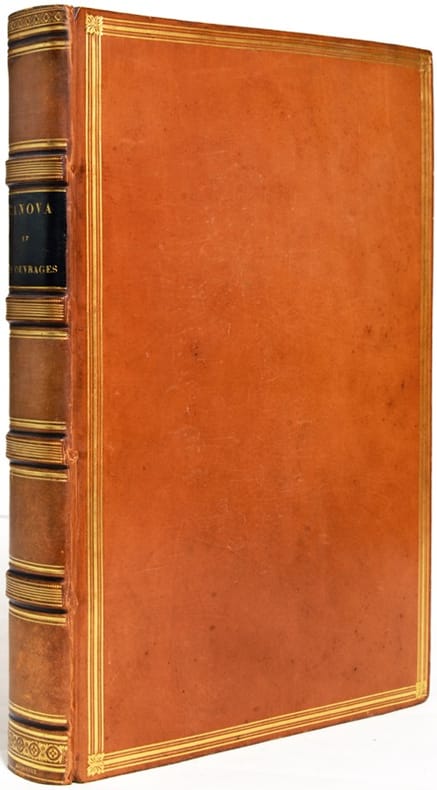
1829PHO-1464Paris, Henri Gaugain et Cie -Caillou., 1829. 2 volumes de texte in-8, et un atlas grand in-folio (440x600),illustré du portrait de Vivant Denon en frontispice gravé par Garnier d'après R. Lefèvre et de 143 planches dont deux cartes., relié demi-veau époque , dos lisse avec titre et tomaison , coins usés ,frottements aux plats , frottements, coiffes usées et traces de réparations (atlas) , peu de rousseurs dans le texte .
1929025041Pasadena 1929. Original Drawing . No Binding. Near Fine. 13 3/4" x 12 1/4. Original Pencil Engineering Drawing Of Three Views Of A "Latitude Finder At Any Hour Angle With Three Reflections" Dated 1929 Signed Rwp. The Drawing Is 9 5/8" X 11 1/8" With Ample Margins. Porter Is Famous For His Prescient Pre-Construction Drawings Of The Palomar Observatory And Its Telescopes Machinery And Buildings So Well Visualized That They Were Used As Guides During Construction. <br/> <br/> unknown
1905027752New York: Keppler & Schwarzmann / Puck 1905. First Edition . Single Embossed Tin Sheet. Very Good . 14 1/2" x 11. Rare Embossed Tin Color Broadside With Puck Heading Numbered Vol. Lvii No. 149 Possibly An Advertising Display For That Issue Of Puck. A Prototypical Demonstration Of The Emerging Consciousness That The Modern Institutional Economic World Was Apparently Designed By Greedy Self-Centered Drunken Seventeen Year Olds With Expectations Of Managing It When They Grew Up With The Finer Structure Continually Redrawn By Self-Serving Politicians Bureaucrats And Judges Concerned Mostly With Preserving Their Salaries. Contains 10 1/8" X 8 3/4" Color Illustration Of John D. Rockefeller And Senator Aldrich Father-In-Law Of John D. Ii With Dark Skins Each Dressed Only In A Short Skirt Or Tutu Bearing The Legend "Gold Dust" Aldrich Holding A Model Of The Capitol And Standing On A Model Of The Stock Exchange John D. Holding A Satchel Of Money And A Standard Oil Can With Uncle Sam Looking On Dubiously; Text At Bottom "Let The Gold Dust Twins Do Your Work" A Take-Off On A Well-Known Advertising Logo Depicting Two Black Children Selling Soap. A Classic Display From The Era Of Outspoken Political Outrage. To Add To The Satire The Gold Dust Twins Washing Compound Was Owned By The Fairbanks Company A "Rockefeller Concern" And The Company Was Subject To A Major Trade Union Dispute And Strike Led By William Z. Foster Famous As Head Of The American Communist Party. <br/> <br/> Keppler & Schwarzmann / Puck unknown
10456Bwa - Burkina Faso. Bwa. PLANK MASK - BWA - BURKINA FASO. An exceptional and elegant mask from of Bwa people of Burkina Faso in West Africa. Circa 20th Century. 81 inches tall 10 inches wide about 9 inches deep at the mask lower 12 3/4 inches with the "head-dress" portion about 3/4 inch in thickness the whole carved from a single board. In excellent condition. The mask was presented to its American liaison officer by the Burkina Faso team at the 1996 Olympics in Atlanta. The thinness and lightness of the piece indicates it was made for and used in dance ceremonies rather than as an export or tourist piece which are often too heavy to be used for dancing. Most of the modern masks of this type which we have seen are more brightly colored less elegantly proportioned and not as skillfully carved as this example. Masks play an important role in the renewal ceremonies of the Bwa. The masks are danced during initiation ceremonies for young men and women and appear at funerals and memorial services. They are also danced during the harvest ceremonies. During the fifteen day initiation ceremony young petitioners are taught the meanings of the symbols on the mask. They learn the importance of becoming a respected Bwa and the dangers of straying from the path of social behavior established by the ancestors. These lessons are symbolically represented on the mask. The double zig-zag line on the plank of the mask represents the path of the ancestors. The crescent shape on the top of the plank represents the moon and the importance of time in the ceremonial year when masks are danced. The checkerboard pattern on the back of the mask represents the value of learning. When young initiates graduate from the ceremony they are given a new white goat hide to sit on during ceremonies. Years later the young initiate becomes an elder and the hide ages to a dark color. The checkerboard pattern emphasizes the reliance between the elders symbolized by the dark areas and the young initiates symbolized by the light areas. Minneapolis Institute of Art. unknown
- s.d. [vers 1948], Photographie : 17,3x21,3cm ; Feuille 18x24cm , une feuille. - n.d. [around 1948], Photograph: 17.3 x 21.3cm; Leaf: 18 x 24cm, one leaf. Rare original photograph of Pablo Picasso turning towards one of his ceramic creations, taken by Michel Sima. Contemporary silver print. Pencil inscription on the back. Very light scratch on the surface, not affecting the image. "In September 1946, Pablo Picasso set up his workshop in the attic of the Château Grimaldi in Antibes, in a former "guards room" to which the curator Romuald Dor de la Souchère gave him the keys so that he could work there as he pleased. It is the artist Michel Sima, sculptor and photographer, who introduced the two men. Arriving from his native Poland in 1929, Sima, whose real name was Michel Smajewki, met Picasso in Paris, where he frequented the Académie de la Grande Chaumière and was the pupil of Zadkine. From mid-September to mid-November 1946 in Antibes, then from 1947-48 and until the beginning of the 50's in Vallauris, Sima regularly photographed Picasso, who willingly posed for the camera - alone or with his companion Françoise Gilot, in front of completed works or those in progress, staring at the lens, or on the contrary, focusing on his work" (Anne de Staël, L'Atelier des combles, 2009). Sublime chiaroscuro shot of the master contemplating his work. Provenance: Paul Destribats collection. [FRENCH VERSION FOLLOWS] Rare photographie originale de Michel Sima en tirage d'époque représentant Pablo Picasso se tournant vers une de ces créations céramiques. Tirage argentique d'époque. Inscription au crayon au verso. Très légère rayure en surface, n'affectant pas l'image. "Au mois de septembre 1946, Pablo Picasso installe son atelier dans les combles du château Grimaldi d'Antibes, dans une ancienne "salle des gardes" dont le conservateur Romuald Dor de la Souchère lui a confié les clés pour qu'il y travaille à sa guise. C'est l'artiste Michel Sima, sculpteur et photographe, qui a fait se rencontrer les deux hommes. Arrivé de sa Pologne natale en 1929, Sima, de son vrai nom Michel Smajewski , avait fait la connaissance de Picasso à Paris, où il avait fréquenté l'Académie de la Grande Chaumière et été l'élève de Zadkine. De la mi-septembre à la mi-novembre 1946 à Antibes, puis en 1947-48 et jusqu'au début des années 50 à Vallauris, Sima photographiera régulièrement Picasso, qui se prête volontiers au jeu de la pose - seul ou avec sa compagne Françoise Gilot, devant des oeuvres terminées ou en cours d'achèvement, fixant l'objectif ou au contraire concentré sur son travail" (Anne de Staël, L'Atelier des combles, 2009). Sublime cliché en clair-obscur du maître contemplant son oeuvre. Provenance : collection Paul Destribats.
- Paris s.d. (circa 1954), photographie : 14,5x20,4cm ; feuille : 18,2x24cm, une photographie. - Original photographic portrait of Nicolas de Staël in his atelier. Paris n.d. (circa 1954), photo: 14,5x20,4cm ; leaf : 18,2x24cm. Original silver print portrait of Nicolas de Staël by Denise Colomb. The painter sits in his Parisian atelier in rue Gauget, one year before his death. The photograph was taken by Denise Colomb, great portraitist of the 20th century, known for her portraits of Antonin Artaud, Giacometti, Picasso, Soulages and Miro in their studio. "It is said that his workshop was the cave of a palaeontological potter. With sediment, layers of paleo... A crucible, a large material well, riddled with pigments, paintbrushes, pots of plastered trowels, buckets, rags. In a strong smell of turpentine. A workshop covered, soiled, stained with dirt, with masonry clay. Its wingspan, its strength, its topsail height springs into this crater of Vesuvius. Slightly disoriented, he leans, he pours. To paint, for him, is to be prey to vertigo, to unpredictable, accidental, chance junctions. (Patrick Grainville, Les Yeux de Milos). [FRENCH VERSION FOLLOWS] Portrait photographique en noir et blanc de Nicolas de Staël par Denise Colomb, en tirage argentique d'époque. Superbe cliché du peintre aux yeux inquiets, dans son atelier de la rue Gauguet à Paris, un an avant sa fin tragique. La photographie fut prise par Denise Colomb, grande portraitiste du XXe siècle, qui immortalisa Antonin Artaud, Giacometti, Picasso, Soulages et Miro. "On dit que son atelier était une caverne de potier paléontologique. A sédiments, couches du paléo... Un creuset, un grand puits matériel, criblé de pigments, de pinceaux, de pots de truelles plâtrées, de seaux, de chiffons. Dans une forte odeur de térébenthine. Un atelier gorgé, souillé, empanaché de crasses, des pâtes de la maçonnerie. Son envergure, sa force, sa hauteur de hunier s'élançent dans ce cratère de Vésuve. Légèrement déboussolé, il incline, il verse. Peindre, pour lui, c'est être en proie au vertige, à des bifurcations imprévisibles d'accident, de hasard." (Patrick Grainville, Les Yeux de Milos).
- AMIEL Léon, Paris, New-York 1966, 36x49.5cm, une feuille. - Original color lithograph, one of 15 proofs on Japon impérial paper reserved for the artist and his collaborators, the only printing with 20 more on Japon and 250 on Arches paper. Unsigned proof, as all proofs in this series, other than the frontispiece. A superb proof on Japon paper specially made for The Story of Exodus, published in 1966, for which Chagall made 24 hors-text lithographs printed by Mourlot. An exceedingly rare original proof on Japon paper, the most attractive and best for color lithographs. Fernand Mourlot was undoubtedly the finest lithographic printer of the 20th century and was thus the friend and printer to the leading artists of his day. "Picasso, Matisse, Chagall, Miró, Braque, Dubuffet, Léger, Giacometti...added to their own expression and contemporary art a new field of research. With Mourlot, and thanks to him, lithography acquired both a personality and a future" (Pierre Cabanne, in Cinquante années de lithographie). Having already printed two volumes of the Bible illustrated by Chagall, Mourlot contributed to the artist's lithographic training in the 1950s. It was during this period that Chagall began to visit Mourlot's workshop regularly in order to learn lithographic techniques and that he developed bonds of friendship with the staff of the workshop, most notably Charles Sorlier. It was thus at the peak of his powers that Chagall made this story of Exodus, which coincided with the termination of his immense lithographic and pictoral work on the Bible, undertaken in 1930 at the urging of Ambroise Vollard. This decorative cycle, entitled Le Message Biblique [The Biblical Message] was in fact the basis for the creation of the Chagall Museum, originally called the Musée national du message biblique Marc-Chagall. [FRENCH VERSION FOLLOWS] Lithographie originale en couleur, une des 15 épreuves imprimées sur papier japon impérial et réservées à l'artiste et à ses collaborateurs, seul tirage avec 20 autres japon et 250 Arches. Epreuve non signée, comme toutes les épreuves de cette série, hormis le frontispice. Superbe épreuve sur Japon réalisée spécialement pour The Story of Exodus paru en 1966, dont Chagall réalisa les 24 lithographies hors-texte imprimés par Mourlot. Fernand Mourlot, incontestablement le meilleur artisan lithographe du XXeme siècle, fut naturellement l'imprimeur et l'ami des plus grands artistes de son temps. "Picasso, Matisse, Chagall, Miró, Braque, Dubuffet, Léger, Giacometti...ont enrichi leurs expressions propres et l'art contemporain d'un domaine de recherches nouveau. Avec Mourlot, et grâce à lui, la lithographie a acquis à la fois une personnalité et un avenir." (Pierre Cabanne, in Cinquante années de lithographie). Déjà imprimeur des deux volumes de la Bible illustrée par Chagall, Mourlot contribua à la formation de l'artiste à l'art de la lithographie dans les années 1950. C'est à cette époque que Chagall commence en effet à fréquenter l'atelier de Mourlot afin d'apprendre les procédés lithographiques et qu'il se lie d'amitié avec les artisans de l'imprimerie, notamment Charles Sorlier. Ainsi est-ce au sommet de son art que Chagall réalise cette histoire de l'Exode qui coincide avec l'achèvement de son immense travail lithographique et pictural sur la Bible entamé en 1930 à l'initiative d'Ambroise Vollard. Ce Cycle décoratif intitulé Le Message Biblique sera d'ailleurs à l'origine de la création du Musée Marc Chagall, originellement Musée national du message biblique Marc-Chagall. Rarissime épreuve originale imprimée sur Japon, le plus beau papier et le meilleur pour les gravures en couleur.
- AMIEL Léon, Paris, New-York 1966, 36x49.5cm, une feuille. - CHAGALL Marc. And Moses beheld all the worke, and beholde, they had done it as the Lorde had commanded; and Moses blessed them - The Story of Exodus Amiel Léon, Paris, New-York 1966, 36 x 49,5 cm, one single leaf Original color lithograph, one of 15 proofs on Japon impérial paper reserved for the artist and his collaborators, the only printing with 20 more on Japon and 250 on Arches paper. Unsigned proof, as all proofs in this series, other than the frontispiece. A superb proof on Japon paper specially made for The Story of Exodus, published in 1966, for which Chagall made 24 hors-text lithographs printed by Mourlot. An exceedingly rare original proof on Japon paper, the most attractive and best for color lithographs. Fernand Mourlot was undoubtedly the finest lithographic printer of the 20th century and was thus the friend and printer to the leading artists of his day. "Picasso, Matisse, Chagall, Miró, Braque, Dubuffet, Léger, Giacometti...added to their own expression and contemporary art a new field of research. With Mourlot, and thanks to him, lithography acquired both a personality and a future" (Pierre Cabanne, in Cinquante années de lithographie). Having already printed two volumes of the Bible illustrated by Chagall, Mourlot contributed to the artist's lithographic training in the 1950s. It was during this period that Chagall began to visit Mourlot's workshop regularly in order to learn lithographic techniques and that he developed bonds of friendship with the staff of the workshop, most notably Charles Sorlier. It was thus at the peak of his powers that Chagall made this story of Exodus, which coincided with the termination of his immense lithographic and pictoral work on the Bible, undertaken in 1930 at the urging of Ambroise Vollard. This decorative cycle, entitled Le Message Biblique [The Biblical Message] was in fact the basis for the creation of the Chagall Museum, originally called the Musée national du message biblique Marc-Chagall. [FRENCH VERSION FOLLOWS] Lithographie originale en couleur, une des 15 épreuves imprimées sur papier japon impérial et réservées à l'artiste et à ses collaborateurs, seul tirage avec 20 autres japon et 250 Arches. Epreuve non signée, comme toutes les épreuves de cette série, hormis le frontispice. Superbe épreuve sur Japon réalisée spécialement pour The Story of Exodus paru en 1966, dont Chagall réalisa les 24 lithographies hors-texte imprimés par Mourlot. Fernand Mourlot, incontestablement le meilleur artisan lithographe du XXeme siècle, fut naturellement l'imprimeur et l'ami des plus grands artistes de son temps. "Picasso, Matisse, Chagall, Miró, Braque, Dubuffet, Léger, Giacometti...ont enrichi leurs expressions propres et l'art contemporain d'un domaine de recherches nouveau. Avec Mourlot, et grâce à lui, la lithographie a acquis à la fois une personnalité et un avenir." (Pierre Cabanne, in Cinquante années de lithographie). Déjà imprimeur des deux volumes de la Bible illustrée par Chagall, Mourlot contribua à la formation de l'artiste à l'art de la lithographie dans les années 1950. C'est à cette époque que Chagall commence en effet à fréquenter l'atelier de Mourlot afin d'apprendre les procédés lithographiques et qu'il se lie d'amitié avec les artisans de l'imprimerie, notamment Charles Sorlier. Ainsi est-ce au sommet de son art que Chagall réalise cette histoire de l'Exode qui coincide avec l'achèvement de son immense travail lithographique et pictural sur la Bible entamé en 1930 à l'initiative d'Ambroise Vollard. Ce Cycle décoratif intitulé Le Message Biblique sera d'ailleurs à l'origine de la création du Musée Marc Chagall, originellement Musée national du message biblique Marc-Chagall. Rarissime épreuve originale imprimée sur Japon, le plus beau papier et le meilleur pour les gravures en couleur.
- AMIEL Léon, Paris, New-York 1966, 36x49.5cm, une feuille. - CHAGALL Marc. Moreover they made garments of ministration to minister in the Sanctuarie; they made also the holy garments for Aaron, as the Lorde had commanded Moses - The Story of Exodus Amiel Léon, Paris, New-York 1966, 36 x 49.5 cm, one single leaf Original color lithograph, one of 15 proofs on Japon impérial paper reserved for the artist and his collaborators, the only printing with 20 more on Japon and 250 on Arches paper. Unsigned proof, as all proofs in this series, other than the frontispiece. A superb proof on Japon paper specially made for The Story of Exodus, published in 1966, for which Chagall made 24 hors-text lithographs printed by Mourlot. An exceedingly rare original proof on Japon paper, the most attractive and best for color lithographs. Fernand Mourlot was undoubtedly the finest lithographic printer of the 20th century and was thus the friend and printer to the leading artists of his day. "Picasso, Matisse, Chagall, Miró, Braque, Dubuffet, Léger, Giacometti...added to their own expression and contemporary art a new field of research. With Mourlot, and thanks to him, lithography acquired both a personality and a future" (Pierre Cabanne, in Cinquante années de lithographie). Having already printed two volumes of the Bible illustrated by Chagall, Mourlot contributed to the artist's lithographic training in the 1950s. It was during this period that Chagall began to visit Mourlot's workshop regularly in order to learn lithographic techniques and that he developed bonds of friendship with the staff of the workshop, most notably Charles Sorlier. It was thus at the peak of his powers that Chagall made this story of Exodus, which coincided with the termination of his immense lithographic and pictoral work on the Bible, undertaken in 1930 at the urging of Ambroise Vollard. This decorative cycle, entitled Le Message Biblique [The Biblical Message] was in fact the basis for the creation of the Chagall Museum, originally called the Musée national du message biblique Marc-Chagall. [FRENCH VERSION FOLLOWS] Lithographie originale en couleur, une des 15 épreuves imprimées sur papier japon impérial et réservées à l'artiste et à ses collaborateurs, seul tirage avec 20 autres japon et 250 Arches. Epreuve non signée, comme toutes les épreuves de cette série, hormis le frontispice. Superbe épreuve sur Japon réalisée spécialement pour The Story of Exodus paru en 1966, dont Chagall réalisa les 24 lithographies hors-texte imprimés par Mourlot. Fernand Mourlot, incontestablement le meilleur artisan lithographe du XXeme siècle, fut naturellement l'imprimeur et l'ami des plus grands artistes de son temps. "Picasso, Matisse, Chagall, Miró, Braque, Dubuffet, Léger, Giacometti...ont enrichi leurs expressions propres et l'art contemporain d'un domaine de recherches nouveau. Avec Mourlot, et grâce à lui, la lithographie a acquis à la fois une personnalité et un avenir." (Pierre Cabanne, in Cinquante années de lithographie). Déjà imprimeur des deux volumes de la Bible illustrée par Chagall, Mourlot contribua à la formation de l'artiste à l'art de la lithographie dans les années 1950. C'est à cette époque que Chagall commence en effet à fréquenter l'atelier de Mourlot afin d'apprendre les procédés lithographiques et qu'il se lie d'amitié avec les artisans de l'imprimerie, notamment Charles Sorlier. Ainsi est-ce au sommet de son art que Chagall réalise cette histoire de l'Exode qui coincide avec l'achèvement de son immense travail lithographique et pictural sur la Bible entamé en 1930 à l'initiative d'Ambroise Vollard. Ce Cycle décoratif intitulé Le Message Biblique sera d'ailleurs à l'origine de la création du Musée Marc Chagall, originellement Musée national du message biblique Marc-Chagall. Rarissime épreuve originale imprimée sur Japon, le plus beau papier et le meilleur pour les gravures en couleur.
- Carjat et Cie, Paris s.d. (circa 1860), 6x10,3cm, une photographie. - Photographic portrait of Eugène Delacroix Carjat et Cie | Paris n.?d. [circa 1860] | 6 x 10.3 cm | photograph Original photograph on albumin paper, in a visiting-card format, laid down on card. Foxing. We have found only one other copy of this photograph, at the Musée Carnavalet. [FRENCH VERSION FOLLOWS] Photographie originale sur papier albuminé, au format carte de visite, contrecollée sur un carton. Rousseurs. Nous n'avons trouvé qu'un autre exemplaire de cette photographie au Musée Carnavalet.
61014BBo.J. (Peter Großbach, geboren 1934 in Freudenstadt, gestorben 1988 in Köln. Deutscher Bildhauer. Studium 1954-55 an der Kunstakademie Stuttgart bei Otto Braun, 1956-58 an den Kölner Werkschulen bei Josef Jaekel, 1959-60 Hochschule für bildende Künste Hamburg bei Gustav Seitz). [8 Warenabbildungen]
- Carjat, Paris s.d. (circa 1870), 6,5x10,4cm, une photographie. - Rare original photograph on albumen paper, in carte de visite format, mounted on a board, depicting Gustave Courbet. Handwritten annotations on the back. We have been able to find only one other copy of this photograph at the New York International Center of Photography. [FRENCH VERSION FOLLOWS] Rare photographie originale sur papier albuminé, au format carte de visite, contrecollée sur un carton, représentant Gustave Courbet. Annotations manuscrites au dos. Nous n'avons trouvé qu'un seul autre exemplaire de cette photographie à l'International Center of Photography de New York.
194882290s. d. [vers 1948] | 17.30 x 21.30 cm | une feuille
36984Paris Centre Georges Pompidou / Musée national d'art moderne 1978 in 8 (23,5x18,5) 1 volume broché, couverture à rabats estampée à froid, 86 pages. Catalogue de lexposition Ateliers Aujourd'hui 6 - Antoni Clavé au Centre Georges Pompidou - Musée National d'Art Moderne, Paris, 24 février - 27 mars 1978. Antoni Clavé, Barcelone 1913 - Saint-Tropez 2005, peintre, graveur et sculpteur espagnol. Exemplaire enrichi d'une importante composition originale sur double page en technique mixte, encre bleue, collages, dédicacée et signée à l'encre bleue par l'artiste (dimensions: 36x23,5, important montage à partir de 2 fragments déchirés d'estampes originales de Clavé), rehaussé d'un important travail à l'encre bleue, et d'un envoi autographe signé par le peintre catalan Antoni Clavé à un conservateur de musée français. Bel exemplaire
- [Antibes] s.d. [1946], 23,9x17,7cm, une feuille. - [Antibes] n.d. [1946], 23.9 x 17.7cm, one leaf. Exceptional original photograph of Pablo Picasso by Michel Sima. The artist is holding and owl in front of his painting "Nature morte à la chouette et aux trois oursins" now in the Picasso Museum in Antibes. Contemporary silver print. Pencil inscription on the back. The photographer had entrusted Picasso with a wounded owl. Named Ubu, after Alfred Jarry's literary masterpiece, the bird kept the artist company in his atelier in Antibes and served as a model in many of his paintings, including the one that features in the background of this photograph. "In September 1946, Pablo Picasso set up his workshop in the attic of the Château Grimaldi in Antibes, in a former "guards room" to which the curator Romuald Dor de la Souchère gave him the keys so that he could work there as he pleased. It is the artist Michel Sima, sculptor and photographer, who introduced the two men. Arriving from his native Poland in 1929, Sima, whose real name was Michel Smajewki, met Picasso in Paris, where he frequented the Académie de la Grande Chaumière and was the pupil of Zadkine. From mid-September to mid-November 1946 in Antibes, then from 1947-48 and until the beginning of the 50's in Vallauris, Sima regularly photographed Picasso, who willingly posed for the camera - alone or with his companion Françoise Gilot, in front of completed works or those in progress, staring at the lens, or on the contrary, focusing on his work" (Anne de Staël, L'Atelier des combles, 2009). Provenance: Paul Destribats collection. [FRENCH VERSION FOLLOWS] Exceptionnelle photographie originale de Michel Sima en tirage argentique d'époque représentant Pablo Picasso tenant une chouette devant son tableau "Nature morte à la chouette et aux trois oursins" aujourd'hui conservé au musée Picasso d'Antibes. Tirage argentique d'époque. Inscription au crayon au verso. Le photographe avait confié à Picasso une petite chouette blessée. Baptisé Ubu, l'oiseau tient compagnie à l'artiste dans son atelier à Antibes et servit de modèle dans nombre de ses toiles, dont celle qui figure en arrière-plan de cette photographie. "Au mois de septembre 1946, Pablo Picasso installe son atelier dans les combles du château Grimaldi d'Antibes, dans une ancienne "salle des gardes" dont le conservateur Romuald Dor de la Souchère lui a confié les clés pour qu'il y travaille à sa guise. C'est l'artiste Michel Sima, sculpteur et photographe, qui a fait se rencontrer les deux hommes. Arrivé de sa Pologne natale en 1929, Sima, de son vrai nom Michel Smajewski , avait fait la connaissance de Picasso à Paris, où il avait fréquenté l'Académie de la Grande Chaumière et été l'élève de Zadkine. De la mi-septembre à la mi-novembre 1946 à Antibes, puis en 1947-48 et jusqu'au début des années 50 à Vallauris, Sima photographiera régulièrement Picasso, qui se prête volontiers au jeu de la pose - seul ou avec sa compagne Françoise Gilot, devant des oeuvres terminées ou en cours d'achèvement, fixant l'objectif ou au contraire concentré sur son travail" (Anne de Staël, L'Atelier des combles, 2009). Provenance : collection Paul Destribats.
- Edizioni Apollinaire, Milano 1960, 24x34cm, reliure de l'éditeur. - Edition originale quadrilingue, un des 1000 exemplaires numérotés. Reliure de l'éditeur en pleine toile bleue, dos lisse muet. Ouvrage illustré de reproductions d'oeuvres de Jean Fautrier. Une petite tache en pied des deux dernières pages de la table des matières, exemplaire complet de sa jaquette illustrée qui comporte une petite déchirure en pied du dos et de légers manque en tête. Bel exemplaire. Précieux envoi autographe daté et signé de Jean Fautrier à son ami André Malraux. [ENGLISH DESCRIPTION ON DEMAND]
- Hachette & Cie, Paris 1906, 34x44cm, reliure de l'éditeur. - Edition originale imprimée à 500 exemplaires numérotés à la presse et revêtus de la signature d'Aimé Morot à la justification du tirage. Reliure de l'éditeur en pleine toile rouge, dos lisse. Introduction de C. Moreau-Vauthier. Ouvrage illustré de 60 planches de reproductions d'oeuvres de Aimé Morot. Petites rousseurs affectant les gardes. Rare et agréable exemplaire. [ENGLISH DESCRIPTION ON DEMAND]
- Pierre PETIT, Paris 1860 (Ca), 5,8x10,3cm, une photographie. - Photographie originale sur papier albuminé, au format carte de visite, contrecollée sur carton de Pierre Petit, avec sa marque au dos. Portrait en pied de Gustave Doré, habillé de blanc, vers l'âge de 30 ans, portant moustache. Très rare photographie du peintre dans sa jeunesse. Annotation manuscrite au dos. Le musée d'Orsay possède une photo de Doré par Pierre Petit de la même période mais l'artiste porte un gilet noir en velours, un manteau noir, les mains dans les poches. [ENGLISH DESCRIPTION ON DEMAND]
- Galerie René Drouin, Paris 1947, 27x43,5cm, une feuille. - Poster catalogue of Jean Dubuffet's exhibition at the Galerie René Drouin, entitled: "Les gens sont bien plus beaux qu'ils croient. Vive leur vraie figure. Portraits." "People are much more beautiful than they believe. Long live their true face. Portraits." Galerie René Drouin, Paris 1947, 27 x 43.5 cm, one leaf Rare poster-catalogue of the exhibition "Les gens sont bien plus beaux qu'ils croient. Vive leur vraie figure. "People are much more beautiful than they believe. Long live their true face. Portraits." by Jean Dubuffet at the Galerie René Drouin which took place from 7 to 31 October 1947. Beautiful copy of this catalogue, in poster format, two folds, one horizontal and one vertical, facilitating the storage of this document which presents as four-leaf journal illustrated with portraits of writers and artists such as Henri Michaux, Henri Calet, René Bertelé, Francis Ponge, Antonin Artaud, Jean Fautrier... Text by Jean Dubuffet entitled "Causette". Rare. [FRENCH VERSION FOLLOWS] Rare affiche-catalogue de l'exposition "Les gens sont bien plus beaux qu'ils croient. Vive leur vraie figure. Portraits." de Jean Dubuffet à la galerie René Drouin s'étant tenue du 7 au 31 Octobre 1947. Bel exemplaire de ce catalogue, au format affiche, deux pliures, une horizontale et une verticale, ayant facilité le rangement de ce document se présentant comme un journal de quatre feuilles illustrées de portraits d'écrivains ou d'artistes tels qu'Henri Michaux, Henri Calet, René Bertelé, Francis Ponge, Antonin Artaud, Jean Fautrier... Texte de Jean Dubuffet intitulé "Causette". Rare.
- Galerie René Drouin, Paris 17 Avril 1954, 21x27,5cm, une feuille. - Invitation card to the private viewing of the exhibition of Jean Dubuffet's work produced from 1942 to 1954 at the Galerie René Drouin Galerie René Drouin, Paris 17 April 1954, 21 x 27.5 cm, one leaf Invitation card to the private viewing of Jean Dubuffet's retrospective exhibition at the Cercle Volney, organised at the René Drouin Gallery from 17 March to 17 April 1954. On the recto, a superb and large original photolithograph in black and white of Jean Dubuffet, printed by Mourlot. (Webel 389). We attached the exhibition catalogue illustrated with reproductions of Jean Dubuffet's works. Rare and large photolithograph that is unusual as it has not been folded. [FRENCH VERSION FOLLOWS] Carton d'invitation au vernissage de l'exposition rétrospective de Jean Dubuffet au Cercle Volney, organisée à la galerie René Drouin du 17 mars au 17 avril 1954. Au recto, superbe et grande photolithographie originale en noir de Jean Dubuffet, imprimée par Mourlot. (Webel 389). Nous joignons le catalogue de l'exposition illustré de reproductions d'oeuvres de Jean Dubuffet. Rare et grande photolithographie qui a la particularité de ne pas avoir été pliée.
- Galerie Druet, Paris 1906, 13,5x18,5cm, agrafé. - Exposition Henri Matisse [Matisse Exhibition] Galerie Druet | Paris 1906 | 13.5 x 18.5 cm | stapled Rare first edition of the catalogue of Henri Matisse's second personal exhibition, assembling 58 of the artist's paintings, held at the Galerie Duret between 19 March and 7 April 1906. Following the famous Salon d'Automne in October 1905, Matisse individually presents his scandalous canvases painted during his stay in Collioure, accompanied by André Derain, at the Galerie Druet. These brightly coloured pieces, largely inspired by Gauguin, set the principles of Fauvism and give rise to criticism. The Galerie Druet catalogue includes 4 of the 10 paintings by Matisse exhibited in the "Fauves" salon VII of the Salon d'Automne some months previously, along with works by Derain, Vlaminck, Manguin, Camoin and Marquet. This consecutive exhibition at the Salon, held at the Galerie Druet, was also an opportunity for the artist to present his views of Collioure for the first time, which were absent from the Salon d'Automne which had favoured Derain's landscapes - thus, included in this catalogue is the famous "Plage rouge", which marks the artist's definitive break from the imitation of colour. A light sign of a vertical fold on the first wrapper, otherwise a beautiful copy. Rare early illustrated catalogue comprising reproductions of 3 of Henri Matisse's works. [FRENCH VERSION FOLLOWS] Rare édition originale du catalogue de la deuxième exposition personnelle d'Henri Matisse, rassemblant 58 oeuvres de l'artiste présentées à la Galerie Druet du 19 Mars au 7 Avril 1906. Au lendemain du célèbre Salon d'Automne d'octobre 1905, Matisse présente individuellement à la Galerie Druet ses scandaleuses toiles peintes durant son séjour à Collioure en compagnie d'André Derain. Ces oeuvres éclatantes de couleur largement inspirées de Gauguin posèrent les principes du fauvisme et déchaînèrent les critiques. Le catalogue de la galerie Druet comprend 4 des 10 tableaux de Matisse exposés dans la salle VII des "Fauves" du Salon d'Automne quelques mois auparavant, parmi les oeuvres de Derain, Vlaminck, Manguin, Camoin, et Marquet. Cette exposition consécutive au Salon, tenue à la galerie Druet, fut également l'occasion pour l'artiste de présenter pour la première fois ses vues de Collioure, absentes du Salon d'Automne qui avait privilégié les paysages de Derain - ainsi figure dans ce catalogue la fameuse Plage rouge, qui marque la rupture définitive de l'artiste avec le mimétisme de la couleur. Une légère trace de pliure verticale sur le premier plat, sinon bel exemplaire. Rare catalogue illustré de 3 reproductions d'oeuvres d'Henri Matisse.
- Galerie Durand-Ruel, Paris 1904, 10x17,5cm, relié. - [Views of the Thames in London] Galerie Durand-Ruel | Paris 1904 | 10 x 17,5 cm bound in vellum-effect paper boards First edition of the exhibition catalogue presenting 37 works by Claude Monet at the Galerie Durand-Ruel from 9 May to 4 June 1904. During the exhibition, most of the paintings were immediately purchased by American collectors. Binding in vellum-effect paper boards, names of the catalogue preface writer and the painter inscribed in ink, water-effect paper endpapers, covers and spine preserved, curious ex-libris drawn by H. P. Gassier glued to a pastedown endpaper, binding signed Gonon. Preface by Octave Mirbeau. A rare and pleasant copy. [FRENCH VERSION FOLLOWS] Édition originale du catalogue de l'exposition présentant 37 uvres de Claude Monet à la Galerie Durand-Ruel du 9 mai au 4 juin 1904. Durant dette exposition, la plupart des toiles ont été immédiatement achetées par des collectionneurs américains. Reliure en plein cartonnage façon vélin, dos lisse, noms du préfacier du catalogue et du peintre inscrits à la plume, gardes et contreplats de papier à effet moiré, couvertures et dos conservés, curieux ex-libris dessiné par H. P. Gassier encollé sur un contreplat, reliure signée Gonon. Préface d'Octave Mirbeau. Rare et agréable exemplaire.