300 résultats
1846SW476-7257England 1846-1891. Hardcover. Near Fine. Contemporary full dark green morocco lavishly stamped in blind and gilt on boards and spine; 4to 210 x 265 mm; approx. pp. 200 nearly full with handwritten poetry and prose original artwork albumen photographs and ephemera -- sometimes adhered to the page direct on the page or loosely inserted via corner slots. A little scuffing along spine and edges of boards else fine. A varied collection of highly skilled original artwork including 6 paintings en brunelle 12 in watercolor or gouache and 7 in black ink wash; plus 11 pencil drawings 4 sepia albumen photographs mounted direct to the page ranging in size from 122x85 to 132x195 mm about a dozen handwritten contributions of prose and poetry including one in Spanish and more than 50 pieces of ephemera. Decades in the making and with contributions from numerous hands this is a rich and remarkably accomplished volume -- one wonders if it was perhaps created by a circle of artists. Landscapes and landmarks of England appear in the original artwork such as a finely detailed drawing of the house where Sir Isaac Newton was born and photographs St. Mary's Church; New College from the Gardens as well as the ephemera numerous engraved illustrations of castles neatly clipped from unknown sources. Far-flung locales are also represented: View on the Medina River pencil drawing Martaban at Sunrise beautiful watercolor of Burma an architectural drawing that suggests India. Prose and poetry contributions mostly original offer religious sentiments thoughts on love and friendship and a bit of humor in particular a piece entitled "Georgy on Shakespeare" argues that the Bard is greatly over-rated. Ephemera includes holiday greetings numerous illustrations extracted from unknown sources and the occasional die-cut. Landscapes birds flowers -- all the hallmarks of a typical album of the period -- though this one is particularly nice. <br/><br/> hardcover
1846SW476-7257England 1846-1891. Hardcover. Near Fine. Contemporary full dark green morocco lavishly stamped in blind and gilt on boards and spine; 4to 210 x 265 mm; approx. pp. 200 nearly full with handwritten poetry and prose original artwork albumen photographs and ephemera -- sometimes adhered to the page direct on the page or loosely inserted via corner slots. A little scuffing along spine and edges of boards else fine. A varied collection of highly skilled original artwork including 6 paintings en brunelle 12 in watercolor or gouache and 7 in black ink wash; plus 11 pencil drawings 4 sepia albumen photographs mounted direct to the page ranging in size from 122x85 to 132x195 mm about a dozen handwritten contributions of prose and poetry including one in Spanish and more than 50 pieces of ephemera. Decades in the making and with contributions from numerous hands this is a rich and remarkably accomplished volume -- one wonders if it was perhaps created by a circle of artists. Landscapes and landmarks of England appear in the original artwork such as a finely detailed drawing of the house where Sir Isaac Newton was born and photographs St. Mary's Church; New College from the Gardens as well as the ephemera numerous engraved illustrations of castles neatly clipped from unknown sources. Far-flung locales are also represented: View on the Medina River pencil drawing Martaban at Sunrise beautiful watercolor of Burma an architectural drawing that suggests India. Prose and poetry contributions mostly original offer religious sentiments thoughts on love and friendship and a bit of humor in particular a piece entitled "Georgy on Shakespeare" argues that the Bard is greatly over-rated. Ephemera includes holiday greetings numerous illustrations extracted from unknown sources and the occasional die-cut. Landscapes birds flowers -- all the hallmarks of a typical album of the period -- though this one is particularly nice. <br/><br/> hardcover books
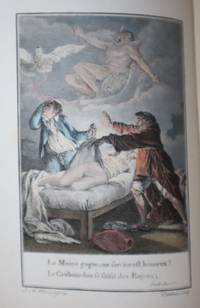
1899007992London: The Lutetian Society 1899. First Edition Thus. Full Straight-Grained Morocco. Fine. An exceptional copy. No. 415 of 500 copies limitation. Also extra-illustrated with 23 hand-colored engraved plates 21 of which depict scenes from the play and are after J. M. Moreau and two portraits one of Joan of Arc the other of Voltaire. There are also 25 b/w engravings these proofs of plates done by Duplessis-Bertaux. Bound beautifully by R. Wallis for Robson & Co. a rare bookseller at the turn-of-the-twentieth century stated in full straight-grained morocco with five raised bands and gilt spine decoration gilt turn-ins and gilt edges. And plates are all printed on a luxuriant and thick vellum paper. 8vo. 22 by 16 cm. 406 pp. Pagination continuous between two volumes. Some of the Moreau plates are dated 1788 or 1789. We can assume all of the Moreau plates are from that time. They were created for an earlier French edition of the poem and most of them have two line captions quoting the poem. The Condition: Light rubbing evident on raised bands and spine extremities. Otherwise binding fresh tight. Overall a fine copy. The Lutetian Society unknown
Creator: Hiroshi Hirabayashi. Kamishibai propaganda play / Japanese picture show (kamishibai) illustrating the benefits and immense moral obligation of collaborating with one other for survival. Folio. The complete work, comprising 20 offset full-colour printed illustrative cards which together form a story to educate or indoctrinate the viewer with nationalist concepts during the Second World War, each with printed story text to verso, one of the cards being the title and publishing information. Text is in Japanese. Contained in publisher's original paper portfolio covers, with title label to front. Story cards measure approximately 38 x 26 cm. Portfolio covers measure approximately 39 x 27 x 1 cm. Some age-toning and wear to portfolio, otherwise in very good and original condition, cards retaining vivid impression, a fascinating and scarce Second World War propaganda presentation. Japanese wartime propaganda was distributed through films, magazines and newspapers, radio, books, cartoons and the education system. Publications such as the present illustrative stories, promoted the ideal citizen's nationalistic point of view, indoctrinating civilians to work collectively and in support of their government's actions, even when creating some form of imposition on the citizen himself. Kamishibai are Japanese paper plays that gained popularity among children in the 1930s and were subsequently used as a medium for propaganda during World War II. Also referred to as a "Picture Card Show," they were made for influencing youth with their engaging storylines and vivid imagery. In 1940, elementary schools were renamed "Citizen's Schools." Textbooks became vivid, engaging, and contained militaristic picture-books. During the course of World War II, the Japanese government attempted to indoctrinate Japanese children through education and propaganda. Both methods nationalized youth and encouraged them to support the war effort. Science curriculum, for example education taught children about agriculture so they could better assist in food production for the nation. Youth were expected to volunteer in factories and farms to replace the conscripted labor force. Additionally, "kokutai," meaning the uniqueness of the Japanese people in having a leader with spiritual origins, was officially promulgated by the government, including a text book distributed by the Ministry of Education. The purpose of this instruction was to ensure that every child regarded himself first of all as a Japanese and was grateful for the "family polity" structure of government, with its apex in the emperor. Indeed, little effort was made during the course of the war to explain to the Japanese people what it was fought for; instead, it was presented as a chance to rally about the emperor. This is a dramatic story of collaboration and innovation, its ultimate message being that these virtues are necessary for survival of a society and the individual. Sustenance being the key to survival, the story unfolds as follows. A village in Western Japan suffering a long arid season which led to drought, was unable to support vegetation and was seeing abandonment as many farmers left the region. Evidently this was a large village, having five shoya (village headman), and the latter devised an irrigation plan to restore its agriculture and ultimately preserve the village. In order to instill the urgency of success with the undertaking, the local bugyo (governor) approved the project under the alarming condition that if the project failed, the five headmen who also owned estates in the region, would be burnt alive at the stake. He had five hanging platforms erected in preparation of failure, and also to motivate them to accomplish the task lest they meet a gruesome public fate. Villagers supported the idea and all hands worked diligently to ensure its success. Indeed, working together with a common goal was the key. The water flowed abundantly. The village was saved, and so were the lives of the five headmen. The hanging platforms were set ablaze (without victims) in celebration.
Kamishibai propaganda plays / Japanese picture show (kamishibai) illustrating the importance of taxation, specifically relating to the all-important commodity: rice. Folio. The complete work, comprising 20 offset full-colour printed illustrative cards which together form a story to educate or indoctrinate the viewer with nationalist concepts during the Second World War, each with printed story text to verso, one of the cards being the title and publishing information. Text is in Japanese. Contained in publisher's original paper portfolio covers, with title label to front. Story cards measure approximately 38 x 26 cm. Portfolio covers measure approximately 39 x 27 x 1 cm. Some age-toning and wear to portfolio, otherwise in very good and original condition, cards retaining vivid impression, a fascinating Second World War propaganda presentation. Japanese wartime propaganda was distributed through films, magazines and newspapers, radio, books, cartoons and the education system. Publications such as the present illustrative stories, promoted the ideal citizen's nationalistic point of view, indoctrinating civilians to work collectively and in support of their government's actions, even when creating some form of imposition on the citizen himself. Kamishibai are Japanese paper plays that gained popularity among children in the 1930s and were subsequently used as a medium for propaganda during World War II. Also referred to as a "Picture Card Show," they were made for influencing youth with their engaging storylines and vivid imagery. In 1940, elementary schools were renamed "Citizen's Schools." Textbooks became vivid, engaging, and contained militaristic picture-books. During the course of World War II, the Japanese government attempted to indoctrinate Japanese children through education and propaganda. Both methods nationalized youth and encouraged them to support the war effort. Science curriculum, for example education taught children about agriculture so they could better assist in food production for the nation. Youth were expected to volunteer in factories and farms to replace the conscripted labor force. Additionally, "kokutai," meaning the uniqueness of the Japanese people in having a leader with spiritual origins, was officially promulgated by the government, including a text book distributed by the Ministry of Education. The purpose of this instruction was to ensure that every child regarded himself first of all as a Japanese and was grateful for the "family polity" structure of government, with its apex in the emperor. Indeed, little effort was made during the course of the war to explain to the Japanese people what it was fought for; instead, it was presented as a chance to rally about the emperor. By using the example of the esteemed agrarian reformer and economic savant Ninomiya Kinjiro who was born into peasantry, lost his family and home in a disaster, and overcame all odds to become a notable leader and economic reformer, this story promotes the importance of government taxation, even on basic needs such as rice. Ninomiya Kinjiro (1787-1856) was an important agrarian reformer and economic thinker of the late Edo period. His legendary diligence and studiousness as a child made him a natural exemplar for Japanese schoolchildren. At one time, most every elementary school in Japan displayed a statue depicting Ninomiya as a youth with a bundle of firewood on his back and an open book in his hand.
Kamishibai propaganda play / Japanese picture show (kamishibai) illustrating Samurai warriors plying away in the fields aid in food production for the nation at war. Folio. The complete work, comprising 20 offset full-colour printed illustrative cards which together form a story to educate or indoctrinate the viewer with nationalist concepts during the Second World War, each with printed story text to verso, one of the cards being the title and publishing information. Text is in Japanese. Contained in publisher's original paper portfolio covers, with title label to front. Story cards measure approximately 38 x 26 cm. Portfolio covers measure approximately 39 x 27 x 1 cm. Some age-toning and wear to portfolio, otherwise in very good and original condition, cards retaining vivid impression, a fascinating and scarce Second World War propaganda presentation. Japanese wartime propaganda was distributed through films, magazines and newspapers, radio, books, cartoons and the education system. Publications such as the present illustrative stories, promoted the ideal citizen's nationalistic point of view, indoctrinating civilians to work collectively and in support of their government's actions, even when creating some form of imposition on the citizen himself. Kamishibai are Japanese paper plays that gained popularity among children in the 1930s and were subsequently used as a medium for propaganda during World War II. Also referred to as a "Picture Card Show," they were made for influencing youth with their engaging storylines and vivid imagery. In 1940, elementary schools were renamed "Citizen's Schools." Textbooks became vivid, engaging, and contained militaristic picture-books. During the course of World War II, the Japanese government attempted to indoctrinate Japanese children through education and propaganda. Both methods nationalized youth and encouraged them to support the war effort. Science curriculum, for example education taught children about agriculture so they could better assist in food production for the nation. Youth were expected to volunteer in factories and farms to replace the conscripted labor force. Additionally, "kokutai," meaning the uniqueness of the Japanese people in having a leader with spiritual origins, was officially promulgated by the government, including a text book distributed by the Ministry of Education. The purpose of this instruction was to ensure that every child regarded himself first of all as a Japanese and was grateful for the "family polity" structure of government, with its apex in the emperor. Indeed, little effort was made during the course of the war to explain to the Japanese people what it was fought for; instead, it was presented as a chance to rally about the emperor. This is a story of Samurai warriors working in the fields with ordinary people in order to help grow food, a clever example using the elite class that all look up to, in order to encourage citizens to contribute to Japan's efforts in World War II. It is cleverly named after the famous and revered Uesugi Yozan, who at the young age of 17 became daimyo of the economically failing Yonezawa domain, and through hard work and sacrifice, led his people and feudal land back to prosperity. Uesugi Yozan (1751-1822), the daimyo (feudal baron) who restored the fortunes of the impoverished Yonezawa domain, is famously known as one of Japan's most virtuous lords. Perhaps the most famous words left by Yozan are, "To achieve, one must act. To not act is to not achieve; this is true in all things. The inability to achieve is the result of inaction." Indeed, Yozan is a fitting an influential figure to support this propaganda and motivate citizens to contribute their efforts to winning the war.
Archive of London Artist, featuring a tribute to king of Belgium; comprises 5 published book dustjackets for notable authors, 2 bookplate designs, 11 heraldic arms of the British monarchy and the Royal Armed Forces, 30 hand-drawn and coloured Oxford coat of arms, 21 unique greeting cards, 7 photographs, and a few other items pertaining to publications and to colleges. Artworks and photographs range in size, the smallest measuring approximately 8 x 11 cm and the largest measuring 20 x 25 cm. With the exception of the greeting cards and bookplates, all other works are mounted to large cardstock leafs measuring approximately 29 x 35 cm. Two series of works are accompanied by typescript descriptions; one is accompanied by a facsimile letter from the College of Arms in London. The lot in very good condition, providing insight into the works of an all but forgotten London-based commercial artist who was active before and during the Second World War. Norman Walker James (1886-1963) was a commercial artist and designer established in London from about 1910-1911. He is listed as a Decorative Designer residing at a boarding house in Kensington, in the 1911 census. Although little-known today, he evidently rose to some acclaim in his trade, as he was selected to design a memorial tablet for Belgian King Albert I. Born in Leicester, he was the son of a congregational minister. The present archive consists of an artist's own retained copies of his work, which form a fascinating portfolio of a man who was notable and active, not long ago from the 1920s into at least the 1940s, and yet seems to be vanished into obscurity. His undertakings and contracts connected him to Belgian royalty, notable publishers, and administrators of renowned college institutions. Especially interesting are the items pertaining to his contribution to a memorial located in the Sint-Maartenskathedraal in Ypres [St Martin's Cathedral re-built in 1930] , including a photograph of the tablet designed by James and accompanied by his design description, two coats of arms printed true-to-size as they would be on the tablet, as well as two rare large press photographs of its unveiling on 21 May 1938. The tablet served to honour Albert I King of Belgium together with the British Armed Forces for the gift of the exquisite rose stained glass window mounted above the south transept door. James designed the nine-foot tall tablet, on which he hand painted the inscription, and which was unveiled by King Leopold III. It featured the coat of arms of Albert I, as well as the Arms of the British Army, the RAF and the Dragoon Guards. Some of James' dustjacket designs retained here include: Commodore Anson's Voyage Into the South Seas and Around the World, by Boyle T. Somerville, published in 1934; The Recollections of Sir Henry Dickens, published in 1934; The Daughters of George III, by Dorothy Margaret Stuart, published in 1939; War & Peace, by Leo Tolstoy, published in 1942 (Also with original book boards); The Heart of Jade, by Salvador de Madariaga, published in 1944. Other book and publishing related designs include: Four photographs showing the dedication leafs and front boards of a book issued by Great Britain's Postal Administration to commemorate the tricentennial anniversary of Norway's postal service and to celebrate the two nations' collaboration in a Universal Postal Union; A front wrapper for a 1934 issue of "Paris Salon Illustrated" magazine for artists. On two leafs are mounted 30 hand coloured drawings of heraldic shields, being the Arms of the University of Oxford, and twenty-nine of its colleges or halls, some examples of which include Pembroke College, St. John's College, Jesus College, Queens College, Magdalen College, and Campion Hall. A ticket of R. P. Gossop Limited stamped "Norman James" reveals a connection to the agency. [Reginald Percy Gossop (1876-1951) was a commercial artist specializing in graphic and landscape art, and is best remembered for designing posters for the Underground Group from 1925 to 1932. He started an agency for artists circa 1920. He studied at Birkbeck College in London, then at the Hammersmith School of Art.] Manuscript
Korea's most prestigious Yi Dynasty paintings reproduced and thus preserved in a most elegant single presentation, this is an exceedingly scare work. The famous original paintings are held in private and museum collections throughout Korea. Each painting here is illustrated in colour, most also being the same size as the original artworks. Some of the larger ones are foldout plates. Each is tipped to its own printed carrier folder with a descriptive text printed adjacent on the same large leaf. These four portfolios weigh 30 kg and we will provide free shipping anywhere in the world.
196562964New York & Bronx NY Los Angeles CA: Harold Berson ca. 1965-1978. 12mo. sized 3 x 5 in. up to 8 x 11 in. 4to. 81 separate pen & ink drawings intended for text illustrations and page illustrations many with paginations some for during printing mock-ups while most appear in storyboard format others are just image montages most on translucent paper with a couple on ruled paper some with fold creases from mailing and 1 w/ portion burned at margin still a remarkable set of original artwork. This exceptional archive original illustrations reflect the artist’s interests in whimsical fairy tale and folk tale settings and exotic locales he embraces from his many travels. Several of the first grouping within this archive depict a rural thatched roof farm and family with animals while another group focuses on a Japanese folktale. About 25% of the illustrations are focused on his book Raminagrobis and the Mice including notes on colours assorted stages of a few of the illustrations and others. The remainder appear focused on “Kassim’s Shoes†and others including his “Mother Goose†with inventive portrayals of animals and nicely executed storyboarding. As a sociologist and folklorist Berson actively sketched and drew from his surroundings in Europe the Middle East and North Africa to create inventive and engaging worlds for young readers. Berson 1926-1986 was born in Los Angeles served at the end of World War II and was an avid traveler. He graduated from UCLA with a BA in 1953 and spent most of the next two decades traveling in Europe studying art in Paris and then living in Spain France Italy Yugoslavia Turkey North Africa and after 1958 together with his fellow artist & wife Paula Winter Berson 1929-2003. His first illustrated book was “Loretta Mason Potts†by Mary Chase in 1958. He is perhaps best-remembered for his whimsical fairy tale creatures in his Henry Possum Mabel Watts’s “The King and the Whirlybird†“Mother Goose Treasury†“Raminagrobis and the Mice†“King Midas and the Golden Touch†and many others. Harold Berson, unknown
1850D4292c. 1850. Fine. Half leather and marbled paper over boards 9-by-11 inches; approx. pp. 200 different color papers. Includes 11 beautiful hand-colored landscapes on heavy cardstock 7-by-10.5 inches; and 14 pencil sketches on lighter gauge paper studies of the human form seemingly with Greek and Roman statues of men and women as their inspiration. A lovely collection of original drawings and paintings. The landscapes include castles from the Isle of Man and Rudesheim Germany as well as mountain scenes lake scenes bridges and more. All artwork is easily removed from the book and suitable for framing. <br/><br/> hardcover books
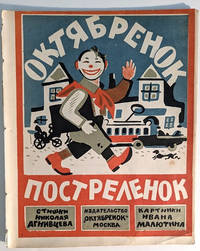
5206<p>Large quarto 26x21 cm. wrappers 16 pp. A youthful energetic pioneer struts through the new Soviet streets rejecting the baggage of outworn religious imperatives and embracing mass production science and technology moving toward the realization of Marxist-Leninist vision. Fine artwork by Ivan Andreevich Maliutin 1891-1932 member of the Futurist group Jack of Diamonds famous for his poster work in ROSTa with Mayakovsky taught at VKhUTEIN and was a leading satirical artist published widely until his untimely death. OCLC locates two North American holdings Harvard Princeton. A bright copy with a publisher's flawed page cut not affecting images.</p> Oktobrenok paperback
1920D6746Europe late-19th or early 20th century. Ephemera. Near Fine. A collection of original artwork possibly all by the same artist though only one of the three groups is signed E. H. Holmes. The collection includes: 2 pencil sketches heightened in white 5x6.5 inches both dated 1852 showing a part of the Berry Pomeroy castle and Marldon Church in Devon; 14 pencil sketches 5.25x8.25 inches of Greek and Roman men and women likely drawn from statues; 11 beautiful landscapes each in pencil and gouache and heightened in white oval-shaped on heavy cardstock white leaves 10.5x7 inches some of them identified in the lower margin Ardennes Tower of Refuge at the Isle of Man Baltimore Head and more. All works are nicely accomplished and loose suitable for framing. The occasional graphite finger-smudge else fine. <br/><br/> unknown books
35309Ca early-to-mid 1920s. Painting matted and housed in a gilded wooden frame. A Nr Fine exemplar. Frame: 23" x 20". Painting to matte: 16-1/2" x 13-1/2" <br/><br/>Picture depicts an elevated view of the harbor from the hills to the South-SouthEast. unknown books
1875D6816likely England c. 1875. Hardcover. Very Good. Full black morocco ornate border and initials "S. M. B." gilt-stamped on boards details gilt-stamped in spine compartments 5 raised bands; square 8vo 7.5 x 8.75 inches; contains 24 tipped-on reproductions of famous portraits and scenes usually religious printed in sepia or b/w and surrounded by original watercolors beautifully accomplished botanical borders in full-color. Corners and spine tips gently scuffed; faint waterstain at the very top edge of a few leaves small trimmable. A lovely variety -- bluebells snowdrops lily of the valley branches ivy and more. <br/><br/> hardcover books
196443865London: Jonathan Cape n. d. 1964. 1964. First edition. Approximately 20" x 26 1/2" framed and glazed original color poster for Len Deighton's "Funeral In Berlin" and signed in ink by Raymond Hawkey next to his printed design credit at the lower right of the poster. The poster pictures a chessboard and chess pieces of a Nazi skull a hand grenade and a machine gun. An attractive design in excellent condition and very scarce to rare. Jonathan Cape, n. d. (1964). unknown
198644327Washington DC: Mage Publishers Inc 1986. First Trade Edition. Quarto 28.75cm; full black cloth with titling and artist's facsimile signature stamped in white on spine and front cover; illustrated endpapers; dustjacket; 1431pp; illus; text is in French and English. Inscribed by the artist to Broadway star Sondra Lee on the first blank page "Pour Sondra / trés amicalement / Franta / April 87" beneath a full-page mixed media illustration of two nude figures sitting cross-legged opposite each other. Fine in a lightly shelfworn Near Fine dustjacket. Laid into this copy is an invitation for the 2001 exhibition Franta: "oeuvres choisies" signed by the artist in teal marker with two other signed invitations send to Sondra Lee laid in. The first monograph of Franta's work tracing "his development from the 1960s when he first arrived in France a refugee from Czechoslovakia up to his recent exhibitions in New York and Paris." A bilingual edition with 109 illustrations 50 of them in color. A distinguished copy with a masterful full-page work of art. Provenance: From the library of Sondra Lee. Mage Publishers, Inc unknown books
1932D37241932. Hardcover. Fine. Half brown cloth and morocco with gilt-stamped lettering on spine. Fine. Contains 21 grey heavy cardstock leaves each with a tipped-on drawing 6-by-7-inches colored by hand usually in watercolor and pencil. Osborn holds forth in 19 cartoons on the subjects of hair and California. Also includes 2 more serious drawings both concerned with landscape and the human figure. <br/><br/>Early original cartoons by the noted caricaturist cartoonist and satiric commentator Robert Osborn who died in 1994 at age 90. Educated at the University of Wisconsin and Yale University where he was art editor of the Yale Record Osborn studied painting in Rome and Paris before returning to teach art and philosophy at the Hotchkiss School in Lakeville Connecticut. At the outbreak of World War II he enlisted in the Navy with the hope of becoming an aviator. He was assigned to an information unit under the command of the photographer Edward Steichen. As a Navy officer he learned the art of speed drawing and over his military career produced some 40000 drawings for training manuals -- many of them featuring a cartoon character named Dilbert a blunderer who violated rules of military safety. In 1946 he achieved his first public recognition for "War Is No Damn Good" said to be the first antiwar book of the nuclear age. He went on to draw for Harper's Fortune Life and Look and became a regular contributor to The New Republic. Garry Trudeau creator of the "Doonesbury" strip called Mr. Osborn "one of the very few masters of illustrative cartooning." hardcover books
1932D37241932. Hardcover. Fine. Half brown cloth and morocco with gilt-stamped lettering on spine. Fine. Contains 21 grey heavy cardstock leaves each with a tipped-on drawing 6-by-7-inches colored by hand usually in watercolor and pencil. Osborn holds forth in 19 cartoons on the subjects of hair and California. Also includes 2 more serious drawings both concerned with landscape and the human figure. <br/><br/>Early original cartoons by the noted caricaturist cartoonist and satiric commentator Robert Osborn who died in 1994 at age 90. Educated at the University of Wisconsin and Yale University where he was art editor of the Yale Record Osborn studied painting in Rome and Paris before returning to teach art and philosophy at the Hotchkiss School in Lakeville Connecticut. At the outbreak of World War II he enlisted in the Navy with the hope of becoming an aviator. He was assigned to an information unit under the command of the photographer Edward Steichen. As a Navy officer he learned the art of speed drawing and over his military career produced some 40000 drawings for training manuals -- many of them featuring a cartoon character named Dilbert a blunderer who violated rules of military safety. In 1946 he achieved his first public recognition for "War Is No Damn Good" said to be the first antiwar book of the nuclear age. He went on to draw for Harper's Fortune Life and Look and became a regular contributor to The New Republic. Garry Trudeau creator of the "Doonesbury" strip called Mr. Osborn "one of the very few masters of illustrative cartooning." hardcover
196962962New York; Los Angeles CA & Bronx NY: Beman Lord 106 East 85th Harold Berson Dec. 1969. 8vo. Approx. 150 separate pen & ink drawings a few water-coloured apparently intended for possible frontisp. or dustjacket cover all laid-out with margins and blanks left for text to be inserted later during printing mock-ups all w/ neat pagination below some with editorial notes; 4to. 14 leaves carbon copy typescript editing corrections in pencil & ink further notes w/ original working title center fold crease from mailing all preserved in original manila mailing envelope with postmark dated Dec. 5 1969 in excellent condition and from the library of Harold Berson artist. This exceptional typescript manuscript and complete suite of original illustrations provide splendid specimens for children’s book publishing during the Civil Rights & Women’s Rights movements through the Vietnam-War era. Set against the backdrop of a new young woman teacher convincing her young students to embrace intramural soccer and set up a league with other nearby schools fielding teams of all genders and races. The title was changed to “Shrimp’s Soccer Goal†when published by H.Z. Walck in 1970 but evidently intended by Lord & Berson to focus on the impact of young Miss Taylor’s enthusiasm for soccer her admiration of Pele after traveling to Brazil to see him play and inspire her students to learn the sport. The young “Negro†character Paul the best athlete is best friends with “Shrimp†and they both belong to neighborhood club with three others with Steve encouraging the young people to become involved in social justice causes. In 1969-1970 the United States featured the newly created professional soccer league sanctioned by FIFA -- North American Soccer League whose most successful franchise was the New York Cosmos who later managed to recruit both Pele from Brazil and Franz Breckenbauer from West Germany to play for them. Berson 1926-1986 was born in Los Angeles served at the end of World War II and was an avid traveler. He graduated from UCLA with a BA in 1953 and spent most of the next two decades traveling in Europe studying art in Paris and then living in Spain France Italy Yugoslavia Turkey North Africa and after 1958 together with his fellow artist & wife Paula Winter Berson 1929-2003. His first illustrated book was “Loretta Mason Potts†by Mary Chase in 1958. He is perhaps best-remembered for his whimsical fairy tale creatures in his Henry Possum Mabel Watts’s “The King and the Whirlybird†“Mother Goose Treasury†“Raminagrobis and the Mice†“King Midas and the Golden Touch†and many others. Beman Lord, 106 East 85th, Harold Berson, unknown
1940D7485n.p. but England c. 1940. Hardcover. Very Good. Original grey cloth over boards decorative paste-downs; 195 x 260 mm; pp. 47 with tipped-on typed text some handwritten annotations and underlines. Extra illustrated with clippings postcards original drawings ephemera and one photograph. Dedicated to Gertrude Alison Densler. Uniformly toned at edges; gently worn; minor tears. <br/><br/>Book commences with the popular Italian tale "Fagiolino" by Elisa Amati translated by Alan C. Dunn. Containing 26 clipped illustration pasted to leaves and hand-colored pen and ink drawings depicting characters from the story. After which book includes typed poems by William Blake William Shakespeare Walter de la Mare Carl Sandburg; and other original works by the poet are clipped and pasted-in. An original hand-drawn paper doll with original hats and clothes are secured by decorative pockets. A charming "book of favorites" and a sophisticated compilation; sketches and poems collaged into this album offer a fascinating glimpse into the mind of a young artist and poet. hardcover
1940D7485n.p. but England c. 1940. Hardcover. Very Good. Original grey cloth over boards decorative paste-downs; 195 x 260 mm; pp. 47 with tipped-on typed text some handwritten annotations and underlines. Extra illustrated with clippings postcards original drawings ephemera and one photograph. Dedicated to Gertrude Alison Densler. Uniformly toned at edges; gently worn; minor tears. <br/><br/>Book commences with the popular Italian tale "Fagiolino" by Elisa Amati translated by Alan C. Dunn. Containing 26 clipped illustration pasted to leaves and hand-colored pen and ink drawings depicting characters from the story. After which book includes typed poems by William Blake William Shakespeare Walter de la Mare Carl Sandburg; and other original works by the poet are clipped and pasted-in. An original hand-drawn paper doll with original hats and clothes are secured by decorative pockets. A charming "book of favorites" and a sophisticated compilation; sketches and poems collaged into this album offer a fascinating glimpse into the mind of a young artist and poet. hardcover books
19700039281970 A unique and original artwork from the celebrated political satirist John Kent. This is a magnificent large drawing created for the issue of 21st December 1970. It measures 30" x 20" and is signed by John Kent. The episode depicts the then PM Edward Heath and one of the worst rogues in Tory history the racist Enoch Powell. Beautiful clean artwork with no sign of a correction. Varoomshka was the blonde bombshell who appeared for many years in The Guardian. 0.0 0.0 0.0. Illus. by John Kent. Soft cover. Fine. paperback
ABE-4450566152A unique and original artwork from the celebrated political satirist John Kent. This is a magnificent large drawing created for the issue of 15th December 1975. It measures 30" x 20" and is signed by John Kent. The episode depicts the then PM Harold Wilson and it was done in the style of a Tiger Tim comic strip. Beautiful clean artwork with no sign of a correction. Varoomshka was the blonde bombshell who appeared for many years in The Guardian. Language: eng Language: eng 0.0 Language: eng 0.0 Language: eng 0.0 Language: eng. Signed by Illustrator. Soft cover. Fine. paperback
Original oil painting of a striking and stylish Chinese junk (Vessel), on thick cardstock. Made circa 1901-1910. Measuring approximately 25,5 cm x 20,5 cm. Indication at perimeters of previous framing, otherwise in very good condition. With its two strong sails inscribed with Chinese lettering by the artist, this handsome artisan work memorializes the traditions of the ancient Chinese junk, by highlighting the revolutionary and long-standing sailing designs as well as a fascinating superstitious practice. The vessel features painted eyes and an open stern with far reaching tips which exudes speed. A dragon-like flag flies from one of the masts. A stern rudder helps steer through the rough waters of the harbour, which is surrounded by mountains, possibly representing Hong Kong's Victoria Harbour. The peaked and winged-style stern of the vessel suggests speed and agility at high seas. Five Chinese seafarers onboard are wearing traditional dress.
Tibet, circa 1955-60. An original pastel portrait of a Tibetan native by world renowned artist Goray Douglas, with signature. Beautifully framed behind glass. Image measures approximately 32.5 x 25cm. Gold colour frame measures approximately 40 x 50 cm. Very Good Condition, an exceptionally well rendered pastel painting on grey paper laid to a wide margin mount. This is not a reprint. This is a RARE ORIGINAL PAINTING by Douglas Goray. From the artist's "Faces of the Hills" collection, an immense work in which he portrayed 350 individual Tibetan and Burmese subjects with exquisite likeness, the elder in this painting has distinctly Chinese features. Douglas is a noted Darjeeling artist, a master of portraiture, revered for his documentation of native peoples.