2 100 résultats
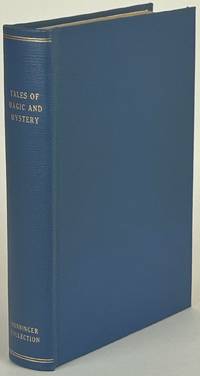
192731906Camden NJ: Personal Arts Company Publishers 1927-1928. Issues slightly trimmed for binding otherwise quite fine with little tanning to text paper mostly cream colored. At the base of the spine is stamped "Dunninger Collection." A lovely presentation. 31906. Octavo five issues pictorial wrappers bound in blue boards with gold stamping to spine. A bound volume of all five issues that were noted magician Joseph Dunningers copy with his signed name and also inscribed and signed by editor/author Walter Gibson to Joe Dunninger. Gibson wrote several books about magic for Dunninger they were lifelong friends. This is likely a presentation volume to Dunninger. Tales of Magic and Mystery was a short lived magazine which published stories and articles about magic and the occult as well as some short fiction. The March 1928 issue published the H. P. Lovecraft short story "Cool Air." Other authors of fiction include Frank Owen Miriam Allen de Ford Archie Binns Robert Leslie Bellem and others. Gibson wrote most non-fiction material under his own name and also using the pseudonyms Alfred Maurice and Bernard Perry. Personal Arts Company, Publishers unknown
1947D10934America 1947. Cloth-covered 3-ring binder American manufactured covers illustrated in black marker with drawings of top-hats an ace of spades an eight ball faces names and maxims "Flunk Early Avoid the Rush" "Here's Your Hat What's Your Hurry". The inside front cover bears our author's name "Budd Leader Sophomore 1st half" as well as a cloud of girls' names Joan Ginger Darlene Sally Betty Roberta et al perhaps referring to his lovely assistants -- women who put birds back in their cages who comforted newly hatless rabbits who were sawn in half or who otherwise gave themselves to magic. This distinctly American binder is bursting with 382 tricks handwritten in ink in tidy script on lined paper most of them accompanied by careful pencil drawings demonstrations of steps and techniques on small leaves of onion skin paper stapled to the trick they describe. Extremities bumped and cloth a bit frayed; boards warped see aforementioned "bursting" I wasn't joking with a few small spots of soiling. Top ring of binder doesn't close all the way ahem bursting so a few pages have come loose but could be easily reinforced if one were so inclined. Contents are bright and clean perfectly legible pleasing to behold and -- one assumes -- hitherto privileged information. <br/><br/>Includes tricks with cards rope dice balloons sleights of hand mind reading break-away cabinets and so much more. Though some of the illusions strike this cataloguer as enticingly practical "How to be Marvelous without Skill" "The Vanishing Alarm Clock" many of the illusions seem quite advanced and particular to the world of magic "Second Sight Extraordinary" "Mind Signals" "You Do As I Do". Though little can be found on Budd Leader now he was clearly a high school student of some talent and considerable dedication. A quintessential distinct volume. Remarkable. hardcover
1947D10934America 1947. Cloth-covered 3-ring binder American manufactured covers illustrated in black marker with drawings of top-hats an ace of spades an eight ball faces names and maxims "Flunk Early Avoid the Rush" "Here's Your Hat What's Your Hurry". The inside front cover bears our author's name "Budd Leader Sophomore 1st half" as well as a cloud of girls' names Joan Ginger Darlene Sally Betty Roberta et al perhaps referring to his lovely assistants -- women who put birds back in their cages who comforted newly hatless rabbits who were sawn in half or who otherwise gave themselves to magic. This distinctly American binder is bursting with 382 tricks handwritten in ink in tidy script on lined paper most of them accompanied by careful pencil drawings demonstrations of steps and techniques on small leaves of onion skin paper stapled to the trick they describe. Extremities bumped and cloth a bit frayed; boards warped see aforementioned "bursting" I wasn't joking with a few small spots of soiling. Top ring of binder doesn't close all the way ahem bursting so a few pages have come loose but could be easily reinforced if one were so inclined. Contents are bright and clean perfectly legible pleasing to behold and -- one assumes -- hitherto privileged information. <br/><br/>Includes tricks with cards rope dice balloons sleights of hand mind reading break-away cabinets and so much more. Though some of the illusions strike this cataloguer as enticingly practical "How to be Marvelous without Skill" "The Vanishing Alarm Clock" many of the illusions seem quite advanced and particular to the world of magic "Second Sight Extraordinary" "Mind Signals" "You Do As I Do". Though little can be found on Budd Leader now he was clearly a high school student of some talent and considerable dedication. A quintessential distinct volume. Remarkable. hardcover books
1932027073London 1932 Macmillan & Co Hardcover Very Good
2000010348New York: Knopf 2000. First American edition of book 3 of the "His Dark Materials" trilogy; A most acceptable copy; 518pp. First U.S. Edition. Hard Cover. VG/VG. Knopf Hardcover
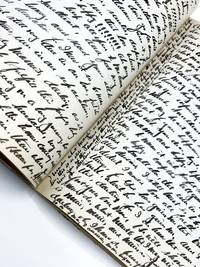
191745784Ithaca NY: n.p. 1917. Very good plus. Original manuscript journal containing the wildly ardent lovelorn musings of "Magie" to "Margie" written while waiting for the finalization of Margie's divorce. To call "Magie's" love for "Margie" superlative would be an understatement: his writing in this journal is comprised of verbose expressions of fondness and adoration for her "the only blessed wonderful loyal fine sweet true adorable lovable precious beautiful altogether lovely incomparable perfect little woman in God's great universe whom I ever have ever can really love!!!!!!!!!" Magie's enthusiasm even bleeds into the margins of some leaves where he has written additional missives around the main text. <br /> <br /> Who is the lovesick "Magie" the author of this manuscript journal that positively oozes with pent-up emotion and who is the "Margie" for whom he so desperately pines Magie's remark that "our marriage . will be so far different from the marriages we knew that they will seem like a bad dream" as well as several references to the day when Margie will be "legally free" to "give and receive" love indicate that both parties had been married previously and that Margie was likely still in the divorce process or the remarriage waiting period when this journal was written. The US divorce rate in 1917 was just 1.2%; this borderline-taboo action often had dire social consequences for the parties involved particularly the women and a state- or self-imposed period of waiting before remarriage was not unusual. Magie apparently spent this separation in varying degrees of agony emptying his evidently very full heart into this journal almost every day from May 28th to July 22nd. <br /> <br /> The lovebirds remain somewhat elusive in official records despite several tantalizing pieces of information nestled within Magie's lovelorn ramblings: references to "this fearful year" which in addition to a mention of a state military census pins the date of this journal pretty convulsively to 1917 which was "three quarters of the way through" by July 19th his occupation as a lawyer and the address 302 N. Cayuga Street a location Magie calls "our office". That address is sometimes listed as the location of a local Ithaca restaurant The City Cafeteria but more frequently as the longtime residence of prominent citizen and noted Wordsworth collector - her collection was donated to Cornell Cynthia Woodward Morgan St. John. Her son Edward Morgan St. John Cornell 1911 Cornell Law 1913 did work as an attorney and in the records of his 1919 marriage to Ruth Cronk he lists at least one and possibly two previous marriages though we find only a 1910 marriage to Lena Marie Smith. Cronk however does not. Which suggests perhaps sadly that "Margie" if she existed at all did not get her happily ever after. Nevertheless a compelling document overall and a vivid vernacular portrait of limerence. 10.25'' x 7.5''. Original cloth-backed marbled boards with printed label to front board hand-lettered "I". 94 manuscript leaves written both recto and verso. Boards with light edgewear. Hinges a touch cracked. Tight and clean. n.p. unknown
1959214711959. Gloye Eugene E. Archive of Autograph letters on Magic late 1950s to mid 1960s document the working methods technical experimentation and intellectual framework of a mid twentieth century American magician engaged in both performance and psychological analysis of illusion. Written primarily to fellow magician Don Tanner these letters provide direct evidence of how tricks were conceived refined and communicated within professional networks revealing the intersection of apparatus design sleight of hand and audience perception. Gloye's dual role as performer and psychologist situates the correspondence within broader developments in performance theory and applied psychology supporting research into the history of magic entertainment culture and the study of deception. Eugene Gloye authored 23 magic books including "For Magicians Only" "Fantastic Tricks with Plastic Cups" and "Theatrical Magic" <br /> <br /> Archive of sixteen letters spanning approximately the late 1950s through the mid 1960s containing detailed discussions of trick construction performance strategy and experimentation with materials and methods.Throughout the letters Gloye discusses numerous tricks he devised or refined often providing detailed explanations of their mechanics and performance nuances. His correspondence reveals a deep engagement with magical apparatus sleight of hand and psychological deception. One of the more detailed discussions in the letters revolves around Gloye's development of Fan-Ta-Cups which evolved from an earlier trick he had devised Fan-Ta-Bill. On September 5 1961 he describes how the trick was born: "I first got the idea for this cup trick about 14 years ago when I was experimenting with a bill trick which I eventually put on the market. The bill trick also uses a celluloid gimmick and was an adaptation of Liquid Appear. Since I thought of the cup trick at the time of my Fan-Ta-Bill I decided it was fitting to call it 'Fan-Ta-Cups.'" He further explains that while the idea had been percolating in his mind for years he hadn't developed a complete routine for it until recently. Inspired by the classic three-shell game he worked out a performance structure that he believed would make it more engaging.<br /> <br /> In a letter from July 11 1961 Gloye excitedly shares his thoughts on using hollow plastic golf balls for new magic tricks: "I am convinced that this new golf ball will open up many new trick possibilities. The fact that they come in several colors is also interesting." This suggests that Gloye was experimenting with different materials for manipulation tricks possibly related to vanishing or color-changing effects. Gloye also played with magical history concocting a hoax to see how the magic community would react. In the September 5 1961 letter he reveals his plan: "Last December I got an idea for a variation on the Tip-Over Box. It's just a slightly different way of building it. At first I was going to put it in my 'New Look' series but then as we were talking about it I commented that this trick should have been in Hoffmann. This led to the devilish idea of writing it up in Hoffmann style and publishing it in Genii as a lost page from the original book." He notes that Bill Larsen and another friend were in on the plan and they wanted to see if the trick would be accepted as a legitimate discovery.<br /> <br /> Another standout trick mentioned in the letters is Gloye's adaptation of Billy McComb's routine using a flap slate and a force deck. On January 31 1961 he explains: "My version which I tried for the first time several days ago with huge success uses one deck and a flap slate. The deck is made like a peek deck but with two cards only. All faces are the same and all concealed cards are the same. Cards which audience sees are trimmed and glued at one end to a second group of 26 duplicates." This approach ensured that the spectator would believe they had freely chosen a card when in fact the outcome was predetermined.<br /> <br /> Gloye describes modifications he made to a Head Chopper Illusion a prop widely used in stage magic in a February 23 1961 letter: "My version does not retain the Chinese theme. My blade is a simple black affair with a couple of brass stripes across it to make it look more solid. I spent a long time trying to figure out a good lock for the blades Abbott's want you to remove a couple of tacks which hold the blade and this is simply not workable. I ultimately did come up with a practical idea only to abandon it in my current routine." He explains that his routine involved swapping out the real blade for a fake setting up a comedic climax where "carrots fly in all directions" as the blade seemingly falls.<br /> <br /> This archive is a rare window into the intellectual and technical world of a magician who bridged academia and performance. Gloye's detailed notes on illusion mechanics reflections on the state of magic and collaboration with figures like Bill Larsen and Frances Marshall make this a significant collection for magic historians and collectors alike.<br /> <br /> Produced during a period of active exchange among professional magicians through correspondence and publications such as The Linking Ring these letters document how knowledge circulated within specialized communities and how innovation often emerged through incremental modification of established techniques. Gloye's attention to apparatus construction coded deception and audience management reflects broader mid century interest in performance psychology while his references to collaborators and publication strategies illustrate the role of print culture and informal networks in shaping the field. As a cohesive manuscript archive the letters preserve the technical language and creative process underlying stage magic offering a detailed record of mid twentieth century illusion practice. Light wear and handling consistent with age with legible manuscript throughout; overall condition very good. unknown
199838962New York New York U.S.A.: Scholastic Press 1998. 1st US . Hardcover. As New/As New. Grandpre Mary. 1st US Larger book fine green cloth spine dark blue boards with diamond pattern bright silver lettering on spine red inside covers and adjacent end papers 341 pages. DJ heavy paper colorful illustration of Harry with phoenix. DJ beneath mylar and book both As New. <br/> <br/> Scholastic Press hardcover
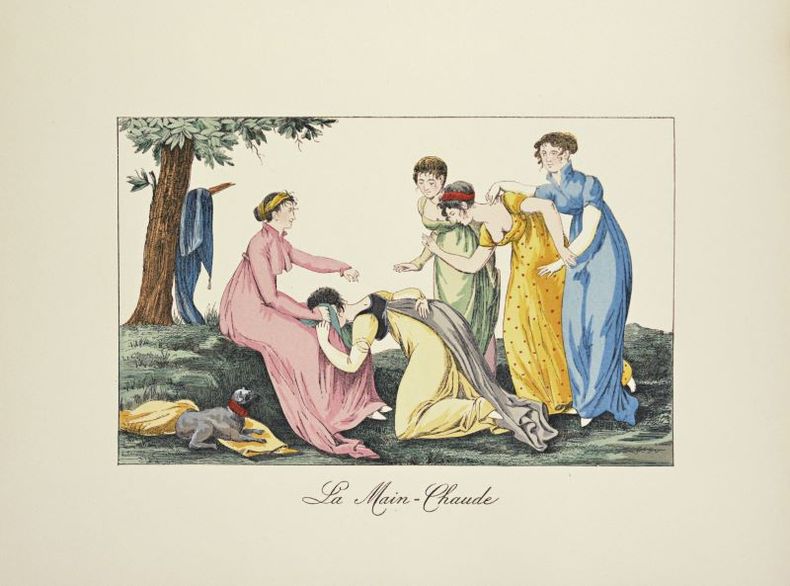
19050041551905 Paris, Hachette, sans date [1905]. Grand in-quarto (270 X 328 mm) reliure à la Bradel cartonnage papier crème illustré en couleurs, tête dorée (reliure de l'éditeur); (2) ff. blancs, (2) ff. de faux-titre et titre illustré imprimé en rouge et noir, 380 pages, 41 planches sous serpente, (2) ff. blancs.
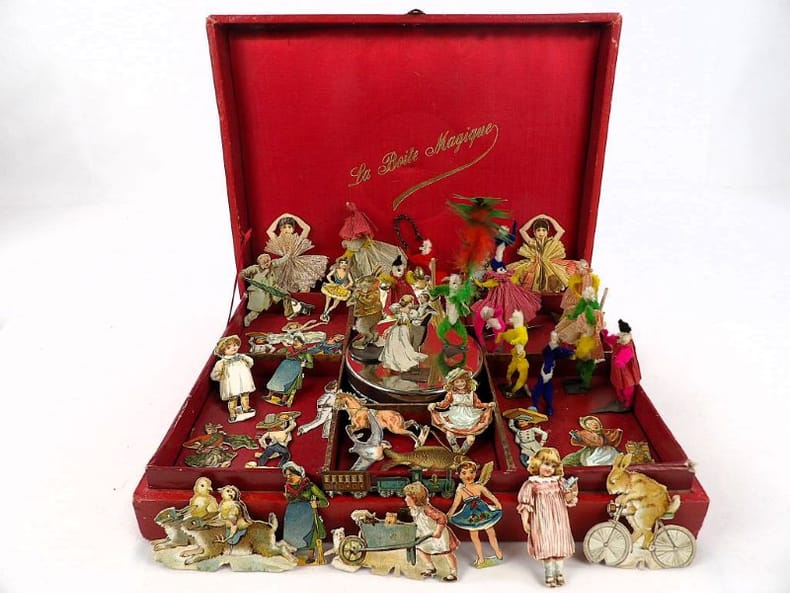
19062854Paris, K-B (Kratz-Boussac), circa 1906. 26,5 x 20 x 5 cm. Boîte recouverte de papier rouge. Titre doré sur le couvercle. La Boîte Magique est un jouet magnétique créé à l'origine par Abraham Martin, ingénieur mécanicien, qui déposa son brevet en France le 21 décembre 1894 avant de céder ses droits à Henri Kratz-Boussac en janvier 1906. Ce dernier, fondateur de la célèbre "Société des inventions brevetées" et de la marque Euréka, commercialisa alors le jouet sous sa propre marque. Malgré son nom évocateur, le principe est purement magnétique : à l'intérieur d'un boîtier en métal chromé, un mécanisme entraîne en rotation un ou plusieurs volants à axe aimanté, lequel — actionné par une crémaillère — communique son mouvement à des figurines [en chromos, en papier crépon et cure pipe, en simple fil de fer torsadé, ou encore en tôle lithographiée (train et poisson)] posées sur des patins métalliques glissant sur la surface lisse de la boîte, s'animant ainsi en va-et-vient ou en rotation. Cette version de la boîte magique de Kratz-Boussac, avec ses sept compartiments, correspond vraisemblablement à la version de luxe, bien plus généreuse en figurines et accessoires que les modèles courants à deux compartiments décrits dans les catalogues de l'époque.
1916YRG-415Deux forts in-8, broché reliure de l’époque, 573 et 847 pages.Complet. Jauni dans l'ensemble, quelques manques de papier au dos et traces d'usage sur la couverture et la 4ème de couverture. Chez Durville, Paris.
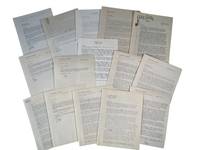
1930List313Massachusetts 1930. 8 ½ by 11 inch leatherette binder filled with correspondence. An interesting small archive of material from the semi-professional club magician George Corrigan consisting of letters written by other magicians most concerning the sale and trade of tricks. Corregan was the managing editor of the Sphinx published by Boston Assembly No. 9 and wrote a humorous personal interest column. He also like many magicians of the era traded tricks. According to Magicpedia Corregan "ran a humorous personal-interest column headed as "Dear Uncle Koko Esq." It was years before members realized that the initials of the heading spelled out a clue to the unknown author "D-U-K-E". Corregan contributed his magical ideas to the Sphinx. His Four Ace Trick published in 1922 was a favorite of Ted Annemann. He also marketed "Be a Human Calendar" and "Unkle Koko's Kloryphyll Kard Trick". He authored a column "Spilling the Beans" in The Seven Circles in the 1930s."<br /> <br /> Some entertaining material is included here particularly the effusive letters of Corregan's colleagues trying to upsell their tricks or engage in small time bartering: "Perhaps you think I am trying to pull the wool over your eyes in our transaction regarding my item Cig-o-Jest." Over 75 unique some in duplicate including correspondence trick want lists two realphoto postcards and unused stationery. We have kept the material as found loosely inserted into a leatherette binder. An interesting window into the life of a small time touring magician and magic writer circa 1930. Generally very good with some normal wear and some mimeographed pages showing normal chipping. unknown books
192926783NANTES LES AFFICHES NANTAISES, 8, rue Baron 1929 une affiche originale imprimée en noir sur papier bleu et illustrée en noir et rouge par HENRI BOUYER, format : 60 x 80 cm), avec le texte suivant : "LE VENTRILOQUE MARC LOS ET SON FILS TOTOR", sans date (1929) NANTES LES AFFICHES NANTAISES, 8, rue Baron Editeur,
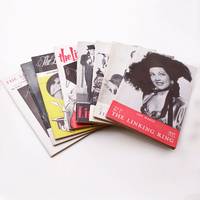
1962374500Kenton Ohio: The International Brotherhood of Magicians 1962. Illustrated throughout with black and white photos and pen and ink sketches. 60 vols. 8vo. Illustrated wrappers. Generally very good to fine. Illustrated throughout with black and white photos and pen and ink sketches. 60 vols. 8vo. 60 monthly volumes of The Linking Ring. Including: January February 1948 2 issues; September-December and March May June 1950 7 issues; the complete year for 1951 12 issues; the complete year for 1952 12 issues; January February 1953 2 issues; March-October and December 1954 9 issues; the complete year for 1955 12 issues; April 1959 1 issue; January May August 1962 3 issues.<br /> <br /> The International Brotherhood of Magicians I.B.M. monthly journal The Linking Ring has been in publication since 1922 and is available exclusively to members of the I.B.M. Our mid-20th century collection includes profiles of the most famed magicians of the day articles from the world of magic revealed magic tricks and pages of vintage advertisements.<br /> <br /> "It has documented the most significant events in our art over the past nine decades traced the rise to fame of the "greats" in magic and enabled magicians all over the world to exchange ideas." International Brotherhood of Magicians. The International Brotherhood of Magicians unknown
1956024505NY: HARPER & BROS. two small closed tears to an unclipped dj. owner's label to front paste-down. . VG. Hardcover. First Edition. 1956. HARPER & BROS hardcover
1910027042London 1910 Watt's & Co Hardcover
192962472Philadelphia: Dorrance and Co. 1929. 8vo. 273 3 pp. Photo frontisp. numerous photo plates. Dark green publisher’s cloth gilt lettering front cover & spine slight shelfwear couple leaves at lower corner w/ tear from poorly opened w/ d.j. cover art by WD minor chipping head & foot of spine couple closed tears edgewear still VG/VG- copy. First edition 1st printing of this memoir of the famed early 20th-Century stage magician whose gian production required 40 tons of equipment and entertained millions. Largely overshadowed by Houdini in history in his day Thurston was the best performing incredible tricks including the “Rising Card†with cards rising out of a glass goblet and floating like butterflies across the audience. He popularized the floating woman illusion or “Levitation of Princess Karnac†and even added Ziegfeld-inspired touches to his shows with scantily clad beautiful assistants. He performed and corresponded with D.L. Moody Emperor Franz Josef Sun Yat-Sen John L. Sullvian and Theodore Roosevelt. Very scarce in original dustjacket. Dorrance and Co., hardcover
198043524Omaha & San Francisco: Lovensko 1980-1987. Complete run of 22 issues all very near fine or better. Founded in Omaha Nebraska moved to San Francisco in mid-life. After initially concentrating on the small but active Omaha arts scene the focus of the tabloid rapidly expanded to include articles on overseas arts injustices in South America alternative living and American politics in addition to art record and film reviews. Specific appearances within the covers: interviews with The Waitresses 9 Philip Glass 10 21 Lawrence Ferlinghetti 13 Meredith Monk 13 Jean Tinguely 14 Shonen Knife 16 Survival Research Labs 17 Nina Hagen 18 H.R. Giger 18 Exene Cervenka & Wanda Coleman 18 Yoko Ono 19 Nam Jun Paik 21 Fakir Musafar 22; articles on mail art 3 14 computer hacking 12 ; poems John M. Bennett 3 opal nations 4 a short piece on an Allen Ginsberg performance in Denver with photographs 9 Mike Basinski 12; art by Gary Panter 4; an insert: “Cow Town Art: Bovine Issue #4†by Patrick Beilman 5; and Calypso Machine Gun/Bump Fuzz 7†single on red vinyl laid into issue #9. BEEF TABLOID was distributed free; complete runs are difficult to assemble. For the set: Omaha & San Francisco: Lovensko unknown books
1935355490721661London: Routledge 1935. First Edition. Hard Cover. Dust Jacket. London: George Routledge & Sons Ltd. 1935. First UK Edition. Introduction by Horace Goldin President of the Magicians' Club. Publisher's salmon pink boards with gilt lettering to the spine. A neat stamp to the front free end-paper withdrawn from circulation otherwise a very fine copy in like dustwrapper priced 7s 6d net to the inside flap as called for. A superlative copy and very scarce in dustwrapper in this condition. Photographs/scans available upon request. Routledge hardcover
1931766411931-1955. Many items hold-punched at the left margin; generally very nice. Additional materials include three 8 x 10 glossy photographs of six subjects on stage undergoing hypnosis and another of Sokeitous performing a magic trick; and dozens of ephemeral items including four issues of Hypnotic World; a flyer for the First Occult School of Philadelphia; pamphlets and promotional materials on on telepathy and Psycho-Power; and dozens of related items collected by Stanley Sokeitous. unknown
192719591ABBerlin, Horsterscher Verlag, 1927-28. 4to. Mit zahlreichen Abbildungen. Orig.-Kartoniert.
191017096ABParis, ca. 1910. 24 : 16 cm. 128 pages with many illustrations. Typographic printed original wrappers.
199916619CBLüchow, Phänomen - Gitta Peyn Verlag, 1999. 8°, 240 S., farbig illustr. original Kartonage (Paperback), 1., überarbeitete Auflage Einband minimal berieben, sonst schönes, sauberes Exemplar.
1907951600Le Caire: Imprimerie de l'Institut Français d'Archéologie Orientale. 1907 und 1958. Groß-Quart. (A very good set. Scarce. Sehr gut erhalten. Selten.) [13 Warenabbildungen] [6], 132, [2] pp., XXXI ff. plates with numerous photographs. Vol. I: 20th-century boards, upper original wrapper glued to the surface of the upper cover, lower original wrapper bound with, uncut. Vol. II: 20th-century black calf-backed boards, spine gilt (= Catalogue général des antiquités Égyptiennes du Musée du Caire, Vol. XXXV)
19203554907218371920. First Edition. Hard Cover. Signed by Author. New York: Adams Press Print 1920. First US Edition. SIGNED LIMITED DELUXE EDITION. Publisher's red leatherette pebbled softcover with flexible boards with gilt lettering to the spine and gilt vignette to the front board. Pink marbled end-papers. All edges gilt. "Serial Number 191 Higher Magic de Luxe Edition Issued to Arthur J Moose With fraternal Greetings and Best Wishes of the Author. Oscar S Teale". "191" "Arthus J Prince" and "Oscar S Teale" are in black fountain pen ink in the Author's hand. There are 2 copies of the Trade Edition only on COPAC. Oscar S Teale was an architect amateur magician and a researcher for Harry Houdini. He was alleged to have ghost-written some of Houdini's books and designed Houdini's gravesite. He also served as President of the Society of American Magicians from 1908-09. Arthur J Moose was a fellow magician who had a politically incorrect magic act with patter. A rubbed otherwise VG copy. Photographs/scans available upon request. hardcover