8 476 résultats
14442(Venedig, de Zanis, nicht vor 1487). Romanische Type. 26 nn. Bll. (letztes weiss) mit 2 Spalten zu je 38 Zeilen mit unausgefüllten Initialspatien. 8°. Mod. HPgmt. unter Verwendung von Material des 18. Jahrhunderts.
1900G1ADNMOA0S9LKopenhagen 1900. Housed in the original publisher's wooden boxes. Includes 2 original projectors and 1 camera. More than 400 glass slides depicting various motifs related to coal mining chemical processes and astronomy as well as topographical motifs from Asia Africa China Europe and America. Remarkable all-encompassing collection of turn-of-the-century magic lantern slides. Several of the slides show cavalry horses: the "Krigen 1848-1864" set includes no. 45 an equestrian portrait of General Bülow victor of the 1849 Battle of Fredericia painted by Aug. Jerndorff; no. 29 Friedrich von Schleppegrell riding at the battle of Isted; no. 26 General Krogh on horseback all V. Richter Kopenhagen; no. 20. captioned "Pferdeablieferung" horse delivery.A box lebelled "København" includes: no. 21 Brandmajoren rykker ud; no. 20 a fire at the time of King Frederik VI of Denmark d. 1839.Other slides show workhorses in Denmark and Sweden during haying-time or spreading manure as well as works of the Danish painter Otto Bache: the Coronation of Christian IV in 1596; the conspirators escaping from Finderup on horseback after having murdered Eric V of Denmark in 1286. The collection also contains copies of paintings by various artists such as Leonardo da Vinci Raphael and Rembrandt. Among the remaining slides we find astronomical illustrations and pictures of observatories Greenwich Delhi Potsdam etc.; as well as numerous photographs and paintings of landscapes people and architecture in Africa Asia Europe China and America. unknown
1561GEJ-10Paris, apud Gilles Corrozet, 1561, [1], 40, [1] pp, 8°. Book in Latin. RARE AND UNCOMMON ON THE MARKET FIRST PARISIAN PRINTING! 17/18 century full calf binding, gold lettered spine, marbled endpapers, owner's ex libris of Emeric Bigot (?) on title page. Good antiquarian condition, woodcut printers device to title, woodcut initials. Few stains and discolorations. Complete. Published in Paris by Gilles Corrozet in 1561, this rare edition of Ulrich Molitor’s Tractatus de lamiis et pythonicis stands as a definitive cornerstone of early occult literature and a fascinating, skeptical counterpoint to fanatical witch-hunting manuals like the Malleus Maleficarum. Written by a prominent German jurist, the treatise is historically significant for its early skepticism, as Molitor boldly argued that supernatural acts like shape-shifting or flying to sabbaths were merely illusions and dreams induced by the Devil rather than physical realities. This text is equally famous for containing the earliest printed depictions of witches, establishing the modern iconography of the occult through striking woodcut imagery that includes scenes of witches brewing storms in cauldrons, a wizard riding a wolf, and the Devil corrupting a woman. Composed as a direct response to Europe's rising witchcraft hysteria, this treatise introduces cold legal logic and canonical jurisprudence into a debate previously dominated by religious fanaticism. Moving away from dry academic lecturing, the text adopts the dynamic structure of a scholarly dialogue between three real historical figures: Archduke Sigismund of Austria, the ruler of Tyrol, who acts as the voice of skepticism by raising logical doubts and challenging the validity of witch trials; Conrad Schatz, the magistrate of Constance, who champions the strict, traditional view by defending the physical reality of witchcraft and demanding harsh punishments; and Ulrich Molitor himself, the author, who serves as the impartial arbiter utilizing Roman and Canon law to systematically resolve the disagreements between his interlocutors. Ulrich Molitor (c. 1442–1507) was a pioneering German jurist, humanist, and diplomat who shaped early modern legal thought. After studying humanities in Basel, he earned a prestigious doctorate in civil and canon law from the University of Pavia, positioning him at the forefront of Renaissance jurisprudence. He spent the pinnacle of his career as a trusted legal advisor to Archduke Sigismund of Austria in Innsbruck and later served as chancellor to the Bishop of Worms. Molitor’s enduring legacy is his 1489 masterpiece, Tractatus de lamiis et pythonicis, which stands as one of history's earliest legal critiques of witch-hunt fanaticism. By utilizing rigorous Roman and Canon law to argue that witchcraft was largely a demonic illusion, he became a vehement opponent of judicial torture, forever marking his place as a trailblazer of European rationalism. Provenance: Emeric Bigot (?) - Ex Libris: Emeric Bigot (1626–1689) was a prominent French humanist, bibliophile, and a central figure in the 17th-century European intellectual network known as the Respublica Literaria (Republic of Letters). Born and based in Rouen, he used his substantial wealth to amass one of the most legendary private libraries in Europe, renowned for its rare Greek and Latin manuscripts and early printed books. Though he published little under his own name—focusing primarily on editing early Christian texts—Bigot served as an indispensable international scholarly coordinator. He maintained a vast correspondence with major thinkers like John Milton and Nicolas Heinsius, utilizing his unparalleled bibliographic expertise to source texts, verify translations, and generously assist scholars across the continent in preparing their own monumental works for print. Bibliography: Herbert M. Adams, M 1573; USTC, 153205; Pettegree i Walsby, 153205, only found in one US institution (Yale University, Beinecke Library), Not in VD 16, Yve-Plessis, Dorbon-Aîné and Bibliotheca Esoterica; Caillet, II, 7641; Grässe, p. 55; Bibliotheca Daemonologica (Robbins).
"In-8°piccolo, (4cc), 643pp, (33cc), legatura in piena pergamena coeva con unghiature, titolo manoscritto al dorso. Prima edizione, curata da Peiresc. Raguseo, un chierico che arrivò a Padova come secondo professore ordinario di filosofia,diventando amico di Galileo, fu uno dei maggiori esponenti di quella corrente contraria all'astrologia, così in voga in quel periodo. Questo volume contiene le sue lettere sulla divinazione e sull'astrologia, che condanna assieme ad altre scienze occulte quali la chiromanzia, la fisiognomica e la geomanzia. ""Inizialmente coltivò l'eloquenza, quindi la filosofia e teologia, poi si dedicò interamente alla medicina e alla matematica...E non si fermò qui, ché diventò presto seguace dell'arte di Lullo...Possedeva una famosa biblioteca, che sfortunatamente venne venduta dopo la sua morte"" (Thorndike, VI, pp 201-02) Riccardi I. 336. Cantamessa 3693. In-8 ° small, (4cc), 643pp, (33cc), contemporary full vellum binding with overlapping fore-edges, handwritten title on the spine. First edition, published by Peiresc. Raguseo, a cleric who arrived in Padua as a second professor of philosophy, becoming a friend of Galileo, was one of the leading exponents of that current contrary to astrology, so in vogue at that time. This volume contains his letters on divination and astrology, which he condemns along with other occult sciences such as palmistry, physiognomy and geomancy. ""Initially he cultivated eloquence, then philosophy and theology, then he devoted himself entirely to medicine and mathematics ... And he didn't stop there, as he soon became a follower of Llull's art ... He owned a famous library, which unfortunately was sold after his death ""(Thorndike, VI, pp 201-02) Riccardi I. 336. Cantamessa 3693. "
159183N.p.: N.p. 1970. Substantial archive of material belonging to Austrian-American stage hypnotist and magician John Kolisch including two three-ring card binders with typescript and manuscript notes for Kolisch's live shows and 271 vintage photographs of Kolisch in performance. Archive appears to date from the 1950s through the 1970s the heyday of Kolisch's career. <br /> <br /> One binder holds notes and scripts for Kolisch's magic tricks powers of suggestion and general show patter and jokes while the other binder focuses primarily on feats of hypnosis. The binders hold a variety of material relating to Kolisch's performances a mix of more formal typed scripts for routines alongside manuscript draft notes and annotations noting potential "ad-libbed" interjections. Several pages capture Kolisch recording his ideas for changes to the pacing and setup of his shows as well as reminders about modernizing his patter and updating his celebrity references. <br /> <br /> Although the bulk of Kolisch's material is undated earlier acts appear to reference specific actors films or shows such as opera singers or the television show "Cavalcade of Stars" while later routines simply note the names of prominent contemporary actors and celebrities to insert at random. Kolisch who billed himself as "The Fastest Hypnotist in the World" apparently used a blend of serious hypnotism stage magic and standup comedy in his shows and accordingly an entire binder section labeled "Funny Lines" is devoted to ripostes and one-liners. These zingers cover every performance eventuality from hecklers "Have you ever been to the zoo I mean as a visitor" to a silent audience "Well they say a silent tribute is the sincerest of them all!". <br /> <br /> The archive's considerable collection of photographs captures the spirit and energy of Kolisch's live shows with audience members engaged in a number of humorous activities-stripping saluting yelling and singing dancing acting as human furniture kissing and hugging each other playing musical instruments such as maracas and the ukulele-or simply sleeping. Several photographs bear Kolisch's name and company address in Jackson Heights New York in the recto margins an address that also appears in Kolisch's company letterhead on many of his show notes. <br /> <br /> Included in the archive are 17 contact sheets capturing images from performances and portrait photographs of Kolisch. Also included are two gatherings of typescript and copied material related to Kolisch's lectures on "dynamic auto-conditioning" and "dynamic auto-suggestion" with many pages annotated by Kolisch in manuscript ink or pencil. Archive also features a 17-page bound treatise titled "Your Incredible Subconscious Mind" published in 1956 by the "Subconscious Research Institute" an organization possibly created by Kolisch himself.<br /> <br /> Photographs range in size with the majority measuring 10 x 8 inches. Near Fine to Very Good plus with occasional edgewear and creasing. <br /> <br /> Binders contact sheets lecture material and treatise Near Fine to Very Good plus with some light edgewear creasing and soil on binder exteriors. N.p. unknown
in-4 (mm 224x159), pp.(16), 372 (ultima bianca), leg. coeva in pergamena. Pagina di titolo racchiusa da un'elaborata bordura incisa e raffigurante il sole, alberi di palma e una campana. Prima edizione, assai rara e pregiata, di una delle opere più studiate e influenti del filosofo, al quale costò la prigione e la tortura, su condanna dell'Inquisizione per eresia. Il De Sensu Rerum rappresenta un completo esposto di filosofia neo-platonica ed ermetica. Campanella ivi tenta di dimostrare che il numero dei mondi è infinito, che i pianeti sono abitati e che il sole si avvicina gradatamente alla terra. Discute inoltre di magia, dei sensi, dell'intelletto, dell'anima, del mondo esterno, ecc. Il trattato lascia intuire di essere stato influenzato dalla linea filosofica di B. Telesio e G. Bruno. Scritto originalmente nel 1590-92, il manoscritto venne rubato a Campanella da alcuni frati a Bologna. Venne quindi riscritto dallo stesso autore attorno al 1604 e pubblicato nella presente edizione originale nel 1620.. Firpo n.7. Yates 381-82. Caillet 1984. Vinciana 2162: ''Opera rarissima scritta durante la prigionia...'' Mellon 79. Thorndike II, 291-300. Ferguson I, 138-139..
1555GEJ-11Pescia: Lorenzo Torrentino, 1555, 4to, [13] 18-126 [1] of colophon 1 blank. Book in Italian. 1st Italian Edition (2nd overall) of this rare demonology tratise. Later (18/19 .century) later half morocco with gold lettered spine and blank pages. Marbled endpapers. Architectural woodcut border on title-page with a small view of Florence and with Medici coat of arms. Woodcut initials, woodcut vignette on verso of A4. Colophon leaf at end. Very ginuine interior, clean, without marks, annotations, stamps and ex libris. No foxing and stains. Complete. First Italian edition and the first translation from the 1523 Latin original by Turino Turini, marking the earliest book on witchcraft printed in the Italian vernacular. While the dialogue format reinforces the grim theological framework of the Malleus Maleficarum and contemporary inquisitorial manuals regarding sabbaths and demonic pacts, it stands apart for its erudition. By sophisticatedly weaving classical and pagan citations into medieval scholastic precepts, Pico della Mirandola effectively pioneered the "humanistic literature of witchcraft," bridging Renaissance intellectualism and counter-reformation demonology. The work embodies the Renaissance approach to demonology, demonstrating how a humanist could substantiate the reality of witchcraft, transvection, and the sabbath using classical sources alongside scripture and inquisitorial manuals. Ultimately, the early modern obsession with demonology is presented not as an irrational residue of a rational age, but as a foundational conceptual nexus essential to understanding sixteenth-century philosophy. Bibliography: Censimento 16 CNCE 34704; Riccardi II, 281; Moreni, Annali della tipografia di Lorenzo Torrentino, s. 394; Sander 5688; Graesse V, 283; USTC No. 848435; Caillet 8654; Encyclopaedia of Witchcraft 2006.
1620GEJ-1France, Lyon, Claude Landry, 1620. In-8. Text in Latin. 2 volumes of 3 complete itself. Last part dated 1621 under title: Daemonomastix sive Vniversi operis adversus daemones et maleficos ad vsum praesertim exorcistarum concinnati, is not included. Colation: V 1: title page in black and red, indexes and 544 p.: Henricus Institoris & Jakob Sprenger - Malleus maleficarum : maleficas et earum haeresin framea conterens... 2. Fr. Ioannis Nideri - Formicarum de maleficis, & earum praestigiis ac deceptionibus... V2.1: title page in black and red, indexes and 317 p.: 3. Bernhardi Basin - Opusculum de artibus magicis ac magorum maleficiis. 4. Vlrici Molitoris - Dialogus de lamiis, & Pythonicis mulieribus. 5. Ioannis de Gerson - Libellus de triale spirituum. 6. Thomas Murner - Libellus de Pythonico contractu.7. Bartholomaei de Spina - Quaestio de strigibus seu maleficis. 8. Io. Franciscum Ponzinbium - De lamiis, apologia prima [-quarta]. V2.2: title page in black and red, indexes and 506 p.: 9. Joan. Laurentii Ananiae - De Natura daemonum. 10. R.P.F. Bernardi Comensis - Tractatus de strigibus, cum notis Franc. Pennae. 11. Ambrosii de Vignate - Elegans ac utilis quaestio de lamiis seu strigibus. 12. Joan. Gersonii - Tractatus de erroribus circa artem magicam et articulis reprobatis. 13. Joan. French Leonis - Libellus de sortilegiis. 14. Jacobi Simancae - Titulus unicus de lamiis. 15. Alphonsi a Castro, Zamorensis - de Impia sortilegarum. 16. Pauli Grillandi - Tractatus de sortilegiis eorumque poenis. A collected edition of the most famous book about witches ever written including other works dedicated to occult topic. 16 extremely rare treatises on demonology and witchcraft in a single binding in three parts! Over 1,300 pages, 3 separate title pages, tables of contents, and indexes. Complete 1620 edition itself. Internal condition: very good. Binding: good. Professionaly restored parchment on the spine. Solid antiquarian condition. Bibliography: The Encyclopedia of Witchcraft and Demonology, Robbins, 1964; Not in Caillet, Dorbon, Yve-Plessis or Bibliotheca esoterica; USTC 6902887. Provenance: XVII c. - Chistophori Solarij U.I.D. & Bibliothecae Slacoverdensis Scholarum Piarum.
1833ST12867New York: N. C. Nafis 1833. 144 x 85 mm. 5 5/8 x 3 3/8". 71 pp. <br/> PUBLISHER'S ORIGINAL GRAY-GREEN PRINTED BOARDS upper cover with titling and an illustration of a gentleman identified as the author lower cover with two amusing woodcuts "The Lawyer and his Client" a bewigged gentleman astride an ass and "Hocus Poke-us" two boys fighting. In a brown cloth chemise and a slightly rubbed matching calf-backed slipcase. With a folding frontispiece depicting a conjurer and his assistant onstage before an amazed crowd. Toole-Stott 724. ◆Small stains at top and bottom of spine covers just slightly grubby endpapers a bit browned text with light inoffensive foxing but for what it is AN UNUSUALLY FINE COPY the fragile binding entirely sound and the text remarkably fresh and clean.<br/> <br/> Given the materials it was made from and the hard use it would have been expected to suffer this is an exceptionally well-preserved copy of a popular handbook of conjuring tricks an early American edition of a work first compiled in 1722 by the British magician Henry Dean. Dean's work was itself based on Reginald Scot's influential "Discoverie of Witchcraft" 1584 which sought to discredit belief in "supernatural" forces by exposing the tricks by which conjurers deceived their audience. In the publications of Dean and subsequent editors this exposé of witchcraft evolved into a guide for performing parlor tricks. Our edition is a reprint or reissue of the 1831 version published by R. Schoyer; because the word "renowned" is spelled "renowed" on both title pages Toole-Stott speculates that Nafis bought sheets from Schoyer suggesting that our item would have been a reissue. These insubstantial guide books typically experienced considerable uncareful use in the hands of amateur and often juvenile magicians; consequently the few copies that do appear on the market are in deplorable shape. N. C. Nafis unknown
192731906Camden NJ: Personal Arts Company Publishers 1927-1928. Issues slightly trimmed for binding otherwise quite fine with little tanning to text paper mostly cream colored. At the base of the spine is stamped "Dunninger Collection." A lovely presentation. 31906. Octavo five issues pictorial wrappers bound in blue boards with gold stamping to spine. A bound volume of all five issues that were noted magician Joseph Dunningers copy with his signed name and also inscribed and signed by editor/author Walter Gibson to Joe Dunninger. Gibson wrote several books about magic for Dunninger they were lifelong friends. This is likely a presentation volume to Dunninger. Tales of Magic and Mystery was a short lived magazine which published stories and articles about magic and the occult as well as some short fiction. The March 1928 issue published the H. P. Lovecraft short story "Cool Air." Other authors of fiction include Frank Owen Miriam Allen de Ford Archie Binns Robert Leslie Bellem and others. Gibson wrote most non-fiction material under his own name and also using the pseudonyms Alfred Maurice and Bernard Perry. Personal Arts Company, Publishers unknown
In-4°; pp. (16), 1177, (3). Dedica a Papa Clemente VIII. Legatura in piena pergamena molle con titolo manoscritto al dorso. Al frontespizio una nota manoscritta coeva recita "Expensis Regiis Villalpandus"; accanto al titolo timbro a inchiostro della biblioteca Borghese. Edizione originale di quest’opera enciclopedica, che fu poi messo all'indice. Fu ristampato in successive edizioni solo a Praga e Francoforte, con privilegi che esplicitamente vengono ottenuti grazie alle censura di una parte del testo. L'opera è strutturata in ventitre colloqui, tra il teologo, il cavaliere e il filosofo, ciascuno dei quali ha un argomento, ad esempio Meteora, Lapides, Metalla, Herbae, Plantae, Ignis ecc.; vi si tratta tra l’altro di fossili, vulcanologia, biologia, entomologia ecc.; molti i riferimenti all'Orbe Novo, in particolare al Messico e al Giappone con l'esplicito richiamo a Xavier, Froes e agli altri viaggiatori Gesuiti. Il libro è concepito come un Museo di rarità di scienze naturali. Evidentemente il Maiolo non esita a descrivere scrupolosamente anche molti aspetti esoterici e soprannaturali, tanto da incorrere nella censura: sono questi gli anni del processo a Giordano Bruno. Il Maioli voleva con questa voluminosa opera condensare tutto il sapere dei suoi tempi, e in particolare censisce le ultime scoperte, siano esse stata fatte per invenzione e sperimentazione, siano esse dei rari ritrovamenti in natura nelle terre che in quegli anni venivano per la prima volta esplorate. cfr. Weeler Gift cat. 70 : "Properties of the load stone p.780, Ethiopian magnet said to repel iron p. 781, Magnetic clock of Gerbert (Pope Sylvester II) p.783. Il Maioli oltre ad interessarsi di scienze naturali fu Canonista, nacque ad Asti verso il 1520, vescovo di Volturara dal 1572, morì 1598. Edizione successive di questa opera sono anche citate in: Krivatsy 7287; Caillet 7023; Hozenav Lancaster 2867; Wellcome I 3994. Ex-libris Mario Carmenati.
in-4 antico (mm. 210x140), pp. (30), 1 cb, 222 (manca ultima bianca), leg. m. perg. coeva con tit. oro al d. Marca tipogr. in legno. Dedicat. a Carlo Emanuele Duca di Savoia. Sonetto di Angelo Ingegneri a Cesare Della Riviera. A pag.24 incisione in legno con figura "geroglifica" del segno dell'Ariete. Seconda rara edizione, publicata 2 anni dopo la prima di Mantova del 1603, di opera esoterica e alchemica con riferimenti astrologici (influssi degli astri), tratta della magia naturale e della ricerca della pietra filosofale, si sofferma a spiegare cosa siano Geomanzia, Idromanzia e Piromanzia, con annotazioni etimologiche di alcuni vocaboli pertinenti derivanti dal latino e dal greco. Per la difficile comprensione del testo si rimanda alla riedizione curata da Julius Evola nel 1932. Magnaguti, Gli Osanna tipografi.... Caillet 2951. Piantanida 2177. Casanatense 372. Cantamessa 2118bis. Duveen 166. Due picc. mancanze di carta bianca al front., e alla perg. del d. Belliss. esempl. genuino. [598]
17475968Bologna, Bartolomeo Borghi, 1747. VIII, 313, (1) SS. Mit 16 gest. Tafeln und mehreren gedr. Schemata im Text. Flexibler italienischer Pappband der Zeit. 8vo.
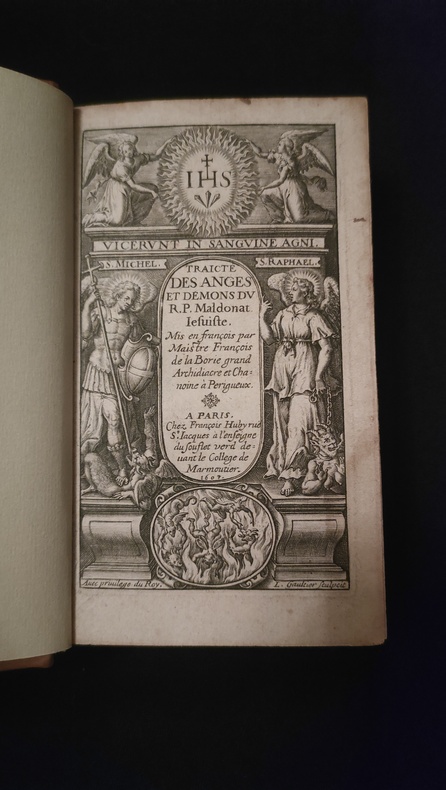
1607GEJ-7A Paris: chez Francois Huby, 1607. Book in French. In-12. Engreved title page in black, 7 sheets unnumbered and 242 numbered sheets. Later XIX c. full brown blind stamped calf. Gold lettering and ornamenting spine, red lables. Red paper edges. Clean ecrue endpapers. Nice ornameting and lettering, initial letters, some light browning and few water stains inside. Otherwise very clean without any anotations, marks or stamps. Complete. 2nd rare edition (First, 1605) of interesting and influential work on demonology and angelology. Very uncommon issue on the market. Rare in any edition. Tratise deals with the angels' names, their immortality, movement and the power by Spanish Jesuit theologian Juan de Maldonado (1533-1583). Juan Maldonado was a scholar and demonologist known for his profound knowledge of ancient languages. "Traicté des anges et demons" is a translation of some lectures of Maldonado, collected and translated by Canon Fr. Arnault de La Borie (1525?-1607) in 1605 and published in the same year in French. Bibliography: Coumont M:11.8., Wellcome I:3996., Not in Caillet (other ed. 7042), USTC No. 6024485. Provenance: No markings (?).
Volume in folio legato in pelle di porco impressa a secco su assi di legno ("alla cappuccina"), dorso rinforzato in pelle ab antiquo (mende e piccole mancanze ai piatti, segni di tarli), sguardie (motto a pennino "Assai ben balla a chi la Fortuna suona" e timbro d'estinta biblioteca straniera, presente anche sul frontespizio), frontespizio inciso in rame con cartiglio centrale ed 11 vignette che lo contornano tutte riferite all'Esodo, 10 carte, bianca, 276 pp., 8 carte d'indici, occhiello, 268 pp., 9 carte d'indici, bianca, occhiello, due carte, 250 pp., 6 carte d'indici. Che dire: forse l'opera più vasta, esauriente ed esaustiva sulle arti magiche ed esoteriche scritta da Del Rio e che ebbe subito un'eccezionale accoglienza. E quella presentata è forse l'edizione più bella e ricercata, preziosa e rara. La copia in catalogo ha i piccoli difetti citati alla legatura (peraltro accettabile, anzi) e presenta tracce puntiformi di tarlo (e questo è dovuto principalmente alla presenza delle tavolette di legno della legatura) che non causano mai fastidio alla lettura e passano quasi del tutto inosservate. Qualche raro quaderno brunito d'un tenue tabacco. Lo studioso della materia esoterica quanto il curioso ed il ricercatore troveranno nell'opera eccezionale interesse. In bello stato, raro esemplare
13464La philosophie Occulte.Divisée en trois livres et traduite du latin. Deux tomes en deux volumes in 8 (185x110mm) plein cuir fauve glacé d’époque, à nerfs, titre, roulette, tomaison, filets,caissons, palmettes dorés, roulette dorée sur les coupes. Tome premier : titre avec figure gravée, XX, 427 pages. Tome deuxième titre avec figure gravée, 317 pages, tranches rouges Nombreux tableaux et figures cabalistiques gravés, dans le texte et 12 planches gravées hors texte certaines dépliantes, nombreux bandeaux et fleurons gravés. Première édition de la traduction française par A.A Levasseur. A Lahaye chez R.Ch Alberts 1727. Très bon état. Fort rare. Caillet 95. « capital pour l’étude de la science occulte » DORBIN
1674GEJ-2Basel, Getrukt bey Johann Heinrich Meyer, 1674. In-8. Latin & German text. 1 volume complete itself. 1107 p. Colation complete. First edition of kind of warning against sorcery by the XVII c. Swiss Protestant pastor Bartholomäus Anhorn. Contains chapters on dreams, palmistry, duelling, witches, alchemy, and charming. Very rare book including an introductory eulogy by Johannes Tonjola. Internal condition: original gold ornamented brown calf binding. Rubbed, bumped, with minor defects on the spine with missing the closure ribbons. Title page and engraved title printed in black. Slightly browned due to paper, dampstained in places and few corners bent with XIX c. unknown bookplate on the endpaper. Red paper edges. Rare first edition. Bibliography: VD17 3:600284P. Graesse, BMP, 51. Goedeke III, 241, 22. Por. Faber du Faur 1265 and Jantz 378. Hayn-Gotendorf III, 172. USTC 6144407. Faber du Faur 1265: "Anhorn believed in devils and witchery, but advocated caution as regards such phenomena as the bleeding of corpses in the presence of their murderers, and thought that no one should be imprisoned and questioned under torture on such kind of evidence alone". Jantz 378: "A partially critical survey of occult phenomena and popular superstitions". Provenance: Unknown, probably XIX c. coat of arms bookplate on the first endpaper.
16772-0-32Leipzig, J. Ockel (in Sagan) für E. Fiebig, 1677. 8°, mit 1 Titel- und 1 Textholzschnitt, 216 S., Ppbd. d. Zt
1805303284-1Berlin u. Stettin, Nicolai 1789-1805. Mit 241 Kupferstichen auf 239 Tafeln (so komplett!). Pbde. d. Zt.
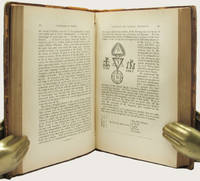
188634453London: George Redway 1886. Very Rare First Edition. Illustrated within the text with various symbols relating to magic and the genre. 8vo bound in early half-calf over marbled paper covered boards. xliii 1 349 1 pp. A rare survival the text-block quite clean and very well preserved the binding with evidence of use and age with rubbing to the extremities. VERY RARE AND THE TRUE FIRST EDITION VERY SELDOM ENCOUNTERED IN COMMERCE. Perhaps the first truly significant publication of Lévi's work in the English language. R. A. Gilbert tells that Waite was fascinated by the quotes from Lévi that he read in Blavatsky's "Isis Unveiled" 1877 and that Waite promptly acquired a copy of Lévi's major work "Dogme et Rituel de la Haute Magie" which he began translating into English. In 1885 Waite suggested to the prominent Theosophist A. P. Sinnett that an anthology of Lévi's writings based on these translations would make a good book. Sinnett evidently agreed and recommended him to the publisher George Redway who took on the project thus beginning what would turn out to be a lengthy collaboration with Waite. In addition to translating and editing Lévi's essays Waite contributed a Biographical and Critical Essay. Gilbert B1. Weiser <br> In the preface to The History of Magic Waite enumerates what he believed to be the nine key tenets of magic as codified in Levi's earlier work Doctrine and Ritual of Transcendental Magic.<br> They are: 1 There is a potent and real Magic popular exaggerations of which are actually below the truth. 2 There is a formidable secret which constitutes the fatal science of good and evil. 3 It confers on many powers apparently super-human. 4 It is the traditional science of the secrets of Nature which has been transmitted to us from the Magi. 5 Initiation therein gives empire over souls to the sage and full capacity for ruling human wills. 6. Arising apparently from this science there is one infallible indefectible and truly catholic religion which has always existed in the world but it is unadapted for the multitude. 7 For this reason there has come into being the exoteric religion of apologue parable fable and wonder-stories which is all that is possible for the profane : it has undergone various transformations and it is represented at this day by Latin Christianity under the obedience of Rome. 8 Its veils are valid in their symbolism and it may be called valid for the crowd but the doctrine of initiates is tantamount to a negation of any literal truth therein. 9 It is Magic alone which imparts true science. Levi<br> The three chief components of Levi's magical thesis were: Astral Light the Will and the Imagination. <br> "Eliphas Lévi" the name under which he published his books was his attempt to translate or transliterate his given names "Alphonse Louis" into Hebrew .In 1854 Lévi visited England where he met the novelist Edward Bulwer-Lytton who was interested in Rosicrucianism as a literary theme and was the president of a minor Rosicrucian order. With Bulwer-Lytton Lévi conceived the notion of writing a treatise on magic. This appeared in 1855 under the title Dogme et Rituel de la Haute Magie and was translated into English by Arthur Edward Waite as Transcendental Magic its Doctrine and Ritual . Its famous opening lines present the single essential theme of Occultism and gives some of the flavor of its atmosp:Lévi's version of magic became a great success especially after his death. That Spiritualism was popular on both sides of the Atlantic from the 1850s contributed to this success. His magical teachings were free from obvious fanaticisms even if they remained rather murky; he had nothing to sell and did not pretend to be the inititate of some ancient or fictitious secret society . He incorporated the Tarot cards into his magical system and as a result the Tarot has been an important part of the paraphernalia of Western magicians. He had a deep impact on the magic of the Hermetic Order of the Golden Dawn and later on the ex-Golden Dawn member Aleister Crowley . It was largely through the occultists inspired by him that Lévi is remembered as one of the key founders of the twentieth century revival of magic." wiki<br> Arthur Edward Waite was a scholarly mystic who wrote extensively on occult and esoteric matters and was the co-creator of the Rider-Waite Tarot deck. As his biographer R.A. Gilbert described him "Waite's name has survived because he was the first to attempt a systematic study of the history of western occultism — viewed as a spiritual tradition rather than as aspects of proto-science or as the pathology of religion." Waite was a prolific author with many of his works being well received in academic circles. He wrote occult texts on subjects including divination esotericism Rosicrucianism Freemasonry black and ceremonial magic Kabbalism and alchemy ; he also translated and reissued several important mystical and alchemical works. His works on the Holy Grail influenced by his friendship with Arthur Machen were particularly notable. wiki George Redway hardcover
1947D10934America 1947. Cloth-covered 3-ring binder American manufactured covers illustrated in black marker with drawings of top-hats an ace of spades an eight ball faces names and maxims "Flunk Early Avoid the Rush" "Here's Your Hat What's Your Hurry". The inside front cover bears our author's name "Budd Leader Sophomore 1st half" as well as a cloud of girls' names Joan Ginger Darlene Sally Betty Roberta et al perhaps referring to his lovely assistants -- women who put birds back in their cages who comforted newly hatless rabbits who were sawn in half or who otherwise gave themselves to magic. This distinctly American binder is bursting with 382 tricks handwritten in ink in tidy script on lined paper most of them accompanied by careful pencil drawings demonstrations of steps and techniques on small leaves of onion skin paper stapled to the trick they describe. Extremities bumped and cloth a bit frayed; boards warped see aforementioned "bursting" I wasn't joking with a few small spots of soiling. Top ring of binder doesn't close all the way ahem bursting so a few pages have come loose but could be easily reinforced if one were so inclined. Contents are bright and clean perfectly legible pleasing to behold and -- one assumes -- hitherto privileged information. <br/><br/>Includes tricks with cards rope dice balloons sleights of hand mind reading break-away cabinets and so much more. Though some of the illusions strike this cataloguer as enticingly practical "How to be Marvelous without Skill" "The Vanishing Alarm Clock" many of the illusions seem quite advanced and particular to the world of magic "Second Sight Extraordinary" "Mind Signals" "You Do As I Do". Though little can be found on Budd Leader now he was clearly a high school student of some talent and considerable dedication. A quintessential distinct volume. Remarkable. hardcover
1947D10934America 1947. Cloth-covered 3-ring binder American manufactured covers illustrated in black marker with drawings of top-hats an ace of spades an eight ball faces names and maxims "Flunk Early Avoid the Rush" "Here's Your Hat What's Your Hurry". The inside front cover bears our author's name "Budd Leader Sophomore 1st half" as well as a cloud of girls' names Joan Ginger Darlene Sally Betty Roberta et al perhaps referring to his lovely assistants -- women who put birds back in their cages who comforted newly hatless rabbits who were sawn in half or who otherwise gave themselves to magic. This distinctly American binder is bursting with 382 tricks handwritten in ink in tidy script on lined paper most of them accompanied by careful pencil drawings demonstrations of steps and techniques on small leaves of onion skin paper stapled to the trick they describe. Extremities bumped and cloth a bit frayed; boards warped see aforementioned "bursting" I wasn't joking with a few small spots of soiling. Top ring of binder doesn't close all the way ahem bursting so a few pages have come loose but could be easily reinforced if one were so inclined. Contents are bright and clean perfectly legible pleasing to behold and -- one assumes -- hitherto privileged information. <br/><br/>Includes tricks with cards rope dice balloons sleights of hand mind reading break-away cabinets and so much more. Though some of the illusions strike this cataloguer as enticingly practical "How to be Marvelous without Skill" "The Vanishing Alarm Clock" many of the illusions seem quite advanced and particular to the world of magic "Second Sight Extraordinary" "Mind Signals" "You Do As I Do". Though little can be found on Budd Leader now he was clearly a high school student of some talent and considerable dedication. A quintessential distinct volume. Remarkable. hardcover books
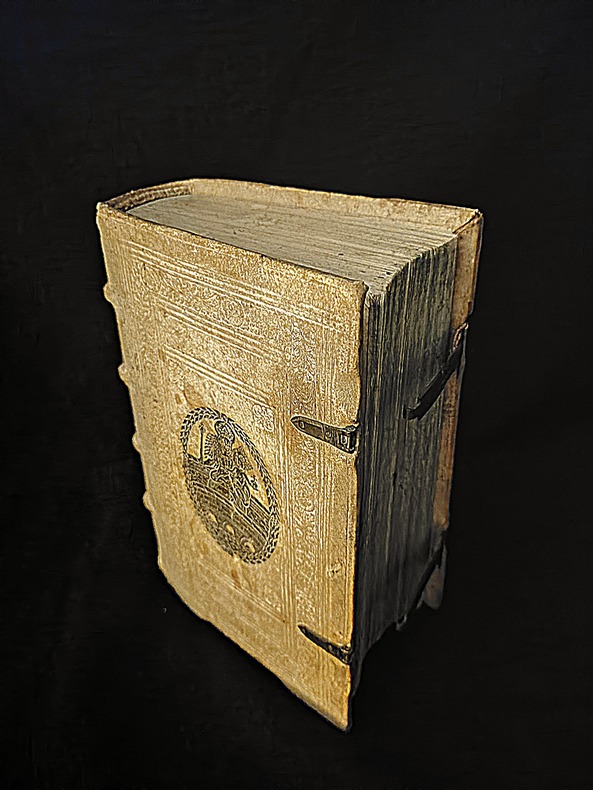
1581GEJ-8Ingolstadt, apud Davidem Sartorium, 1581. pp. [80] 542 p. Book in Latin. In-8. Beautifull ornamented white blind stamped calf. Additionally black engreved to front cover. Two original clasps. Fist and last blank leaf missing. Title page in black. 80 unnumbered and 542 numbered pages. Blue paper edges. Clean endpapers with small pencil annotation on the first back cover. Nice ornameting, wide margins and initial letters. Very clean and bright interior. Franziskaner Kloster Dettelbach stamp and hand-written anotations on the title page. Complete. Very good condition. 2nd rare edition (First, 1580) of interesting and influential work on heresy. Very uncommon issue on the market. Rare in any edition. "Hammer of Heretics" is a Catholic counter-reformation text by Georg Eder, published in Ingolstadt, that defends Catholicism against Protestant doctrines, particularly Lutheranism and Anabaptism. It is distinct from the 1487 Malleus Maleficarum (witch-hunting manual), focusing instead on combating heresy through theological argumentation. Eder was a lawyer and Catholic theologian (1523 - 1587), Imperial Court Councillor and advisor to Emperors Ferdinand I, Maximilian II, and Rudolf II. Best known for his theological polemical writings. "His oratorical and literary talent, the decidedly Catholic orientation from his Bavarian homeland, which deepened in Cologne and, in Vienna, where he immediately sought contact with the Jesuits, manifested itself in tireless activity, making Eder a champion of Catholicism struggling for its existence in Austria" (NDB IV, 311 f.). "Eder's writings from this period all deal with the question of church confession with regard to the differing and opposing positions of the Protestants" (ADB V, 318). Bibliography: USTC No. 674751, VD16 E 541, Stalla 1413, Adams E 64. Provenance: Franziskaner Kloster Dettelbach.
18563début du XXe siècle..
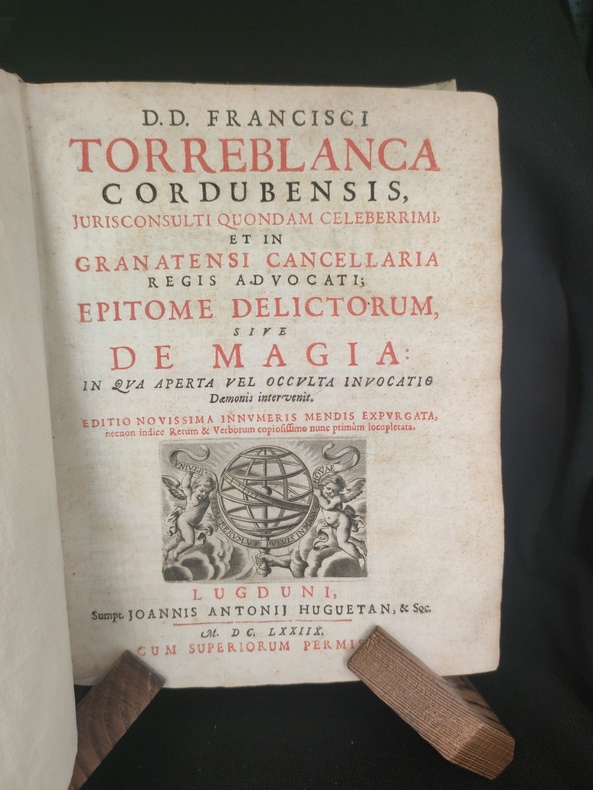
1678GEJ-9Lugduni (Lyon), sumpt. J. A. Huguetan, 1678. Book in Latin. In-4. Collation: [8], 576, [104]. Original full vellum, ink title on the spine. Title in red & black. Armorial bookplate of the Prince of Lichtenstein on the front pastedown. First and last blank endpapers intact. Some wear and soiling to vellum. Foxing. Overall Very good. Complete. 3rd edition of Summary of Crimes, or On Magic: In which open or hidden invocation of the demon intervenes, is a comprehensive legal guide on defining, identifying, and prosecuting acts of magic, witchcraft, and sorcery, heavily influenced by the Spanish Inquisition and demonological theory. The work categorizes different types of magic—distinguishing between "open" (explicit pacts) and "hidden" (implicit/superstitious) invocation of demons. It was a standard reference for canon law and criminal issues related to magic in the 17th century, including its use in Spanish and Portuguese colonial contexts. Book is devided into 4 parts + "Defensa". Pages 514-76 contain the author's "Defensa de los Libros Católicos de la Magia". Bibliography: Caillet 10764; Cornell Witchcraft Collection 53; Graesse (Magica) 53; Palau 334.827; Thorndike VII, 326-30; USTC No. 6080367; Coumont T.33.3; Goldsmith T-444; Crowe 551; OCLC: 11407716; Robbins 1026. "The work is divided into four books devoted to divining magic, operative magic, and its punishment in the forum exterior and juridical, and in the interior tribunal of the soul and confessional. Magic is defined after Proclus and Psellus as an exacter knowledge of secret things in which, by observing the course and influence of the stars and the sympathies and antipathies of particular things, they are applied to one another at the proper time and place and in the proper manner, so that marvels are worked. Torreblanca turns to diabolical magic and the extent of the powers of the devil to make it possible. Torreblanca has jumbled together natural and diabolical magic almost inextricably, but his remaining chapters are on witchcraft, with the two last on natural and divine remedies against it." (Thorndike VII, A History of Magic and Experimental Science). Provenance: Old Ex libris - (library ?) Lichtensteinianis (Armorial bookplate of the Prince of Lichtenstein?).