8 477 résultats
1888PUF, Paris, 1952, in-8 (250x160mm), VIII-277pp., broché (couverture légèrement défraîchie).
057936Paris ( Chez la Veuve Duchesne ) 1775 in 12 (17,5x10) 1 volume reliure pleine basane fauve de l'époque, dos à nerfs, pièce de titre de maroquin rouge, XXIV et 363 pages [1], la page de titre et les 8 premières pages de préface manquent (VIII), coins émoussés. Bon exemplaire de travail
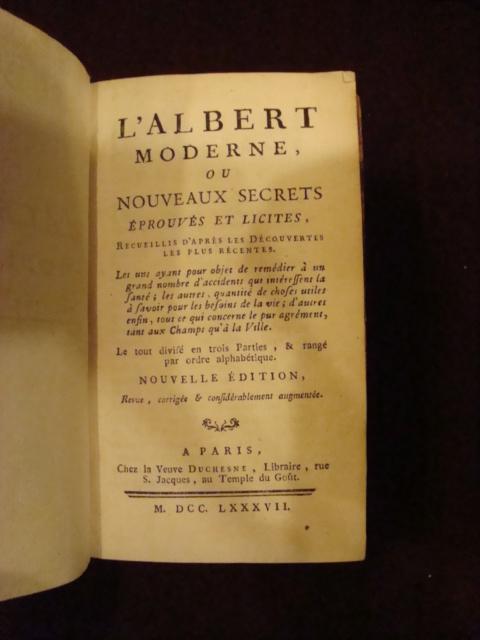
12246Ou nouveaux secrets éprouvés et licites recueillis d'après les découvertes les plus récentes .Paris ,Veuve Duchesne ,1787 .XII ,420 pp.
2017LFA-126747145N° 560 (Décembre 2017) : revue de 82 pages, format 215 x 285 mm, illustrée, brochée couverture couleurs, bon état
240538Paris, chez l'auteur, s.d. (1638) in-4, [2] ff. n. ch., 27 pp., en feuilles.
1983105825Paris, Musée National des Techniques 1983 In-8 22 x 15,5 cm. Broché, couverture ivoire, titre sur le dos et le premier plat illustré, 57 pp., illustrations dans le lexte, 92 notices, table des matières. Exemplaire en bon état.
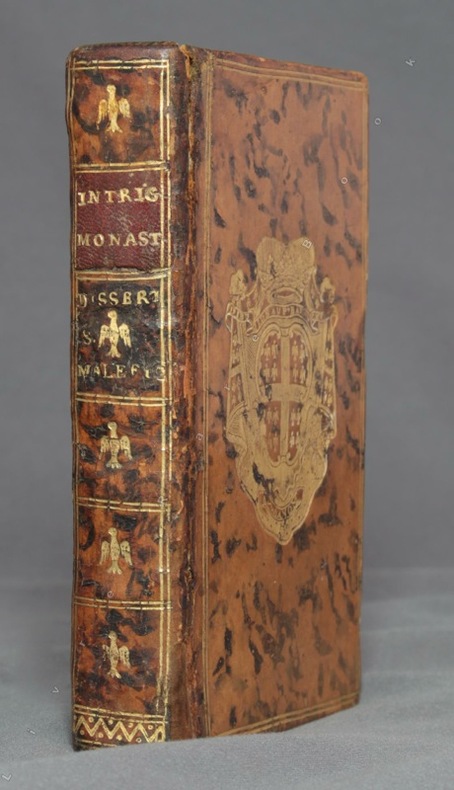
9367A La Haye [et] A Tourcoing, chez Jean van den Bergh [et] sans nom, 1739 [et] 1752. 2 tomes en un volume in-16 de [6]-256; de 2 à 102 pages (manque p. 3/4), plein veau marbré fauve, dos lisse orné de filets et 4 alérions dorés, double filet doré encadrant les plats, simple sur les coupes, armes d'Anne Léon (Ier) de Montmorency avec la devise: Dieu aide au premier baron chretien, ainsi que la devise grecque. Mors frottés et légèrement fendus, tampon rose répété deux fois sur chaque page de titre, restauration à la première, avec une cote de bibliothèque à l'encre bleue.
197999823Paris, Fernand Nathan 1979 In-8 24,5 x 17,5 cm. Cartonnage éditeur illustré en couleurs, 233 pp., dessins explicatifs de James Hodges, table des matières. Exemplaire en bon état.
181512528A Paris, chez Béchet, 1815. Petit in-8 de [4]-188; 208 pages, cartonnage avec vignette d'une société de lecture au dos et au premier plat. Non rogné.
167814608Lyon, Pierre André, 1678. In-4 de [40]-1108-[24] pages, pleine basane brune du temps, dos à nerfs orné de filets et fleurons dorés.
107579A Paris, chez Grégoire, libraire, rue du Coq-St-Honoré, n° 135, et chez Touvenin, libraire, quai des Augustins, n°44, An XI de la République (1803), 1 volume in-8 de 205x130x5 mm environ, 1f.blanc, iv-130 pages, 2ff.blancs, demi-basane vert foncé, titres dorés sur dos lisse. Cuir décoloré et frotté avec début de fente sur les mors, coins émoussés, mors interne fendu mais structure solide, manque de papier dans la marge d'une page, notes manuscrites anciennes sur la première garde, rares petites rousseurs et légers défauts de marge.
2009EYL-289Paris, Gallimard, Bibliothèque de La Pléiade, 2001-2003-2009. 3 vol. in 12 de LXXV-1918 p., XIII-1967 p. et XIII-1707 p. Cuir souple bleu de l’éditeur, dos lisses ornés de filets et titre dorés, rhodoïds, étuis blancs ornés d’une figure en couleurs.. + Album du Graal (2009), in 12 de 248 p. Cuir souple brun de l’éditeur, dos lisse orné de filets et titre dorés, rhodoïd, sous étui illustré en couleurs. L’ensemble à l’état neuf.
First edition, oblong 4to (196 x 242 mm), [10]pp., [8] leaves of plates, lithographed throughout, orig. pink lithographed paper wrappers stitched as issued. The posthumously published work of the Reverend Reginald Heber (1783-1826), the hand-written lithographic verse and gothic like illustrations tells the story of Lord Llewellyn who tries to summon up the Devil with disappointing results. Twyman, Early Lithographed Books, 1.116.
2003LFA-126741628N° 44 - Août 2003 : Revue culturelle sur la vie au Moyen Age : 100 pages, format 210 x 300 mm, illustrée, brochée couverture couleurs, bon état
Lausanne, Éditions Rencontre, 1961; in-4, 424 pp., reliure d'éditeur pleine toile noire, textes et illustrations estampés rouge et or, dos lisse, sous emboîtage. Nombreuses illustrations en noir et blanc. Très bon état.
159183N.p.: N.p. 1970. Substantial archive of material belonging to Austrian-American stage hypnotist and magician John Kolisch including two three-ring card binders with typescript and manuscript notes for Kolisch's live shows and 271 vintage photographs of Kolisch in performance. Archive appears to date from the 1950s through the 1970s the heyday of Kolisch's career. <br /> <br /> One binder holds notes and scripts for Kolisch's magic tricks powers of suggestion and general show patter and jokes while the other binder focuses primarily on feats of hypnosis. The binders hold a variety of material relating to Kolisch's performances a mix of more formal typed scripts for routines alongside manuscript draft notes and annotations noting potential "ad-libbed" interjections. Several pages capture Kolisch recording his ideas for changes to the pacing and setup of his shows as well as reminders about modernizing his patter and updating his celebrity references. <br /> <br /> Although the bulk of Kolisch's material is undated earlier acts appear to reference specific actors films or shows such as opera singers or the television show "Cavalcade of Stars" while later routines simply note the names of prominent contemporary actors and celebrities to insert at random. Kolisch who billed himself as "The Fastest Hypnotist in the World" apparently used a blend of serious hypnotism stage magic and standup comedy in his shows and accordingly an entire binder section labeled "Funny Lines" is devoted to ripostes and one-liners. These zingers cover every performance eventuality from hecklers "Have you ever been to the zoo I mean as a visitor" to a silent audience "Well they say a silent tribute is the sincerest of them all!". <br /> <br /> The archive's considerable collection of photographs captures the spirit and energy of Kolisch's live shows with audience members engaged in a number of humorous activities-stripping saluting yelling and singing dancing acting as human furniture kissing and hugging each other playing musical instruments such as maracas and the ukulele-or simply sleeping. Several photographs bear Kolisch's name and company address in Jackson Heights New York in the recto margins an address that also appears in Kolisch's company letterhead on many of his show notes. <br /> <br /> Included in the archive are 17 contact sheets capturing images from performances and portrait photographs of Kolisch. Also included are two gatherings of typescript and copied material related to Kolisch's lectures on "dynamic auto-conditioning" and "dynamic auto-suggestion" with many pages annotated by Kolisch in manuscript ink or pencil. Archive also features a 17-page bound treatise titled "Your Incredible Subconscious Mind" published in 1956 by the "Subconscious Research Institute" an organization possibly created by Kolisch himself.<br /> <br /> Photographs range in size with the majority measuring 10 x 8 inches. Near Fine to Very Good plus with occasional edgewear and creasing. <br /> <br /> Binders contact sheets lecture material and treatise Near Fine to Very Good plus with some light edgewear creasing and soil on binder exteriors. N.p. unknown
1904107232Paris, Ernest Flammarion, coll. « Auteurs célèbres » 1904 In-16 16,5 x 10,5 cm. Broché, couverture beige, titre en noir sur le dos et le premier plat illustré, 224 pp., table des matières. Couverture ternie, intérieur uniformément et légèrement jauni.
201207612Paris, VILO jeunesse, 2005 ; in-4, 29 pp., cartonnage de l'éditeur. Très bon état - organise ton spectacle de magie.
233545Paris, rue de Seine, 32, juillet 1848, 2 journaux in-folio, [2] ff. n. ch.
177764911Frankfurt-Leipzig, J. B. Mezler, 1777. 8°. Mit gest. Titelvignette, einigen Holzschn.-Vignetten u. einer Kupfertafel. 4 Bll., 226; 256 S., Ldr. d. Zt. m. reicher Rückenverg., goldgepr. Rückenschild u. dreiseitigem Rotschnitt.
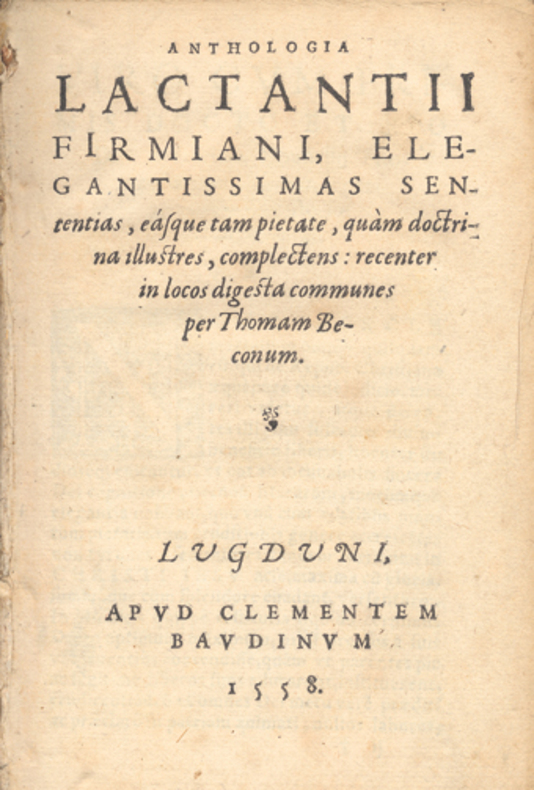
15581254Lyon, Clément Baudin, 1558, in-8 ; plein veau bordeaux foncé, dos à nerfs orné de fleurs de lys, double filet doré d'encadrement des plats avec quatre grandes fleurs de lys dorées en écoinçons, toutes tranches dorées (reliure du XVIIIe) ; (16) ff., le dernier blanc, 246 pp., (5) ff. dont 3 blancs.
188634453London: George Redway 1886. Very Rare First Edition. Illustrated within the text with various symbols relating to magic and the genre. 8vo bound in early half-calf over marbled paper covered boards. xliii 1 349 1 pp. A rare survival the text-block quite clean and very well preserved the binding with evidence of use and age with rubbing to the extremities. VERY RARE AND THE TRUE FIRST EDITION VERY SELDOM ENCOUNTERED IN COMMERCE. Perhaps the first truly significant publication of Lévi's work in the English language. R. A. Gilbert tells that Waite was fascinated by the quotes from Lévi that he read in Blavatsky's "Isis Unveiled" 1877 and that Waite promptly acquired a copy of Lévi's major work "Dogme et Rituel de la Haute Magie" which he began translating into English. In 1885 Waite suggested to the prominent Theosophist A. P. Sinnett that an anthology of Lévi's writings based on these translations would make a good book. Sinnett evidently agreed and recommended him to the publisher George Redway who took on the project thus beginning what would turn out to be a lengthy collaboration with Waite. In addition to translating and editing Lévi's essays Waite contributed a Biographical and Critical Essay. Gilbert B1. Weiser <br> In the preface to The History of Magic Waite enumerates what he believed to be the nine key tenets of magic as codified in Levi's earlier work Doctrine and Ritual of Transcendental Magic.<br> They are: 1 There is a potent and real Magic popular exaggerations of which are actually below the truth. 2 There is a formidable secret which constitutes the fatal science of good and evil. 3 It confers on many powers apparently super-human. 4 It is the traditional science of the secrets of Nature which has been transmitted to us from the Magi. 5 Initiation therein gives empire over souls to the sage and full capacity for ruling human wills. 6. Arising apparently from this science there is one infallible indefectible and truly catholic religion which has always existed in the world but it is unadapted for the multitude. 7 For this reason there has come into being the exoteric religion of apologue parable fable and wonder-stories which is all that is possible for the profane : it has undergone various transformations and it is represented at this day by Latin Christianity under the obedience of Rome. 8 Its veils are valid in their symbolism and it may be called valid for the crowd but the doctrine of initiates is tantamount to a negation of any literal truth therein. 9 It is Magic alone which imparts true science. Levi<br> The three chief components of Levi's magical thesis were: Astral Light the Will and the Imagination. <br> "Eliphas Lévi" the name under which he published his books was his attempt to translate or transliterate his given names "Alphonse Louis" into Hebrew .In 1854 Lévi visited England where he met the novelist Edward Bulwer-Lytton who was interested in Rosicrucianism as a literary theme and was the president of a minor Rosicrucian order. With Bulwer-Lytton Lévi conceived the notion of writing a treatise on magic. This appeared in 1855 under the title Dogme et Rituel de la Haute Magie and was translated into English by Arthur Edward Waite as Transcendental Magic its Doctrine and Ritual . Its famous opening lines present the single essential theme of Occultism and gives some of the flavor of its atmosp:Lévi's version of magic became a great success especially after his death. That Spiritualism was popular on both sides of the Atlantic from the 1850s contributed to this success. His magical teachings were free from obvious fanaticisms even if they remained rather murky; he had nothing to sell and did not pretend to be the inititate of some ancient or fictitious secret society . He incorporated the Tarot cards into his magical system and as a result the Tarot has been an important part of the paraphernalia of Western magicians. He had a deep impact on the magic of the Hermetic Order of the Golden Dawn and later on the ex-Golden Dawn member Aleister Crowley . It was largely through the occultists inspired by him that Lévi is remembered as one of the key founders of the twentieth century revival of magic." wiki<br> Arthur Edward Waite was a scholarly mystic who wrote extensively on occult and esoteric matters and was the co-creator of the Rider-Waite Tarot deck. As his biographer R.A. Gilbert described him "Waite's name has survived because he was the first to attempt a systematic study of the history of western occultism — viewed as a spiritual tradition rather than as aspects of proto-science or as the pathology of religion." Waite was a prolific author with many of his works being well received in academic circles. He wrote occult texts on subjects including divination esotericism Rosicrucianism Freemasonry black and ceremonial magic Kabbalism and alchemy ; he also translated and reissued several important mystical and alchemical works. His works on the Holy Grail influenced by his friendship with Arthur Machen were particularly notable. wiki George Redway hardcover
200399679Arles, Actes Sud 2003 In-4 28 x 22 cm. Broché, couverture à rabats, titre en blanc sur le dos et le premier plat, 128 pp.-XLVIII pp. de planches en noir et en couleur, [8] pp. de planches dont 8 repliées, sommaire. Exemplaire en très bon état.
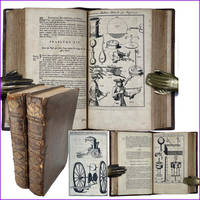
169628<p>the forerunner of mathematical recreations and its use in the art of illusionism and magic</p><p>an early manual for the first "mentalists"</p><p>Ozanam Jacques<strong>.</strong> <em>Recreations mathematiques et physiques VOL I. </em>Amsterdam: Gallet 1696.</p><p>Togheter with</p><p>Ozanam Jacques<strong>.</strong> <em>Recreations mathematiques et physiques VOL II. </em>Paris : Jombert 1696.</p><p>2 volumes in 8vo 188x120 mm contemporary calf with gilt decorations at spine pp. 16 265 1; 266-583 25 the last is blank. Engraved title-page.</p><p>Second edition of the forerunner of modern books on mathematical recreations including illusionism mentalism fireworks conjuring sundials and clocks.</p><p>84 engraved folding plates 45 first Vol. 39 second that support the solution of mathematical arithmetic geometric optical or cosmographic problems or that visualize the mechanism of a clock.</p><p>Scarce second edition 1st published in 1694 of the first work on recreational mathematics. This is one of the most popular books on the subject dealing among the other subjects with fireworks conjuring and presenting in vol. 2 a translation of Domenico Martinelli's treatise on clocks printed in Venice in 1663 p. 473</p><p>The volumes are divided into 9 topics</p><p>Vol 1: 1 Arithmetic 2 Geometry 3 Optics 4 Gnomonics and 5 Cosmography.</p><p>Vol 2 6 Mechanics 7 Pyrotechnics 8 Physics and 9 the translation Martinelli treatise on Watches.</p><p>For each topic Ozanam presents a series of problems with the various possible solutions described and often illustrated</p><p>Among the problems of mechanics Ozanam describes and illustrate a form of transport that foreshadows the automobile: behind the driver who holds reins in his hands stands a valet who activates with his feet two spring-loaded boards giving the carriage its impetus playing the role of a modern engine.</p><p>Most of the chapter about arithmetic is dedicated to the art of illusionism and mathematical games. A long chapter is dedicated to magic squares from pp. 36 on but many are the tricks described always in the form of a problem/solution which today are attributed to a kind of illusionism called <strong><em>mentalism</em></strong> a form of illusionism whose practitioners through techniques such as <em>cold reading</em> or <em>hot reading</em> give the illusion of being able to read others 'minds demonstrating supernatural or at least highly developed mental and intuitive ability.</p><p>In their performances mentalists give the impression of being able to exercise telepathy clairvoyance divination precognition psychokinesis mediumship mind control hypnosis prodigious memory and rapid mental calculation.</p><p>Among the games described in the text that can be accounted under this category we remember for example:</p><p>Problem XII: Thrown two dice how to guess the values on the top two sides without looking at them.</p><p>Problem XIV: Guessing a number that someone has chosen by asking him questions</p><p>Problem XVI: Guessing a number someone has chosen without asking them questions</p><p>problem XX: Guess how many coins a spectator hides in his hands</p><p>Problem XXVIII: Given three known playing cards and three spectators guess which card each one has chosen.</p><p>problem XXXI: Among different cards arranged on three decks how to guess which one the spectator has chosen</p><p>and many others.</p><p>Jacques Ozanam 1640 - 1718 was a French mathematician.</p><p>Although his father pushed him toward an ecclesiastical career he was much more attracted by science and mathematics that continued to study as a self-taught. At the age of 15 he was able to write a treatise on mathematics but his father induced him to enroll in courses in theology despite his little inclination for the priestly life. After four years of theological studies his father died and he returned to scientific studies.</p><p>In 1670 he published trigonometric and logarithmic tables more accurate than the existing Ulacq Pitiscus and Briggs works and numerous and well received mathematical publications.</p><p>In particular he had great success with <em>Dictionnaire mathématique</em> the five volumes of the <em>Cours de mathématiques</em> and <em>Récréations mathématiques et physiques </em>; his manuscript entitled <em>Les six livres de l'Arithmétique de Diophante augmentés et reduits à la spécieuse</em> received commendations from Leibnitz himself.</p><p><em>Récréations mathématiques et physiques</em> was also successful in the English translation and is still well known and looked after today.</p><p>He was elected a member of the <em>Académie Royale des Sciences</em> now <em>Académie des Sciences </em>in 1701. The death of his wife plunged him into deep sorrow and the loss of his foreign pupils through the War of the Spanish Succession reduced him to poverty.</p><p>Conditions: light marks of use at bindng in general very good condotions</p><p>Provenance: Paper ex-libris pasted at title page of both volumes " Engeg. Gio Battisa Carraca.</p>
193062288Manchester UK: Allied Newspapers Ltd. ca. 1930. 8vo. 192 pp. With text illustrations vignettes diagrams photo plates throughout. Black publisher’s cloth illustrated cover art of Gypsy Travellers Wagon front cover silver lettering front cover & spine foxing & minor toning throughout still G copy from the library of Elizabeth Pullen Belvin Jones 1908-1999 noted Florence South Carolina teacher worked for Southern School Supply Co. and was an intrepid world traveler between the Wars dated London August 1938. First edition of this how-to manual fortune telling and palmistry at parties and events featuring a laid-in stating “Pullen read fortunes at parties. Would read Palm lines “And you are a terrible flirt. Why You had to be to holding hand this long! Would bring the house down. Pullen Jan. 31 1994. Allied Newspapers Ltd., hardcover