Neale, Frederick ArthurAntiquariat.de

507 résultats
185450856London, James Madden, (1854). 8°. Mit 4 kolor. lithogr. Kostümtafeln. XVI, 365; 315 S., Blauer blind- u. goldgepr. OLwd.-Bd. m. dreiseitigem Goldschnitt.
1841290748London : J. Hatchard and Son 1841. First Edition. Hardcover. Poor copy in the original blind-boardered cloth; wear and tear as with age with some loss to the spine. Text remains in fine condition and without blemish. Includes previous owner's signature. Physical description; viii 191 pages. Subjects; Exiles Australia. Prisoners Transportation of Great Britain. Penal colonies Australia. Prisoners Australia. Penal transportation Great Britain. Reformatories for women Australia History. Women prisoners Australia History. Australia Exiles. London : J. Hatchard and Son hardcover
1846007828London: sold at the depository 77 Great Queen Street Lincoln's Inn Fields and 4 Royal Exchange: Society For Promoting Christian Knowledge 1846. 1st Edition . Hardcover. Very Good/Very Good. Folio - over 12 - 15" tall. WHIMPER J.W. or WHYMPER Josiah Wood. 1846. First edition in the publishers marked embossed brown cloth gilt titles. corners bumped. Carefully respined printed paper titles. Internally not paginated but title leaf followed by 30 leaves of Phenomena's depicted in numbered & hand coloured illustration with a descriptive text below blank to versos. 337276 mm. <br/> <br/> Society For Promoting Christian Knowledge hardcover
189471028Washington: United States Geological Survey 1894-1900. First edition of all seven folios. 21 2/4 x 18 1/2 inches each. Folio 3 Placerville. 3 maps. 1894. Folio 5 Sacramento. 2 maps. 1894. Folio 29 Nevada City Special. 9 maps. 1896. Folio 41 Sonora. 4 maps. 14x4" portion of rear wrapper torn off affecting lettering on inside rear wrapper; plates and text fine. 1897. Folio 51 Big Trees. 3 maps & 1 plate reproducing 5 photographs. 1898. Folio 63 Mother Lode District. 8 maps. 1900. Folio 66 Colfax. 3 maps. 1900. All in original printed wrappers and cloth spines. Cursive stamp of Chas. S. Sawyer to each volume. Bit of soiling ad corner wear but altogether a very good collection of this attractive group of atlases. United States Geological Survey hardcover
181198077Catskill NY: Printed by M. Croswell for John Shaw Book-seller and Book-binder 1811. 1811. Fair. RARE MACKAY CROSWELL CATSKILL NEW YORK IMPRINT - Octavo 6-10/16 inches high by 4-2/16 inches wide. Hardcover bound in original marbled paper covered boards backed with a tan calf spine titled "American Revolution" in gilt on the spine. The covers are heavily rubbed and chipped and the front cover is detached. Pages i-xii 1 and pages 14-264. There is evidence of early worming to the top front corner of the first 2 leaves. There is some scattered foxing and staining throughout with occasional pencil annotations. An internally good copy of this rare imprint. <p>RARE CATSKILL NEW YORK IMPRINT.<p>Although for many years attributed to the Reverend William Cooper see Howes C-761 modern scholarship has identified the author as being Richard Johnson 1733 or 1734-1793 He wrote the text for Elizabeth Newbery who published the first edition in 1789. M.J.P. Weedon "Richard Johnson and the Successors to John Newbery" The Library 1949 pp. 25-63. Richard Johnson also wrote an adaptation for children of several stories of the "Thousand and one nights" under the pseudonym Reverend J. Cooper. It appeared under the title "The Oriental moralist or the beauties of the Arabian nights entertainments" accompanied with suitable reflections adapted to each story in 1790.<p>Mackay Croswell 1765-1847 was an important early printer in the Hudson Valley who started the first Catskill New York newspaper "The Catskill Packet" in 1792. Together with his brother Thomas he opened a book and print shop in Catskill in 1790. Mackay was soon joined in the the business of journalism by his brother Harry Croswell. In 1800 the paper was renamed "The Western Constellation" in 1800 and was co-edited by Mackay and Harry. For a brief period the brothers mentored a well-known future journalist Thurlow Weed who worked in their print shop. Catskill, [NY]: Printed by M. Croswell, for John Shaw, Book-seller, and Book-binder, 1811. hardcover
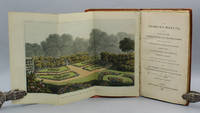
182717725<p>London: Henry Colburn 1827 Third edition enlarged of this gardening guidebook that was among the first of its kind written for women by a woman. The second and third editions are significantly expanded from the first edition 1816 which is about half as many pages and contains only two plates. Publisher's rose-colored boards. . Twelvemo. . With six hand-colored aquatint plates including large folding frontispiece 11 x 7 ". Expertly rebacked with printed paper spine label. Wear to corners. A very good unusually bright and wide copy. Maria Elizabetha Jacson 1755 – 1829 was a botanical writer and the daughter of a clergyman who owned land in Derbyshire and Cheshire. Her family had connections to Enlightenment culture in the midlands through Erasmus Darwin and her cousin Sir Brooke Boothby. She also knew Maria Edgeworth who described Jacson as a "gay garden lady" and was undoubtedly an influence on Jacson's work. Jackson took an interest in botany from a young age but did not publish her first book the children's educational volume Botanical Dialogues 1797 until she was in her forties. She later published Botanical Lectures 1804 and Sketches of the Physiology of Vegetable Life 1811 for an adult audience the former book being an introduction to the translation of Linnaeus's System of Vegetables 1783 by Erasmus Darwin. The Florist's Manual was her most popular and influential work.</p> Henry Colburn, hardcover
185183020London: John Van Voorst 1851. First edition. Hardcover. Very Good. 23 x 14.5 cm. Slim octavo. viii 74pp 2 ads. Small stamp on page vii. Complete with 6 lithographs of flies by Paul Jerrard of which 5 are vibrantly hand colored and one that is not in color of other tackle. Bound in original brown cloth. Spine is faded and head and tail of spine are chipped. ~ 8 cm closed tear to front free endpaper. With sections on salmon white trout trout pike grayling sea fly-fishing and lengthy appendix including a section on angling in America. Authorship is unattributed internally but various sources give either Mrs. Hutchinson or Richard Bowden-Smith as the author. Uncommon work. References: Heckscher 1075. Westwood & Satchell p 95. John Van Voorst hardcover
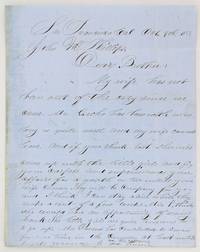
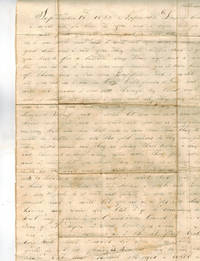
18522473San Francisco: October 4 1852. Very good. 2pp. with integral address leaf. Old folds mild staining and soiling three-inch closed tear to address leaf. An interesting letter documenting the family side of the California Gold Rush in which a San Francisco man writes to his brother offering to send his wife and daughters to Placerville as helpers. Interestingly at first Phillips addresses the letter to his brother in Ohio then scratches it out and writes in "Cal;" this most likely indicates the Phillipses hailed from Ohio and trekked to California along with scores of others in hopes of untold riches in the California gold fields. In his letter Phillips writes that his wife who has long been in San Francisco looking after a sick friend can now leave as he is better "And if you think best she will come up with the little girls and fix your carpets and superintend your affairs for a month or two untill your wife comes." The formerly sick friend Mr. Gardner could also accompany them apparently as "He is coming up to P. and he wants you to give him work for a short time. Mr. G. is a good sailsman sic having been in the dry goods business." While not overtly concerned with gold mining the correspondence is nevertheless interesting for providing details on family routines during the Gold Rush era when numerous families uprooted their lives and moved not only to places like San Francisco and Placerville but between such locations during the years of speculation. A nice example of history from below particularly notable for its domestic implications during the time of the great California Gold Rush. October 4 unknown
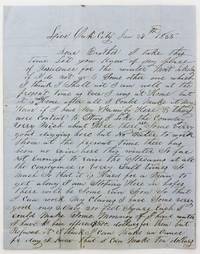
18555504Live Oak City Ca: January 27 1855. Still very good. 4pp. on a bifolium. Previously folded with manuscript docketing on lower half of second leaf verso. Minor wear along old folds with a couple of short separations. Minor soiling and dampstaining somewhat heavier to addressed area. A detailed mid-1850s California Gold Rush letter from Elias Hunt Jr. to his brother in the tiny of Poolville New York southeast of Hamilton. Hunt was camped in Live Oak north of Yuba City when he wrote this letter home on January 27th 1855. He tells his brother that he has good claims but that a lack of rain has not allowed him to work them:<br /> <br /> "It is hard for a man to get along. I am stopping here in hopes there will be some rain soon so that I can work my claims. I have some very good ones 2 only 200 feet square each. I could make some money if I had water. I have been offered $500 dollars for them but I refused it -- I think I can make an ounce per day; I know that I can make ten dollars for I have done that before."<br /> <br /> There is talk of irrigating the area but Hunt is not sure that it will be finished before he wants to return east:<br /> <br /> "There is a ditch coming in here to suply sic the place with water but it will not be completed until Spring some time in April & I should like to come home in June. I shall stay until there is water in the ditch then I can wash a part of my claims & sell the rest to a good advantage for they are situated immediately on the line of the ditch."<br /> <br /> Continuing upon his plans to return he writes:<br /> <br /> "I have had a very good offer to come home across the plains by a man in Sacramento. He is from Utica; his name is Hamilton. He is going to cross with four hundred Spanish horses or mares. He has offered me good money to come with him as I have been over to Carson Valley this last season. It will take some sixty days to do it if I should get through with my claims by the time time that he gets ready to start. I think I shall come with him if the Indians are not to hosstille sic. They were very bad this last season; they got possession of one of Uncle Sam's forts."<br /> <br /> Hunt continues writing about local hunting prospects and family in New York before delivering a Crockett-esque farewell -- "Please give my respects to all may inquire for me & let the rest go to Hell for all that I care." A good letter from one of the less trafficked areas of the California Gold Rush. January 27 unknown
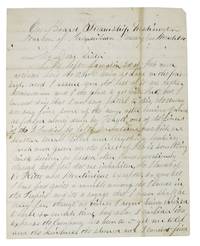
1851476391851. Now housed in an archival mylar sleeve. Age-toning especially along fold-line. Penmanship clear & easily read. Bifolium i.e. 4 pages of lined paper 23 lines per page ~ 10 words per line ~ 900 words. 9-3/4" x 7-5/8" <br/><br/>While no year is written on the ALs itself we posit 1851 as the Maritime Heritage website shows the only visit to San Francisco by the Washington was July 21 1851 arriving from Baltimore per a newspaper entry in the Daily Alta. That said per a online perpetual calender March 14th came on a Tuesday in 1852 not 1851. We lean towards 1851 as the actual year this letter was written. And this historic letter is replete with interesting content written by a man bound for the promised land of California. Chamberlin is from Boston writing a newsy letter his sister posted from the Harbor of Pernambuco Brazil March 14 where the ship in taking on supplies including coal. He describes the voyage thus far the expense of the company that sent him and the trip ahead around the Horn expecting to arrive in California in about 30 days. He describes conditions aboard the ship the places he has visited the people he has met in Brazil his own experiences with the heat and fever and more. Letters from this era are apprearing ever more infrequently on the market. unknown books
1848DEMO015918IGand / Ghent: Chez Ve Vander Schelden 1848. First Belgian edition. Hardcover. Very Good. Small octavo 589 pages contemporary full green sheep extra gilt aeg scuffed. Inked presentation in 1912 from Rev. Francis J. Harbe: Harbe died in 1913 at age 37 in San Antonio Texas. He may have acquired this when a seminarian at Belgium in 1900. <br/><br/>Howes D286; Graff 3826; Field 1425; Sabin 82266; Smith 9549; Strathern 511:iii. "This edition seems to have been prepared by the author himself. It contains more material than the edition in English "Oregon Missions" the illustrations are different and the three maps are entirely new - Sabin 82265." It has several additional letters and an Appendix pp. 360 - 378. "Origine des Americains." Contains Fr. De Smet's description of his travels through and about the central Columbia River Plateau . he continued . to the Fort Vancouver by way of Fort Colville -- Wagner-Cam-Becker 141.2." Contains 16 plates including the pictorial title-age and 3 folding maps. Chez Ve Vander Schelden hardcover
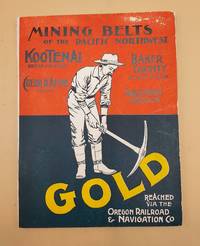
189763736Portland OR: Issued by the Passenger Department of the Oregon Railroad and Navigation Company 1897. First edition. Good. 68pp. With Map. Covers detached but present map still attached to rear wrap. There is a small abraded area in the top fore-edge corner of the title page. The map has a handful of small closed tears. Scarce. The map entitled "Oregon Railroad and Navigation Co. Map of Principal Mining Districts of the Pacific Northwest" has an inset of the "Baker City Mining Region."<br /> <br /> From the opening of the text-<br /> <br /> "What the typical easterner never read or heard or imagined of that vast and varied empire vaguely characterized as The West includes about all there is to be told or written of it. Half the world- a mighty hemisphere incomparable in grandeur incomputable in riches and illimitable in possibilities- lies west of all their geographies. Their maps are all too narrow their ideas all too small. 'Having eyes they see not and having ears they hear not; neither do they understand' that all the boundless productive powers and possibilities of the new-world republic lie in the matchless region which they in their arrogant ignorance stigmatize as 'the wild and wooly west.' Issued by the Passenger Department of the Oregon Railroad and Navigation Company unknown
1866WRCAM26697Washington 1866. 6pp. Folio. Disbound leaves. Minor chipping staining. Very good. One of the Fort Sully treaties. "These famous treaties were concluded at Fort Sully Dakota Territory by Newton Edmunds E.B. Taylor and Generals S.R. Curtis and H.H. Sibley. They stipulate a cessation of hostilities and depredations by the various bands and their withdrawal from the overland routes established or to be established through their country etc. Among the witnesses is Hezeiah L. Hosmer Chief Justice of Montana Territory" - Eberstadt. EBERSTADT INDIAN TREATIES 130. unknown books
1866WRCAM26696Washington 1866. 7pp. Folio. Dbd. Minor chips tears. Very good. One of the famous Sioux treaties of Fort Sully. "These famous treaties were concluded at Fort Sully Dakota Territory by Newton Edmunds E.B. Taylor and Generals S.R. Curtis and H.H. Sibley. They stipulate a cessation of hostilities and depredations by the various bands and their withdrawal from the overland routes established or to be established through their country etc. Among the witnesses is Hezekiah L. Hosmer Chief Justice of Montana Territory" - Eberstadt. EBERSTADT INDIAN TREATIES 130. unknown books
1828D2439Paris: Firmin Didot pour Lami Denozan 1828. First Edition. Hardcover. Very Good. 8vo 210 x 132mm. viii cxlvi 48pp. notes and glossary. Illustrated with hand-colored engraved title with marginal vignettes of female personifications and muses by Richard Parkes Bonington. Illustrated throughout with 10 half-page lithographs printed on chine-collé carefully hand-colored heightened in gilt and mounted; six are by Richard Parkes Bonington and four are by Henry Monnier and 15 decorative initials highlighted with colors inspired by ornaments found on the Books of Hours printed in the fifteenth and sixteenth centuries. 19th-century full red morocco decoratively tooled in gilt five raised bands gilt doublures marbled endpapers all edges gilt; lightly foxed throughout miniatures remain bright and fresh; spine slightly scuffed. Armorial bookplate of J. Austin Stevens Junior to front pastedown. First Edition of this rare and unusual book OCLC locates only four copies all in German libraries. Férdinand Langlé littérateur dramatist and occasional necromancer focused his literary interests on the nostalgic and the romantic. In 1828 he edited Les Contes du Gay-Sçavoir a witty collection of medieval ballads and fables. The text is printed in Gothic characters and illustrated to imitate the style of medieval manuscript illumination; it is followed by endnotes and a glossary printed in Roman type. The major illustrator of the work Richard Parkes Bonington was an English Romantic landscape painter who also worked in lithography. He was a close and admired friend of painters Eugene Delacroix and Antoine-Jean Gros. Gordon Ray speaking of Bonington says his importance in the development of lithography can hardly be overstated.His designs for Vues pittoresques de lEcosse and Contes des Gay-Sçavoir are by no means negligible. Boningtons career as a lithographer was short but splendid. - Art of the French illus. book pp. 173 & 176. Fine fresh and bright rare colored copy of this nostalgic work on the medieval period. Brunet III 819; Carteret III p. 172 livre tres rare; Curtis 54-60; Ray 114 <br/><br/> Firmin Didot pour Lami Denozan hardcover books
1827177815New York: Imprint whereof is at New-York 1827. VG few foxing spots but remarkably clean and tight. No evidence of page removal between pages xxx and xxv as mentioned in research. Original boards with cloth spines and remnants of affixed paper labels. Untrimmed uncut. Volume 1: irregular pagination. 2 blanks tp copyright iii iv-xx xxv-xvii blank 29 30-263. There is ample evidence of three sheets having been excised after pp. xviii and that a sheet numbered xix/xx has been inserted and glued after these three remnants. The text from page xx to the following page xxv appears to be continuous indicating a re-working of the text from the original printed sheets for pages xix-xxiv. An 1877 book auction catalogue lists this publication which was indicated to be 2 volumes as Very Scarce having been suppressed by the author. No auction or sales records found. A copy of part 2 was sold in 1904 as an odd volume as part of aa larger lot. A 1911 auction catalogue notes the following: "2 vols. 12° boards uncut. A caustic satire on New York's Four Hundred in 1827 which led to the prosecution of its author for libel and the mutilation of all copies of the work by the removal of pp. xxi.-xxiv. of A Short Proem its most vitriolic portion." It can be noted that the copy in the American Antiquarian Society lacks 3 sheets xix-xxiv. Their copy was printed in Boston and not New York. Shoemaker R.H. Checklist of American imprints for 1820-1829 29389<br /> Blanck J. Bibliography of American literature 11021<br /> Wright L.H. American fiction 1774-1850 2nd ed. 1510<br /> Hebrew Union College-Jewish Institute of Religion. Jewish Americana 76<br /> Singerman R. Judaica Americana 0448. Imprint whereof is at New-York hardcover
180229918Canterbury: Printed by W. Bristow for J. Badcock 1802. 1st edition Canterbury issue. Period brown half-sheep binding with marbled paper boards. Some rubs & general wear to binding. Period pos to ffep. A VG copy. vi 7 - 20 232 pp. Illustrated with 15 copperplate engravings 4 color and the 6th Fig 1 serving as frontis. 12mo signed in 6s. 6-3/4' x 3-7/8" <br/><br/> Printed by W. Bristow, for J. Badcock hardcover books
1895011295Paris Léon Chailley 1895 Demi-reliure Dédicacé par l'auteur
1855007164Sacramento California 1855. Two manuscript letters in ink both on ruled paper with folding creases the 1855 letter 8" x 12 1/2" with single spaced writing both sides approx. 500 words. The 1856 letter 15" x 10" folded in half to make 4 pp. approx. 300 words with small blindstamp top left corner depicting an eagle. The earlier letter is headed "September 18th 1855 Naperville Dupage County Illinois" and ends "Michael direct your letters Nevada County Nevada post office California". George writes to his brother Michael in Naperville that he has "seen a good dele sins i rote you they last letter" including a hundred "inshins" and some "Buffellow". He adds that "we had good luck all they way of may we left Council Bluff" and that he is not home sick yet. He then talks of the gold mines river mining what they are paying and the cost of things such as board "from five to ten dollars a week" "Beaf" "wors 15 to 20 cents" and "potato" "4 cent per pound". He adds that he intends to have some gold before he comes home and that "girls are not so plenty here as they are in state". He closes by asking his brother to write him and to remain at home in Illinois to care for their parents. The 1856 letter headed Sacramento august 3th 1856 informs his brother that he is well and "down to Sacramento now" working on a farm feeding a "schrasing" thrashing machine and that "they times is verry hard in California now". He adds that he had some money "stole" while he was in the mountains but since coming down into the valley he was making money and will send some home soon. The letter ends with George wishing to see them all soon and that he is not home sick. The third page of the letter bears a drawing of a wing or leaf eleven smaller versions of the same image interspersed on page 2. A fascinating testimonial on California during the gold rush written in a strong hand and in a wonderful vernacular style by a good observer. . HOLOGRAPH LETTER SIGNED. Manuscript. Very Good. books
1850DEMO014460IPhiladelphia: Printed by C. Sherman 1850. Popular Edition. Hardcover. Good. 64 excellent steel-plate engravings with 12 of 13 maps Samoa map apparently never inserted many vignettes and woodcuts. Octavos half brown calf blue marbled boards edges and endpapers; vol. 1 rebacked retaining original back and leather labels scuffing and wear to other spines corners worn. <br/><br/>Wilkes' expedition was the first American scientific exploring expedition by sea voyage. His six ships sailed south around South America along Antarctica causing Wilkes to decide that Antarctica was indeed a separate continent. Other stops were at the Pacific islands of Tahiti the Samoas Australia and New Zealand. Maps of Tahiti & Australia and New South Wales Along the way they charted the coasts of California Washington and Oregon. Howes W414; Palau 375505; Sabin 103994 note; see Cowan p.683; Taylor PACIFIC BIBLIOGRAPHY p.13. "Wilkes' spectacular Antarctic and South Sea explorations - Goetzmann ARMY EXPLORATION IN THE . WEST p.61" 64 excellent steel-plate engravings many vignettes and woodcuts. Unlike the 1844 edition the following Sherman editions did not have a 6th volume - the Atlas but have 3 Tables and 11 maps Printed by C. Sherman hardcover
185942532London: John Henry and James Parker 1859. First edition. 4to. xii 243 1 pp. Contemporary brown half morocco over plum cloth sides spine with raised bands gilt lettered direct to two panels marbled endpapers early armorial bookplate to the front pastedown another early ownership inscription to the front flyleaf with a further more recent one underneath top edge gilt. 73 plates plus 43 woodcuts in the text. Very good. London: John Henry and James Parker unknown
1893010081Paris Alphonse Lemerre 1893 Demi-reliure
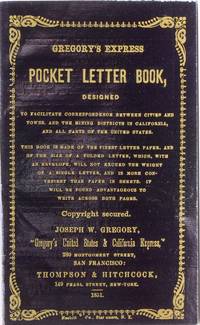
1851320912San Francisco: Joseph W. Gregory 1851. 20 blank leaves. 24mo. Original dark purple wrappers printed in gilt. Minor ink stains on inner wrappers otherwise a near fine copy with the original unused plain paper envelope. 20 blank leaves. 24mo. A lovely example of an unused Gold Rush letter book intended to advertise Joseph Gregory's California and New York Express Line by means of a convenient way for gold seekers in California to communicate with friends and family back home. According to the wrapper "this book is made of the finest letter paper and of the size of a folded letter which with an envelope will not exceed the weight of a single letter and is more convenient than paper in sheets Joseph W. Gregory unknown
1851320912San Francisco: Joseph W. Gregory 1851. 20 blank leaves. 24mo. Original dark purple wrappers printed in gilt. Minor ink stains on inner wrappers otherwise a near fine copy with the original unused plain paper envelope. 20 blank leaves. 24mo. A lovely example of an unused Gold Rush letter book intended to advertise Joseph Gregory's California and New York Express Line by means of a convenient way for gold seekers in California to communicate with friends and family back home. According to the wrapper "this book is made of the finest letter paper and of the size of a folded letter which with an envelope will not exceed the weight of a single letter and is more convenient than paper in sheets." Gregory also published a pamphlet GREGORY'S GUIDE FOR CALIFORNIA TRAVELLERS; VIA THE ISTHMUS OF PANAMA 1850. This is a scarce California Gold Rush ephemeron. Joseph W. Gregory unknown books
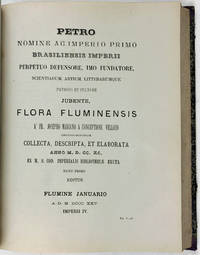
188145183Flumine Januario / Rio de Janeiro: Typ. Economica 1881. First complete edition. Half black morocco over marbled boards gilt spine title. A very good copy boards rubbed repaired tear and closed tear on Volume V half title and title page. xii vii 467 1 pp. 4to. Published in and taking up the entire volume of Archivos do Museu Nacional do Rio De Janeiro. Volume V. 1880 1881. Added title page: Petro nomine ac imperio primo Brasiliensis imperii perpetuo defensore . jubente Flora fluminensis a' fr. Josepho Mariano a Conceptione Vellozo Ordinis monorum collecta descripta et elaborata anno M.D. CC. XC. Ex M.S. cod. Imperialis bibliothecæ eruta nunc primo etitur. Flumine Januario A.D.M. DCCC. XXV imperii IV. José Xavier Veloso 1742-1811 born in what is now Minas Gerais Brazil was ordained in 1766 in the convent of St. Anthony in Rio de Janeiro where he studied philosophy and theology later geometry in San Paulo and finally natural history. He collected plants animals and minerals in the Rio de Janeiro area from 1783 to 1790 at which time he moved to Lisbon where he worked at the Royal Academy of Sciences while preparing Florae Fluminensis his greatest work for publication. Using the Linnaeus' system of sexual classification of plants he prepared very highly detailed texts and 1700 prints many of them of new species. But the publication of the work was beset by problems. First sent to Venice the plates were never completed. Later the French invasion of the Iberian peninsular sent the Portuguese government then Veloso and his manuscripts into exile in Brazil where he died in 1811. In 1825 an abbreviated version of the text was published followed by the eleven volumes of the Icones in 1827 of which few copies survive. The complete text was not published until this edition in 1881. Bound with and proceeded by Archivos do Museu Nacional do Rio De Janeiro. Volume IV. 1879. Rio 1881. viii 151 1 pp vii plates. Folded color plate split at fold. Volume subtitle: Insectologia. Includes Müller Fritz: A metamorphose de um insecto diptero among other works. Rodrigues 2473. Sabin 98833n. For the shorter version of 1825 see: Barba de Moraes II p. 343. Pritzel 468. Jackson 377. Innocencio V.5 4258; V.13 p.122. Also see Nissen BBI 2046. Typ. Economica hardcover books