63 résultats
15556824Padova: Gratioso Perchacino 1555. Original edition. Very Good. Quarto 20 cm; 12 leaves signed a-c4 last leaf blank. Printer's device a crowned salamander ensconced in flames on title page. Woodcut initial at start of text. Bound in recent half morocco over marbled boards. Trimmed close to top edge. Gutters guarded. Some spotting on title page but generally clean. <br /> <br />Reference: EDIT 16 CNCE 57958; For attribution to Lando see Silvana Seidel Menchi Chi fu Ortensio Lando "Rivista storica italiana" #106 1994 501-564. Not in Grendler. <br /><br />This is an essay about death. In particular it is a eulogy on the death of young Elizabetta Dotta who it is stated in the text died recently married at the age of 16 years 8 months 24 days and 12 hours. The cause of her death is not given. It does not indulge in a moment's sorrow over the young woman's early demise. Instead it is an extended encomium of death itself praising death as liberation from the essential misery of life in this corrupt and depraved world. As such it is an eloquent statement of philosophical pessimism the tradition which views life as the soul's exile as suffering and sees death as a preferable alternative. While the text is not signed the author is presumed to be Ortensio Lando the uncomfortable peripatetic humanist who never stayed in one place for very long either physically or philosophically. "What is life" Lando asks. "Smoke a dream a running shadow a ship that leaves no trace an arrow shot to its destination. Gratioso Perchacino hardcover
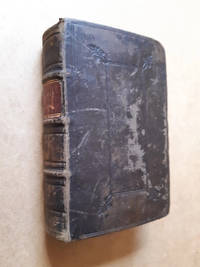
1581#BIBLIO-1187<p>Ioan. Ravisii Textoris Nivernen: dialogi aliqvot festiuissimi studiosæ iuuentuti cum primis vtiles: Item eivsdem epigrammata non pavca vt dictissima ita & lepidissima. Omniarecens diligenter recognita & emendata</p><p><em>John Ravisius or Johannes Ravisius Textor or Jean Tixier de Revisi the writer of Nivernen Nivernais: dialogues somewhat festive studious and very useful: also epigrams not very plain as very eloquent and very delightful. All recently diligently revised and amended.</em> Londini London: Ex officina H. Bynnemani Typographi Anno Domini. 1581. Hardback greyish-brown leather binding probably 18th or more likely 19th century with maroon title label gilt-blocked title and raised bands to spine. Blind-stamped design to boards and spine. Octavo/8vo collation but small measures around 3 1/8" x 4 7/8" x 1 1/4" circa 400-500 pages see below for explanation of unusual pagination and collation</p><p>Scuffing and wear to binding some discolouration but reasonably clean. Bumping and a little tearing to corners and to head of spine. Otherwise binding firm. A little cracking to title label but intact with some discolouration. Deckled page edges which are very browned scuffed and otherwise marked. small bookseller label to front pastedown. Some marking a little staining and foxing around pastedowns and endpapers. Toning staining a little light foxing and other marking throughout. Some creasing dog-eared corners and the odd tear with loss to a few leaves including to title leaf which is missing a few characters of text at bottom left-hand corner and is quite fragile and only attached at top. Heavy ink staining to several leaves towards end of book. Occasional underlining marginalia and a little text scored out in several latter pages.</p><p>Very unusual and defective page numbering. Firstly the numbering is of each leaf not each page and the print is a little unclear for some figures. It appears to run after the initial three blank endpapers and preliminary pages that could presumably be numbered i - vi being the tile page to end of 'epistole' from leaf 1 - 20 13 or 18 25 23 - 25 iB 27 blank 20 - 35 6 64 - 72 74 74 repeating 76 76 repeating - 92. However the leaves do not appear to be pages out of order nor duplications and the pages do all seem to be in correct sequence so it appears to be a printing fault rather than a binding one. The order of the page collation is more accurate sequentially though even then there are a few oddities running after the first three blank endpapers on the basis of numbers denoted on leaves as i-v then vi-viii blank from A i - F viii then G ii G G iv G iii blank G v - T viii no use of U V no use of W X - Z viii Aa i - Ff ii Gg ii-Gg iii Ff iv Gg ii Gg iv Gg iii Gg v - Ii v with blank leaves Ii vi-vii removed and three blank endpapers. See pictures for further information. About the author: <em>John Ravisius or Johannes Ravisius Textor or Jean Tixier de Revisi</em><em> c. 1470–1542 was a French Renaissance humanist scholar and professor of rhetoric. He was born in Ravisi which is near the commune of Saint-Saulge in the central province of Nivernais. His works which are mostly on the topic of education were widely accepted and employed by French academia. Tixier eventually adopted the Latinised name Johannes Textor Ravisius Nivernensis. Per the epitaph on his headstone Tixier was born in 1470 and died on 3 December 1542. According to Victor Gueneau other scholars pretend that he died on 13 December 1524 and that his brother Jacques completed Jean's book l'Origine de l'imprimerie "The Origin of Printing". Similarly some authors report his year of birth to be approximately 1480. Tixier studied humanities at the College of Navarre. When he graduated he accepted a position in the college's rhetoric department; there he impressed faculty and students alike. In 1520 he accepted a position as rector of the University of Paris. He held the position until 1525 succeeded by William Manderstown. More than thirty editions of his principal work Officina were published as he continued to expand it. Source: Wiki</em></p> H. Bynnemani Typographi hardcover