Hammer-Purgstall, Joseph vonAntiquariat.de

424 résultats
183666509Pesth, C. A. Hartleben?s Verlag, 1834-1836. 8°. Mit 8 gefalt. Kupferstichkarten u. einem großen, mehrf. gefalt. Kupferstichplan von Konstantinopel. Zus. ca. 3.600 S., HLdr.-Bde. d. Zt. a. 4 Bünden m. Rückenverg., je 2 goldgepr. Rückenschildern u. Farbschnitt.
18990001206WASHINGTON DC LEIPZIG LEIPSIC. Very Good. 1899. On offer is the original 1899 manuscript diary handwritten by Rebecca P. Warner known by one and all as Bess or Bessie who was 26 at the time. Bess the oldest of 9 children offers the reader a unique view of how a prominent wealthy Washington DC family the lived at the end of the 19th century but even more important is the very intimate interesting view of Germany during one of the country's most fascinating eras of historical development pror to World War I. Bess' father was Brainard Warner Sr. who was a lawyer but made his fortune in banking real estate and land development. His company was responsible for the oversight or building of over 1000 buildings and homes in the Washington DC area. Bess's mother was Mary Jacobs Parker Warner who was descended from Edward Doty a Pilgrim and indentured servant who sailed over on the Mayflower signed the Mayflower Compact and helped to settle Plymouth Colony. This diary describes Bess' trip with her sister Anna and brother Brainard Jr. to Leipzig Germany where Brainard Jr. was the US Consul. Bess does a super job of detailing setting up house in Leipzig and also about their daily lives there. They also did a lot of traveling within Germany and she describes that as well. Research notes that the Warner family endured a lot of sadness. They lost three children at birth or very early in life. They lost their mother Mary Jacobs after the birth of Lucy who then died. They lost their son and brother Southard who committed suicide at age 33 by shooting himself while stationed as a consul in China. Then Brainard Warner Sr died two years after the death of Southard. Here are some snippets and observations from a casual reading: They went to the motette at St Thomas Kirche which was very beautiful. The church was crowded. Students belonging to a club were there. They stayed after the service and thought they might see a German wedding. They have them nearly every Saturday after motette. They got caught in the middle of a religious service. They were sitting right in front of the minister and Bess was afraid they'd get called up to do something In the evening Mrs Young telephoned to ask them over. Brainard had an engagement but Bess and Anne went. They left Leipzig for Chemnitz and went directly to the consulate where they had supper. They went with Mr Monaghan to Schellenburg where his family was summering. "This was a queer little town located on the top of a mountain" There is a beautiful castle and some old walls. Aside from that Bess thought it was an uninteresting place to spend a summer. They left on Monday. They went to a parade in honor of the King of Saxony. About 5000 men were received. They expected to see the King on horseback but he was on foot with other officers. They met Professor Gregory who showed them around some parts of the University. In the afternoon Brainard Anne and Bess called on Mrs Monroe. Brainard went out in the evening with friends. "Today is the Emperor's birthday and all the flags are out. We stood for a long time to watch the Lieut General review the officers. It was a fine sight. what little we could see though the crowd But we were nearly frozen it was so cold" Bess practiced and then went for a lesson with Herr Krause only he wasn't in. She went again at 4 pm. "He was very discouraging and said I had no independence of fingers" Bess thought it would take her several lessons to get the right finger position and that there was no royal road to piano playing. "Hard work is the only road to success in anything". She went home. They had letters from Mamma and Pa. Then they went over to hear the St Thomas Kircke choir practice such beautiful voices. They had a number of people who stopped by for visits." We actually had a count call on us Graf Laisher who was very bright and interesting. He is studying medicine at the University" He said he couldn't speak English but he was very fluent. He proceeded to show them some of his feats of exercise and they were petrified because of their rented furniture. But everything was whole when he left. In the evening Bess and Anne went to the home of Mrs Morris. They danced but it was more of a lesson for the young grandson. He fancied Bess as a teacher and so they whirled around in a circle for 2 hours. Bess wrote that dancing on the ship over was "nothing compared to my feelings after dancing in the mad German fashion" Bess Anne and Lucy went to the Catholic Church which the royal family attended. "I must say I was thoroughly disappointed in royalty as exhibited here. The king queen and two other members of the family sat in boxes on a level with the gallery of the church and just to the left of the altar. Princess Matilda is one of the coarsest people I have ever seen. She spent most of her time yawning. She must weigh at least 200 lbs. We only stayed while the King and Queen were there." The diary has approximately 141 pages of entries from January 1 1899 to August 2 1899 with some gaps in this 4" x 6 ½" diary. Overall G.; English; 12mo - over 6¾" - 7¾" tall; MAYFLOWER GENDER STUDIES TRAVEL PRE WORLD WAR I BRAINARD WARNER DOTY WOMEN'S STUDIES GERMAN ROYALTY DEUTSCHLAND ANTI SEMITISM GERMANY AUTOGRAPH HANDWRITTEN MANUSCRIPT Gründerzeit Emperor William II antiquité contrat vélin document manuscrit papier Antike Brief Pergament Dokument Manuskript Papier oggetto d'antiquariato atto velina documento manoscritto carta antigüedad hecho vitela documento Manuscrito HANDWRITTEN MANUSCRIPT DOCUMENT LETTER AUTOGRAPH DIARY JOURNAL LOG KEEPSAKE WRITER HAND WRITTEN DOCUMENTS SIGNED LETTERS MANUSCRIPTS HISTORICAL HOLOGRAPH WRITERS DIARIES JOURNALS LOGS AUTOGRAPHS PERSONAL MEMOIR MEMORIAL PERSONAL HISTORY . unknown
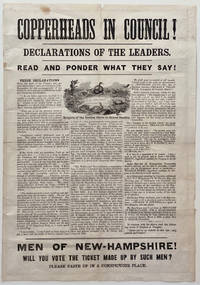
1863List1004New Hampshire: Printer Unknown 1863. First Edition. Printed broadside 16 ½ x 11 ½ inches archivally mounted and matted. A very good copy with some light toning small closed tear at upper margin light foxing at upper margin very tiny spot of loss to illustration at fold. Franklin Pierce remained politically active upon his return to New Hampshire following his presidency advocating for the Democratic cause and generally opposing the Civil War and Lincoln’s policies. This scarce pro-Union anti-slavery broadside printed for the 1863 New Hampshire elections which happened March 12 takes aim at Pierce and his fellow Democrats repeating the unfounded claim first made in 1862 by William Seward that Pierce belonged to the secret Knights of the Golden Circle the secret society formed with the goal of forming a new territory out of the CSA Mexico Central America and the Caribbean. There was never evidence that Pierce had any involvement in the KGC though the society had members in southern parts of some Union states such as Indiana Ohio Illinois and Missouri.<br /> <br /> The broadside printed for the March 12 elections quotes heavily from Pierce as well as the other Democrat candidates and party officials who were either running for office in New Hampshire or involved in politics a group which included Ira Eastman John Goerge Josiah Minot Thomas Treadwell Daniel Marcy William Burns and George Stevens. The broadside includes an engraving of coiled snakes each with these politicians named and the caption “et id omne genus.†Eastman the Democratic candidate for governor won the popular vote but lacked the constitutional majority necessary for election. Marcy was successful in his bid for the First District. “Men of New Hampshire!†the broadside asks: “Will you Vote the Ticket Made up by Such Men†with the final line imploring to “Please paste up in a Conspicuous Place.†<br /> <br /> Overall an uncommon survival from the 1863 elections. A very good copy with some light toning small closed tear at upper magin light foxing at upper margin very tiny spot of loss to illustration at fold. Quite scarce with OCLC locating two copies only at the Huntington Library and the New York Historical Society. Printer Unknown unknown
1863List1004New Hampshire: Printer Unknown 1863. First Edition. Printed broadside 16 ½ x 11 ½ inches archivally mounted and matted. A very good copy with some light toning small closed tear at upper margin light foxing at upper margin very tiny spot of loss to illustration at fold. Franklin Pierce remained politically active upon his return to New Hampshire following his presidency advocating for the Democratic cause and generally opposing the Civil War and Lincoln's policies. This scarce pro-Union anti-slavery broadside printed for the 1863 New Hampshire elections which happened March 12 takes aim at Pierce and his fellow Democrats repeating the unfounded claim first made in 1862 by William Seward that Pierce belonged to the secret Knights of the Golden Circle the secret society formed with the goal of forming a new territory out of the CSA Mexico Central America and the Caribbean. There was never evidence that Pierce had any involvement in the KGC though the society had members in southern parts of some Union states such as Indiana Ohio Illinois and Missouri.<br /> <br /> The broadside printed for the March 12 elections quotes heavily from Pierce as well as the other Democrat candidates and party officials who were either running for office in New Hampshire or involved in politics a group which included Ira Eastman John Goerge Josiah Minot Thomas Treadwell Daniel Marcy William Burns and George Stevens. The broadside includes an engraving of coiled snakes each with these politicians named and the caption "et id omne genus." Eastman the Democratic candidate for governor won the popular vote but lacked the constitutional majority necessary for election. Marcy was successful in his bid for the First District. "Men of New Hampshire!" the broadside asks: "Will you Vote the Ticket Made up by Such Men" with the final line imploring to "Please paste up in a Conspicuous Place." <br /> <br /> Overall an uncommon survival from the 1863 elections. A very good copy with some light toning small closed tear at upper magin light foxing at upper margin very tiny spot of loss to illustration at fold. Quite scarce with OCLC locating two copies only at the Huntington Library and the New York Historical Society. Printer Unknown unknown books
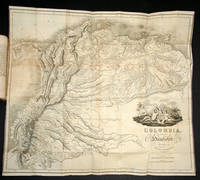
1824WRCAM35060ALondon: G. Cowie 1824. xvi208pp. plus folding map. 20th-century tan buckram spine gilt with a wax seal presumably covering a library call number. Bookplate removed from front pastedown. Light scattered foxing. A good solid copy. Published anonymously but attributed by the British Museum to John Hankshaw while THE ECONOMIC LITERATURE OF LATIN AMERICA Palau and OCLC assign authorship to Francis Hall. This record of a journey was published according to the anonymous author due to the desire "so universally felt in Great Britain of information as to the actual condition of the Republic of Colombia. The more that rich and beautiful country becomes known the greater will be the interest excited towards it among all Europeans. So extensive a field for the exercise of European industry and intelligence has not for ages presented itself." <br> <br> A travel journal composed in the form of letters the author describes the landscape the inhabitants the climate and soil natural resources commodities government and the possibilities for commerce. The highly detailed map of Greater Colombia is "taken from Humboldt and various other recent authorities." ALBERICH 1336. NAYLOR 85. SABIN 14598. PALAU 112082. G. Cowie hardcover books
18670001244SS ALEPPO EUROPE MT. VESUVIUS ITALY. Good. 1867. Full-Leather. On offer is an original manuscript travel diary of a young woman who travels from America to Ireland on the S.S. Aleppo and then spends time in London and Paris before going to Italy. Stating "Bought at Dublin 12 Nov. 1867" then a later hand in pencil on the fep suggests the names of Julia L. Hale or Julia de Rubignir. Entries range from 1867 to 1868 and our diarist does a great job describing the journey from America to Ireland on the ship as well as all the places she visits. The passages of her witnessing the eruption of Mount Vesuvius and their attempt to be 'tourists' of the lava flow while in Italy are great. She adds further dimension by drawing a lovely folk art picture of the volcano in action. She also sees the Prince and Princess of Italy shortly after their marriage. Here are some snippets: We first caught sight of Vesuvius an hour and a half or two hours before we reached Naples it was then quite light and we could just see a silvery white cloud hanging over it but it became brighter and showed the fire as the day grew darker and we drew nearer. The first night at Naples we went to the Hotel Washington. I shall never forget the scene as we drove up to the door there was Vesuvius black as night except where the volcanic fires rose and fell while above the mountain a cloud hung even darker but a little on the right the full moon was just rising at first we could not see it but only its effects in the silver edges of the clouds and a lovely silver light which seemed to float up from a cloud then gradually it rose into sight flooding the whole city with light gleaming on the water in strange contrast to the reflection of the Red lights on the volcano. We could scarcely tear ourselves away from the windows that night and were very sorry to leave the Hotel the next morning but there was an odor which could not be explained away so we walked away We went ashore and went to the ruin of the temple of Jupiter we went to the amphitheatre which is believe the most perfect one in the world we killed quite a large snake which was nearly at the very top then all the others except John and I went to Solfatara which is a mountain called the back door of Vesuvius. First we went to Vesuvius and drove up as far as we could then walked about two mils till we came to the lave which was thrown up or down or both as Mary wrote. It looks something like as if very thick black or brownish mush had been boiling furiously and suddenly congealed or like a storm raging at sea. We only went about half way up but it was not considered safe to go farther but we could see the mountain perfectly of course and had a good idea of the lava. Here another accident happened while we were in the tunnels there was so much smoke and steam that the engineer was poisoned by it and first fainted and then had convulsions very badly but they fanned them with branches and after an hour or two he was well enough to go on. We then went to San Lazzaro an island about a mile and a half from Venus there is a learned and celebrated Armenian convent there the monks are all so handsome and look so intelligent we had such a lovely monk to go around with us he was very small but quite handsome he had large bright black eyes and such a merry pleasant expression he had curly black hair and wore spectacles and was very restless indeed we could scarcely glance at a thing before he would say No we will go. The most interesting things we saw were the autographs of Byron his portrait which was very handsome and the room which he occupied for three months while studying the Armenian language. Thursday morning the Prince and Princess and attendants came into town about half past ten there was a rope drawn across the grand canal just above the depot and none but private gondolas were allowed to go inside of it and our gondola was just outside and when the rope was taken away the jam was so great that no one could move scarcely the men shouted agua agua and there was the greatest hubbub and confusion and I really never saw anything so exciting in my life. Many of the hired gondolas go way ahead of the private ones ours was next but one to the prince's just before they landed so we could see them splendidly. The gondola or rather barge was finely ornamented there were a great many rowers the boys took off their hats and bowed the prince did the same to them he looked very tired and dusty he had a melancholy look as usual but we all liked him. The princess looked very pretty as usual she was dressed in a very handsome suit of dove colored silk. There were also several ladies of honor and two celebrated generals one has the highest position in the army or rather the command of the army I believe." Included is a CDV of Will Morgan who is talked about throughout the diary and was traveling with her although their connection is not fully explained in a casual reading. The spine is gone for the most part but otherwise overall G.; English; 12mo - over 6¾" - 7¾" tall; VOLCANO ERUPTIONS VESUVIUS ITALY TRAVEL EUROPE GENDER STUDIES WOMEN'S STUDIES antiquité contrat vélin document manuscrit papier Antike Brief Pergament Dokument Manuskript Papier oggetto d'antiquariato atto velina documento manoscritto carta antigüedad hecho vitela documento Manuscrito HANDWRITTEN MANUSCRIPT DOCUMENT LETTER AUTOGRAPH DIARY JOURNAL LOG KEEPSAKE WRITER HAND WRITTEN DOCUMENTS SIGNED LETTERS MANUSCRIPTS HISTORICAL HOLOGRAPH WRITERS DIARIES JOURNALS LOGS AUTOGRAPHS PERSONAL MEMOIR MEMORIAL PERSONAL HISTORY Monte Vesuvio Mons Vesuvius Pompeii Herculaneum. . hardcover
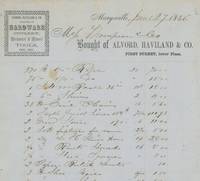
1860List2417Marysville 1860. Marysville 1850s-1860s the bulk mid-1850s. A collection of documents including eleven receipts three manuscript legal documents four manuscript documents relating to land claims; five partially printed documents relating to land claims; two letters from the US Land Office in Marysville 1858 regarding land claims; six billheads from Marysville firms with receipts for a range of goods some illustrated; one letter from Marysville written in 1853 concerning a death in a family. Generally fine condition. Fine. A mini-archive or assemblage of documents relating to the early Euro-American citizens of Marysville and its environs in the 1850s. The population of Marysville grew quickly after the town’s incorporation to 10000 by the mid-1850s due to its strategic location close to the gold fields but the levee system put in place to control flood damage limited the town’s growth beyond this initial phase. The documents here relate to Marysville in this early period of growth and include several quitclaim land deeds as well as illustrated billheads. As a group they offer an ephemeral record of the city in its early period with the legal documents and deeds showing the means with which the area was settled. A well preserved group overall. unknown
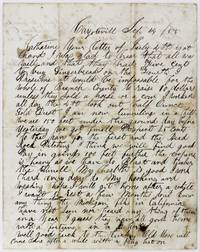
18553206Coyoteville: September 12 1855. Very good. 2pp. plus integral blank. Original mailing folds moderate toning staining and ink spotting but still easily readable. Bottom fourth of integral blank excised. An informative Gold Rush letter about mining in the long-vanished ghost town of Coyoteville which was an extraordinarily rich gold area for a couple of years in the early 1850s. A noted tunneling method nicknamed "coyoteing" was developed in the town and subsequently inspired the name of the town. In the present letter Moses Pine writes to "Catherine" in Branch County Michigan and signs his name simply as "Mose Esq" at the conclusion. The author informs Catherine presumably his wife or sister of his activities some of the economic realities and some of the practical details of prospecting for gold in California. Presuming that "it would be impossible for the whole of Branch County to raise $10 unless they sell a horse" Pine comments that he had ginger bread on the Fourth of July after working all day and yielding a "half Ounce Gold Dust." He then provides a detailed description of his mining: "I am now tunneling in a hill. We are 150 feet under the ground. Day before yesterday we got small respect 25 cents to the pan for the first and the bed rock pitching. I think we will find good pay in the going 100 feet further the expense is heavy as we have to blast and timber the tunnel." Pine also talks of his health and that "I work hard every day do my cooking and baking." He then expresses his hope to get back to Michigan to "rest a few months" but knows nothing of other Michigan folks in California: "Have not seen nor heard anything of them in a year. I guess they have all gone home with a fortune in a horn. Well good luck to the lucky. Old Mose will come home after a while with a pretty hat on." A nicely-detailed letter from an unusual and obscure Gold Rush location. September 12 unknown
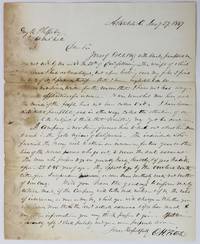
18492389Ashtabula Oh: January 29 1849. About very good. 1pp. on a bifolium. Previously folded. Light dampstaining and short closed tears along gutter somewhat affecting first few lines of text but not overall sense. An interesting letter from O.H. Field an aspirational field representative of the Connecticut Mutual Life Insurance Company in Ashtabula Ohio to the company secretary George R. Phelps inquiring about a policy for a group of men headed to the Gold Rush in California in January 1849. Connecticut Mutual was founded in Hartford three years prior to the composition of this letter in 1846. Fitch's missive begins with a report on his efforts to drum up interest in life insurance in his area with pamphlets and other materials sent to him by Phelps: <br /> <br /> "Yours of Oct 1 1849 with blanks pamphlets &c was not received by me until the 25th of Dec. following. I have not had any definitive applications for insurance. It was somewhat new here and the minds of the people had not been called to it. I have however distributed pamphlets and in other ways called the attention of our citizens to the subject. I think that something yet might be done.<br /> <br /> The letter goes on to describe a potential policy for a group soon leaving for the Gold Rush and requests a favorable rate in order to stimulate interest in policies from additional parties: <br /> <br /> "A company is now being formed to head out about ten men to work in the gold regions of California. The individuals who furnish the money wish to obtain an insurance for two years on the lives of the several persons who go out to secure the amount advanced. The men who propose to go are generally hardy healthy & of good habits & from 25 to 45 years of age. They expect to go by the overland route either from Independence Missouri or some more southerly route not south of Vera Cruz. Will you have the goodness to inform me by return mail if the company will take such risks -- & if so the rates of insurance as near as may be which you will charge -- whether you will insure more than the amt. actually advanced & if so how much & any other information you may think proper to give. If I receive a favorably sic reply I shall probably send you more proposals soon."<br /> <br /> A neat letter concerning the preparations and considerations necessary for a journey to California in the early days of the Gold Rush and the role and rise of early American insurance companies in the planning of such lengthy and dangerous overland travel. January 29 unknown
188461664Cleveland OH: S. Brainard's Sons 1884. Second edition. 4to. 11 pp. Long introduction on the verso of the title page the music with printed notes indicating stages of the battle. Thomas "Blind Tom" Wiggins Bethune 1849-1908 an African-American autistic savant and musical prodigy was born a slave on a plantation in Harris County Georgia near Columbus and began his musical career at an early age on his master's piano. At eight Tom was hired out to a promoter who toured him extensively in the United States earning prodigious sums of money; his former master took him to Europe in 1866 for a successful tour there. A series of custodial battles and other problems essentially ended Blind Tom's career in the mid-1890s. "In the wave of euphoria after Manassas Tom turned his hypersensitive ear into the music of the big-mouthed guns. He then framed these sounds with the South's triumphant version of events before composing what many believed was his masterpiece . Tom's impressionistic musical description of the battle pits the harmony of the right hand against the discord of the left. An insistent bass conjures the trudge of marching columns tonal clusters evoke the roar of cannon and musketry. A brooding soundscape then ducks weaves and punches its way into a medley of popular and patriotic songs . discord tugging at the heels of melody until it finally explodes into the chaos of a harem-scarem finale" from Deidre O'Connell's "The Ballad of Blind Tom Slave Pianist America's Lost Genius". The first edition of "The Battle of Manassas" was published in 1866 by Root & Cady in Chicago; this second edition including a catalogue of other war related pieces of sheet music available from the publisher was issued by Brainard's in 1884. Both editions are uncommon in institutional holdings and in trade. Not in Dichter & Shapiro Levy or Wolf. OCLC locates 9 copies of the first edition and 8 for the one offered here Yale Columbus State Allen County Public Detroit Public Michigan Virginia SE Illinois Library of Virginia; it's unclear how many of those still retain the color illustrated front wrapper but at least two include it. Spine with tape repairs several marginal tears to interior leaves one leaf with tape repairs not extending into text old tidelines in upper margin of several leaves not extending into text lower front wrapper chipped a good copy of a scarce printing of Blind Tom's masterpiece. Original chromolithographic wrappers illustrated with a Civil War battle scene by Goes & Quensel Lith. Chicago. 8686. <br/><br/> S. Brainard's Sons unknown books
1897WRCAM43100Circle City Alaska and on a steamer between Juneau and Seattle 1897. 12pp. typed on folio sheets of onion-skin paper plus three hand-drawn maps. A total of some 6750 words. Stapled at upper edge. Three horizontal folds. Near fine. A very interesting pair of typed letters from a young man in Alaska during the Klondike Gold Rush. The anonymous author wrote these two letters to his parents describing his journey overland and by water to the Birch Creek mining district his experiences mining for gold and his decision to go into business as a merchant. The letters are written in a detailed style that indicates an educated author. They include three manuscript sketches showing the routes traversed in Alaska and provide a great deal of information about the writer's experiences in the Klondike. These letters are typed but they were likely originally handwritten by the author who later typed them and included his manuscripts maps and sketch in order to send them to his family when he arrived in Seattle or San Francisco. <br> <br> The letter dated Nov. 10 begins with a description of the writer's boat journey from Juneau to Dyea which was a popular disembarkation point for the Chilkoot Trail to Dawson City a center of the gold rush. He arrived at Dyea on April 23 and notes that "dinner at the Dyea post was the last square meal I have had up to the present date November 10." After dinner he loaded his equipment on horses for the journey inland: <br> <br> "My outfit consisted of about 1000 lbs. of provisions guns amunition sic tools for boat building a whip-saw jack-plane cross- cut saw hand saw rip saw hatchet hammer draw knife brace and bits square etc. and clothing blankets tent sheet-iron stone and in fact I think I had about every thing that ever went down the Yukon. Altogether my outfit weighed about 1302 pounds which is much more than is usually taken into the interior." <br> <br> The author spent the next several days transporting his provisions between Dyea and Lake Linderman and he includes in his letter a sketch of the route from Dyea through the valley to the lake noting several camps along the way as well as a sketch of his sled. <br> <br> The second letter dated Feb. 17 1897 was written on board the steamer Al Ki between Juneau and Seattle. He continues the narrative of his trip inland explaining that he arrived at Lake Linderman on May 14. A month later on June 14 the author and a partner their canoe loaded with provisions departed for Circle City which they reached on June 29. There they stored most of their provisions and headed for the mines in the Birch Creek region. Mining was at its height in the middle of the summer but rather than seek out a claim on their own the author and his companion Jim Wishard decided to work for other miners earning some $10 a day. He describes working at mining from 7 p.m. until 6 a.m. the long days making the task of working at night possible. In August the author bought a claim in the Harrison Creek region but decided to forego mining in favor of establishing himself as a merchant: <br> <br> "From what I could see the miners are poorly supplied with food by the two companies and there is always a great demand for luxuries; that is something out of the ordinary and even the necessaries of life. I made up my mind last summer that I could do as well bringing in some food - in other words being something of a merchant - as in any other way to start and having a good knowledge of the country and keeping my eyes open I would undoubtedly have many good chances for speculation. It is a conceded fact that one cannot lose money taking in such an outfit. Everything brings in an average profit of 400 per cent. over the original cost and whatever any one has to sell in the 'grub' line is in demand." <br> <br> The author then describes his construction of a small cabin in Circle City and his decision soon afterward to leave Alaska for the winter. He describes the trip to Dyea undertaken in January and the hardships of winter overland travel in Alaska. Included are some very practical tips: <br> <br> "In crossing water when it is thirty or forty degrees below zero one should dip his moccasins into the water very quickly taking them out before the moccasin is wet through. They will then freeze in a mass on your feet and will serve the same purpose as rubber boots. You can then walk right through water though I would not advise any one to tempt Providence too much." <br> <br> The letter concludes with a description of a recently discovered gold strike called "Bonanza" not far from the Forty Mile camp. The author describes the high hopes around the strike and includes a manuscript map of the region indicating the location of a claim in which he himself has invested. He hopes that his mine will bring him some wealth but reiterates his belief that the way to wealth in the Yukon Gold Rush is by supplying miners with goods and that he is on his way to Seattle and San Francisco to buy provisions to resell. hardcover books
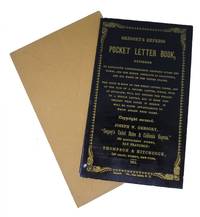
185148314San Francisco / New York: "Gregory's United States & California Express" 280 Montgomery Street / Thompson & Hitchcock 149 Pearl Street 1851. Shiny dark blue paper covers with gilt stamped lettering stapled. Buff paper mailing envelope. Wrapper insides: front instructions for use; rear 2 estimonials dated 1851 from the Panama Star newspaper. Unused Nr Fine with an envelope in similar condition. Unpaginated blank pages. 4-3/4" x 2-7/8" <br/><br/>From the inside of the front cover: "Gregory's California Express. This line one of the oldest established in the business dispatch messengers BY EVERY STEAMER leaving New-York and San Francisco in charge of Letters Parcels Packages Gold Dust and valuables for distribution throughout the United States and California. If possible letters should be directed to the care of mercantile houses or well-known residents in San Francisco or other parts of California by which means their earlier delivery may be insured. Letters directed simply to 'California' or 'at the mines' will not be forwarded as little probability exists of their reacing the persons so vaguely addressed." From the rear cover: "The Central Office of this Express is located in the throughly fire-proof building corner of Montgomery and Merchant Streets San Francisco from which the proprietor Daily dispatches Expresses by steamboat to all parts of the Mines and to Portland Oregon and Honolulu Sandwich Islands on the arrival of ecah steamer with packages from the States." A rare Gold Rush survivor documenting the 'letter & dispatch' business of the era. "Gregory's United States & California Express," 280 Montgomery Street / Thompson & Hitchcock, 149 Pearl St unknown books
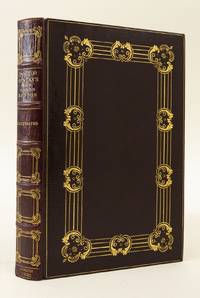
1820ST15905London: J. Johnston 1820. FIRST EDITION IN BOOK FORM. 233 x 143 mm. 9 1/8 x 5 7/8". iv 2 319 pp. <br/> Attractive contemporary purple straight-grain morocco covers with gilt frame in the Romantic style raised bands spine compartments framed in gilt with drawer-handle cornerpieces gilt titling gilt-ruled turn-ins with drawer-handle ornaments at corners green watered silk endleaves all edges gilt. With engraved title page featuring hand-colored vignette and 19 HAND-COLORED ENGRAVED PLATES. Front flyleaf with bookplate of Harald Pedersen and verso of front free endpaper with bibliographical notes in pencil. Abbey "Life" 265; Tooley 434. ◆Spine sunned to maroon bottom corners a bit rubbed frontispiece cropped close at foot with much of the imprint trimmed away otherwise quite a fine copy--the plates in excellent impressions and pleasantly colored without the typical offsetting from these kinds of illustrations and the binding lustrous and with scarcely any wear.<br/> <br/> With charming illustrations by one or more of the 19th century's leading caricaturists this work is an imitation of the popular "Tour" books of Doctor Syntax featuring a pedantic clergyman and schoolmaster meeting with an onslaught of amusing misfortunes in the course of his wanderings. The original "Tour" published in 1812 was conceived of as a parody of the books of picturesque travels then enjoying a considerable vogue and when it met with a great popular response itself two more tours followed in 1820 and 1821. Even this could not sate the public and a number of imitations of the Syntax books including the present work were issued. There is some disagreement as to whether Thomas Rowlandson 1756-1827 or Isaac Robert Cruikshank 1789-1856 created the illustrations here; as Tooley notes "Both Rowlandson and I. R. Cruikshank are credited with the designs for the plates the balance of opinion favoring Cruikshank but according to the advertisement . . . more than one artist was employed or at least a different engraver to the artist." Either way the amusing illustrations of the follies and faux-pas of the good Doctor Syntax do not disappoint. Aside from being in pleasing condition our copy also stands out for its particularly attractive contemporary binding. J. Johnston unknown
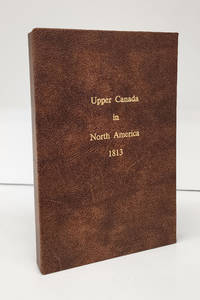
1813157227London: W. Faden Geographer To His Majesty and To His Royal Highness The Prince Regent 1813. Second Edition. Hardcover. Good. 125 p. 23 cm book in leatherette box. Chart pp. 4-10. One fold-out distance table. Book has brown cloth spine with grey paper boards the latter looking like original publisher's wraps. Worn extremities. Small tear in paper on front board. Front free endpaper loosening. Ink signature on title. <br/><br/>Second edition first was 1799 of the earliest published topographical description of the young province of Upper Canada prepared by its first surveyor-general. Smith 1764-1837 originally came to Upper Canada in 1793 serving as a quartermaster in a British regiment stationed at Niagara. That same year he was appointed to the position of surveyor-general by Gov.-Gen. Simcoe. Advertisement following the title states that the notes and gazetteer were drawn up at Simcoe's request to illustrate a separately issued map of the colony. This second edition was revised corrected and updated by Lt.-Gov. Francis Gore to accompany a new map compiled in the surveyor-general's office and published under his direction. Casey I 983. Lande 2208 with map. Morgan p. 353. Sabin 85205. TPL 736. W. Faden, Geographer To His Majesty, and To His Royal Highness The Prince Regent hardcover
1832465994London : John Murray ; Parbury Allen & Co 1832. First Edition. Hardcover. Near fine text bound in good waxed green cloth with a contemporary paper spine label now age-toned. Covers and label scuffed with faint damp-stains to the margins. Endbands rubbed with the lower spine showing a tight crosswise tear and joint split with the the tail lifting; corners bumped. Preliminary and final leaves somewhat foxed with the interior very clean on the whole. Text remains tight with pages unread and unopened. A well-preserved example overall. Notes; Engraved subscriber's page for J. F. Davis Esq. F.R.S. bound in before title page somewhat foxed. Series; Oriental translation fund of Great Britain and Ireland. Physical description; ix 465 pages : table. Notes; ""Volume I."" No more published. Revised from the translation of Haji Mustefa and collated with the Persian original by John Briggs. Subjects; Muslims. India. History. 18th century. Mughal Empire. British India. London : John Murray ; Parbury, Allen, & Co hardcover
181012097Haarlem, Joh. Enschede en Zoonen, 1810. 12° (15-18,5 cm). 184 num Bll., 412, 491 SS. Samteinband der Zeit mit Ganzkopfgoldschnitt und Schließen aus Echtgold
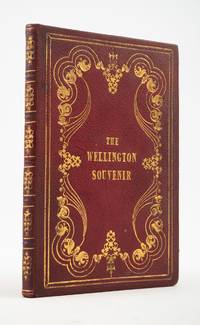
1852ST20768London: Simpkin & Marshall 1852. FIRST EDITION. 153 x 102 mm. 6 x 4". 64 pp. <br/> Publisher's deluxe red pebble-grain morocco gilt covers with graceful Romantic-style frame central panel of upper cover with gilt lettering that of lower cover with gilt ornament spine blind-stamped to resemble raised bands panels with gilt ornament gilt turn-ins pale yellow endpapers all edges gilt. With title page vignette frontispiece portrait of Wellington and three full-page engravings of battles. Printed entirely in gilt on "enamel" gloss paper. Front free endpaper with faint pencilled signature. Binding very slightly soiled joints and extremities a little rubbed trivial soiling to front endpapers otherwise quite a fine copy the text entirely clean fresh and bright with sparkling gold.<br/> <br/> This now-scarce luxuriously produced little volume celebrates the life and military achievements of Arthur Wellesley Field Marshall and 1st Duke of Wellington perhaps the most widely admired Briton of the 19th century--and does so in glittering fashion. The key facts of Wellington's life and the decisive battles of his storied career are related here in sparkling gold text and images on alabaster white pages. Poet laureate Tennyson's funerary ode described Wellington 1769-1852 as "the last great Englishman" and his death evoked great mourning in response to his life of public service. DNB notes that his defeat of Napoleon at Waterloo crushing the emperor's ambition for European dominance put him in a class of his own: "No man certainly no Briton had ever been in such a situation before in Europe the object of universal hero-worship and gratitude." Wellington was particularly notable among senior military officers for his determination to lead his troops on the frontline in battle. The three battles depicted in the illustrations here attest to this: in "The Battle of Assaye" we see him on horseback two horses were shot from under him during the conflict wielding his sword as he bears down on enemy cannon. At the "Battle of Vittoria" he is shown leading the infantry to face the enemy with bayonet fixed. And in the decisive "Battle of Waterloo" scene he is once again with the cavalry wheeling to attack the advancing French. The frontispiece shows Wellington astride his famed horse Copenhagen who was his mount at Waterloo. Our volume concludes with a chronology of principal events in the duke's life. It is notable that such a handsome memorial work was produced so quickly after Wellington's sudden death on 14 September 1852: a contemporary ad in Bent's Literary Advertiser notes our title was published on 15 November three days before Wellington's state funeral on the 18th. Copies of this work are rare: we could trace no auction sales and OCLC records only seven copies just one in North America. Simpkin & Marshall unknown
1828321057London: J. Taylor 1828. Engraved title and 55 plates on thick wove paper. Uncut. 8vo. Early calf rebacked. Minor dampstaining. Engraved title and 55 plates on thick wove paper. Uncut. 8vo. Includes designs for gates garden seats alcoves temples baths entrance gates lodges facades prospect towers cattle sheds ruins bridges greenhouses a hot house & hot wall with plans and scales. First issued circa 1800 this later issue from the same plates. Variously ascribed to Elison or Middleton. A charming pattern book. Berlin Kat. 3433; Archer 68.1; ESTC N71679 J. Taylor unknown books
18374940London: Longman Rees Orme Brown Green & Longman 1837. First edition. References: Ibrahim-Hilmy i 310; Kalfatovic 0338. Fine/Living in Luxor in 1836 Hoskins traveled with Robert Hay and Frederick Catherwood to the oases of Libya where he ran into Joseph Bonomi. "A good account" Kalfatovic illustrated with maps and engravings from Hoskins's own drawings. 22 cm; xvi 338 i.e. 341 pages map and 20 engraved plates 3 of them folding. Bound in recent half leather over marbled boards in period style. Marbled edges. Ownership inscription of W. Cushman of Watertown. Longman, Rees, Orme, Brown, Green & Longman, unknown books
18632111902160201223Not Available 1863. Soft Cover. Fine. Volume: 1 Not Available paperback
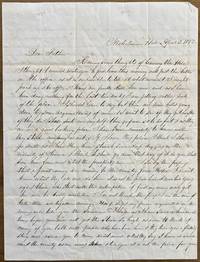
18524789Mokilomni Hill Ca: April 3 1852. Very good. 2pp. plus integral address leaf. Quarto on a folded folio sheet. Old fold lines minor wear. In a highly legible script. An interesting letter from a disillusioned fortune-seeker in Calaveras County advising his father not to come west as all the easy pickings are gone. He writes "Times are pretty dull here now and as I have been doing nothing for the last two weeks I am getting rather sick of the place. I should leave today but there are some holes going down by some acquaintance of mine & I want to see if they get anything. If they do I shall sink one myself they go from 50 to 60 feet & as they are in a good looking place I have some curiosity to know whether they strike anything or not. If I leave this place I think I shall go south as I hear they have struck some deep diggings in the vicinity of Sonora & think I shall go down that way. I see by the papers that a great many are coming to the country from Boston. I do not know what they all will do here it is not the place here it was two years ago & those who start with the anticipation of finding money easily got here will be badly mistaken. April 3 unknown
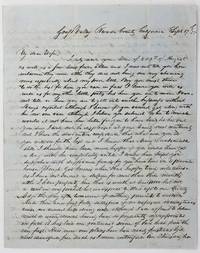
18554791Grass Valley Ca: September 17 1855. Very good. 4pp. on a folded folio sheet. Old fold lines minor wear. An intimate letter from a gold seeker in Nevada County California. Theodore Shaw writes to his wife about mixed luck in California a terrible fire his concern for their children and his great anxiety about the future. He writes in part: "I have property here that is worth at least $1000 but not a cent in my pocket but we expect to start up to our quartz ledge the day after tomorrow if nothing prevents to errect a mill up there. And now our plans have been nearly frustrated by a most dreadful fire such as I never witnessed. On Thursday last about 11 o'clock p.m. an alarm of fire was heard and by about half past 12 some 350 stores dwellings and buildings were consumed with a large portion of their contents our hotel included. . The entire business part of the town is in ruins.we have been sleeping under an old shed in the suburbs. This fire has injured us in this way several who had taken stock in our company have lost their means still we intend going on in a smaller way. We had formed a company with a Capital Stock of $50000 divided into 50 shares of $1000 each. Do you know Lydia I have more anxiety about your health than anything else as I know you work hard; only think what would happen to our dear children if anything serious should happen to your health and I away here in California. September 17 unknown
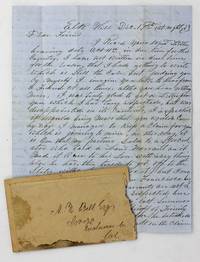
18534788Elk Hill Ca: December 17 1853. Very good. 3pp. on a folded folio sheet. Old folds light wear and soiling. With original mailing envelope. An informative letter sent from a miner in Gold Rush-era California to a friend in Tuolumne County primarily concerning a mining claim but also providing many interesting local details. The author writes "I managed to keep a claim for you which is joining to mine in this way it is one that my partner sold to a speculator who laid a land warrant on it." He discusses the process of the land warrants and how he made the man title the claim properly in San Francisco. "This claim was jumped last summer by W.H. Dixon first sheriff of Trinity City who died the day before he intended to occupy the house he built on the claim. He shot himself accidentally and never spoke." The author immediately stepped in and nabbed it for his friend but it was short-lived. "The claim is cheap at $2000 as soon as I made it known that I should not administer it was jumped by 3 in one day before 9 o'clock. So much for your not coming as I told you I could not keep them off any longer and you would not come if I had." He further mentions that he is digging potatoes which he deems the finest in the world discusses issues with the crop and further talks about new arrivals in the area. December 17 unknown
18717912San Francisco: A. L. Bancroft & Company 1871. First Edition. Hardcover. Good . 12mo. 256 pp. original green cloth lettered in gilt index to advertisers advertisements i-lvii. -- Moderate wear to the extremities some fraying to the spine tips & corner edges corners bumped. Blank paste-down and first free end-paper paper a little separated but hinges still strong. Rear hinges strong. Rear paste-down has an advertisement pasted on and a small stamp at bottom near the gutter of "H. K. Van Siclen Bibliophile 133 Nassau St. Ny". --. "This tourist guide for visitors of San Francisco and the Yosemite Valley offers a look at travel and accommodations in the late 19th century".-googlebks. A. L. Bancroft & Company hardcover
183870800London: Saunders & Otley 1838. First volume 302 pages; second volume 325 pages with 2 pages of ads. Translated by Henry Reeve. Date 1838 on title pages. Third Edition Stated. Hardbacks. Good Used Condition. Saunders & Otley Paperback