64 résultats
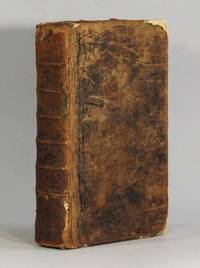
153872632Basileae: Roberto Cheimerino = Winter 1538. Second edition folio pp. 8 1900 columns pp. 1; 210 index; printer's woodcut device on verso of final leaf; lightly ruled in red throughout woodcut initials and ornaments; scruffy old calf gilt spine considerably rubbed and worn joints cracked cords holding; internally clean with perhaps 100 early and informed annotations in the margins. Armorial bookplate of Sir Edward W. Watkin Rose Hill Northenden the MP and railway entrepreneur. This copy includes the very extensive index which is not in all copies. Guarino ca. 1450-1537 an Italian Benedictine monk was one of the most significant 16th-century lexicographers. He was appointed bishop of Nocera in 1514 and is best known for producing the first Thesaurus Linguae Graecae. "In 1523 appeared his Etymologicum magnum sive thesaurus universae linguae Graecae ex multis variisque autoribus collectus a compilation which has been frequently reprinted and which has laid subsequent scholars under great though not always acknowledged obligations" EB. Adams P-984. [Roberto Cheimerino = Winter] unknown
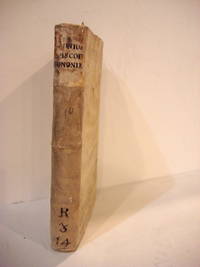
1599111111113633Gualtherus 1599. Vellum. Very Good. Gualtherus; Colonia 1599. Hardcover. A mirror of the concubines of priests nuns and clerics and Letter from the Bishop of the Church of Roermond to Maurice Count of Nassau. Bound with two titles: Speculum concubiniariorum sacerdotum monachorum ac clericorum 148pp and Henrici Cuickij Ruraemudensis ecclesiæ episcopi Ad Mauritium comitem Nassauium paraenetica epistola 48pp. Very uncommon book. Hendrik van Cuyk or Henricus Cuyckius was the second bishop of Roermond from 1596 until his death in 1609. Text in Latin. A Very Good full period vellum binding some age-appropriate discoloration and handling marks to vellum binding sturdy still sturdy and intact previous owner bookplate affirmed to front and rear pastedown ink notation front free endpaper and rear pastedown age toned text block with some age spotting/foxing throughout some warping to vellum binding and bowed boards without Dust wrapper. A nice overall clean and uncommon copy. 18mooctodecimo or approx. 4 x 6.5 inches. We pack securely and ship daily with delivery confirmation on every book. The picture on the listing page is of the actual book for sale. Additional Scans are available for any item please inquire. Gualtherus hardcover
1585B6597Paris: Apud Dionysium Duvallium sub Bucephalo in vico Bellouasco; c. April 1585 colophon . A very nice copy of this rarely found work; old minor marginal repair tape of title slight marginal stains and very small in-text and marginal oxidation spots none affecting legibility; light damp staining of the lower margin. Endpapers watermarked. Binding: 17th century mottled calf spine with six 6 raised bands with gilt lettered title on two and remainder of compartments ornamented in floral gilt; all edges speckled red. Notes: This medical work on gynaecology attributed to or by Hippocrates and his school is accompanied by the commentary in French of French Renaissance physician Maurice de La Corde; it is rare with three known exemplars incl. Yale & Oxford. <br> <br> Size: Folio 311x201mm Illustration: Text in Latin and Greek. Text in two columns of Latin and Greek respectively with accompanying Latin commentary in one; except index printed in three columns.<br>Illustrated title depicting determined/ inspired Hippocrates riding on horseback through crises or critical times toward the sun – this with marginal text in Latin and Greek; each major section opens with an elaborate headpiece and initial. <br> References: Pasquale Sfameni in Enciclopedia Italiana 1933; Adams H-615; Choulant 31; Durling 2412. Graesse III 283; Hirsch II 76; Renouard Marques 287; STC French 227. Not in Osler. Pages: Ll: bl. 10 pp. 1-361 6 bl.2. Collation: bl. a1-4 e1-6 A1-Z6 Aa1-Gg6 Hh1-7 bl.2. Category: Book Medical; Book Early Printed 1500; Apud Dionysium Duvallium, sub Bucephalo, in vico Bellouasco; hardcover
15966042Frankfurt: Andreae Wecheli Heredes Claudium Marnium & Joann. Aubrum 1596. 4to. 2 volumes in 1. 16464;5502pp. Indices. Woodcut device of Wechel on both titles and verso of final leaf otherwise blank. In this copy all of the devices have been hand colored old coloring. Old plain vellum somewhat worn. Title and text with some old moderate water stains. Free endpapers lacking. Not a particularly attractive copy but quite useable. Later 16th century edition of Horace edited by the great scholar Dionysius Lambinus. Dibdin in his GREEK AND LATIN CLASSIC 4th ed. Vol II p.45 makes reference to two editions printed by Wechel a 1577 folio and our 1596 4to. Andreae Wecheli Heredes, Claudium Marnium & Joann. Aubrum hardcover books
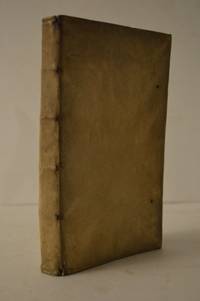
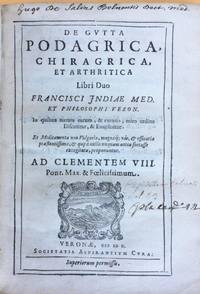
1600M13168Verona: Societatis Aspirantium cura 1600. 1600. Two parts in 1. Small 4to. xxiv 118 1 pp. Printer's woodcut device 5 snakes over landscape woodcut initials and tailpiece rear errata & colophon; old ink marginalia p.36 underlining pp. 97-99. Original vellum; lacks ties. Ownership inscription on title: Hugo De Salins Belnensis Doct. Med. d.1659 and another signature obscured. Bookplate of Château de Montrevost Cuisery France. EARLY SEVENTEENTH CENTURY WORK ON GOUT & RHEUMATOID ARTHRITIS: : HUGUES DE SALINS' COPY. First edition of this rare work on the nature cause and treatment of rheumatoid arthritis and gout. The status of gout in the late sixteenth century was such that gout was said by Turberville to be found in "horses capons and falcons." p. 64. John Gerard's Herball 1597 stated that Gout-wort or Herba Gerardi was a native herb that could be used with some benefit supported further by Culpeper. According to Copeman Thomas Sydenham 1624-1689 suffered from gout and wrote the classic description of the disease and was the first to be able to differentiate between rheumatoid arthritis and gout. The present work was written decades earlier. Francesco India cites Galen Chap. 1 Ambroise Pare Chap. 12 and Jean Fernel Chapters 5 7 8. India makes two 15-page tables of causes which he uses to organize his data. <br /><br /> PROVENANCE: Hugues de Salins: The British Library catalogue lists a "Hugues de Salins; see: Jean Baptiste de Salins Defense du vin de Bourgogne 1704." This may be a descendent. See: Societe d'Histoire d'Archeologie et de Litterature de l'arrondissement de Beaune Memoires annee 1890 Volumes 15-16 Beaune 1891 pp. 75 177. Mentions the wife of Hugues de Salins as buried in 1626 and Hugues de Salins buried in 1659. <br /><br /> Francisci Indiae an Italian philosopher and physician who is little known wrote the present work and two others: Hygiphylus: sive de febre maligna dialogus 1593. Hygiophilvs Tertivs Vel De Symptomatvm Febri Malignae Svper 1599. See: Frederic Paulhan Catalogue des legs Gide & Teissier-Rolland 1892 p. 212. Showing a copy of Strabo's Strabonis rerum geographicarum libri XVII 1571 with the same provenance inscription is this book. This inscription must date prior to 1892. <br /><br /> Copeman W.S.C. A Short History of the Gout and the Rheumatics Diseases pp. 53 64. Locations: British Library; Edinburgh University; Middle Temple Library; Wellcome Library. Societatis Aspirantium cura, 1600. hardcover books
1581#BIBLIO-1187<p>Ioan. Ravisii Textoris Nivernen: dialogi aliqvot festiuissimi studiosæ iuuentuti cum primis vtiles: Item eivsdem epigrammata non pavca vt dictissima ita & lepidissima. Omniarecens diligenter recognita & emendata</p><p><em>John Ravisius or Johannes Ravisius Textor or Jean Tixier de Revisi the writer of Nivernen Nivernais: dialogues somewhat festive studious and very useful: also epigrams not very plain as very eloquent and very delightful. All recently diligently revised and amended.</em> Londini London: Ex officina H. Bynnemani Typographi Anno Domini. 1581. Hardback greyish-brown leather binding probably 18th or more likely 19th century with maroon title label gilt-blocked title and raised bands to spine. Blind-stamped design to boards and spine. Octavo/8vo collation but small measures around 3 1/8" x 4 7/8" x 1 1/4" circa 400-500 pages see below for explanation of unusual pagination and collation</p><p>Scuffing and wear to binding some discolouration but reasonably clean. Bumping and a little tearing to corners and to head of spine. Otherwise binding firm. A little cracking to title label but intact with some discolouration. Deckled page edges which are very browned scuffed and otherwise marked. small bookseller label to front pastedown. Some marking a little staining and foxing around pastedowns and endpapers. Toning staining a little light foxing and other marking throughout. Some creasing dog-eared corners and the odd tear with loss to a few leaves including to title leaf which is missing a few characters of text at bottom left-hand corner and is quite fragile and only attached at top. Heavy ink staining to several leaves towards end of book. Occasional underlining marginalia and a little text scored out in several latter pages.</p><p>Very unusual and defective page numbering. Firstly the numbering is of each leaf not each page and the print is a little unclear for some figures. It appears to run after the initial three blank endpapers and preliminary pages that could presumably be numbered i - vi being the tile page to end of 'epistole' from leaf 1 - 20 13 or 18 25 23 - 25 iB 27 blank 20 - 35 6 64 - 72 74 74 repeating 76 76 repeating - 92. However the leaves do not appear to be pages out of order nor duplications and the pages do all seem to be in correct sequence so it appears to be a printing fault rather than a binding one. The order of the page collation is more accurate sequentially though even then there are a few oddities running after the first three blank endpapers on the basis of numbers denoted on leaves as i-v then vi-viii blank from A i - F viii then G ii G G iv G iii blank G v - T viii no use of U V no use of W X - Z viii Aa i - Ff ii Gg ii-Gg iii Ff iv Gg ii Gg iv Gg iii Gg v - Ii v with blank leaves Ii vi-vii removed and three blank endpapers. See pictures for further information. About the author: <em>John Ravisius or Johannes Ravisius Textor or Jean Tixier de Revisi</em><em> c. 1470–1542 was a French Renaissance humanist scholar and professor of rhetoric. He was born in Ravisi which is near the commune of Saint-Saulge in the central province of Nivernais. His works which are mostly on the topic of education were widely accepted and employed by French academia. Tixier eventually adopted the Latinised name Johannes Textor Ravisius Nivernensis. Per the epitaph on his headstone Tixier was born in 1470 and died on 3 December 1542. According to Victor Gueneau other scholars pretend that he died on 13 December 1524 and that his brother Jacques completed Jean's book l'Origine de l'imprimerie "The Origin of Printing". Similarly some authors report his year of birth to be approximately 1480. Tixier studied humanities at the College of Navarre. When he graduated he accepted a position in the college's rhetoric department; there he impressed faculty and students alike. In 1520 he accepted a position as rector of the University of Paris. He held the position until 1525 succeeded by William Manderstown. More than thirty editions of his principal work Officina were published as he continued to expand it. Source: Wiki</em></p> H. Bynnemani Typographi hardcover
15641907280011Genevae : Ex officina Francisci Perrini M.D. LXIIII 1564. First Edition. Hardcover. Good. Calvin's 16th century commentary on the book of Joshua and Beza'z Biography of Calvin Bound in contemporary vellum. Some soiling to cover. Octavo. 32 316 p. Printer's woodcut device on title-page. Slight worming in inner margin towards beginning not affecting text. Bookplate of Duncan Shaw and early inscription of Franciscus Saluardus. Calvin's last work. Includes the Latin translation Theodore de Besze's Life of Calvin. Adams C280. The French edition was printed in 1565. Genevae : Ex officina Francisci Perrini, M.D. LXIIII hardcover
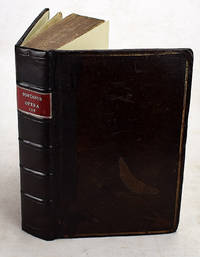
15182304190005Venice: Aldus Manutius and Andrea Soceri 1518. First Edition. Hardcover. Acceptable. First collected edition of Pontano's works - Aldine Imprint Later leather binding. Rebacked. Red leather spine label gilt. 4 326 pages. Early ink inscription on title page acid stain. Colophon page lacking bottom third blank park. Aldine printer's device dolphin and anchor on title. Brunet IV 808; Riccardi I 303; Olschki 12243; Ahmanson-Murphy 168; Adams P1860. Venice: Aldus Manutius and Andrea Soceri hardcover
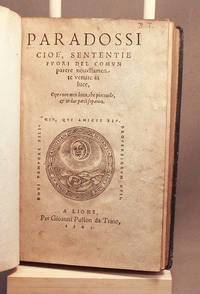
15436296Lyon: per Gioanni Pullon da Trino" i.e. Jean Pullon dit de Trin 1543. First edition. Very Good/Exquisitely rare first printing of Ortensio Lando's most famous book his first in a modern language that in later editions and in translations became a 16th-century best seller. Lando's name does not appear on the title page or anywhere in the book except in code. His real name shows up on no edition published in the 16th century. A dedicatory leaf after the colophon attributes the text to "M.O.L.M" interpreted generally as "Messer Ortensio Landi Milanese." More cryptically there is a phrase printed after the telos "SVISNETROH TABEDVL" mirror writing for "ludebat Hortensius" Ortensio has played. It is serious play. The Paradossi undertakes in the key of popular "world upside down" folklore to prove black what is commonly accepted as white. For instance it is better to be poor than rich better ugly than handsome better drunk than sober and so on. Biographical sketches of Lando are remarkable for how little information about him is available. Peer of Aretino and Doni friend to Etienne Dolet later incinerated for heresy he was a non-believer who nevertheless took Augustinian orders and later deserted them. Member of a prestigious literary club L'accademia degli elevati he was above all an outsider. All of his books landed on the Index of Prohibited Books and "I paradossi" in particular was widely banned and copies of it were confiscated. Probably the first book printed by the obscure Italian printer working in Lyon Giovanni Pullone da Trino later called "Jean Pullon de Trin". Following Pullon's modest press run the text was quickly taken up and reprinted badly by Bindoni and others in Venice twice in 1544 1545 1563 1594 etc. and translated into Latin into French by Charles Estienne 1553 and into English 1596. If you Google "Jean Pullon" you will get dozens of pages advertising pull-on jeans. . Octavo 17cm; 112 leaves signed A-O8. Printer's device on title page Ferraris 1 showing a human-faced moon in the sky reflected on the surface of the land. Bound in later 18th-century or 19th-century dark green leather in neoclassical style with gilt central losenge within gilt borders on both boards; gilt-tooled spine with leather title label. Joints reinforced but tender; light marginal stain along bottom edge; O7 torn and repaired remains of tape. Early marginalia trimmed close. Later c19 notes in French on endleaves. Pages not bright. All in all a very good copy of a very rare book. References: Ferraris "Giovanni Pullone e altri stampatori trinesi a Lione" in "Trino e l'arte tipografica nel XVI secolo." 2014 #1; USTC 116008 BM Italian 399; Grendler "Critics of the Italian World" #8; Gültlingen "Bibliographie des livres imprimés à Lyon." vol. X p. 7; Bongi "Catalogo delle opere di M. Ortensio Lando" p. xxxvi "eseguita in bel carattere rotonde cui la originalità e la bellezza danno il pregio sopre le ristampe"; not in Adams; not in Baudrier. per Gioanni Pullon da Trino" (i.e., Jean Pullon dit de Trin) hardcover books
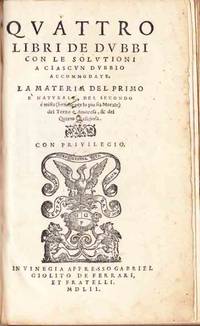
15526331Venice: Gabriel GIolito de' Ferrari 1552. First edition. Very Good/The title promises four sets of "questions and their solutions" and indeed that was the plan. Lando wrote Q&A on four topics: medical questions including dietary and aging functions ethical questions questions about religion and questions about love and sex. It was the love and sex part that raised the eyebrows of the censors and neither Lando or his publisher Giolito could get permissions to print it as the book was going to press. As Giolito himself declares in a postscript to the reader: "I promised you four books of doubts but since I haven't yet been granted a license for the doubts about love I'm forced to give you only three. Be well and enjoy as much of the book as I could give you." The license came later and the text appeared in later editions. This unfinished text with its publisher's apology represents a fascinating birthmark on the 16th-century book trade. The Q&A ranges over hundreds of topics calling upon the author's medical training much involved with the humors and temperaments associated with various organs objects and creatures his classical erudition and his training in the Augustinian order. The three sections together provide comprehensive insight into 16th century medicine and popular religious and moral thought. The odd matter of two versions of the dedication page leaf A ii is not easily explained. We suspect with some justification that Lando sought patronage for the same work in different locations knowing that Protestant Germany rarely spoke with Catholic Italy and vice versa. He might have found different backers in different markets. We know that to be the case with at least one other book of Lando's the "Sermoni Funebri" 1549 where some copies are dedicated to Fugger and others to Niccolo degli Alberti. That case is known and recorded. We find no recorded instance of the alternate dedication of "Quattro libri dei dubbi" to Fugger and no record of the author being identified by signing the dedication letter in any other copy. The "Quattro libri de dubbi" was quickly translated into French Lyon 1558 and by William Painter into English entitled "Delectable demaundes and pleasaunt questions with their severall aunswers." 1566 and again 1640. . Octavo 16 cm; 318 2 pages. Woodcut device on title page and on last page. Woodcut initials. Bound in recent vellum in period style yapp edges titled in ink on spine. Early 20th-century bibliographical note bound in. Marginal annotations in contemporary hand. Leaf a ii the dedicatory letter present in two states the cancel addressed to Johann Jakob Fugger closing with Lando's name and the original leaf addressed to Christoph Mielich and not signed as usual. Small perforation in the cancel affecting a word. Occasional light stains darker on last leaf. References: Bongi I 368; Melzi II 391; BM Italian 377 1556 ed.; Fontanini II 117. Gabriel GIolito de' Ferrari hardcover books
15556824Padova: Gratioso Perchacino 1555. Original edition. Very Good. Quarto 20 cm; 12 leaves signed a-c4 last leaf blank. Printer's device a crowned salamander ensconced in flames on title page. Woodcut initial at start of text. Bound in recent half morocco over marbled boards. Trimmed close to top edge. Gutters guarded. Some spotting on title page but generally clean. <br /> <br />Reference: EDIT 16 CNCE 57958; For attribution to Lando see Silvana Seidel Menchi Chi fu Ortensio Lando "Rivista storica italiana" #106 1994 501-564. Not in Grendler. <br /><br />This is an essay about death. In particular it is a eulogy on the death of young Elizabetta Dotta who it is stated in the text died recently married at the age of 16 years 8 months 24 days and 12 hours. The cause of her death is not given. It does not indulge in a moment's sorrow over the young woman's early demise. Instead it is an extended encomium of death itself praising death as liberation from the essential misery of life in this corrupt and depraved world. As such it is an eloquent statement of philosophical pessimism the tradition which views life as the soul's exile as suffering and sees death as a preferable alternative. While the text is not signed the author is presumed to be Ortensio Lando the uncomfortable peripatetic humanist who never stayed in one place for very long either physically or philosophically. "What is life" Lando asks. "Smoke a dream a running shadow a ship that leaves no trace an arrow shot to its destination. Gratioso Perchacino hardcover
155133109-74Augsburg Philip Ulhard October 1551. Diagrams showing eclipses and celestial positions in the format of astrological squares. 346 leaves author's name crossed out on title. 4to. Contemporary vellum. Augsburg Philip Ulhard October 1551. First edition of a little known work by Cyprian Leowitz 1524-1574. The celebrated Bohemian astronomer was professor of astronomy and appointed mathematician to Elector Palatine Otho Henry German: Ottheinrich 1502-1559 and acquired a high reputation at the time of the reception of the Copernican theory. It is well known that the cosmological elements of the Copernican theory i.e. the "centrality" of the Sun and the Earth's revolution about it were not widely accepted for nearly a century after the publication of the "De Revolutionibus". Leowitz played a central role in facilitating conjunctionist theory and the actual contents of the "Tabulae" are in line with those by Stöffler. From the end of the 15th century onwards many editions of the tables of Regiomontanus were produced with commentaries and additions i.e. by Erasmsus Reinhold Luca Gaurico Leowitz with participation of Melanchthon etc. The present huge work by Leowitz appeared without introduction and without explanation. It contains so-called position plates for the places from the 33rd to the 60th latitude the pole height of the places gradus latitudinis. A final short "secundes pars" with plates up to the 66th latitude appeared in November 1551 and is not present here as in a microfiche copy stored in the Herzogin Anna Amanlia Bibliothek Weimar. . "Position" is not be taken here in the sense of modern astronomy. It is well known that the cosmological elements of the Copernican theory was not widely accepted for a long time after the publication of the "De Revolutionibus" see Burmeister Magister Rhecicus 2015. A current subject of investigation is the variety in response to the theory in the various countries of Europe. Tycho Brahe 1546-1601 visited Cyprian Leowitz in 1569. According to Tycho Leowitz told him that in his opinion the predictions of Copernicus agreed better with observations of the superior planets and solar eclipses while Ptolemy's predictions were more accurate for lunar eclipses and the positions of the inferior planets. Leowitz was correct about the relative superiority of the two theories in predicting the longitudes of the planets.- Good copy. _ _ - Adams L-520; Zinner 2018; NBG 30 814; not in Houzeau & Lancaster; cf. VD 16 L 1276. SCIENCE:ASTRONOMY & ASTROLOGY ; Augsburg, Philip Ulhard hardcover
1581ABC_47414Antwerp 1581. Large folio. Christoffel Plantin Later 17th-century blind tooled vellum with a single fillet frame and a large ornamental centre piece sewn on 5 supports corresponding with the 5 raised bands on the spine creating 6 compartments with a manuscript title in the first compartment at the head of the spine. With an engraved title-page the author's large "candore et spe" woodcut device on leaf 6r approximately 2185 botanical woodcuts in the text 8 woodcut decorated sometimes interlaced initials plus repeats 6 series and 1 typographic interlaced initial. Set in fraktur types with extensive roman and textura and incidental italic and civilité. 2 volumes bound as 1 the second in 3 parts. 10 994 2 blank "312"= 312 294 2 blank 2 blank 15 1 blank 67 1 blank pp. First Dutch edition with approximately 435 more woodcuts than Plantin's Latin edition of 1576 of one of the greatest herbals. Besides the expected herbs medical plants etc. it illustrates and discusses mushrooms a coconut corals petrified wood and what may be a fossil fern. Matthias de Lobel 1538-1616 a Flemish botanist and physician published his Stirpium adversaria nova in London in 1571 but greatly expanded it after his return to the Low Countries. Plantin bought 800 copies of the London edition and reissued it in 1576 cancelling a few leaves but printing extensive supplementary material to incorporate Lobel's further work. Lobel further expanded it for the present first edition in Dutch evidently his own translation giving the work its definitive form. The 1571 Latin edition had included about 275 woodcuts. Plantin acquired 120 of them but also added many more for his editions including many he had used for his editions of Dodoens and Clusius. The number of woodcuts therefore grew to about 1750 in the 1576 Latin edition and about 2185 in the present Dutch edition but Plantin appears to have had some new blocks cut as well. Many blocks were cut by Antoon van Leest and Gerard Janssen van Kampen after drawings by Pieter van der Borcht.With a clear purple owner's stamp "Jan Veth" and a clear 18th-century inscription "Cost 2800" on the front pastedown and some additional inscriptions on the rectos of the blank flyleaves engraved title-page and the back pastedown. With some occasional annotations in brown ink in the margins and some discrete additional manuscript shading to a few illustrations. The binding is somewhat soiled and the head and foot of the spine are slightly damaged all without affecting the structural integrity of the binding. The margins of the preliminary leaves including pastedown and flyleaves final blank flyleaves and back pastedown are somewhat water stained and have been restored. Somewhat browned throughout but the impressions of the woodcut illustrations remain clear. With some minor defects to several leaves only occasionally slightly affecting the text. Otherwise in good condition.l Arber Herbals p. 278; Belg. Typ. vol 1 1974; Bibl. Belgica L119; BM NH vol. 3 p. 1160; Carter & Vervliet 199; Nissen BBI 1219; Plesch mille et un livres botaniques p. 314; Stafleu & Cowan 4908; STCN 344385353 5 copies; STCV 12914575 9 copies incl. 4 incomplete; Voet the Plantin press 1579; Wellcome 3829; WorldCat 833674408 2 copies. hardcover
15254627Vinegia Venice: Nicolo di Aristotile detto Zoppino 1525. Very Good. Bound in period vellum with title and intricate symbol on spine. Covers have moderate and common aging to vellum. Partially separated from binding and some loose pages; all pages present - there is a jump in pages from LVII to LXI but text appears complete and same issue with other copies currently/recently available. Some minor spotting inside. Contains 30 engravings including allegorical scenes surrounding title page intricate capital lettering in text image on final page and 27 images related to the dialogue throughout. Type is all in italics except where names are in capital characters. Comprising the works of Lucian this is the first Italian translation. Comes with a cardboard slipcase for stability in shipping.<br /> <br /> Pages: 488<br /> Dimensions: 4 x 6 x 1¼. Nicolo di Aristotile detto Zoppino unknown
15984716Cologne: In Officina Birckmannica 1598. 12mo. 725895pp. 17th cent. vellum soiled. Two paper labels on spine. Popular handbook edition of this often reprinted work of religious instruction containing meditations for the seven days of the week. It first appeared in 1554 in Salamanca under the title LIBRO DE LA ORACION Y MEDITACION. The first Latin edition appeared in Cologne in 1586. Not in Adams or BL German STC. VD16 #L3244. Palau 107537. In Officina Birckmannica hardcover books
157033006-178Ingolstatt Alexander Weissenhorn 1570. Title printed in red and black within woodcut-border. 16 232 8 leaves. 8vo. Contemporary blind-ruled vellum 1 of 2 metal claps small old library stamp and owner's ms. entry on title. Ingolstatt Alexander Weissenhorn 1570. Fourth issue of one of the many polemics written by Johann Nas 1534-1590 a Franciscan monk and counter-reformation preacher and controversialist notably at the court of the Archduke Ferdinand in Innsbruck where he followed Petrus Canisius. In 1580 he became Bishop of Brixen. - VD 16 N 102; STC German 643. GERMANY ; RELIGION ; Ingolstatt, Alexander Weissenhorn hardcover
15439601Paris: Joannis Boulle 1543. Full calf. Very good. 8vo. ff.82394. 20th century tan calf with red morocco spine label over modern boards. The first 4 leaves have an old round embossed stamp of a seminary in Granby Mass. Title page also with an inked Catholic stamp of some order otherwise a nice clean copy. This work has been falsely attributed to Saint Thomas Aquinas. Apparently the author/editor is Nicolaus de Gorra or spelled Nicolas de Corran. Adams B1852. Joannis Boulle unknown books
15646012<p>8vo. 112 ff pages 2 and 110-112 are blank. Bound in modern paneled calf with gilt-stamped fleurons on front and back covers raised bands. Generally good.<br /></p><p>The first edition of this plague treatise by Paracelsus Theophrastus Bombastus von Hohenheim 1493-1541 the "Luther of Medicine" and one of the key figures in the history of medicine. Written originally in Nördlingen in 1529-1530 it remained unpublished during Paracelsus' lifetime and subsequently taken up and edited for publication by the Paracelsian scholar Adam von Bodenstein 1528-1577. The latter dedicated it to Johann Rudolph Stör von Störenberg Abbot of Murbach and Luders. In addition to the study on pestilence the text includes two short works by Paracelsus: "Vom Preservatiff durch den Schwebel" and "Von der Mummia."</p><p>In the primary tract Paracelsus for the first time presents his complex theory on the origins of the plague which he believed were the result of astrological and corporeal events set in motion by human sins. "This anthropocentric view of an individual disease is in harmony with Paracelsus' whole philosophy and indeed with Renaissance philosophy in general" Pagel p. 179. Paracelsus also postulates the importance of the principle of sulphur the corresponding agent of the planet Mars in pestilence's causation. He believed that sulphur hidden in three minerals—antimony arsenic and marcasite—affected three corresponding organs: the groin the axillae and the ears.</p><p>The chapters on causation are followed by sections on remedies. The doctor must cure the agent causing the disease rather than the symptoms of the disease Paracelsus writes. Humoral pathology and its insistence on diet is of no use. "Paracelsus' plague remedies include sulphur spirit of vitriol sulphur sublimate and metals also—for external treatment of boils—toads and decoctions of beetles designed to remove the evil of magnetic attraction but herbs and drugs as prescribed by Ficino and Agrippa are greatly amplified and still appear in a prominent place" Pagel pp. 180-181 n. 151.</p><p>The editor of this volume Adam von Bodenstein was one of the key figures in the revival of Paracelsian ideas in the German lands in the middle of the sixteenth century. A son of a radical reformer he believed in transmutation of metals into gold and played a key role in the publication of over 80 works by Paracelsus. For his Paracelsianism he was excluded from the faculty and council of Basel University.</p><p>OCLC records US copies at NYAM NLM Wash. U and UMn.</p><p>Karl Sudhoff <i>Bibliographia Paracelsica</i> Berlin 1894 60; Walter Pagel <i>Paracelsus: An Introduction to Philosophical Medicine in the Era of the Renaissance</i> Boston 1982 2nd revised edition; Georgiana D. Hedesan "Alchemy Potency Imagination Paracelsus's Theories of Poison" in John Arrizabalaga Ole Peter Grell Andrew Cunningham eds. <i>It All Depends on the Dose: Poisons and Medicines in European History. The History of Medicine in Context Series</i> New York 2018 pp. 81-102; Peter J. Forshaw "'Paradoxes Absurdities and Madness:' Conflict over Alchemy Magic and Medicine in the Works of Andreas Libavius and Heinrich Khunrath" <i>Early Science and Medicine</i> vol. 13 no. 1 2008 pp. 53-81.</p> Paul Messerschmidt hardcover
1566B6630Bononiae /Bologna: Alexandri or Alexander or Alessandro Benatii or Benatius or Benacci publisher c. 1566. . Edition: First Commandino edition. Binding: 17th century mottled calf; spine raised with six 6 bands compartments gilt gilt lettered title on two; all edges speckled red. Notes: First edition by Commandino. David Clement judges this edition of the first four books bound with the two books of Sereni on cones and cylinders to be extremely rare. Also footnote 32 states: in Bibliotheca Uilenbroukiana P.I. p. 55. Catal. duarum Bibliothecaruin Dom. N. B. & D. L. Hagae - Com. ap. Beauregard 1747. in 8vo. p. 9 Vogt Libror. rarior. p. 40. describes this Commandin edition surpassing that of Jean-Baptiste Memmius which was printed in Venice in 1537. It quotes Fabricius’ statement in the Bibliotheca Graeca about Memmius or Memus not having understood the subject at hand translated from a basically wanting manuscript with manifold thereby rendering his version weak. It also mentions that this didn’t mean Commandin’s was fault-free remaring the Greek manuscript he had drawn on was filled with failts. <br>Concerning Apollonius’s work Koudela states†Interest in ancient Greek knowledge increased gradually in the fifteenth and sixteenth centuries especially in Italy the leading country of Europe's culture and science of the time. Latin translations of Greek works on conic sections and other curves - Apollonius and Pappus in particular - appeared in several editions. Although some original works were also published in the sixteenth century no significant progress in the study of conic sections had been made until the work of Kepler. His contribution influenced the further development of projective geometry and can be regarded as the transition from ancient to modern geometry. The spread of Greek knowledge in the Renaissance The invention of conic sections is attributed to Menaechmus 4th cent. BC a member of Plato's Academy at Athens. Various species of conic sections were obtained by truncating an acute-angled right-angled and obtuse-angled cone by a plane perpendicular to the generator of the cone. Conic sections were also investigated by Aristaeus the Elder 4th cent. BC and by Euclid c. 325 - c. 265 BC. Their works on this subject are now lost. The works of Archimedes 287 - 212 BC contain some important results concerning the properties of conic sections especially parabolas. The greatest ancient writer on conic sections was Apollonius of Perga c. 262 - c. 190 BC. His famous work Conics consisted of eight books and contained 487 propositions. Apollonius introduced the terms ellipse parabola and hyperbola and showed that various sections of the cone can be obtained by varying the inclination of the intersecting plane. Among other ancient authors dealing with conic sections we should mention Pappus of Alexandria c. 290 - c. 350 AD the last of great Greek geometers. His main work known as Collection is valuable - among other things - because it provides an account and comments on the results obtained by his predecessors. Pappus introduced the notion of the focus and the directrix of a hyperbola Kline 1990 p. 128 .<br> <br>Apollonius’ work influenced the greatest scholars of the modern era such as Descartes and Newton. The Latin translation of the first four books of Apollonius by Gianbattista Memo appeared in Venice in 1537. The present edition of Apollonius’ Conics of the sixteenth century is based on the translation and important new edits by Federico Commandino 1506-1575 who published “classical Greek mathematical texts under the auspices of the Duke of Urbino.†Horblit: “The most influential early edition of this highly important text entirely superceding Memmo’s version of 1537â€. <br>Other sources state that in total the Conics consist of 387 not 487 propositions published in seven books with the eighth book remaining unconfirmed. <br> <br>References: Adams A-1310; Brunet I 347; David Clement Bibliothèque curieuse historique et critique: A-Aqvino 1750 p.415/6; Dibner 101; Honeyman 118; Horblit 4; Koudela L.: Curves in the History of Mathematics: The Late Renaissance 2005; Norman 57; Riccardi I/1 361 51; Commandino; Sotheran I 124.<br>Work II: Conicorum lib. V VI VII with Archimedis Assumptorum liber.<br> Pergaeus Apollonius c. 262-c. 190 B.C. author; Archimedes c. 287-c. 212 B.C author; Abu'l Fath of Isphahan or Bundari al-Fath ibn Ali c. 1190 - c. 1245 author; Borelli Giovanni Alfonso c. 1608-1679 editor; Abraham Ecchellensis 1605-1664 translator: <br>APOLLONII PERGAEI// CONICORVM LIB. V.VI.VII. // PARAPHRASTE // ABALPHATO ASPHAHANENSI // Nunc primum editi. // ADDITVS IN CALCE. // ARCHIMEDIS ASSVMPTORVM LIBER // EX CODICIBVS ARABICIS M.SS. // SERENISIMI // MAGNI DVCIS ETRVRIAE //ABRAHAMVS ECCHELLENSIS MARONITA // In Alma Vrbe Linguar. Orient. Professor Latinos reddidit. // IO: ALFONSVS BORELLVS // In Pisana Academia Matheseos Professor curam in Geometricis versioni // contulit & notas vberiores in vniversum opus adiecit. // AD SERENISSIMVM // COSMVM III. // ETRVRIAE PRINCIPEM. // FLORENTIAE // Ex Typographia Iosephi Cocchini ad insigne Stellae MDCLXI. // SVPERIORVM PERMISSV. <br> <br>Two parts in one.Text in Latin.<br>First edition. / Editio princeps <br>Florentiae / Florence: ex Typographia Iosephi Cocchini publisher; c. 1661. Folio 294x199mm.<br> <br>Illustrated with a red and black ink title decorative head- tail pieces and woodcut initials of varying sizes at openings a large number of mathematical in-text woodcut illustrations mainly diagrams throughout again of varying sizes; wide margined paper.<br> <br>Pagination: 36 415 bl. Collation: Ll: bl. half title red and black ink title 3-6 1-4 with index A1-Z4 Aa1-Zz4 Aaa1-Fff4 with errata bl. <br> <br>Very beautiful and rare work edited by Alfonso Borelli is the first edition of books<br>V VI and VII of the Conicorum of Apollonius. Concerning Apollonius Koudela states†Interest in ancient Greek knowledge increased gradually in the fifteenth and sixteenth centuries especially in Italy the leading country of Europe's culture and science of the time. Latin translations of Greek works on conic sections and other curves - Apollonius and Pappus in particular - appeared in several editions. Although some original works were also published in the sixteenth century no significant progress in the study of conic sections had been made until the work of Kepler. His contribution influenced the further development of projective geometry and can be regarded as the transition from ancient to modern geometry. The spread of Greek knowledge in the Renaissance The invention of conic sections is attributed to Menaechmus 4th cent. BC a member of Plato's Academy at Athens. Various species of conic sections were obtained by truncating an acute-angled right-angled and obtuse-angled cone by a plane perpendicular to the generator of the cone. Conic sections were also investigated by Aristaeus the Elder 4th cent. BC and by Euclid c. 325 - c. 265 BC. Their works on this subject are now lost. The works of Archimedes 287 - 212 BC contain some important results concerning the properties of conic sections especially parabolas. The greatest ancient writer on conic sections was Apollonius of Perga c. 262 - c. 190 BC. His famous work Conics consisted of eight books and contained 487 propositions. Apollonius introduced the terms ellipse parabola and hyperbola and showed that various sections of the cone can be obtained by varying the inclination of the intersecting plane. Among other ancient authors dealing with conic sections we should mention Pappus of Alexandria c. 290 - c. 350 AD the last of great Greek geometers. His main work known as Collection is valuable - among other things - because it provides an account and comments on the results obtained by his predecessors. Pappus introduced the notion of the focus and the directrix of a hyperbola Kline 1990 p. 128.<br> <br>While Koudela mentions 487 propositions in total for eight books comprising the Conics other sources mention 387 published in seven books only with an eighth book announced but its publication unconfirmed/ elusive. Apollonius’ work influenced the work of great scholars such as Descartes and Newton. A Latin translation of Conicorum’s first four books appeared in Venice in 1537 and it was not until 1661 for the present work - Conicorum’s books V to VII - to be published; the present work constitutes the most innovative or original part of the work of Apollonius. Translated from the Arabic manuscript of Abu'l Fath of Isphahan c. 1190 - c. 1245 purchased by the Medici’s during the first half of the 17th century the text of had survived only in the Arabic language. Norman states: “This was a valuable addition to the mathematical knowledge of the time for whereas Books I-IV of the Conics dealt with information already known to Apollonius’s predecessors Books V-VII were largely original. Book V discusses normals to conics and contains Apollonius’s proof for the construction of the evolute curve; Book VI treats congruent and similar conics and segments of conics; Book VII is concerned with propositions about inequalities between various functions of conjugate diametersâ€. Cajori states: “The fifth book reveals better than any other the giant intellect of its author. Difficult questions of maxima and minima of which few examples are found in earlier works are here treated most exhaustively. The subject investigated is to find the longest and shortest lines that can be drawn from a given point to a conic. Here are also found the germs of the subject of evolutes and centres of osculation.†<br>Cajori A history of mathematics 40; Brunet I: 347; D.B.I. XII 546; De Vitry 29; DSB I 191re: Apollonius & II 308 re Borelli ; III 364. Honeyman 119; Koudela L.: Curves in the History of Mathematics: The Late Renaissance 2005; Norman 58; Riccardi I /1 158 Borelli.<br><br> Size: Folio 294x199mm. Illustration: Text in Latin.<br>Illustrated with numerous decorative historiated woodcut initials of varying sizes at openings; hundreds of in-text illustrations mainly diagrams of varying sizes. Volume: Two parts in one. Pages: Pagination: Bl. 4 114 2 36 bl. Collation: Ll:1-6 1 -4 with index A1-Z4 a1-f2; 2 a1-i4. Category: Book Europe Italy; Book Science & Technology; Alexandri or Alexander or Alessandro Benatii or Benatius or Benacci, publisher unknown
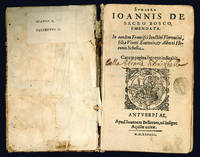
158273<p>COPY CONTAINING THE MINUTE OF A LETTER ADDRESSED BY GIORGIO RAGUSEO TO HIS COLLEAGE OF THE UNIVERSITY OF PADUA GIROLAMO PALLANTIERI</p><p>8vo 153x93 mm. 16 327 1 pp. and 1 folding plate with the movable parts to be cut out and the instructions on how to assemble them. Collation: †8 A-V8 X4. Printer's device on title page and several woodcut diagrams and illustrations in text. On the front pastedown label with the shelf mark "Scansia N. G10 Palchetto N.". On title page is the ownership's entry "Della libraria di Brisighella" and an old faded stamp. Contemporary binding made with a manuscript vellum leaf datable to the 12th-13th century inked title on spine and on the upper edge round worm holes and small losses to the panels heavier loss to the bottom part of the spine lacking ties and front flyleaf. Leaves †6 and †7 stained and with minor losses of paper and occasionally also of text small hole in the middle of quire M affecting a few letters other hole in the lower blank margin of ll. V3-X4 with no loss of text uniformly browned throughout first quire slightly loose. A genuine copy.</p><p>On back flyleaf recto is a manuscript note containing the minute of a letter presumably autograph by Giorgio Raguseo d. 1622 dated "Patavi ex academia nostra V. Non. Marti 94" 3 March 1594 and addressed to the "Admodum Rev.do ac Ecellentiss.o Patri Magistro Hieronimo Palanterio in almo Patavino Gimnasio theologiam publice proficienti" in which Raguseo thanks his colleague and professor of theology Girolamo Pallantieri 1533-1619 and asks his permission to print some not better specified academic "conclusiones ex variis doctoribus scholasticiis" which he thinks are worth publishing. It is also not clear which academy he is referring to in the letter.</p><p>On the verso of the same leaf is another note by the same hand quoting as a reminder the 1566 Giovanni Battista & Marchiò Sessa edition of <i>Le nuove teoriche de i pianeti</i> by Georg Peurbach in the translation by Orazio Toscanella.</p><p>RARE EDITION published in Antwerp of Sacrobosco's famous astronomical treatise accompanied by notes of Francesco Giuntini 1523-1590 Elie Vinet 1509-1587 and Albert Hero d. 1589 which appeared for the first time in the Lyon edition of 1562.</p><p>"Sacrobosco's <i>Sphaera</i> written in Paris around 1220 enjoyed a long popularity as the leading introduction to spherical astronomy. First printed in 1472 it went through at least a score of editions in the fifteenth century and something over 100 in the sixteenth … Publishing Sacrobosco entered a new and different phase in Wittenberg in 1531. Prior to that year all the editions were folio or quarto that is large often quite beautiful and presumably expensive volumes. In 1531 the Lutheran University of Wittenberg apparently sponsored a version cheap enough to become a required textbook for the astronomy course. It is fully illustrated with didactic figures and comes with a preface in praise of astronomy by Philipp Melanchthon … Demand for the small Sacrobosco textbook remained high at Wittenberg and a new edition was issued every few years. In 1538 a revised revision appeared: for the first time three of the diagrams incorporated moving parts. This proved to be such a popular feature that virtually every octavo Sacrobosco from the 1540s on – regardless of whether it was printed in Paris Antwerp Cologne or Venice – included these same identical volvelles. Incidentally these volvelles were not pre-cut and pasted by the printer. They were issued on ancillary sheets together with instructions for assembling them. Hence it is possible to find copies of these text books with no sign that the volvelles were ever in place and very occasionally the original sheet with the instructions and cutouts can still be found with the book" O. Gingerich <i>Sacrobosco as a Textbook</i> in: "Journal of History of Astronomy" 19 no. 4 Nov. 1988 pp. 269-273.</p><p>The letter contained in the present copy is particularly interesting as it connects two prominent figures of the University of Padua at the end of the 16th century highlighting their academic and professional ties. It is also worth noting that Raguseo wrote a commentary on Sacrobosco's <i>Sphaera</i> <i>Expositio super spheram Ioannis de Sacrobosco</i> Milan Biblioteca Ambrosiana manuscript N.207 sup. which has remained unpublished.</p><p>Giorgio di Ragusa or Raguseo as he was called after the name of his hometown today's Dubrovnik in Dalmatia was born on an unspecified date in the second half of the 16th century. He spent his youth in Venice where he was educated in mathematics by his father in the letters by L. Natali and in astrology his favourite discipline by Osvaldo da Gent and F. Barozzi. He then studied and graduated at the Studio of Padua first in the arts the exact date is not known then in 1592 in theology and in 1601 in medicine. In the meantime he took the minor orders and gained a certain reputation as an expert in Lull's art taking part in two public disputes over theological conclusions exposed according to R. Lull's method one in Venice in 1594 and the other in Padua in 1595. In 1599 he set off on a journey that kept him away from Venice for two years. In Pisa he met G. Mercuriale while in Naples he made the acquaintance of G. Della Porta. When he returned to Padua in the spring of 1601 he was appointed to the second ordinary chair of natural philosophy at the local Studio replacing C. Cremonini recently promoted to the first chair. In the following years he was deeply involved in all academic activities not only in teaching. His name in fact is one of those that most often appears in the commission that conferred the doctorate titles according to the practice of the Palatine counts and in this capacity on April 25 1602 he conferred the title of doctor in philosophy and medicine to W. Harvey. In 1613 in Venice he published twenty-four Aristotelian disputes under the title of <i>Peripateticae disputationes</i>. Around 1618 Raguseo took part in the discussions raised by the appearance of a comet. Despite his academic Aristotelianism he expressed an original position in the debate supporting the need for critical scrutiny by the senses and experience. From a letter of 1611 we also know that he used the telescope to verify some of discoveries announced by Galileo in the <i>Sidereus nuncius</i>. Raguseo died in Padua on 13 January 1622 cf. C. Preti <i>Giorgio da Ragusa</i> in: "Dizionario Biografico degli Italiani" LV 2001 s.v.; see also L. Thorndike <i>A history of magic and experimental science</i> VI New York 1941 pp. 198-202; M. Josipovic <i>Il pensiero filosofico di G. Raguseo</i> Milan 1985; and G.F. Tomasini <i>Gymnasium Patavinium</i> Udine 1654 pp. 309 and 445 for Ragueseo and p. 284 for Girolamo Pallantieri professor of theology from 1580 to 1603.</p><p>Bernardino Pallantieri was born in Castel Bolognese in 1533. In 1547 at the age of fourteen he entered the order of friars minor conventual taking the name of Girolamo. In Ferrara he studied philosophy with the theologian Filippo Braschi and the famous philosopher Vincenzo Maggio. He then continued his studies in Bologna under the guidance of Giovanni Antonio Delfini and Franceschino Visdomini. At first appointed regent of the Studio of Pavia in 1566 Pallantieri took up the chair of theology at that university. In 1568 he was called to Milan by St Charles Borromeo archbishop of that city who appointed him as preceptor of the candidates for priesthood and as his personal theologian. Pallantieri remained in Milan for 5 years then in 1573 he resumed his teaching in Pavia. Between 1575 and 1581 he was in Rome at the service of Cardinal Felice Peretti as his personal advisor and theologian. In 1581 he was called back to Bologna and in 1582 he was elected minister provincial of the friars minor of the province of Bologna. He was also a member of the Accademia degli Infiammati of Parma with the name of "Solingo". When his three-year mandate in Bologna expired in 1585 Pallantieri was called by the Reformers of the Studio of Padua to occupy the chair of theology and at the same time he was appointed superior of the convent of the Saint Anthony the patron of the city. Girolamo remained in Padua for ten years until about 1595. In 1603 he was appointed bishop of Bitonto by Pope Clement VIII but he moved to his diocese only in 1605. Pallantieri died in Bitonto in 1619 at the age of eighty-six cf. E. Papagna <i>Pallantieri Bernardino</i> in: "Dizionario Biografico degli Italiani" LXXX 2014 s.v.</p>Houzeau-Lamcaster no. 1658; L. Desgraves <i>Elie Vinet</i> Genève 1977 no. 125. Jean Bellère books
157665511576. Numerous woodcut illus. in the text. Largely printed in black letter. 7 p.l. first leaf blank except for signature mark 63 1 pp. Small 4to early 20th cent. polished mottled calf by Riviere triple gilt fillet round sides spine richly gilt red morocco lettering pieces on spine dentelles gilt a.e.g. London: H. Denham 1576.<br/> <br/> Second edition “nowe newly corrected and augmented†of the first English book on hops. The first edition appeared two years earlier; both editions are very rare. This is “an eminently practical treatise illustrating the various methods of setting the roots making the hills and ramming the poles tying the bine and its pulling up and preservation with a number of curious cuts. It was the work of a practical man written for practical men and in this respect is far in advance of most of Scot’s contemporaries who were still much interested in the superstitions of the time and the traditional pseudo-science of the Middle Ages.â€â€“Fussell I p. 12.<br/> <br/> Clinch in his English Hops a History of Cultivation and Preparation for the Market from the Earliest Times 1919 states that in many respects “the information is as useful today as it was nearly three-and-a-half centuries ago when it was published.â€<br/> <br/> Scot d. 1599 is most famous for his The Discoverie of Witchcraft 1584 in which he attacked the general belief in witchcraft and other forms of credulity and superstition including astrology alchemy and Catholicism. For more on Scot and his fascinating life see ODNB.<br/> <br/> Fine copy. Signature of T. Barling on first leaf.<br/> <br/> ⧠Henrey I p. 64 & no. 338. McDonald Agricultural Writers from Sir Walter of Henley to Arthur Young 1200-1800 pp. 34-36. unknown
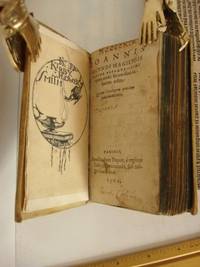
15617610Paris: Jacobum Dupuis 1561. Second edition. Vellum. Very Good. 16mo. ff.172. BOUND WITH: Marullo Michele or Marullo Tarcaniota Michele. EPIGRAMMATA & HYMNI. Paris: Jacobum Dupuis. 1561. ff.92. Title with outer margin restoration 1/2" vertical strip of later paper with a few letters of title & imprint in manuscript. 2 pages of cont. manuscript notes in German at back. Both works bound togetherin cont. vellum soiled. Large bookplate of American classical scholar Kirby Flower Smith 1862-1918. I: The second edition of the works of Secundus. Also found with the variant imprint of A. Wechelum as in both Adams S838 and BL French STC p. 397. II: Uncommon edition of the Greek scholar and Neo Latin poet Marullo 1458-1500. Not in BL French STC. Adams T145 under "Tarchaniota" and with the variant imprint of Wechelum. Jacobum Dupuis hardcover books
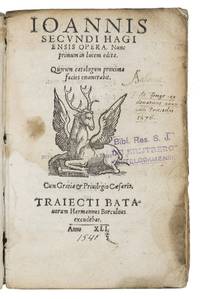
1541M23NGJ7IKRQ5Utrecht: Herman van Borculo 1541. Contemporary vellum wrapper straight-sewn on 3 tanned calf straps laced through the wrapper with the authors name in large textura lettering reading up the spine. Small 8vo 16 x 10.5 cm. With Van Borculos winged stag couchant regardant and book device on the title page and another salient regardant with 2 books on the verso of the otherwise blank last leaf; and 3 vine-leaf ornaments Vervilet 7 8 & 43. Set in an Aldine-style italic type with upright capitals; 92 mm/20 lines with roman capitals for occasional words phrases and 2-line initials. Rare first edition in the original Latin of the collected poetic works of the humanist and neo-Latin poet Janus or Joannes Secundus Jan Everaerts 1511-1536 who "ranks among the foremost poets of the world" as "the only famous 16th-century Dutch poet" Guépin p. 231: "one of the most significant and enduring poets of the Renaissance" and "the outstanding Latin love poet of the northern Renaissance" Price p. 1. Although not quite twenty-five when he died he published numerous poetic works from 1532 to 1536 but left most of his work unpublished at his premature death. Much of his poetry appeared for the first time in the present posthumous edition. Janus is most famous for his "Basia" kisses: 19 lyric love poems influenced by Catullus. Janus's three books of elegies especially the first book comprising 11 love poems to his possibly fictional first love Julia are also masterpieces of neo-Latin poetry.Although revered internationally in his own century and influential throughout the 17th and 18th centuries among his avid readers were Ronsard Fleming Huygens Milton and Goethe Janus's name has been eclipsed in the Netherlands by those of Cats and Vondel in part because they wrote in Dutch.Janus Secundus was born in The Hague. His father was a lawyer at the leading courts of the Low Countries and the family moved to Maastricht when Janus was sixteen. He studied law there and later studied at Bourges and at the University in Louvain. Though a native Dutch speaker and fluent in French Janus had learned Latin with his older brothers at an early age and corresponded with them in Latin.With 3 French verses in a near contemporary hand on the endleavesFurther with a near contemporary donation inscription on the title-page; a 19th-century bookplate on the inside front wrapper and blue ink stamp on the title-page. With the title-page somewhat worn and with stains in its margins plus a water stain in the first 10 leaves and a fainter marginal one some of the last few leaves but otherwise in good condition. The sewing supports have broken at the front hinge and the velum wrapper is somewhat soiled with a small corner of the back wrapper lost. Rare first edition of a seminal work of neo-Latin poetry by the first great Dutch poet Janus Secundus.l Adams S837 1 copy; BMC STC Dutch p. 185; G. Joos Uitgaven van Janus Secundus 10; Netherlandish books 27713 10 copies; USTC 421142 same 10 copies; Valkema Blouw Typ. Batava 2673 13 copies; not in Oberlé Poètes néo-Latins; for Secundus: J.P. Guépin "Tres fratres Belgae: brothers poets and civil servants in the sixteenth century" in: The Low Countries 8 2000 pp. 231-238; David Price Janus Secundus 1996. Herman van Borculo, hardcover
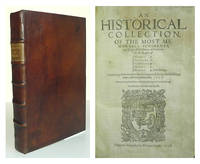
1598001041London: Thomas Creede 1598. First English language edition. . Hardcover. See Description. Small folio. Lacking preliminary blank leaf thus pp. 10 310 292 4. Page numbering is erratic. Leaf Ee3 is mis-signed as F3 but all leaves are present and in order. The title page contains a woodcut vignette/device. Each chapter begins with a woodcut decorative head piece and an initial. Bound in full dark brown modern calf with blind tooled borders and stamps after an early period style. The upper part of the title page is age-toned / tanned; a professionally sealed 7 cm. tear runs from the gutter part way across the upper portion of the title and is difficult to detect on first sight; a couple of tiny chips on the top edge are restored. Interior pages are generally attractive but with occasional mild age-toning and periodic faint marginal damp staining. A small repair patch is present on the inner margins of leaves A6 and V6. A tear on leaf V6 also carefully sealed extends vertically about 8.5 cm from the lower gutter and part way into the text but causing almost no obscuration. Printed by Thomas Creede who is best known for issuing dramatic works including some of Shakespeares plays. The book is divided into two parts. The first part is a translation of "Recueil des choses mémorables avenues en France sous le règne de Henri II François II Charles IX Henri III et Henri IV." This work is generally attributed to either Simon Goulart or Jean de Serres and was first printed in French no place or publisher in 1595 and again in 1598 expanded to include the reign of Henri IV up to the year 1597. See Brunet IV 1161-1162. The second part with new pagination provides translated selections from Pierre Matthieus 4 part "Histoire des derniers troubles de France" first published in Lyons 1594-95. A section at the end is titled "a brief recitall of the most memorable things which came to passé in Fraunce under the raigne of Henry the fourth until the middle of the Yeare 1598" which if written by Matthieu may possibly represent the first printing of some amendments which Matthieu later added to the second edition of his "Histoire" printed in 1600. This collection provides interesting testaments to the wars of religion in France during the 16th century. A separate 4 page tract at the end is titled: "A true discourse concerning the deliverie of Brittaine in the yeare 1598." ESTC S121331; USTC 513796; Lowndes p. 831; Hazlitt Biblio. Collections 2nd Series p. 231. <br/> <br/> Thomas Creede hardcover
15867398Bologna: Per Alexandrum Benatium 1586. First edition. Hardbound. Very Good. 4to. 42 blank leaves2602 blank leaves64pp. Index. With a beautiful title page illustrated with a large woodcut depicting St. Petronius the patron saint of Bologna and 2 smaller woodcuts of the arms of the city and of a bishop. Cont. limp vellum some light soiling hand lettered paper spine label chipped some old library lettering at foot of spine. Old private library bookplate on front pastedown. This book by the historian Sigonio 1524-1584 gives short biographies of the bishops and archbishops of Bologna from St. Zama 270 to Gabriele Paleozzi 1566. Not in Adams. BL Italian STC p. 627. Per Alexandrum Benatium hardcover books