64 résultats
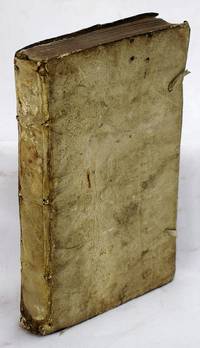
15254627Vinegia Venice: Nicolo di Aristotile detto Zoppino 1525. Very Good. Bound in period vellum with title and intricate symbol on spine. Covers have moderate and common aging to vellum. Partially separated from binding and some loose pages; all pages present - there is a jump in pages from LVII to LXI but text appears complete and same issue with other copies currently/recently available. Some minor spotting inside. Contains 30 engravings including allegorical scenes surrounding title page intricate capital lettering in text image on final page and 27 images related to the dialogue throughout. Type is all in italics except where names are in capital characters. Comprising the works of Lucian this is the first Italian translation. Comes with a cardboard slipcase for stability in shipping.<br /> <br /> Pages: 488<br /> Dimensions: 4 x 6 x 1¼. Nicolo di Aristotile detto Zoppino unknown
1581ABC_47414Antwerp 1581. Large folio. Christoffel Plantin Later 17th-century blind tooled vellum with a single fillet frame and a large ornamental centre piece sewn on 5 supports corresponding with the 5 raised bands on the spine creating 6 compartments with a manuscript title in the first compartment at the head of the spine. With an engraved title-page the author's large "candore et spe" woodcut device on leaf 6r approximately 2185 botanical woodcuts in the text 8 woodcut decorated sometimes interlaced initials plus repeats 6 series and 1 typographic interlaced initial. Set in fraktur types with extensive roman and textura and incidental italic and civilité. 2 volumes bound as 1 the second in 3 parts. 10 994 2 blank "312"= 312 294 2 blank 2 blank 15 1 blank 67 1 blank pp. First Dutch edition with approximately 435 more woodcuts than Plantin's Latin edition of 1576 of one of the greatest herbals. Besides the expected herbs medical plants etc. it illustrates and discusses mushrooms a coconut corals petrified wood and what may be a fossil fern. Matthias de Lobel 1538-1616 a Flemish botanist and physician published his Stirpium adversaria nova in London in 1571 but greatly expanded it after his return to the Low Countries. Plantin bought 800 copies of the London edition and reissued it in 1576 cancelling a few leaves but printing extensive supplementary material to incorporate Lobel's further work. Lobel further expanded it for the present first edition in Dutch evidently his own translation giving the work its definitive form. The 1571 Latin edition had included about 275 woodcuts. Plantin acquired 120 of them but also added many more for his editions including many he had used for his editions of Dodoens and Clusius. The number of woodcuts therefore grew to about 1750 in the 1576 Latin edition and about 2185 in the present Dutch edition but Plantin appears to have had some new blocks cut as well. Many blocks were cut by Antoon van Leest and Gerard Janssen van Kampen after drawings by Pieter van der Borcht.With a clear purple owner's stamp "Jan Veth" and a clear 18th-century inscription "Cost 2800" on the front pastedown and some additional inscriptions on the rectos of the blank flyleaves engraved title-page and the back pastedown. With some occasional annotations in brown ink in the margins and some discrete additional manuscript shading to a few illustrations. The binding is somewhat soiled and the head and foot of the spine are slightly damaged all without affecting the structural integrity of the binding. The margins of the preliminary leaves including pastedown and flyleaves final blank flyleaves and back pastedown are somewhat water stained and have been restored. Somewhat browned throughout but the impressions of the woodcut illustrations remain clear. With some minor defects to several leaves only occasionally slightly affecting the text. Otherwise in good condition.l Arber Herbals p. 278; Belg. Typ. vol 1 1974; Bibl. Belgica L119; BM NH vol. 3 p. 1160; Carter & Vervliet 199; Nissen BBI 1219; Plesch mille et un livres botaniques p. 314; Stafleu & Cowan 4908; STCN 344385353 5 copies; STCV 12914575 9 copies incl. 4 incomplete; Voet the Plantin press 1579; Wellcome 3829; WorldCat 833674408 2 copies. hardcover
155133109-74Augsburg Philip Ulhard October 1551. Diagrams showing eclipses and celestial positions in the format of astrological squares. 346 leaves author's name crossed out on title. 4to. Contemporary vellum. Augsburg Philip Ulhard October 1551. First edition of a little known work by Cyprian Leowitz 1524-1574. The celebrated Bohemian astronomer was professor of astronomy and appointed mathematician to Elector Palatine Otho Henry German: Ottheinrich 1502-1559 and acquired a high reputation at the time of the reception of the Copernican theory. It is well known that the cosmological elements of the Copernican theory i.e. the "centrality" of the Sun and the Earth's revolution about it were not widely accepted for nearly a century after the publication of the "De Revolutionibus". Leowitz played a central role in facilitating conjunctionist theory and the actual contents of the "Tabulae" are in line with those by Stöffler. From the end of the 15th century onwards many editions of the tables of Regiomontanus were produced with commentaries and additions i.e. by Erasmsus Reinhold Luca Gaurico Leowitz with participation of Melanchthon etc. The present huge work by Leowitz appeared without introduction and without explanation. It contains so-called position plates for the places from the 33rd to the 60th latitude the pole height of the places gradus latitudinis. A final short "secundes pars" with plates up to the 66th latitude appeared in November 1551 and is not present here as in a microfiche copy stored in the Herzogin Anna Amanlia Bibliothek Weimar. . "Position" is not be taken here in the sense of modern astronomy. It is well known that the cosmological elements of the Copernican theory was not widely accepted for a long time after the publication of the "De Revolutionibus" see Burmeister Magister Rhecicus 2015. A current subject of investigation is the variety in response to the theory in the various countries of Europe. Tycho Brahe 1546-1601 visited Cyprian Leowitz in 1569. According to Tycho Leowitz told him that in his opinion the predictions of Copernicus agreed better with observations of the superior planets and solar eclipses while Ptolemy's predictions were more accurate for lunar eclipses and the positions of the inferior planets. Leowitz was correct about the relative superiority of the two theories in predicting the longitudes of the planets.- Good copy. _ _ - Adams L-520; Zinner 2018; NBG 30 814; not in Houzeau & Lancaster; cf. VD 16 L 1276. SCIENCE:ASTRONOMY & ASTROLOGY ; Augsburg, Philip Ulhard hardcover
15556824Padova: Gratioso Perchacino 1555. Original edition. Very Good. Quarto 20 cm; 12 leaves signed a-c4 last leaf blank. Printer's device a crowned salamander ensconced in flames on title page. Woodcut initial at start of text. Bound in recent half morocco over marbled boards. Trimmed close to top edge. Gutters guarded. Some spotting on title page but generally clean. <br /> <br />Reference: EDIT 16 CNCE 57958; For attribution to Lando see Silvana Seidel Menchi Chi fu Ortensio Lando "Rivista storica italiana" #106 1994 501-564. Not in Grendler. <br /><br />This is an essay about death. In particular it is a eulogy on the death of young Elizabetta Dotta who it is stated in the text died recently married at the age of 16 years 8 months 24 days and 12 hours. The cause of her death is not given. It does not indulge in a moment's sorrow over the young woman's early demise. Instead it is an extended encomium of death itself praising death as liberation from the essential misery of life in this corrupt and depraved world. As such it is an eloquent statement of philosophical pessimism the tradition which views life as the soul's exile as suffering and sees death as a preferable alternative. While the text is not signed the author is presumed to be Ortensio Lando the uncomfortable peripatetic humanist who never stayed in one place for very long either physically or philosophically. "What is life" Lando asks. "Smoke a dream a running shadow a ship that leaves no trace an arrow shot to its destination. Gratioso Perchacino hardcover
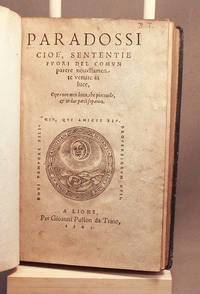
15436296Lyon: per Gioanni Pullon da Trino" i.e. Jean Pullon dit de Trin 1543. First edition. Very Good/Exquisitely rare first printing of Ortensio Lando's most famous book his first in a modern language that in later editions and in translations became a 16th-century best seller. Lando's name does not appear on the title page or anywhere in the book except in code. His real name shows up on no edition published in the 16th century. A dedicatory leaf after the colophon attributes the text to "M.O.L.M" interpreted generally as "Messer Ortensio Landi Milanese." More cryptically there is a phrase printed after the telos "SVISNETROH TABEDVL" mirror writing for "ludebat Hortensius" Ortensio has played. It is serious play. The Paradossi undertakes in the key of popular "world upside down" folklore to prove black what is commonly accepted as white. For instance it is better to be poor than rich better ugly than handsome better drunk than sober and so on. Biographical sketches of Lando are remarkable for how little information about him is available. Peer of Aretino and Doni friend to Etienne Dolet later incinerated for heresy he was a non-believer who nevertheless took Augustinian orders and later deserted them. Member of a prestigious literary club L'accademia degli elevati he was above all an outsider. All of his books landed on the Index of Prohibited Books and "I paradossi" in particular was widely banned and copies of it were confiscated. Probably the first book printed by the obscure Italian printer working in Lyon Giovanni Pullone da Trino later called "Jean Pullon de Trin". Following Pullon's modest press run the text was quickly taken up and reprinted badly by Bindoni and others in Venice twice in 1544 1545 1563 1594 etc. and translated into Latin into French by Charles Estienne 1553 and into English 1596. If you Google "Jean Pullon" you will get dozens of pages advertising pull-on jeans. . Octavo 17cm; 112 leaves signed A-O8. Printer's device on title page Ferraris 1 showing a human-faced moon in the sky reflected on the surface of the land. Bound in later 18th-century or 19th-century dark green leather in neoclassical style with gilt central losenge within gilt borders on both boards; gilt-tooled spine with leather title label. Joints reinforced but tender; light marginal stain along bottom edge; O7 torn and repaired remains of tape. Early marginalia trimmed close. Later c19 notes in French on endleaves. Pages not bright. All in all a very good copy of a very rare book. References: Ferraris "Giovanni Pullone e altri stampatori trinesi a Lione" in "Trino e l'arte tipografica nel XVI secolo." 2014 #1; USTC 116008 BM Italian 399; Grendler "Critics of the Italian World" #8; Gültlingen "Bibliographie des livres imprimés à Lyon." vol. X p. 7; Bongi "Catalogo delle opere di M. Ortensio Lando" p. xxxvi "eseguita in bel carattere rotonde cui la originalità e la bellezza danno il pregio sopre le ristampe"; not in Adams; not in Baudrier. per Gioanni Pullon da Trino" (i.e., Jean Pullon dit de Trin) hardcover books
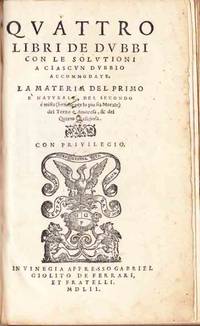
15526331Venice: Gabriel GIolito de' Ferrari 1552. First edition. Very Good/The title promises four sets of "questions and their solutions" and indeed that was the plan. Lando wrote Q&A on four topics: medical questions including dietary and aging functions ethical questions questions about religion and questions about love and sex. It was the love and sex part that raised the eyebrows of the censors and neither Lando or his publisher Giolito could get permissions to print it as the book was going to press. As Giolito himself declares in a postscript to the reader: "I promised you four books of doubts but since I haven't yet been granted a license for the doubts about love I'm forced to give you only three. Be well and enjoy as much of the book as I could give you." The license came later and the text appeared in later editions. This unfinished text with its publisher's apology represents a fascinating birthmark on the 16th-century book trade. The Q&A ranges over hundreds of topics calling upon the author's medical training much involved with the humors and temperaments associated with various organs objects and creatures his classical erudition and his training in the Augustinian order. The three sections together provide comprehensive insight into 16th century medicine and popular religious and moral thought. The odd matter of two versions of the dedication page leaf A ii is not easily explained. We suspect with some justification that Lando sought patronage for the same work in different locations knowing that Protestant Germany rarely spoke with Catholic Italy and vice versa. He might have found different backers in different markets. We know that to be the case with at least one other book of Lando's the "Sermoni Funebri" 1549 where some copies are dedicated to Fugger and others to Niccolo degli Alberti. That case is known and recorded. We find no recorded instance of the alternate dedication of "Quattro libri dei dubbi" to Fugger and no record of the author being identified by signing the dedication letter in any other copy. The "Quattro libri de dubbi" was quickly translated into French Lyon 1558 and by William Painter into English entitled "Delectable demaundes and pleasaunt questions with their severall aunswers." 1566 and again 1640. . Octavo 16 cm; 318 2 pages. Woodcut device on title page and on last page. Woodcut initials. Bound in recent vellum in period style yapp edges titled in ink on spine. Early 20th-century bibliographical note bound in. Marginal annotations in contemporary hand. Leaf a ii the dedicatory letter present in two states the cancel addressed to Johann Jakob Fugger closing with Lando's name and the original leaf addressed to Christoph Mielich and not signed as usual. Small perforation in the cancel affecting a word. Occasional light stains darker on last leaf. References: Bongi I 368; Melzi II 391; BM Italian 377 1556 ed.; Fontanini II 117. Gabriel GIolito de' Ferrari hardcover books
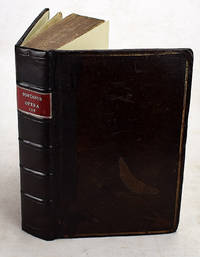
15182304190005Venice: Aldus Manutius and Andrea Soceri 1518. First Edition. Hardcover. Acceptable. First collected edition of Pontano's works - Aldine Imprint Later leather binding. Rebacked. Red leather spine label gilt. 4 326 pages. Early ink inscription on title page acid stain. Colophon page lacking bottom third blank park. Aldine printer's device dolphin and anchor on title. Brunet IV 808; Riccardi I 303; Olschki 12243; Ahmanson-Murphy 168; Adams P1860. Venice: Aldus Manutius and Andrea Soceri hardcover
15641907280011Genevae : Ex officina Francisci Perrini M.D. LXIIII 1564. First Edition. Hardcover. Good. Calvin's 16th century commentary on the book of Joshua and Beza'z Biography of Calvin Bound in contemporary vellum. Some soiling to cover. Octavo. 32 316 p. Printer's woodcut device on title-page. Slight worming in inner margin towards beginning not affecting text. Bookplate of Duncan Shaw and early inscription of Franciscus Saluardus. Calvin's last work. Includes the Latin translation Theodore de Besze's Life of Calvin. Adams C280. The French edition was printed in 1565. Genevae : Ex officina Francisci Perrini, M.D. LXIIII hardcover
1581#BIBLIO-1187<p>Ioan. Ravisii Textoris Nivernen: dialogi aliqvot festiuissimi studiosæ iuuentuti cum primis vtiles: Item eivsdem epigrammata non pavca vt dictissima ita & lepidissima. Omniarecens diligenter recognita & emendata</p><p><em>John Ravisius or Johannes Ravisius Textor or Jean Tixier de Revisi the writer of Nivernen Nivernais: dialogues somewhat festive studious and very useful: also epigrams not very plain as very eloquent and very delightful. All recently diligently revised and amended.</em> Londini London: Ex officina H. Bynnemani Typographi Anno Domini. 1581. Hardback greyish-brown leather binding probably 18th or more likely 19th century with maroon title label gilt-blocked title and raised bands to spine. Blind-stamped design to boards and spine. Octavo/8vo collation but small measures around 3 1/8" x 4 7/8" x 1 1/4" circa 400-500 pages see below for explanation of unusual pagination and collation</p><p>Scuffing and wear to binding some discolouration but reasonably clean. Bumping and a little tearing to corners and to head of spine. Otherwise binding firm. A little cracking to title label but intact with some discolouration. Deckled page edges which are very browned scuffed and otherwise marked. small bookseller label to front pastedown. Some marking a little staining and foxing around pastedowns and endpapers. Toning staining a little light foxing and other marking throughout. Some creasing dog-eared corners and the odd tear with loss to a few leaves including to title leaf which is missing a few characters of text at bottom left-hand corner and is quite fragile and only attached at top. Heavy ink staining to several leaves towards end of book. Occasional underlining marginalia and a little text scored out in several latter pages.</p><p>Very unusual and defective page numbering. Firstly the numbering is of each leaf not each page and the print is a little unclear for some figures. It appears to run after the initial three blank endpapers and preliminary pages that could presumably be numbered i - vi being the tile page to end of 'epistole' from leaf 1 - 20 13 or 18 25 23 - 25 iB 27 blank 20 - 35 6 64 - 72 74 74 repeating 76 76 repeating - 92. However the leaves do not appear to be pages out of order nor duplications and the pages do all seem to be in correct sequence so it appears to be a printing fault rather than a binding one. The order of the page collation is more accurate sequentially though even then there are a few oddities running after the first three blank endpapers on the basis of numbers denoted on leaves as i-v then vi-viii blank from A i - F viii then G ii G G iv G iii blank G v - T viii no use of U V no use of W X - Z viii Aa i - Ff ii Gg ii-Gg iii Ff iv Gg ii Gg iv Gg iii Gg v - Ii v with blank leaves Ii vi-vii removed and three blank endpapers. See pictures for further information. About the author: <em>John Ravisius or Johannes Ravisius Textor or Jean Tixier de Revisi</em><em> c. 1470–1542 was a French Renaissance humanist scholar and professor of rhetoric. He was born in Ravisi which is near the commune of Saint-Saulge in the central province of Nivernais. His works which are mostly on the topic of education were widely accepted and employed by French academia. Tixier eventually adopted the Latinised name Johannes Textor Ravisius Nivernensis. Per the epitaph on his headstone Tixier was born in 1470 and died on 3 December 1542. According to Victor Gueneau other scholars pretend that he died on 13 December 1524 and that his brother Jacques completed Jean's book l'Origine de l'imprimerie "The Origin of Printing". Similarly some authors report his year of birth to be approximately 1480. Tixier studied humanities at the College of Navarre. When he graduated he accepted a position in the college's rhetoric department; there he impressed faculty and students alike. In 1520 he accepted a position as rector of the University of Paris. He held the position until 1525 succeeded by William Manderstown. More than thirty editions of his principal work Officina were published as he continued to expand it. Source: Wiki</em></p> H. Bynnemani Typographi hardcover
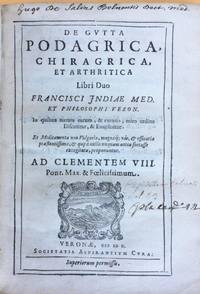
1600M13168Verona: Societatis Aspirantium cura 1600. 1600. Two parts in 1. Small 4to. xxiv 118 1 pp. Printer's woodcut device 5 snakes over landscape woodcut initials and tailpiece rear errata & colophon; old ink marginalia p.36 underlining pp. 97-99. Original vellum; lacks ties. Ownership inscription on title: Hugo De Salins Belnensis Doct. Med. d.1659 and another signature obscured. Bookplate of Château de Montrevost Cuisery France. EARLY SEVENTEENTH CENTURY WORK ON GOUT & RHEUMATOID ARTHRITIS: : HUGUES DE SALINS' COPY. First edition of this rare work on the nature cause and treatment of rheumatoid arthritis and gout. The status of gout in the late sixteenth century was such that gout was said by Turberville to be found in "horses capons and falcons." p. 64. John Gerard's Herball 1597 stated that Gout-wort or Herba Gerardi was a native herb that could be used with some benefit supported further by Culpeper. According to Copeman Thomas Sydenham 1624-1689 suffered from gout and wrote the classic description of the disease and was the first to be able to differentiate between rheumatoid arthritis and gout. The present work was written decades earlier. Francesco India cites Galen Chap. 1 Ambroise Pare Chap. 12 and Jean Fernel Chapters 5 7 8. India makes two 15-page tables of causes which he uses to organize his data. <br /><br /> PROVENANCE: Hugues de Salins: The British Library catalogue lists a "Hugues de Salins; see: Jean Baptiste de Salins Defense du vin de Bourgogne 1704." This may be a descendent. See: Societe d'Histoire d'Archeologie et de Litterature de l'arrondissement de Beaune Memoires annee 1890 Volumes 15-16 Beaune 1891 pp. 75 177. Mentions the wife of Hugues de Salins as buried in 1626 and Hugues de Salins buried in 1659. <br /><br /> Francisci Indiae an Italian philosopher and physician who is little known wrote the present work and two others: Hygiphylus: sive de febre maligna dialogus 1593. Hygiophilvs Tertivs Vel De Symptomatvm Febri Malignae Svper 1599. See: Frederic Paulhan Catalogue des legs Gide & Teissier-Rolland 1892 p. 212. Showing a copy of Strabo's Strabonis rerum geographicarum libri XVII 1571 with the same provenance inscription is this book. This inscription must date prior to 1892. <br /><br /> Copeman W.S.C. A Short History of the Gout and the Rheumatics Diseases pp. 53 64. Locations: British Library; Edinburgh University; Middle Temple Library; Wellcome Library. Societatis Aspirantium cura, 1600. hardcover books
15966042Frankfurt: Andreae Wecheli Heredes Claudium Marnium & Joann. Aubrum 1596. 4to. 2 volumes in 1. 16464;5502pp. Indices. Woodcut device of Wechel on both titles and verso of final leaf otherwise blank. In this copy all of the devices have been hand colored old coloring. Old plain vellum somewhat worn. Title and text with some old moderate water stains. Free endpapers lacking. Not a particularly attractive copy but quite useable. Later 16th century edition of Horace edited by the great scholar Dionysius Lambinus. Dibdin in his GREEK AND LATIN CLASSIC 4th ed. Vol II p.45 makes reference to two editions printed by Wechel a 1577 folio and our 1596 4to. Andreae Wecheli Heredes, Claudium Marnium & Joann. Aubrum hardcover books
1585B6597Paris: Apud Dionysium Duvallium sub Bucephalo in vico Bellouasco; c. April 1585 colophon . A very nice copy of this rarely found work; old minor marginal repair tape of title slight marginal stains and very small in-text and marginal oxidation spots none affecting legibility; light damp staining of the lower margin. Endpapers watermarked. Binding: 17th century mottled calf spine with six 6 raised bands with gilt lettered title on two and remainder of compartments ornamented in floral gilt; all edges speckled red. Notes: This medical work on gynaecology attributed to or by Hippocrates and his school is accompanied by the commentary in French of French Renaissance physician Maurice de La Corde; it is rare with three known exemplars incl. Yale & Oxford. <br> <br> Size: Folio 311x201mm Illustration: Text in Latin and Greek. Text in two columns of Latin and Greek respectively with accompanying Latin commentary in one; except index printed in three columns.<br>Illustrated title depicting determined/ inspired Hippocrates riding on horseback through crises or critical times toward the sun – this with marginal text in Latin and Greek; each major section opens with an elaborate headpiece and initial. <br> References: Pasquale Sfameni in Enciclopedia Italiana 1933; Adams H-615; Choulant 31; Durling 2412. Graesse III 283; Hirsch II 76; Renouard Marques 287; STC French 227. Not in Osler. Pages: Ll: bl. 10 pp. 1-361 6 bl.2. Collation: bl. a1-4 e1-6 A1-Z6 Aa1-Gg6 Hh1-7 bl.2. Category: Book Medical; Book Early Printed 1500; Apud Dionysium Duvallium, sub Bucephalo, in vico Bellouasco; hardcover
1599111111113633Gualtherus 1599. Vellum. Very Good. Gualtherus; Colonia 1599. Hardcover. A mirror of the concubines of priests nuns and clerics and Letter from the Bishop of the Church of Roermond to Maurice Count of Nassau. Bound with two titles: Speculum concubiniariorum sacerdotum monachorum ac clericorum 148pp and Henrici Cuickij Ruraemudensis ecclesiæ episcopi Ad Mauritium comitem Nassauium paraenetica epistola 48pp. Very uncommon book. Hendrik van Cuyk or Henricus Cuyckius was the second bishop of Roermond from 1596 until his death in 1609. Text in Latin. A Very Good full period vellum binding some age-appropriate discoloration and handling marks to vellum binding sturdy still sturdy and intact previous owner bookplate affirmed to front and rear pastedown ink notation front free endpaper and rear pastedown age toned text block with some age spotting/foxing throughout some warping to vellum binding and bowed boards without Dust wrapper. A nice overall clean and uncommon copy. 18mooctodecimo or approx. 4 x 6.5 inches. We pack securely and ship daily with delivery confirmation on every book. The picture on the listing page is of the actual book for sale. Additional Scans are available for any item please inquire. Gualtherus hardcover
153872632Basileae: Roberto Cheimerino = Winter 1538. Second edition folio pp. 8 1900 columns pp. 1; 210 index; printer's woodcut device on verso of final leaf; lightly ruled in red throughout woodcut initials and ornaments; scruffy old calf gilt spine considerably rubbed and worn joints cracked cords holding; internally clean with perhaps 100 early and informed annotations in the margins. Armorial bookplate of Sir Edward W. Watkin Rose Hill Northenden the MP and railway entrepreneur. This copy includes the very extensive index which is not in all copies. Guarino ca. 1450-1537 an Italian Benedictine monk was one of the most significant 16th-century lexicographers. He was appointed bishop of Nocera in 1514 and is best known for producing the first Thesaurus Linguae Graecae. "In 1523 appeared his Etymologicum magnum sive thesaurus universae linguae Graecae ex multis variisque autoribus collectus a compilation which has been frequently reprinted and which has laid subsequent scholars under great though not always acknowledged obligations" EB. Adams P-984. [Roberto Cheimerino = Winter] unknown
15779612Venice: Gabriel Giolito de' Ferrari 1577. Firdt Italian trans. 2nd issue. Vellum. Very good -. 4to. 202671pp. Large woodcut device on title and verso of final leaf. Text illustrated with 28 text woodcuts most within a decorative woodcut border. Cont. vellum part of the bottom edge and one corner rat gnawed exposing the boards under the vellum; some light text soiling. Still a decent copy. The first Italian translation second issue with the 1577 date rather than 1576 of contemporary theologian Luis de Granada 1504-1588. See Bonghi. GIOLITO DE'FERRARI II pp. 357-358. Gabriel Giolito de' Ferrari hardcover books
15616593Basil: Henricum Petri et Petrium Pernam 1561. First collected edition. Vellum. Very Good. 8vo. 2 parts in 1 each with its own title page see below. 16240;18010pp. With the final leaf of errata and colophon. Orig. limp vellum inner hinges reinforced with linen cloth strips. Later endpapers. The first part is a description of England Scotland Ireland the Hebrides and the Orkney Islands with a long English historical chronicle. The second part separately collated is the author's "Moschovia in qua Situs Regionis Antiquis Incognitus." a description of Moscow but it also includes his description of Lake Como the place of the author's birth and a text on Italian fish. VD 16 G2058; BL German STC p. 360; not in Adams. Henricum Petri et Petrium Pernam hardcover books
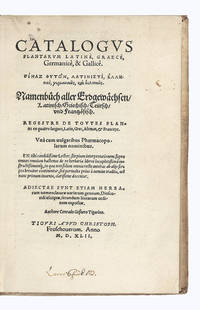
154255061542. 4 p.l. 162 leaves. Small 4to cont. blindstamped panelled pigskin remains of two deerskin ties. Zurich: C. Froschauer 1542.<br/> <br/> First edition of a very rare book on the market; this is a lovely fresh copy in contemporary blind-stamped pigskin. This Gesner’s second botanical work is “an alphabetically arranged catalog of plant names in four languages the first of its kind and an indication of the growing interest in botany beyond purely philological investigations into the writings of the classics. The Greek names are based on the works of Dioscorides. This early work is already characteristic of Gessner’s life-long endeavour to arrange scientific topics in alphabetical or systematic order; it also show his proficiency in languages and his interest in their comparative treatment.â€â€“Wellisch 8.1.<br/> <br/> A fine copy. Signature at foot of title of “Lucas Schröck M.D.†Schröck 1646-1730 was a professor of medicine at Jena and president of the Deutschen Akademie der Naturforscher see Hirsch V pp. 139-40. Early inscription on front free endpaper stating this is a duplicate from the Royal Library of Munich. Engraved armorial bookplate dated 1744 of Franziskus Topsl 1711-96 prior of the Polling Abbey in Upper Bavaria. Modern booklabel of D. Henry. Some minor worming to upper inner corner of first seven leaves touching a few letters of the first two leaves.<br/> <br/> ⧠Pritzel 3298. unknown
15517506Venice: Per Giovanmaria Bonello 1551. First edition thus. Vellum. Very Good. Sm. 8vo. ff.8239. Lacking the final blank leaf. Title page with a large woodcut printer's device with initials Z.M./B.V. at bottom. Cont. vellum a bit soiled a few minor chips ties lacking. Some old soiling including some discoloration to blank fore-edge of a few final leaves. A collection of aphorisms and apothegms selected chiefly from Cicero's correspondence. Per Giovanmaria Bonello hardcover books
1593CA0273<p><strong>Groundbreaking treatise on exotic botany and tropical medicine</strong></p><p>4586blank leaf pages with numerous woodcut illustrations. Duodecmo 6 1/4 x 3 3/4" octavo bound in quarter leather with five raised spine bands with spine tooled in gilt over brown boards. Translated from the Portuguese into Latin by Carolus Clusius Charles de L'Ecluse. Fourth Edition.<br /><br />Garcia de Orta's groundbreaking treatise on exotic botany and tropical medicine to which are added two other important works on the subject. Orta's contribution comprises pp. 1-2177. It is followed by:<br /><br /><em>Christophori a Costa medici et cheirurgi Aromatum & medicamentorum in Orientali India nascentium</em>. Pp. 225-312. <br /><br /><em>Simplicium medicamentorum ex novo orbe delatorum quorum in medicina usus est historia. descripta à d. Nicolao Monardis.</em> Tertia editio. Pp. 313-4044 <br /><br /><em>Simplicium medicamentorum ex novo orbe delatorum quorum in medicina usus est historia. descripta à d. Nicolao Monardis</em>. Altera editio. Pp. 409-456.<br /><br />Rare combined edition of three major 16th century treatises in the history of botanical and medical knowledge of plants from India and the New World. These Latin editions had all previously been published by Plantin. Garcia da Orta's treatise originally published in 1563 in Goa in Portuguese is the first Indian materia medica written by a European and the first textbook of tropical medicine. The text of Acosta of which L'Ecluse gives an abridgment is a complement to the text of Orta. Finally the Latin translation also abbreviated of the treatises of Nicolas Monardes details the medicines and medicinal herbs of South America and describes their native uses. His text also contains the first representation of tobacco and also that of pepper and even the armadillo. A rare complete copy with the final unpaginated leaves including three privileges the colophon the large printer's device of Plantin and the final blank.<br /><br /><strong>Condition: <br /></strong><br />Some rubbing and wear to covers spine foot chipped; some minor foxing and aging within early ink underlines to the early leaves of the first work else good.</p> Ex officina Plantiniana, apud viduam, & Ioannem Moretum hardcover
15679576Basel: P. Perna suis & H. Petri 1567. Vellum. good . 62050pp. Index. Contemporary vellum. Front & rear free-endpapers lacking. Modern ink ownership inscription on blank portions around the imprint on title. Historical work on the Kingdom of Naples with 2 texts one by Facius and another by J.J. Pontanus. B.L. German p.297. P. Perna suis & H. Petri hardcover books
15679512Basel: P. Perna suis & H. Petri 1567. Vellum. Very good. 62050pp. Index. Contemporary vellum hand lettered spine. Small portion of top edge of front cover 1/4" x 2" chipped. Tipped in ahead of the title are 3 pages of a previous early owner's manuscript biographical notes on Facius. Historical work on the Kingdom of Naples with 2 texts one by Facius and another by J.J. Pontanus. B.L. German p.297. (P. Perna suis & H. Petri) hardcover books
1566160Basel: P. Perna suis & H. Petri 1566. 62050pp. Index. Contemporary vellum. Front & rear free-endpapers lacking. Modern ink ownership inscription on blank portions around the imprint on title. Note: the colophon is dated 1567. Historical work on the Kingdom of Naples with 2 texts one by Facius and another by J.J. Pontanus. B.L. German p.297. Adams F207 under "Fazio". VD16 #F545. (P. Perna suis & H. Petri) hardcover books
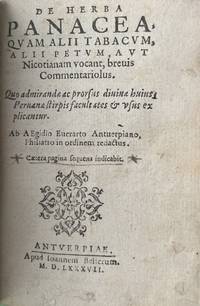
15873021Antverpiae Antwerp: Antverpiae Antwerp 1587. First edition a variant with 246 pages in the second part was published in the same year by the same publisher; no priority has been established. In 17th-century limp vellum. Title lettered in ink on spine. Occasional annotations and underlines by a 17th-century hand in ink. Binding restored new endpapers and thongs. Pages restored throughout heavily in the first third at some places affecting the text few leaves over trimmed. Overall in very good condition. First edition a variant with 246 pages in the second part was published in the same year by the same publisher; no priority has been established. In 17th-century limp vellum. Title lettered in ink on spine. Occasional annotations and underlines by a 17th-century hand in ink. 78 =98 4; 234 pp. The first book devoted entirely to tobacco.<br> <br /> <br /> “This little work produced by a physician who is said to have practiced with distinction in Antwerp appears to have been the first published entirely devoted to the subject of tobacco . a neat compendium of much of the information then available. It was consequently popular.†Arents <br /> De herba panacea concerns with the beneficial medicinal properties of tobacco and describes most of what was then known of this New World plant including its origin native methods of curing and cultivation and lore surrounding tobacco. Everard gives numerous recipes depending on tobacco for ailments to all kinds of illnesses. The book also contains texts by Castore Durante Gérard van Bergen Galen Jean de Jonghe and Andrés de Laguna.<br> <br /> <br /> The book was included in the John Carter Brown Library’s 1974-published Rare Americana list A Selection of One Hundred & One Books Maps & Prints not in The John Carter Brown Library.<br /> Ref.: Sabin 23218; Adams E1150; Alden 587/15; Arents 32; Books not in JCB 21. Antverpiae [Antwerp] unknown
1501000683<p>Strasbourg: Argentinae: Ex officina Martini Flach junioris 1501. Half leather. Fine. Folio printed in Strassburg by Martin Flach 7 February 1501; 161 unnumbered leaves. BINDING: new Gothic hand-sewn oak binding by Arthur Green of Ledbury; tawed quarter leather over quarter-sawn oak boards quires hand-sewn on four double-cords creating four raised spine bands board leather blind-tooled with period style rosettes and fleurs-de-lys within panel of diagonal blind triple fillets hand-sewn Gothic double headbands of alternate hand-dyed indigo and undyed linen thread hand-made brass hasps and clasps ornamented in period style; an exceptionally attractive recreation of a Gothic hand-sewn binding employing medieval techniques contemporaneous with the date the book was printed. COLLATION: pi6 a2-8 b-y6 z8 zeta6 antisigma8; leaf a1 excised and subsequent first few lines of a2recto redacted in black ink in the sixteenth century by the inquisitor for its heretical content see below. TEXT: Double column 50 lines and headline gothic type red manuscript rubrication throughout in a contemporary hand with numerous 3 4 and 6 line capitals red paragraph markers and in-text capitals marked out in yellow. CONDITION: indecipherable contemporary manuscript ink inscriptions to title page final two leaves a little soiled new endpapers in complementary period-style paper small professional paper repairs to fore-edges of opening and closing leaves unobtrusive light stain to lower outer page corners well clear of printed text overall a beautifully clean wide-margined copy. BIBLIOGRAPHICAL REFERENCES: Rare not in Adams USTC 696770 citing 32 copies with just 3 in the UK and 2 in the US. Sebonde's Theologia was a celebrated text in its day but is mainly known now through Montaigne's attention and his French translation of the work in 1569. Its prologue asserting the ability of human reason to understand the existence and attributes of God through observation of the natural world was added to the Index Prohibitorum in 1559. A beautiful example of this rare text in an exceptionally fine binding.</p> Argentinae: Ex officina Martini Flach junioris hardcover
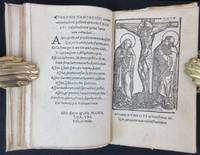
153612039Antwerp: Simon Cock Cocus. Good with no dust jacket. 1536. First Edition. Vellum. 44 ff. Small octavo. Newer vellum binding over card. Vellum has some light wear some browning to the rear. Newer end papers. Title page a bit grubby. Some occasional small staining/thumbing but otherwise very nice. Recto of last leaf has a full-page woodcut of the crucifixion verso has an errata and a neat older owner name in ink. A very scarce copy only 5 recorded in World Cat of a collection of religious verse hymns elegies and prayers by three Neolatin poets. The first is "Cornelius" which may refer to Cornelius Crocus Kroock 1500-1550 a Dutch theologian and educator; then Joannes Fernandus and Rodolphus Langius. There is an introductory poem by Faustus Andrelinus and a final poem by J. B. Cantalicius. Printed in March 1536. OCLC 69408729 NK 1631. ; 8vo 8" - 9" tall; 88 pages . Simon Cock (Cocus) hardcover